REVIEW 2 major objections 4 minor 34 references
General Field Evaluation in High-Order Meshes on GPUs
T0 review · 2 major / 4 minor · reviewed 2026-08-10 · deepseek-v4-flash
Pith's one-line read This paper claims a robust technique for evaluating any field at arbitrary points in large-scale high-order quadrilateral and hexahedral meshes, including meshes split across MPI ranks and meshes that lie on surfaces, with per-point cost…
desk verdict Solid engineering paper: GPU kernels and surface-mesh support are genuinely new, but the robustness claim leans on an unproven bounding-box construction that deserves either a proof or an explicit scope. read the letter →
The pith
A machine-rendered reading of the paper's core claim, the machinery that carries it, and where it could break.
The reading
What carries the argument
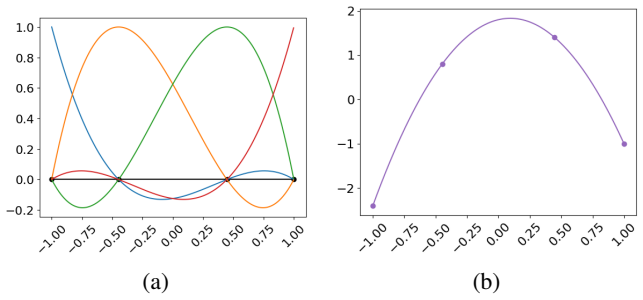
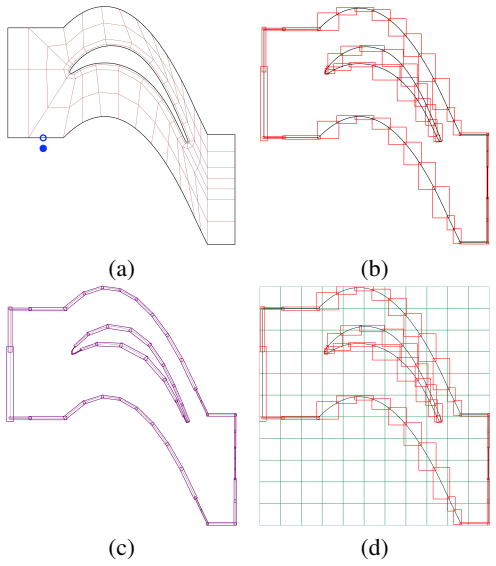
Four components carry the argument. Two Cartesian-aligned search structures map a point to candidate ranks and candidate elements: a global mesh $M_G$ partitioned across MPI ranks yields the multi-valued map $\Psi_G$, and a processor-local mesh $M_L$ yields $\Psi_L$. Candidate elements are then filtered by two bounding boxes per element: an axis-aligned box computed from piecewise-linear envelope bounds on the Lagrange bases via Chebyshev interval points, and a tighter oriented box aligned by the center Jacobian. For the final inversion, a Newton method with trust-region factor $\alpha$ minimizes the distance functional $0.5\|x^* - x(r)\|_2^2$ with the step constrained to the reference element, using the exact Hessian (second-derivative terms) only when the iterate is on the element boundary. The GPU implementation gives one thread block per query point with $N\cdot D$ threads, exploiting the tensor-product basis structure.
What would settle it
Take an element of degree p=30 or higher, set the coordinate map to a single high-order Lagrange basis function with a large coefficient, compute the bound from Eqs. (7)-(9), and compare against the element's true image obtained by dense sampling; if the bound is below any true coordinate value, that element will be missing from the candidate list and a query point at that location will return NOT FOUND.
Extended reading notes
Core claim
The central claim is that general field evaluation—finding which element of a high-order mesh contains a given physical point and what the reference-space coordinates are—can be made robust and fast at scale by layering cheap filters around a local Newton solve. A globally partitioned Cartesian map returns candidate MPI ranks in $O(1)$, a processor-local map returns candidate elements, axis-aligned and oriented bounding boxes cut that list further, and a trust-region Newton method inverts the element's nonlinear map to tolerance $10^{-10}$. The paper demonstrates this on meshes with up to tens of thousands of elements and hundreds of millions of query points, on both volumes and surfaces, and shows the point-finding cost scaling linearly with the number of points while remaining nearly independent of total mesh size. It further claims that the setup cost is paid once per mesh and reused across point sets and multiple solution fields.
Load-bearing premise
The whole pipeline assumes the axis-aligned bounding boxes never shrink below an element's true extent; the authors verify this only by experiment for polynomial orders up to 29, not by proof, so a hidden under-estimate could silently drop the element that contains a query point.
Editorial extensions
If this is right
- Queries that previously required a global rendezvous or k-nearest-node heuristics can now be answered by point location and interpolation at machine precision, so spectrally accurate values are available at arbitrary monitor points or particle positions.
- After a one-time setup, any number of point sets and any number of solution fields on the same mesh reuse the same maps and bounding boxes, making the per-query cost nearly independent of mesh size.
- Surface meshes are supported through a zero-extent-aware AABB, a rotation-based oriented box, and a distance threshold in the interior test, enabling closest-point projection and tangential relaxation along curved boundaries.
- On GPUs the find and interpolate steps scale linearly in the number of points; in the reported turbulent channel run, particle tracking costs match the fluid solve when there are about 0.23 particles per computational point, with find and interpolate accounting for roughly 95% of the particle time.
- The trust-region Newton inversion converges in about five iterations per point even for a 9th-order spiral element, yielding machine-precision field values.
Reading between the lines
- Because the robustness of the bounding boxes is the only unproven link, a formal proof for arbitrary polynomial orders would remove the last empirical assumption; the authors list this as future work.
- The same filter cascade could be applied to meshes with simplices or mixed element types if the tensor-product GPU kernels are replaced by simplex-specific basis evaluation, since the Cartesian maps and bounding boxes are element-type agnostic.
- The near mesh-size-independence of per-point cost suggests the method could be used for in-situ visualization, feature extraction, or data reduction on exascale outputs, where query points are far fewer than the mesh's degrees of freedom.
- If the oriented box were aligned using a global optimization instead of the center Jacobian, candidate lists on strongly deformed meshes would likely shrink further, improving the Find step's constant factor.
Signed reviews
Editorial analysis
A structured set of objections, weighed in public.
Referee Report
Summary. The paper describes a complete pipeline, implemented in the open-source findpts/gslib, MFEM, and NekRS codes, for evaluating finite/spectral element fields at arbitrary points in high-order quadrilateral and hexahedral meshes and on surface meshes. The method builds global and processor-local Cartesian bin maps from element axis-aligned bounding boxes, refines the candidate list with oriented bounding boxes, inverts the element map with a trust-region Newton method, and evaluates the solution with tensor-product interpolation. Specialized GPU kernels are described and benchmarked. The paper reports that the find step is up to 12.7x faster on GPUs than on CPUs and demonstrates the method on r-adaptivity, overlapping grids, and Lagrangian particle tracking.
Significance. The contribution is significant for the spectral-element and high-order FEM communities. The method is open source, the algorithmic description is detailed enough to be reproduced, and the numerical experiments evaluate interpolation against known functions rather than against the method's own output. The reported GPU speedups are substantial and measured at realistic scales. The principal weakness is that the element bounding boxes, which are the gatekeeper for all candidate searches, rely on an empirically verified but unproven bound on Lagrange bases, so the advertised robustness guarantee is conditional on that empirical evidence.
major comments (2)
- [Section 3.1.1, Eqs. (7)-(9); Section 7] The AABB construction is load-bearing for both candidate maps Psi_L and Psi_G and for the subsequent OBB construction: if an element's AABB is too small, the element is absent from the candidate list and a point inside it is permanently NOT FOUND; the Newton iteration cannot recover it. The paper states in footnote 5 that the piecewise-linear basis bounds are only empirically verified for Lagrange bases at GLL points with M=2N up to N<=30, and Section 7 lists 'theoretically provable bounds' as future work. This leaves the central robustness claim of the abstract unproven in the general high-order regime the paper promises. Please either provide a proof, restrict the robustness claim to the verified range and state that restriction in the abstract, or add a fallback mechanism (e.g., detection of under-bounds and iterative local refinement of the Cartesian maps) that restores completeness.
- [Section 3.1.1, text after Eq. (9)] The statement that the interval-bounding approach 'is guaranteed to work for a function that is strictly convex/concave in each interval' is correct only for such functions; Lagrange interpolants are not generally convex/concave on Chebyshev intervals, as the following sentence implicitly concedes with 'predominantly convex/concave.' The manuscript should distinguish the proven guarantee from the empirical validation that follows, and should state explicitly that no guarantee is currently claimed for N>30 or for nodal sets other than GLL.
minor comments (4)
- [Figure 8 and Section 3.1.3] The caption of Figure 8 describes the left panel as intersecting '8 elements,' while the text in Section 3.1.3 says '6 elements' for the same example; please reconcile the numbers.
- [Section 3.2.1, Eq. (22)] The underbrace on H^{-1}J is labeled Delta r_l and the constraint reads Delta r_l in alpha_l[-1,1]^D, but the update is r_{l+1} = r_l - H^{-1}J; as written it is ambiguous whether the trust-region factor applies to the negative step or to the labeled quantity. Please fix the notation.
- [References [10] and [22]; Section 6.7] References [10] and [22] contain a duplicated 'https://' in their URLs, and Section 6.7 contains the typos 'noder' and 'independednt'; please correct these errors.
- [Section 4.4] The threshold epsilon_d for the INTERIOR criterion on surface meshes is defined only through examples ('epsilon_d = 10^{-10}' or 'epsilon_d = 10^{-10}|Omega_e*|'); please state the default value actually used in the numerical experiments.
Circularity Check
No significant circularity: the derivation is self-contained, and the main limitation (empirically verified AABB bounds) is an unsupported robustness assumption rather than a circular step.
full rationale
The paper's central claim is an algorithmic method: given a mesh and a query point, construct Cartesian maps from geometry-derived bounding boxes, reduce candidates, and invert the element map with trust-region Newton iteration. None of these stages is defined in terms of the target output, and no parameter is fitted to the points being located. Accuracy is benchmarked against known functions (Sections 6.1, 6.2), providing an external check on the interpolation result. Citations to gslib [10], NekRS [21], MFEM [19], and the authors' prior overlapping-grid work [5] are provenance and application references; no load-bearing uniqueness theorem or ansatz is imported from those self-citations. The only notable weakness is in Section 3.1.1: the piecewise-linear basis bounds of Eqs. (7)-(9) are justified by empirical verification up to N<=30 (footnote 5: 'we have empirically verified that the proposed approach works with M = 2N points for at-least N<=30'), and Section 7 explicitly defers 'theoretically provable bounds' to future work. That is a genuine correctness/robustness gap, since an under-bound could silently drop the true containing element from the candidate list, but it is not a circularity: the bounds are not fitted to the test points, nor do they encode the interpolation output. Accordingly, the paper does not exhibit any self-definitional reduction, fitted-input-called-prediction pattern, or self-citation chain that forces its conclusion.
Assumptions & free parameters
free parameters (6)
- M (Chebyshev interval points for bounding) =
2N by default
- NL (local Cartesian mesh resolution) =
based on mesh size (default)
- NG (global Cartesian mesh resolution) =
based on mesh size (default)
- Bounding box expansion factor =
10% (default); 100% for tangential relaxation
- Surface INTERIOR threshold epsilon_d =
1e-10 or 1e-10 |Omega_e|
- Newton tolerance and max iterations =
1e-10, 50
assumptions (3)
- domain assumption Mesh elements are images of [-1,1]^d under polynomial maps with nonsingular Jacobian at least at the element center.
- ad hoc to paper The piecewise-linear bounding construction in Eqs. (7)-(9) is conservative for Lagrange bases at GLL points with M=2N for N<=30.
- domain assumption Newton's method with trust region, with at most 50 iterations, converges to the closest point on the element boundary for points inside the bounding boxes.
Cite this review
Pith. "Pith review of General Field Evaluation in High-Order Meshes on GPUs." pith.science (2026). https://pith.science/paper/XY52A3FH
@misc{pith2026250112349,
  author       = {Pith},
  title        = {Pith review of: General Field Evaluation in High-Order Meshes on GPUs},
  year         = {2026},
  howpublished = {\url{https://pith.science/paper/XY52A3FH}},
  note         = {Machine review of arXiv:2501.12349}
}
read the original abstract
Robust and scalable function evaluation at any arbitrary point in the finite/spectral element mesh is required for querying the partial differential equation solution at points of interest, comparison of solution between different meshes, and Lagrangian particle tracking. This is a challenging problem, particularly for high-order unstructured meshes partitioned in parallel with MPI, as it requires identifying the element that overlaps a given point and computing the corresponding reference space coordinates. We present a robust and efficient technique for general field evaluation in large-scale high-order meshes with quadrilaterals and hexahedra. In the proposed method, a combination of globally partitioned and processor-local maps are used to first determine a list of candidate MPI ranks, and then locally candidate elements that could contain a given point. Next, element-wise bounding boxes further reduce the list of candidate elements. Finally, Newton's method with trust region is used to determine the overlapping element and corresponding reference space coordinates. Since GPU-based architectures have become popular for accelerating computational analyses using meshes with tensor-product elements, specialized kernels have been developed to utilize the proposed methodology on GPUs. The method is also extended to enable general field evaluation on surface meshes. The paper concludes by demonstrating the use of proposed method in various applications ranging from mesh-to-mesh transfer during r-adaptivity to Lagrangian particle tracking.
Figures


Figures from the paper (14 more)




Reference graph
Works this paper leans on
-
[1]
S. J. Plimpton, B. Hendrickson, J. R. Stewart, A parallel rendezvous algo- rithm for interpolation between multiple grids, Journal of Parallel and Dis- tributed Computing 64 (2) (2004) 266–276. 3
work page 2004
-
[2]
A. M. Herring, C. R. Ferenbaugh, C. M. Malone, D. W. Shevitz, E. Kikin- zon, G. A. Dilts, H. N. Rakotoarivelo, J. Velechovsky, K. Lipnikov, N. Ray, et al., Portage: A modular data remap library for multiphysics applications on advanced architectures, Journal of Open Research Software 9 (LA-UR- 20-24654) (2021). 3
work page 2021
-
[3]
N. Ray, D. Shevitz, Y . Li, R. Garimella, A. Herring, E. Kikinzon, K. Lip- nikov, H. Rakotoarivelo, J. Velechovsky, E fficient kd-tree based mesh redistribution for data remapping algorithms, in: International Meshing Roundtable, Springer, 2023, pp. 25–41. 3
work page 2023
-
[4]
S. Slattery, P. Wilson, R. Pawlowski, The data transfer kit: A geometric rendezvous-based tool for multiphysics data transfer, in: International con- ference on mathematics & computational methods applied to nuclear science & engineering (M&C 2013), 2013, pp. 5–9. 3
work page 2013
- [5]
-
[6]
G. Aparicio-Estrems, A. Gargallo-Peir ´o, X. Roca, Defining a stretching and alignment aware quality measure for linear and curved 2D meshes, Springer International Publishing, 2019, pp. 37–55. 4
work page 2019
-
[7]
K. Lipnikov, M. Shashkov, Conservative high-order data transfer method on generalized polygonal meshes, Journal of Computational Physics 474 (2023) 111822. 4
work page 2023
-
[8]
M. Lacroix, S. F ´evrier, E. Fern´andez, L. Papeleux, R. Boman, J.-P. Ponthot, A comparative study of interpolation algorithms on non-matching meshes for pfem-fem fluid-structure interactions, Computers & Mathematics with Applications 155 (2024) 51–65. 4
work page 2024
Show all 34 references
-
[9]
D. D. Chandar, On overset interpolation strategies and conservation on unstructured grids in openfoam, Computer Physics Communications 239 (2019) 72–83. 4
2019
-
[10]
GSLIB, https://https://github.com/Nek5000/gslib. 5, 32
-
[11]
Dutta, P
S. Dutta, P. Fischer, M. H. Garcia, Large eddy simulation (les) of flow and bedload transport at an idealized 90-degree diversion: Insight into bulle- effect, in: Proc., Int. Conf. on Fluvial Hydraulics, CRC, Boca Raton, FL, 2016, pp. 101–109. 5, 41
2016
-
[12]
Zwick, S
D. Zwick, S. Balachandar, A scalable euler–lagrange approach for multi- phase flow simulation on spectral elements, The International Journal of High Performance Computing Applications 34 (3) (2020) 316–339. 5, 41 48
2020
-
[13]
Fabregat, F
A. Fabregat, F. Gisbert, A. Vernet, J. A. Ferr´e, K. Mittal, S. Dutta, J. Pallar`es, Direct numerical simulation of turbulent dispersion of evaporative aerosol clouds produced by an intense expiratory event, Physics of Fluids 33 (3) (2021). 5, 41
2021
-
[14]
Y . Yang, S. Balachandar, A scalable parallel algorithm for direct-forcing im- mersed boundary method for multiphase flow simulation on spectral ele- ments, The Journal of Supercomputing 77 (2021) 2897–2927. 5
2021
-
[15]
Min, Y .-H
M. Min, Y .-H. Lan, P. Fischer, E. Merzari, T. Nguyen, H. Yuan, P. Shriwise, S. Kerkemeier, A. Davis, A. Dubas, et al., Exascale simulations of fusion and fission systems, arXiv preprint arXiv:2409.19119 (2024). 5
2024 arXiv
-
[16]
Dutta, M
S. Dutta, M. W. V . Moer, P. Fischer, M. H. Garcia, Visualization of the bulle- effect at river bifurcations, in: Proceedings of the practice and experience on advanced research computing, 2018, pp. 1–4. 5, 41
2018
-
[17]
Mittal, S
K. Mittal, S. Dutta, P. Fischer, Direct numerical simulation of rotating el- lipsoidal particles using moving nonconforming schwarz-spectral element method, Computers & Fluids 205 (2020) 104556. 5, 41
2020
-
[18]
MFEM, https://github.com/mfem/mfem/. 5, 32
-
[19]
Andrej, N
J. Andrej, N. Atallah, J.-P. B¨acker, J. Camier, D. Copeland, V . Dobrev, Y . Du- douit, T. Duswald, B. Keith, D. Kim, et al., High-performance finite elements with MFEM, arXiv preprint arXiv:2402.15940 (2024). 5, 6, 31 49
2024 arXiv
-
[20]
Lindquist, P
N. Lindquist, P. Fischer, M. Min, Scalable interpolation on gpus for thermal fluids applications, Tech. rep., Argonne National Lab.(ANL), Argonne, IL (United States) (2021). 5
2021
-
[21]
Fischer, S
P. Fischer, S. Kerkemeier, M. Min, Y .-H. Lan, M. Phillips, T. Rathnayake, E. Merzari, A. Tomboulides, A. Karakus, N. Chalmers, et al., Nekrs, a gpu- accelerated spectral element navier–stokes solver, Parallel Computing 114 (2022) 102982. 5, 31, 32
2022
-
[22]
NekRS, https://https://github.com/Nek5000/nekrs. 5, 32
-
[23]
Anderson, J
R. Anderson, J. Andrej, A. Barker, J. Bramwell, J.-S. Camier, J. Cerveny, V . A. Dobrev, Y . Dudouit, A. Fisher, T. V . Kolev, W. Pazner, M. Stowell, V . Z. Tomov, I. Akkerman, J. Dahm, D. Medina, S. Zampini, MFEM: a modular finite elements methods library, Comput. Math. Appl....
2021 doi
-
[24]
M. O. Deville, P. F. Fischer, E. H. Mund, High-order methods for incom- pressible fluid flow, V ol. 9, Cambridge university press, 2002. 7, 16
2002
-
[25]
Nov ´ak, C
J. Nov ´ak, C. Dachsbacher, Rasterized bounding volume hierarchies, in: Computer Graphics Forum, V ol. 31, Wiley Online Library, 2012, pp. 403–
2012
-
[26]
V . A. Dobrev, P. Knupp, T. V . Kolev, K. Mittal, R. N. Rieben, V . Z. Tomov, Simulation-driven optimization of high-order meshes in ALE hydrodynam- ics, Comput. Fluids (2020). 37 50
2020
-
[27]
V . A. Dobrev, P. Knupp, T. V . Kolev, K. Mittal, V . Z. Tomov, The Target- Matrix Optimization Paradigm for high-order meshes, SIAM J. Sci. Comp. 41 (1) (2019) B50–B68. 37, 39
2019
-
[28]
Mittal, P
K. Mittal, P. Fischer, Mesh smoothing for the spectral element method, Jour- nal of Scientific Computing 78 (2) (2019) 1152–1173. 39
2019
-
[29]
Dobrev, T
V . Dobrev, T. Kolev, R. Rieben, High-order curvilinear finite element meth- ods for Lagrangian hydrodynamics, SIAM J. Sci. Comp. 34 (5) (2012) 606–
2012
-
[30]
Mittal, S
K. Mittal, S. Dutta, P. Fischer, Multirate timestepping for the incompress- ible Navier-Stokes equations in overlapping grids, Journal of Computational Physics 437 (2021) 110335. 41
2021
-
[31]
Lloyd, K
C. Lloyd, K. Mittal, S. Dutta, R. Dorrell, J. Peakall, G. Keevil, A. Burns, Multi-fidelity modelling of shark skin denticle flows: insights into drag gen- eration mechanisms, Royal Society Open Science 10 (2) (2023) 220684. 41
2023
-
[32]
Mittal, Highly scalable solution of incompressible Navier-Stokes equa- tions using the spectral element method with overlapping grids, Ph.D
K. Mittal, Highly scalable solution of incompressible Navier-Stokes equa- tions using the spectral element method with overlapping grids, Ph.D. thesis, University of Illinois at Urbana-Champaign (2019). 41
2019
-
[33]
Dutta, Bulle-e ffect and its implications for morphodynamics of river di- versions, Ph.D
S. Dutta, Bulle-e ffect and its implications for morphodynamics of river di- versions, Ph.D. thesis, University of Illinois at Urbana-Champaign (2017). 41 51
2017
-
[34]
NekRS Example: Wall-resolved LES of turbulent channel flow, https:// github.com/Nek5000/nekRS/tree/master/examples/turbChannel. 42 52
Reviewed August 10, 2026 · model on record in the stance chip above.
Discussion (0). Continue with ORCID to comment.