REVIEW 2 major objections 4 minor 50 references
Optimal Targeted Mode Transport in Complex Wave Environments: A Universal Statistical Framework
T0 review · 2 major / 4 minor · reviewed 2026-08-10 · deepseek-v4-flash
Pith's one-line read This paper claims that optimal targeted mode transport in any wave-chaotic environment is governed by a universal eigenvalue distribution depending on four macroscopic parameters.
desk verdict Useful and mostly careful extension of filtered RMT to non-ideal coupling and absorption, but the printed main-text formula has an indexing error that must be fixed. read the letter →
The pith
A machine-rendered reading of the paper's core claim, the machinery that carries it, and where it could break.
The reading
What carries the argument
The central object is the TMT matrix $T = \tilde S^\dagger \tilde S$, whose eigenvalues $\tau$ are the achievable targeted-transmission efficiencies. The argument is carried by the resolvent $g(z) = \frac{1}{M_{\mathrm{in}}} \mathrm{Tr}(z - T)^{-1}$, from which $P(\tau) = -\frac{1}{\pi} \lim_{\eta\to 0^+} \mathrm{Im}\, g(\tau + i\eta)$. To evaluate $g(z)$, the paper models the cavity as a perfectly coupled, lossless unitary scattering matrix placed behind a barrier that encodes imperfect coupling and loss channels, and averages over the unitary group with a diagrammatic expansion. In the limit of many input and target channels, only planar diagrams survive and the resolvent reduces to Eq. (2) with self-energies $\Sigma_{\mathrm{in}}$ and $\Sigma_{\mathrm{tar}}$ fixed by the coupled equations $F_{\mathrm{in}} = 0$ and $F_{\mathrm{tar}} = 0$. This machinery turns a microscopic wave problem into a four-parameter statistical statement.
What would settle it
Take a wave-chaotic system with a known population of scarred or localized modes, measure the full $P(\tau)$ without discarding any eigenvalues, and compare with Eq. (2); a deviation in the low-$\tau$ tail would show that the universal law is conditional on filtering non-ergodic states. In a lossless cavity with $m_{\mathrm{in}} + m_{\mathrm{tar}} = 1$, Eq. (2) predicts the density reaches $\tau = 1$; a measured hard gap below $\tau = 1$ would contradict the prediction.
Extended reading notes
Core claim
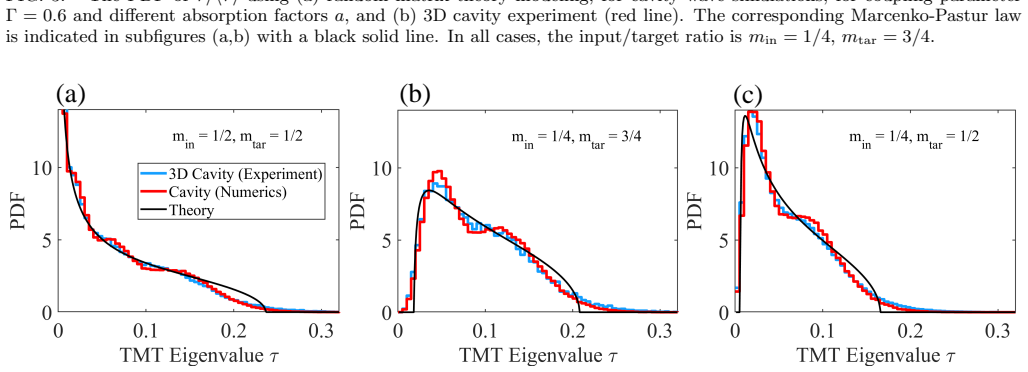
The central discovery is that for a wave-chaotic cavity with many channels, the full eigenvalue density $P(\tau)$ of the TMT matrix $T = \tilde S^\dagger \tilde S$, where $\tilde S = P_{\mathrm{tar}} S P_{\mathrm{in}}$ projects the scattering matrix onto input and target subspaces, is given by the single resolvent formula $g(z) = \frac{1}{z} \frac{1 - (1-\Gamma)\Sigma_{\mathrm{in}}\Sigma_{\mathrm{tar}}}{1 - (1-\Gamma)\Sigma_{\mathrm{in}}\Sigma_{\mathrm{tar}} - \Gamma \Sigma_{\mathrm{in}}/\sqrt{z}}$, with the self-energies fixed by two coupled equations. The distribution is universal in the sense that microscopic details of the cavity enter only through the channel ratios $m_{\mathrm{in}} = M_{\mathrm{in}}/M$, $m_{\mathrm{tar}} = M_{\mathrm{tar}}/M$, the coupling parameter $\Gamma$, and the absorption factor $a$. From the same equations the paper derives the upper bound $\tau_{\max}$ of optimal TMT and identifies conditions for near-perfect targeted transport, including reflectionless states under the complementary channel constraint. The formula is tested against simulations of random networks and chaotic cavities and against microwave measurements in networks, two-dimensional cavities, and three-dimensional reverberation chambers, with agreement that survives even at moderate channel numbers $M = 8$.
Load-bearing premise
The load-bearing premise is that the lossless cavity is fully ergodic, so its scattering matrix is statistically uniform, and that there are enough input and target channels for the planar-diagram approximation to hold; the paper itself discards the lowest 18 percent of eigenvalues in sparse-network simulations to restore agreement.
Editorial extensions
If this is right
- If Eq. (2) holds, the best achievable TMT efficiency in a given environment can be computed from four macroscopic parameters, without knowing the cavity geometry or connection graph in detail.
- In lossless cavities obeying the complementary channel constraint ($m_{\mathrm{in}} + m_{\mathrm{tar}} = 1$), the theory predicts reflectionless states with $\tau_{\max} = 1$ for almost any coupling strength and any input fraction.
- Imperfect coupling and absorption are not small corrections: they skew and compress the eigenvalue distribution and open a statistical gap below $\tau_{\max}$, setting a quantitative design trade-off for wireless power or information delivery.
- In the strong-loss or weak-control limit, the TMT statistics cross over to the Marchenko-Pastur law with explicit bounds $\tau_\pm = \Gamma(\sqrt{m_{\mathrm{in}}} \pm \sqrt{m_{\mathrm{tar}}})^2 / (1 + a/\Gamma)$.
- Experimental agreement with only $M = 8$ channels indicates that the asymptotic large-channel formula is practically useful in realistic indoor and reverberant settings.
Reading between the lines
- Editorial inference: the same four-parameter distribution should apply to acoustic, elastic, and optical wave-chaotic systems, since the derivation uses only unitary ergodic scattering; a direct acoustic or optical transmission experiment would be a clean test.
- Editorial inference: the theory suggests a certification protocol for wavefront-shaping devices: measure the coupling, absorption, and channel fractions once, then predict the statistical range of achievable targeting without ever measuring the full scattering matrix.
- Editorial inference: the observed need to discard the lowest 18% of eigenvalues in sparse networks implies a possible extension: treating non-ergodic localized or scarred modes as an effective extra absorption channel might extend Eq. (2) to networks with low connectivity.
Signed reviews
Editorial analysis
A structured set of objections, weighed in public.
Referee Report
Summary. The paper introduces the concept of targeted mode transport (TMT) in multimode wave-chaotic cavities and claims that the eigenvalues of the TMT matrix are statistically universal, depending only on four macroscopic parameters: the channel ratios m_in and m_tar, the coupling strength Gamma, and the absorption factor a. The central object is the resolvent g(z) in Eq. (2), with self-energies obtained from the coupled equations (6) and (7). The theory is compared with wave simulations of sparse random networks and random-matrix cavities, and with experiments on microwave networks, two-dimensional chaotic cavities, and three-dimensional reverberation chambers. The paper also derives upper bounds for the maximal TMT eigenvalue and shows that strong absorption or strong channel incompleteness leads to a Marcenko-Pastur regime.
Significance. If correct, the framework would replace system-specific numerical wavefront shaping calculations with a four-parameter universal description, which is of clear practical relevance for wireless power transfer, indoor communications, and imaging through complex media. The paper's strengths include explicit analytic reductions to known limits: the filtered-random-matrix solution for Gamma=1 and a=0, the closed bimodal form for m_in=m_tar=1/2, and the exact mean-transmission and mean-absorption relations. The cross-platform experimental validation is a further positive feature. The main caveat is that the universality claim for sparse networks is tested only after discarding the lowest 18% of eigenvalues, so the paper's stated universality is stronger than the evidence for that platform.
major comments (2)
- [Eq. (2) vs Supplementary Eq. (20)] Equation (2) of the main text is not equivalent to the supplementary derivation. The printed denominator contains Gamma*Sigma_in/sqrt(z), whereas Supplementary Eq. (20) contains Gamma*Sigma_tar/sqrt(z). This is not a superscript-omission issue, because Sigma_in and Sigma_tar are different functions when m_in differs from m_tar. In the limit Gamma=1 and a=0, the printed formula reduces to g=1/[z(1-Sigma_in/sqrt(z))], while the supplementary formula gives g=1/[z(1-Sigma_tar/sqrt(z))]. Using the closed-form self-energies from Supplementary Eqs. (33) and (34) at m_in=1/4, m_tar=3/4, and z=0.5, only the Sigma_tar version reproduces the filtered-random-matrix result of Supplementary Eq. (10). Since Eq. (2) is the central formula from which the black-line densities and the reported tau_max bounds are derived, the main text must be corrected to match the supplementary expression, and the authors should state explicitly that the discrepancy is typographical. As printed, a reader cannot reproduce the paper's predictions from the main text alone.
- [Fig. 2] The claim that the TMT eigenvalue distribution is universal for wave-chaotic systems is tested on the sparse network only after discarding the lowest 18% of eigenvalues, as shown by the blue lines in Fig. 2 and stated in the caption and text. The grey unfiltered network histograms deviate from the theoretical curve, and the 18% threshold is introduced post hoc without a quantitative criterion. The deviations are attributed to scarring and localization, which are precisely the non-ergodic effects that the theoretical derivation assumes away. The paper should either restrict the universality claim to the ergodic part of the spectrum or provide a prescriptive criterion for identifying the excluded sector. This caveat does not invalidate the cavity simulations or the fully connected network experiments, but it is load-bearing for the title-level claim of universality.
minor comments (4)
- [Notation] The channel ratios are typeset as 'min' and 'mtar', which can be misread as the minimum function and as a standalone variable 'mtar'; please use m_in and m_tar with subscripts in the published version.
- [Fig. 2] The relation among the grey, blue, and red curves in Fig. 2 should be stated explicitly at first mention in the main text; the reader currently must infer that grey is the raw network distribution and blue is the distribution after eigenvalue truncation.
- [Methods] The self-energy equations in the Methods are written without the superscript plus signs that appear in the Supplementary; adding a sentence noting that the '+' branch is the one used for P(tau) would prevent confusion.
- [Supplementary III] The reduction of the diagrammatic approach to the Marcenko-Pastur law is asserted rather than shown; a brief indication of the limit (for example a >> 1 or m_in, m_tar << 1) would make the claim checkable.
Circularity Check
No significant circularity: Eq. (2) is derived from a unitary-group diagrammatic expansion with Gamma, a, min and mtar as independent macroscopic inputs.
full rationale
The central claim, Eq. (2) with the Supplementary self-consistent equations (27)-(31), is obtained by a diagrammatic expansion over the unitary group for a uniformly distributed S0 (Supplementary II.C), with the planar-diagram combinatorial weights taken from the external Brouwer-Beenakker/Mello literature. The quantities min, mtar, Gamma and a are model inputs, and the eigenvalue density P(tau) is never fitted to the data. Calibrating Gamma and A from one-point S-matrix measurements (e.g., Gamma = 1 - |<S_alpha_alpha>|^2 and A = 1 - <Tr S^dagger S>/M) and then comparing the predicted eigenvalue statistics is not a circular reduction, because the one-point observables are independent of the target distribution. The special cases are used as consistency checks: the Gamma = 1, a = 0 limit is shown to recover the known filtered-random-matrix solution (Supplementary Eqs. (33)-(34) with Eq. (20) reproducing Eq. (10)), and the min = mtar = 1/2, a = 0 case recovers the closed bimodal formula. Self-citations (Refs. [14], [37], [38]) are not load-bearing: the FRM limit is re-derived from the diagrammatic equations rather than imported as the central result, and the scar/localization references only motivate the stated exclusion of non-ergodic eigenvalues. The discrepancy between main-text Eq. (2) (Gamma Sigma_in / sqrt(z)) and Supplementary Eq. (20) (Gamma Sigma_tar / sqrt(z)) is an internal-consistency or typographical issue affecting reproducibility; it is not an equivalence between the prediction and an input, so it does not constitute circularity. No circular step is exhibited.
Assumptions & free parameters
free parameters (3)
- 2D cavity microscopic parameters (γ, γ') =
(0.56, 0.003)
- Network loss parameter n_i =
≈ 2×10^-3 (experiments), ≈ 2×10^-4 (simulations)
- Eigenvalue exclusion threshold for network simulations =
lowest 18% of eigenvalues removed
assumptions (5)
- domain assumption The scattering matrix S0 of the lossless, perfectly coupled system is uniformly distributed in the unitary group.
- domain assumption Input and target channel subspaces are orthogonal: P_tar·P_in = 0.
- ad hoc to paper Planar diagram approximation: only planar diagrams contribute for M_in, M_tar >> 1; non-planar diagrams and diagonal self-energy blocks are neglected.
- domain assumption Absorption is modeled by M' effective channels with coupling Γ'→0 and M'→∞, keeping a = M'Γ'/M finite.
- domain assumption All M physical channels are statistically equivalent except for their coupling Γ.
Cite this review
Pith. "Pith review of Optimal Targeted Mode Transport in Complex Wave Environments: A Universal Statistical Framework." pith.science (2026). https://pith.science/paper/VBGQEZBD
@misc{pith2026250112511,
  author       = {Pith},
  title        = {Pith review of: Optimal Targeted Mode Transport in Complex Wave Environments: A Universal Statistical Framework},
  year         = {2026},
  howpublished = {\url{https://pith.science/paper/VBGQEZBD}},
  note         = {Machine review of arXiv:2501.12511}
}
read the original abstract
Recent advances in the field of structured waves have resulted in sophisticated coherent wavefront shaping schemes that provide unprecedented control of waves in various complex settings. These techniques exploit multiple scattering events and the resulting interference of wave paths within these complex environments. Here, we introduce the concept of targeted mode transport (TMT), which enables energy transfer from specific input channels to designated output channels in multimode wave-chaotic cavities by effectively engaging numerous cavity modes. We develop a statistical theory that provides upper bounds on optimal TMT, incorporating operational realities such as losses, coupling strengths and the accessibility of specific interrogating channels. The theoretical predictions for the probability distribution of TMT eigenvalues are validated through experiments with microwave chaotic networks of coaxial cables as well as two-dimensional and three-dimensional complex cavities. These findings have broad implications for applications ranging from indoor wireless communications to imaging and beyond.
Figures


Figures from the paper (5 more)


Reference graph
Works this paper leans on
-
[1]
A study on propagation models for 60 GHz signals in indoor environments,
Let´ ıcia Carneiro de Souza, Celso Henrique de Souza Lopes, Rita de Cassia Carlleti dos Santos, Arismar Cerqueira Sodr´ e Junior, and Luciano Leonel Mendes, “A study on propagation models for 60 GHz signals in indoor environments,” Frontiers in Communications and Networks 2, 757842 (2022)
work page 2022
-
[2]
Electromagnetic interference in ris-aided communications,
Andrea de Jesus Torres, Luca Sanguinetti, and Emil Bj¨ ornson, “Electromagnetic interference in ris-aided communications,” IEEE Wireless Communications Let- ters 11, 668–672 (2021)
work page 2021
-
[3]
Shap- ing the propagation of light in complex media,
Hui Cao, Allard Pieter Mosk, and Stefan Rotter, “Shap- ing the propagation of light in complex media,” Nat. Phys. 18, 994–1007 (2022)
work page 2022
-
[4]
Roadmap on wavefront shaping and deep imaging in complex media,
Sylvain Gigan, Ori Katz, Hilton De Aguiar, et al. , “Roadmap on wavefront shaping and deep imaging in complex media,” Journal of Physics: Photonics 4, 042501 (2022)
work page 2022
-
[5]
Non- 10 linear optical encoding enabled by recurrent linear scat- tering,
Fei Xia, Kyungduk Kim, Yaniv Eliezer, SeungYunL Han, Liam Shaughnessy, Sylvain Gigan, and Hui Cao, “Non- 10 linear optical encoding enabled by recurrent linear scat- tering,” Nature Photonics 18, 1067–1075 (2024)
work page 2024
-
[6]
Perfect absorption in complex scattering systems with or without hidden symmetries,
Lei Chen, Tsampikos Kottos, and Steven M Anlage, “Perfect absorption in complex scattering systems with or without hidden symmetries,” Nat. Comm. 11, 5826 (2020)
work page 2020
-
[7]
Theory of reflectionless scattering modes,
William R Sweeney, Chia Wei Hsu, and A Douglas Stone, “Theory of reflectionless scattering modes,” Phys. Rev. A 102, 063511 (2020)
work page 2020
-
[8]
Coherent control of chaotic op- tical microcavity with reflectionless scattering modes,
Xuefeng Jiang, Shixiong Yin, Huanan Li, Jiamin Quan, Heedong Goh, Michele Cotrufo, Julius Kullig, Jan Wier- sig, and Andrea Al` u, “Coherent control of chaotic op- tical microcavity with reflectionless scattering modes,” Nat. Phys. 20, 109–115 (2024)
work page 2024
Show all 50 references
-
[9]
Nonlinearity- induced scattering zero degeneracies for spectral manage- ment of coherent perfect absorption in complex systems,
Cheng-Zhen Wang, John Guillamon, William Tuxbury, Ulrich Kuhl, and Tsampikos Kottos, “Nonlinearity- induced scattering zero degeneracies for spectral manage- ment of coherent perfect absorption in complex systems,” Phys. Rev. Appl. 22, 064093 (2024)
2024
-
[10]
Detecting and focus- ing on a nonlinear target in a complex medium,
Antton Go¨ ıcoechea, Jakob H¨ upfl, Stefan Rotter, Fran¸ cois Sarrazin, and Matthieu Davy, “Detecting and focus- ing on a nonlinear target in a complex medium,” arXiv preprint arXiv:2407.07932 (2024)
2024 arXiv
-
[11]
Singular topology of scattering matrices,
Cheng Guo, Jiazheng Li, Meng Xiao, and Shanhui Fan, “Singular topology of scattering matrices,” Phys. Rev. B 108, 155418 (2023)
2023
-
[12]
Reflectionless programmable sig- nal routers,
J´ erˆ ome Sol, Ali Alhulaymi, A Douglas Stone, and Philipp Del Hougne, “Reflectionless programmable sig- nal routers,” Science Advances 9, eadf0323 (2023)
2023
-
[13]
Hidden black: Co- herent enhancement of absorption in strongly scattering media,
YD Chong and A Douglas Stone, “Hidden black: Co- herent enhancement of absorption in strongly scattering media,” Phys. Rev. Lett. 107, 163901 (2011)
2011
-
[14]
Filtering random matrices: the effect of incomplete channel control in multiple scat- tering,
A Goetschy and AD Stone, “Filtering random matrices: the effect of incomplete channel control in multiple scat- tering,” Phys. Rev. Lett. 111, 063901 (2013)
2013
-
[15]
Coherent control of total transmission of light through disordered media,
S´ ebastien M Popoff, Arthur Goetschy, SF Liew, A Dou- glas Stone, and Hui Cao, “Coherent control of total transmission of light through disordered media,” Phys. Rev. Lett. 112, 133903 (2014)
2014
-
[16]
Correlation-enhanced con- trol of wave focusing in disordered media,
Chia Wei Hsu, Seng Fatt Liew, Arthur Goetschy, Hui Cao, and A Douglas Stone, “Correlation-enhanced con- trol of wave focusing in disordered media,” Nat. Phys. 13, 497–502 (2017)
2017
-
[17]
Random matrix theory approach to chaotic coherent perfect absorbers,
Huanan Li, Suwun Suwunnarat, Ragnar Fleischmann, Holger Schanz, and Tsampikos Kottos, “Random matrix theory approach to chaotic coherent perfect absorbers,” Phys. Rev. Lett. 118, 044101 (2017)
2017
-
[18]
Statistical design of chaotic waveforms with enhanced targeting capabilities,
Huanan Li, Suwun Suwunnarat, and Tsampikos Kottos, “Statistical design of chaotic waveforms with enhanced targeting capabilities,” Phys. Rev. B 98, 041107 (2018)
2018
-
[19]
Full character- ization of the transmission properties of a multi-plane light converter,
Pauline Boucher, Arthur Goetschy, Giacomo Sorelli, Mattia Walschaers, and Nicolas Treps, “Full character- ization of the transmission properties of a multi-plane light converter,” Phys. Rev. Research 3, 023226 (2021)
2021
-
[20]
Depth- targeted energy delivery deep inside scattering media,
Nicholas Bender, Alexey Yamilov, Arthur Goetschy, Hasan Yılmaz, Chia Wei Hsu, and Hui Cao, “Depth- targeted energy delivery deep inside scattering media,” Nature Physics 18, 309–315 (2022)
2022
-
[21]
Delivering broadband light deep inside diffusive media,
Rohin McIntosh, Arthur Goetschy, Nicholas Bender, Alexey Yamilov, Chia Wei Hsu, Hasan Yılmaz, and Hui Cao, “Delivering broadband light deep inside diffusive media,” Nat. Photon. , 1–7 (2024)
2024
-
[22]
Direct processes in chaotic microwave cavities in the presence of absorption,
U Kuhl, M Mart´ ınez-Mares, RA M´ endez-S´ anchez, and H-J St¨ ockmann, “Direct processes in chaotic microwave cavities in the presence of absorption,” Phys. Rev. Lett. 94, 144101 (2005)
2005
-
[23]
Chaotic scattering with direct processes: a generalization of Poisson’s kernel for non-unitary scat- tering matrices,
VA Gopar, M Mart´ ınez-Mares, and RA M´ endez- S´ anchez, “Chaotic scattering with direct processes: a generalization of Poisson’s kernel for non-unitary scat- tering matrices,” J. Phys. A: Math. Theor. 41, 015103 (2007)
2007
-
[24]
Absorption strength in absorbing chaotic cavities,
G B´ aez, M Mart´ ınez-Mares, and RA M´ endez-S´ anchez, “Absorption strength in absorbing chaotic cavities,” Phys. Rev. E 78, 036208 (2008)
2008
-
[25]
Transmission channels for light in absorbing random media: from diffusive to ballistic-like transport,
Seng Fatt Liew, S´ ebastien M Popoff, Allard P Mosk, Willem L Vos, and Hui Cao, “Transmission channels for light in absorbing random media: from diffusive to ballistic-like transport,” Phys. Rev. B 89, 224202 (2014)
2014
-
[26]
Generalized circular ensemble of scattering matrices for a chaotic cavity with nonideal leads,
Piet Wibertus Brouwer, “Generalized circular ensemble of scattering matrices for a chaotic cavity with nonideal leads,” Phys. Rev. B 51, 16878 (1995)
1995
-
[27]
Reducing nonideal to ideal coupling in ran- dom matrix description of chaotic scattering: Applica- tion to the time-delay problem,
Dmitry V Savin, Yan V Fyodorov, and Hans-J¨ urgen Sommers, “Reducing nonideal to ideal coupling in ran- dom matrix description of chaotic scattering: Applica- tion to the time-delay problem,” Phys. Rev. E63, 035202 (2001)
2001
-
[28]
Distribution of zeros of the s-matrix of chaotic cavities with localized losses and coherent perfect absorp- tion: non-perturbative results,
Yan V Fyodorov, Suwun Suwunnarat, and Tsampikos Kottos, “Distribution of zeros of the s-matrix of chaotic cavities with localized losses and coherent perfect absorp- tion: non-perturbative results,” Journal of Physics A: Mathematical and Theoretical 50, 30LT01 (2017)
2017
-
[29]
Quantum graphs: a model for quantum chaos,
Tsampikos Kottos and Holger Schanz, “Quantum graphs: a model for quantum chaos,” Physica E 9, 523–530 (2001)
2001
-
[30]
Quantum graphs: a simple model for chaotic scattering,
Tsampikos Kottos and Uzy Smilansky, “Quantum graphs: a simple model for chaotic scattering,” Journal of Physics A: Mathematical and General 36, 3501 (2003)
2003
-
[31]
Universal chaotic scattering on quantum graphs,
Z Pluhaˇ r and Hans A Weidenm¨ uller, “Universal chaotic scattering on quantum graphs,” Phys. Rev. Lett. 110, 034101 (2013)
2013
-
[32]
Universal quantum graphs,
Z Pluhaˇ r and HA Weidenm¨ uller, “Universal quantum graphs,” Phys. Rev. Lett. 112, 144102 (2014)
2014
-
[33]
Hurt, Mathematical physics of quantum wires and devices: from spectral resonances to Anderson local- ization, Vol
Norman E. Hurt, Mathematical physics of quantum wires and devices: from spectral resonances to Anderson local- ization, Vol. 506 (Springer Science & Business Media, 2000)
2000
-
[34]
Graph models for waves in thin struc- tures,
Peter Kuchment, “Graph models for waves in thin struc- tures,” Waves in random media 12, R1 (2002)
2002
-
[35]
Quantum graphs and their applications,
P Kuchment, “Quantum graphs and their applications,” Special issue of Waves in Random Media 14 (2004)
2004
-
[36]
Gregory Berkolaiko and Peter Kuchment, Introduction to quantum graphs , 186 (American Mathematical Soc., 2013)
2013
-
[37]
Scars on quan- tum networks ignore the Lyapunov exponent,
Holger Schanz and Tsampikos Kottos, “Scars on quan- tum networks ignore the Lyapunov exponent,” Phys. Rev. Lett. 90, 234101 (2003)
2003
-
[38]
Bound states in the continuum induced via local symmetries in complex structures,
Cheng-Zhen Wang, Ulrich Kuhl, Adin Dowling, Hol- ger Schanz, and Tsampikos Kottos, “Bound states in the continuum induced via local symmetries in complex structures,” Phys. Rev. Applied 22, 014010 (2024)
2024
-
[39]
Statistics of resonance poles, phase shifts and time delays in quan- tum chaotic scattering: Random matrix approach for systems with broken time-reversal invariance,
Yan V. Fyodorov and Hans-J¨ urgen Sommers, “Statistics of resonance poles, phase shifts and time delays in quan- tum chaotic scattering: Random matrix approach for systems with broken time-reversal invariance,” Journal of Mathematical Physics 38, 1918–1981 (1997)
1997
-
[40]
Random-matrix theory of quantum transport,
C. W. J. Beenakker, “Random-matrix theory of quantum transport,” Rev. Mod. Phys. 69, 731–808 (1997)
1997
-
[41]
Coherent enhancement of optical remission in diffusive media,
Nicholas Bender, Arthur Goetschy, Chia Wei Hsu, et al., 11 “Coherent enhancement of optical remission in diffusive media,” Proc. Natl. Acad. Sci. U.S.A. 119 (2022)
2022
-
[42]
Diagrammatic method of integration over the unitary group, with ap- plications to quantum transport in mesoscopic systems,
P. W. Brouwer and C. W. J. Beenakker, “Diagrammatic method of integration over the unitary group, with ap- plications to quantum transport in mesoscopic systems,” Journal of Mathematical Physics 37, 4904–4934 (1996)
1996
-
[43]
Distribution of eigenvalues for some sets of random matrices,
Vladimir Alexandrovich Marchenko and Leonid Andree- vich Pastur, “Distribution of eigenvalues for some sets of random matrices,” Matematicheskii Sbornik 114, 507– 536 (1967)
1967
-
[44]
Statistical model for mimo propagation channel in cav- ities and random media,
Gabriele Gradoni, Martin Richter, Sendy Phang, et al. , “Statistical model for mimo propagation channel in cav- ities and random media,” in 2020 XXXIIIrd General Assembly and Scientific Symposium of the International Union of Radio Science (IEEE, 2020) pp. 1–4. Supplementary M...
2020 arXiv
-
[45]
Quantum graphs: a simple model for chaotic scattering,
Tsampikos Kottos and Uzy Smilansky, “Quantum graphs: a simple model for chaotic scattering,” Journal of Physics A: Mathematical and General 36, 3501 (2003). 10
2003
-
[46]
Voltage-probe and imaginary-potential models for dephasing in a chaotic quantum dot,
P. W. Brouwer and C. W. J. Beenakker, “Voltage-probe and imaginary-potential models for dephasing in a chaotic quantum dot,” Phys. Rev. B 55, 4695–4702 (1997)
1997
-
[47]
Scattering, reflection and impedance of waves in chaotic and disordered systems with absorption,
Y V Fyodorov, D V Savin, and H-J Sommers, “Scattering, reflection and impedance of waves in chaotic and disordered systems with absorption,” Journal of Physics A: Mathematical and General 38, 10731 (2005)
2005
-
[48]
Filtering random matrices: the effect of incomplete channel control in multiple scattering,
A Goetschy and AD Stone, “Filtering random matrices: the effect of incomplete channel control in multiple scattering,” Phys. Rev. Lett. 111, 063901 (2013)
2013
-
[49]
Diagrammatic method of integration over the unitary group, with applications to quantum transport in mesoscopic systems,
P. W. Brouwer and C. W. J. Beenakker, “Diagrammatic method of integration over the unitary group, with applications to quantum transport in mesoscopic systems,” Journal of Mathematical Physics 37, 4904–4934 (1996)
1996
-
[50]
Averages on the unitary group and applications to the problem of disordered conductors,
P. A. Mello, “Averages on the unitary group and applications to the problem of disordered conductors,” Journal of Physics A: Mathematical and General 23, 4061 (1990)
1990
Reviewed August 10, 2026 · model on record in the stance chip above.
Discussion (0). Continue with ORCID to comment.