REVIEW 3 major objections 3 minor 182 references
Computational modelling of biological systems now and then: revisiting tools and visions from the beginning of the century
T0 review · 3 major / 3 minor · reviewed 2026-08-10 · deepseek-v4-flash
Pith's one-line read The paper argues that computational modelling of biological systems has matured into an integral part of biomedical research, and that the next advances will come from deliberately combining mechanistic, first-principles models with…
desk verdict A useful, well-referenced perspective on 25 years of cardiac M&S that is honest about its limits; the 'maturity' claim is asserted more than proven, but this is advocacy, not fraud. read the letter →
The pith
A machine-rendered reading of the paper's core claim, the machinery that carries it, and where it could break.
The reading
What carries the argument
The conceptual centrepiece is the "mountain and village" pairing, integrationist panorama versus reductionist close-up, which the authors repurpose into the modern pairing of mechanistic (village) and data-driven (mountain-top) modelling. The concrete machinery that carries the technical claims is the multi-scale cardiac electrophysiology hierarchy: ion-channel kinetics described by ordinary differential equations, cell-level models that couple currents into action potentials, tissue-level reaction-diffusion partial differential equations that propagate excitation, and Poisson's equation mapping the resulting fields to a body-surface electrocardiogram. This hierarchy is what makes digital twins personalisable, digital chimeras sampleable, and synthetic labelled training data producible at scale. Around it, the paper places an ecosystem layer of markup languages, FAIR data and software practices, and credibility frameworks, which is the mechanism that makes models interoperable and trustworthy in regulatory settings.
What would settle it
A head-to-head comparison in which machine-learning classifiers trained on synthetic data from mechanistic cardiac models are outperformed, on out-of-sample clinical data, by classifiers trained on equal-sized clinical datasets for the same diagnostic task would undermine the synergy claim. So would a post-market audit showing that in silico trial predictions—for instance, proarrhythmia risk classifications—fail to correlate with adverse outcomes in subsequent real clinical trials.
Extended reading notes
Core claim
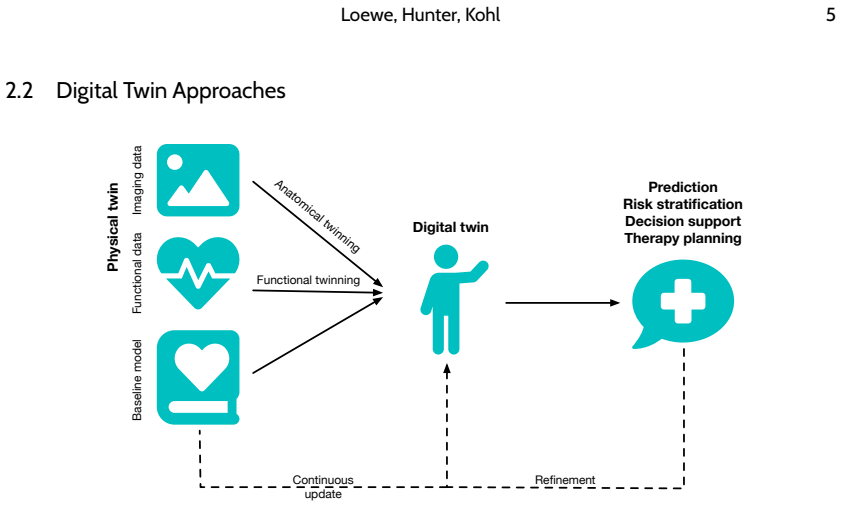
On its own terms, the paper's central claim is that "in silico methods" have become "an integral part of physiological and medical research" and that the next wave of progress will come from a synergy between mechanistic and data-driven modelling. The review traces a shift away from the early ambition of one universal model of "the human" toward two complementary targets: digital twins, which personalise a baseline mechanistic model to a single patient, and digital chimeras, synthetic individuals sampled from shape and parameter distributions so that statistically representative cohorts can undergo simulated interventions. It further claims that machine learning does not replace mechanistic modelling but is strengthened by it: validated multi-scale simulations supply large, class-balanced, precisely labelled synthetic training data; physics-informed neural networks constrain learning with known laws; and hybrid simulated-plus-clinical datasets improve classifiers in atrial fibrillation, flutter, fibrosis, and electrolyte disorders. The paper's corollary is that the binding constraints on future progress are data standardisation, uncertainty quantification, reproducibility, and community infrastructure rather than computational power.
Load-bearing premise
The load-bearing premise is that the selected success stories—rising publication counts, digital-twin pilots, regulatory uptake, and synthetic-data machine-learning demos—are representative enough to prove that modelling and simulation has matured into an integral part of biomedical research, rather than being early or atypical exceptions.
Editorial extensions
If this is right
- In silico trials built on cohorts of digital chimeras can reduce, refine, or replace some animal and early human experiments, and regulators are already beginning to accept simulation evidence.
- Cardiac multi-scale models can supply large, well-labelled, class-balanced synthetic datasets that improve machine-learning classifiers beyond what scarce clinical data alone allow.
- Physics-informed neural networks and statistical emulators will become routine tools for parameter identification, sensitivity analysis, and uncertainty quantification.
- Interoperable standards and open, FAIR data and code are prerequisites for building and validating models across scales, diseases, and contexts of use.
- The controlled in silico environment lets researchers isolate confounding factors and test cause-and-effect hypotheses in ways wet-lab experiments cannot easily match.
Reading between the lines
- A fair quantitative test of the maturation narrative would be a longitudinal analysis of how many M&S publications in cardiology report prospective clinical implementation, as opposed to retrospective simulation studies; the ratio would show whether adoption is broad or confined to showcases.
- If the synergy claim generalises, the same digital-chimera-plus-machine-learning recipe should transfer to non-cardiac fields such as oncology, neurology, and immunology, where mechanistic models are less mature; demonstrating benefit there would be a strong external confirmation.
- The paper's own caveat that no data quantify M&S's contribution to rising life expectancy implies a concrete evaluative gap: a cost-effectiveness meta-analysis of in silico-guided versus conventional drug and device development would directly test whether the promised savings in time and money actually materialise.
- An implicit, testable consequence is that classifiers trained on synthetic data should fail gracefully when a simulation omits a silent variable such as age; a benchmark that introduces such variables in held-out clinical sets would probe the limits of the whole synthetic-data strategy.
Editorial analysis
A structured set of objections, weighed in public.
Referee Report
Summary. This perspective article revisits the 2000 vision of Kohl, Noble, Winslow, and Hunter on computational modelling of biological systems, with a focus on the cardiovascular system. It argues that computational modelling and simulation (M&S) has matured into an integral part of physiological and medical research, that the old reductionism/integrationism debate has been superseded by a mechanistic-vs-data-driven dichotomy, and that the two approaches can and should be combined synergistically. The paper surveys recent developments in digital twins, in silico clinical trials, machine learning, open tools and standards, and selected cardiology applications, and it concludes with near-term frontiers and community-oriented recommendations. The article is explicitly a perspective/review and does not present new quantitative analyses.
Significance. If the central narrative is accepted, this paper provides a useful synthesis and agenda for the field, connecting historical visions to current tooling and identifying actionable needs such as FAIR data, metadata and software standards, uncertainty quantification, and better incentives for sharing. Its strengths include an extensive and largely accurate reference base, a clear description of the Physiome/VPH lineage, and an unusually honest treatment of limitations: the 'plausibility trap' in synthetic training data, domain gaps between simulated and real-world data, missing evidence for population-level health impact, and unresolved issues in digital twin personalisation. The paper's main value is as a statement of current consensus and future priorities by three leaders in the field, rather than as an empirical demonstration of clinical impact. Its central claims therefore need to be phrased with a level of confidence commensurate with the evidence presented.
major comments (3)
- [Section 2 (life-expectancy paragraph)] The sentence 'The millennial promise of reducing morbidity and mortality turned out to be true: life expectancy in the EU rose...' is not supported by the evidence that follows, because the authors immediately concede that 'we are not aware of data that would allow one to quantify the contribution of M&S to this improvement.' This assertion is load-bearing for the paper's broader maturity-and-benefit narrative. I recommend either replacing this passage with concrete adoption evidence (e.g., the ICH E14/S7B update, regulatory qualification examples, or prospective clinical trials using model-derived predictions) or explicitly softening the claim to state that anticipated benefits are becoming plausible and are beginning to materialize in specific contexts, rather than that the promise has been fulfilled.
- [Section 2 opening and Section 6] The assertion that M&S 'has become an integral part of physiological and medical research' is supported mainly by a five-fold increase in a PubMed fraction (reaching 2.2% in 2023) and by selected success stories, several of which originate from the authors' own groups (e.g., MedalCare-XL, openCARP, the bi-atrial statistical shape model). Publication counts measure research activity, not clinical integration or patient benefit, and the examples are not demonstrated to be representative of the field as a whole. Please add indicators of adoption beyond publication metrics (regulatory decisions, clinical guidelines, reimbursement, or numbers of patients reached) or reframe the conclusion as 'increasingly established in research and emerging in specific clinical contexts,' which would be better matched to the evidence actually presented.
- [Section 2.2 (Digital Twin Approaches)] The statement that digital twins 'have proven valuable across diverse medical applications' is stronger than the cited reviews support. The two prospective trials referenced later in Section 4 ([140,141]) are encouraging but small and restricted to ablation guidance, and the other cited sources are position papers or reviews. Because clinical utility is central to the maturity narrative, I recommend replacing 'have proven valuable' with 'have shown promise in early clinical evaluations' or 'are being evaluated in prospective clinical settings.'
minor comments (3)
- [Section 2.4] The phrase 'in silico generated data' should be hyphenated as 'in silico-generated data' for consistency with standard usage.
- [Section 3] There are two consecutive 'Acknowledgments' blocks after the author contributions; these should be merged into a single section.
- [Section 2.1] The sentence stating that in silico research has an 'absence of inherent variability, obviating the need for repeated experiments' is overstated for numerical simulations, which still face discretization error and stochastic algorithm variability; the later discussion of uncertainty quantification should be reflected in this sentence as well.
Circularity Check
No circular derivation: the paper is a narrative review whose claims rest on external evidence, and self-citations are illustrative rather than load-bearing.
full rationale
This manuscript is a perspective/review, not a derivation. Its central claims, that computational modelling has matured, that mechanistic and data-driven modelling can synergize, and that open standards and sharing are needed, are supported by publication statistics, external benchmark initiatives such as CiPA and the Physiome/VPH programme, and a broad set of independent literature. The authors explicitly disclaim quantitative attribution of health-outcome improvements to modelling, writing in Section 2 that “we are not aware of data that would allow one to quantify the contribution of M&S to this improvement”; this is an evidentiary limitation, not a circular step. Author-affiliated work appears among many examples (e.g., MedalCare-XL [39], openCARP [78], a bi-atrial shape model [70]), but the review’s conclusions do not reduce to those citations, and removing them would not change the structure of the argument. No equations are derived, no fitted parameter is renamed as a prediction, and no uniqueness theorem from the authors is invoked to force a conclusion. The paper is self-contained as a narrative assessment, so the circularity score is 0.
Assumptions & free parameters
assumptions (2)
- domain assumption The selected citations and examples are representative of the field's development since 2000.
- domain assumption The dichotomy between mechanistic and data-driven modelling is a meaningful organizing frame.
Cite this review
Pith. "Pith review of Computational modelling of biological systems now and then: revisiting tools and visions from the beginning of the century." pith.science (2026). https://pith.science/paper/4NGKL7W3
@misc{pith2026250113142,
  author       = {Pith},
  title        = {Pith review of: Computational modelling of biological systems now and then: revisiting tools and visions from the beginning of the century},
  year         = {2026},
  howpublished = {\url{https://pith.science/paper/4NGKL7W3}},
  note         = {Machine review of arXiv:2501.13142}
}
read the original abstract
Since the turn of the millennium, computational modelling of biological systems has evolved remarkably and sees matured use spanning basic and clinical research. While the topic of the peri-millennial debate about the virtues and limitations of 'reductionism and integrationism' seems less controversial today, a new apparent dichotomy dominates discussions: mechanistic vs. data-driven modelling. In light of this distinction, we provide an overview of recent achievements and new challenges with a focus on the cardiovascular system. Attention has shifted from generating a universal model of the human to either models of individual humans (digital twins) or entire cohorts of models representative of clinical populations to enable in silico clinical trials. Disease-specific parameterisation, inter-individual and intra-individual variability, uncertainty quantification as well as interoperable, standardised, and quality-controlled data are important issues today, which call for open tools, data and metadata standards, as well as strong community interactions. The quantitative, biophysical, and highly controlled approach provided by in silico methods has become an integral part of physiological and medical research. In silico methods have the potential to accelerate future progress also in the fields of integrated multi-physics modelling, multi-scale models, virtual cohort studies, and machine learning beyond what is feasible today. In fact, mechanistic and data-driven modelling can complement each other synergistically and fuel tomorrow's artificial intelligence applications to further our understanding of physiology and disease mechanisms, to generate new hypotheses and assess their plausibility, and thus to contribute to the evolution of preventive, diagnostic, and therapeutic approaches.
Figures


Figures from the paper (1 more)

Reference graph
Works this paper leans on
-
[82]
(10.3389/fphys.2021.646023)
arXiv 2021
-
[98]
2017 SimVascular: An Open Source Pipeline for Cardiovascular Simulation
Updegrove A, Wilson NM, Merkow J et al. 2017 SimVascular: An Open Source Pipeline for Cardiovascular Simulation. Annals of Biomedical Engineering 45, 525–541. (10.1007/s10439-016- 1762-8)
-
[60]
Pilia N, Schuler S, Rees M et al. 2023 Non-invasive Localization of the Ventricular Excitation Origin Without Patient-specific Geometries Using Deep Learning. Artificial Intelligence in Medicine 143, 102619. (10.1016/j.artmed.2023.102619)
arXiv 2023
-
[1]
2000 Computational modelling of biological systems: tools and visions
Kohl P, Noble D, Winslow RL, Hunter PJ. 2000 Computational modelling of biological systems: tools and visions. Phil. Trans. R. Soc. Lond. A 358, 579–610. (10.1098/rsta.2000.0547)
arXiv 2000
-
[2]
2020 The ‘Digital Twin’ to enable the vision of precision cardiology
Corral-Acero J, Margara F, Marciniak M et al. 2020 The ‘Digital Twin’ to enable the vision of precision cardiology. Eur Heart J 41, 4556–4564. (10.1093/eurheartj/ehaa159)
-
[3]
Hunter PJ, Borg TK. 2003 Integration from proteins to organs: the Physiome Project.Nature Reviews Molecular Cell Biology 4, 237–243. (10.1038/nrm1054)
-
[4]
2010 A vision and strategy for the virtual physiological human in 2010 and beyond
Hunter P, Coveney PV, de Bono B et al. 2010 A vision and strategy for the virtual physiological human in 2010 and beyond. Philosophical Transactions of the Royal Society A: Mathematical, Physical and Engineering Sciences 368, 2595–2614. (10.1098/rsta.2010.0048)
arXiv 2010
-
[5]
2009 The Cardiac Physiome: perspectives for the future
Bassingthwaighte J, Hunter P, Noble D. 2009 The Cardiac Physiome: perspectives for the future. Exp Physiol 94, 597–605. (10.1113/expphysiol.2008.044099)
arXiv 2009
Show all 182 references
-
[6]
2013 A vision and strategy for the virtual physiological human: 2012 update
Hunter P, Chapman T, Coveney PV et al. 2013 A vision and strategy for the virtual physiological human: 2012 update. Interface Focus 3, 20130004. (10.1098/rsfs.2013.0004)
2013
-
[7]
2021 Quantitative cross-species translators of cardiac myocyte electrophysiology: Model training, experimental validation, and applications
Morotti S, Liu C, Hegyi B et al. 2021 Quantitative cross-species translators of cardiac myocyte electrophysiology: Model training, experimental validation, and applications. Science Advances 7. (10.1126/sciadv.abg0927)
2021 doi
-
[8]
Pierre SR, Peirlinck M, Kuhl E
St. Pierre SR, Peirlinck M, Kuhl E. 2022 Sex Matters: A Comprehensive Comparison of Female and Male Hearts. Frontiers in Physiology 13. (10.3389/fphys.2022.831179)
2022
-
[9]
2021 Artificial intelligence-enhanced elec- trocardiography in cardiovascular disease management
Siontis KC, Noseworthy PA, Attia ZI, Friedman PA. 2021 Artificial intelligence-enhanced elec- trocardiography in cardiovascular disease management. Nature Reviews Cardiology 18, 465–478. (10.1038/s41569-020-00503-2) Loewe, Hunter, Kohl 13
2021 doi
-
[10]
2020 Artificial Intelligence and Machine Learn- ing in Arrhythmias and Cardiac Electrophysiology
Feeny AK, Chung MK, Madabhushi A et al. 2020 Artificial Intelligence and Machine Learn- ing in Arrhythmias and Cardiac Electrophysiology. Circ Arrhythm Electrophysiol 13, e007952. (10.1161/CIRCEP.119.007952)
2020 doi
-
[11]
2021 Application of artificial intelligence to the electrocardiogram
Attia ZI, Harmon DM, Behr ER, Friedman PA. 2021 Application of artificial intelligence to the electrocardiogram. European Heart Journal 42, 4717–4730. (10.1093/eurheartj/ehab649)
2021 doi
-
[12]
2021 Artificial intelligence in the diagnosis and management of arrhythmias
Nagarajan VD, Lee SL, Robertus JL et al. 2021 Artificial intelligence in the diagnosis and management of arrhythmias. European Heart Journal. (10.1093/eurheartj/ehab544)
2021 doi
-
[13]
2023 The application of simulation methods during the COVID-19 pandemic: A scoping review
Sun Z, Bai R, Bai Z. 2023 The application of simulation methods during the COVID-19 pandemic: A scoping review. Journal of Biomedical Informatics 148, 104543. (10.1016/j.jbi.2023.104543)
2023
-
[14]
2023 Mortality and life expectancy statistics
eurostat. 2023 Mortality and life expectancy statistics. https://ec.europa.eu/eurostat/ statistics-explained/index.php?title=Mortality and life expectancy statistics. Accessed: 2024-01-14
2023
-
[15]
2023 25 years of basic and translational science in EP Europace: novel insights into arrhythmia mechanisms and therapeutic strategies
Remme CA, Heijman J, Gomez AM et al. 2023 25 years of basic and translational science in EP Europace: novel insights into arrhythmia mechanisms and therapeutic strategies. Europace 25. (10.1093/europace/euad210)
2023 doi
-
[16]
2022 Dyssynchronous Left Ventricular Activation is Insufficient for the Breakdown of Wringing Rotation
Gerach T, Appel S, Wilczek J et al. 2022 Dyssynchronous Left Ventricular Activation is Insufficient for the Breakdown of Wringing Rotation. Frontiers in Physiology 13, 838038. (10.3389/fphys.2022.838038)
2022
-
[18]
2018 Computational models in cardiology.Nat Rev Cardiol 16, 100–111
Niederer SA, Lumens J, Trayanova NA. 2018 Computational models in cardiology.Nat Rev Cardiol 16, 100–111. (10.1038/s41569-018-0104-y)
2018 doi
-
[19]
2021 Computational models of atrial fibrillation: achievements, challenges, and perspectives for improving clinical care
Heijman J, Sutanto H, Crijns HJGM et al. 2021 Computational models of atrial fibrillation: achievements, challenges, and perspectives for improving clinical care. Cardiovascular Research 117, 1682–1699. (10.1093/cvr/cvab138)
2021 doi
-
[20]
2018 Cardiac ischemia-insights from computational models
Loewe A, W¨ ulfers EM, Seemann G. 2018 Cardiac ischemia-insights from computational models. Herzschrittmachertherapie & Elektrophysiologie 29, 48–56. (10.1007/s00399-017-0539-6)
2018 doi
-
[21]
2009 Effects of fibroblast-myocyte coupling on cardiac conduction and vulnerability to reentry: A computational study
Xie Y, Garfinkel A, Camelliti P et al. 2009 Effects of fibroblast-myocyte coupling on cardiac conduction and vulnerability to reentry: A computational study. Heart Rhythm 6, 1641–1649. (10.1016/j.hrthm.2009.08.003)
2009 doi
-
[22]
2021 Novel insights into the electrophysiology of murine cardiac macrophages: relevance of voltage-gated potassium channels
Simon-Chica A, Fern´andez MC, W¨ ulfers EM et al. 2021 Novel insights into the electrophysiology of murine cardiac macrophages: relevance of voltage-gated potassium channels. Cardiovascular Research 118, 798–813. (10.1093/cvr/cvab126)
2021 doi
-
[23]
2017 Effects of Fibroblasts Coupling on the Electrophysiology of Cardiomyocytes from Different Regions of the Human Atrium: A Simulation Study
Seemann G, Loewe A, W¨ ulfers EM. 2017 Effects of Fibroblasts Coupling on the Electrophysiology of Cardiomyocytes from Different Regions of the Human Atrium: A Simulation Study. InComputing in Cardiology vol. 44. (10.22489/CinC.2017.380-451)
2017 doi
-
[25]
2020 Digital twin: Definition & value
Committee ADEI et al. 2020 Digital twin: Definition & value. An AIAA and AIA position paper, American Institute of Aeronautics and Astronautics (AIAA) and Aerospace Industries Association (AIA)
2020
-
[26]
2023 Biventricular shape modes discriminate pulmonary valve replacement in tetralogy of Fallot better than imaging indices.Scientific Reports 13
Govil S, Mauger C, Hegde S et al. 2023 Biventricular shape modes discriminate pulmonary valve replacement in tetralogy of Fallot better than imaging indices.Scientific Reports 13. (10.1038/s41598- 023-28358-w) Loewe, Hunter, Kohl 14
2023 doi
-
[27]
2021 Left atrial shape is independent predictor of arrhythmia recurrence after catheter ablation for atrial fibrillation: A shape statistics study
Jia S, Nivet H, Harrison J et al. 2021 Left atrial shape is independent predictor of arrhythmia recurrence after catheter ablation for atrial fibrillation: A shape statistics study. Heart Rhythm O2 2, 622–632. (10.1016/j.hroo.2021.10.013)
2021 doi
-
[28]
2021 Scaling digital twins from the artisanal to the industrial
Niederer SA, Sacks MS, Girolami M, Willcox K. 2021 Scaling digital twins from the artisanal to the industrial. Nature Computational Science 1, 313–320. (10.1038/s43588-021-00072-5)
2021 doi
-
[29]
2016 In silico clinical trials: how computer simulation will transform the biomedical industry.International Journal of Clinical Trials3, 37
Viceconti M, Henney A, Morley-Fletcher E. 2016 In silico clinical trials: how computer simulation will transform the biomedical industry.International Journal of Clinical Trials3, 37. (10.18203/2349- 3259.ijct20161408)
2016 doi
-
[30]
2021 Possible Contexts of Use for In Silico Trials Methodologies: A Consensus-Based Review.IEEE Journal of Biomedical and Health Informatics 25, 3977–3982
Viceconti M, Emili L, Afshari P et al. 2021 Possible Contexts of Use for In Silico Trials Methodologies: A Consensus-Based Review.IEEE Journal of Biomedical and Health Informatics 25, 3977–3982. (10.1109/JBHI.2021.3090469)
2021
-
[31]
2018 Assessing credibility of computational modeling through verification and validation: application to medical devices
V&V40 A. 2018 Assessing credibility of computational modeling through verification and validation: application to medical devices. The American Society of Mechanical Engineers
2018
-
[32]
2024 Toward Good Simulation Practice — Best Practices for the Use of Computational Modelling and Simulation in the Regulatory Process of Biomedical Products
Viceconti M, Emili L, editors. 2024 Toward Good Simulation Practice — Best Practices for the Use of Computational Modelling and Simulation in the Regulatory Process of Biomedical Products. Springer International Publishing. (10.1007/978-3-031-48284-7)
2024 doi
-
[33]
2022 Successes and Opportunities in Modeling & Simulation for FDA
Modeling & Simulation Working Group of the Senior Science Council of the FDA. 2022 Successes and Opportunities in Modeling & Simulation for FDA. https://www.fda.gov/media/163156/ download. Accessed: 2024-04-29
2022
-
[34]
2023 Unlocking the power of computational modelling and simulation across the product lifecycle in life sciences: A UK Landscape Report
Frangi A, Denison T, Myles P et al. 2023 Unlocking the power of computational modelling and simulation across the product lifecycle in life sciences: A UK Landscape Report . InSilicoUK Pro-Innovation Regulations Network. (10.5281/zenodo.8325274)
2023 doi
-
[35]
2021 In-silico trial of intracranial flow diverters replicates and expands insights from conventional clinical trials
Sarrami-Foroushani A, Lassila T, MacRaild M et al. 2021 In-silico trial of intracranial flow diverters replicates and expands insights from conventional clinical trials. Nature Communications 12. (10.1038/s41467-021-23998-w)
2021 doi
-
[36]
2019 Statistical Shape Models: Understanding and Mastering Variation in Anatomy
Ambellan F, Lamecker H, von Tycowicz C, Zachow S. 2019 Statistical Shape Models: Understanding and Mastering Variation in Anatomy. In Rea PM, editor,Advances in Experimental Medicine and Biology , pp. 67–84. Cham: Springer International Publishing. (10.1007/978-3-030-19385-0 5)
2019 doi
-
[37]
2024 A Generative Shape Compositional Framework to Synthesize Populations of Virtual Chimeras
Dou H, Virtanen S, Ravikumar N, Frangi AF. 2024 A Generative Shape Compositional Framework to Synthesize Populations of Virtual Chimeras. IEEE Transactions on Neural Networks and Learning Systems p. 1–15. (10.1109/tnnls.2024.3374121)
2024
-
[38]
2013 Experimentally calibrated population of models predicts and explains intersubject variability in cardiac cellular electrophysiology.Proc Natl Acad Sci U S A 110, E2098–105
Britton OJ, Bueno-Orovio A, Van Ammel K et al. 2013 Experimentally calibrated population of models predicts and explains intersubject variability in cardiac cellular electrophysiology.Proc Natl Acad Sci U S A 110, E2098–105. (10.1073/pnas.1304382110)
2013 doi
-
[39]
2023 MedalCare-XL: 16,900 healthy and pathological synthetic 12 lead ECGs from electrophysiological simulations
Gillette K, Gsell MAF, Nagel C et al. 2023 MedalCare-XL: 16,900 healthy and pathological synthetic 12 lead ECGs from electrophysiological simulations.. Sci Data 10, 531–531. (10.1038/s41597-023- 02416-4)
2023 doi
-
[40]
2018 Unlocking data sets by calibrating popu- lations of models to data density: A study in atrial electrophysiology
Lawson BAJ, Drovandi CC, Cusimano N et al. 2018 Unlocking data sets by calibrating popu- lations of models to data density: A study in atrial electrophysiology.. Sci Adv 4, e1701676. (10.1126/sciadv.1701676)
2018 doi
-
[41]
2021 Applications of artificial intelligence in cardiovascular imaging
Sermesant M, Delingette H, Cochet H et al. 2021 Applications of artificial intelligence in cardiovascular imaging. Nat Rev Cardiol 18, 600–609. (10.1038/s41569-021-00527-2)
2021 doi
-
[42]
2022 Machine Learning for Clinical Electrophyisology
Loewe A, Luongo G, S´anchez J. 2022 Machine Learning for Clinical Electrophyisology. In Jadczyk T, Loewe A, Caluori G, Golba KS, editors,Innovative treatment strategies for clinical electrophysiology , . Springer. (10.1007/978-981-19-6649-1 6) Loewe, Hunter, Kohl 15
2022 doi
-
[43]
2021 Machine Learning in Arrhythmia and Electrophysiology
Trayanova NA, Popescu DM, Shade JK. 2021 Machine Learning in Arrhythmia and Electrophysiology. Circulation Research 128, 544–566. (10.1161/CIRCRESAHA.120.317872)
2021 doi
-
[44]
2021 Controversies between regulations of research ethics and protection of personal data: informed consent at a cross-road
Gefenas E, Lekstutiene J, Lukaseviciene V et al. 2021 Controversies between regulations of research ethics and protection of personal data: informed consent at a cross-road. Medicine, Health Care and Philosophy 25, 23–30. (10.1007/s11019-021-10060-1)
2021 doi
-
[45]
2023 The challenges of research data management in cardiovascular science: a DGK and DZHK position paper-executive summary
Steffens S, Schr ¨oder K, Kr¨ uger M et al. 2023 The challenges of research data management in cardiovascular science: a DGK and DZHK position paper-executive summary.. Clin Res Cardiol. (10.1007/s00392-023-02303-3)
2023 doi
-
[46]
2021 Fairness in Cardiac MR Image Analysis: An Investigation of Bias Due to Data Imbalance in Deep Learning Based Segmentation
Puyol-Ant´on E, Ruijsink B, Piechnik SK et al. 2021 Fairness in Cardiac MR Image Analysis: An Investigation of Bias Due to Data Imbalance in Deep Learning Based Segmentation. InMedical Image Computing and Computer Assisted Intervention – MICCAI 2021 , pp. 413–423. Cham: Spring...
2021 doi
-
[47]
2020 Quantification and Classification of Potassium and Calcium Disorders with the Electrocardiogram – What Do Clinical Studies, Modeling and Reconstruction Tell Us?
Pilia N, Severi S, Raimann JG et al. 2020 Quantification and Classification of Potassium and Calcium Disorders with the Electrocardiogram – What Do Clinical Studies, Modeling and Reconstruction Tell Us?. APL Bioengineering 4, 041501. (10.1063/5.0018504)
2020 doi
-
[48]
2024 A causal perspective on dataset bias in machine learning for medical imaging
Jones C, Castro DC, De Sousa Ribeiro F et al. 2024 A causal perspective on dataset bias in machine learning for medical imaging. Nature Machine Intelligence. (10.1038/s42256-024-00797-8)
2024 doi
-
[49]
2020 The future of digital health with federated learning
Rieke N, Hancox J, Li W et al. 2020 The future of digital health with federated learning. npj Digital Medicine 3. (10.1038/s41746-020-00323-1)
2020 doi
-
[50]
2016 The FAIR Guiding Principles for scientific data management and stewardship
Wilkinson MD, Dumontier M, Aalbersberg IJJ et al. 2016 The FAIR Guiding Principles for scientific data management and stewardship.. Sci Data 3, 160018. (10.1038/sdata.2016.18)
2016 doi
-
[51]
2022 FAIR Principles for Research Software (FAIR4RS Principles)
Chue Hong NP, Katz DS, Barker M et al. 2022 FAIR Principles for Research Software (FAIR4RS Principles). RDA. (10.15497/RDA00068)
2022 doi
-
[52]
2019 Integrating machine learning and multiscale modeling—perspectives, challenges, and opportunities in the biological, biomedical, and behavioral sciences
Alber M, Buganza Tepole A, Cannon WR et al. 2019 Integrating machine learning and multiscale modeling—perspectives, challenges, and opportunities in the biological, biomedical, and behavioral sciences. npj Digital Medicine 2. (10.1038/s41746-019-0193-y)
2019 doi
- [53]
-
[54]
2019 Improving the clinical understanding of hypertrophic cardiomyopathy by combining patient data, machine learning and computer simulations: A case study
Lyon A, Minchol´e A, Bueno-Orovio A, Rodriguez B. 2019 Improving the clinical understanding of hypertrophic cardiomyopathy by combining patient data, machine learning and computer simulations: A case study. Morphologie 103, 169–179. (10.1016/j.morpho.2019.09.001)
2019 doi
-
[55]
2021 Machine learning enables non-invasive prediction of atrial fibrillation driver location and acute pulmonary vein ablation success using the 12-lead ECG
Luongo G, Azzolin L, Schuler S et al. 2021 Machine learning enables non-invasive prediction of atrial fibrillation driver location and acute pulmonary vein ablation success using the 12-lead ECG. Cardiovascular Digital Health Journal 2, 126–136. (10.1016/j.cvdhj.2021.03.002)
2021 doi
-
[57]
2022 Hybrid Machine Learning to Localize Atrial Flutter Substrates Using the Surface 12-lead ECG
Luongo G, Vacanti G, Nitzke V et al. 2022 Hybrid Machine Learning to Localize Atrial Flutter Substrates Using the Surface 12-lead ECG. Europace 24, 1186–1194. (10.1093/europace/euab322)
2022 doi
-
[59]
2011 Systems biology of the heart: hype or hope?
Quinn TA, Kohl P. 2011 Systems biology of the heart: hype or hope?. Annals of the New York Academy of Sciences 1245, 40–43. (10.1111/j.1749-6632.2011.06327.x) Loewe, Hunter, Kohl 16
2011
-
[61]
2022 Physics-informed neural networks to learn cardiac fiber orientation from multiple electroanatomical maps
Ruiz Herrera C, Grandits T, Plank G et al. 2022 Physics-informed neural networks to learn cardiac fiber orientation from multiple electroanatomical maps. Engineering with Computers. (10.1007/s00366- 022-01709-3)
2022 doi
-
[62]
2023 Physics-informed Neural Network Estimation of Material Properties in Soft Tissue Nonlinear Biomechanical Models
Caforio F, Regazzoni F, Pagani S et al. 2023 Physics-informed Neural Network Estimation of Material Properties in Soft Tissue Nonlinear Biomechanical Models. eprint. (10.48550/arXiv.2312.09787)
-
[63]
2021 EP-PINNs: Cardiac Electrophysiology Characterisation Using Physics-Informed Neural Networks
Herrero Martin C, Oved A, Chowdhury RA et al. 2021 EP-PINNs: Cardiac Electrophysiology Characterisation Using Physics-Informed Neural Networks.. Front Cardiovasc Med 8, 768419. (10.3389/fcvm.2021.768419)
2021
-
[64]
2020 Physics-Informed Neural Networks for Cardiac Activation Mapping
Sahli Costabal F, Yang Y, Perdikaris P et al. 2020 Physics-Informed Neural Networks for Cardiac Activation Mapping. Frontiers in Physics 8. (10.3389/fphy.2020.00042)
2020
-
[65]
2018 Fitting two human atrial cell models to experimental data using Bayesian history matching
Coveney S, Clayton RH. 2018 Fitting two human atrial cell models to experimental data using Bayesian history matching.. Prog Biophys Mol Biol. (10.1016/j.pbiomolbio.2018.08.001)
2018 doi
-
[67]
2023 Cell to whole organ global sensitivity analysis on a four-chamber heart electromechanics model using Gaussian processes emulators
Strocchi M, Longobardi S, Augustin CM et al. 2023 Cell to whole organ global sensitivity analysis on a four-chamber heart electromechanics model using Gaussian processes emulators. PLOS Computational Biology 19, e1011257. (10.1371/journal.pcbi.1011257)
2023 doi
-
[68]
2021 Accelerating the convergence to a limit cycle in 3D cardiac electromechanical simulations through a data-driven 0D emulator
Regazzoni F, Quarteroni A. 2021 Accelerating the convergence to a limit cycle in 3D cardiac electromechanical simulations through a data-driven 0D emulator. Computers in Biology and Medicine p. 104641. (10.1016/j.compbiomed.2021.104641)
2021
-
[69]
2021 Ten Simple Rules for FAIR Sharing of Experimental and Clinical Data with the Modeling Community
K¨onig M, Grzegorzewski J, Golebiewski M et al. 2021 Ten Simple Rules for FAIR Sharing of Experimental and Clinical Data with the Modeling Community. Preprints. (10.20944/preprints202108.0303.v2)
2021
-
[70]
2021 A bi-atrial statistical shape model for large-scale in silico studies of human atria: model development and application to ECG simulations
Nagel C, Schuler S, D¨ossel O, Loewe A. 2021 A bi-atrial statistical shape model for large-scale in silico studies of human atria: model development and application to ECG simulations. Medical Image Analysis 74, 102210. (10.1016/j.media.2021.102210)
2021
-
[71]
2020 A publicly available virtual cohort of four-chamber heart meshes for cardiac electro-mechanics simulations
Strocchi M, Augustin CM, Gsell MAF et al. 2020 A publicly available virtual cohort of four-chamber heart meshes for cardiac electro-mechanics simulations.. PLoS One 15, e0235145. (10.1371/jour- nal.pone.0235145)
2020 doi
-
[73]
2019 Universal atrial coordinates applied to visualisa- tion, registration and construction of patient specific meshes
Roney CH, Pashaei A, Meo M et al. 2019 Universal atrial coordinates applied to visualisa- tion, registration and construction of patient specific meshes.. Med Image Anal 55, 65–75. (10.1016/j.media.2019.04.004)
2019 doi
-
[74]
Nairn D, Eichenlaub M, M¨ uller-Edenborn B et al. 2023 Differences in atrial substrate localization using late gadolinium enhancement-magnetic resonance imaging, electrogram voltage, and conduction velocity: a cohort study using a consistent anatomical reference frame in patie...
2023 doi
-
[75]
2012 The San Francisco declaration on research assessment.https://sfdora.org/read/
DORA S. 2012 The San Francisco declaration on research assessment.https://sfdora.org/read/. Accessed: 2024-04-27. Loewe, Hunter, Kohl 17
2012
-
[76]
2022 The Agreement on Reforming Research Assess- ment
Coalition for Advancing Research Assessment. 2022 The Agreement on Reforming Research Assess- ment. https://coara.eu/app/uploads/2022/09/2022 07 19 rra agreement final.pdf. Ac- cessed: 2024-04-27
2022
-
[77]
2021 An environment for sustainable research software in Germany and beyond: current state, open challenges, and call for action
Anzt H, Bach F, Druskat S et al. 2021 An environment for sustainable research software in Germany and beyond: current state, open challenges, and call for action. F1000Research 9, 295. (10.12688/f1000research.23224.2)
2021 doi
-
[78]
2021 The openCARP Simulation Environment for Cardiac Electrophys- iology.Computer Methods and Programs in Biomedicine208, 106223
Plank G, Loewe A, Neic A et al. 2021 The openCARP Simulation Environment for Cardiac Electrophys- iology.Computer Methods and Programs in Biomedicine208, 106223. (10.1016/j.cmpb.2021.106223)
2021
-
[79]
2023 lifex-ep: a robust and efficient software for cardiac electrophysiology simulations
Africa PC, Piersanti R, Regazzoni F et al. 2023 lifex-ep: a robust and efficient software for cardiac electrophysiology simulations. BMC Bioinformatics 24. (10.1186/s12859-023-05513-8)
2023 doi
-
[81]
2021 OpenEP: A Cross-Platform Electroanatomic Mapping Data Format and Analysis Platform for Electrophysiology Research.Frontiers in Physiology
Williams SE, Roney CH, Connolly A et al. 2021 OpenEP: A Cross-Platform Electroanatomic Mapping Data Format and Analysis Platform for Electrophysiology Research.Frontiers in Physiology
2021
-
[83]
2021 Consistent biventricular coordinates for precise and intuitive description of position in the heart – with MATLAB implementation
Schuler S, Pilia N, Potyagaylo D, Loewe A. 2021 Consistent biventricular coordinates for precise and intuitive description of position in the heart – with MATLAB implementation. Medical Image Analysis 74, 102247. (10.1016/j.media.2021.102247)
2021
-
[84]
2021 A Reproducible Protocol to Assess Arrhythmia Vulnerability in Silico: Pacing at the End of the Effective Refractory Period
Azzolin L, Schuler S, D ¨ossel O, Loewe A. 2021 A Reproducible Protocol to Assess Arrhythmia Vulnerability in Silico: Pacing at the End of the Effective Refractory Period. Frontiers in Physiology 12, 656411. (10.3389/fphys.2021.656411)
2021
-
[85]
2022 The openCARP CDE – Concept for and implementation of a sustainable collaborative development environment for research software
Bach F, Klar J, Loewe A et al. 2022 The openCARP CDE – Concept for and implementation of a sustainable collaborative development environment for research software. Bausteine Forschungs- datenmanagement 2022, 64–84. (10.17192/bfdm.2022.1.8368)
2022 doi
-
[86]
Houillon M, Klar J, Stary T, Loewe A. 2023 p. 228–234. InAutomated Software Metadata Conversion and Publication Based on CodeMeta, p. 228–234. heiBOOKS. (10.11588/heibooks.1288.c18081)
2023 doi
-
[87]
2020 Specifications of standards in systems and synthetic biology: status and developments in 2020
Schreiber F, Sommer B, Czauderna T et al. 2020 Specifications of standards in systems and synthetic biology: status and developments in 2020. Journal of Integrative Bioinformatics 17. (10.1515/jib-2020-0022)
2020 doi
-
[88]
2020 Towards standardization guidelines for in silico approaches in personalized medicine
Brunak S, Bjerre Collin C, Eva ´O Cathaoir K et al. 2020 Towards standardization guidelines for in silico approaches in personalized medicine. Journal of Integrative Bioinformatics 17. (10.1515/jib- 2020-0006)
2020 doi
-
[89]
2020 CellML 2.0
Clerx M, Cooling MT, Cooper J et al. 2020 CellML 2.0.. J Integr Bioinform 17. (10.1515/jib-2020- 0021)
2020 doi
-
[90]
2003 The systems biology markup language (SBML): a medium for representation and exchange of biochemical network models.Bioinformatics 19, 524–531
Hucka M, Finney A, Sauro HM et al. 2003 The systems biology markup language (SBML): a medium for representation and exchange of biochemical network models.Bioinformatics 19, 524–531. (10.1093/bioinformatics/btg015)
2003 doi
-
[91]
2009 FieldML: concepts and implementation
Christie GR, Nielsen PM, Blackett SA et al. 2009 FieldML: concepts and implementation. Philo- sophical Transactions of the Royal Society A: Mathematical, Physical and Engineering Sciences367, 1869–1884. (10.1098/rsta.2009.0025)
2009
-
[92]
2021 SPARC Data Structure: Rationale and Design of a FAIR Standard for Biomedical Research Data.bioRxiv
Bandrowski A, Grethe JS, Pilko A et al. 2021 SPARC Data Structure: Rationale and Design of a FAIR Standard for Biomedical Research Data.bioRxiv. (10.1101/2021.02.10.430563)
2021 doi
-
[93]
2023 GPU Code Generation of Cardiac Electrophysiol- ogy Simulation with MLIR
Trevisan Jost T, Thangamani A, Colin R et al. 2023 GPU Code Generation of Cardiac Electrophysiol- ogy Simulation with MLIR. In Cano J, Dikaiakos MD, Papadopoulos GA et al, editors,Euro-Par 2023: Parallel Processing pp. 549–563 Cham. Springer Nature Switzerland. (10.1007/978-3-...
2023 doi
-
[94]
2024 ForCEPSS—A framework for cardiac electrophysiol- ogy simulations standardization
Gsell MA, Neic A, Bishop MJ et al. 2024 ForCEPSS—A framework for cardiac electrophysiol- ogy simulations standardization. Computer Methods and Programs in Biomedicine 251, 108189. (10.1016/j.cmpb.2024.108189)
2024
-
[95]
2023 Vision for the 12 LABOURS Digital Twin Platform
Babarenda Gamage TP, Elsayed A, Lin C et al. 2023 Vision for the 12 LABOURS Digital Twin Platform. In 2023 45th Annual International Conference of the IEEE Engineering in Medicine & Biology Society (EMBC). IEEE. (10.1109/embc40787.2023.10341138)
2023
-
[96]
https://www.virtualhumantwins.eu/manifesto
2023 Virtual Human Twins Manifesto. https://www.virtualhumantwins.eu/manifesto. Ac- cessed: 2024-04-29
2023
-
[97]
2023 EDITH CSA Deliverable 3.2: first draft of the VHT roadmap
Consortium E. 2023 EDITH CSA Deliverable 3.2: first draft of the VHT roadmap. Zenodo. (10.5281/ZENODO.8200954)
2023 doi
-
[99]
2020 Chaste: Cancer, Heart and Soft Tissue Environment
Cooper F, Baker R, Bernabeu M et al. 2020 Chaste: Cancer, Heart and Soft Tissue Environment. Journal of Open Source Software 5, 1848. (10.21105/joss.01848)
2020 doi
-
[100]
2011 The Physiome Model Repository 2.Bioinformatics 27, 743–744
Yu T, Lloyd CM, Nickerson DP et al. 2011 The Physiome Model Repository 2.Bioinformatics 27, 743–744. (10.1093/bioinformatics/btq723)
2011 doi
-
[101]
1980 Programs, life cycles, and laws of software evolution.Proceedings of the IEEE 68, 1060–1076
Lehman M. 1980 Programs, life cycles, and laws of software evolution.Proceedings of the IEEE 68, 1060–1076. (10.1109/proc.1980.11805)
1980
-
[102]
2024 Physiologists as Medical Scientists: An Early Warning from the German Academic System
Streckfuß-B¨omeke K, Kr ¨ankel N, Maack C et al. 2024 Physiologists as Medical Scientists: An Early Warning from the German Academic System. Physiological Reports 12, e70055. (10.14814/phy2.70055)
2024 doi
-
[103]
2023 Computational modeling of cardiac electrophysi- ology and arrhythmogenesis
Trayanova NA, Lyon A, Shade J, Heijman J. 2023 Computational modeling of cardiac electrophysi- ology and arrhythmogenesis. Physiological Reviews. (10.1152/physrev.00017.2023)
2023
-
[104]
2017 Integrated Heart—Coupling multiscale and multiphysics models for the simulation of the cardiac function
Quarteroni A, Lassila T, Rossi S, Ruiz-Baier R. 2017 Integrated Heart—Coupling multiscale and multiphysics models for the simulation of the cardiac function. Comput Methods Appl Mech Engrg 314, 345–407. (10.1016/j.cma.2016.05.031)
2017 doi
-
[105]
1962 A modification of the Hodgkin-Huxley equations applicable to Purkinje fibre action and pace-maker potentials
Noble D. 1962 A modification of the Hodgkin-Huxley equations applicable to Purkinje fibre action and pace-maker potentials. Journal of Physiology 160, 317–352. (10.1113/jphysiol.1962.sp006849)
1962 doi
-
[106]
Nagel C, Barrios Espinosa C, Gillette K et al. 2023 Comparison of propagation models and forward calculation methods on cellular, tissue and organ scale atrial electrophysiology.IEEE Transactions on Biomedical Engineering 70, 511–522. (10.1109/TBME.2022.3196144)
2023
-
[107]
2014 ECG-Based Detection of Early Myocardial Ischemia in a Computational Model: Impact of Additional Electrodes, Optimal Placement, and a New Feature for ST Deviation
Loewe A, Schulze WHW, Jiang Y et al. 2014 ECG-Based Detection of Early Myocardial Ischemia in a Computational Model: Impact of Additional Electrodes, Optimal Placement, and a New Feature for ST Deviation. BioMed Research International Article 2015, 530352. (10.1155/2015/530352)
2014 doi
-
[108]
2021 Computer Modeling of the Heart for ECG Interpretation
D¨ossel O, Lunogo G, Nagel C, Loewe A. 2021 Computer Modeling of the Heart for ECG Interpretation. Hearts 2, 350–368. (10.3390/hearts2030028)
2021 doi
-
[109]
2017 Using personalized computer models to custom-tailor ablation procedures for atrial fibrillation patients: are we there yet?
Boyle PM, Zahid S, Trayanova NA. 2017 Using personalized computer models to custom-tailor ablation procedures for atrial fibrillation patients: are we there yet?. Expert Rev Cardiovasc Ther 15, 339–341. (10.1080/14779072.2017.1317593)
2017
-
[110]
2021 Scientific and regulatory evaluation of mechanistic in silico drug and disease models in drug development: building model credibility
Musuamba FT, Skottheim Rusten I, Lesage R et al. 2021 Scientific and regulatory evaluation of mechanistic in silico drug and disease models in drug development: building model credibility.. CPT Pharmacometrics Syst Pharmacol. (10.1002/psp4.12669) Loewe, Hunter, Kohl 19
2021 doi
-
[111]
2016 Multiphysics and multiscale modelling, data–model fusion and integration of organ physiology in the clinic: ventricular cardiac mechanics
Chabiniok R, Wang VY, Hadjicharalambous M et al. 2016 Multiphysics and multiscale modelling, data–model fusion and integration of organ physiology in the clinic: ventricular cardiac mechanics. Interface Focus 6, 20150083. (10.1098/rsfs.2015.0083)
2016
-
[112]
2021 Passive myocardial mechanical properties: meaning, measurement, models
Emig R, Zgierski-Johnston CM, Timmermann V et al. 2021 Passive myocardial mechanical properties: meaning, measurement, models. Biophysical Reviews 13, 587–610. (10.1007/s12551- 021-00838-1)
2021 doi
-
[113]
G¨oktepe S, Abilez OJ, Kuhl E. 2010 A generic approach towards finite growth with examples of athlete’s heart, cardiac dilation, and cardiac wall thickening.Journal of the Mechanics and Physics of Solids 58, 1661–1680. (10.1016/j.jmps.2010.07.003)
2010 doi
-
[114]
2021 Cardiac Mechano-Electric Coupling: Acute Effects of Mechanical Stimulation on Heart Rate and Rhythm
Quinn TA, Kohl P. 2021 Cardiac Mechano-Electric Coupling: Acute Effects of Mechanical Stimulation on Heart Rate and Rhythm.. Physiol Rev 101, 37–92. (10.1152/physrev.00036.2019)
2021
-
[115]
2021 Electro-mechanical Whole-Heart Digital Twins: a Fully Coupled Multi-Physics Approach
Gerach T, Schuler S, Fr¨ohlich J et al. 2021 Electro-mechanical Whole-Heart Digital Twins: a Fully Coupled Multi-Physics Approach. Mathematics 9, 1247. (10.3390/math9111247)
2021 doi
-
[116]
2023 A comprehensive and biophysically detailed computational model of the whole human heart electromechanics
Fedele M, Piersanti R, Regazzoni F et al. 2023 A comprehensive and biophysically detailed computational model of the whole human heart electromechanics. Computer Methods in Applied Mechanics and Engineering 410, 115983. (10.1016/j.cma.2023.115983)
2023
-
[117]
2016 Anatomically accurate high resolution modeling of human whole heart electromechanics: A strongly scalable algebraic multigrid solver method for nonlinear deformation
Augustin CM, Neic A, Liebmann M et al. 2016 Anatomically accurate high resolution modeling of human whole heart electromechanics: A strongly scalable algebraic multigrid solver method for nonlinear deformation.. J Comput Phys 305, 622–646. (10.1016/j.jcp.2015.10.045)
2016 doi
-
[118]
2024 Differential effects of mechano-electric feedback mechanisms on whole- heart activation, repolarization, and tension
Gerach T, Loewe A. 2024 Differential effects of mechano-electric feedback mechanisms on whole- heart activation, repolarization, and tension. The Journal of Physiology pp. 1–20. (10.1113/jp285022)
2024 doi
-
[119]
2023 A stable loosely-coupled scheme for cardiac electro-fluid-structure interaction
Bucelli M, Gabriel MG, Quarteroni A et al. 2023 A stable loosely-coupled scheme for cardiac electro-fluid-structure interaction. Journal of Computational Physics 490, 112326. (10.1016/j.jcp.2023.112326)
2023
-
[120]
2021 A sequential coupling approach for fluid-structure interaction in a patient-specific whole-heart geometry
Brenneisen J, Daub A, Gerach T et al. 2021 A sequential coupling approach for fluid-structure interaction in a patient-specific whole-heart geometry. Frontiers in Cardiovascular Medicine 8, 768548. (10.3389/fcvm.2021.768548)
2021
-
[121]
2023 Beyond CFD: Emerging methodologies for predictive simulation in cardiovascular health and disease.Biophysics Reviews4
Schwarz EL, Pegolotti L, Pfaller MR, Marsden AL. 2023 Beyond CFD: Emerging methodologies for predictive simulation in cardiovascular health and disease.Biophysics Reviews4. (10.1063/5.0109400)
2023 doi
-
[122]
2022 A geometric multiscale model for the numerical simulation of blood flow in the human left heart
Zingaro A, Fumagalli I, Dede L et al. 2022 A geometric multiscale model for the numerical simulation of blood flow in the human left heart. Discrete and Continuous Dynamical Systems - S 15,
2022
-
[123]
2021 A Fully-Coupled Electro-Mechanical Whole-Heart Computational Model: Influence of Cardiac Contraction on the ECG
Moss R, W¨ ulfers EM, Schuler S et al. 2021 A Fully-Coupled Electro-Mechanical Whole-Heart Computational Model: Influence of Cardiac Contraction on the ECG. Frontiers in Physiology 12, 778872. (10.3389/fphys.2021.778872)
2021
-
[124]
2022 A Review of Healthy and Fibrotic Myocardium Microstruc- ture Modeling and Corresponding Intracardiac Electrograms
S´anchez J, Loewe A. 2022 A Review of Healthy and Fibrotic Myocardium Microstruc- ture Modeling and Corresponding Intracardiac Electrograms. Frontiers in Physiology 13. (10.3389/fphys.2022.908069)
2022
-
[125]
2018 Influence of left atrial size on P-wave morphology: differential effects of dilation and hypertrophy
Andlauer R, Seemann G, Baron L et al. 2018 Influence of left atrial size on P-wave morphology: differential effects of dilation and hypertrophy. Europace 20, iii36–iii44. (10.1093/europace/euy231)
2018 doi
-
[126]
2016 Influence of the earliest right atrial activation site and its proximity to interatrial connections on P-wave morphology
Loewe A, Krueger MW, Holmqvist F et al. 2016 Influence of the earliest right atrial activation site and its proximity to interatrial connections on P-wave morphology. Europace 18, iv35–iv43. (10.1093/europace/euw349)
2016 doi
-
[127]
2022 Characterization of the Pace-and-Drive Capacity of the Human Sinoatrial Node: a 3D in silico Study
Amsaleg A, S´anchez Arciniegas J, Mikut R, Loewe A. 2022 Characterization of the Pace-and-Drive Capacity of the Human Sinoatrial Node: a 3D in silico Study. Biophysical Journal 121, 4247–4259. (10.1016/j.bpj.2022.10.020)
2022 doi
-
[128]
2019 Hypocalcemia-Induced Slowing of Human Sinus Node Pacemaking
Loewe A, Lutz Y, Nairn D et al. 2019 Hypocalcemia-Induced Slowing of Human Sinus Node Pacemaking. Biophysical Journal 117, 2244–2254. (10.1016/j.bpj.2019.07.037) Loewe, Hunter, Kohl 20
2019 doi
-
[129]
Wiedmann F, Beyersdorf C, Zhou X et al. 2020 Pharmacologic TWIK-Related Acid-Sensitive K+ Channel (TASK-1) Potassium Channel Inhibitor A293 Facilitates Acute Cardioversion of Paroxysmal Atrial Fibrillation in a Porcine Large Animal Model. Journal of the American Heart Associat...
2020 doi
-
[130]
2014 In-silico assessment of the dynamic effects of amiodarone and dronedarone on human atrial patho-electrophysiology
Loewe A, Lutz Y, Wilhelms M et al. 2014 In-silico assessment of the dynamic effects of amiodarone and dronedarone on human atrial patho-electrophysiology. Europace 16, iv30–iv38. (10.1093/eu- ropace/euu230)
2014 doi
-
[131]
2014 Rechanneling the cardiac proarrhythmia safety paradigm: A meeting report from the Cardiac Safety Research Consortium
Sager PT, Gintant G, Turner JR et al. 2014 Rechanneling the cardiac proarrhythmia safety paradigm: A meeting report from the Cardiac Safety Research Consortium. American Heart Journal 167, 292–300. (10.1016/j.ahj.2013.11.004)
2014 doi
-
[132]
2017 Human In Silico Drug Trials Demonstrate Higher Accuracy than Animal Models in Predicting Clinical Pro-Arrhythmic Cardiotoxicity
Passini E, Britton OJ, Lu HR et al. 2017 Human In Silico Drug Trials Demonstrate Higher Accuracy than Animal Models in Predicting Clinical Pro-Arrhythmic Cardiotoxicity. Frontiers in Physiology 8. (10.3389/fphys.2017.00668)
2017
-
[133]
2023 AugmentA: Patient-specific aug- mented atrial model generation tool
Azzolin L, Eichenlaub M, Nagel C et al. 2023 AugmentA: Patient-specific aug- mented atrial model generation tool.. Comput Med Imaging Graph 108, 102265–102265. (10.1016/j.compmedimag.2023.102265)
2023
-
[134]
2021 Translational Models and Tools to Reduce Clinical Trials and Improve Regulatory Decision Making for QTc and Proarrhythmia Risk (ICH E14/S7B Updates)
Strauss DG, Wu WW, Li Z et al. 2021 Translational Models and Tools to Reduce Clinical Trials and Improve Regulatory Decision Making for QTc and Proarrhythmia Risk (ICH E14/S7B Updates). Clinical Pharmacology & Therapeutics 109, 319–333. (10.1002/cpt.2137)
2021 doi
-
[135]
2021 A Framework for the Generation of Digital Twins of Cardiac Electrophysiology from Clinical 12-leads ECGs
Gillette K, Gsell MA, Prassl AJ et al. 2021 A Framework for the Generation of Digital Twins of Cardiac Electrophysiology from Clinical 12-leads ECGs. Medical Image Analysis 71, 102080. (10.1016/j.media.2021.102080)
2021
-
[136]
2023 Evaluation of an open-source pipeline to create patient-specific left atrial models: A reproducibility study
Sol´ıs-Lemus JA, Baptiste T, Barrows R et al. 2023 Evaluation of an open-source pipeline to create patient-specific left atrial models: A reproducibility study. Computers in Biology and Medicine p. 107009. (10.1016/j.compbiomed.2023.107009)
2023
-
[137]
2020 Creation and application of virtual patient cohorts of heart models
Niederer SA, Aboelkassem Y, Cantwell CD et al. 2020 Creation and application of virtual patient cohorts of heart models. Philosophical Transactions of the Royal Society A: Mathematical, Physical and Engineering Sciences 378, 20190558. (10.1098/rsta.2019.0558)
2020
-
[138]
2019 Patient-Specific Identification of Atrial Flutter Vulnerability–A Computational Approach to Reveal Latent Reentry Pathways.Frontiers in Physiology 9, 1910
Loewe A, Poremba E, Oesterlein T et al. 2019 Patient-Specific Identification of Atrial Flutter Vulnerability–A Computational Approach to Reveal Latent Reentry Pathways.Frontiers in Physiology 9, 1910. (10.3389/fphys.2018.01910)
2019
-
[139]
2023 in-Silico TRials Guide Optimal Stratification of ATrIal FIbrillation Patients to Catheter Ablation vs Pharmacological medicaTION: The i-STRATIFICATION Study
Das´ı A, Nagel C, Riebel L et al. 2023 in-Silico TRials Guide Optimal Stratification of ATrIal FIbrillation Patients to Catheter Ablation vs Pharmacological medicaTION: The i-STRATIFICATION Study. In Computing in Cardiology Conference (CinC) CinC2023. Computing in Cardiology. ...
2023 doi
-
[140]
2023 Constructing bilayer and volumetric atrial models at scale
Roney CH, Solis Lemus JA, Lopez Barrera C et al. 2023 Constructing bilayer and volumetric atrial models at scale. Interface Focus 13. (10.1098/rsfs.2023.0038)
2023
-
[141]
2019 Computationally guided personalized targeted ablation of persistent atrial fibrillation
Boyle PM, Zghaib T, Zahid S et al. 2019 Computationally guided personalized targeted ablation of persistent atrial fibrillation. Nat Biomed Eng 3, 870–879. (10.1038/s41551-019-0437-9) Loewe, Hunter, Kohl 21
2019 doi
-
[142]
Shim J, Hwang M, Song JS et al. 2017 Virtual Modeling Guided Catheter Ablation Predicts Effective Linear Ablation Lesion Set for Longstanding Persistent Atrial Fibrillation: Multicenter Prospective Randomized Study.. Front Physiol 8, 792. (10.3389/fphys.2017.00792)
2017
-
[143]
2023 The impact of standard ablation strategies for atrial fibrillation on cardiovascular performance in a four-chamber heart model
Gerach T, Schuler S, Wachter A, Loewe A. 2023 The impact of standard ablation strategies for atrial fibrillation on cardiovascular performance in a four-chamber heart model. Cardiovascular Engineering and Technology 14, 296–314. (10.1007/s13239-022-00651-1)
2023 doi
-
[144]
2023 A systematic review of cardiac in-silico clinical trials
Rodero C, Baptiste TM, Barrows RK et al. 2023 A systematic review of cardiac in-silico clinical trials. Progress in Biomedical Engineering. (10.1088/2516-1091/acdc71)
2023 doi
-
[145]
2021 Left Atrial Appendage Electrical Isolation Reduces Atrial Fibrillation Recurrences
Gharaviri A, Pezzuto S, Potse M et al. 2021 Left Atrial Appendage Electrical Isolation Reduces Atrial Fibrillation Recurrences. Circulation: Arrhythmia and Electrophysiology 14. (10.1161/cir- cep.120.009230)
2021 doi
-
[146]
2023 Personalized ablation vs
Azzolin L, Eichenlaub M, Nagel C et al. 2023 Personalized ablation vs. conventional ablation strategies to terminate atrial fibrillation and prevent recurrence: a systematic in silico study.Europace 25, 211–222. (10.1093/europace/euac116)
2023 doi
-
[147]
2018 Novel Electrocardiographic Criteria for Real- Time Assessment of Anterior Mitral Line Block
Lehrmann H, Jadidi AS, Minners J et al. 2018 Novel Electrocardiographic Criteria for Real- Time Assessment of Anterior Mitral Line Block. JACC: Clinical Electrophysiology 4, 920–932. (10.1016/j.jacep.2018.03.007)
2018 doi
-
[148]
2018 A Computational Framework to Bench- mark Basket Catheter Guided Ablation in Atrial Fibrillation
Alessandrini M, Valinoti M, Unger L et al. 2018 A Computational Framework to Bench- mark Basket Catheter Guided Ablation in Atrial Fibrillation. Frontiers in Physiology 9, 1251. (10.3389/fphys.2018.01251)
2018
-
[149]
2020 Mapping and Removing the Ventricular Far Field Component in Unipolar Atrial Electrograms
Frisch D, Oesterlein TG, Unger LA et al. 2020 Mapping and Removing the Ventricular Far Field Component in Unipolar Atrial Electrograms. IEEE Transactions on Biomedical Engineering 67, 2905 – 2915. (10.1109/TBME.2020.2973471)
2020
-
[150]
Monaci S, Qian S, Gillette K et al. 2022 Non-invasive localization of post-infarct ventricular tachycardia exit sites to guide ablation planning: a computational deep learning platform utilizing the 12-lead electrocardiogram and intracardiac electrograms from implanted devices...
2022 doi
-
[151]
2023 What determines the optimal pharmacological treatment of atrial fibrillation? Insights from in silico trials in 800 virtual atria
Das´ı A, Pope MT, Wijesurendra RS et al. 2023 What determines the optimal pharmacological treatment of atrial fibrillation? Insights from in silico trials in 800 virtual atria. The Journal of Physiology. (10.1113/jp284730)
2023 doi
-
[152]
2023 Recommender System for Ablation Lines to Treat Complex Atrial Tachycardia.Computer Methods and Programs in Biomedicine 231, 107406
Vila M, Rivolta MW, Barrios Espinosa CA et al. 2023 Recommender System for Ablation Lines to Treat Complex Atrial Tachycardia.Computer Methods and Programs in Biomedicine 231, 107406. (10.1016/j.cmpb.2023.107406)
2023
-
[153]
2022 How drugs modulate the performance of the human heart
Peirlinck M, Yao J, Sahli Costabal F, Kuhl E. 2022 How drugs modulate the performance of the human heart. Computational Mechanics. (10.1007/s00466-022-02146-1)
2022 doi
-
[154]
2022 Cross clinical-experimental-computational qualification of in silico drug trials on human cardiac Purkinje cells for proarrhythmia risk prediction
Trovato C, Mohr M, Schmidt F et al. 2022 Cross clinical-experimental-computational qualification of in silico drug trials on human cardiac Purkinje cells for proarrhythmia risk prediction. British Journal of Pharmacology 81, 41–47. (10.22541/au.164504834.41877071/v1)
2022
-
[155]
2022 Training machine learning models with synthetic data improves the prediction of ventricular origin in outflow tract ventricular arrhythmias
Doste R, Lozano M, Jimenez-Perez G et al. 2022 Training machine learning models with synthetic data improves the prediction of ventricular origin in outflow tract ventricular arrhythmias. Frontiers in Physiology 13. (10.3389/fphys.2022.909372)
2022
-
[156]
Mill J, Harrison J, Legghe B et al. 2021 In-Silico Analysis of the Influence of Pulmonary Vein Configuration on Left Atrial Haemodynamics and Thrombus Formation in a Large Cohort.Functional Imaging and Modeling of the Heart 12738, 605–616. (10.1007/978-3-030-78710- 58)
2021 doi
-
[157]
2022 A Bi-atrial Statistical Shape Model as a Basis to Classify Left Atrial Enlargement from Simulated and Clinical 12-Lead ECGs
Nagel C, Schaufelberger M, D¨ossel O, Loewe A. 2022 A Bi-atrial Statistical Shape Model as a Basis to Classify Left Atrial Enlargement from Simulated and Clinical 12-Lead ECGs. Statistical Atlases and Computational Models of the Heart. Multi-Disease, Multi-View, and Multi-Cent...
2022 doi
-
[158]
Nagel C, Luongo G, Azzolin L et al. 2021 Non-invasive and Quantitative Estimation of Left Atrial Fibrosis based on P waves of the 12-lead ECG - A Large-scale Computational Study Covering Anatomical Variability.Journal of Clinical Medicine 10, 1797. (10.3390/jcm10081797) Loewe,...
2021 doi
-
[159]
2022 Predicting Atrial Fibrillation Recurrence by Combining Population Data and Virtual Cohorts of Patient-Specific Left Atrial Models
Roney CH, Sim I, Yu J et al. 2022 Predicting Atrial Fibrillation Recurrence by Combining Population Data and Virtual Cohorts of Patient-Specific Left Atrial Models.. Circ Arrhythm Electrophysiol 15, e010253–e010253. (10.1161/CIRCEP.121.010253)
2022 doi
-
[160]
2021 Using Machine Learning to Characterize Atrial Fibrotic Substrate from Intracardiac Signals using a Hybrid in silico and in vivo Dataset
S´anchez J, Luongo G, Nothstein M et al. 2021 Using Machine Learning to Characterize Atrial Fibrotic Substrate from Intracardiac Signals using a Hybrid in silico and in vivo Dataset. Frontiers in Physiology 12, 699291. (10.3389/fphys.2021.699291)
2021
-
[161]
2019 Deep learning enables rapid identification of potent DDR1 kinase inhibitors
Zhavoronkov A, Ivanenkov YA, Aliper A et al. 2019 Deep learning enables rapid identification of potent DDR1 kinase inhibitors. Nature Biotechnology 37, 1038–1040. (10.1038/s41587-019-0224-x)
2019 doi
-
[162]
2020 Pre-Procedure Application of Machine Learning and Mechanis- tic Simulations Predicts Likelihood of Paroxysmal Atrial Fibrillation Recurrence Following Pulmonary Vein Isolation
Shade JK, Ali RL, Basile D et al. 2020 Pre-Procedure Application of Machine Learning and Mechanis- tic Simulations Predicts Likelihood of Paroxysmal Atrial Fibrillation Recurrence Following Pulmonary Vein Isolation. Circulation: Arrhythmia and Electrophysiology. (10.1161/circe...
2020 doi
-
[163]
2023 Effects of cardiac growth on electrical dyssynchrony in the single ventricle patient
Tikeno˘gulları OZ, Peirlinck M, Chubb H et al. 2023 Effects of cardiac growth on electrical dyssynchrony in the single ventricle patient. Computer Methods in Biomechanics and Biomedical Engineering pp. 1–17. (10.1080/10255842.2023.2222203)
2023
-
[164]
2023 A comprehensive mathematical model for cardiac perfusion
Zingaro A, Vergara C, Dede’ L et al. 2023 A comprehensive mathematical model for cardiac perfusion. Scientific Reports 13. (10.1038/s41598-023-41312-0)
2023 doi
-
[165]
2024 Boundary integral formulation of the cell-by-cell model of cardiac electrophysiology.Engineering Analysis with Boundary Elements 158, 239–251
Rosilho de Souza G, Krause R, Pezzuto S. 2024 Boundary integral formulation of the cell-by-cell model of cardiac electrophysiology.Engineering Analysis with Boundary Elements 158, 239–251. (10.1016/j.enganabound.2023.10.021)
2024 doi
-
[166]
2021 Modeling Excitable Tissue
Tveito A, Mardal KA, Rognes ME, editors. 2021 Modeling Excitable Tissue . Cham: Springer International Publishing. (10.1007/978-3-030-61157-6)
2021 doi
-
[167]
2023 Credibility assessment of computational models accord- ing to ASME V&V40: Application to the Bologna Biomechanical Computed Tomography solu- tion
Aldieri A, Curreli C, Szyszko JA et al. 2023 Credibility assessment of computational models accord- ing to ASME V&V40: Application to the Bologna Biomechanical Computed Tomography solu- tion. Computer Methods and Programs in Biomedicine 240, 107727. (10.1016/j.cmpb.2023.107727)
2023
-
[168]
2018 Validation and Trustworthiness of Multiscale Models of Cardiac Electrophysiology.Frontiers in Physiology 9
Pathmanathan P, Gray RA. 2018 Validation and Trustworthiness of Multiscale Models of Cardiac Electrophysiology.Frontiers in Physiology 9. (10.3389/fphys.2018.00106)
2018
-
[169]
2021 Cycle Length Statistics During Human Atrial Fibrillation Reveal Refractory Properties of the Underlying Substrate – A Combined in Silico and Clinical Test of Concept Study
Unger LA, Luik A, Azzolin L et al. 2021 Cycle Length Statistics During Human Atrial Fibrillation Reveal Refractory Properties of the Underlying Substrate – A Combined in Silico and Clinical Test of Concept Study. Europace 23, i133–i142. (10.1093/europace/euaa404)
2021 doi
-
[170]
2016 Uncertainty and variability in models of the cardiac action potential: Can we build trustworthy models?
Johnstone RH, Chang ETY, Bardenet R et al. 2016 Uncertainty and variability in models of the cardiac action potential: Can we build trustworthy models?. J Mol Cell Cardiol 96, 49–62. (10.1016/j.yjmcc.2015.11.018)
2016 doi
-
[171]
2022a Atrial conduction velocity mapping: clinical tools, algorithms and approaches for understanding the arrhythmogenic substrate
Coveney S, Cantwell C, Roney C. 2022a Atrial conduction velocity mapping: clinical tools, algorithms and approaches for understanding the arrhythmogenic substrate. Medical & Biological Engineering & Computing. (10.1007/s11517-022-02621-0)
-
[172]
2021 Estimating Cardiac Active Tension from Wall Motion - The Inverse Problem of Cardiac Biomechanics
Kovacheva E, Th¨amer L, Fritz T et al. 2021 Estimating Cardiac Active Tension from Wall Motion - The Inverse Problem of Cardiac Biomechanics. International Journal for Numerical Methods in Biomedical Engineering 37, e3448. (10.1002/cnm.3448)
2021 doi
-
[173]
Camps J, Berg LA, Wang ZJ et al. 2024 Digital twinning of the human ventricular activation sequence to Clinical 12-lead ECGs and magnetic resonance imaging using realistic Purkinje networks for in silico clinical trials. Medical Image Analysis 94, 103108. (10.1016/j.media.2024.103108)
2024
-
[174]
2022b Calibrating cardiac electrophysiology models using latent Gaussian processes on atrial manifolds
Coveney S, Roney CH, Corrado C et al. 2022b Calibrating cardiac electrophysiology models using latent Gaussian processes on atrial manifolds. Scientific Reports 12. (10.1038/s41598-022-20745-z) Loewe, Hunter, Kohl 23
-
[175]
2016 White paper: Uncertainty and variability in computational and mathematical models of cardiac physiology.J Physiol
Mirams GR, Pathmanathan P, Gray RA et al. 2016 White paper: Uncertainty and variability in computational and mathematical models of cardiac physiology.J Physiol. (10.1113/JP271671)
2016 doi
-
[176]
2021 Data integration for the numerical simulation of cardiac electrophysiology..Pacing Clin Electrophysiol
Pagani S, Dede’ L, Manzoni A, Quarteroni A. 2021 Data integration for the numerical simulation of cardiac electrophysiology..Pacing Clin Electrophysiol. (10.1111/pace.14198)
2021 doi
-
[177]
2020 An audit of uncertainty in multi-scale cardiac electrophysiology models
Clayton RH, Aboelkassem Y, Cantwell CD et al. 2020 An audit of uncertainty in multi-scale cardiac electrophysiology models. Philosophical Transactions of the Royal Society A: Mathematical, Physical and Engineering Sciences 378, 20190335. (10.1098/rsta.2019.0335)
2020
-
[178]
2018 Patient-Specific Cardiovascular Computational Modeling: Diversity of Personalization and Challenges
Gray RA, Pathmanathan P. 2018 Patient-Specific Cardiovascular Computational Modeling: Diversity of Personalization and Challenges. Journal of Cardiovascular Translational Research 11, 80–88. (10.1007/s12265-018-9792-2)
2018 doi
-
[179]
2022 Global Sensitivity Analysis of Four Chamber Heart Hemodynamics Using Surrogate Models
Karabelas E, Longobardi S, Fuchsberger J et al. 2022 Global Sensitivity Analysis of Four Chamber Heart Hemodynamics Using Surrogate Models. IEEE Transactions on Biomedical Engineering 69, 3216–3223. (10.1109/tbme.2022.3163428)
2022
-
[180]
2023 Global Sensitivity Analysis and Uncertainty Quantifi- cation of Synthetic Atrial Electrocardiogram Data via Polynomial Chaos Expansion
Winkler B, Nagel C, Farchmin N et al. 2023 Global Sensitivity Analysis and Uncertainty Quantifi- cation of Synthetic Atrial Electrocardiogram Data via Polynomial Chaos Expansion. Metrology 3, 1–28. (10.3390/metrology3010001)
2023 doi
-
[181]
2023 UncertainSCI: A Python Package for Noninvasive Parametric Uncertainty Quantification of Simulation Pipelines
Tate J, Liu Z, Bergquist JA et al. 2023 UncertainSCI: A Python Package for Noninvasive Parametric Uncertainty Quantification of Simulation Pipelines. Journal of Open Source Software 8, 4249. (10.21105/joss.04249)
2023 doi
-
[182]
2023 Uncertainty quantification of the effect of cardiac position variability in the inverse problem of electrocardiographic imaging
Bergquist JA, Zenger B, Rupp L et al. 2023 Uncertainty quantification of the effect of cardiac position variability in the inverse problem of electrocardiographic imaging. Physiological Measurement. (10.1088/1361-6579/acfc32)
2023 doi
-
[183]
2018 The UK Biobank resource with deep phenotyping and genomic data
Bycroft C, Freeman C, Petkova D et al. 2018 The UK Biobank resource with deep phenotyping and genomic data. Nature 562, 203–209. (10.1038/s41586-018-0579-z)
2018 doi
-
[184]
2024 Position Paper From the Digital Twins in Healthcare to the Virtual Human Twin: A Moon-Shot Project for Digital Health Research
Viceconti M, De Vos M, Mellone S, Geris L. 2024 Position Paper From the Digital Twins in Healthcare to the Virtual Human Twin: A Moon-Shot Project for Digital Health Research. IEEE Journal of Biomedical and Health Informatics 28, 491–501. (10.1109/jbhi.2023.3323688)
2024
-
[185]
2023 Statistical Properties of a Virtual Cohort for In Silico Trials Generated with a Statistical Anatomy Atlas.Annals of Biomedical Engineering 51, 117–124
La Mattina AA, Baruffaldi F, Taylor M, Viceconti M. 2023 Statistical Properties of a Virtual Cohort for In Silico Trials Generated with a Statistical Anatomy Atlas.Annals of Biomedical Engineering 51, 117–124. (10.1007/s10439-022-03050-8)
2023 doi
-
[186]
2021 Virtual cohort of 1000 synthetic heart meshes from adult human healthy population
Rodero C, Strocchi M, Marciniak M et al. 2021 Virtual cohort of 1000 synthetic heart meshes from adult human healthy population. Zenodo. (10.5281/zenodo.4506930)
2021 doi
-
[187]
2009 Systems biology and the virtual physiological human.Molecular Systems Biology 5
Kohl P, Noble D. 2009 Systems biology and the virtual physiological human.Molecular Systems Biology 5. (10.1038/msb.2009.51)
2009 doi
-
[188]
2023 Predictive Male-to-Female Translation of Car- diac Electrophysiological Response to Drugs
Hellgren KT, Ni H, Morotti S, Grandi E. 2023 Predictive Male-to-Female Translation of Car- diac Electrophysiological Response to Drugs. JACC: Clinical Electrophysiology 9, 2642–2648. (10.1016/j.jacep.2023.08.016)
2023 doi
-
[2391]
(10.3934/dcdss.2022052)
Reviewed August 10, 2026 · model on record in the stance chip above.
Discussion (0). Continue with ORCID to comment.