REVIEW 4 major objections 5 minor 32 references
GWEn -- An Open-Source Wireless Physical-Layer Evaluation Platform
T0 review · 4 major / 5 minor · reviewed 2026-08-10 · deepseek-v4-flash
Pith's one-line read This paper presents GWEn, an open-source 3D-printed two-axis positioner whose measured UWB distance error is 1.684 cm, well below the device's advertised ±10 cm accuracy, and whose repeated 360° runs reproduce mean distances within 0.632…
desk verdict A genuinely useful open-source positioner for UWB experiments, but its general 'minimal RF interference' claim is under-supported; referee it with a request for broader RF transparency data. read the letter →
The pith
A machine-rendered reading of the paper's core claim, the machinery that carries it, and where it could break.
The reading
What carries the argument
The central object is GWEn itself: a two-axis gimbal positioner built from 3D-printed PLA parts and off-the-shelf components, with the device under test mounted on a rotation arm whose holding plate can be adjusted so the DUT's antenna sits exactly at the center point where the two rotation axes meet — the arm's x-axis, angle $\phi$, and the base's y-axis, angle $\theta$. Each axis rotates with a theoretical resolution of 0.01°, and the entire assembly is controlled by a Raspberry Pi with a web interface; a USB cable carries measurement data from the DUT to the controller. The argument for minimal interference rests on the low relative permittivity of PLA (2.52, from a cited characterization) and on UWB time-of-flight ranging, which detects added propagation delay as an increased measured distance. The reproducibility claim is carried by the automated rotation routine, which steps the DUT through a full 360° of $\theta$ at fixed $\phi$ and records measurements at every position.
What would settle it
Measure the same antenna's radiation pattern in an anechoic chamber once with the full GWEn assembly (including the rotation arm and a USB cable attached) and once with the antenna on a non-conductive foam stand; if the arm or cable produces pattern deviations beyond the tolerance implied by the tower-only UWB test, the minimal-interference claim fails.
Extended reading notes
Core claim
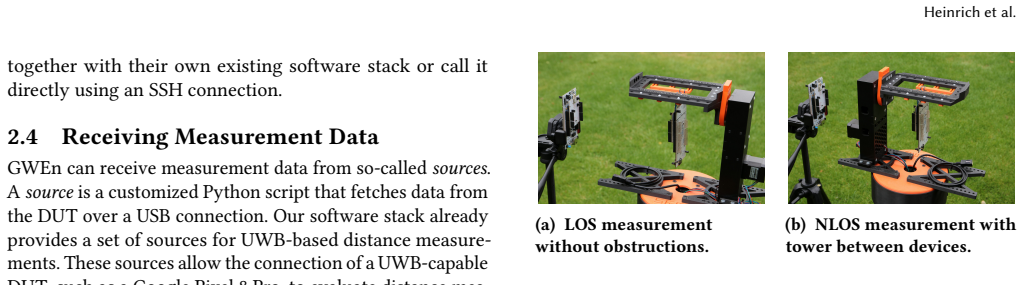
On its own terms, GWEn demonstrates that a low-cost, 3D-printed positioner can serve as a reproducible testbed for wireless physical-layer evaluation. The load-bearing quantitative evidence comes from UWB ranging: with 10,000 measurements per configuration, the mean distance in clear line of sight was 34.660 cm (standard deviation 1.345 cm), and with the hollow PLA tower interposed between the two UWB transceivers it rose to 36.344 cm (standard deviation 1.735 cm), an added error of 1.684 cm, which the authors describe as well below the ±10 cm accuracy margin of the Qorvo DW3000 device. Reproducibility is supported by three consecutive automated 360° runs whose mean distances stayed within 0.632 cm, and a fourth run one week later within 2.264 cm. From this the authors conclude that GWEn is capable of conducting reproducible measurements with minimal influence on wireless signals, and they position it as an extensible platform for UWB, mmWave, and acoustic physical layers.
Load-bearing premise
The claim that GWEn minimizes wireless interference rests on a single UWB experiment in Section 4.1 that places only the hollow tower between the two devices, while the rotation arm, holding plate, and USB cable that sit closest to the antenna are never measured for their effect.
Editorial extensions
If this is right
- Researchers can build a ~€300 open-source positioner for antenna radiation-pattern measurements without an anechoic chamber, following the released 3D files and assembly instructions.
- Automated UWB evaluations of real-world devices such as smartphones become repeatable across orientations, environments, and locations, supporting work on digital car key security.
- GWEn's extensible architecture — plugin sources, a Python web interface, and an optional linear rail — allows new DUTs and movement patterns to be added with modest effort, covering mmWave beam-pattern characterization and acoustic data-over-sound measurements.
- The stored per-angle measurement data and initial configuration ZIP file give researchers a reproducibility trail for physical-layer experiments, including recovery after power interruption.
- Because the tower-induced error (1.684 cm) is under the UWB device's ±10 cm accuracy, GWEn can be used for ranging experiments where the platform itself does not dominate the error budget.
Reading between the lines
- Beyond the paper: because the interference test only places the hollow tower between two UWB devices, the rotation arm, holding plate, and required USB cable are never measured; if they detune the antenna, radiation-pattern measurements could carry more error than the UWB distance figure suggests.
- Beyond the paper: a network-analyzer or channel-sounder measurement of the full assembly would convert the 1.684 cm distance error into the amplitude and phase distortions that actually matter for antenna pattern work.
- Beyond the paper: extending the same reproducibility protocol to mmWave and acoustic links would test whether the platform's low-interference claim holds outside UWB, where the paper's evidence currently concentrates.
Signed reviews
Editorial analysis
A structured set of objections, weighed in public.
Referee Report
Summary. This paper presents GWEn, an open-source, 3D-printed, two-axis gimbal platform for wireless physical-layer evaluation. It describes the mechanical design, the software/web workflow, a seven-step measurement procedure, and an evaluation consisting of two experiments: (i) an interference test that compares UWB time-of-flight distance measurements with and without the tower placed between two DWM3000EVB boards, and (ii) a reproducibility test that repeats a 360-degree base rotation three times in succession and once after one week. The paper reports a mean distance increase of 1.684 cm when the tower blocks the line of sight, below the manufacturer's +/-10 cm UWB accuracy, and mean-distance differences of at most 0.632 cm within a day and 2.264 cm after one week. It also sketches UWB, mmWave, and acoustic use cases and concludes that GWEn is a reproducible and proven testbed with minimal influence on wireless signals.
Significance. If the claims hold, GWEn is a valuable low-cost (~300 EUR), portable (<5 kg) open-source positioner that could lower the barrier to physical-layer measurements. The paper's strengths are its concrete open-source release, the clear measurement workflow, the large sample sizes (10,000 UWB packets per interference condition), and the honest use of external datasheet and permittivity references rather than fitted parameters. The main limitation is that the 'minimal RF interference' conclusion rests on a single UWB time-of-flight metric through the tower only; the amplitude and phase quantities that matter for radiation-pattern measurements are not evaluated, and components near the DUT (rotation arm, holding plate, USB cable) are not tested. The reproducibility evidence is based on orientation-averaged means and would benefit from per-angle agreement metrics.
major comments (4)
- [Section 4.1] The interference evaluation measures only UWB time-of-flight distance with the tower placed between two DWM3000EVB boards. This does not substantiate the Section 2.1 design requirement of 'little interference to electromagnetic signals' for the intended radiation-pattern use case, which depends on amplitude and phase, not only group delay. The reported 1.684 cm mean distance shift is about 0.45 wavelengths at 8 GHz (roughly 160 degrees of phase) and several wavelengths at the mmWave frequencies claimed in Section 5.2, so being below the +/-10 cm UWB ranging accuracy is not evidence of small phase or amplitude perturbation. Please add an S-parameter or amplitude/phase pattern measurement covering the rotation arm, holding plate, and USB cable used in the Section 3 workflow, or explicitly limit the interference claim to UWB ranging.
- [Section 4.1] The tested configuration does not cover the components closest to the DUT antenna. In the LoS/NLoS comparison, the tower is between the two devices, while the rotation arm and holding plate sit immediately next to the DUT and rotate with it, and the standard workflow (Section 3, step 2) requires a USB cable attached to the DUT. These elements are absent from the described test. A nearby cable or structure can alter the antenna's effective radiation pattern and impedance, so the measured 1.684 cm bound cannot be generalized to the full GWEn configuration. In addition, the description does not make clear whether the metal motor and ball bearings were in the direct path, so the phrase 'maximum introduced error' is not justified.
- [Section 7] The conclusion that 'GWEn represents a reproducible and proven testbed' goes beyond the evidence in Section 4. Only one device pair, one geometry, and one metric were evaluated. If additional experiments are not possible, the conclusion should be qualified to 'initial evidence' or 'for UWB ranging', and the Section 4.1 claim of identifying the maximum introduced error should be softened.
- [Section 4.2 / Table 1] The reproducibility conclusion is based on the mean distance aggregated over all orientations, while the reported standard deviations are about 11 cm, roughly 22% of the 50 cm nominal distance. The per-angle plots in Figure 5 are qualitative; no per-orientation agreement metric such as mean absolute angular error or RMS pattern difference is reported. To support the 'reproducible measurements' claim for radiation-pattern use, please provide a quantitative per-angle comparison and state whether the standard deviation in Table 1 is per-sample or per-position.
minor comments (5)
- [Section 4.1] The sentence 'the only part which could interfere with signals is the hollow tower' is contradicted by the following sentence acknowledging that metal-based motors and ball bearings can influence or block the entire signal; please reconcile these statements.
- [Section 5.2 / 5.3] Sections 5.2 and 5.3 describe potential use cases rather than measurements, but Section 7 says three distinct use cases were 'showcased' and 'applied successfully'; only UWB has experimental data (Figure 6). Please revise the wording or add pilot results.
- [Section 2.1 / Section 3] The manual adjustment of the tower and holding plate to place the DUT antenna exactly at the intersection of the two rotation axes is described, but no verification procedure or tolerance analysis is given; a short description of how to check alignment would improve reproducibility.
- [Section 4.2 / Figure 5] The measured mean distances in Table 1 are consistently below the nominal 50 cm shown as the dotted line in Figure 5, but the paper does not discuss this offset; please clarify whether it is an expected UWB bias or a setup artifact.
- [General] There are minor typographical inconsistencies, including 'GWEN' in Section 5.1 and the abstract's line break 'measuringan-tenna'; these should be corrected.
Circularity Check
No circularity: GWEn's claims rest on direct measurements, an external UWB datasheet, and external PLA permittivity data.
full rationale
The paper's load-bearing quantitative claims are empirical results, not derivations. Section 4.1 compares 10,000 UWB ranging measurements with and without the tower and benchmarks the 1.684 cm mean increase against the manufacturer's advertised accuracy of ±10 cm (Qorvo DW3000 datasheet [24]). The only parameter entering the interpretation is the external PLA relative permittivity of 2.52 from [4], which is used as a rough sanity estimate (0.6 cm per cm of solid PLA), not as a fitted value. Section 4.2 reports repeated measurements whose similarity (maximum 0.632 cm within a day, 2.264 cm after one week) is compared against the same external datasheet margin. Neither comparison defines its target in terms of its evidence: the measured distance error is not constructed from the datasheet, and the reproducibility values are not fit to the data being predicted. The sole self-citation, [14], appears in Section 5.1 only to point to separate UWB ranging results and is not used to justify GWEn's minimal-interference or reproducibility conclusions. The evaluation's limitation is a scope gap rather than circularity: the interference test covers only the tower on one UWB time-of-flight metric, leaving the arm, holding plate, and USB cable unmeasured; that gap affects how general the conclusion can be, but it does not make any step equivalent to its inputs by construction. Under the hard rules, no circular step can be exhibited, so the score is 0.
Assumptions & free parameters
assumptions (4)
- domain assumption UWB device advertised accuracy of +/-10 cm (DW3000 datasheet [24]) is a valid external benchmark for judging whether GWEn introduces meaningful error.
- domain assumption PLA relative permittivity of 2.52 measured by Boussatour et al. [4] applies to the printed parts used in GWEn.
- ad hoc to paper A USB cable connecting the DUT to GWEn does not significantly perturb the DUT's RF properties.
- ad hoc to paper Manual adjustment of the tower and holding plate places the DUT antenna exactly at the intersection of the two rotation axes.
Cite this review
Pith. "Pith review of GWEn -- An Open-Source Wireless Physical-Layer Evaluation Platform." pith.science (2026). https://pith.science/paper/EBXZDCWR
@misc{pith2026250113144,
  author       = {Pith},
  title        = {Pith review of: GWEn -- An Open-Source Wireless Physical-Layer Evaluation Platform},
  year         = {2026},
  howpublished = {\url{https://pith.science/paper/EBXZDCWR}},
  note         = {Machine review of arXiv:2501.13144}
}
read the original abstract
Wireless physical layer assessment, such as measuring antenna radiation patterns, is complex and cost-intensive. Researchers often require a stationary setup with antennas surrounding the device under test. There remains a need for more cost-effective and open-source platforms that facilitate such research, particularly in automated testing contexts. This paper introduces the Gimbal-based platform for Wireless Evaluation (GWEn), a lightweight multi-axis positioner designed to portably evaluate wireless systems in real-world scenarios with minimal RF interference. We present an evaluation workflow that utilizes GWEn and show how it supports different types of wireless devices and communication systems, including Ultra-wideband, mmWave, and acoustic communication. GWEn is open-source, combining 3D-printed components with off-the-shelf parts, thus allowing researchers globally to replicate, utilize, and adapt the system according to their specific needs.
Figures


Figures from the paper (3 more)


Reference graph
Works this paper leans on
-
[1]
IEEE Recommended Practice for Near-Field Antenna Measure- ments
2012. IEEE Recommended Practice for Near-Field Antenna Measure- ments. IEEE Std 1720-2012 (2012), 1–102. https://doi.org/10.1109/ IEEESTD.2012.6375745
-
[2]
2024. Rotary positioners. https://www.mvg-world.com/en/products/ positioning-equipment/rotary-positioners [Online; accessed 5. Feb. 2024]
work page 2024
-
[3]
Fadel M. Adib and Dina Katabi. 2013. See through walls with WiFi! Proceedings of the ACM SIGCOMM 2013 conference on SIGCOMM (2013). https://api.semanticscholar.org/CorpusID:215947532
work page 2013
-
[4]
G. Boussatour, P.-Y. Cresson, B. Genestie, N. Joly, and T. Lasri. 2018. Dielectric Characterization of Polylactic Acid Substrate in the Fre- quency Band 0.5–67 GHz. 28, 5 (2018), 374–376. https://doi.org/10. 1109/LMWC.2018.2812642
-
[5]
Diamond Engineering. 2019. Diamond Engineering - D6050 - Au- tomated Antenna Measurement System | Diamond Engineering Inc. https://www.diamondeng.net/antenna-measurement/d6050-series/
work page 2019
-
[6]
Diamond Engineering. 2019. Diamond Engineering - DC402 - Au- tomated Antenna Measurement System | Diamond Engineering Inc. https://www.diamondeng.net/antenna-measurement/dc402-series/
work page 2019
- [7]
-
[8]
ETS Lindgren Inc. [n. d.]. 2112 Multi-Axis Positioner (MAPS) - ETS- Lindgren. https://www.ets-lindgren.com/datasheet/positioners/ multi-axis-positioner-(maps)/8003/800302
Show all 32 references
-
[9]
Matthew Finger, Taylor Hansen, and Christian Hearn. 2022. Open- Source Antenna Pattern Measurement System: SDR-based Student Research and Development. In Proceedings of the GNU Radio Confer- ence, Vol. 7
2022
-
[10]
Laura Flueratoru, Silvan Wehrli, Michele Magno, Elena Simona Lohan, and Dragoş Niculescu. 2022. High-Accuracy Ranging and Localiza- tion With Ultrawideband Communications for Energy-Constrained Devices. IEEE Internet of Things Journal 9, 10 (May 2022), 7463–7480. https://doi.o...
2022
-
[11]
Joseph Timothy Foley, Vladimir Omelianov, Slawomir Koziel, and Adrian Bekasiewicz. 2017. Low-cost antenna positioning system de- signed with axiomatic design. In MATEC web of conferences, Vol. 127. EDP Sciences, 01015
2017
-
[12]
Irina Gavrilovich, Sébastien Krut, Marc Gouttefarde, François Pierrot, and Laurent Dusseau. 2014. Test bench for nanosatellite attitude determination and control system ground tests. In 4S: Small Satellites Systems and Services Symposium
2014
-
[13]
Christian W Hearn, Dustin S Birch, Daniel Newton, and Shelby L Chatlin. 2020. Open-source antenna pattern measurement system. In 2020 Antenna Measurement Techniques Association Symposium (AMTA). IEEE, 1–6
2020
-
[14]
Alexander Heinrich, Sören Krollmann, Florentin Putz, and Matthias Hollick. 2023. Smartphones with UWB: Evaluating the Accuracy and Reliability of UWB Ranging. arXiv:2303.11220 [cs.CR] https: //arxiv.org/abs/2303.11220
2023 arXiv
-
[15]
Wei Hong, Zhi Hao Jiang, Chao Yu, Debin Hou, Haiming Wang, Chong Guo, Yun Hu, Le Kuai, Yingrui Yu, Zhengbo Jiang, Zhe Chen, Jixin Chen, Zhiqiang Yu, Jianfeng Zhai, Nianzu Zhang, Ling Tian, Fan Wu, Guangqi Yang, Zhang-Cheng Hao, and Jian Yi Zhou. 2021. The Role of Millimeter-Wa...
2021
-
[16]
Meng Jin, Xinbing Wang, and Chenghu Zhou. 2023. Key Agreement on IoT Devices With Echo Profiling. IEEE/ACM Transactions on Net- working (2023), 1–14. https://doi.org/10.1109/TNET.2022.3230642
2023
-
[17]
Hermann Leinweber, Jonatan Crystall, Frank Hessel, Florentin Putz, and Matthias Hollick. 2023. Introducing FreeSpeaker – A Modular Smart Home Hub Prototyping Platform . Association for Computing Machinery, New York, NY, USA. https://doi.org/10.1145/3570361. 3614080
2023 doi
-
[18]
Patrick Leu, Giovanni Camurati, Alexander Heinrich, Marc Roeschlin, Claudio Anliker, Matthias Hollick, Srdjan Capkun, and Jiska Classen
-
[19]
Marko Malajner, Peter Planinšič, and Dušan Gleich. 2015. UWB Rang- ing Accuracy. In 2015 International Conference on Systems, Signals and Image Processing (IWSSIP) . 61–64. https://doi.org/10.1109/IWSSIP. 2015.7314177
2015
-
[20]
OpenBuilds. 2022. C-Beam Gantry Plate. https://openbuildspartstore. com/c-beam-gantry-plate [Online; accessed 5. Feb. 2024]
2022
-
[21]
Vittorio Picco and Keith Martin. 2011. An automated antenna measure- ment system utilizing Wi-Fi hardware. IEEE Antennas and Propagation Magazine 53, 6 (2011), 173–184
2011
-
[22]
Josh Planton. 2022. Car Connectivity Consortium Publishes Digi- tal Key Release 3.0. https://carconnectivity.org/press-release/car- connectivity-consortium-publishes-digital-key-release-3-0/
2022
-
[23]
Florentin Putz, Flor Álvarez, and Jiska Classen. 2020. Acoustic Integrity Codes: Secure Device Pairing Using Short-Range Acous- tic Communication. In Proceedings of the 13th Conference on Secu- rity and Privacy in Wireless and Mobile Networks (WiSec ’20) . ACM. https://doi.org...
2020
-
[24]
Qorvo Inc. 2020. DW3000 Data Sheet V1.3. https://www.qorvo.com/ products/d/da008142
2020
-
[25]
A Rehman, T Rasul, MF Shafique, B Ijaz, KS Alimgeer, M Saeed Khan, Raed M Shubair, and N Khaddaj Mallat. 2016. Development of a cost effective antenna radiation pattern measurement setup. In 2016 16th Mediterranean Microwave Symposium (MMS) . IEEE, 1–4
2016
-
[26]
Markus Scheck, Florentin Putz, Frank Hessel, Hermann Leinweber, Jonatan Crystall, and Matthias Hollick. 2023. DEMO: Secure Boot- strapping of Smart Speakers Using Acoustic Communication. (2023). https://doi.org/10.26083/tuprints-00024180 Demo presented at the 16th ACM Conferen...
2023 doi
-
[27]
Prakash Shrestha, Ahmed Tanvir Mahdad, and Nitesh Saxena. 2023. Sound-Based Two-Factor Authentication: Vulnerabilities and Re- design. ACM Transactions on Privacy and Security (Nov. 2023). https: //doi.org/10.1145/3632175
2023 doi
-
[28]
Mahmoud Wagih and Thomas Moody. 2021. Open-Source Low-Cost Antenna Measurement Setup for Rapid Echoic Measurements. In 2021 IEEE Conference on Antenna Measurements & Applications (CAMA) . IEEE, 98–101
2021
-
[29]
Almos Zarandy, Ilia Shumailov, and Ross Anderson. 2020. BatNet: Data Transmission between Smartphones over Ultrasound. arXiv preprint arXiv:2008.00136 (2020)
2020 arXiv
-
[30]
Zhang, J
X. Zhang, J. Liu, S. Chen, Y. Kong, and K. Ren. 2019. PriWhisper+: An Enhanced Acoustic Short-Range Communication System for Smart- phones. IEEE Internet of Things Journal 6, 1 (Feb. 2019), 614–627–614–
2019
-
[627]
https://doi.org/10.1109/jiot.2018.2850524
2018
-
[2022]
In 31st USENIX Security Symposium (USENIX Security 22)
Ghost Peak: Practical Distance Reduction Attacks against HRP UWB Ranging. In 31st USENIX Security Symposium (USENIX Security 22). USENIX Association, Boston, MA, 1343–1359. https: //www.usenix.org/conference/usenixsecurity22/presentation/leu
Reviewed August 10, 2026 · model on record in the stance chip above.
Discussion (0). Continue with ORCID to comment.