REVIEW 4 major objections 5 minor 50 references
Voter model can accurately predict individual opinions in online populations
T0 review · 4 major / 5 minor · reviewed 2026-08-10 · deepseek-v4-flash
Pith's one-line read The paper claims that a multi-state voter model with zealots, applied to a retweet network around the 2017 French election, predicts individual party affiliation for 92.5% of users from equilibrium opinion distributions alone.
desk verdict Clean user-level test of the voter model, but the 92.5% accuracy claim is vulnerable to label leakage from retweet-based annotation and lacks basic baselines. read the letter →
The pith
A machine-rendered reading of the paper's core claim, the machinery that carries it, and where it could break.
The reading
What carries the argument
The central object is the individual equilibrium opinion distribution $x_i = (x_i^s)_{s \in S}$ of the multi-state voter model with zealots on a directed weighted network, defined by the linear system $$x_i^s = \sum_{j \in \mathcal{N}} w_{ij} x_j^s + z_i^s,$$ where $w_{ij}$ is the fraction of user $i$'s retweets originating from $j$ and $z_i^s$ is the aggregated weight of retweets from party-account zealots of opinion $s$. The companion object is the discord probability $\rho_{ij}$, the equilibrium probability that users $i$ and $j$ hold different opinions. Together these quantities turn the parameter-free voter model into a user-level opinion score and a pairwise agreement score, computed without using the users' stated labels.
What would settle it
Rewire the non-zealot retweet edges while preserving each user's total retweet weight and all zealot weights, recompute $x_i$, and compare argmax accuracy: if it stays near 92.5%, the prediction is carried by direct attachment to party accounts and the multi-step voter mechanism is not load-bearing; if it drops sharply, the user-to-user propagation is essential.
Extended reading notes
Core claim
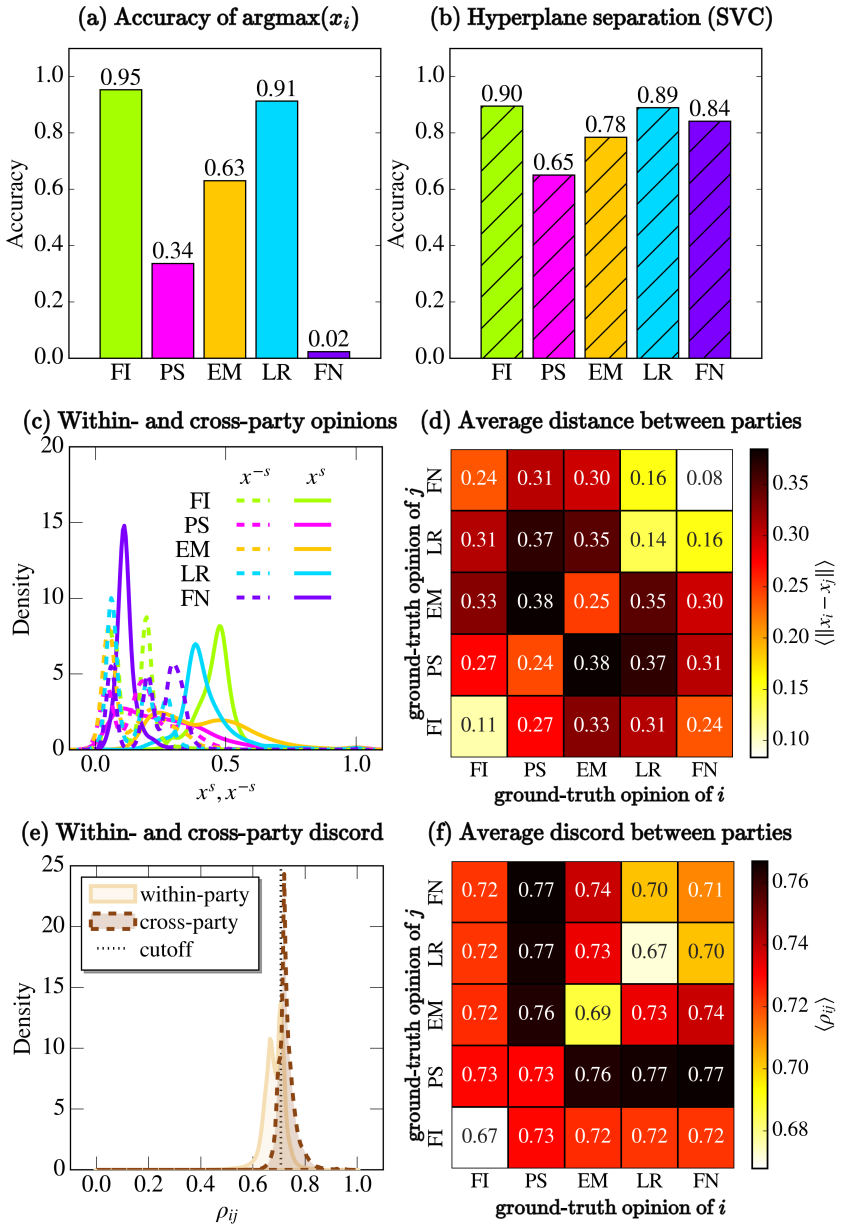
On a directed, weighted retweet network built from six months of Twitter activity around the 2017 French presidential election, the paper solves the multi-state voter model's equilibrium equations and compares each user's equilibrium opinion distribution $x_i$ with the annotated party affiliation $y_i$. The most likely opinion under the model matches the annotated party for 92.5% of the 15,607 non-zealot users considered, with per-party accuracy ranging from 81% (PS) to 95% (FN). Within-party values of $x_i^s$ are concentrated near 1 and cross-party values near 0, supporters of the same party cluster in the opinion space spanned by the $x_i$ vectors, and discord probabilities $\rho_{ij}$ let a logistic classifier distinguish same-party from cross-party pairs with about 93% accuracy. The model achieves this without parameter fitting and without using the users' own labels; the only fixed inputs are retweet weights and the party affiliations of political-entity accounts.
Load-bearing premise
The load-bearing premise is that the fraction of retweets directed from $j$ to $i$ measures how much $j$'s opinion influences $i$, and that political-entity accounts can be treated as immutable zealots with known opinions.
Editorial extensions
If this is right
- The equilibrium vector $x_i$ provides a party-affiliation score for every user, including the 27% who have no direct retweet connection to a political-entity account.
- Discord probabilities $\rho_{ij}$ give a usable pairwise agreement measure: a logistic classifier on $\rho_{ij}$ identifies same-party pairs with about 93% accuracy, and cross-party pairs are easier to identify than same-party pairs.
- Directed, weighted retweet interactions are the appropriate network substrate; unweighted or undirected versions and follow or mention networks all give lower accuracy.
- The parameter-free nature of the method means it can be applied directly to any interaction network with identifiable zealot nodes and edge weights.
- The results extend the empirical validation of the voter model from aggregate opinion distributions to individual-level prediction in a heterogeneous online population.
Reading between the lines
- If retweets mostly signal endorsement rather than causal influence, the high accuracy shows that retweet networks are strongly sorted by party, and Eq. (1) acts as a semi-supervised label-propagation rule; the paper does not fully separate these readings.
- The direct-zealot baseline $z_i$ nearly matches the full model's accuracy (95.1% versus 96.2% on the subset with direct zealot links), suggesting that most of the signal travels through one-step links to party accounts; a rewiring null model could quantify the added value of the multi-step mechanism.
- The same pipeline could be extended to non-political stances or to datasets with temporally varying stated opinions, where treating some accounts as immutable zealots is less straightforward.
- The discord-probability result could be used as a structure-only method to detect like-minded communities without declared labels.
Signed reviews
Editorial analysis
A structured set of objections, weighed in public.
Referee Report
Summary. The paper tests the multi-state voter model with zealots at the individual-user level. Using a retweet network from the #Elysée2017fr dataset, it defines political-entity accounts as zealots with fixed party opinions and computes each user's equilibrium opinion distribution x_i by solving Eq. (1). The most likely opinion argmax(x_i) is then compared with the ground-truth party label y_i, yielding 92.5% agreement; discord probabilities ρ_ij are used to classify same-party vs. cross-party pairs with about 93% accuracy. Robustness checks compare against direct zealot connections z_i, other interaction networks (follow, mention), and unweighted/undirected variants of the retweet network. The paper argues that the parameter-free equilibrium computation provides an external, user-level validation of the voter model.
Significance. If the empirical claim holds, this is a valuable user-level test of an opinion dynamics model, demonstrating that a parameter-free equilibrium computation contains individual-level information, not just aggregate statistics. Strengths: no fitted parameters enter Eq. (1); ground-truth labels are not inputs to the equilibrium computation; the comparison across network definitions is informative; and the theoretical foundation is a published derivation. However, the evaluation currently lacks baselines, out-of-sample classifier evaluation, and protection against label leakage, so the magnitude of the claimed accuracy cannot yet be taken at face value.
major comments (4)
- [Section III.A and Section III.B] The accuracy figures 92.5% (argmax), 93% (SVC), and 93% (logistic regression on ρ_ij) are never compared against a trivial baseline. With five parties, random guessing gives about 20%, but the paper itself notes that some parties have more supporters than others, so the majority-class baseline may be substantially higher. The comparison to z_i in Section IV.A is restricted to the 73% of users with direct zealot connections and does not substitute for a full-population baseline. Please report, on the full evaluation set, at least the majority-class accuracy and a label-shuffled null accuracy, together with the class proportions; this is necessary to interpret 92.5% as evidence for the model.
- [Section III.A, Section III.B, Supplemental Material I] The SVC and logistic regression accuracies are computed on the same data used to fit the classifiers ("fitting a basic SVC to the (x_i, y_i) pairs", with sklearn default parameters). No train/test split or cross-validation is reported, so these numbers are in-sample and can overstate separation, especially with the default RBF kernel on about 15,000 users. Please report cross-validated or held-out accuracies for both classifiers. If the goal is prediction, the out-of-sample numbers are the relevant ones; if the goal is separation, say so and use a separation measure that does not involve fitting.
- [Section II (label annotation) and Section IV.A] The ground-truth labels were assigned by the dataset creators "on the basis of the content of their tweets and profile description." Since the retweet network and z_i^s are constructed from retweets, and retweets are part of tweet content, the annotation protocol may have used the same signal that the model reads. The statement that "the ground-truth opinion y_i of i does not bear involvement in the computation of x_i^s" addresses algorithmic circularity but not label leakage. The robustness result in Section IV.A, where z_i alone reaches 95.1% accuracy on the 73% of users with direct zealot connections, is also consistent with annotators having used retweeted party accounts to assign labels. Please clarify the annotation protocol (for example, whether annotators saw retweet content or only profile descriptions) or validate on labels obtained independently of retweet content; without this, the 92.5% accuracy may partly reflect the annotators' use of the retweet signal rather than the voter model's dynamics.
- [Supplemental Material I] The definition of argmax accuracy counts a user as correct if the ground-truth party is among the coordinates attaining the maximum of x_i. This tie-breaking rule can inflate the reported accuracy. Please report the fraction of users with multiple argmax coordinates and recompute the headline 92.5% under a deterministic rule (for example, random tie-break averaged over seeds, or lowest-index tie-break). The same issue applies to the z_i baseline comparisons in Section IV.A. Without this, the 92.5% figure is not uniquely defined.
minor comments (5)
- [Title and Abstract] The word "predict" is used although the evaluation is retrospective classification of already observed party affiliations; consider using "identify" or "retrieve" consistently to avoid overclaiming temporal prediction.
- [Section III.A] The text says the SVC finds "the best separating hyperplane," but sklearn's default SVC uses an RBF kernel, which does not correspond to a hyperplane in the original five-dimensional space; please specify the kernel and, if a hyperplane is intended, use a linear SVC.
- [Section III.B] It is not stated explicitly whether the reported ρ_ij values are computed with the exact formula Eq. (5) or the approximation Eq. (6); the supplemental material compares the two, but the main text should state which one is used for the logistic regression results.
- [Throughout] Accuracy figures are reported without confidence intervals or significance tests; given the large sample sizes, even small differences may be statistically significant, so binomial confidence intervals or a paired test would help assess the network comparisons in Table I.
- [Section III.A and Discussion] There are minor typographical issues, including "embedds" in Section III.A and "muti-state" in the Discussion; the title also begins with "V oter model" with an apparent spacing artifact.
Circularity Check
No significant circularity: the model is parameter-free and the non-zealot ground-truth labels are not used in the equilibrium computation; the cited theoretical basis is an independent published derivation.
full rationale
The paper's central claim is that the multi-state voter model with zealots, applied to a retweet network, yields equilibrium opinion distributions whose argmax matches external party labels for 92.5% of non-zealot users. The computation in Eq. (1), x_i^s = sum_j w_ij x_j^s + z_i^s, is a linear system whose only label inputs are the fixed opinions of political-entity zealots; the paper explicitly states that 'the ground-truth opinion y_i of i does not bear involvement in the computation of x_i^s' (Section II). Thus the main target labels are not fitted or used to construct the predictions, so the headline accuracy is not a fitted-input circularity. The theoretical foundation, Eq. (1) and the discord formulas Eqs. (5)-(6), is imported from ref. [11], which shares the first author; however, that is a published, parameter-free derivation under stated voter-model assumptions and does not include the present dataset or fitted values, so it constitutes independent support rather than a circular self-justification. The robustness analysis (Section IV.A) candidly compares the full model against the direct-zealot baseline z_i, showing that the user-to-user mechanism adds a small but real improvement over an already strong direct-retweet signal; this is an honest ablation, not a circular step. A data-provenance caveat remains: accounts were manually labelled 'on the basis of the content of their tweets and profile description,' and retweets are tweets, so if annotators used retweeted political content to assign labels, the ground truth and the network weights could share a common signal. That is a potential label-leakage issue, but it is not an equation-level reduction in the paper and would require external evidence about the annotation protocol to establish; under the requested standard of exhibited reductions, it does not count as formal circularity. Overall, the derivation chain is self-contained against external benchmarks, and no load-bearing step reduces to its own inputs.
Assumptions & free parameters
assumptions (5)
- domain assumption The multi-state voter model with zealots describes opinion evolution on the network, so that Eq. 1 gives the equilibrium probability distribution x_i for each user i.
- domain assumption Political entity accounts are zealots with fixed, known party opinions; these labels are used as reference points and are not free parameters.
- domain assumption Every included user is reachable from at least one zealot, guaranteeing existence and uniqueness of the equilibrium (Yildiz et al., Thm 2.1); unreachable users are removed from analysis.
- domain assumption Manual ground-truth labels are accurate enough for evaluation; creators report 89% annotator agreement.
- standard math For discord probabilities, the independence conditions for Eq. 6 either hold or the approximation error is negligible.
Cite this review
Pith. "Pith review of Voter model can accurately predict individual opinions in online populations." pith.science (2026). https://pith.science/paper/W7O3ETRM
@misc{pith2026250113215,
  author       = {Pith},
  title        = {Pith review of: Voter model can accurately predict individual opinions in online populations},
  year         = {2026},
  howpublished = {\url{https://pith.science/paper/W7O3ETRM}},
  note         = {Machine review of arXiv:2501.13215}
}
read the original abstract
Models of opinion dynamics describe how opinions are shaped in various environments. While these models are able to replicate general opinion distributions observed in real-world scenarios, their capacity to align with data at the user level remains mostly untested. We evaluate the capacity of the multi-state voter model with zealots to capture individual opinions in a fine-grained Twitter dataset collected during the 2017 French Presidential elections. Our findings reveal a strong correspondence between individual opinion distributions in the equilibrium state of the model and ground-truth political leanings of the users. Additionally, we demonstrate that discord probabilities accurately identify pairs of like-minded users. These results emphasize the validity of the voter model in complex settings, and advocate for further empirical evaluations of opinion dynamics models at the user level.
Figures


Figures from the paper (9 more)


Reference graph
Works this paper leans on
-
[1]
Crucially, the ground-truth opinion yi of i does not bear involvement in the computation of xs i
In other words, the value of xs i can be interpreted as the likeliness attributed by the model to the possibility that i supports party s. Crucially, the ground-truth opinion yi of i does not bear involvement in the computation of xs i . This justifies our analysis, where we compare xi and yi in several fashions to assess the validity of the model. 3 III. ...
-
[2]
A. F. Peralta, P . Ramaciotti, J. Kert ´esz, and G. I ˜niguez, Phys. Rev. Res. 6, 013170 (2024)
work page 2024
-
[3]
J. Ojer, M. Starnini, and R. Pastor-Satorras, Phys. Rev. Lett. 130, 207401 (2023)
work page 2023
-
[4]
T. M. Pham, J. Korbel, R. Hanel, and S. Thurner, Proceedings of the National Academy of Sciences 119, e2121103119 (2022)
work page 2022
-
[5]
F. Baumann, P . Lorenz-Spreen, I. M. Sokolov, and M. Starnini, Phys. Rev. X 11, 011012 (2021)
work page 2021
-
[6]
A. F. Peralta, M. Neri, J. Kert ´esz, and G. I ˜niguez, Phys. Rev. E 104, 044312 (2021)
work page 2021
-
[7]
R. Axelrod, J. J. Daymude, and S. Forrest, Proc Natl Acad Sci USA 118, e2102139118 (2021)
work page 2021
-
[8]
M. W. Macy, M. Ma, D. R. Tabin, J. Gao, and B. K. Szymanski, Proc Natl Acad Sci USA 118, e2102144118 (2021)
work page 2021
Show all 50 references
-
[9]
V endeville and F
A. V endeville and F. Diaz-Diaz, Echo chamber effects in signed networks (2024), 2406.17435 [physics]
2024 arXiv
-
[10]
V endeville, A
A. V endeville, A. Giovanidis, E. Papanastasiou, and B. Guedj, in Complex Networks and Their Applications XI , V ol. 1077, edited by H. Cherifi, R. N. Mantegna, L. M. Rocha, C. Cher- ifi, and S. Miccich `e (Springer International Publishing, Cham,
-
[11]
Y . Li, W. Chen, Y . Wang, and Z.-L. Zhang, Internet Mathemat- ics 11, 93 (2015)
2015
-
[14]
Mobilia, A
M. Mobilia, A. Petersen, and S. Redner, J. Stat. Mech. 2007, P08029 (2007)
2007
-
[15]
Iannelli, G
G. Iannelli, G. De Marzo, and C. Castellano, Chaos: An Inter- disciplinary Journal of Nonlinear Science 32, 043103 (2022)
2022
-
[16]
Ramaciotti Morales and J.-P
P . Ramaciotti Morales and J.-P . Cointet, in RecSys ’21: 15th ACM Conference on Recommender Systems (Amsterdam, Netherlands, 2021)
2021
-
[17]
P . S. Vishnuprasad, G. Nogara, F. Cardoso, S. Cresci, S. Gior- dano, and L. Luceri, ICWSM 18, 1557 (2024)
2024
-
[18]
Lorenz-Spreen, L
P . Lorenz-Spreen, L. Oswald, S. Lewandowsky, and R. Hertwig, Nat Hum Behav 7, 74 (2023)
2023
-
[19]
Kubin and C
E. Kubin and C. V on Sikorski, Annals of the International Com- munication Association 45, 188 (2021)
2021
-
[20]
P ´erez-Mart´ınez, F
H. P ´erez-Mart´ınez, F. Bauz ´a Mingueza, D. Soriano-Pa ˜nos, J. G ´omez-Garde˜nes, and L. Flor ´ıa, Chaos, Solitons & Fractals 175, 113917 (2023)
2023
-
[21]
Baumann, P
F. Baumann, P . Lorenz-Spreen, I. M. Sokolov, and M. Starnini, Phys. Rev. Lett. 124, 048301 (2020)
2020
-
[22]
Sikder, R
O. Sikder, R. E. Smith, P . Vivo, and G. Livan, Sci Rep 10, 5493 (2020)
2020
-
[23]
Gs ¨anger, V
M. Gs ¨anger, V . H¨osel, C. Mohamad-Klotzbach, and J. M ¨uller, Entropy 26, 212 (2024)
2024
-
[24]
P . G. Meyer and R. Metzler, New J. Phys. 10.1088/1367- 2630/ad27bc (2024)
2024 doi
-
[25]
V endeville, B
A. V endeville, B. Guedj, and S. Zhou, Applied Network Sci- ence 6, 1 (2021)
2021
-
[26]
S. Mori, M. Hisakado, and K. Nakayama, Phys. Rev. E 99, 052307 (2019)
2019
-
[27]
Fern ´andez-Gracia, K
J. Fern ´andez-Gracia, K. Suchecki, J. J. Ramasco, M. San Miguel, and V . M. Egu ´ıluz, Phys. Rev. Lett. 112, 158701 (2014)
2014
-
[28]
J. Liu, S. Huang, N. M. Aden, N. F. Johnson, and C. Song, Phys. Rev. Lett. 130, 037401 (2023)
2023
-
[29]
C. M. V alensise, M. Cinelli, and W. Quattrociocchi, Informa- tion Sciences 642, 119152 (2023)
2023
-
[30]
Sasahara, W
K. Sasahara, W. Chen, H. Peng, G. L. Ciampaglia, A. Flam- mini, and F. Menczer, J. Comput. Soc. Sc.10.1007/s42001-020- 00084-7 (2020)
2020 doi
-
[31]
Braha and M
D. Braha and M. A. M. de Aguiar, PLOS ONE 12, 1 (2017)
2017
-
[32]
A. F. Peralta, J. Kert ´esz, and G. I ˜niguez, Opinion dy- namics in social networks: From models to data (2022), arXiv:2201.01322 [physics.soc-ph]
2022 arXiv
-
[33]
Sobkowicz, Frontiers in Physics 8, 10.3389/fphy.2020.587009 (2020)
P . Sobkowicz, Frontiers in Physics 8, 10.3389/fphy.2020.587009 (2020)
2020
-
[34]
Rosanvallon,The Populist Century: History, Theory, Critique (Wiley, Hoboken, NJ, 2021)
P . Rosanvallon,The Populist Century: History, Theory, Critique (Wiley, Hoboken, NJ, 2021)
2021
-
[35]
Roozenbeek and F
J. Roozenbeek and F. Zollo, Nature 612, 404 (2022)
2022
-
[36]
Pansanella, A
V . Pansanella, A. Sˆırbu, J. Kertesz, and G. Rossetti, Sci Rep 13, 14600 (2023)
2023
-
[37]
Fraisier, G
O. Fraisier, G. Cabanac, Y . Pitarch, R. Besanc ¸on, and M. Boughanem, 10.5281/zenodo.5535333 (2018)
2018 doi
-
[38]
Ramirez, M
L. Ramirez, M. San Miguel, and T. Galla, Phys. Rev. E 106, 054307 (2022)
2022
-
[39]
Papanastasiou and A
E. Papanastasiou and A. Giovanidis, J Soc. Netw. Anal. Min. 2301.10646 (2023)
2023 arXiv
-
[40]
Fraisier, G
O. Fraisier, G. Cabanac, Y . Pitarch, R. Besanc ¸on, and M. Boughanem, in Proceedings of the 12th International AAAI Conference on Web and Social Media (2018)
2018
-
[41]
V azquez and V
F. V azquez and V . M. Egu´ıluz, New J. Phys. 10, 063011 (2008)
2008
-
[42]
V . R. K. Garimella and I. Weber, in Proceedings of the 11th International Conference on Web and Social Media (ICWSM
-
[43]
M. D. Conover, J. Ratkiewicz, M. Francisco, B. Goncalves, F. Menczer, and A. Flammini, in ICWSM (2011)
2011
-
[44]
Halberstam and B
Y . Halberstam and B. Knight, J Public Econ 143, 73 (2016)
2016
-
[45]
H. T. Williams, J. R. McMurray, T. Kurz, and F. Hugo Lambert, Glob Environ Change 32, 126 (2015)
2015
-
[46]
Tacchi, C
J. Tacchi, C. Boldrini, A. Passarella, and M. Conti, in Proceed- ings of the 2022 IEEE International Conference on Big Data (2022) pp. 6030–6038
2022
-
[47]
L. S. Ramirez, F. V azquez, M. San Miguel, and T. Galla, Phys. Rev. E 109, 034307 (2024) . V oter model can accurately predict individual opinions in online populations: Supplemental Material Antoine V endeville∗ m´edialab, Sciences Po, 75007 Paris, France Complex Systems Inst...
2024
-
[48]
Llabr ´es, M
J. Llabr ´es, M. San Miguel, and R. Toral, Phys. Rev. E 108, 054106 (2023)
2023
-
[50]
within” and “cross
This corresponds to a weighted out-degree centrality, shedding light on the importance of zealots within the networks. Again we do not see major differences between networks, except that zealots exhibit lower directed influences in the Mention network. Interestingly however, co...
-
[51]
V endeville, S
A. V endeville, S. Zhou, and B. Guedj, Phys. Rev. E 109, 024312 (2024)
2024
-
[52]
M. E. Yildiz, A. Ozdaglar, D. Acemoglu, A. Saberi, and A. Scaglione, Trans. Econ. Comput. 1, 10.1145/2538508 (2013). 6 Retweet network Unweighted rt network Undirected rt network UU network Follow network Mention network FIG. 5: Comparison between ρij values computed using the...
2013 doi
-
[2017]
(AAAI Press, 2017) pp. 528–531
2017
Reviewed August 10, 2026 · model on record in the stance chip above.
Discussion (0). Continue with ORCID to comment.