REVIEW 3 major objections 5 minor 164 references
Simulations of the accreted stellar halos of low-mass field galaxies
T0 review · 3 major / 5 minor · reviewed 2026-08-10 · deepseek-v4-flash
Pith's one-line read Low-mass field galaxies are predicted to have faint, compact accreted stellar halos that overtake the in-situ stars only around 15 kiloparsecs, at surface densities of $10^{3.5}$ to $10^6$ solar masses per square kiloparsec.
desk verdict Solid extension of particle tagging to low-mass halos; testable predictions, but the transition-radius headline rides on a spherical-in-situ assumption the paper itself flags. read the letter →
The pith
A machine-rendered reading of the paper's core claim, the machinery that carries it, and where it could break.
The reading
What carries the argument
The central mechanism is the STINGS particle-tagging method, in which every single-age stellar population formed by the semi-analytic model receives its own set of $N$-body particles drawn from the most-bound fraction $f_{\rm mb}=3$ per cent of its host dark-matter halo, ranked by binding energy and given equal stellar weight. Because tagged particles diffuse in phase space over time, each population relaxes into a near-exponential surface-density profile whose scale is set by the mass and concentration of the halo at formation, with no baryonic back-reaction on the potential. This one-parameter construction converts the GALFORM merger trees in the COCO simulation into roughly 6400 resolved central galaxies above $10^{10}$-solar-mass halos, and tags every star with its formation time and its branch of the merger tree, so in-situ and accreted stars are separated cleanly. The value of $f_{\rm mb}$ is calibrated against the observed size-mass relation of low-mass galaxies, and the paper shows the average profile of the accreted component is insensitive to its value.
What would settle it
Image a few dozen isolated M33-like field galaxies at surface brightnesses near 30 magnitudes per square arcsecond (roughly $10^3$ solar masses per square kiloparsec). If the radius at which an extended, accreted component overtakes the in-situ body is systematically outside 10 to 25 kiloparsecs, or the crossover surface density lies outside the predicted range $10^{3.5}$ to $10^6$ solar masses per square kiloparsec at matched virial mass, the tagging prescription fails at this mass scale. An independent check is the 'failed Milky Way' population: deep surveys of field galaxies around $10^{12}$-solar-mass halos should uncover an excess of M33-stellar-mass galaxies with anomalously bright accreted halos, and not finding that excess would falsify the model's star-formation efficiency at this halo mass.
Extended reading notes
Core claim
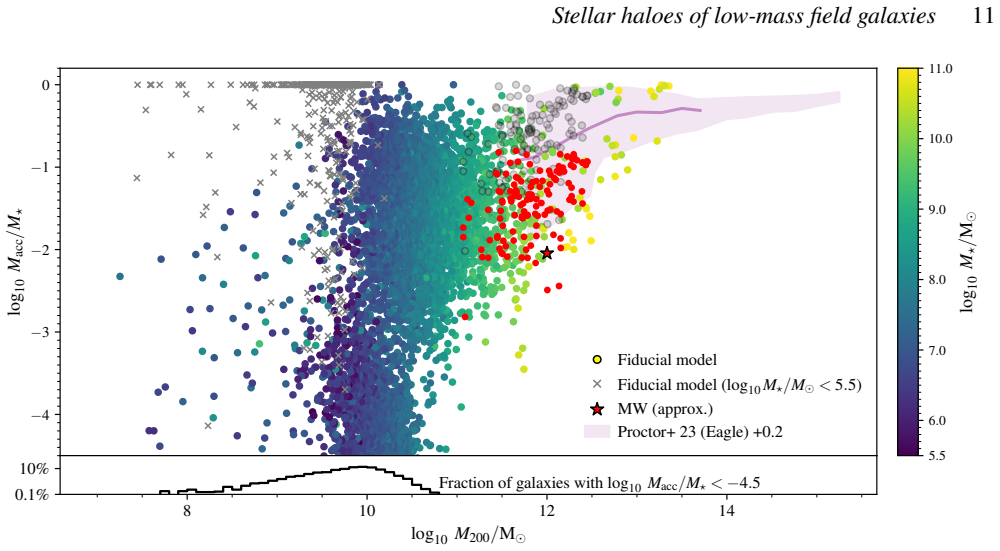
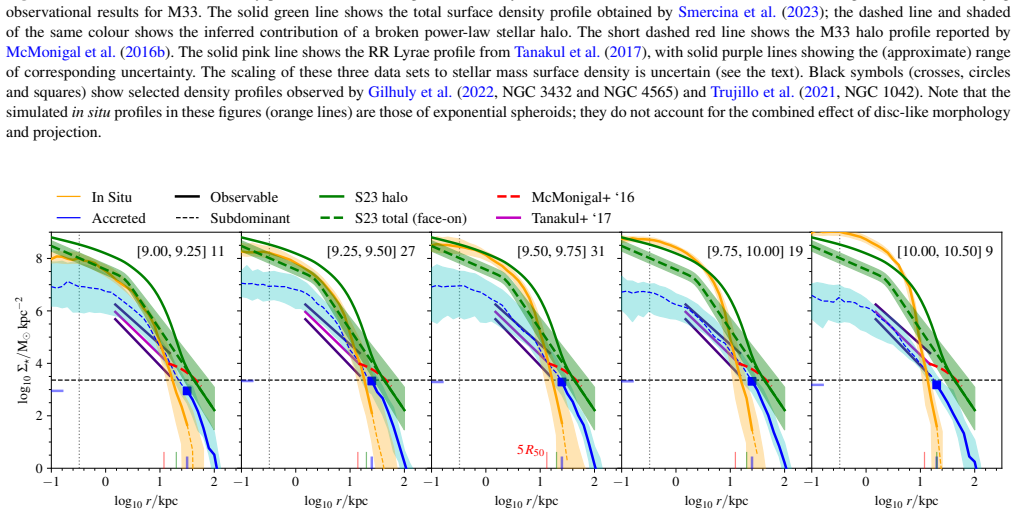
The paper claims that at fixed stellar mass the stellar halos of low-mass field galaxies are far more diverse than at fixed virial mass, and that the properties of the accreted component are governed by the virial mass of the host. Its headline result is at M33-like stellar masses: the surface density of accreted stars exceeds that of the in-situ component at roughly 15 kiloparsecs, at a level $3.5 \lesssim \log_{10} M_\star/{\rm M}_\odot\,{\rm kpc}^{-2} \lesssim 6$ that varies systematically with virial mass. Around this scale the paper further claims that the scale lengths of accreted halos are smaller than those of the in-situ disk yet the accreted component remains diffuse rather than bulge-like; that in halos below about $10^{11}$ solar masses the accreted density is lower than the in-situ density at every radius accessible to integrated-light observations; and that below roughly $10^8$ solar masses of stars the fraction of galaxies with no significant accreted component rises toward half of the population. It also advances a population statement: a small but significant subset of $\sim 10^{12}$-solar-mass halos hosts 'failed Milky Ways', galaxies with M33-like stellar mass and exceptionally inefficient star formation whose comparatively bright accreted halos make their abundance measurable by low-surface-brightness surveys.
Load-bearing premise
The load-bearing assumption is that each new generation of stars simply copies the orbits of the most-bound 3 per cent of its halo's dark-matter particles at birth, with no extra gravity from the galaxy itself, so the in-situ component comes out spherical rather than disk-like and satellite disruption is driven by dark matter alone.
Editorial extensions
If this is right
- Ultra-deep surveys of M33-mass field galaxies should find the accreted component overtaking the in-situ component near 15 kiloparsecs, with the crossover surface density tied systematically to virial mass.
- Below virial masses of about $10^{11}$ solar masses the accreted halo should be effectively undetectable in integrated light at every radius accessible to current surveys.
- Classical bulges built by accretion should be rare below Milky Way mass, so observed spheroids in dwarf galaxies should trace in-situ formation (pseudo-bulges) rather than merger-built components.
- Near $10^9$ solar masses of stars, halos assembled from several comparable progenitors become rare, and below $10^8$ solar masses the fraction of galaxies with no significant accreted component rises to roughly half at $10^7$ solar masses.
- The average metallicity measured at about 30 kiloparsecs should recover the mass of the most massive accreted progenitor to within roughly a factor of ten, with scatter growing toward lower galaxy mass.
Reading between the lines
- A scale-free version of the paper's central test is implied by its own figures: the radius where accreted stars overtake the in-situ body, divided by the in-situ half-mass radius, varies strongly across the simulated population, so measuring that ratio — which needs no virial masses — would discriminate this model from prescriptions that tie the halo transition to the disk scale length.
- The model's neglect of baryonic gravity cuts asymmetrically at this mass scale: the claim that accreted halos are invisible at observable radii in the lowest-mass halos is the fragile half (a disk potential would shred satellites more aggressively than the collisionless treatment), whereas the M33-scale crossover numbers are the robust half, because they are set by dark-matter assembly that the ta
- The 'failed Milky Way' population converts a galaxy-formation question into a counting experiment: with a few hundred ultra-deep fields of M33-like dwarfs, the measured space density of galaxies with anomalously bright accreted halos would either confirm or rule out the star-formation efficiency at fixed halo mass assumed by the semi-analytic model used here.
- Passing the released star-particle data through a mock-image pipeline that applies a real survey's surface-brightness limits, pixel scale, and sky noise would upgrade the paper's qualitative 'observable halo' statements into countable detection fractions — a direct route from these predictions to a survey strategy.
Editorial analysis
A structured set of objections, weighed in public.
Referee Report
Summary. This paper uses the GALFORM semi-analytic galaxy formation model applied to the COCO zoom N-body simulation, together with the STINGS particle-tagging technique, to predict the properties of accreted stellar halos in field galaxies with present-day virial masses between 10^8 and 10^12 solar masses. After calibrating the single free tagging parameter f_mb = 3 per cent against the observed size-mass relation, the authors compare their model to the SMHM relation, TNG, Auriga, and observational data for M33 and other low-mass galaxies. The main quantitative claims are that accreted mass fractions are typically below 10 per cent in the least massive star-forming halos, that the radial scale lengths of accreted halos are comparable to or smaller than the in situ components at low masses, and that at the M33 stellar-mass scale the accreted surface density exceeds the in situ surface density at about 15 kpc, with surface densities in the range 3.5 < log10(M_star/Msun kpc^-2) < 6. The paper also highlights a population of 'failed Milky Ways' and makes a subset of the stellar particle data publicly available.
Significance. If the quantitative predictions hold, this paper provides a useful and testable extension of stellar-halo modelling to the dwarf-galaxy regime, a range that has been comparatively little explored with self-consistent cosmological methods. The headline prediction of a transition radius around 15 kpc and the associated surface-density range is falsifiable with current and upcoming ultra-low-surface-brightness surveys, and the comparison with M33 data is a genuinely useful synthesis. The paper's strengths include its explicit validation against the SMHM relation, size-mass relation, Auriga, TNG, and Dragonfly data; its transparent discussion of resolution limits and model dependence; and the public release of stellar particle data. The principal weakness is that the quantitative transition-radius prediction rests on a single value of f_mb calibrated to sizes and on a spherical exponential in-situ component that is acknowledged to be an oversimplification; the sensitivity of the quoted numbers to these assumptions is not quantified.
major comments (3)
- [Sections 2.3.3, 5.1.1, 5.1.2; conclusion (v)] The headline prediction of a transition radius near 15 kpc and the quoted surface-density range is computed using in-situ profiles that are spherical exponentials by construction (Section 2.3.3), and the paper itself acknowledges in Section 5.1.2 that this is too simplistic to draw firm conclusions about central accretion structure. The transition radius in Fig. 7 is defined as the radius where the projected accreted density exceeds the projected in-situ density, so replacing the spherical exponential with a realistic thin exponential disc changes the projected in-situ density at 15 kpc by a factor of order 2-3 for plausible scale lengths, and therefore shifts the crossover radius and the surface density at crossover. The paper does not quantify this sensitivity for the M33-analogue sample. Because the abstract and conclusion quote these numbers as precise predictions for observers, this sensitivity should be quantified, for example by applying a simple disc-projection correction or by varying f_mb, before the headline numbers can be taken at face value.
- [Section 3.2; Appendix C; conclusions (i)-(iv)] The single free parameter f_mb = 3 per cent is calibrated against the size-mass relation in the regime around M33 and Milky Way masses (Figs. 3 and C1), and it directly sets the in-situ scale length. The conclusions about low-mass halos, in particular the claim that accreted fractions are below 10 per cent and that the accreted and in-situ profiles have similar shapes at M200 < 10^11 Msun, rely on extrapolating this calibration to lower masses. Fig. 3 shows that the predicted size relation flattens near the force-softening scale, and the text cautions that galaxies below M* ~ 10^7 Msun may have artificially large sizes. A demonstration that these conclusions are stable to a small grid of f_mb values, or a comparison against resolved dwarf galaxies with reliable sizes in this regime, would substantially strengthen the low-mass portion of the paper's central claim.
- [Sections 3.1 and 4.1; Appendix B1; Figs. 7 and 8] The 'failed Milky Way' population is an acknowledged peculiarity of the L16 galform model that is not present to the same degree in TNG, Eagle, or Auriga, and the paper shows that this population has a significant effect on stellar-mass-selected samples. Since the M33-analogue sample in Figs. 7 and 8 is selected by stellar mass, it includes these failed Milky Ways at high virial mass, and the transition-radius statistics and the conclusion (v) are therefore affected by objects whose existence is disputed. The paper does not show how the transition-radius distribution or the quoted density range changes when failed Milky Ways are removed or when the sample is reweighted to an empirical SMHM relation. Given that the existence of this population is one of the paper's more model-dependent results, this is a relevant robustness test for the quantitative claims.
minor comments (5)
- [Section 2.1] The phrase 'Himass function' should read 'HI mass function'.
- [Section 2, first paragraph] 'halo with viral mass' should read 'halo with virial mass'.
- [Section 3.2] The sentence referring to 'the much steeper locus of S03' is clear, but the earlier reference to 'early types from M15' appears to be a typo; the text in context suggests M13.
- [Fig. 3 caption and legend] The legend entry 'Fiducal model (3%)' should be 'Fiducial model (3%)'.
- [Abstract and conclusion (v)] The phrase 'the surface density of accreted stars exceeds that of the in situ component at ~15 kpc, corresponding to surface densities 3.5 < log10 ... < 6' is ambiguous because the quoted density range could be read as referring to the accreted component alone rather than the total or the in-situ component at the transition; the text should specify which surface density is being quoted.
Circularity Check
Partial circularity: the f_mb=3% size calibration sets the in-situ profile used for the headline ~15 kpc transition, while the accreted-halo predictions themselves remain independently grounded.
-
fitted input called prediction
[Section 3.2 (f_mb calibration); Section 5.1.1 (transition-radius definition); Section 7 conclusion (v)]
"As described in Section 2.2, the sizes of low-mass central galaxies in our model are determined almost directly by our choice of f_mb, the free parameter of STINGS... For this reason, we use the observed size–mass relation in the low-mass regime to determine f_mb. ... At this stellar mass scale, the surface density of accreted stars exceeds that of the in situ component at ≈15 kpc, corresponding to surface densities 3.5≲log10 Mstar/Msun kpc−2 ≲6, varying systematically with virial mass."
Conclusion (v)'s transition radius is defined (Section 5.1.1) as the radius where the accreted surface density is an order of magnitude larger than the in-situ surface density. Section 3.2 states that low-mass galaxy sizes are 'determined almost directly' by f_mb, and that f_mb is chosen to match the observed size–mass relation. The in-situ profile entering the crossover is therefore a calibrated quantity, not a free prediction; the 1% f_mb variant shown in Fig. 13 shifts that profile. The accreted profile is independently computed from orbital dynamics, but the quoted ≈15 kpc is the intersection of that profile with a fitted curve, so the headline number is partly constructed from the calibration rather than derived from first principles.
full rationale
No load-bearing self-citation chain is present: the STINGS method is validated against the independent Auriga hydrodynamical simulations (Appendix D) and compared with Eagle simulations, so the C13/C17 self-citations are not the sole support. No uniqueness theorem is imported, and no external result is renamed as a new prediction. The principal concern is the f_mb parameter: it is openly fitted to the observed size–mass relation, and this calibration directly sets the scale and normalization of the in-situ component used to define the 'transition radius' in conclusion (v). That quantitative claim is therefore partly a recalibration of the fitted input rather than a parameter-free prediction. However, the core accreted-halo results—accreted mass fractions, density profiles, scale lengths, and the comparison to M33 stellar-halo data—are not fitted to those same data; they emerge from the merger trees and orbital dynamics of the COCO simulation. The paper also explicitly identifies the spherical-exponential shape of the in-situ component as a limitation rather than a discovery. The circularity is real but partial and does not invalidate the independent accreted-halo content.
Assumptions & free parameters
free parameters (1)
- f_mb (most-bound fraction) =
3% fiducial; 1% variant
assumptions (7)
- domain assumption Lambda CDM cosmology with WMAP7 parameters (Omega_m=0.272, h=0.704, sigma8=0.81) is the correct framework for galaxy formation.
- domain assumption Dark-matter-only N-body simulation with particle mass 1.6e5 Msun and softening 0.327 kpc resolves all star-forming progenitor halos down to about 2e8 Msun.
- domain assumption GALFORM L16 semi-analytic model, with its calibrated feedback and star-formation prescriptions, yields correct stellar mass growth histories for low-mass galaxies.
- ad hoc to paper STINGS tagging assumption: stars in each new stellar population follow the phase-space distribution of the most-bound fraction f_mb of dark matter particles in their host halo, and baryons do not alter the potential.
- domain assumption SUBFIND and DHALO merger trees correctly track satellite disruption and accretion events, and disabling orphan galaxies is acceptable at this resolution.
- ad hoc to paper In-situ stars are distributed as a spherical exponential set by the f_mb threshold, rather than a thin disc.
- ad hoc to paper The M33 observational comparison uses assumed RR Lyrae specific frequency S_RR=50-100 and mass-to-light ratio M/L~3 to convert counts to mass.
Cite this review
Pith. "Pith review of Simulations of the accreted stellar halos of low-mass field galaxies." pith.science (2026). https://pith.science/paper/AXJUF23L
@misc{pith2026250113317,
  author       = {Pith},
  title        = {Pith review of: Simulations of the accreted stellar halos of low-mass field galaxies},
  year         = {2026},
  howpublished = {\url{https://pith.science/paper/AXJUF23L}},
  note         = {Machine review of arXiv:2501.13317}
}
abstract
We predict the properties of stellar halos in galaxies of present-day virial mass $10^8 < M_{200} < 10^{12} {\rm M_\odot}$ by combining the GALFORM semi-analytic model of galaxy formation, the COCO cosmological N-body simulation, and the STINGS particle tagging technique. Galaxies in low mass halos have a wide range of stellar halo properties. Their diversity is much greater at fixed stellar mass than fixed virial mass. In the least massive DM halos capable of supporting galaxy formation, accreted mass fractions are < 10 per cent, and the typical density profile of accreted stars is similar to that of stars formed in situ. In low mass galaxies, the radial scale lengths of accreted stellar halos are smaller than those of stellar disks formed in situ, but the accreted component is still diffuse, not bulge-like. At the scale of galaxies like M33, the surface density of accreted stars exceeds that of the in situ component at ~15kpc; the accreted surface density at this radius is $3.5\lesssim \log_{10} M_\star/{\rm M_\odot} \mathrm{kpc^{-2}} \lesssim 6$, varying systematically with virial mass. We compare our predictions to observations and other cosmological simulations. A small but significant number of $\sim 10^{12} {\rm M_\odot}$ halos with exceptionally inefficient star formation -- "failed Milky Ways" -- are more prominent in our model than others; the true abundance of this population is a potential constraint on galaxy formation physics and could be measured by low surface brightness surveys targeting field galaxies with M33-like stellar mass. The stellar particle data for our simulation is publicly available.
Figures


Figures from the paper (18 more)





Reference graph
Works this paper leans on
-
[1]
Abadi M. G., Navarro J. F., Steinmetz M., Eke V. R., 2003, @doi [ ] 10.1086/375512 , https://ui.adsabs.harvard.edu/abs/2003ApJ...591..499A 591, 499
doi:10.1086/375512 2003
-
[2]
Abraham R. G., van Dokkum P. G., 2014, @doi [ ] 10.1086/674875 , http://adsabs.harvard.edu/abs/2014PASP..126...55A 126, 55
doi:10.1086/674875 2014
-
[3]
Amorisco N. C., 2017a, @doi [ ] 10.1093/mnras/stw2229 , http://adsabs.harvard.edu/abs/2017MNRAS.464.2882A 464, 2882
-
[4]
Amorisco N. C., 2017b, @doi [ ] 10.1093/mnrasl/slx044 , http://adsabs.harvard.edu/abs/2017MNRAS.469L..48A 469, L48
-
[5]
Annibali F., et al., 2020, @doi [ ] 10.1093/mnras/stz3185 , https://ui.adsabs.harvard.edu/abs/2020MNRAS.491.5101A 491, 5101
-
[6]
Astropy Collaboration et al., 2013, @doi [ ] 10.1051/0004-6361/201322068 , http://adsabs.harvard.edu/abs/2013A
-
[7]
Astropy Collaboration et al., 2018, @doi [ ] 10.3847/1538-3881/aabc4f , https://ui.adsabs.harvard.edu/abs/2018AJ....156..123A 156, 123
-
[8]
Astropy Collaboration et al., 2022, @doi [ ] 10.3847/1538-4357/ac7c74 , https://ui.adsabs.harvard.edu/abs/2022ApJ...935..167A 935, 167
Show all 164 references
-
[9]
F., Valluri M., Stinson G
Bailin J., Bell E. F., Valluri M., Stinson G. S., Debattista V. P., Couchman H. M. P., Wadsley J., 2014, @doi [ ] 10.1088/0004-637X/783/2/95 , http://adsabs.harvard.edu/abs/2014ApJ...783...95B 783, 95
2014 doi
-
[10]
H., Hearin A
Behroozi P., Wechsler R. H., Hearin A. P., Conroy C., 2019, @doi [ ] 10.1093/mnras/stz1182 , https://ui.adsabs.harvard.edu/abs/2019MNRAS.488.3143B 488, 3143
2019 doi
-
[11]
Belokurov V., Kravtsov A., 2023, @doi [ ] 10.1093/mnras/stad2241 , https://ui.adsabs.harvard.edu/abs/2023MNRAS.525.4456B 525, 4456
2023 doi
-
[12]
W., Koposov S
Belokurov V., Erkal D., Evans N. W., Koposov S. E., Deason A. J., 2018, @doi [ ] 10.1093/mnras/sty982 , http://adsabs.harvard.edu/abs/2018MNRAS.478..611B 478, 611
2018 doi
-
[13]
Benitez-Llambay A., Frenk C., 2020, @doi [ ] 10.1093/mnras/staa2698 , https://ui.adsabs.harvard.edu/abs/2020MNRAS.498.4887B 498, 4887
2020 doi
-
[14]
S., Ludlow A
Ben \' tez-Llambay A., Frenk C. S., Ludlow A. D., Navarro J. F., 2019, @doi [ ] 10.1093/mnras/stz1890 , https://ui.adsabs.harvard.edu/abs/2019MNRAS.488.2387B 488, 2387
2019 doi
-
[17]
K., Fischer J
Bernardi M., Meert A., Sheth R. K., Fischer J. L., Huertas-Company M., Maraston C., Shankar F., Vikram V., 2017, @doi [ ] 10.1093/mnras/stx176 , https://ui.adsabs.harvard.edu/abs/2017MNRAS.467.2217B 467, 2217
2017 doi
-
[18]
Boardman N., et al., 2020, @doi [ ] 10.1093/mnras/staa2731 , https://ui.adsabs.harvard.edu/abs/2020MNRAS.498.4943B 498, 4943
2020 doi
-
[19]
J., 2023, @doi [ ] 10.1093/mnras/stad1123 , https://ui.adsabs.harvard.edu/abs/2023MNRAS.522.5013B 522, 5013
Bose S., Deason A. J., 2023, @doi [ ] 10.1093/mnras/stad1123 , https://ui.adsabs.harvard.edu/abs/2023MNRAS.522.5013B 522, 5013
2023 doi
-
[20]
Bose S., et al., 2017, @doi [ ] 10.1093/mnras/stw2686 , http://adsabs.harvard.edu/abs/2017MNRAS.464.4520B 464, 4520
2017 doi
-
[21]
J., Frenk C
Bose S., Deason A. J., Frenk C. S., 2018, @doi [ ] 10.3847/1538-4357/aacbc4 , https://ui.adsabs.harvard.edu/abs/2018ApJ...863..123B 863, 123
2018 doi
-
[22]
G., Benson A
Bower R. G., Benson A. J., Malbon R., Helly J. C., Frenk C. S., Baugh C. M., Cole S., Lacey C. G., 2006, @doi [ ] 10.1111/j.1365-2966.2006.10519.x , http://adsabs.harvard.edu/abs/2006MNRAS.370..645B 370, 645
2006
-
[23]
G., Schaye J., Frenk C
Bower R. G., Schaye J., Frenk C. S., Theuns T., Schaller M., Crain R. A., McAlpine S., 2017, @doi [ ] 10.1093/mnras/stw2735 , https://ui.adsabs.harvard.edu/abs/2017MNRAS.465...32B 465, 32
2017 doi
-
[27]
S., Johnston K
Bullock J. S., Johnston K. V., 2005, @doi [ ] 10.1086/497422 , http://adsabs.harvard.edu/abs/2005ApJ...635..931B 635, 931
2005 doi
-
[28]
S., Kravtsov A
Bullock J. S., Kravtsov A. V., Weinberg D. H., 2001, @doi [ ] 10.1086/318681 , http://adsabs.harvard.edu/abs/2001ApJ...548...33B 548, 33
2001 doi
-
[29]
M., et al., 2019, @doi [ ] 10.1093/mnras/stz365 , https://ui.adsabs.harvard.edu/abs/2019MNRAS.484.5453C 484, 5453
Callingham T. M., et al., 2019, @doi [ ] 10.1093/mnras/stz365 , https://ui.adsabs.harvard.edu/abs/2019MNRAS.484.5453C 484, 5453
2019 doi
-
[30]
L., et al., 2016, @doi [ ] 10.3847/2041-8205/828/1/L5 , https://ui.adsabs.harvard.edu/abs/2016ApJ...828L...5C 828, L5
Carlin J. L., et al., 2016, @doi [ ] 10.3847/2041-8205/828/1/L5 , https://ui.adsabs.harvard.edu/abs/2016ApJ...828L...5C 828, L5
2016 doi
-
[31]
Chandro-G \'o mez \'A ., et al., 2025, @doi [ ] 10.1093/mnras/staf519 , https://ui.adsabs.harvard.edu/abs/2025MNRAS.539..776C 539, 776
2025 doi
-
[32]
Chiti A., et al., 2021, @doi [Nature Astronomy] 10.1038/s41550-020-01285-w , https://ui.adsabs.harvard.edu/abs/2021NatAs...5..392C 5, 392
2021 doi
-
[33]
Cockcroft R., et al., 2013, @doi [ ] 10.1093/mnras/sts112 , http://adsabs.harvard.edu/abs/2013MNRAS.428.1248C 428, 1248
2013 doi
-
[34]
G., Baugh C
Cole S., Lacey C. G., Baugh C. M., Frenk C. S., 2000, @doi [ ] 10.1046/j.1365-8711.2000.03879.x , http://adsabs.harvard.edu/abs/2000MNRAS.319..168C 319, 168
2000
-
[35]
Conroy C., et al., 2024, @doi [ ] 10.3847/1538-4357/ad414a , https://ui.adsabs.harvard.edu/abs/2024ApJ...968..129C 968, 129
2024 doi
-
[37]
P., D'Souza R., Kauffmann G., Wang J., Boylan-Kolchin M., Guo Q., Frenk C
Cooper A. P., D'Souza R., Kauffmann G., Wang J., Boylan-Kolchin M., Guo Q., Frenk C. S., White S. D. M., 2013, @doi [ ] 10.1093/mnras/stt1245 , http://adsabs.harvard.edu/abs/2013MNRAS.434.3348C 434, 3348
2013 doi
-
[38]
P., Gao L., Guo Q., Frenk C
Cooper A. P., Gao L., Guo Q., Frenk C. S., Jenkins A., Springel V., White S. D. M., 2015a, @doi [ ] 10.1093/mnras/stv1042 , http://ui.adsabs.harvard.edu/abs/2015MNRAS.451.2703C 451, 2703
-
[39]
P., Parry O
Cooper A. P., Parry O. H., Lowing B., Cole S., Frenk C., 2015b, @doi [ ] 10.1093/mnras/stv2057 , http://adsabs.harvard.edu/abs/2015MNRAS.454.3185C 454, 3185
-
[40]
P., Cole S., Frenk C
Cooper A. P., Cole S., Frenk C. S., Le Bret T., Pontzen A., 2017, @doi [ ] 10.1093/mnras/stx955 , https://ui.adsabs.harvard.edu/abs/2017MNRAS.469.1691C 469, 1691
2017 doi
-
[41]
A., et al., 2015, @doi [ ] 10.1093/mnras/stv725 , https://ui.adsabs.harvard.edu/abs/2015MNRAS.450.1937C 450, 1937
Crain R. A., et al., 2015, @doi [ ] 10.1093/mnras/stv725 , https://ui.adsabs.harvard.edu/abs/2015MNRAS.450.1937C 450, 1937
2015 doi
-
[42]
F., 2018, @doi [ ] 10.1093/mnras/stx3081 , https://ui.adsabs.harvard.edu/abs/2018MNRAS.474.5300D 474, 5300
D'Souza R., Bell E. F., 2018, @doi [ ] 10.1093/mnras/stx3081 , https://ui.adsabs.harvard.edu/abs/2018MNRAS.474.5300D 474, 5300
2018 doi
-
[43]
D'Souza R., Kauffman G., Wang J., Vegetti S., 2014, @doi [ ] 10.1093/mnras/stu1194 , http://adsabs.harvard.edu/abs/2014MNRAS.443.1433D 443, 1433
2014 doi
-
[44]
D'Souza R., Vegetti S., Kauffmann G., 2015, @doi [ ] 10.1093/mnras/stv2234 , http://adsabs.harvard.edu/abs/2015MNRAS.454.4027D 454, 4027
2015 doi
-
[45]
S., White S
Davis M., Efstathiou G., Frenk C. S., White S. D. M., 1985, @doi [ ] 10.1086/163168 , https://ui.adsabs.harvard.edu/abs/1985ApJ...292..371D 292, 371
1985 doi
-
[46]
J., Belokurov V., Evans N
Deason A. J., Belokurov V., Evans N. W., Johnston K. V., 2013, @doi [ ] 10.1088/0004-637X/763/2/113 , http://adsabs.harvard.edu/abs/2013ApJ...763..113D 763, 113
2013 doi
-
[47]
J., et al., 2021, @doi [ ] 10.1093/mnras/staa3984 , https://ui.adsabs.harvard.edu/abs/2021MNRAS.501.5964D 501, 5964
Deason A. J., et al., 2021, @doi [ ] 10.1093/mnras/staa3984 , https://ui.adsabs.harvard.edu/abs/2021MNRAS.501.5964D 501, 5964
2021 doi
-
[48]
J., Bose S., Fattahi A., Amorisco N
Deason A. J., Bose S., Fattahi A., Amorisco N. C., Hellwing W., Frenk C. S., 2022, @doi [ ] 10.1093/mnras/stab3524 , https://ui.adsabs.harvard.edu/abs/2022MNRAS.511.4044D 511, 4044
2022 doi
-
[50]
A., van den Bosch F
Dutton A. A., van den Bosch F. C., Dekel A., Courteau S., 2007, @doi [ ] 10.1086/509314 , http://adsabs.harvard.edu/abs/2007ApJ...654...27D 654, 27
2007 doi
-
[51]
M., Sales L
Elias L. M., Sales L. V., Creasey P., Cooper M. C., Bullock J. S., Rich R. M., Hernquist L., 2018, @doi [ ] 10.1093/mnras/sty1718 , https://ui.adsabs.harvard.edu/abs/2018MNRAS.479.4004E 479, 4004
2018 doi
-
[52]
Errani R., Pe \ n arrubia J., Laporte C. F. P., G \'o mez F. A., 2017, @doi [ ] 10.1093/mnrasl/slw211 , https://ui.adsabs.harvard.edu/abs/2017MNRAS.465L..59E 465, L59
2017 doi
-
[53]
F., Pe \ n arrubia J., Famaey B., Ibata R., 2023, @doi [ ] 10.1093/mnras/stac3499 , https://ui.adsabs.harvard.edu/abs/2023MNRAS.519..384E 519, 384
Errani R., Navarro J. F., Pe \ n arrubia J., Famaey B., Ibata R., 2023, @doi [ ] 10.1093/mnras/stac3499 , https://ui.adsabs.harvard.edu/abs/2023MNRAS.519..384E 519, 384
2023 doi
-
[54]
F., Pe \ n arrubia J., Walker M
Errani R., Ibata R., Navarro J. F., Pe \ n arrubia J., Walker M. G., 2024, @doi [ ] 10.3847/1538-4357/ad402d , https://ui.adsabs.harvard.edu/abs/2024ApJ...968...89E 968, 89
2024 doi
-
[55]
S., Johnston K
Font A. S., Johnston K. V., Bullock J. S., Robertson B. E., 2006, @doi [ ] 10.1086/498970 , http://adsabs.harvard.edu/abs/2006ApJ...638..585F 638, 585
2006 doi
-
[58]
S., et al., 2020, @doi [ ] 10.1093/mnras/staa2463 , https://ui.adsabs.harvard.edu/abs/2020MNRAS.498.1765F 498, 1765
Font A. S., et al., 2020, @doi [ ] 10.1093/mnras/staa2463 , https://ui.adsabs.harvard.edu/abs/2020MNRAS.498.1765F 498, 1765
2020 doi
-
[59]
S., White S
Frenk C. S., White S. D. M., Davis M., Efstathiou G., 1988, @doi [ ] 10.1086/166213 , http://adsabs.harvard.edu/abs/1988ApJ...327..507F 327, 507
1988 doi
-
[60]
M., et al., 2022, @doi [ ] 10.3847/1538-4357/ac3480 , https://ui.adsabs.harvard.edu/abs/2022ApJ...924..116G 924, 116
Gilbert K. M., et al., 2022, @doi [ ] 10.3847/1538-4357/ac3480 , https://ui.adsabs.harvard.edu/abs/2022ApJ...924..116G 924, 116
2022 doi
-
[61]
Gilhuly C., et al., 2022, @doi [ ] 10.3847/1538-4357/ac6750 , https://ui.adsabs.harvard.edu/abs/2022ApJ...932...44G 932, 44
2022 doi
-
[62]
Goater A., et al., 2024, @doi [ ] 10.1093/mnras/stad3354 , https://ui.adsabs.harvard.edu/abs/2024MNRAS.527.2403G 527, 2403
2024 doi
-
[63]
A., et al., 2017, @doi [ ] 10.1093/mnras/stx2149 , https://ui.adsabs.harvard.edu/abs/2017MNRAS.472.3722G 472, 3722
G \'o mez F. A., et al., 2017, @doi [ ] 10.1093/mnras/stx2149 , https://ui.adsabs.harvard.edu/abs/2017MNRAS.472.3722G 472, 3722
2017 doi
-
[64]
Gommers R., et al., 2024, scipy/scipy: SciPy 1.14.1, @doi 10.5281/zenodo.13352243 , https://doi.org/10.5281/zenodo.13352243
2024 doi
-
[65]
G., Baugh C
Gonzalez-Perez V., Lacey C. G., Baugh C. M., Lagos C. D. P., Helly J., Campbell D. J. R., Mitchell P. D., 2014, @doi [ ] 10.1093/mnras/stt2410 , http://adsabs.harvard.edu/abs/2014MNRAS.439..264G 439, 264
2014 doi
-
[66]
Gozman K., et al., 2023, @doi [ ] 10.3847/1538-4357/acbe3a , https://ui.adsabs.harvard.edu/abs/2023ApJ...947...21G 947, 21
2023 doi
-
[67]
Grand R. J. J., et al., 2017, @doi [ ] 10.1093/mnras/stx071 , http://adsabs.harvard.edu/abs/2017MNRAS.467..179G 467, 179
2017 doi
-
[68]
Grand R. J. J., Fragkoudi F., G \'o mez F. A., Jenkins A., Marinacci F., Pakmor R., Springel V., 2024, @doi [ ] 10.1093/mnras/stae1598 , https://ui.adsabs.harvard.edu/abs/2024MNRAS.532.1814G 532, 1814
2024 doi
-
[69]
B., van den Bosch F
Green S. B., van den Bosch F. C., Jiang F., 2021, @doi [ ] 10.1093/mnras/stab696 , https://ui.adsabs.harvard.edu/abs/2021MNRAS.503.4075G 503, 4075
2021 doi
-
[70]
B., van den Bosch F
Green S. B., van den Bosch F. C., Jiang F., 2022, @doi [ ] 10.1093/mnras/stab3130 , https://ui.adsabs.harvard.edu/abs/2022MNRAS.509.2624G 509, 2624
2022 doi
-
[72]
Guo Q., White S., 2014, @doi [ ] 10.1093/mnras/stt2116 , http://adsabs.harvard.edu/abs/2014MNRAS.437.3228G 437, 3228
2014 doi
-
[74]
Guo Q., et al., 2011a, @doi [ ] 10.1111/j.1365-2966.2010.18114.x , http://adsabs.harvard.edu/abs/2011MNRAS.413..101G 413, 101
2010
-
[76]
Guzman R., et al., 2022, Analysis of Resolved Remnants of Accreted galaxies as a Key Instrument for Halo Surveys, ARRAKIHS Proposal https://www.cosmos.esa.int/documents/7423467/7423486/ESA-F2-ARRAKIHS-Phase-2-PUBLIC-v0.9.2.pdf/61b363d7-2a06-1196-5c40-c85aa90c2113?t=1667557422996
2022
-
[77]
F., de Jong R
Harmsen B., Monachesi A., Bell E. F., de Jong R. S., Bailin J., Radburn-Smith D. J., Holwerda B. W., 2017, @doi [ ] 10.1093/mnras/stw2992 , http://adsabs.harvard.edu/abs/2017MNRAS.466.1491H 466, 1491
2017 doi
-
[78]
R., et al., 2020, @doi [Nature] 10.1038/s41586-020-2649-2 , 585, 357
Harris C. R., et al., 2020, @doi [Nature] 10.1038/s41586-020-2649-2 , 585, 357
2020 doi
-
[79]
A., Frenk C
Hellwing W. A., Frenk C. S., Cautun M., Bose S., Helly J., Jenkins A., Sawala T., Cytowski M., 2016, @doi [ ] 10.1093/mnras/stw214 , http://adsabs.harvard.edu/abs/2016MNRAS.457.3492H 457, 3492
2016 doi
-
[80]
R., McConnachie A
Higgs C. R., McConnachie A. W., Annau N., Irwin M., Battaglia G., C \^o t \'e P., Lewis G. F., Venn K., 2021, @doi [ ] 10.1093/mnras/stab002 , https://ui.adsabs.harvard.edu/abs/2021MNRAS.503..176H 503, 176
2021 doi
-
[81]
K., et al., 2024, @doi [arXiv e-prints] 10.48550/arXiv.2405.13499 , https://ui.adsabs.harvard.edu/abs/2024arXiv240513499H p
Hunt L. K., et al., 2024, @doi [arXiv e-prints] 10.48550/arXiv.2405.13499 , https://ui.adsabs.harvard.edu/abs/2024arXiv240513499H p. arXiv:2405.13499
2024 doi
-
[82]
D., 2007, @doi [Computing in Science & Engineering] 10.1109/MCSE.2007.55 , 9, 90
Hunter J. D., 2007, @doi [Computing in Science & Engineering] 10.1109/MCSE.2007.55 , 9, 90
2007 doi
-
[83]
Irwin M., Hatzidimitriou D., 1995, @doi [ ] 10.1093/mnras/277.4.1354 , https://ui.adsabs.harvard.edu/abs/1995MNRAS.277.1354I 277, 1354
1995 doi
-
[84]
S., de Jong R
Jang I. S., de Jong R. S., Holwerda B. W., Monachesi A., Bell E. F., Bailin J., 2020a, @doi [ ] 10.1051/0004-6361/201936994 , https://ui.adsabs.harvard.edu/abs/2020A&A...637A...8J 637, A8
-
[85]
S., et al., 2020b, @doi [ ] 10.1051/0004-6361/202038651 , https://ui.adsabs.harvard.edu/abs/2020A&A...640L..19J 640, L19
Jang I. S., et al., 2020b, @doi [ ] 10.1051/0004-6361/202038651 , https://ui.adsabs.harvard.edu/abs/2020A&A...640L..19J 640, L19
-
[86]
R., Sestito F., McConnachie A
Jensen J., Hayes C. R., Sestito F., McConnachie A. W., Waller F., Smith S. E. T., Navarro J., Venn K. A., 2024, @doi [ ] 10.1093/mnras/stad3322 , https://ui.adsabs.harvard.edu/abs/2024MNRAS.527.4209J 527, 4209
2024 doi
-
[87]
C., Cole S., Frenk C
Jiang L., Helly J. C., Cole S., Frenk C. S., 2014, @doi [ ] 10.1093/mnras/stu390 , https://ui.adsabs.harvard.edu/abs/2014MNRAS.440.2115J 440, 2115
2014 doi
-
[88]
Kado-Fong E., et al., 2022, @doi [ ] 10.3847/1538-4357/ac6c88 , https://ui.adsabs.harvard.edu/abs/2022ApJ...931..152K 931, 152
2022 doi
-
[89]
D., Ricotti M., 2019, @doi [ ] 10.1093/mnras/stz1886 , https://ui.adsabs.harvard.edu/abs/2019MNRAS.488.2673K 488, 2673
Kang H. D., Ricotti M., 2019, @doi [ ] 10.1093/mnras/stz1886 , https://ui.adsabs.harvard.edu/abs/2019MNRAS.488.2673K 488, 2673
2019 doi
- [90]
- [91]
-
[92]
Kluge M., Bender R., Riffeser A., Goessl C., Hopp U., Schmidt M., Ries C., 2021, @doi [ ] 10.3847/1538-4365/abcda6 , https://ui.adsabs.harvard.edu/abs/2021ApJS..252...27K 252, 27
2021 doi
-
[93]
IOS Press, pp 87 -- 90
Kluyver T., et al., 2016, in Loizides F., Schmidt B., eds, Positioning and Power in Academic Publishing: Players, Agents and Agendas. IOS Press, pp 87 -- 90
2016
-
[94]
Komatsu E., et al., 2011, @doi [ ] 10.1088/0067-0049/192/2/18 , http://adsabs.harvard.edu/abs/2011ApJS..192...18K 192, 18
2011 doi
-
[95]
G., et al., 2016, @doi [ ] 10.1093/mnras/stw1888 , http://adsabs.harvard.edu/abs/2016MNRAS.462.3854L 462, 3854
Lacey C. G., et al., 2016, @doi [ ] 10.1093/mnras/stw1888 , http://adsabs.harvard.edu/abs/2016MNRAS.462.3854L 462, 3854
2016 doi
-
[96]
Lagos C. D. P., Lacey C. G., Baugh C. M., Bower R. G., Benson A. J., 2011, @doi [ ] 10.1111/j.1365-2966.2011.19160.x , http://adsabs.harvard.edu/abs/2011MNRAS.416.1566L 416, 1566
2011
-
[97]
R., et al., 2007, @doi [ ] 10.1086/518223 , http://adsabs.harvard.edu/abs/2007ApJ...662..808L 662, 808
Lauer T. R., et al., 2007, @doi [ ] 10.1086/518223 , http://adsabs.harvard.edu/abs/2007ApJ...662..808L 662, 808
2007 doi
-
[98]
P., Frenk C., Zolotov A., Brooks A
Le Bret T., Pontzen A., Cooper A. P., Frenk C., Zolotov A., Brooks A. M., Governato F., Parry O. H., 2017, @doi [ ] 10.1093/mnras/stx552 , https://ui.adsabs.harvard.edu/abs/2017MNRAS.468.3212L 468, 3212
2017 doi
-
[99]
Li Y.-S., White S. D. M., 2008, @doi [ ] 10.1111/j.1365-2966.2007.12748.x , http://adsabs.harvard.edu/abs/2008MNRAS.384.1459L 384, 1459
2008
-
[100]
Li Y.-S., Helmi A., De Lucia G., Stoehr F., 2009, @doi [ ] 10.1111/j.1745-3933.2009.00690.x , http://adsabs.harvard.edu/abs/2009MNRAS.397L..87L 397, L87
2009
-
[101]
P., 2023, @doi [ ] 10.1093/mnras/stac3327 , https://ui.adsabs.harvard.edu/abs/2023MNRAS.518.3999L 518, 3999
Liao L.-W., Cooper A. P., 2023, @doi [ ] 10.1093/mnras/stac3327 , https://ui.adsabs.harvard.edu/abs/2023MNRAS.518.3999L 518, 3999
2023 doi
-
[102]
C., Newman J
Licquia T. C., Newman J. A., Bershady M. A., 2016, @doi [ ] 10.3847/1538-4357/833/2/220 , https://ui.adsabs.harvard.edu/abs/2016ApJ...833..220L 833, 220
2016 doi
-
[103]
R., Cautun M., Frenk C
Lovell M. R., Cautun M., Frenk C. S., Hellwing W. A., Newton O., 2021, @doi [ ] 10.1093/mnras/stab2452 , https://ui.adsabs.harvard.edu/abs/2021MNRAS.507.4826L 507, 4826
2021 doi
-
[104]
D., Fall S
Ludlow A. D., Fall S. M., Wilkinson M. J., Schaye J., Obreschkow D., 2023, @doi [ ] 10.1093/mnras/stad2615 , https://ui.adsabs.harvard.edu/abs/2023MNRAS.525.5614L 525, 5614
2023 doi
-
[106]
Mart \' nez-Delgado D., et al., 2023, @doi [ ] 10.1051/0004-6361/202245011 , https://ui.adsabs.harvard.edu/abs/2023A&A...671A.141M 671, A141
2023 doi
-
[107]
W., 2012, @doi [ ] 10.1088/0004-6256/144/1/4 , http://adsabs.harvard.edu/abs/2012AJ....144....4M 144, 4
McConnachie A. W., 2012, @doi [ ] 10.1088/0004-6256/144/1/4 , http://adsabs.harvard.edu/abs/2012AJ....144....4M 144, 4
2012 doi
-
[108]
McMonigal B., et al., 2016a, @doi [ ] 10.1093/mnras/stv2690 , http://adsabs.harvard.edu/abs/2016MNRAS.456..405M 456, 405
-
[109]
McMonigal B., et al., 2016b, @doi [ ] 10.1093/mnras/stw1657 , http://adsabs.harvard.edu/abs/2016MNRAS.461.4374M 461, 4374
-
[110]
Merritt A., van Dokkum P., Abraham R., Zhang J., 2016, @doi [ ] 10.3847/0004-637X/830/2/62 , https://ui.adsabs.harvard.edu/abs/2016ApJ...830...62M 830, 62
2016 doi
-
[111]
Merritt A., Pillepich A., van Dokkum P., Nelson D., Hernquist L., Marinacci F., Vogelsberger M., 2020, @doi [ ] 10.1093/mnras/staa1164 , https://ui.adsabs.harvard.edu/abs/2020MNRAS.495.4570M 495, 4570
2020 doi
- [112]
-
[113]
D., Lacey C
Mitchell P. D., Lacey C. G., Baugh C. M., Cole S., 2013, @doi [ ] 10.1093/mnras/stt1280 , https://ui.adsabs.harvard.edu/abs/2013MNRAS.435...87M 435, 87
2013 doi
-
[114]
J., Mao S., White S
Mo H. J., Mao S., White S. D. M., 1998, @doi [ ] 10.1046/j.1365-8711.1998.01227.x , https://ui.adsabs.harvard.edu/abs/1998MNRAS.295..319M 295, 319
1998
-
[115]
F., Radburn-Smith D
Monachesi A., Bell E. F., Radburn-Smith D. J., Bailin J., de Jong R. S., Holwerda B., Streich D., Silverstein G., 2016a, @doi [ ] 10.1093/mnras/stv2987 , http://adsabs.harvard.edu/abs/2016MNRAS.457.1419M 457, 1419
-
[116]
A., Grand R
Monachesi A., G \'o mez F. A., Grand R. J. J., Kauffmann G., Marinacci F., Pakmor R., Springel V., Frenk C. S., 2016b, @doi [ ] 10.1093/mnrasl/slw052 , http://adsabs.harvard.edu/abs/2016MNRAS.459L..46M 459, L46
-
[117]
Monachesi A., et al., 2019, @doi [ ] 10.1093/mnras/stz538 , https://ui.adsabs.harvard.edu/abs/2019MNRAS.485.2589M 485, 2589
2019 doi
-
[118]
J., Franx M., 2013, @doi [ ] 10.1088/0004-637X/777/2/117 , http://adsabs.harvard.edu/abs/2013ApJ...777..117M 777, 117
Mosleh M., Williams R. J., Franx M., 2013, @doi [ ] 10.1088/0004-637X/777/2/117 , http://adsabs.harvard.edu/abs/2013ApJ...777..117M 777, 117
2013 doi
-
[119]
P., Naab T., White S
Moster B. P., Naab T., White S. D. M., 2018, @doi [ ] 10.1093/mnras/sty655 , https://ui.adsabs.harvard.edu/abs/2018MNRAS.477.1822M 477, 1822
2018 doi
-
[120]
F., Eke V
Navarro J. F., Eke V. R., Frenk C. S., 1996, @doi [ ] 10.1093/mnras/283.3.72L , http://adsabs.harvard.edu/abs/1996MNRAS.283L..72N 283, L72
1996 doi
-
[121]
Ogami I., et al., 2024, @doi [ ] 10.3847/1538-4357/ad5445 , https://ui.adsabs.harvard.edu/abs/2024ApJ...971..107O 971, 107
2024 doi
-
[122]
Orkney M. D. A., et al., 2021, @doi [ ] 10.1093/mnras/stab1066 , https://ui.adsabs.harvard.edu/abs/2021MNRAS.504.3509O 504, 3509
2021 doi
-
[123]
T., 2018, @doi [ ] 10.3847/1538-4357/aab78f , http://adsabs.harvard.edu/abs/2018ApJ...857...78P 857, 78
Patel E., Besla G., Mandel K., Sohn S. T., 2018, @doi [ ] 10.3847/1538-4357/aab78f , http://adsabs.harvard.edu/abs/2018ApJ...857...78P 857, 78
2018 doi
-
[124]
Peebles P. J. E., 2020, @doi [ ] 10.1093/mnras/staa2649 , https://ui.adsabs.harvard.edu/abs/2020MNRAS.498.4386P 498, 4386
2020 doi
-
[125]
E., 2007, @doi [Computing in Science and Engineering] 10.1109/MCSE.2007.53 , https://ui.adsabs.harvard.edu/abs/2007CSE.....9c..21P 9, 21
Perez F., Granger B. E., 2007, @doi [Computing in Science and Engineering] 10.1109/MCSE.2007.53 , https://ui.adsabs.harvard.edu/abs/2007CSE.....9c..21P 9, 21
2007 doi
-
[126]
Pillepich A., et al., 2014, @doi [ ] 10.1093/mnras/stu1408 , https://ui.adsabs.harvard.edu/abs/2014MNRAS.444..237P 444, 237
2014 doi
-
[128]
Posti L., Marasco A., Fraternali F., Famaey B., 2019, @doi [ ] 10.1051/0004-6361/201935982 , https://ui.adsabs.harvard.edu/abs/2019A&A...629A..59P 629, A59
2019 doi
- [129]
-
[130]
L., Lagos C
Proctor K. L., Lagos C. d. P., Ludlow A. D., Robotham A. S. G., 2024b, @doi [ ] 10.1093/mnras/stad3341 , https://ui.adsabs.harvard.edu/abs/2024MNRAS.527.2624P 527, 2624
-
[131]
P., Grand R
Pu S.-Y., Cooper A. P., Grand R. J. J., G \'o mez F. A., Monachesi A., 2025, @doi [ ] 10.3847/1538-4357/ada382 , https://ui.adsabs.harvard.edu/abs/2025ApJ...980...63P 980, 63
2025 doi
-
[132]
Pucha R., et al., 2019, @doi [ ] 10.3847/1538-4357/ab29fb , https://ui.adsabs.harvard.edu/abs/2019ApJ...880..104P 880, 104
2019 doi
-
[133]
W., Bullock J
Purcell C. W., Bullock J. S., Zentner A. R., 2007, @doi [ ] 10.1086/519787 , http://adsabs.harvard.edu/abs/2007ApJ...666...20P 666, 20
2007 doi
-
[134]
J., et al., 2011, @doi [ ] 10.1088/0067-0049/195/2/18 , http://adsabs.harvard.edu/abs/2011ApJS..195...18R 195, 18
Radburn-Smith D. J., et al., 2011, @doi [ ] 10.1088/0067-0049/195/2/18 , http://adsabs.harvard.edu/abs/2011ApJS..195...18R 195, 18
2011 doi
-
[135]
P., Pontzen A., Saintonge A., 2019a, @doi [ ] 10.1093/mnras/stz552 , http://adsabs.harvard.edu/abs/2019MNRAS.485.1906R 485, 1906
Rey M. P., Pontzen A., Saintonge A., 2019a, @doi [ ] 10.1093/mnras/stz552 , http://adsabs.harvard.edu/abs/2019MNRAS.485.1906R 485, 1906
1906 doi
-
[136]
P., Pontzen A., Agertz O., Orkney M
Rey M. P., Pontzen A., Agertz O., Orkney M. D. A., Read J. I., Saintonge A., Pedersen C., 2019b, @doi [ ] 10.3847/2041-8213/ab53dd , https://ui.adsabs.harvard.edu/abs/2019ApJ...886L...3R 886, L3
-
[137]
Richings J., et al., 2020, @doi [ ] 10.1093/mnras/stz3448 , https://ui.adsabs.harvard.edu/abs/2020MNRAS.492.5780R 492, 5780
2020 doi
-
[138]
Ricotti M., Polisensky E., Cleland E., 2022, @doi [ ] 10.1093/mnras/stac1485 , https://ui.adsabs.harvard.edu/abs/2022MNRAS.515..302R 515, 302
2022 doi
-
[139]
Ristea A., Cortese L., Groves B., Fraser-McKelvie A., Obreschkow D., Glazebrook K., 2024, @doi [ ] 10.1093/mnras/stae2085 , https://ui.adsabs.harvard.edu/abs/2024MNRAS.534..995R 534, 995
2024 doi
-
[140]
Santos-Santos I. M. E., Frenk C. S., Navarro J. F., Cole S., Helly J., 2025, @doi [ ] 10.1093/mnras/staf749 , https://ui.adsabs.harvard.edu/abs/2025MNRAS.tmp..721S
2025 doi
-
[141]
Scannapieco C., et al., 2012, @doi [ ] 10.1111/j.1365-2966.2012.20993.x , http://adsabs.harvard.edu/abs/2012MNRAS.423.1726S 423, 1726
2012
-
[142]
J., White S
Shen S., Mo H. J., White S. D. M., Blanton M. R., Kauffmann G., Voges W., Brinkmann J., Csabai I., 2003, @doi [ ] 10.1046/j.1365-8711.2003.06740.x , http://adsabs.harvard.edu/abs/2003MNRAS.343..978S 343, 978
2003
-
[143]
arXiv:2410.09143
Shipp N., et al., 2024, arXiv e-prints, https://ui.adsabs.harvard.edu/abs/2024arXiv241009143S p. arXiv:2410.09143
2024 arXiv
-
[144]
Simha V., Cole S., 2017, @doi [ ] 10.1093/mnras/stx1942 , https://ui.adsabs.harvard.edu/abs/2017MNRAS.472.1392S 472, 1392
2017 doi
-
[145]
F., Price P
Smercina A., Bell E. F., Price P. A., D'Souza R., Slater C. T., Bailin J., Monachesi A., Nidever D., 2018, @doi [ ] 10.3847/1538-4357/aad2d6 , http://adsabs.harvard.edu/abs/2018ApJ...863..152S 863, 152
2018 doi
-
[146]
Smercina A., et al., 2020, @doi [ ] 10.3847/1538-4357/abc485 , https://ui.adsabs.harvard.edu/abs/2020ApJ...905...60S 905, 60
2020 doi
-
[147]
Smercina A., et al., 2023, @doi [ ] 10.3847/2041-8213/acd5d1 , https://ui.adsabs.harvard.edu/abs/2023ApJ...949L..37S 949, L37
2023 doi
-
[148]
Springel V., 2005, @doi [ ] 10.1111/j.1365-2966.2005.09655.x , http://adsabs.harvard.edu/abs/2005MNRAS.364.1105S 364, 1105
2005
-
[149]
Springel V., White S. D. M., Tormen G., Kauffmann G., 2001, @doi [ ] 10.1046/j.1365-8711.2001.04912.x , http://adsabs.harvard.edu/abs/2001MNRAS.328..726S 328, 726
2001
-
[150]
Springel V., et al., 2005, @doi [ ] 10.1038/nature03597 , https://ui.adsabs.harvard.edu/abs/2005Natur.435..629S 435, 629
2005 doi
-
[151]
P., Okamoto S., Spitler L., 2018, @doi [ ] 10.3847/1538-4357/aad9fe , http://adsabs.harvard.edu/abs/2018ApJ...865..125T 865, 125
Tanaka M., Chiba M., Hayashi K., Komiyama Y., Okamoto T., Cooper A. P., Okamoto S., Spitler L., 2018, @doi [ ] 10.3847/1538-4357/aad9fe , http://adsabs.harvard.edu/abs/2018ApJ...865..125T 865, 125
2018 doi
-
[152]
Tanakul N., Yang S.-C., Sarajedini A., 2017, @doi [ ] 10.1093/mnras/stx515 , https://ui.adsabs.harvard.edu/abs/2017MNRAS.468..870T 468, 870
2017 doi
- [153]
-
[154]
A., Vivas A
Tau E. A., Vivas A. K., Mart \' nez-V \'a zquez C. E., 2024b, @doi [ ] 10.3847/1538-3881/ad1509 , https://ui.adsabs.harvard.edu/abs/2024AJ....167...57T 167, 57
-
[155]
D., 2002--, PyTables : Hierarchical Datasets in Python , http://www.pytables.org/
Team P. D., 2002--, PyTables : Hierarchical Datasets in Python , http://www.pytables.org/
2002
-
[156]
Trujillo I., et al., 2021, @doi [ ] 10.1051/0004-6361/202141603 , https://ui.adsabs.harvard.edu/abs/2021A&A...654A..40T 654, A40
2021 doi
-
[157]
L., 2009, Python 3 Reference Manual
Van Rossum G., Drake F. L., 2009, Python 3 Reference Manual. CreateSpace, Scotts Valley, CA
2009
-
[158]
Virtanen P., et al., 2020, @doi [Nature Methods] 10.1038/s41592-019-0686-2 , https://rdcu.be/b08Wh 17, 261
2020 doi
-
[159]
S., 2024, arXiv e-prints, https://ui.adsabs.harvard.edu/abs/2024arXiv240604405W p
Wagg T., Broekgaarden F. S., 2024, arXiv e-prints, https://ui.adsabs.harvard.edu/abs/2024arXiv240604405W p. arXiv:2406.04405
2024
-
[160]
Wagg T., Broekgaarden F., G \"u ltekin K., 2024, TomWagg/software-citation-station: v1.2, @doi 10.5281/zenodo.13225824 , https://doi.org/10.5281/zenodo.13225824
2024 doi
-
[161]
Wang W., et al., 2019, @doi [ ] 10.1093/mnras/stz1339 , https://ui.adsabs.harvard.edu/abs/2019MNRAS.487.1580W 487, 1580
2019 doi
-
[162]
N., 2020, @doi [Science China Physics, Mechanics, and Astronomy] 10.1007/s11433-019-1541-6 , https://ui.adsabs.harvard.edu/abs/2020SCPMA..63j9801W 63, 109801
Wang W., Han J., Cautun M., Li Z., Ishigaki M. N., 2020, @doi [Science China Physics, Mechanics, and Astronomy] 10.1007/s11433-019-1541-6 , https://ui.adsabs.harvard.edu/abs/2020SCPMA..63j9801W 63, 109801
2020 doi
-
[163]
P., Bose S., Frenk C
Wang C.-W., Cooper A. P., Bose S., Frenk C. S., Hellwing W. A., 2023, @doi [ ] 10.3847/1538-4357/ad011d , https://ui.adsabs.harvard.edu/abs/2023ApJ...958..166W 958, 166
2023 doi
-
[164]
White S. D. M., Frenk C. S., 1991, @doi [ ] 10.1086/170483 , http://adsabs.harvard.edu/abs/1991ApJ...379...52W 379, 52
1991 doi
-
[165]
F., et al., 2021, @doi [ ] 10.3847/1538-4365/abdf4e , https://ui.adsabs.harvard.edu/abs/2021ApJS..253...53W 253, 53
Williams B. F., et al., 2021, @doi [ ] 10.3847/1538-4365/abdf4e , https://ui.adsabs.harvard.edu/abs/2021ApJS..253...53W 253, 53
2021 doi
-
[166]
Zaritsky D., Behroozi P., 2023, @doi [ ] 10.1093/mnras/stac3610 , https://ui.adsabs.harvard.edu/abs/2023MNRAS.519..871Z 519, 871
2023 doi
-
[167]
Zaritsky D., et al., 2024, @doi [ ] 10.3847/1538-3881/ad543f , https://ui.adsabs.harvard.edu/abs/2024AJ....168...69Z 168, 69
2024 doi
-
[168]
S., 2021, @doi [ ] 10.1093/mnras/stab2642 , https://ui.adsabs.harvard.edu/abs/2021MNRAS.508.2098Z 508, 2098
Zhang S., Mackey D., Da Costa G. S., 2021, @doi [ ] 10.1093/mnras/stab2642 , https://ui.adsabs.harvard.edu/abs/2021MNRAS.508.2098Z 508, 2098
2021 doi
-
[169]
Zhu Q., Marinacci F., Maji M., Li Y., Springel V., Hernquist L., 2016, @doi [ ] 10.1093/mnras/stw374 , http://adsabs.harvard.edu/abs/2016MNRAS.458.1559Z 458, 1559
2016 doi
-
[170]
M., Governato F., Brook C
Zolotov A., Willman B., Brooks A. M., Governato F., Brook C. B., Hogg D. W., Quinn T., Stinson G., 2009, @doi [ ] 10.1088/0004-637X/702/2/1058 , http://adsabs.harvard.edu/abs/2009ApJ...702.1058Z 702, 1058
2009 doi
-
[171]
G., Abraham R., Merritt A., 2014, @doi [ ] 10.1088/2041-8205/782/2/L24 , http://adsabs.harvard.edu/abs/2014ApJ...782L..24V 782, L24
van Dokkum P. G., Abraham R., Merritt A., 2014, @doi [ ] 10.1088/2041-8205/782/2/L24 , http://adsabs.harvard.edu/abs/2014ApJ...782L..24V 782, L24
2014 doi
-
[172]
C., Ogiya G., 2018, @doi [ ] 10.1093/mnras/sty084 , https://ui.adsabs.harvard.edu/abs/2018MNRAS.475.4066V 475, 4066
van den Bosch F. C., Ogiya G., 2018, @doi [ ] 10.1093/mnras/sty084 , https://ui.adsabs.harvard.edu/abs/2018MNRAS.475.4066V 475, 4066
2018 doi
-
[173]
C., Ogiya G., Hahn O., Burkert A., 2018, @doi [ ] 10.1093/mnras/stx2956 , https://ui.adsabs.harvard.edu/abs/2018MNRAS.474.3043V 474, 3043
van den Bosch F. C., Ogiya G., Hahn O., Burkert A., 2018, @doi [ ] 10.1093/mnras/stx2956 , https://ui.adsabs.harvard.edu/abs/2018MNRAS.474.3043V 474, 3043
2018 doi
-
[174]
P., Fardal M
van der Marel R. P., Fardal M. A., Sohn S. T., Patel E., Besla G., del Pino A., Sahlmann J., Watkins L. L., 2019, @doi [ ] 10.3847/1538-4357/ab001b , https://ui.adsabs.harvard.edu/abs/2019ApJ...872...24V 872, 24
2019 doi
-
[175]
write newline
" write newline "" before.all 'output.state := FUNCTION fin.entry write newline FUNCTION new.block output.state before.all = 'skip after.block 'output.state := if FUNCTION new.sentence output.state after.block = 'skip output.state before.all = 'skip after.sentence 'output.stat...
-
[176]
@esa (Ref
\@ifclassloaded aguplus natbib The aguplus class already includes natbib coding, so you should not add it explicitly Type <Return> for now, but then later remove the command natbib from the document \@ifclassloaded nlinproc natbib The nlinproc class already includes natbib cod...
-
[177]
@stdbsttrue NAT@ctr \@lbibitem[ NAT@ctr ] \@lbibitem[#1]#2 \@extra@b@citeb \@ifundefined br@#2\@extra@b@citeb \@namedef br@#2 \@nameuse br@#2\@extra@b@citeb \@ifundefined b@#2\@extra@b@citeb @num @parse #2 [ @natanchorstart #2\@extra@b@citeb \@biblabel @num @natanchorend] @ifc...
-
[178]
@open @close @open @close and [1] URL: #1 \@ifundefined chapter * \@mkboth \@ifundefined NAT@sectionbib * \@mkboth * \@mkboth\@gobbletwo \@ifclassloaded amsart * \@ifclassloaded amsbook * \@ifundefined bib@heading @heading NAT@ctr thebibliography [1] @ \@biblabel NAT@ctr \@bib...
Reviewed August 10, 2026 · model on record in the stance chip above.
Discussion (0). Continue with ORCID to comment.