REVIEW 5 major objections 5 minor 1 cited by
Structural schemes for hamiltonian systems
T0 review · 5 major / 5 minor · reviewed 2026-08-10 · deepseek-v4-flash
Pith's one-line read The structural method adapts to Hamiltonian systems, giving unconditionally stable integrators whose order is set by block size.
desk verdict A numerically strong extension of the structural method to Hamiltonian systems, but the headline stability claims are carried over from the scalar case without proof; worth a serious review if the gap is addressed. read the letter →
The pith
A machine-rendered reading of the paper's core claim, the machinery that carries it, and where it could break.
The reading
What carries the argument
The load-bearing object is the block of structural equations: for a block of R time steps, one needs R linearly independent relations among the unknown function values and derivatives at the R+1 grid points, with coefficients taken from the kernel of a polynomial-exactness matrix so that the relations are exact for polynomials up to degree R+1 (ZD) or 2(R+1) (ZDS). These coefficients depend only on the uniform time step and block size, not on the Hamiltonian, which is why the same equations can be applied unchanged to x and p and why they can be assembled in a preprocessing stage. The nonlinear Hamiltonian enters solely through the physical equations $D_x=\partial_p H$, $D_p=-\partial_x H$ (and their differentiated forms in ZDS), and the coupled block system is solved by a fixed-point iteration whose only matrix operation is the inverse of the block matrix $A_z$, assumed non-singular. Higher accuracy is obtained not by adding composition stages but by increasing R, which is the mechanism behind the stated order formulas and unconditional stability.
What would settle it
Compute $\det(A_z)$ for a range of block sizes R: if any R gives a singular matrix, the scheme cannot be built for that R and the universal order/stability claim fails. Alternatively, take the non-separable charged-particle benchmark and increase the time step beyond the Stömer-Verlet limit; if the basic fixed-point iteration diverges for some R, the unconditional-stability claim for the Hamiltonian adaptation is refuted.
Extended reading notes
Core claim
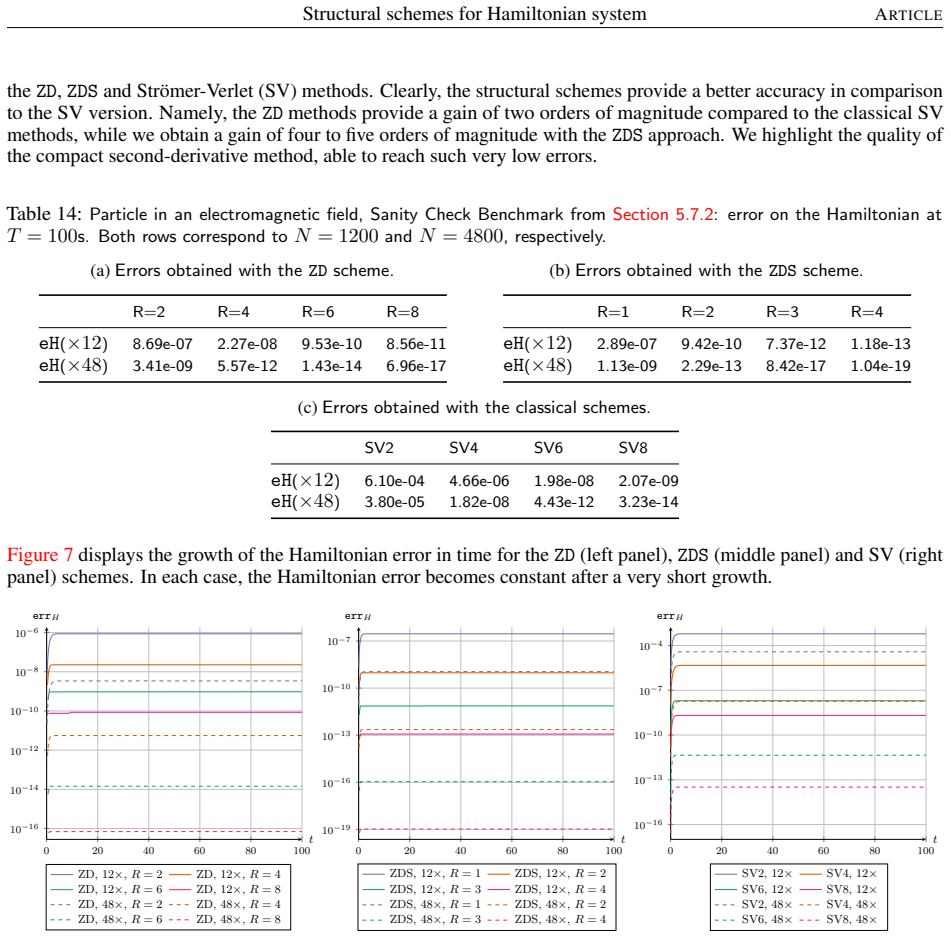
The central discovery is that the structural decomposition, physical equations describing the Hamiltonian dynamics plus structural equations that only involve the grid, survives the transition from a scalar ODE to a coupled Hamiltonian system. For each block of R time steps the same R structural equations are written for position and for momentum, so the nonlinearity of the Hamiltonian lives entirely in the physical equations and the structural part can be precomputed once per grid. The ZDS formulation, which adds second-derivative physical equations, is the more efficient of the two: numerical benchmarks show order 4, 6, 8, and 10 accuracy for R=1, 2, 3, 4, with position errors three orders of magnitude smaller than the classical symplectic schemes at matched order, and Hamiltonian deviation flat in time rather than growing. The paper further claims unconditional stability, demonstrated in practice by running the charged-particle benchmark at time steps roughly 20 times larger than the Stömer-Verlet stability limit, and argues from a complexity analysis that high-order structural schemes need fewer function calls than composition-based symplectic methods.
Load-bearing premise
The paper carries the scalar method's stability and accuracy guarantees over to the coupled position-momentum system without a fresh proof, and the construction needs the block matrix $A_z$ (the matrix that determines the block of new positions) to be invertible and the fixed-point iteration to converge; if either condition fails for some block size or Hamiltonian, the claimed unconditional stability and order do not hold.
Editorial extensions
If this is right
- For separable Hamiltonian systems the order of the ZDS scheme is raised simply by increasing the block size, with the numerical tests reaching order 10 at R=4, so no new implementation is needed to change accuracy.
- Hamiltonian error in long runs (up to 100,000 time units) stays essentially constant rather than drifting, at levels near 1e-25 in quadruple precision, matching or exceeding what the compared symplectic schemes deliver in the separable benchmarks.
- In the non-separable charged-particle test, the structural schemes remain stable with time steps about 20 times larger than the Stömer-Verlet limit, cutting total function calls substantially despite the extra fixed-point iterations.
- Projection onto an additional invariant manifold (the Laplace-Runge-Lenz vector in the Kepler problem) bounds that invariant's error but converts the flat error curves of the other two invariants into linear growth, a trade-off the paper documents.
- The fixed-point iteration typically needs 1 to 3 iterations per block on the outer solar system at tolerance 1e-15, so the per-step cost of the high-order structural schemes is competitive with composition-based symplectic methods.
Reading between the lines
- Because the structural coefficients depend only on the grid, the same precomputed matrices could be reused for a Hamiltonian whose parameters change during the simulation, enabling cheap parameter sweeps or time-dependent Hamiltonians; the paper does not explore this.
- If the proposed extension to third- and higher-order derivatives is implemented, the method's accuracy should scale far beyond order 10; a direct test would be to compare a hundred-digit benchmark against the analytical two-spring solution, which would verify whether the fixed-point iteration converges at extreme accuracy.
- The benchmarks suggest a hybrid use: classical symplectic methods when angular momentum is the invariant of interest (they reach machine precision), structural ZDS when total energy and high accuracy over very long times matter, and projection only when a specific non-energy invariant must be bounded.
- A practical implementation detail not fully investigated in the paper is acceleration of the fixed-point iteration by warm-starting each block from the previous block's converged values; the paper notes that a better initialization would cut iterations, and this is directly testable in the non-separable benchmarks.
Editorial analysis
A structured set of objections, weighed in public.
Referee Report
Summary. The paper adapts the structural method of Clain, Machado, and Malheiro to Hamiltonian systems, presenting ZD and ZDS variants for scalar, vector, and non-separable Hamiltonians. It derives physical and structural equations, proposes block fixed-point iterations, and benchmarks the resulting schemes against classical symplectic integrators on mass-spring, pendulum, Kepler, three-body, outer-solar-system, and charged-particle problems. The central advertised properties are high-order accuracy, unconditional stability, invariant preservation, and computational efficiency through large time steps.
Significance. If the claimed properties held, the method would be an attractive alternative to composition-based symplectic integrators, particularly for non-separable Hamiltonians and for raising order simply by increasing the block size R. The manuscript provides extensive numerical evidence: convergence orders are consistently reproduced, long-time energy and angular-momentum errors remain bounded in most benchmarks, and the ZDS variant achieves very high accuracy at moderate step sizes. The structural coefficients are derived from polynomial exactness rather than fitted to data, and the numerical studies use very high precision and a fair comparison with classical schemes. However, the central theoretical properties are asserted rather than proved for the Hamiltonian schemes, so the significance of the paper is currently contingent on analysis that is not supplied.
major comments (5)
- [§2.3.1, §2.3.2, §3.2] The order and unconditional-stability claims are stated only as remarks for the scalar ODE and then transferred to the Hamiltonian setting. The remark in §2.3.1 ('R = 2 provides a 4th-order unconditionally stable scheme while R = 4 reaches sixth-order accuracy') and the corresponding remark in §2.3.2 are not supported by a proof even for the scalar case in this manuscript, and no theorem establishes the order or stability of the coupled x-p system described in §3.2.1, §3.2.2, and §4.2. Since the Hamiltonian algorithm is a genuinely coupled fixed-point iteration, these properties cannot be taken as inherited from the scalar analysis.
- [§2.3.1, Eq. (7)] The algorithm requires the matrix Az to be non-singular, but the paper only assumes this ('Assuming the matrix Az ∈ RR×R is non-singular') and never proves it for the coefficient sets used for the reported values of R. If Az were singular for some R, the scheme would not be well-defined. The numerical experiments imply invertibility for the specific R tested, but the paper makes no general statement, and this assumption is load-bearing for the Hamiltonian schemes because they use the same structural equations (see §3.2.1, Eq. (14)-(15)).
- [§3.2.2 and §4.2] Convergence of the fixed-point iteration is not analyzed. The iteration alternates between the structural equations for Zx and Zp and the physical equations for Dx, Dp (and Sx, Sp in the ZDS case), and no contraction argument, step-size condition, or damping strategy is provided. The remark in §3.2.2 concedes that 'for stiff problems, a more sophisticated fixed-point procedure may be implemented,' which directly undercuts the unconditional-stability claim for the method as implemented. No large-Δt test is reported, so the regime in which unconditional stability is claimed is exactly the regime for which no numerical evidence is given.
- [§5.8, Table 17 and bullet list] The complexity comparison and the conclusion that the method allows 'very large time steps' rest on unconditional stability and on the fixed-point iteration converging with few iterations. The iteration counts reported in Tables 18-21 are tied to the specific time steps used in the benchmarks; without a stability and convergence analysis, the complexity ratios in Table 17 do not establish the claimed advantage in the large-Δt regime. The statement in §5.8 'One of the key benefits of the structural method is its unconditional stability' is therefore not supported by the evidence in the paper.
- [§5.1.2 and §5.2.2] The paper repeatedly labels the measured convergence rates as 'optimal' and attributes them to theoretical analysis (e.g., §5.1.2: 'the accuracy and order of convergence are the optimal ones, given by the theoretical analysis'). Since no Hamiltonian-specific theoretical analysis is supplied, these rates should be presented as numerical evidence for, not as consequences of, the claimed order. This distinction matters because the order properties are central to the paper's contribution.
minor comments (5)
- [§2.2] The text 'the 3(R + 1)(R + 1) linear system' should read 'the 3(R + 1) linear system' (or 'the 3(R + 1) equations'), since there are 3(R + 1) unknown coefficients a_{r,d}.
- [Throughout] There are several typos: 'stuffer' should be 'suffer' in the Introduction; 'Hamtilonian' should be 'Hamiltonian' in §5.8.1; 'Not that this potential' should be 'Note that this potential' in §5.7.3; 'octa-precision' should be 'octuple precision' in the Conclusions; and 'Strömer-Verlet' is used instead of the standard 'Störmer-Verlet'.
- [§3.2.2] The remark 'very few iterations (3 to 12 in practice)' is inconsistent with the measured iteration counts in Tables 20 and 21, where the average number of fixed-point iterations reaches 28.4 for the ZDS scheme with R = 1 and 15.7 for the ZD scheme with R = 2 in the non-separable benchmark. Please reconcile the remark with the reported data.
- [§5.4 and §5.5] The classical scheme is labeled 'MA2' in some tables and 'MC2' in others (Tables 4-5 versus Tables 9 and 11), and the legend of Figure 2 also uses 'MC2'. Please use one name consistently.
- [§5] The manuscript does not state data or code availability. Given the very high precision and the reproducibility requirements of a numerical methods paper, a public implementation or detailed pseudocode for constructing the structural-equation coefficients would be helpful.
Circularity Check
No circularity: structural coefficients derive from polynomial exactness and the numerical predictions are validated against external exact solutions and invariants, not against fitted inputs.
full rationale
I walked the derivation chain and found no step in which a prediction or first-principles result reduces by construction to its own inputs. The structural equation coefficients are obtained in Section 2 from the polynomial exactness condition E(a, pi_l) = 0, i.e. by enforcing exactness on monomials, not by fitting the solution, the Hamiltonian, or any invariant. The physical equations in Section 3 are just Hamilton's equations rewritten in the ZD/ZDS variables, and the Hamiltonian fixed-point iteration updates derivatives through the physical equations rather than through a fitted constant. The advertised accuracy and stability properties are asserted for the scalar ODE in remarks in Sections 2.3.1 and 2.3.2 and imported to the coupled x-p setting, with the stability/order background attributed to the authors' earlier work Clain et al. [2023a]; this is a self-citation, and the coupled-system stability and fixed-point convergence are not re-proved. However, that is a missing proof and a correctness risk, not circularity: the claim is not manufactured from the Hamiltonian benchmark data, and the cited prior work is an independent published result for the scalar structural method. The numerical sections reinforce this assessment: benchmarking against exact solutions (mass-spring, two-mass-spring, pendulum), known invariants (Kepler angular momentum and Laplace-Runge-Lenz vector, solar-system angular momentum), and standard symplectic integrators provides external, non-fitted checks of the convergence orders. The paper's own limitation in Section 3.2.2, noting that 'for stiff problems, a more sophisticated fixed-point procedure may be implemented,' weakens the practical large-time-step benefit claimed in Section 5.8, but it is an acknowledged robustness caveat rather than a circular dependence. No fitted parameter is renamed as a prediction, and no load-bearing argument reduces to a self-citation chain. Hence the central derivation is self-contained apart from the imported scalar stability/order result, and the appropriate circularity score is low.
Assumptions & free parameters
assumptions (4)
- domain assumption The structural method for scalar ODEs is unconditionally stable and has the stated order of accuracy, as established in Clain et al. 2023a.
- domain assumption The matrix Az is non-singular for the chosen block size R.
- domain assumption The fixed-point iteration converges to the unique solution of the coupled physical and structural equations.
- domain assumption The polynomial exactness of the structural equations implies the claimed convergence order for the coupled Hamiltonian system.
Cite this review
Pith. "Pith review of Structural schemes for hamiltonian systems." pith.science (2026). https://pith.science/paper/TX5COLTM
@misc{pith2026250113515,
  author       = {Pith},
  title        = {Pith review of: Structural schemes for hamiltonian systems},
  year         = {2026},
  howpublished = {\url{https://pith.science/paper/TX5COLTM}},
  note         = {Machine review of arXiv:2501.13515}
}
abstract
We present an adaptation of the so-called structural method \cite{CMM23} for Hamiltonian systems, and redesign the method for this specific context, which involves two coupled differential systems. Structural schemes decompose the problem into two sets of equations: the physical equations, which describe the local dynamics of the system, and the structural equations, which only involve the discretization on a very compact stencil. They have desirable properties, such as unconditional stability or high-order accuracy. We first give a general description of the scheme for the scalar case (which corresponds to e.g. spring-mass interactions or pendulum motion), before extending the technique to the vector case (treating e.g. the $n$-body system). The scheme is also written in the case of a non-separable system (e.g. a charged particle in an electromagnetic field). We give numerical evidence of the method's efficiency, its capacity to preserve invariant quantities such as the total energy, and draw comparisons with the traditional symplectic methods.
Figures


Figures from the paper (5 more)



Forward citations
Cited by 1 Pith paper
-
Learning Hamiltonian Dynamics with Bayesian Data Assimilation
An autoregressive Hamiltonian neural network coupled with an unscented Kalman filter improves long-term trajectory prediction and uncertainty quantification for unknown Hamiltonian systems.
Reference graph
Works this paper leans on
-
[1]
S. Clain, G. J. Machado, and M. T. Malheiro. Compact schemes in time with applications to partial differential equations. Comput. Math. Appl., 140:107–125, 2023a. doi:10.1016/j.camwa.2023.03.011. B. Leimkuhler and S. Reich. Simulating Hamiltonian Dynamics . Cambridge University Press,
-
[9]
doi:10.1017/s0962492902000144. M. Suzuki. Fractal decomposition of exponential operators with applications to many-body theories and monte carlo simulations. Phys. Lett. A, 146(6):319–323,
-
[10]
doi:10.1016/0375-9601(90)90962-n
ISSN 0375-9601. doi:10.1016/0375-9601(90)90962-n. H. Yoshida. Construction of higher order symplectic integrators. Phys. Lett. A , 150(5–7):262–268,
-
[11]
doi:10.1016/0375-9601(90)90092-3
ISSN 0375-9601. doi:10.1016/0375-9601(90)90092-3. R. I. McLachlan. On the numerical integration of ordinary differential equations by symmetric composition methods. SIAM J. Sci. Comput., 16(1):151–168,
-
[17]
URL https://doi.org/10.1137/141000671. C. Rackauckas and Q. Nie. DifferentialEquations.jl – A Performant and Feature-Rich Ecosystem for Solving Differential Equations in Julia. J. Open Res. Softw., 5(1):15,
-
[18]
ISSN 2049-9647. doi:10.5334/jors.151. A. Beléndez, C. Pascual, D.I. Méndez, T. Beléndez, and C. Neipp. Exact solution for the nonlinear pendulum. Rev. Bras. Ens. Fis., 29(4):645–648,
-
[1967]
ISSN 0031-899X. doi:10.1103/physrev.159.98. E. Hairer, C. Lubich, and G. Wanner. Geometric numerical integration illustrated by the Störmer-Verlet method. Acta Numer ., 12:399–450,
-
[1987]
ISBN 9783540481263. doi:10.1007/bfb0078537. M. Kraus, K. Kormann, P. J. Morrison, and E. Sonnendrücker. GEMPIC: geometric electromagnetic particle-in-cell methods. J. Plasma Phys., 83(4), July
Show all 18 references
-
[1990]
Experiments
doi:10.1016/s0065-2687(08)60429-x. L. Verlet. Computer “Experiments” on Classical Fluids. I. Thermodynamical Properties of Lennard-Jones Molecules. Phys. Rev., 159(1):98–103,
-
[1992]
doi:10.1088/0951-7715/5/2/011
ISSN 1361-6544. doi:10.1088/0951-7715/5/2/011. J. M. Sanz-Serna and M. P. Calvo. Symplectic numerical methods for Hamiltonian problems. Int. J. Mod. Phys. C , 04 (02):385–392,
-
[1993]
doi:10.1142/s0129183193000410
ISSN 1793-6586. doi:10.1142/s0129183193000410. W. Kahan and R.-C. Li. Composition constants for raising the orders of unconventional schemes for ordinary differential equations. Math. Comput., 66(219):1089–1099,
-
[1995]
doi:10.1137/0916010
ISSN 1095-7197. doi:10.1137/0916010. E. Hairer, C. Lubich, and G. Wanner. Geometric Numerical Integration. Springer Series in Computational Mathematics. Springer-Verlag,
-
[1997]
doi:10.1090/s0025-5718-97-00873-9
ISSN 1088-6842. doi:10.1090/s0025-5718-97-00873-9. S. Clain, R. M. S. Pereira, P. A. Pereira, and D. Lopes. Structural schemes for one dimension stationary equations. Appl. Math. Comput., 457:128207, 2023b. doi:10.1016/j.amc.2023.128207. Y . Hida, X. S. Li, and D. H. Bailey. Q...
-
[2003]
doi:10.1051/0004-6361:20030065
ISSN 1432-0746. doi:10.1051/0004-6361:20030065. K. Feng and M.-Z. Qin. The symplectic methods for the computation of hamiltonian equations , pages 1–37. Springer Berlin Heidelberg,
-
[2005]
doi:10.1017/cbo9780511614118
ISBN 9780511614118. doi:10.1017/cbo9780511614118. H. Beust. Symplectic integration of hierarchical stellar systems. Astron. Astrophys., 400(3):1129–1144,
-
[2006]
doi:10.1007/3-540-30666-8. R. I. McLachlan and P. Atela. The accuracy of symplectic integrators. Nonlinearity, 5(2):541–562,
-
[2017]
doi:10.1017/s002237781700040x
ISSN 1469-7807. doi:10.1017/s002237781700040x. Y . Li, M. Campos Pinto, F. Holderied, S. Possanner, and E. Sonnendrücker. Geometric Particle-In-Cell discretizations of a plasma hybrid model with kinetic ions and mass-less fluid electrons. J. Comput. Phys., 498:112671, February
-
[2024]
doi:10.1016/j.jcp.2023.112671
ISSN 0021-9991. doi:10.1016/j.jcp.2023.112671. T. G. Shepherd. Symmetries, Conservation Laws, and Hamiltonian Structure in Geophysical Fluid Dynamics , pages 287–338. Elsevier,
2023
Reviewed August 10, 2026 · model on record in the stance chip above.
Discussion (0). Continue with ORCID to comment.