REVIEW 2 major objections 3 minor 1 cited by
Jiggling: an h-principle without homotopical assumptions
T0 review · 2 major / 3 minor · reviewed 2026-08-10 · deepseek-v4-flash
Pith's one-line read Every continuous section can be jiggled into a piecewise smooth solution of any open and fiberwise dense first-order differential relation.
desk verdict A genuinely new generalization of Thurston's jiggling with a solid main theorem, but the advertised simplicial-set h-principle has a gap in the write-up that needs patching. read the letter →
The pith
A machine-rendered reading of the paper's core claim, the machinery that carries it, and where it could break.
The reading
What carries the argument
The engine is the jiggling construction of Section 6, which combines three ingredients. Crystalline subdivision refines a triangulation by pulling back the standard subdivision of a cube; its defining feature is that every simplex in every iterated subdivision is a scaled, translated copy of one of finitely many model simplices, so the quantities controlling $C^1$ estimates (edge length and the degeneracy constant $\Lambda$) scale predictably with subdivision depth. A fixed finite coloring of the top-dimensional simplices allows the proof to perturb the section one color at a time, because same-colored simplices have disjoint stars and earlier solutions are only mildly disturbed. On each simplex, slope perturbation uses fiberwise density to tilt the jet of the section into the relation and then extends the tilted jet linearly, while a join construction glues the local tilts to the part of the section that is left unchanged. The parametric statement is encoded in the simplicial set $sSol_{PS}(R)$, whose $n$-simplices are piecewise solutions of the pulled-back relation on $M \times \Delta^n$.
What would settle it
Consider the immersion relation on maps $M \to N$ with $\dim M < \dim N$, which is open and fiberwise dense, and a loop in $C^0(M,N)$ whose values are immersions; Theorem 7.4 predicts a piecewise immersive filling of that loop. A loop for which one can prove that no piecewise smooth immersion filling exists would falsify the central weak equivalence.
Extended reading notes
Core claim
The central discovery is that jiggling is not just a way to put triangulations in general position: it is a way to solve differential relations. Given an open and fiberwise dense relation $R \subset J^1(E)$, Theorem 6.3 takes any piecewise smooth section $s$ and any positive error function $\varepsilon$ and produces an $\varepsilon$-jiggling $(s', T')$ in which $s'$ is a piecewise smooth solution of $R$ and $s'$ agrees with $s$ on any prescribed subcomplex $Q$ where $s$ already solves $R$. Because the proof is relative and uniform over parameters, Theorem 7.4 follows: the inclusion of the simplicial set $sSol_{PS}(R)$ of piecewise solutions into $\operatorname{Sing}(\Gamma^0(E))$ is a weak homotopy equivalence of Kan complexes, meaning simplicial sets in which every horn can be filled. The authors read this as an h-principle without homotopical assumptions, since the first jet of a piecewise solution may jump along the triangulation and hence no formal solution or jet homotopy class appears in the statement.
Load-bearing premise
The load-bearing premise is fiberwise density: at every point of the bundle, the allowed first-order jets must be dense among all possible slopes over that point, so that any jet can be tilted into the relation by an arbitrarily small change of slope.
Editorial extensions
If this is right
- Every continuous section of $E$, and every continuous family of sections parametrized by a simplex, can be deformed relatively into a piecewise smooth solution of $R$; in simplicial terms, $sSol_{PS}(R)$ and $\operatorname{Sing}(\Gamma^0(E))$ have the same weak homotopy type.
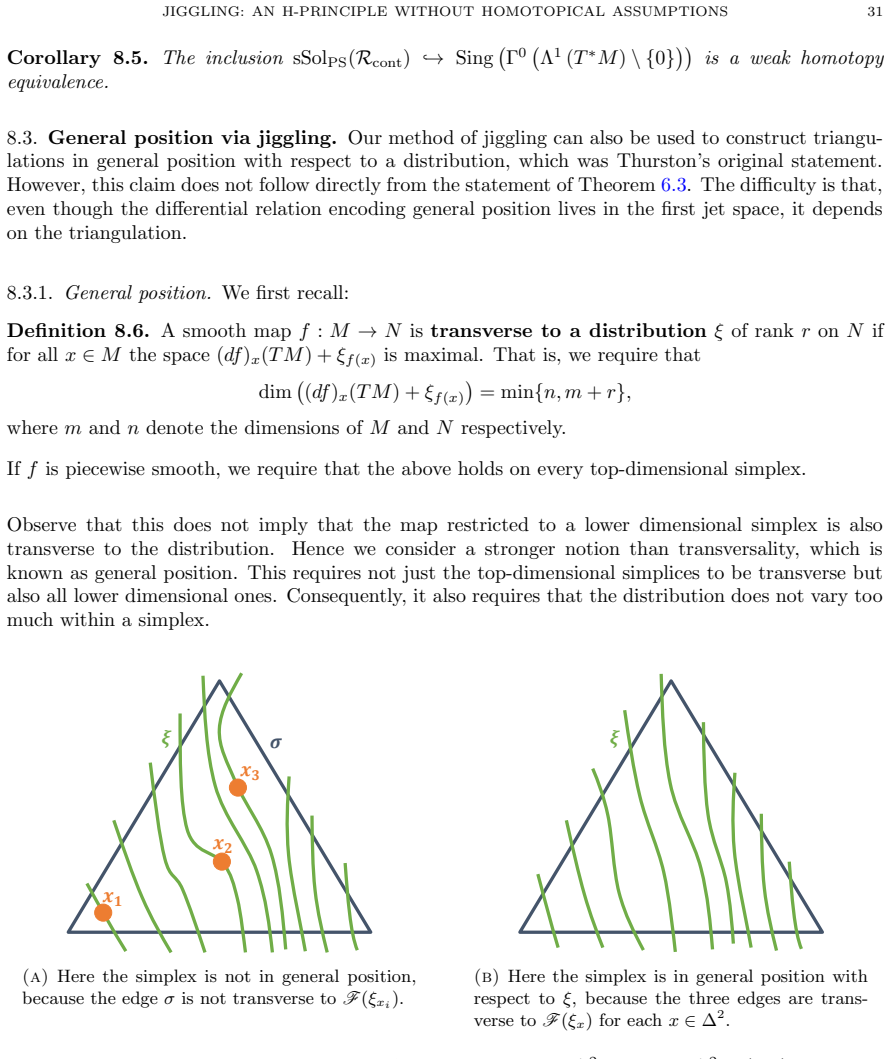
- Any map between manifolds can be jiggled to be piecewise transverse to a fixed distribution, and, in the appropriate dimensions, to be piecewise immersive or submersive; the corresponding inclusions of solution spaces into spaces of continuous maps are weak homotopy equivalences.
- On any odd-dimensional manifold, every nonvanishing 1-form is $C^1$-close to a piecewise smooth contact form, and the simplicial set of piecewise contact forms is weakly equivalent to the space of nonvanishing continuous 1-forms, on closed manifolds as well as open ones.
- Every triangulation can be jiggled to be in very general position with respect to a distribution, including on noncompact manifolds, and the same statement holds for finitely many distributions at once.
Reading between the lines
- Editorial inference: if Theorem 7.4 is correct, then in the piecewise smooth category every open and fiberwise dense first-order relation is automatically flexible at the level of homotopy types; rigidity phenomena, such as the conjectured rigidity of positive contact structures in dimension 3, would have to come precisely from failure of fiberwise density.
- Editorial inference: the color-by-color induction is the transferable core of the proof, since it replaces delicate Grassmannian distance estimates with a finite coloring; a testable extension is to higher-order jets, where a subdivision scheme controlling higher derivatives might yield analogous h-principles without homotopical assumptions for relations in $J^r(E)$.
- Editorial inference: one could try to replace fiberwise density by an ampleness condition in the sense of convex integration; if sufficiently controlled local tilts exist without density, jiggling would extend piecewise h-principles to a larger class of relations, including some that are not fiberwise dense.
Editorial analysis
A structured set of objections, weighed in public.
Referee Report
Summary. The paper proves a generalized jiggling theorem (Theorem 6.3): for any open and fiberwise dense differential relation R ⊂ J^1(E) of first order, every piecewise smooth section of E can be subdivided and C^1-approximated by a piecewise smooth solution of R, with relative and non-compact variants. The proof works by choosing a fine crystalline subdivision, linearizing the section, and then slope-perturbing it color by color, using quantitative estimates on the geometry of crystalline subdivisions. The authors then package this into an h-principle without homotopical assumptions: the simplicial set sSol_PS(R) of piecewise smooth solutions over M × Δ^n is weakly equivalent to the singular complex of the space of continuous sections of E (Theorem 7.4). Applications are given to piecewise transversality, immersions and submersions, contact forms, and a new proof of Thurston's jiggling lemma, including non-compact manifolds.
Significance. If Theorem 6.3 and Theorem 7.4 are correct, this is a substantial contribution to the flexibility of piecewise smooth first-order differential relations. The paper gives a self-contained, quantitative proof of the core jiggling result, with explicit bounds coming from model simplices (Lemma 3.8), linearization (Lemma 4.2), interpolation and join estimates (Lemmas 4.4 and 4.6), and slope-perturbation estimates (Lemma 5.8). The color-by-color induction in Theorem 6.1 is a genuine simplification of Thurston's original argument and is carefully set up. The applications to contact forms and to general position are attractive and show the power of the result. There is no circularity or fitting of parameters in the main construction. The central weakness is in Section 7: the passage from jiggling to the simplicial h-principle contains an unproved relative piecewise-smooth extension/approximation step. This step is load-bearing for both Lemma 7.3 and Theorem 7.4, so the paper needs a dedicated argument there before the announced h-principle is fully established.
major comments (2)
- [Section 7 (Lemma 7.3)] The proof of Lemma 7.3 states: 'Extend s to a piecewise smooth section tilde{s} of E over M × Δ^n such that it is piecewise smooth with respect to a triangulation tilde{T} that extends T. We assume that tilde{s} is a solution on Op(M × Λ^n_k).' The second sentence is not automatic from openness of R. A solution on the horn fixes the values and derivatives on the horn, but it gives no control on the normal derivatives used to extend into the missing faces; for n ≥ 2 the collars of the horn meet in corners, so the extension has to be assembled simplex by simplex and across faces. Because the Kan property of sSol_PS(R) is asserted from this lemma and is then used in the weak-equivalence criterion (Definition 2.29), this gap must be closed by a proof or by a precise reference to a relative extension theorem for piecewise smooth sections of open relations.
- [Section 7 (proof of Theorem 7.4)] The proof begins with the assertion: 'Firstly, we approximate F by a section F′ that is piecewise smooth such that F′ is a solution on Op(M × ∂Δ^n) and such that F′ agrees with F on M × ∂Δ^n.' No argument is supplied for this step. This is load-bearing: Theorem 6.3 can only be applied to a piecewise smooth F′ that is already a solution on a neighborhood of the relative subcomplex Q = M × ∂Δ^n. The requirement F′ = F on the boundary is an exact interpolation condition, while the requirement that first-order jets in the collar lie in R is a differential condition; openness of R alone does not imply that an arbitrary piecewise-smooth approximation of F satisfies the latter. The same type of unproved extension appears in Lemma 7.3. A dedicated relative approximation/extension lemma for piecewise smooth sections over products M × Δ^n, with corners, is needed here.
minor comments (3)
- [Section 6.1 (proof of Theorem 6.1)] In the paragraph handling simplices of a previous color, the inequality dC0(j1s(i), j1s(i+1)) < δ_i/2 does not follow from the stated item (1), which gives a δ_i/4 bound for an ε_{i+1}-slope perturbation on adjacent simplices. The indices and constants should be harmonized (probably δ_i/4), although this is a local fix and does not affect the overall strategy.
- [Section 2.2.5 (Definition 2.12)] The phrasing 'a triangulation K′ subdividing K1, K2, K' should be 'subdividing K1, K2, and K'. Also, the fact that the C^r distance depends on the auxiliary triangulation K is only explained after the definition; putting that caveat before the displayed formula would avoid confusion.
- [Section 7.1] The informal discussion of the topological-space analogue is useful motivation, but it contains the phrase 'we leave for the reader to explore'; if this is not intended as a mathematical claim, it is fine as a remark, but it should be clearly marked as non-essential and not as a lemma.
Circularity Check
No circularity: the jiggling construction is self-contained; the only flagged issue is an unproved relative approximation step in Theorem 7.4, which is a proof gap rather than a circular reduction.
full rationale
The central derivation is self-contained. Theorem 6.3 is proved by an explicit construction: linearize relative to a crystalline subdivision (Corollary 4.7, Lemma 4.2), color simplices (Lemma 3.3), slope-perturb over colors using Lemma 5.1 and Corollary 5.5, and glue with joins and interpolations (Lemmas 4.4, 4.6, 5.8). No parameter is fitted to the target conclusion: the constants epsilon_i, delta_i and l are chosen from the relation R and the input section s, not from the existence of a solution. The only self-citations ([6], [26]) appear in the introduction and applications as illustrations of prior uses of jiggling and Engel structures; they are not load-bearing for Theorem 6.3 or Theorem 7.4. The h-principle Theorem 7.4 reduces to Theorem 6.3, plus standard simplicial-set facts and the contractibility of the space of triangulations [21], which is external. I flag one omitted proof, as required by the review rules: in the proof of Theorem 7.4 the paper asserts 'Firstly, we approximate F by a section F′ that is piecewise smooth such that F′ is a solution on Op(M × ∂∆n) and such that F′ agrees with F on M × ∂∆n' without proving this relative piecewise-smooth approximation and extension step; the same kind of extension is asserted in Lemma 7.3. This is a correctness and completeness gap, likely fillable by standard relative smooth approximation plus openness of R, but it is not a circularity, because nothing in that step is defined in terms of the conclusion or fitted to it. Accordingly the circularity score is 0.
Assumptions & free parameters
assumptions (4)
- standard math Every smooth manifold admits a smooth triangulation compatible with its smooth structure (Whitehead).
- standard math Any triangulation of M×∂∆^n extends to a triangulation of M×∆^n; the space of triangulations is contractible.
- standard math The singular complex Sing(X) is a Kan complex and Definition 2.29 correctly characterizes weak homotopy equivalences of Kan complexes.
- domain assumption The relation R is open and fiberwise dense in J^1(E).
Cite this review
Pith. "Pith review of Jiggling: an h-principle without homotopical assumptions." pith.science (2026). https://pith.science/paper/WHT3ZXWT
@misc{pith2026250113627,
  author       = {Pith},
  title        = {Pith review of: Jiggling: an h-principle without homotopical assumptions},
  year         = {2026},
  howpublished = {\url{https://pith.science/paper/WHT3ZXWT}},
  note         = {Machine review of arXiv:2501.13627}
}
abstract
The jiggling lemma of Thurston shows that any triangulation can be jiggled (read: subdivided and then perturbed) to be in general position with respect to a distribution. Our main result is a generalization of Thurston's lemma. It states that piecewise smooth solutions of a given open and fiberwise dense differential relation $\mathcal{R} \subset J^1(E)$ of first order can be constructed by jiggling arbitrary sections of $E$. Our statement also holds in parametric and relative form. We understand this as an h-principle without homotopical assumptions for piecewise smooth solutions of $\mathcal{R}$.
Figures


Figures from the paper (5 more)



Forward citations
Cited by 1 Pith paper
-
Thurston's jiggling
A new proof of Thurston's jiggling lemma, including a full proof of the manifold case using relative jiggling and quantitative semitransversality.
Reference graph
Works this paper leans on
-
[1]
Arboreal models and their stability
D. ´Alvarez-Gavela, Y. Eliashberg, and D. Nadler. “Arboreal models and their stability”. In: Journal of Symplectic Geometry 21.2 (2023), pp. 331–381
work page 2023
-
[2]
Geomorphology of Lagrangian ridges
D. ´Alvarez-Gavela, Y. Eliashberg, and D. Nadler. “Geomorphology of Lagrangian ridges”. In: Journal of Topology 15.2 (2022), pp. 844–877
work page 2022
-
[3]
D. ´Alvarez-Gavela, Y. Eliashberg, and D. Nadler.Positive arborealization of polarized Weinstein manifolds. 2022. arXiv: 2011.08962 [math.SG]
arXiv 2022
-
[4]
Entrelacements et ´ equations de Pfaff
D. Bennequin. “Entrelacements et ´ equations de Pfaff”. In: Asterisque 107–108 (1983), pp. 87– 161
work page 1983
-
[5]
Bertelson and J
M. Bertelson and J. Distexhe. PL approximations of symplectic manifolds . 2024. arXiv: 2112. 10118 [math.DG]
2024
-
[6]
Existence h-Principle for Engel structures
R. Casals, J.L. P´ erez, A. del Pino, and F Presas. “Existence h-Principle for Engel structures”. In: Invent. Math. 210 (2017), pp. 417–451
work page 2017
-
[7]
K. Cieliebak, Y. Eliashberg, and N. Mishachev. Introduction to the h-principle. Vol. 239. Grad- uate Studies in Mathematics. American Mathematical Society, Providence, RI, 2023
work page 2023
-
[8]
Stabilit´ e topologique des structures de contact en dimension 3
V. Colin. “Stabilit´ e topologique des structures de contact en dimension 3”. In: Duke Mathemat- ical Journal 99.2 (1999), pp. 329–351
1999
Show all 34 references
-
[9]
Symplectic submanifolds and almost-complex geometry
S.K. Donaldson. “Symplectic submanifolds and almost-complex geometry”. In: J. Differential Geom. 44.4 (1996), pp. 666–705
1996
-
[10]
Weak equivalences of simplicial presheaves
D. Dugger and D. C. Isaksen. “Weak equivalences of simplicial presheaves”. In: Contemporary Mathematics 346 (2004), pp. 97–114
2004
-
[11]
A theorem on the structure of wave fronts and its applications in symplectic topology
Y. Eliashberg. “A theorem on the structure of wave fronts and its applications in symplectic topology”. In: Functional Analysis and Its Applications 21.3 (1987), pp. 227–232
1987
-
[12]
Classification of overtwisted contact structures on 3-manifolds
Y. Eliashberg. “Classification of overtwisted contact structures on 3-manifolds”. In: Invent. Math. 98.3 (1989), pp. 623–637
1989
-
[13]
Contact 3–manifolds twenty years since J. Martinet’s work
Y. Eliashberg. “Contact 3–manifolds twenty years since J. Martinet’s work”. In: Ann. Inst. Fourier 42 (1992), pp. 165–192
1992
-
[14]
M. Gromov. Partial differential relations . Vol. 9. Ergebnisse der Mathematik und ihrer Gren- zgebiete (3) [Results in Mathematics and Related Areas (3)]. Springer-Verlag, Berlin, 1986, pp. x+363
1986
-
[15]
Stable mappings of foliations into manifolds
M. Gromov. “Stable mappings of foliations into manifolds”. In: Mathematics of the USSR- Izvestiya 3.4 (1969), p. 671
1969
-
[16]
Heuts and I
G. Heuts and I. Moerdijk. Simplicial and dendroidal homotopy theory . Springer Nature, 2022
2022
-
[17]
Coisotropic rigidity andC 0-symplectic geometry
V. Humili` ere, R. Leclercq, and S. Seyfaddini. “Coisotropic rigidity andC 0-symplectic geometry”. In: Duke Mathematical Journal 164.4 (2015), pp. 767–799
2015
-
[18]
Simplical presheaves
J. Jardine. “Simplical presheaves”. In: Journal of Pure and Applied Algebra 47.1 (1987), pp. 35– 87
1987
-
[19]
No symplectic Lipschitz structures on S2n≥4
D. Joksimovi´ c. “No symplectic Lipschitz structures on S2n≥4”. In: International Journal of Mathematics 33.05 (2022), pp. 1–10
2022
-
[20]
Haefliger structures and symplectic/contact structures
F. Laudenbach and G. Meigniez. “Haefliger structures and symplectic/contact structures”. In: Journal de l’ ´Ecole polytechnique - Math´ ematiques3 (2016), pp. 1–19
2016
-
[21]
J. Lurie. Topics in geometric topology. https://www.math.ias.edu/~lurie/937.html. 2009
2009
-
[22]
Sur l’existence de certaines formes diff´ erentielles remarquables sur la sph` ere S3
R. Lutz. “Sur l’existence de certaines formes diff´ erentielles remarquables sur la sph` ere S3”. In: C.R. Acad. Sci. Paris 270 (1970), pp. 1597–1599
1970
-
[23]
Formes de contact sur les vari´ et´ es de dimension 3
J. Martinet. “Formes de contact sur les vari´ et´ es de dimension 3”. In:Proc. Liverpool Sing. Symp. II, Lect. Notes in Math. 209 (1971), pp. 142–163
1971
-
[24]
Gromov’s alternative, Eliashberg’s shape invariant, andC 0-rigidity of contact diffeomorphisms
S. M¨ uller and P. Spaeth. “Gromov’s alternative, Eliashberg’s shape invariant, andC 0-rigidity of contact diffeomorphisms”. In: International Journal of Mathematics 25.14 (2014), p. 1450124
2014
-
[25]
C0-rigidity of characteristics in symplectic geometry
E. Opshtein. “ C0-rigidity of characteristics in symplectic geometry”. In: Annales scientifiques de l’Ecole normale sup´ erieure42.5 (2009), pp. 857–864
2009
-
[26]
The Engel–Lutz twist and overtwisted Engel structures
´A. del Pino and T. Vogel. “The Engel–Lutz twist and overtwisted Engel structures”. In: Geom- etry & Topology 24.5 (2020), pp. 2471–2546
2020
-
[27]
Chekanov’s dichotomy in contact topology
D. Rosen and J. Zhang. “Chekanov’s dichotomy in contact topology”. In: Mathematical Research Letters 27.4 (2020), pp. 1165–1193. REFERENCES 35
2020
-
[28]
∆-sets I: Homotopy theory
C.P. Rourke and B.J. Sanderson. “∆-sets I: Homotopy theory”. In: The Quarterly Journal of Mathematics 22.3 (1971), pp. 321–338
1971
-
[29]
The Seiberg-Witten invariants and symplectic forms
C. H. Taubes. “The Seiberg-Witten invariants and symplectic forms”. In: Mathematical Research Letters 1.6 (1994), pp. 809–822
1994
-
[30]
Existence of codimension-one foliations
W.P. Thurston. “Existence of codimension-one foliations”. In: Ann. Math. 104.2 (1976), pp. 249– 268
1976
-
[31]
The theory of foliations of codimension greater than one
W.P. Thurston. “The theory of foliations of codimension greater than one”. In: Comm. Math. Helv. 87 (1974), pp. 214–231
1974
-
[32]
On the uniqueness of the contact structure approximating a foliation
T. Vogel. “On the uniqueness of the contact structure approximating a foliation”. In: Geometry & Topology 20.5 (2016), pp. 2439–2573
2016
-
[33]
On C 1-complexes
J.H.C. Whitehead. “On C 1-complexes”. In: Ann. of Math. 41.2 (1940), pp. 809–824
1940
-
[34]
H. Whitney. Geometric Integration Theory. Princeton University Press, 1957. Utrecht University, Department of Mathematics, Budapestlaan 6, 3584 CD Utrecht, The Netherlands Email address : annaf.math@outlook.com Utrecht University, Department of Mathematics, Budapestlaan 6, 358...
1957
Reviewed August 10, 2026 · model on record in the stance chip above.
Discussion (0). Continue with ORCID to comment.