REVIEW 3 major objections 5 minor 67 references
Calibrating Wireless AI via Meta-Learned Context-Dependent Conformal Prediction
T0 review · 3 major / 5 minor · reviewed 2026-08-10 · deepseek-v4-flash
Pith's one-line read A meta-learned ratio estimator lets conformal prediction calibrate wireless AI for unseen contexts using only context vectors.
desk verdict Useful meta-learned WCP paper with a new idea, but the zero-shot claim is not tested because the main experiments use contexts from the meta-training set. read the letter →
The pith
A machine-rendered reading of the paper's core claim, the machinery that carries it, and where it could break.
The reading
What carries the argument
The central object is the meta-learned covariate likelihood ratio estimator $\omega_{\theta}(x, c_1, c_2)$, trained to approximate $w(x, c_1, c_2)=p(x|c_1)/p(x|c_2)$. Lemma 1 rewrites this ratio as $q(c_1|x)/q(c_2|x)$, the posterior ratio of a balanced binary classifier that distinguishes which of two contexts produced an input, so estimating the shift reduces to training such a classifier. The architecture enforces reciprocity, $\omega_{\theta}(x, c_2, c_1)=1/\omega_{\theta}(x, c_1, c_2)$, by writing the estimator as $\exp(g_{\theta}(x, c_1)-g_{\theta}(x, c_2))$ with a shared MLP $g_{\theta}$. Weighted conformal prediction then uses the estimated ratio to reweight calibration scores, and Lemma 2 is the load-bearing result: the coverage gap is bounded by the expected total-variation distance between the estimated and true target covariate distributions. For multiple calibration contexts, the same classifier idea is applied against the mixture of context distributions, using a DeepSet-style permutation-invariant architecture for the estimator.
What would settle it
Take two contexts with identical input distributions $p(x|c)$ but different conditional output distributions $p(y|x)$. ML-WCP then estimates a likelihood ratio of 1, reducing to standard conformal prediction, whose empirical coverage on the target context will fall below $1-\alpha$ by an amount equal to the concept shift; observing that drop would falsify the claim that context-only calibration suffices.
Extended reading notes
Core claim
The central claim is that context vectors alone can carry enough information to calibrate a pre-trained AI model for an unseen operating context. ML-WCP does this by training, from logged data of multiple past contexts, a classifier-based estimator $\omega_{\theta}(x, c_1, c_2)$ of the covariate likelihood ratio $p(x|c_1)/p(x|c_2)$. The estimator plugs into weighted conformal prediction in place of the true ratio, which is unknown because no runtime data exist. Lemma 2 gives the resulting guarantee: coverage of the prediction set is at least $1 - \alpha$ minus half the expected relative deviation between the normalized estimated ratio and the true ratio. Thus the method turns calibration into a zero-shot operation whose reliability is controlled by the fidelity of the meta-learned shift estimator, and multi-context variants pool neighboring contexts to shrink the final prediction sets.
Load-bearing premise
The whole scheme rests on the assumption that the relationship between input and output, $p(y|x)$, is the same in every context; only the input distribution changes. If that mapping itself changes with the context, reweighting inputs cannot restore coverage.
Editorial extensions
If this is right
- A network controller can produce a valid prediction set for a pre-trained app in a new context using only the context vector, with no calibration data from that context.
- Tighter coverage follows from better shift estimation: any improvement in the classifier that distinguishes contexts directly shrinks the slack term in Lemma 2.
- Pooling several nearby calibration contexts, either by majority vote or by mixing their input distributions, reduces prediction-set size while preserving coverage, and adaptive context selection beats a fixed number of contexts.
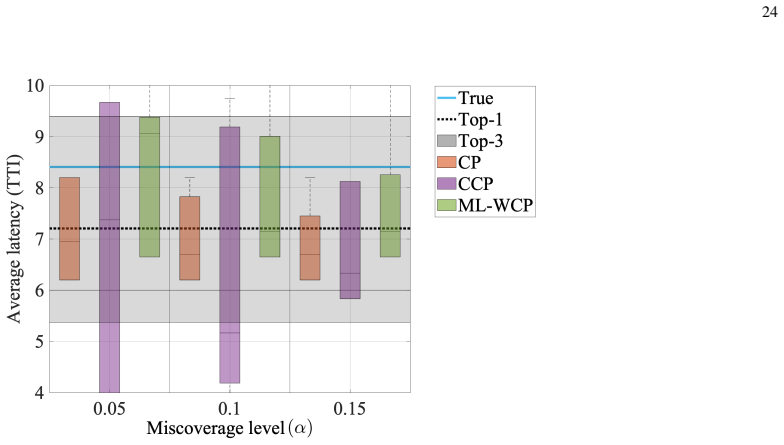
- On the three studied tasks, plain conformal prediction undercovers under context shift, whereas ML-WCP keeps empirical miscoverage at or below the target with noticeably smaller sets than conservative conformal prediction.
Reading between the lines
- Because the guarantee depends only on the score function and the estimated ratio, the same meta-trained weight estimator could be reused across different scoring rules, turning ML-WCP into a drop-in calibration layer for any pre-trained model.
- The context-invariance assumption $p(y|x)$ is the boundary of the method; if the input-to-output mapping also drifts, one could meta-learn a context-dependent correction to the scores themselves rather than only reweighting inputs.
- The results suggest a practical monitoring rule: track the relative error of the ratio estimator on held-out context pairs, and widen sets or retrain when it grows, since that error is exactly the term that eats into coverage.
- Context engineering becomes a first-class design choice: in the interference experiment, more informative context vectors such as the interference burst start time achieve target coverage with fewer meta-training contexts.
Editorial analysis
A structured set of objections, weighed in public.
Referee Report
Summary. The paper proposes ML-WCP, a meta-learned estimator of covariate likelihood ratios that is meant to enable zero-shot calibration of pre-trained wireless AI applications under context-dependent distribution shift. The method uses logged data from multiple contexts to train a classifier ωθ(x, c1, c2) that approximates the likelihood ratio p(x|c1)/p(x|c2), and then plugs this estimate into weighted conformal prediction. The authors prove, via a reduction to existing WCP theory, a coverage bound in Lemma 2 that depends on the estimation error of ωθ. They also extend the method to multiple calibration contexts through majority voting and a mixture-based approach. Experiments are presented for traffic slice prediction, MAC scheduling-app profiling, and interference-limited physical-layer decoding.
Significance. If the zero-shot claim were fully validated, the paper would offer a practically relevant capability: calibrating a pre-trained AI app for a runtime context from which no samples are available, using only contextual metadata. The theoretical backbone is sound insofar as Lemma 2 is a direct plug-in bound that follows from [18, Theorem 1], and the appendix gives the full derivation rather than leaving it as a black box. The paper also demonstrates the method in three distinct wireless tasks at different protocol layers, including a real-world traffic dataset. However, the central experimental protocol evaluates only on contexts that were used during meta-training, and the theoretical bound itself provides no guarantee for truly unseen contexts; both issues concern the paper's main contribution rather than peripheral details.
major comments (3)
- [Section VI-C (Eqs. (39)-(40))] The evaluation protocol states that, unless stated otherwise, empirical coverage and inefficiency are averaged over pairs (cte, ccal) with cte, ccal ∈ Ctr and cte ≠ ccal. Since Ctr is precisely the set of contexts whose data sets D_c are used to train the covariate likelihood estimator ωθ in Section IV-A, every test context in the reported single-context results was already seen during meta-training. This tests interpolation among previously seen contexts, not the paper's headline claim of zero-shot calibration for a context with no data and no meta-training exposure. No result is reported for test contexts drawn from the held-out set Ccal introduced in Section IV-A. Please add experiments with cte ∈ Ccal, or otherwise clearly restrict the claims to interpolation rather than zero-shot generalization.
- [Lemma 2 (Eq. (26))] The coverage guarantee in Lemma 2 is a bound that depends on the estimation error of ωθ for the specific pair (cte, ccal). For a truly unseen context cte, there is no a priori reason this error is small; the meta-learned function gθ(x, c) may only interpolate among the contexts in Ctr. Consequently, Lemma 2 alone does not establish zero-shot validity. The paper should either provide a formal generalization argument for ωθ on unseen contexts (for example, under a smoothness or Lipschitz assumption on gθ) or state explicitly that zero-shot validity is an empirical hypothesis requiring validation on held-out contexts. As it stands, the title and abstract claim 'zero-shot' in a stronger sense than what is proven or tested.
- [Section II-D3 and Section VI-F] The interference-limited physical-layer application violates the covariate-shift assumption (3), since the optimal decoder, and hence p(y|x), depends on the context c. The paper acknowledges this in Section II-D3 and presents Figs. 9-12 as a benchmark for modeling mismatch, which is transparent. However, the conclusions should sharply separate this case from the theoretically guaranteed regime: the empirical coverage in Figs. 9-12 cannot be attributed to Lemma 2, and the claim in the conclusion that ML-WCP is 'effective' across all three scenarios should be qualified to distinguish the mismatch case from the cases that satisfy (3).
minor comments (5)
- [Section V-C] The text says 'Based on Lemma 2, we propose to estimate the ratio (34)' but the relevant statement is Lemma 4; please correct the cross-reference.
- [Section IV-B, Eq. (24)] Equation (24) writes the likelihood ratio as q(x|c2)/q(x|c1), but the quantity q in Lemma 1 is defined as q(ci|x), not q(x|ci). The ratio in (24) should be p(x|c2)/p(x|c1) or q(c2|x)/q(c1|x); the current notation is inconsistent and likely to confuse readers.
- [Section V-C] There is a typo 'Specficially' at the beginning of the section; please fix it.
- [References] Reference [53] is the same paper as reference [21] (Barber, Candes, Ramdas, Tibshirani, 'Conformal prediction beyond exchangeability'); please deduplicate the bibliography.
- [Algorithm 1] The update rule 'θ ← θ − κ Σ_{c1,c2} ∇L_{c1,c2}(θ)' is ambiguous because the loop already samples M context pairs; please clarify that the sum is over a mini-batch of context pairs per optimization step.
Circularity Check
Zero-shot claim rests on in-sample evaluation: test contexts come from the meta-training set Ctr, so the reported coverage is a fit-interpolation result, not an unseen-context prediction.
-
fitted input called prediction
[Section VI-C (Evaluation), contrasted with Section IV-A and Algorithm 1]
"The set Ctr of contexts is used to optimize the zero-shot estimator ωθ(x, c1, c2), while the set Ccal is leveraged for calibration. ... For the case of a single calibration context Ccal = {ccal}, unless stated otherwise, we average the empirical coverage (39) and empirical inefficiency (40) over independent draws of all pairs of context-dependent calibration and test data set {Dcte, Dccal}, where (cte, ccal) ∈ Ctr × Ctr, and cte ̸= ccal."
The estimator ωθ is fit on the data sets {Dc}_{c∈Ctr} via the cross-entropy loss (22), which directly optimizes the very covariate-likelihood ratios used at test time. The reported single-context experiments then choose both test and calibration contexts from Ctr, so every test context cte is one whose data were used to train the estimator. Thus the empirical coverage and inefficiency measure in-sample interpolation over already-seen contexts, not the zero-shot, unseen-context behavior claimed in the abstract. Algorithm 1's runtime protocol (ccal ∈ Ccal, with cte not in Ctr) is bypassed by the evaluation protocol, so the theoretical error term in Lemma 2 is not tested for the regime the headline claim is about.
full rationale
The theoretical derivation chain is largely non-circular. Lemma 2 is imported from the external result [18, Theorem 1] and states a bound in terms of the total-variation distance between the estimated target covariate distribution and the true one; it is a genuine conditional guarantee, not an identity. Lemma 1 and Lemma 4 are direct algebraic rearrangements of density ratios, and the symmetry-preserving architecture exp(gθ(x,c1)−gθ(x,c2)) is a design choice rather than a hidden restatement of the conclusion. The citations to the authors' prior work are contextual and are not load-bearing for the coverage proof, which rests on [17], [18], and [55]. The main circularity-like flaw is in the experimental support for the zero-shot claim: Section VI-C averages over pairs drawn from Ctr × Ctr even though Section IV-A reserves Ctr for meta-training and Algorithm 1 reserves Ccal for runtime calibration. As a result, every reported test context has supplied training data to the shift estimator, so the headline capability of calibrating without data from the current context is not demonstrated by the experiments. This is a fitted-input-called-prediction issue in the evaluation, not a circularity in the mathematical derivation. The acknowledged violation of the covariate-shift assumption in Section II-D3 is a limitation, and it is disclosed by the paper; it does not by itself make the derivation circular.
Assumptions & free parameters
free parameters (2)
- Meta-learner parameters theta =
learned via SGD on cross-entropy loss (22)
- Meta-training hyperparameters D, M, learning rate, weight decay, architecture =
D = 1000 (traffic) or 150 (MAC), lr = 0.001 (ML-WCP) or 0.005 (Mix), weight decay 1e-5, MLP with 4 hidden layers
assumptions (4)
- domain assumption Covariate-shift factorization p(x,y|c) = p(x|c)p(y|x)
- domain assumption Contexts c are observed and informative about p(x|c)
- ad hoc to paper Meta-training on contexts in Ctr generalizes to unseen test context cte
- ad hoc to paper Mixture calibration model: combined calibration data is drawn from a uniform mixture of selected contexts
Cite this review
Pith. "Pith review of Calibrating Wireless AI via Meta-Learned Context-Dependent Conformal Prediction." pith.science (2026). https://pith.science/paper/2VSA3CM3
@misc{pith2026250114566,
  author       = {Pith},
  title        = {Pith review of: Calibrating Wireless AI via Meta-Learned Context-Dependent Conformal Prediction},
  year         = {2026},
  howpublished = {\url{https://pith.science/paper/2VSA3CM3}},
  note         = {Machine review of arXiv:2501.14566}
}
read the original abstract
Modern software-defined networks, such as Open Radio Access Network (O-RAN) systems, rely on artificial intelligence (AI)-powered applications running on controllers interfaced with the radio access network. To ensure that these AI applications operate reliably at runtime, they must be properly calibrated before deployment. A promising and theoretically grounded approach to calibration is conformal prediction (CP), which enhances any AI model by transforming it into a provably reliable set predictor that provides error bars for estimates and decisions. CP requires calibration data that matches the distribution of the environment encountered during runtime. However, in practical scenarios, network controllers often have access only to data collected under different contexts -- such as varying traffic patterns and network conditions -- leading to a mismatch between the calibration and runtime distributions. This paper introduces a novel methodology to address this calibration-test distribution shift. The approach leverages meta-learning to develop a zero-shot estimator of distribution shifts, relying solely on contextual information. The proposed method, called meta-learned context-dependent weighted conformal prediction (ML-WCP), enables effective calibration of AI applications without requiring data from the current context. Additionally, it can incorporate data from multiple contexts to further enhance calibration reliability.
Figures


Figures from the paper (9 more)




Reference graph
Works this paper leans on
-
[18]
Conformal inference of counterfactuals and individual treatment effects,
L. Lei and E. J. Cand `es, “Conformal inference of counterfactuals and individual treatment effects,” J. R. Stat. Soc. Ser. B. Stat. Methodol. , vol. 83, no. 5, pp. 911–938, 10 2021
work page 2021
-
[1]
Toward next generation open radio access networks: What O-RAN can and cannot do!
A. S. Abdalla, P. S. Upadhyaya, V . K. Shah, and V . Marojevic, “Toward next generation open radio access networks: What O-RAN can and cannot do!” IEEE Netw., vol. 36, no. 6, pp. 206–213, Nov. 2022
work page 2022
-
[2]
Artificial intelligence enabled software-defined networking: A comprehensive overview,
M. Latah and L. Toker, “Artificial intelligence enabled software-defined networking: A comprehensive overview,” IET Netw., vol. 8, no. 2, pp. 79–99, 2019
work page 2019
-
[3]
Intelligence and learning in O-RAN for data-driven NextG cellular networks,
L. Bonati, S. D’Oro, M. Polese, S. Basagni, and T. Melodia, “Intelligence and learning in O-RAN for data-driven NextG cellular networks,” IEEE Commun. Mag. , vol. 59, no. 10, pp. 21–27, Oct. 2021
work page 2021
-
[4]
Machine learning-based xApp for dynamic resource allocation in O-RAN networks,
M. M. H. Qazzaz, Łukasz Kułacz, A. Kliks, S. A. Zaidi, M. Dryjanski, and D. McLernon, “Machine learning-based xApp for dynamic resource allocation in O-RAN networks,” arXiv:2401.07643, 2024
arXiv 2024
-
[5]
B. Brik, H. Chergui, L. Zanzi, F. Devoti, A. Ksentini, M. S. Siddiqui, X. Costa-P `erez, and C. Verikoukis, “Explainable AI in 6G O-RAN: A tutorial and survey on architecture, use cases, challenges, and future research,” IEEE Commun. Surv. Tutor., pp. 1–1, 2024. 31
work page 2024
-
[6]
Recent advances in machine learning for network automation in the O-RAN,
M. Q. Hamdan, H. Lee, D. Triantafyllopoulou, R. Borralho, A. Kose, E. Amiri, D. Mulvey, W. Yu, R. Zitouni, R. Pozza, B. Hunt, H. Bagheri, C. H. Foh, F. Heliot, G. Chen, P. Xiao, N. Wang, and R. Tafazolli, “Recent advances in machine learning for network automation in the O-RAN,” Sensors, vol. 23, no. 21, 2023
work page 2023
-
[7]
On calibration of modern neural networks,
C. Guo, G. Pleiss, Y . Sun, and K. Q. Weinberger, “On calibration of modern neural networks,” in International conference on machine learning. PMLR, 2017, pp. 1321–1330
2017
Show all 67 references
-
[8]
Accurate uncertainties for deep learning using calibrated regression,
V . Kuleshov, N. Fenner, and S. Ermon, “Accurate uncertainties for deep learning using calibrated regression,” in International conference on machine learning . PMLR, 2018, pp. 2796–2804
2018
-
[9]
Modular conformal calibration,
C. Marx, S. Zhao, W. Neiswanger, and S. Ermon, “Modular conformal calibration,” in International Conference on Machine Learning . PMLR, 2022, pp. 15 180–15 195
2022
-
[10]
Theoretical foundations of conformal prediction,
A. N. Angelopoulos, R. F. Barber, and S. Bates, “Theoretical foundations of conformal prediction,” arXiv:2411.11824, 2024
2024 arXiv
-
[11]
A tutorial on conformal prediction,
G. Shafer and V . V ovk, “A tutorial on conformal prediction,” J. Mach. Learn. Res. , vol. 9, no. 3, Mar. 2008
2008
-
[12]
Balasubramanian, S.-S
V . Balasubramanian, S.-S. Ho, and V . V ovk, Conformal prediction for reliable machine learning: theory, adaptations and applications . Newnes, 2014
2014
-
[13]
On hyperparameter optimization of machine learning algorithms: Theory and practice,
L. Yang and A. Shami, “On hyperparameter optimization of machine learning algorithms: Theory and practice,” Neurocomputing, vol. 415, pp. 295–316, Nov. 2020
2020
-
[14]
Uncertainty sets for image classifiers using conformal prediction,
A. Angelopoulos, S. Bates, J. Malik, and M. I. Jordan, “Uncertainty sets for image classifiers using conformal prediction,” arXiv:2009.14193, 2020
2009 arXiv
-
[15]
Revisiting the calibration of modern neural networks,
M. Minderer, J. Djolonga, R. Romijnders, F. Hubis, X. Zhai, N. Houlsby, D. Tran, and M. Lucic, “Revisiting the calibration of modern neural networks,” in Proc. Adv. Neural Inf. Process. Syst. (NIPs) , vol. 34, 2021, pp. 15 682–15 694
2021
-
[16]
Calibration in deep learning: A survey of the state-of-the-art,
C. Wang, “Calibration in deep learning: A survey of the state-of-the-art,” arXiv:2308.01222, 2023
2023 arXiv
-
[17]
Conformal prediction under covariate shift,
R. J. Tibshirani, R. Foygel Barber, E. Candes, and A. Ramdas, “Conformal prediction under covariate shift,” in Proc. Adv. Neural Inf. Process. Syst. (NIPs) , vol. 32, 2019, pp. 2526–2536
2019
-
[19]
Doubly robust calibration of prediction sets under covariate shift,
Y . Yang, A. K. Kuchibhotla, and E. Tchetgen Tchetgen, “Doubly robust calibration of prediction sets under covariate shift,” J. R. Stat. Soc. B, 03 2024
2024
-
[20]
Conformal validity guarantees exist for any data distribution,
D. Prinster, S. Stanton, A. Liu, and S. Saria, “Conformal validity guarantees exist for any data distribution,” arXiv preprint arXiv:2405.06627, 2024
2024 arXiv
-
[22]
Robust validation: Confident predictions even when distributions shift,
M. Cauchois, S. Gupta, A. Ali, and J. C. Duchi, “Robust validation: Confident predictions even when distributions shift,” Journal of the American Statistical Association , pp. 1–66, 2024
2024
-
[23]
What if we had used a different app? Reliable counterfactual KPI analysis in wireless systems,
Q. Hou, S. Park, M. Zecchin, Y . Cai, G. Yu, and O. Simeone, “What if we had used a different app? Reliable counterfactual KPI analysis in wireless systems,” arxiv:2410.00150, 2024
2024 arXiv
-
[24]
Learning with limited samples: Meta-learning and applications to communication systems,
L. Chen, S. T. Jose, I. Nikoloska, S. Park, T. Chen, and O. Simeone, “Learning with limited samples: Meta-learning and applications to communication systems,” Found. Trends Signal Process., vol. 17, no. 2, pp. 79–208, 2023
2023
-
[25]
Context-based e2e autonomous operation in B5G networks,
S. Wang, M. Ruiz, and L. Velasco, “Context-based e2e autonomous operation in B5G networks,” Sensors, vol. 24, no. 5, 2024
2024
-
[26]
Context-aware small cell networks: How social metrics improve wireless resource allocation,
O. Semiari, W. Saad, S. Valentin, M. Bennis, and H. V . Poor, “Context-aware small cell networks: How social metrics improve wireless resource allocation,” IEEE Trans. Wireless Commun. , vol. 14, no. 11, pp. 5927–5940, Nov. 2015
2015
-
[27]
The roadmap to 6G: AI empowered wireless networks,
K. B. Letaief, W. Chen, Y . Shi, J. Zhang, and Y .-J. A. Zhang, “The roadmap to 6G: AI empowered wireless networks,” IEEE Commun. Mag., vol. 57, no. 8, pp. 84–90, 2019. 32
2019
-
[28]
Wireless networks design in the era of deep learning: Model-based, AI-based, or both?
A. Zappone, M. Di Renzo, and M. Debbah, “Wireless networks design in the era of deep learning: Model-based, AI-based, or both?” IEEE Trans. Commun. , vol. 67, no. 10, pp. 7331–7376, 2019
2019
-
[29]
Explainable artificial intelligence for 6G: Improving trust between human and machine,
W. Guo, “Explainable artificial intelligence for 6G: Improving trust between human and machine,” IEEE Commun. Mag. , vol. 58, no. 6, pp. 39–45, 2020
2020
-
[30]
Simeone, Machine Learning for Engineers
O. Simeone, Machine Learning for Engineers . Cambridge, U.K.: Cambridge University Press, 2022
2022
-
[31]
Learning to learn to demodulate with uncertainty quantification via bayesian meta-learning,
K. M. Cohen, S. Park, O. Simeone, and S. Shamai, “Learning to learn to demodulate with uncertainty quantification via bayesian meta-learning,” in WSA 2021; 25th International ITG Workshop on Smart Antennas , 2021, pp. 1–6
2021
-
[32]
Modular model-based bayesian learning for uncertainty-aware and reliable deep MIMO receivers,
T. Raviv, S. Park, O. Simeone, and N. Shlezinger, “Modular model-based bayesian learning for uncertainty-aware and reliable deep MIMO receivers,” in IEEE ICC Workshops, 2023, pp. 1032–1037
2023
-
[33]
Real-time bayesian neural networks for 6G cooperative positioning and tracking,
B. C. Tedeschini, G. Kwon, M. Nicoli, and M. Z. Win, “Real-time bayesian neural networks for 6G cooperative positioning and tracking,” IEEE J. Sel. Areas Commun. , vol. 42, no. 9, pp. 2322–2338, 2024
2024
-
[34]
Generalized variational inference: Three arguments for deriving new posteriors,
J. Knoblauch, J. Jewson, and T. Damoulas, “Generalized variational inference: Three arguments for deriving new posteriors,” arXiv:1904.02063, 2019
1904 arXiv
-
[35]
Robust bayesian learning for reliable wireless AI: Framework and applications,
M. Zecchin, S. Park, O. Simeone, M. Kountouris, and D. Gesbert, “Robust bayesian learning for reliable wireless AI: Framework and applications,” IEEE Trans. Cogn. Commun. Netw. , vol. 9, no. 4, pp. 897–912, 2023
2023
-
[36]
V ovk, A
V . V ovk, A. Gammerman, and G. Shafer, Algorithmic learning in a random world . Berlin, Germany: Springer, 2005, vol. 29
2005
-
[37]
Calibrating ai models for wireless communications via conformal prediction,
K. M. Cohen, S. Park, O. Simeone, and S. Shamai Shitz, “Calibrating ai models for wireless communications via conformal prediction,” IEEE Trans. Mach. Learn. Commun. Netw. , vol. 1, pp. 296–312, 2023
2023
-
[38]
Learning cellular network connection quality with conformal,
H. Jiang, E. Belding, E. Zegure, and Y . Xie, “Learning cellular network connection quality with conformal,” arXiv:2407.10976, 2024
2024 arXiv
-
[39]
Metastnet: Multimodal meta-learning for cellular traffic conformal prediction,
H. Ma and K. Yang, “Metastnet: Multimodal meta-learning for cellular traffic conformal prediction,” IEEE Trans. Netw. Sci. Eng. , 2023
2023
-
[40]
Adaptive conformal inference under distribution shift,
I. Gibbs and E. Candes, “Adaptive conformal inference under distribution shift,” Adv. Neural Inf. Process. Syst. , vol. 34, pp. 1660–1672, 2021
2021
-
[41]
Achieving risk control in online learning settings,
S. Feldman, L. Ringel, S. Bates, and Y . Romano, “Achieving risk control in online learning settings,” arXiv:2205.09095, 2022
2022 arXiv
-
[42]
Guaranteed dynamic scheduling of ultra-reliable low-latency traffic via conformal prediction,
K. M. Cohen, S. Park, O. Simeone, P. Popovski, and S. Shamai, “Guaranteed dynamic scheduling of ultra-reliable low-latency traffic via conformal prediction,” IEEE Signal Process. Lett. , vol. 30, pp. 473–477, 2023
2023
-
[43]
Conformal prediction: A gentle introduction,
A. N. Angelopoulos and S. Bates, “Conformal prediction: A gentle introduction,” Found. Trends Mach. Learn., vol. 16, no. 4, pp. 494–591, 2023
2023
-
[44]
TRACTOR: Traffic analysis and classification tool for open RAN,
J. Groen, M. Belgiovine, U. Demir, B. Kim, and K. Chowdhury, “TRACTOR: Traffic analysis and classification tool for open RAN,” in IEEE Int. Conf. Commun. , 2024, pp. 4894–4899
2024
-
[45]
Near real-time data-driven control of virtual reality traffic in open radio access network,
A. Casparsen, B. Soret, J. J. Nielsen, and P. Popovski, “Near real-time data-driven control of virtual reality traffic in open radio access network,” in IEEE Glob. Commun. Conf. , 2023, pp. 3481–3486
2023
-
[46]
Open RAN xApps design and evaluation: Lessons learnt and identified challenges,
M. Hoffmann et al., “Open RAN xApps design and evaluation: Lessons learnt and identified challenges,” IEEE J. Sel. Areas Commun. , vol. 42, no. 2, pp. 473–486, 2024
2024
-
[47]
Managing O-RAN networks: xApp development from zero to hero,
J. F. Santos, A. Huff, D. Campos, K. V . Cardoso, C. B. Both, and L. A. DaSilva, “Managing O-RAN networks: xApp development from zero to hero,” arXiv:2407.09619, 2024
2024 arXiv
-
[48]
On reliable communications over channels impaired by bursty impulse noise,
D. Fertonani and G. Colavolpe, “On reliable communications over channels impaired by bursty impulse noise,” IEEE Trans. Commun. , vol. 57, no. 7, pp. 2024–2030, July 2009
2024
-
[49]
Guruswami, List decoding of error-correcting codes: Winning thesis of the 2002 ACM doctoral dissertation competition
V . Guruswami, List decoding of error-correcting codes: Winning thesis of the 2002 ACM doctoral dissertation competition . Springer Science & Business Media, 2004, vol. 3282
2002
-
[50]
List viterbi decoding of pac codes,
M. Rowshan and E. Viterbo, “List viterbi decoding of pac codes,” IEEE Trans. Veh. Technol., vol. 70, no. 3, pp. 2428–2435, Mar. 2021
2021
-
[51]
Interference-aware spectrum sensing mechanisms in cognitive radio networks,
Z. Ning, Y . Yu, Q. Song, Y . Peng, and B. Zhang, “Interference-aware spectrum sensing mechanisms in cognitive radio networks,” Comput. Electr. Eng., vol. 42, pp. 193–206, 2015. 33
2015
-
[52]
Conformalized quantile regression,
Y . Romano, E. Patterson, and E. Candes, “Conformalized quantile regression,” in Adv. Neural Inf. Process. Syst. , vol. 32, 2019
2019
-
[53]
Conformal prediction beyond exchangeability,
R. F. Barber, E. J. Candes, A. Ramdas, and R. J. Tibshirani, “Conformal prediction beyond exchangeability,” The Annals of Statistics , vol. 51, no. 2, pp. 816–845, 2023
2023
-
[54]
Group-weighted conformal prediction,
A. Bhattacharyya and R. F. Barber, “Group-weighted conformal prediction,” arXiv:2401.17452, 2024
2024 arXiv
-
[55]
Hypothesis testing with e-values,
A. Ramdas and R. Wang, “Hypothesis testing with e-values,” arXiv:2410.23614, 2024
2024 arXiv
-
[56]
Deep sets,
M. Zaheer, S. Kottur, S. Ravanbakhsh, B. Poczos, R. R. Salakhutdinov, and A. J. Smola, “Deep sets,” Proc. Adv. Neural Inf. Process. Syst. (NIPs), vol. 30, 2017
2017
-
[57]
Adam: A method for stochastic optimization,
D. P. Kingma and J. Ba, “Adam: A method for stochastic optimization,” arXiv:1412.6980, 2014
2014 arXiv
-
[58]
Similarity measures for text document clustering,
A. Huang et al., “Similarity measures for text document clustering,” in Proc. 6th New Zealand Comput. Sci. Res. Student Conf. , vol. 4, Christchurch, New Zealand, 2008, pp. 9–56
2008
-
[59]
Visualizing samples with box plots: Use box plots to illustrate the spread and differences of samples,
M. Krzywinski and N. Altman, “Visualizing samples with box plots: Use box plots to illustrate the spread and differences of samples,” Nature Methods, vol. 11, no. 2, pp. 119–121, 2014
2014
-
[60]
MEGATRON: Machine learning in 5G with analysis of traffic in open radio access networks,
M. Belgiovine, J. Gu, J. Groen, M. Sirera, U. Demir, and K. Chowdhury, “MEGATRON: Machine learning in 5G with analysis of traffic in open radio access networks,” in Proc. Int. Conf. Comput., Netw. Commun. (ICNC), , 2024, pp. 1054–1058
2024
-
[61]
5G wireless network slicing for eMBB, URLLC, and mMTC: A communication-theoretic view,
P. Popovski, K. F. Trillingsgaard, O. Simeone, and G. Durisi, “5G wireless network slicing for eMBB, URLLC, and mMTC: A communication-theoretic view,” IEEE Access, vol. 6, pp. 55 765–55 779, 2018
2018
-
[62]
Attention is all you need,
A. Vaswani, N. Shazeer, N. Parmar, J. Uszkoreit, L. Jones, A. N. Gomez, L. Kaiser, and I. Polosukhin, “Attention is all you need,” arxiv:1706.03762, 2017
2017 arXiv
-
[63]
Wireless Suite: A collection of problems in wireless telecommunications,
A. Valcarce, “Wireless Suite: A collection of problems in wireless telecommunications,” https://github.com/nokia/wireless-suite, 2020
2020
-
[64]
Radio access scheduling using CMA-ES for optimized QoS in wireless networks,
P. M. de Sant Ana and N. Marchenko, “Radio access scheduling using CMA-ES for optimized QoS in wireless networks,” in Proc. IEEE Globecom Workshops, 2020, pp. 1–6
2020
-
[65]
Tse and P
D. Tse and P. Viswanath, Fundamentals of wireless communication . Cambridge, U.K.: Cambridge university press, 2005
2005
-
[66]
Heydon and N
R. Heydon and N. Hunn, , Bluetooth Low Energy: The Developer’s Handbook . Boca Raton, FL, USA: Prentice-Hall, 2012
2012
-
[67]
D. H. Morais, 5G NR, Wi-Fi 6, and Bluetooth LE 5 Introduction . Cham: Springer Nature Switzerland, 2023, pp. 1–7
2023
-
[68]
An information theoretic perspective on conformal prediction,
A. H. C. Correia, F. V . Massoli, C. Louizos, and A. Behboodi, “An information theoretic perspective on conformal prediction,” arxiv:2405.02140, 2024
2024 arXiv
Reviewed August 10, 2026 · model on record in the stance chip above.
Discussion (0). Continue with ORCID to comment.