REVIEW 3 major objections 5 minor 9 references
Scintillating Fibre Detector for the Mu3e Experiment
T0 review · 3 major / 5 minor · reviewed 2026-08-10 · deepseek-v4-flash
Pith's one-line read Mu3e's scintillating fibre detector meets its design targets: ~250 ps timing, >97% efficiency, ~100 um position, and <0.2% X0 material budget.
desk verdict Useful Mu3e SciFi status update whose abstract outruns its evidence: the 250 ps claim rests on earlier surrogate-electronics beam tests, not on the final-electronics data shown here. read the letter →
The pith
A machine-rendered reading of the paper's core claim, the machinery that carries it, and where it could break.
The reading
What carries the argument
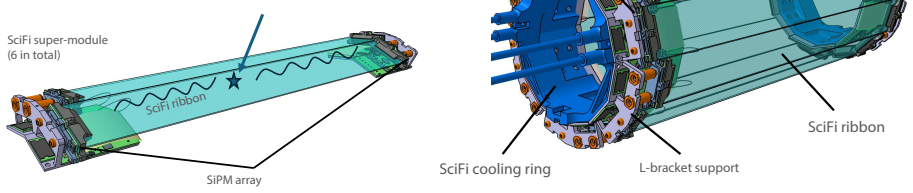
The load-bearing mechanism is the staggered three-layer fibre ribbon: a charged particle crossing 250 um SCSF-78 plastic scintillator excites light that is guided along the fibre to both ends, where silicon photomultiplier arrays convert the photons to electrical signals and the MuTRiG ASIC timestamps them. Reading both ends doubles the collected light and provides two time measurements per hit, which is what makes ~250 ps timing possible from a layer only 0.2% of a radiation length thick. The 3-layer stagger removes the gaps that a single layer of round fibres would have, so efficiency stays above 97% without adding material. The MuTRiG ASIC is the component that must carry this performance to the full 3072-channel system; the paper's key evidence that it works is the synchronized two-ribbon coincidence peak centred at zero.
What would settle it
Take one fully assembled production ribbon with final MuTRiG readout into a beam telescope with a reference time below 50 ps and measure the single-ribbon time resolution; if it is substantially worse than 250 ps, so that two ribbons in quadrature exceed the measured ~380 ps, the central performance claim fails.
Extended reading notes
Core claim
On the paper's own terms, the central discovery is that a compact detector made of three staggered layers of 250 um round scintillating fibres, read out at both ends by 128-channel silicon-photomultiplier arrays and the MuTRiG ASIC, delivers the timing, efficiency, position resolution, and thinness Mu3e requires. Each ribbon is 720 um thick and contributes about 0.2% of a radiation length; six supermodules, each holding two ribbons, cover the full solid angle. Beam tests with surrogate electronics establish the ~250 ps time resolution, >97% efficiency, and ~100 um spatial resolution, and a two-ribbon test with final MuTRiG readout measures a ~380 ps coincidence time spread that the paper attributes to the two per-module resolutions combining in quadrature plus jitter. The paper also reports that the cooling ring holds the readout electronics at about -18 C while dissipating 60 W, and that half the modules are already installed.
Load-bearing premise
The quoted 250 ps, >97% efficiency, and ~100 um performance were measured with surrogate electronics and earlier prototypes, and the paper assumes these numbers carry over to the final production ribbons read out by the MuTRiG ASIC; the only final-electronics timing measurement shown is a two-ribbon spread of ~380 ps, which is reconciled with 250 ps per ribbon only by assuming quadrature addition plus jitter.
Editorial extensions
If this is right
- If the quoted performance holds in the installed modules, Mu3e's inner timing layer will exceed the experiment's 500 ps requirement by a factor of about two, reducing combinatorial background in the rare-decay search.
- The successful two-ribbon MuTRiG beam test implies the final DAQ and front-end chain can time-align multiple detector technologies, a necessary step for combined pixel-fibre operation.
- With half the modules already installed and the cooling ring holding -18 C while dissipating 60 W, the SciFi detector is on track for cosmic-ray commissioning in early 2025 and first physics data in 2026.
- The demonstration that a 4-layer NOL-11 ribbon can reach ~200 ps marks a concrete upgrade path for later Mu3e phases.
Reading between the lines
- If the per-ribbon 250 ps resolution is eventually confirmed on final electronics, the same staggered-fibre geometry could serve as a general timing insert for other high-rate, low-material tracker environments, not only Mu3e; the trade-off between fibre diameter and light yield would need reoptimization for each application.
- Because the only final-electronics timing number is a two-ribbon coincidence spread, a natural next measurement is to timestamp single ribbons against a reference detector with the MuTRiG readout; that would convert the quadrature argument into a direct measurement and is testable before installation is complete.
- The paper's reliance on surrogate-electronics results suggests that cosmic-ray data in coincidence with the pixel detector, expected for early 2025, will be the real acceptance test for the 250 ps claim; a reader following the experiment should watch for that publication.
Editorial analysis
A structured set of objections, weighed in public.
Referee Report
Summary. This proceedings contribution reports the status and performance of the scintillating fibre (SciFi) timing detector for the Mu3e experiment. The detector consists of twelve ribbons, each made of three staggered layers of 250 μm round scintillating fibres read out at both ends by SiPM arrays and the MuTRiG ASIC. The paper recapitulates the detector design, quotes performance figures (time resolution around 250 ps, efficiency above 97%, spatial resolution about 100 μm, material budget below 0.2% X0), presents a beam-test measurement of the time difference between two ribbons using final MuTRiG readout, and describes the current integration status including the cooling ring and the readiness of half of the modules.
Significance. If the quoted performances are accurate, the SciFi detector will comfortably meet the Mu3e timing requirements and will not be a bottleneck for the 2025 data-taking run. The paper is a useful status summary for a collaboration-internal and conference audience, and it honestly identifies what was measured previously (with surrogate electronics, Ref. [6]) and what has been tested with final electronics (the two-ribbon coincidence in Fig. 3). Its main value is as a concise record of the detector's engineering readiness rather than as a new measurement paper. The central performance numbers are not, however, newly demonstrated here: the 250 ps timing, >97% efficiency, and ~100 μm spatial resolution all originate in earlier beam tests with prototype or surrogate readout, and the abstract does not make that provenance explicit.
major comments (3)
- [Section 2.1, Fig. 3] The only timing measurement with final MuTRiG electronics is a two-ribbon time-difference spread of ~380 ps. This does not by itself establish the 250 ps per-ribbon resolution claimed in the abstract; converting 380 ps to a per-ribbon value requires assuming the two ribbons have equal, independent Gaussian resolutions and that jitter and reference-time uncertainty are negligible. The paper should either show a single-ribbon timing resolution obtained with MuTRiG, state the reference-time and jitter contributions explicitly, or explicitly qualify the 250 ps figure as a surrogate-electronics result from Ref. [6] that is consistent with, but not re-measured in, the final-electronics test.
- [Abstract and Section 2.1] The abstract claims a spatial resolution of ~100 μm, but this quantity is never defined, measured, or cited anywhere in the body of the paper. The only resolution-related statements are the timing and efficiency figures from Ref. [6] and the new two-ribbon time-difference plot. Please either add the relevant measurement or a precise citation that demonstrates the ~100 μm value, explain how it relates to the 250 μm fibre diameter and three-layer staggering, or remove the claim from the abstract.
- [Section 2.1] The >97% efficiency is reported from Ref. [6] and was measured with surrogate electronics in a dedicated telescope setup. The abstract presents this as a current performance figure without qualification. The text should clearly separate quantities measured in this paper (the synchronization check of Fig. 3) from quantities established in previous beam tests, so that a reader does not infer that >97% efficiency has been re-established with the final MuTRiG readout and final production modules.
minor comments (5)
- [Section 1 vs Abstract] The abstract states that Mu3e is planned to start taking data in 2025, while Section 1 says 'first physics data in 2026'; please reconcile these dates.
- [Section 2] The sentence 'arranged to provide full 4π coverage' is imprecise for a cylindrical barrel detector surrounding the target; 'full azimuthal coverage' would be more accurate.
- [Figure 3] The two plots have no error bars, no quoted number of events, and no fit or width parameter beyond the '~380 ps' mentioned in the text; adding the standard deviation and event count would strengthen the result.
- [Throughout] There are several typographical and rendering issues, including '10 8' in the abstract (missing superscript), 'G´ en´ eral' in the author affiliation, and inconsistent treatment of 'de-excitation'; a careful proofreading pass is needed.
- [Section 2.1] The phrase 'This apparent increase in time resolution is expected' is confusing because a larger time-difference spread is an increase in the width, not an improvement in resolution; please rephrase to clarify that the two-module measurement convolves two per-ribbon resolutions.
Circularity Check
No circularity: the performance figures are external beam-test measurements cited from prior work, and the new final-electronics result is reported as a measured two-ribbon spread, not relabeled as the single-ribbon resolution.
full rationale
The paper is an engineering status report rather than a derivation. It contains no chain in which a predicted quantity is defined in terms of its own inputs, no fitted parameter that is later renamed as a prediction, and no imported uniqueness theorem. The headline performance values (time resolution ~250 ps, efficiency >97%, spatial resolution ~100 um) are asserted to come from earlier beam tests using surrogate electronics and a telescope reference time, with explicit pointers to Refs. [2,4,5,6]; these are external measurements, not computations performed inside this paper, and they are independent of the claims being made here. The only new final-electronics timing result, the ~380 ps spread of the time difference between two ribbons (Sec. 2.1, Fig. 3 left), is reported honestly as a two-module spread; the paper does not relabel it as the single-ribbon 250 ps resolution. Interpreting the two-ribbon spread as consistent with ~250 ps per ribbon requires a quadrature assumption, but that is an inference about consistency and a validation gap, not circularity. Although the cited performance papers share collaboration members with this report, they constitute independent support: they were made in dedicated telescope setups with reference timing and are externally falsifiable, so the self-citation is not load-bearing in a circular sense. The discrepancy between the abstract-level claim and the directly shown final-electronics measurement belongs to correctness risk, not to circularity.
Assumptions & free parameters
assumptions (2)
- ad hoc to paper Performance measured in earlier beam tests with surrogate electronics is representative of final production ribbons with MuTRiG readout.
- domain assumption Standard scintillation and SiPM response: light production, transport, and photodetection statistics produce the quoted timing and efficiency without substantial degradation.
Cite this review
Pith. "Pith review of Scintillating Fibre Detector for the Mu3e Experiment." pith.science (2026). https://pith.science/paper/ZZXKAPHT
@misc{pith2026250114692,
  author       = {Pith},
  title        = {Pith review of: Scintillating Fibre Detector for the Mu3e Experiment},
  year         = {2026},
  howpublished = {\url{https://pith.science/paper/ZZXKAPHT}},
  note         = {Machine review of arXiv:2501.14692}
}
abstract
We present a compact scintillating fibre timing detector developed for the Mu3e experiment. Mu3e is one of the flagship experiments of the Swiss particle physics scene, aiming to search for the charged lepton flavour violating (neutrinoless) muon decay $\mu^+ \rightarrow e^+e^-e^+$. Mu3e is planned to start taking data in 2025 at the Paul Scherrer Institute in Switzerland, using the most intense continuous surface muon beam in the world (10$^8$ muons per second). At the University of Geneva, together with partners from ETH Zurich, we are developing a scintillating fibre detector formed by staggering three layers of 250 $\mu m$ diameter round scintillating fibres. The fibre ribbons are coupled at both ends to multi-channel silicon photo-multiplier arrays, which are read out with the MuTRiG ASIC, specifically developed for this experiment. This presentation is focused on the performances of the scintillating fibre detector, notably on the time resolution around 250 ps, the efficiency greater than 97\% and the spatial resolution of $\sim$ 100 $\mu m$. In this presentation, we also include the challenges overcome to build this very thin scintillating fibre detector, having a thickness smaller than 0.2\% of the radiation length. Furthermore, we discuss the operation and performance of the MuTRiG ASIC, used for reading out the 3072 channels of the fibre detector.
Figures


Figures from the paper (2 more)


Reference graph
Works this paper leans on
- [6]
-
[1]
H. Augustin et al. The MuPix high voltage monolithic active pixel sensor for the Mu3e experiment . JINST , 10(03):C03044, 2015
work page 2015
-
[2]
A Timing Detector based on Scintillating Fibres for the Mu3e Experiment
Simon Corrodi. A Timing Detector based on Scintillating Fibres for the Mu3e Experiment . PhD thesis, ETH Zurich, 2018
work page 2018
-
[3]
K. Arndt et al. Technical design of the phase I Mu3e experiment . Nucl. Instrum. Meth. A , 1014:165679, 2021
work page 2021
-
[4]
Yannick Demets. Development, Construction, and Characterization of a Timing Detector based on Scintillating Fibers with Silicon Photomultiplier readout for the Mu3e Experiment at PSI . PhD thesis, University of Geneva, 2023
work page 2023
-
[5]
Development of the Scintillating Fiber Detector for Timing Measurements in the Mu3e Experiment
Antoaneta Damyanova. Development of the Scintillating Fiber Detector for Timing Measurements in the Mu3e Experiment . PhD thesis, University of Geneva, 2019
work page 2019
-
[7]
Huangshan Chen, Wei Shen, Konrad Briggl, Vera Stankova, Yonathan Munwes, David Schimansky, and Hans-Christian Schultz-Coulon. Characterization Measurement Results of MuTRiG - A Silicon Photomultiplier Readout ASIC with High Timing Precision and High Event Rate Capability . PoS , TWEPP-17:008, 2017
work page 2017
-
[8]
A. Damyanova, Development of the Scintillating Fiber Detector for Timing Measurements in the Mu3e Experiment , Phd thesis, University of Geneva (2019). @phdthesis Damyanova, author = "Damyanova, Antoaneta", title = " Development of the Scintillating Fiber Detector for Timing Measurements in the Mu3e Experiment ", doi = "10.13097/archive-ouverte/unige:1255...
Show all 9 references
-
[9]
Venturini, Antoine
Y. Demets, Development, Construction, and Characterization of a Timing Detector based on Scintillating Fibers with Silicon Photomultiplier readout for the Mu3e Experiment at PSI , Phd thesis, University of Geneva (2023). @article MEG, author = "Venturini, Antoine", collaborati...
2023 arXiv
Reviewed August 10, 2026 · model on record in the stance chip above.
Discussion (0). Continue with ORCID to comment.