REVIEW 4 major objections 6 minor 58 references
Optical clock based on two-photon spectroscopy of the nuclear transition in ion $^{229}$Th in a monochromatic field
T0 review · 4 major / 6 minor · reviewed 2026-08-10 · deepseek-v4-flash
Pith's one-line read A continuous 296.76 nm laser, at half the clock frequency, could drive the 148.38 nm nuclear transition in $^{229}$Th$^{2+}$ by two-photon absorption through the electron bridge.
desk verdict A concrete two-photon route to the 229Th clock that is worth engaging, but the central intensity estimate rests on an unverified hyperfine-mixing scale. read the letter →
The pith
A machine-rendered reading of the paper's core claim, the machinery that carries it, and where it could break.
The reading
What carries the argument
The central object is the electron bridge, described not by Feynman diagrams but by the hyperfine-interaction operator with magnetic and quadrupole parts, which mixes ion states that differ in nuclear spin ($I=5/2$ and $I=3/2$ in $^{229}$Th). The workhorse identity is the expression for the two-photon Rabi frequency in terms of small mixing parameters $u_\beta$ and $w_\xi$, combined with the exceptionally close intermediate level at 297.86 nm, only 1.1 nm away from the probe wavelength. This machinery converts a single vacuum-ultraviolet photon problem into a two-photon near-resonant Raman-like problem at 296.76 nm.
What would settle it
Spectroscopically resolve the $^{229}$Th$^{2+}$ hyperfine structure around the 297.86 nm intermediate level and measure the electron-bridge-induced decay of the $I=3/2$ clock state; if the off-diagonal hyperfine matrix elements turn out to be tens of megahertz rather than gigahertz, the required intensity rises by roughly four orders of magnitude and the scheme fails.
Extended reading notes
Core claim
The central claim is that the nuclear clock transition in $^{229}$Th$^{2+}$ at 148.38 nm can be driven by a monochromatic 296.76 nm field through a two-photon path. The field couples the ground electronic state to a near-resonant intermediate level at 297.86 nm, and the electron bridge — mixing of nuclear spin 5/2 and 3/2 states by the hyperfine interaction — supplies the second amplitude that connects the nuclear states. Treating hyperfine mixing with both magnetic and quadrupole parts of the hyperfine-interaction operator, the authors estimate a two-photon Rabi frequency of about 10 Hz at 10–100 kW/cm$^2$, and show that the quadrupole contribution to the bridge can be as important as the magnetic contribution.
Load-bearing premise
The off-diagonal hyperfine matrix elements that drive the electron bridge in $^{229}$Th$^{2+}$ are assumed to be gigahertz-scale, based on the size of hyperfine splittings rather than a direct calculation or measurement, and the two-photon Rabi frequency scales linearly with them.
Editorial extensions
If this is right
- If the intensity estimate holds, a single 1 W continuous laser focused to a 100 µm spot is enough to interrogate the nuclear clock transition, removing the need for a vacuum-ultraviolet clock laser.
- The near-resonant intermediate level at 297.86 nm, only 1.1 nm from the probe wavelength, is what makes the two-photon channel strong in $^{229}$Th$^{2+}$.
- The residual light shift, estimated up to about 1 kHz at a 10 Hz Rabi frequency, must be controlled by hyper-Ramsey or autobalanced Ramsey interrogation with a specific polarization geometry.
- For $^{229}$Th$^{3+}$ the same scheme would need much higher intensity because no comparable resonant intermediate state exists, while for $^{229}$Th$^{+}$ many bridge channels may shorten the upper clock-state lifetime.
- The upper clock state in $^{229}$Th$^{2+}$ must have a lifetime of at least 10 s for interrogation; the paper argues this is plausible but leaves the final check to experiment.
Reading between the lines
- If the gigahertz-scale hyperfine mixing is confirmed, the two-photon scheme would likely extend to $^{229}$Th$^{+}$ and possibly other charge states, but the upper-state lifetime would be the limiting factor.
- Because the quadrupole contribution can be comparable to the magnetic one, the electron-bridge amplitude should depend strongly on the hyperfine level $F$; mapping that $F$-dependence would test the model directly.
- In a solid-state host transparent near 296.76 nm and doped with $^{229}$Th$^{2+}$, the same mechanism could operate collectively, reducing the required intensity below the single-ion value because many ions contribute to the signal.
- The light-shift magnitude itself could serve as an indirect probe of the two-photon Rabi frequency before a full clock interrogation is attempted.
Signed reviews
Editorial analysis
A structured set of objections, weighed in public.
Referee Report
Summary. The paper proposes a scheme for two-photon spectroscopy of the 229Th nuclear clock transition (148.38 nm) using a monochromatic laser field at 296.76 nm in the doubly ionized ion 229Th2+. The mechanism relies on the electron bridge, formulated here through the hyperfine interaction operator, which mixes ionic states with different nuclear spins (I=5/2 and I=3/2). The authors derive general angular-momentum expressions for the hyperfine-induced mixing and for the resulting two-photon Rabi frequency, identify a near-resonant intermediate electronic state, and estimate that a laser intensity of 10-100 kW/cm2 would produce a clock Rabi frequency of about 10 Hz. They also discuss the associated light shift and the requirement that the upper clock state have a lifetime of at least 10 seconds.
Significance. If the central intensity estimate holds, the scheme would offer a practical route to nuclear optical clocks without vacuum-ultraviolet lasers, and the general formulation of the electron bridge in terms of the hyperfine interaction could be a useful theoretical contribution. The paper provides a clear derivation of the angular-momentum structure and correctly identifies the near-degenerate intermediate level as a key resource. However, the numerical claim is not yet supported by a quantitative calculation of the relevant matrix elements or a documented evaluation of the state sums; the significance therefore depends on future experimental or theoretical validation.
major comments (4)
- [§4, Eqs. (19)-(24) and the paragraph beginning 'Based on the above approach'] The central intensity estimate rests on the assertion that the off-diagonal hyperfine coupling matrix elements between states with different nuclear spin are of 'gigahertz order,' inferred from the magnitude of the hyperfine level splitting. However, the off-diagonal matrix elements in Eqs. (7) and (12) are products of nuclear reduced matrix elements and electronic matrix elements; they are not determined by the diagonal hyperfine splitting. The paper does not provide values or calculations for the electronic matrix elements K_{n'J',nJ} or Q^e_{n'J',nJ} for the specific states in Fig. 2, nor the hyperfine constants A and B for the (5f6d)^3H_4 and (5f7p) states. Because the two-photon Rabi frequency in Eq. (21) is linear in the mixing parameters u_beta and w_xi, an order-of-magnitude error in these matrix elements would change the required intensity by a large factor. A quantitative calculation or a clearly bounded estimate of the off-diagonal hyperfine matrix elements is needed to support the 10-100 kW/cm2 claim.
- [§4, Eqs. (23)-(24)] The total two-photon Rabi frequency is defined as a sum over intermediate states |beta>, |xi(m)>, and |alpha>, and the paper notes that destructive interference may occur. However, the sums are not evaluated, and the signs and relative magnitudes of the individual contributions are not shown. The mention of an 'accumulation effect' is speculative without such an evaluation. The authors should provide at least the dominant terms and an estimate of the net sum, or explicitly state that the interference pattern is unknown and quantify how this affects the intensity requirement.
- [§5, final paragraph before Conclusion] The proposed clock scheme requires that the upper isomeric state [I=3/2,(5f6d)^3H_4,F=11/2] have a lifetime of at least 10 seconds. The paper states only that this is 'quite possible' and that 'the final conclusion can be made only after direct experimental measurements.' This is a critical unverified assumption for a clock interrogation scheme. A firmer theoretical estimate or a discussion of how the clock performance depends on this lifetime is necessary, since a shorter lifetime would invalidate the proposed interrogation sequence.
- [§4, numerical estimates overall] No error bars or sensitivity analysis are provided for the intensity estimate. The result depends on several unmeasured or poorly constrained parameters: the off-diagonal hyperfine matrix elements, the non-diagonal nuclear quadrupole matrix element Q^(n)_{3/2,5/2}, the signs of interference in Eqs. (23)-(24), and the lifetime of the upper clock state. In the absence of such an analysis, the stated range of 10-100 kW/cm2 cannot be considered a robust prediction; the authors should show how the required intensity varies with these parameters or give a conservative upper bound.
minor comments (6)
- [Title and Abstract] The title contains a spacing typo ('nucle ar transition') and the abstract contains 'an result' and 'an result of'; these should be corrected.
- [§4, paragraph near Eq. (17)] The phrase 'cab be comparable' should read 'can be comparable'.
- [§1, reference [26]] Reference [26] is cited as 'Private communication from M. V. Okhapkin (2024)' to support the statement that efficient second-harmonic generation at the final step has not been realized. A private communication is not a verifiable source; please replace it with a published reference or remove the citation.
- [Fig. 2] Figure 2 is complex and the state labels are not fully explained in the caption. Since the dominant channels are central to the estimate, a table listing the relevant state energies, detunings, and (where available) dipole matrix elements would substantially improve readability and reproducibility.
- [§3, Eq. (16)] The lifetime T=2000 s in Eq. (16) is used to derive the off-diagonal nuclear magnetic moment, but the text later notes that the in-ion lifetime may be shortened by the electron bridge. It would be clearer to distinguish explicitly between the bare nuclear lifetime and the lifetime of the coupled ion-nucleus system.
- [§4, Eq. (20)] The expression for the laser field in the text uses 'Re{E0 e^{-iωt}}' while Eq. (20) uses 'E0 e^{-iωt} + c.c.'; the two conventions are equivalent but should be presented consistently to avoid confusion.
Circularity Check
No significant circularity: the 10-100 kW/cm2 estimate is a forward calculation from assumed hyperfine mixing and independently tabulated level data, not a fit to its own 10 Hz target.
full rationale
The central claim is the two-photon Rabi-frequency estimate built from Eqs. (19)-(24). The mixing parameters u_beta and w_xi are defined by hyperfine matrix elements divided by level spacings, and the paper assumes those matrix elements are of the gigahertz scale set by the hyperfine splitting. The claimed Omega_clock^(2-ph) ~ 10 Hz appears only as the output of this forward calculation; it is never used to set the coupling matrix elements or the detunings. Equations (11) and (14) re-express off-diagonal hyperfine matrix elements in terms of diagonal hyperfine shifts, using known angular-momentum algebra; this is a re-parameterization, not a fit, because the diagonal shifts are independent measured quantities cited to [37]. The near-resonant intermediate level at 297.86 nm and the strong E1 transition are taken from the NIST database [39], an external benchmark. The skeptical concern that the magnetic and quadrupole contributions are not separately determined affects the reliability of the gigahertz input but does not reduce the prediction to its own conclusion. Self-citations [29,40-45] occur in the historical background of two-photon proposals and in the discussion of hyper-Ramsey and autobalanced Ramsey methods for coping with light shifts; none is load-bearing for the intensity estimate, and no author-specific uniqueness theorem is invoked. The paper itself states that the final conclusion requires direct experimental measurement. Thus, the derivation chain is self-contained: no fitted parameter is renamed as a prediction and no equation is equal to its input by construction.
Assumptions & free parameters
free parameters (2)
- Hyperfine mixing scale V_hf in 229Th2+ =
~1 GHz (order of magnitude)
- Non-diagonal nuclear quadrupole matrix element Q^(n)_3/2,5/2 =
several eb, comparable to diagonal values (~3.15 eb and ~1.74 eb)
assumptions (5)
- domain assumption The nuclear magnetic matrix element mu_3/2,5/2 is obtained from the 2000 s isomeric lifetime via the radiative M1 formula (Eq. 16).
- domain assumption The electronic energy levels and transition wavelengths of 229Th2+ from the NIST database [39] are accurate enough that the 297.86 nm intermediate level differs from the probe wavelength by only 1.1 nm.
- ad hoc to paper Hyperfine off-diagonal coupling matrix elements in 229Th2+ are of gigahertz scale, comparable to the hyperfine splitting magnitude.
- ad hoc to paper The upper clock isomeric state in 229Th2+ has a lifetime of at least 10 s.
- domain assumption The non-diagonal nuclear quadrupole moment Q^(n)_3/2,5/2 is comparable to the diagonal quadrupole moments.
Cite this review
Pith. "Pith review of Optical clock based on two-photon spectroscopy of the nuclear transition in ion $^{229}$Th in a monochromatic field." pith.science (2026). https://pith.science/paper/VDMPR4YT
@misc{pith2026250115669,
  author       = {Pith},
  title        = {Pith review of: Optical clock based on two-photon spectroscopy of the nuclear transition in ion $^229$Th in a monochromatic field},
  year         = {2026},
  howpublished = {\url{https://pith.science/paper/VDMPR4YT}},
  note         = {Machine review of arXiv:2501.15669}
}
abstract
For the isotope $^{229}$Th we investigate the possibility of two-photon laser spectroscopy of the nuclear clock transition (148.38 nm) using intense monochromatic laser field at twice the wavelength (296.76 nm). Our estimates show that due to the electron bridge process in the doubly ionized ion $^{229}$Th$^{2+}$ the sufficient intensity of a continuous laser field is about 10-100 kW/cm$^2$, which is within the reach of modern laser systems. This unique possibility is an result of the presence in the electronic spectrum of the ion $^{229}$Th$^{2+}$ of an exceptionally close intermediate (for the two-photon transition) energy level, forming a strong dipole ($E1$) transition with the ground state at the wavelength of 297.86 nm, which differs from the probe field wavelength (296.76 nm) by only 1.1 nm. The obtained results can be used for the practical creation of ultra-precise nuclear optical clocks based on thorium-229 ions. Moreover, we develop an alternative approach to the description of the electron bridge phenomenon in an isolated ion (atom) using the hyperfine interaction operator, that is important for the general quantum theory of an atom. In particular, this approach shows that the contribution to the electron bridge from the nuclear quadrupole moment can be comparable to the contribution from the nuclear magnetic moment.
Figures

Reference graph
Works this paper leans on
-
[1]
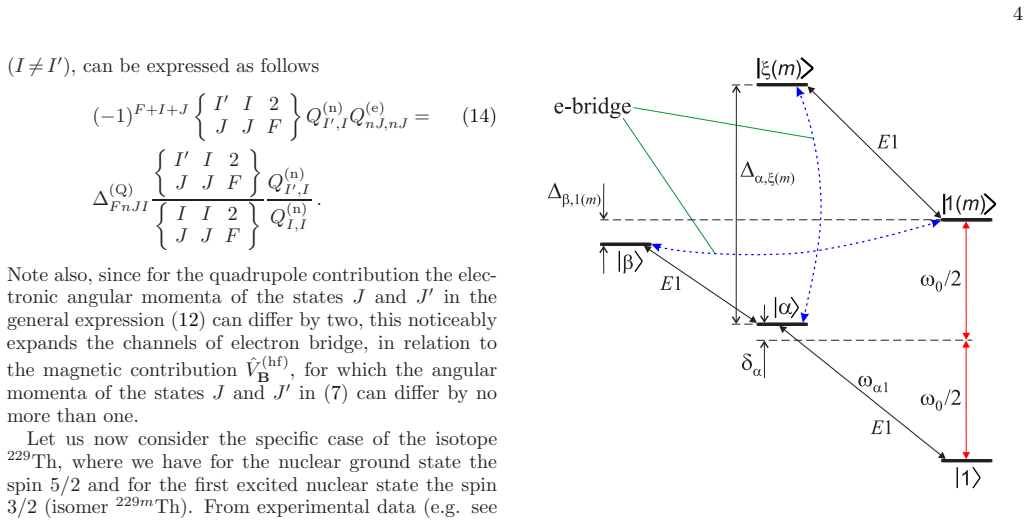
Here the states |1⟩, |α ⟩ and |β ⟩ are some selected energy states of the ion with the ground nuclear state ( I=5/2 in the case of the iso- tope 229Th), while the upper states |1(m)⟩ and |ξ(m)⟩ are states with the excited nuclear state ( I=3/2 for 229mTh). It is assumed that the transition |1⟩ ↔ |1(m)⟩ is a clock transition with frequency ω 0 (ω 0=2π × 20...
work page 2020
-
[2]
N. Hinkley, J. A. Sherman, N. B. Phillips, M. Schioppo, N. D. Lemke, K. Beloy, M. Pizzocaro, C. W. Oates, and A. D. Ludlow, Science 341, 1215 (2013)
work page 2013
-
[3]
between the electronic states |n′, J ′⟩ and |n, J ⟩. The electronic states and nuclear states must have in pairs the same parity, and their angular momenta can differ no more than one: |J − J ′| ≤ 1, |I − I ′| ≤ 1. In the case of diagonal matrix elements in ( 7), the value ∆ (µ ) F nJI = (−1)F +I+J { I I 1 J J F } µ I,I KnJ,nJ , (8) describes the hyperfine ...
-
[4]
S. M. Brewer, J.-S. Chen, A. M. Hankin, E. R. Clements, C. W. Chou, D. J. Wineland, D. B. Hume, and D. R. Leibrandt, Phys. Rev. Lett. 123, 033201 (2019)
2019
-
[5]
to the hyperfine inter- action operator is determined by matrix elements, which, in accordance with the known formulas of the quantum theory of angular momentum (see [36]), have the form ⟨F ′, m F ′, (n′, J ′), I ′| ˆV (hf) B |F, m F , (n, J ), I ⟩ = (7) δF ′F δmF ′ mF (−1)F +I+J ′ { I ′ I 1 J J ′ F } µ I ′,I Kn′J ′,nJ , where µ I ′,I ≡⟨I ′|| ˆµ ||I⟩ is th...
-
[6]
con- tains the contributions to the hyperfine interaction from all electrons. Let us show that the operator ˆV (hf) B , represented in the form ( 5), also allows to describe the connection be- tween the states of an ion (atom) with different nu- cleus spin I, i.e. the electron bridge. For this pur- pose, let us consider the energy structure of the ion (atom...
-
[7]
can differ by two, this noticeably expands the channels of electron bridge, in relation to the magnetic contribution ˆV (hf) B , for which the angular momenta of the states J and J ′ in (
-
[8]
can differ by no more than one. Let us now consider the specific case of the isotope 229Th, where we have for the nuclear ground state the spin 5/2 and for the first excited nuclear state the spin 3/2 (isomer 229mTh). From experimental data (e.g. see [37]), we have the values of nuclear g-factors g5/ 2= 0.36 and g3/ 2=−0. 37, which in accordance with (
Show all 58 references
-
[9]
E. V. Tkalya, Physics – Uspekhi 46, 315 (2003)
2003
-
[10]
61µ N, µ 3/ 2, 3/ 2 = −1
leads to the following diagonal reduced matrix elements µ 5/ 2, 5/ 2 = 2. 61µ N, µ 3/ 2, 3/ 2 = −1. 43µ N. (15) As for the non-diagonal reduced matrix element µ 3/ 2, 5/ 2, responsible for the entanglement of atomic states with different nuclear spins (i.e. the electron bridge)...
2000
-
[11]
Moreover, such states with the nuclear spin I=5/2, which are relatively close to the upper clock level [I=3/2, (5f 6d) 3H 4], are quite numerous
for this con- tribution. Moreover, such states with the nuclear spin I=5/2, which are relatively close to the upper clock level [I=3/2, (5f 6d) 3H 4], are quite numerous. This, due to the accumulation effect, can also lead to an increase of the total two-photon Rabi frequency (...
-
[12]
they also contribute to the elec- tronic bridge together with the magnetic contribution
describe the entanglement of states with differ- ent nuclear spins, i.e. they also contribute to the elec- tronic bridge together with the magnetic contribution. In particular, if the value of the quadrupole contribu- tion to the hyperfine shift ∆ (Q) F nJI is known [see ( 13)],...
-
[13]
with the spin of the nucleus I=3/2, we have presented in Fig. 2 the state with the electronic config- uration (5 f 7p) (7/ 2, 1/ 2) and the electronic angular mo- mentum J=4, where there is a necessary hyperfine level with the total angular momentum F =11/2, coupled by the elect...
-
[14]
In the ion 229Th2+, there are also several such states, similar to the intermediate isomeric state |ξ(m)⟩ in Fig
and (22)]. In the ion 229Th2+, there are also several such states, similar to the intermediate isomeric state |ξ(m)⟩ in Fig. 1. Based on the above approach to the description of the electron bridge through the hyperfine interaction oper- ator ( 1), we can estimate the magnitude...
2000
-
[15]
Riehle, Frequency Standards: Basics and Applications (Wiley-VCH, Weinheim, 2005)
F. Riehle, Frequency Standards: Basics and Applications (Wiley-VCH, Weinheim, 2005)
2005
-
[16]
Huntemann, C
N. Huntemann, C. Sanner, B. Lipphardt, C. Tamm, and E. Peik, Phys. Rev. Lett. 116, 063001 (2016)
2016
-
[17]
Aeppli, K
A. Aeppli, K. Kim, W. Warfield, M. S. Safronova, and J. Ye, Phys. Rev. Lett. 133, 023401 (2024)
2024
-
[18]
H. N. Hausser, J. Keller, T. Nordmann et al., Phys. Rev. Lett. 134, 023201 (2025)
2025
-
[19]
Kozlov, M
M. Kozlov, M. Safronova, J. R. Crespo L´ opez-Urrutia, and P. Schmidt, Rev. Mod. Phys. 90, 045005 (2018)
2018
-
[20]
C. Lyu, C. H. Keitel, and Z. Harman, Commun. Phys. 8, 3 (2025)
2025
-
[21]
In addition, as another level, which is similar to the state |β ⟩ in Fig
and ( 22)]. In addition, as another level, which is similar to the state |β ⟩ in Fig. 1, we presented the state [ I=5/2,(5f 7d)(5/ 2, 3/ 2) J=3] with the elec- tronic configuration (5 f 7d) (5/ 2, 3/ 2) and electron an- gular momentum J=3. This level is distinguished by the rel...
-
[22]
E. V. Tkalya, JETP Lett. 55, 211 (1992)
1992
-
[23]
Peik, Chr
E. Peik, Chr. Tamm, Europhys. Lett. 61, 181 (2003)
2003
-
[24]
C. J. Campbell, A. G. Radnaev, A. Kuzmich, V. A. Dzuba, V. V. Flambaum, and A. Derevianko, Phys. Rev. Lett. 108, 120802 (2012)
2012
-
[25]
G. A. Kazakov, A. N. Litvinov, V. I. Romanenko, L. P. Yatsenko, A. V. Romanenko, M. Schreitl, G. Winkler, and T. Schumm, New J. Phys. 14, 083019 (2012)
2012
-
[26]
R. G. Helmer and C.W. Reich, Phys. Rev. C 49, 1845 (1994)
1994
-
[27]
Z. O. Guimaraes-Filho, Phys. Rev. C 71, 044303 (2005)
2005
-
[28]
B. R. Beck, J. A. Becker, P. Beiersdorfer, G. V. Brown, K. J. Moody, J. B. Wilhelmy, F. S. Porter, C. A. Kilbourne, and R. L. Kelley, Phys. Rev. Lett. 98, 142501 (2007)
2007
-
[29]
B. R. Beck, J. A. Becker, P. Beiersdorfer, G. V. Brown, K. J. Moody, C. Y. Wu, J. B. Wilhelmy, F. S. Porter, C. A. Kilbourne, R. L. Kelley, Lawrence Livermore National Laboratory Report No. LLNL-PROC-415170 (2009). https://ebit.llnl.gov/publications
2009
-
[30]
Seiferle, L
B. Seiferle, L. von der Wense, P. V. Bilous, I. Amersdorf- fer, C. Lemell, F. Libisch, S. Stellmer, T. Schumm, C. E. D¨ ullmann, A. P´ alffy, and P. G. Thirolf, Nature573, 243 (2019)
2019
-
[31]
Yamaguchi, H
A. Yamaguchi, H. Muramatsu, T. Hayashi, N. Yuasa, K. Nakamura, M. Takimoto, H. Haba, K. Konashi, M. Watanabe, H. Kikunaga, K. Maehata, N. Y. Yamasaki, and K. Mitsuda, Phys. Rev. Lett. 123, 222501 (2019)
2019
-
[32]
Sikorsky, J
T. Sikorsky, J. Geist, D. Hengstler, S. Kempf, L. Gastaldo, C. Enss, C. Mokry, J. Runke, C. E. D¨ ullmann, P. Wobrauschek, K. Beeks, V. Rosecker, J. H. Sterba, G. Kazakov, T. Schumm, and A. Fleischmann, Phys. Rev. Lett. 125, 142503 (2020)
2020
-
[33]
Kraemer, J
S. Kraemer, J. Moens, M. Athanasakis-Kaklamanakis, et al., Nature 617, 706 (2023)
2023
-
[34]
Tiedau, M
J. Tiedau, M. V. Okhapkin, K. Zhang, et al., Phys. Rev. Lett. 132, 182501 (2024)
2024
-
[35]
Elwell, Chr
R. Elwell, Chr. Schneider, J. Jeet, et al., Phys. Rev. Lett. 133, 013201 (2024)
2024
-
[36]
Zhang, T
C. Zhang, T. Ooi, J. S. Higgins, J. F. Doyle, L. von der Wense, K. Beeks, A. Leitner, G. A. Kazakov, P. Li, P. G. Thirolf, T. Schumm, and J. Ye, Nature 633, 63 (2024)
2024
-
[37]
Zhang, L
C. Zhang, L. von der Wense, J. F. Doyle, J. S. Higgins, T. Ooi, H. U. Friebel, J. Ye, R. Elwell, J. E. S. Terhune, H. W. T. Morgan, A. N. Alexandrova, H. B. Tran Tan, A. Derevianko, and E. R. Hudson, Nature 636, 603 (2024)
2024
-
[38]
Private communication from M. V. Okhapkin (2024)
2024
-
[39]
S. G. Porsev, V. V. Flambaum, E. Peik, and C. Tamm, Phys. Rev. Lett. 105, 182501 (2010)
2010
-
[40]
R. A. M¨ uller, A. V. Volotka, A. Surzhykov, Phys. Rev. 8 A 99, 042517 (2019)
2019
-
[41]
P. V. Borisyuk, N. N. Kolachevsky, A. V. Taichenachev, E. V. Tkalya, I. Yu. Tolstikhina, and V. I. Yudin, Phys. Rev. C 100, 044306 (2019)
2019
-
[42]
Cai, G.-Q
N.-Q. Cai, G.-Q. Zhang, C.-B. Fu, and Y.-G. Ma, Nucl. Sci. Tech. 32, 59 (2021)
2021
-
[43]
F. F. Karpeshin, Physics of Atomic Nuclei 87, 586 (2024)
2024
-
[44]
V. A. Krutov and V. N. Fomenko, Ann. der Phys. 21, 291 (1968)
1968
-
[45]
Hinneburg, M
D. Hinneburg, M. Nagel, and G. Brunner, Z. Phys. A 291, 113 (1979)
1979
-
[46]
Hinneburg, Z
D. Hinneburg, Z. Phys. A 300, 129 (1981)
1981
-
[47]
V. F. Strizhov and E. V. Tkalya, Sov. Phys. JETP 72, 387 (1991)
1991
-
[48]
D. A. Varshalovich, A. N. Moskalev, V. K. Khersonsky, Quantum Theory of Angular Momentum (World Scien- tific, Singapore, 1988)
1988
-
[49]
Beeks, T
K. Beeks, T. Sikorsky, T, Schumm, J. Thielking, M. V. Okhapkin, and E. Peik, Nature Rev. Phys. 3, 238 (2021)
2021
-
[50]
Yamaguchi, Y
A. Yamaguchi, Y. Shigekawa, H. Haba, H. Kikunaga, K. Shirasaki, M. Wada, and H. Katori, Nature 629, 62 (2024)
2024
-
[51]
Atomic Spectra Database, NIST Standard Reference Database, DOI: https://dx.doi.org/10.18434/T4W30F
-
[52]
V. I. Yudin, A. V. Taichenachev, C. W. Oates, Z. W. Barber, N. D. Lemke, A. D. Ludlow, U. Sterr, Ch. Lisdat, and F. Riehle, Phys. Rev. A 82, 011804(R) (2010)
2010
-
[53]
Huntemann, B
N. Huntemann, B. Lipphardt, M. Okhapkin, Chr. Tamm, E. Peik, A. V. Taichenachev, and V. I. Yudin, Phys. Rev. Lett. 109, 213002 (2012)
2012
-
[54]
Hobson, W
R. Hobson, W. Bowden, S. A. King, P. E. G. Baird, I. R. Hill, and P. Gill, Phys. Rev. A 93, 010501(R) (2016)
2016
-
[55]
Zanon-Willette, R
T. Zanon-Willette, R. Lefevre, R. Metzdorff, N. Silli- toe, S. Almonacil, M. Minissale, E. de Clercq, A. V. Taichenachev, V. I. Yudin, and E. Arimondo, Rep. Prog. Phys. 81, 094401 (2018)
2018
-
[56]
Sanner, N
Ch. Sanner, N. Huntemann, R. Lange, Ch. Tamm, and E. Peik, Phys. Rev. Lett. 120, 053602 (2018)
2018
-
[57]
V. I. Yudin, A. V. Taichenachev, M. Yu. Basalaev, T. Zanon-Willette, J. W. Pollock, M. Shuker, E. A. Donley, and J. Kitching, Phys. Rev. Appl. 9, 054034 (2018)
2018
-
[58]
M. S. Safronova and U. I. Safronova, Phys. Rev. A 87, 062509 (2013)
2013
Reviewed August 10, 2026 · model on record in the stance chip above.
Discussion (0). Continue with ORCID to comment.