REVIEW 4 major objections 6 minor 41 references
Drop size distribution from laboratory experiments based on single-drop fragmentation and comparison with aerial in-situ measurements
T0 review · 4 major / 6 minor · reviewed 2026-08-10 · deepseek-v4-flash
Pith's one-line read Laboratory drop fragmentation, modelled with a two-parameter gamma distribution, recovers the Marshall-Palmer raindrop-size law and matches in-situ aerial data.
desk verdict New lab DSD data and a plausible rain-model application, but Eq. (14) is currently an assertion until the characteristic sizes and gamma parameters are reported. read the letter →
The pith
A machine-rendered reading of the paper's core claim, the machinery that carries it, and where it could break.
The reading
What carries the argument
The central object is the two-parameter gamma distribution $P(x = d/d_{\rm avg}) = x^{\alpha-1}e^{-x/\beta}/(\beta^{\alpha}\Gamma(\alpha))$, with shape $\alpha = (\bar{x}/s)^2$ and rate $\beta = s^2/\bar{x}$, where $\bar{x}$ and $s$ are the mean and standard deviation of eleven characteristic fragment sizes. Four sizes come from bag rupture (bag thickness, receding-rim thickness, the Rayleigh-Plateau ligament size, and satellite droplets), four from rim fragmentation (rim-thickness size, receding-rim collision size, and two satellite corrections), and three from node breakup at minimum, mean, and maximum node volume fractions. This replaces the single-parameter gamma model in which $\alpha = \beta$, and it turns the previously assumed average drop diameter into a computed output. The distribution is then fed through the rainfall-rate integral (Eq. 2) to reach the Marshall-Palmer-type law.
What would settle it
Measure the full child-drop size distribution for the three Weber numbers (9.38, 16.9, 18.9) with the same holography setup, recompute the eleven characteristic sizes from the cited formulas, and check whether the gamma distribution with $\alpha=(\bar{x}/s)^2$ and $\beta=s^2/\bar{x}$ reproduces the measured tail at $d/d_{\rm avg}\approx 7.3$ within a few percent; if the tail deviates by more than the claimed 7\%, the Marshall-Palmer match is not established.
Extended reading notes
Core claim
The central claim is that all breakup modes contribute characteristic sizes that, combined in a two-parameter gamma distribution, predict the full child-drop size distribution, and that this distribution matches both laboratory measurements and the standard steady-rain relation. Computing the integral in Eq. (2) with the model gives $d_{\rm avg}^{-1} = 40R^{-0.21}$, so the average drop diameter tracks rainfall rate with the same exponent (0.21) as Marshall-Palmer and a coefficient of 40 versus 41. At large normalized sizes ($d/d_{\rm avg} = 7.3$), the model deviates from Marshall-Palmer by 6.6--7.6\%, while the single-parameter gamma model deviates by 24--27\%. The same distribution is then compared with in-situ DSD measurements from three research flights, with which it shows satisfactory alignment.
Load-bearing premise
A two-parameter gamma distribution whose shape and rate are fixed by the mean and standard deviation of eleven theoretically estimated characteristic sizes captures the full measured child-drop distribution, including the large-drop tail used for the Marshall-Palmer comparison.
Editorial extensions
If this is right
- The model yields $d_{\rm avg}^{-1}=40R^{-0.21}$, effectively recovering Marshall-Palmer's $41R^{-0.21}$ for steady rain.
- At the large-drop end ($d/d_{\rm avg}\approx 7.3$), the model stays within about 7\% of Marshall-Palmer across all three breakup modes, whereas the single-parameter model deviates by 24--27\%.
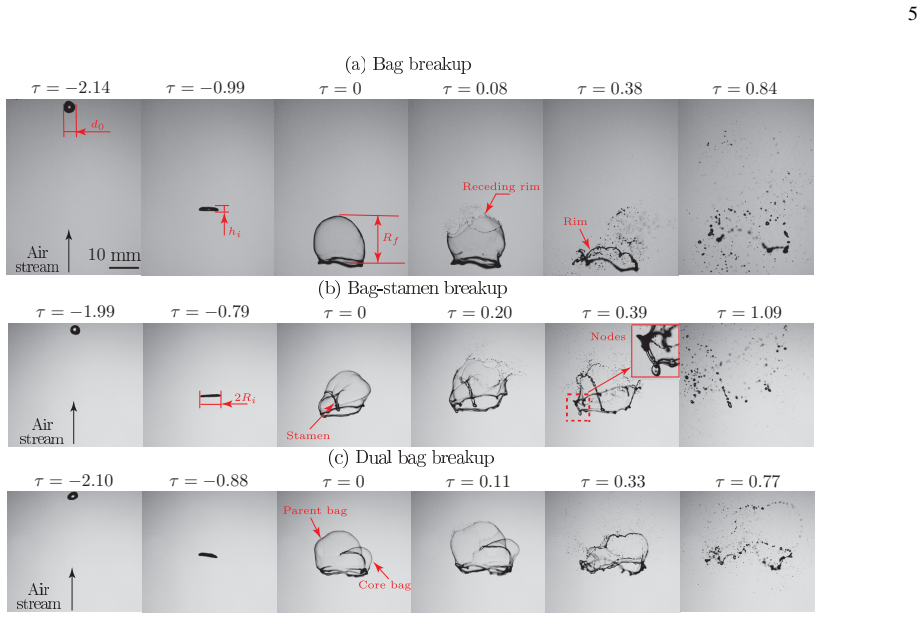
- The same two-parameter distribution describes bag, bag-stamen, and dual-bag breakup, suggesting the eleven characteristic sizes capture the breakup physics relevant to rain.
- In-situ drop spectra from the three CAIPEEX flights fall within the envelope of the laboratory and theoretical distributions, supporting laboratory-scale experiments for rainfall modelling.
- Radar-relevant quantities such as the sixth moment of the drop size distribution can be computed from the model rather than assumed as input.
Reading between the lines
- If the eleven characteristic sizes can be predicted across the Weber-number range rather than measured case by case, the model could extend to unsteady or intense rain without in-situ calibration.
- The comparison with flight data is visual and qualitative; a quantitative, altitude-resolved test against the CAIPEEX spectra would be a sharper check of the model's tail behaviour.
- The model's fidelity at large $d/d_{\rm avg}$ could be tested directly by computing the sixth moment $\int d^6 P(d)\,dd$ from the holography data and comparing it with radar reflectivity--rain-rate relations.
- A natural extension is to test whether the same gamma parameters also describe DSDs altered by collisional breakup or mixed-phase microphysics, processes the paper itself lists as unaddressed.
Signed reviews
Editorial analysis
A structured set of objections, weighed in public.
Referee Report
Summary. This paper reports laboratory experiments on the fragmentation of single water drops in an upward airstream at three Weber numbers (We = 9.38, 16.9, and 18.9), corresponding to bag, bag-stamen, and dual-bag breakup morphologies. The child-drop size distributions are measured using shadowgraphy and machine-learning-assisted digital in-line holography. The authors then construct a two-parameter gamma distribution model, Eq. (4), whose parameters are derived from the mean and standard deviation of eleven characteristic breakup sizes taken from the bag, rim, and node fragmentation modes. They claim that this model reproduces the experimental distributions, and that evaluating the integral in Eq. (2) yields the Marshall-Palmer-like relation d_avg^{-1} = 40 R^{-0.21} (Eq. (14)). The paper also compares the resulting drop size distributions with in-situ raindrop measurements from the CAIPEEX research flights. The central claims are that a lab-derived, breakup-based model can predict the steady-rain drop size distribution and that the model matches aerial observations.
Significance. If the central derivation and comparisons are correct, the paper offers a potentially important bridge between single-drop fragmentation physics and operational rainfall parameterization: a model that estimates davg from measurable breakup mechanisms without treating it as an unknown input. The experimental data set, which combines controlled lab breakup with in-situ aircraft measurements, is a valuable resource, and the use of holography with a U-Net segmentation pipeline is a methodological strength. However, the main quantitative result, Eq. (14), is not verifiable from the preprint as written, and the parameterization in Eq. (4) contains a dimensional ambiguity. The significance of the paper in its current form is therefore conditional on a revised and fully documented derivation.
major comments (4)
- [Section IV, Eq. (14)] The computation of the integral in Eq. (2) that leads to Eq. (14) is not reported. The eleven characteristic sizes, the resulting mean and standard deviation, the values of alpha and beta for each Weber number, and the numerical value of the integral are all absent. The coefficient 40 in Eq. (14) therefore cannot be checked. The manuscript must specify how the three Weber-number cases (We = 9.38, 16.9, and 18.9), which have distinct gamma parameters, are combined into a single power law with fixed constants; if one representative case is used, that choice must be justified.
- [Section IV, Eq. (4)] The definitions alpha = (xbar/s)^2 and beta = s^2/xbar are dimensionally inconsistent as written. The text states that xbar and s are the mean and standard deviation of the eleven characteristic sizes, which are measured in micrometers, but the variable x = d/davg in Eq. (4) is dimensionless. If xbar and s are meant to be normalized by davg, that normalization is not stated. Moreover, because davg is set equal to the arithmetic mean of the characteristic sizes, the normalized mean is identically 1, which reduces the gamma distribution to a single-parameter form; this reduction needs to be acknowledged and the subsequent parameter counting made explicit.
- [Section IV, Eqs. (2) and (14)] The value n0 = 0.08 cm^-4 is taken from the Marshall-Palmer empirical fit and inserted into Eq. (2). Since Eq. (14) is then compared with the Marshall-Palmer relation, the comparison is partly anchored by the chosen n0. The authors should either derive n0 from the fragmentation model or clearly label it as an external input, and they should report the sensitivity of Eq. (14) to a realistic range of n0 values.
- [Section V, Figure 6] The conversion of the CAIPEEX in-situ droplet concentration data C(d) into the normalized distribution P(x) plotted in Figure 6 is not described. In particular, the authors do not state how davg is estimated from the measured size-resolved concentrations or how the normalization is performed. Without this information, the claimed 'satisfactory alignment' between the laboratory model and the aerial data cannot be quantitatively assessed.
minor comments (6)
- [Section IV] The phrase 'we compute the integral R x^{7/2} P(x) x. in Eq. (2)' is malformed; it should read 'the integral \int x^{7/2} P(x) dx in Eq. (2)'.
- [Section II and Figure 3 caption] The initial droplet diameter is stated as 3.6 ± 0.08 mm in the main text but as 3.6 ± 0.06 mm in the caption of Figure 3; please reconcile the uncertainty.
- [Section VI] The sentence fragment '7 also emphasized the importance...' should be rephrased, for example as 'Villermaux and Bossa also emphasized the importance...'.
- [Section II] The description 'n0 is the average spatial density of drops (measured in cm^-4)' is ambiguous; n0 is the intercept of the number concentration per unit size interval per unit volume, and the text should use standard terminology.
- [Section IV] The statement 'All characteristic sizes are measured in µm' should be accompanied by explicit unit conversions, since davg in Eq. (14) is in centimetres and R in mm/hr.
- [Section V, Figure 6] The shaded envelope in Figure 6 is not defined in the caption; specify whether it covers the full range of scattered data points, a percentile interval, or the combined range of all in-situ and laboratory data.
Circularity Check
Eq. (14)'s exponent 0.21 is inherited from Marshall-Palmer/Villermaux-Bossa, while true inversion of Eq. (2) gives 2/9; the headline agreement is partly an input, not an output.
-
fitted input called prediction
[Section IV, Eq. (14); Section I, Marshall-Palmer parameters]
"Marshall and Palmer 5 found that for steady rainfall, n0 = 0.08 cm−4, Λ = 41, and a = 0.21. ... d−1 avg = 48.5R−2/9 (i.e. Λ = 48.5 and a = 2/9). ... we compute the integral ... in Eq. (2), leading to the relationship ... d−1 avg = 40R−0.21, such that Λ = 40 and a = 0.21. This relationship closely matches the one proposed by Marshall and Palmer for steady rain5"
Eq. (2) has the form R = C d_avg^(9/2) I with I a constant from the normalized P(x); inverting gives d_avg^(-1) = C' R^(-2/9) for any normalized P(x). The exponent 0.21 reported in Eq. (14) is therefore not an output of the authors' gamma model: the actual computed exponent is 2/9 ≈ 0.222. The paper instead reports a = 0.21, exactly the Marshall-Palmer input quoted earlier, and it feeds n0 = 0.08 cm^-4 from Marshall-Palmer into the same Eq. (2). The central 'prediction' d_avg^(-1) = 40 R^(-0.21) thus reduces to the Marshall-Palmer parameters used as inputs; the exponent is forced and the prefactor is anchored by the chosen n0.
full rationale
The paper's shape-level comparison in Fig. 5 is a genuine, externally anchored exercise: a two-parameter gamma distribution with parameters derived from characteristic breakup sizes is compared with measured P(x), and this does not reduce to fitting the target DSD. However, the central quantitative rainfall claim, Eq. (14), is not an independent prediction. Eq. (2), taken from Villermaux and Bossa, already imposes d_avg^(-1) proportional to R^(-2/9) for any normalized P(x). The authors state 2/9 for the Villermaux-Bossa result but then report a = 0.21 after evaluating their integral; 0.21 is the Marshall-Palmer exponent, not 2/9. The prefactor 40 is similarly computed using n0 = 0.08 cm^-4 taken from Marshall-Palmer, so the 'close agreement' of the prefactor with Marshall-Palmer's Λ = 41 is partly anchored by that input. In addition, the eleven characteristic sizes, the resulting α and β values, and the integral I are never reported, and Eq. (4)'s parameter definitions are dimensionally inconsistent as written (if x̄ and s are in µm, β has units of length and P(x) is not a properly normalized density in dimensionless x). These omissions prevent independent verification of the derived Λ = 40 but are verifiability concerns rather than the core circularity. The central exponent reduction warrants a score of 6: one or more headline predictions reduce by construction to inputs, while there remains independent content in the shape comparison and experimental data.
Assumptions & free parameters
free parameters (2)
- n0, spatial density of drops =
0.08 cm^-4
- Vn, node volume fractions =
0.2, 0.4, 1.0
assumptions (5)
- domain assumption The child-drop number size distribution follows a two-parameter gamma distribution.
- domain assumption Eleven characteristic sizes from bag, rim, and node breakup are sufficient to determine the full drop size distribution.
- domain assumption Villermaux-Bossa Eq (2) correctly relates rainfall rate to average droplet diameter.
- domain assumption A drop in a counter-current airstream is analogous to a raindrop falling in quiescent air.
- domain assumption CIP and PIP in-situ measurements represent raindrop size distributions at altitude.
Cite this review
Pith. "Pith review of Drop size distribution from laboratory experiments based on single-drop fragmentation and comparison with aerial in-situ measurements." pith.science (2026). https://pith.science/paper/FF3BSB3F
@misc{pith2026250116686,
  author       = {Pith},
  title        = {Pith review of: Drop size distribution from laboratory experiments based on single-drop fragmentation and comparison with aerial in-situ measurements},
  year         = {2026},
  howpublished = {\url{https://pith.science/paper/FF3BSB3F}},
  note         = {Machine review of arXiv:2501.16686}
}
read the original abstract
Laboratory experiments and theoretical modelling are conducted to determine the raindrop size distribution (DSD) resulting from distinct fragmentation processes under various upward airstreams. Since weather radar echoes are proportional to the sixth power of the average droplet diameter, understanding the fragmentation mechanisms that lead to different breakup sizes is crucial for accurate rainfall predictions. We utilize a two-parameter gamma distribution for theoretical modelling and estimate the average droplet diameter from the theoretically obtained characteristic sizes, often treated as assumed input parameters for different rain conditions in rainfall modelling. Our experimental and theoretical findings demonstrate a close agreement with the DSD predicted by the Marshall and Palmer relationship for steady rain conditions. Additionally, in situ DSD measurements at different altitudes were obtained through research flights equipped with advanced sensors, further validating our rainfall model. This study underscores the effectiveness of laboratory-scale experiments and the critical importance of accurately characterizing DSD to enhance rainfall predictions.
Figures


Figures from the paper (3 more)


Reference graph
Works this paper leans on
-
[1]
author author P. J. \ Marinescu , author P. C. \ Kennedy , author M. M. \ Bell , author A. J. \ Drager , author L. D. \ Grant , author S. W. \ Freeman , \ and\ author S. C. \ van den Heever ,\ title title Updraft vertical velocity observations and uncertainties in high plains supercells using radiosondes and radars , \ @noop journal journal Mon. Weather R...
work page 2020
-
[2]
author author D. J. \ Musil , author A. J. \ Heymsfield , \ and\ author P. L. \ Smith ,\ title title Microphysical characteristics of a well-developed weak echo region in a high plains supercell thunderstorm , \ @noop journal journal J. Climate Appl. Meteor. \ volume 25 ,\ pages 1037--1051 ( year 1986 ) NoStop
work page 1986
-
[3]
author author R. Uijlenhoet ,\ title title Raindrop size distributions and radar reflectivity--rain rate relationships for radar hydrology , \ @noop journal journal Hydrol. Earth Syst. Sci. \ volume 5 ,\ pages 615--628 ( year 2001 ) NoStop
work page 2001
-
[4]
author author J. O. \ Laws \ and\ author D. A. \ Parsons ,\ title title The relation of raindrop-size to intensity , \ @noop journal journal Trans. Am. Geophys. Union. \ volume 24 ,\ pages 452--460 ( year 1943 ) NoStop
work page 1943
-
[5]
author author J. S. \ Marshall \ and\ author W. M. \ Palmer ,\ title title The distribution of raindrops with size , \ @noop journal journal J. Meteorol. \ volume 5 ,\ pages 165--166 ( year 1948 ) NoStop
work page 1948
-
[6]
author author M. K. \ Yau \ and\ author R. R. \ Rogers ,\ @noop title A short course in cloud physics \ ( publisher Elsevier ,\ year 1996 ) NoStop
work page 1996
-
[7]
author author E. Villermaux \ and\ author B. Bossa ,\ title title Single-drop fragmentation determines size distribution of raindrops , \ @noop journal journal Nat. Phys. \ volume 5 ,\ pages 697--702 ( year 2009 ) NoStop
work page 2009
-
[8]
Stochastic Theory of the Size Distribution of Raindrops
author author M. Mezhericher \ and\ author H. A. \ Stone ,\ title title Size distribution of raindrops , \ @noop journal journal arXiv preprint arXiv:2204.03151 \ ( year 2022 ) NoStop
work page Pith review arXiv 2022
Show all 41 references
-
[9]
Pilch \ and\ author C
author author M. Pilch \ and\ author C. A. \ Erdman ,\ title title Use of breakup time data and velocity history data to predict the maximum size of stable fragments for acceleration-induced breakup of a liquid drop , \ @noop journal journal Int. J. Multiphase Flow \ volume 13...
1987
-
[10]
author author X. K. \ Cao , author Z. G. \ Sun , author W. F. \ Li , author H. F. \ Liu , \ and\ author Z. H. \ Yu ,\ title title A new breakup regime of liquid drops identified in a continuous and uniform air jet flow , \ @noop journal journal Phys. Fluids \ volume 19 ,\ page...
2007
-
[11]
author author D. R. \ Guildenbecher , author C. L \'o pez-Rivera , \ and\ author P. E. \ Sojka ,\ title title Secondary atomization , \ @noop journal journal Exp. Fluids \ volume 46 ,\ pages 371--402 ( year 2009 ) NoStop
2009
-
[12]
Suryaprakash \ and\ author G
author author R. Suryaprakash \ and\ author G. Tomar ,\ title title Secondary breakup of drops , \ @noop journal journal J. Indian Inst. Sci. \ volume 99 ,\ pages 77--91 ( year 2019 ) NoStop
2019
-
[13]
author author S. K. \ Soni , author P. K. \ Kirar , author P. Kolhe , \ and\ author K. C. \ Sahu ,\ title title Deformation and breakup of droplets in an oblique continuous air stream , \ @noop journal journal Int. J. Multiphase Flow \ volume 122 ,\ pages 103141 ( year 2020 ) NoStop
2020
-
[14]
author author P. K. \ Kirar , author S. K. \ Soni , author P. S. \ Kolhe , \ and\ author K. C. \ Sahu ,\ title title An experimental investigation of droplet morphology in swirl flow , \ @noop journal journal J. Fluid Mech. \ volume 938 ,\ pages A6 ( year 2022 ) NoStop
2022
-
[15]
author author G. I. \ Taylor ,\ title title The shape and acceleration of a drop in a high speed air stream , \ @noop journal journal The Scientific Papers of G. I. Taylor \ volume 3 ,\ pages 457--464 ( year 1963 ) NoStop
1963
-
[16]
author author I. M. \ Jackiw \ and\ author N. Ashgriz ,\ title title On aerodynamic droplet breakup , \ @noop journal journal J. Fluid Mech. \ volume 913 ,\ pages A33 ( year 2021 ) NoStop
2021
-
[17]
author author I. M. \ Jackiw \ and\ author N. Ashgriz ,\ title title Prediction of the droplet size distribution in aerodynamic droplet breakup , \ @noop journal journal J. Fluid Mech. \ volume 940 ,\ pages A17 ( year 2022 ) NoStop
2022
-
[18]
author author S. S. \ Ade , author L. D. \ Chandrala , \ and\ author K. C. \ Sahu ,\ title title Size distribution of a drop undergoing breakup at moderate weber numbers , \ @noop journal journal J. Fluid Mech. \ volume 959 ,\ pages A38 ( year 2023 ) NoStop
2023
-
[19]
Agrawal , author A
author author M. Agrawal , author A. R. \ Premlata , author M. K. \ Tripathi , author B. Karri , \ and\ author K. C. \ Sahu ,\ title title Nonspherical liquid droplet falling in air , \ @noop journal journal Phys. Rev. E. \ volume 95 ,\ pages 033111 ( year 2017 ) NoStop
2017
-
[20]
Balla , author M
author author M. Balla , author M. K. \ Tripathi , \ and\ author K. C. \ Sahu ,\ title title Shape oscillations of a nonspherical water droplet , \ @noop journal journal Phys. Rev. E. \ volume 99 ,\ pages 023107 ( year 2019 ) NoStop
2019
-
[21]
Khain , author T
author author A. Khain , author T. V. \ Prabha , author N. Benmoshe , author G. Pandithurai , \ and\ author M. Ovchinnikov ,\ title title The mechanism of first raindrops formation in deep convective clouds , \ @noop journal journal J. Geophys. Res. Atmos. \ volume 118 ,\ page...
2013
-
[22]
author author S. S. \ Ade , author D. Gupta , author L. D. \ Chandrala , \ and\ author K. C. \ Sahu ,\ title title Application of deep learning and inline holography to estimate the droplet size distribution , \ @noop journal journal Int. J. Multiphase Flow \ volume 177 ,\ pag...
2024
-
[23]
O . C i c ek , author A. Abdulkadir , author Y. Marrakchi , author A. B \
author author T. Falk , author D. Mai , author R. Bensch , author \" O . C i c ek , author A. Abdulkadir , author Y. Marrakchi , author A. B \" o hm , author J. Deubner , author Z. J \" a ckel , author K. Seiwald , author A. Dovzhenko , author O. Tietz , author C. Dal Bosco , ...
-
[24]
author author S. S. \ Ade , author P. K. \ Kirar , author L. D. \ Chandrala , \ and\ author K. C. \ Sahu ,\ title title Droplet breakup and size distribution in an airstream: Effect of inertia , \ @noop journal journal Phys. Rev. Fluids \ volume 9 ,\ pages 084004 ( year 2024 b...
2024
-
[25]
author author S. S. \ Ade , author P. K. \ Kirar , author L. D. \ Chandrala , \ and\ author K. C. \ Sahu ,\ title title Droplet size distribution in a swirl airstream using in-line holography technique , \ @noop journal journal J. Fluid Mech. \ volume 954 ,\ pages A39 ( year 2...
2023
-
[26]
author author J. A. \ Nicholls \ and\ author A. A. \ Ranger ,\ title title Aerodynamic shattering of liquid drops. \ @noop journal journal AIAA J. \ volume 7 ,\ pages 285--290 ( year 1969 ) NoStop
1969
-
[27]
author author F. E. C. \ Culick ,\ title title Comments on a ruptured soap film , \ @noop journal journal J. Appl. Phys. \ volume 31 ,\ pages 1128--1129 ( year 1960 ) NoStop
1960
-
[28]
Wang , author R
author author Y. Wang , author R. Dandekar , author N. Bustos , author S. Poulain , \ and\ author L. Bourouiba ,\ title title Universal rim thickness in unsteady sheet fragmentation , \ @noop journal journal Phys. Rev. Lett. \ volume 120 ,\ pages 204503 ( year 2018 ) NoStop
2018
-
[29]
Keshavarz , author E
author author B. Keshavarz , author E. C. \ Houze , author J. R. \ Moore , author M. R. \ Koerner , \ and\ author G. H. \ McKinley ,\ title title Rotary atomization of newtonian and viscoelastic liquids , \ @noop journal journal Phys. Rev. Fluids \ volume 5 ,\ pages 033601 ( y...
2020
-
[30]
Zhao , author H
author author H. Zhao , author H. F. \ Liu , author W. F. \ Li , \ and\ author J. L. \ Xu ,\ title title Morphological classification of low viscosity drop bag breakup in a continuous air jet stream , \ @noop journal journal Phys. Fluids \ volume 22 ,\ pages 114103 ( year 2010...
2010
-
[31]
Prabhakaran , author P
author author T. Prabhakaran , author P. Murugavel , author M. Konwar , author N. Malap , author K. Gayatri , author S. Dixit , author S. Samanta , author S. Chowdhuri , author S. Bera , author M. Varghese , author J. Rao , author J. Sandeep , author P. D. \ Safai , author A. ...
2023
-
[32]
Patade , author T
author author S. Patade , author T. V. \ Prabha , author D. Axisa , author K. Gayatri , \ and\ author A. Heymsfield ,\ title title Particle size distribution properties in mixed-phase monsoon clouds from in situ measurements during CAIPEEX , \ @noop journal journal J. Geophys....
2015
-
[33]
author author J. E. \ Dye \ and\ author D. Baumgardner ,\ title title Evaluation of the forward scattering spectrometer probe. part i: Electronic and optical studies , \ @noop journal journal J. Atmos. Ocean. Technol. \ volume 1 ,\ pages 329--344 ( year 1984 ) NoStop
1984
-
[34]
Baumgardner , author H
author author D. Baumgardner , author H. Jonsson , author W. Dawson , author D. O'Connor , \ and\ author R. Newton ,\ title title The cloud, aerosol and precipitation spectrometer: a new instrument for cloud investigations , \ @noop journal journal Atmos. Res. \ volume 59 ,\ p...
2001
-
[35]
Patade , author S
author author S. Patade , author S. Shete , author N. Malap , author G. Kulkarni , \ and\ author T. Prabha ,\ title title Observational and simulated cloud microphysical features of rain formation in the mixed phase clouds observed during caipeex , \ @noop journal journal Atmo...
2016
-
[36]
author author B. A. \ Raut , author M. Konwar , author P. Murugavel , author D. Kadge , author D. Gurnule , author I. Sayyed , author K. Todekar , author N. Malap , author S. Bankar , \ and\ author T. Prabhakaran ,\ title title Microphysical origin of raindrop size distributio...
2021
-
[37]
author author R. C. \ Srivastava ,\ title title Parameterization of raindrop size distributions , \ @noop journal journal J. Atmos. Sci. \ volume 35 ,\ pages 108--117 ( year 1978 ) NoStop
1978
-
[38]
author author T. B. \ Low \ and\ author R. List ,\ title title Collision, coalescence and breakup of raindrops. part ii: Parameterization of fragment size distributions , \ @noop journal journal J. Atmos. Sci. \ volume 39 ,\ pages 1607--1619 ( year 1982 ) NoStop
1982
-
[39]
author author G. M. \ McFarquhar ,\ title title A new representation of collision-induced breakup of raindrops and its implications for the shapes of raindrop size distributions , \ @noop journal journal J. Atmos. Sci. \ volume 61 ,\ pages 777--794 ( year 2004 ) NoStop
2004
-
[40]
Straub , author K
author author W. Straub , author K. D. \ Beheng , author A. Seifert , author J. Schlottke , \ and\ author B. Weigand ,\ title title Numerical investigation of collision-induced breakup of raindrops. part ii: Parameterizations of coalescence efficiencies and fragment size distr...
2010
-
[41]
author author F. Y. \ Testik \ and\ author M. K. \ Rahman ,\ title title First in situ observations of binary raindrop collisions , \ @noop journal journal Geophys. Res. Lett. \ volume 44 ,\ pages 1175--1181 ( year 2017 ) NoStop
2017
Reviewed August 10, 2026 · model on record in the stance chip above.
Discussion (0). Continue with ORCID to comment.