REVIEW 4 major objections 4 minor 33 references
Adapting Network Information into Semantics for Generalizable and Plug-and-Play Multi-Scenario Network Diagnosis
T0 review · 4 major / 4 minor · reviewed 2026-08-10 · deepseek-v4-flash
Pith's one-line read NetSemantic claims that translating multimodal network data into semantic text and symbolic logic lets a generic LLM perform zero-shot, plug-and-play network fault diagnosis, reaching 96.10 percent anomaly detection accuracy and 89.49…
desk verdict Interesting system paper whose zero-shot claim hinges on an unverifiable knowledge graph; the KG provenance and online update need to be fixed before the central claim can be trusted. read the letter →
The pith
A machine-rendered reading of the paper's core claim, the machinery that carries it, and where it could break.
The reading
What carries the argument
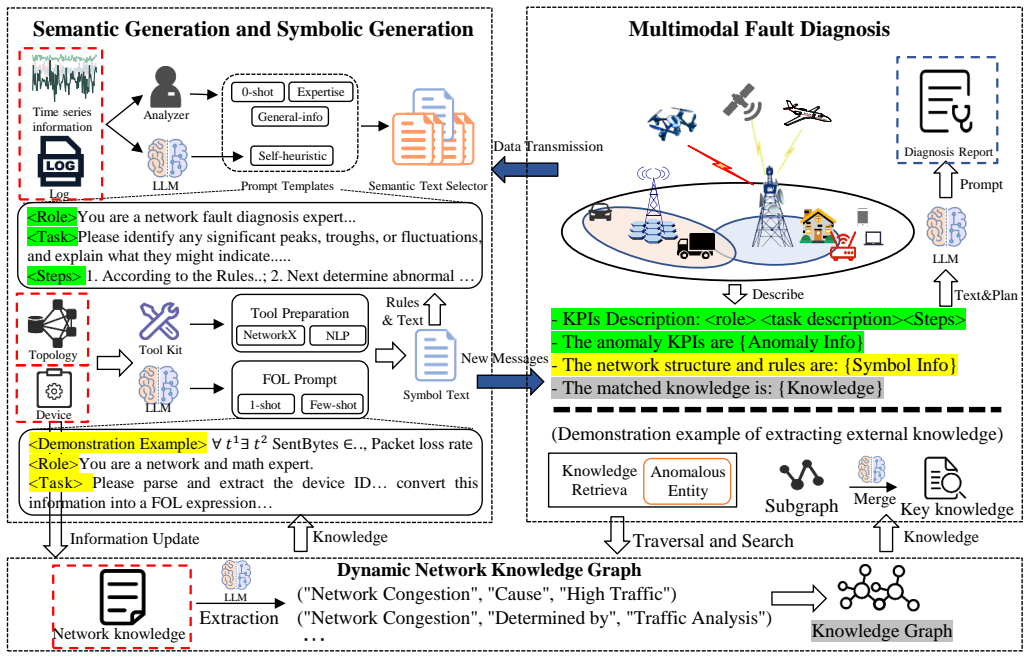
The load-bearing mechanism is the transformation pipeline: (1) a self-heuristic prompt template that is updated automatically from the knowledge graph, turning raw KPIs and logs into semantic text; (2) a symbolization module using one-shot and few-shot first-order-logic templates plus the Z3 solver, representing topology and rules as verifiable formulas; (3) a dynamically updated network knowledge graph built by LLM triple extraction, which both supplies external knowledge for retrieval-augmented generation and shrinks token input by about 40 percent; and (4) a semantic text selector that samples multiple LLM outputs and picks the most representative one via Sentence-BERT cosine centrality. Together these convert unmatched multimodal data into a unified textual form an LLM can reason over without scenario-specific training.
What would settle it
Rebuild the network knowledge graph using an LLM prompt that explicitly prohibits naming any of the six fault categories (application crash, malicious traffic, congestion, node crash, out-of-range, obstacles), then rerun the same evaluation; if anomaly detection accuracy stays near 96 percent the zero-shot claim survives, and if it collapses toward the 62 to 77 percent range of the ablations without knowledge graph, the graph was encoding the test labels.
Extended reading notes
Core claim
The paper's central claim is that network fault diagnosis can be recast as a pure text-understanding problem. The proposed LNSG algorithm first semanticizes time series and logs into structured natural-language descriptions using a self-heuristic prompt template, then symbolizes topology and device state into first-order logic expressions validated by the Z3 solver. These representations feed an LLM that, guided by retrieval from an LLM-constructed network knowledge graph, produces a diagnosis report. The discovery, if true, is that this pipeline transfers across network topologies (star, ring, mesh), network types (mobile, vehicular, UAV, cellular), and even sensor fault data without retraining, because the knowledge graph supplies domain knowledge at inference time rather than being baked into model weights.
Load-bearing premise
The whole zero-shot result rests on the claim that the knowledge graph is built from generic network knowledge only and does not encode the specific fault labels or data distribution of the evaluation datasets; if those details leaked into the graph or prompts, the reported generalization would be circular.
Editorial extensions
If this is right
- Network diagnosis becomes a zero-shot task: a new environment only needs its data converted to the same semantic and symbolic format, not a newly trained model.
- The knowledge graph, not the LLM weights, carries scenario-specific knowledge, so updating diagnosis capabilities means updating the graph rather than fine-tuning.
- Symbolic validation via Z3 reduces LLM hallucination and misclassification, as shown by the 13.39 percent improvement over the no-symbolization variant.
- The framework transfers beyond networking to other sensor-based fault data, as demonstrated on UAV accelerometer fault diagnosis with around 90 percent accuracy.
- Interpretability improves: the LLM emits a natural-language report with fault type, explanation, and remediation suggestions, which is usable by network operators.
Reading between the lines
- If the zero-shot claim holds, a similar semantic-plus-symbolic pipeline could be applied to other infrastructure monitoring domains—power grids, industrial control, data centers—where labeled fault data is scarce but operational logs and KPIs are abundant.
- The 40 percent token reduction from the knowledge graph suggests that representation choice, not model scale, may be the dominant cost factor; this points to a testable extension where the framework is run on smaller open-weight LLMs to see how much accuracy the representation buys back.
- The authors' implicit claim that self-heuristic prompts beat expert prompts implies that LLM-derived knowledge can stay fresher than static expertise; one could test this by injecting a new device type into the graph and measuring diagnosis accuracy before and after knowledge update.
- A circularity risk exists: if the knowledge graph's construction prompt or the self-heuristic template inadvertently includes the six fault categories used in evaluation, the zero-shot result is partly in-context learning rather than generalization. A clean test would build the graph from knowledge statements that never name the evaluation fault classes.
Editorial analysis
A structured set of objections, weighed in public.
Referee Report
Summary. The paper proposes NetSemantic, an LLM-based zero-shot network fault diagnosis framework. It converts multimodal network data (time series, logs, topology, device state) into semantic text and symbolic first-order logic representations via the LNSG algorithm, builds a dynamic Network Knowledge Graph (NKG) from LLM-extracted triples, and uses retrieval-augmented generation (RAG) over that graph to support fault diagnosis. Experiments on a six-class NS-3 digital-twin dataset report 96.10% anomaly detection accuracy and 89.49% fault classification accuracy, outperforming the evaluated ML/DL baselines by 5 to 10 percentage points; ablations show the NKG contributes about 33 points of anomaly-detection accuracy. Additional experiments cover star/ring/mesh topologies, several network types, and a UAV accelerometer fault dataset.
Significance. If the results hold, NetSemantic would be a meaningful step toward data-independent and plug-and-play network diagnosis: the semanticization/symbolization pipeline is generic, the dynamic-KG RAG design is a plausible way to inject domain knowledge without retraining, and the cross-topology and cross-network-type experiments address a real limitation of current ML-based diagnostic models. The paper also gives credit-worthy discussion of why manual template and syntax-tree semanticization approaches are limited. However, the zero-shot generalization claim currently rests on point estimates without statistical validation, and the main risk is circularity in the evaluative setup: the NKG, which is the decisive component in the ablation, may encode the very fault taxonomy used in the test data. These issues must be resolved before the contribution can be assessed.
major comments (4)
- [Section IV.B.1 and Table IV] The zero-shot claim is not yet supported because the NKG provenance is not established. The paper says the NKG is built by classifying 'common fault types according to the seven-layer network protocol' and collecting KPI thresholds, while the evaluation dataset (Section V.A) has exactly six fault classes (Application Crash, Malicious Traffic, Network Congestion, Network Node Crash, Out of Communication Range, Communication Obstacles) generated by the authors' own NS-3 digital twin. If the NKG entities include these concrete fault types with their symptom signatures, then the RAG retrieval in Section IV.C can act as answer lookup rather than evidence of generalization; the Table IV gap (96.10% vs 62.43% without the KG) makes this the load-bearing component. Please release the NKG, the prompts, and the LLM triple-extraction instructions, and/or evaluate on independently collected datasets whose fault taxonomy was not used in KG construction; also provide a contamination check where the KG is built with the test fault classes held out.
- [Section IV.B.2 and Section V.B] The zero-shot and 'data-independent' terminology is internally inconsistent with the described update mechanism. Section IV.B.2 states the NKG is 'online updated with real-time network data during each diagnosis process' and that 'All knowledge updates are based on LLMs.' If the NKG is updated with data and diagnostic results from the test scenario during the experiments, then the reported numbers are not zero-shot evaluations. Please clarify whether test-time updates were enabled in Tables III--VII; if they were, report a variant with updates disabled, and state exactly which information flows into the NKG during each reported run.
- [Section V.B, Tables III--VII] All reported accuracies are single point estimates with no error bars, no number of repeated runs, and no statistical significance tests. This matters especially because Section IV.A.1 acknowledges the LLM's 'inherent random sampling mechanism' causes output discrepancies; a 5 to 10 percentage point claimed margin over baselines could be within run-to-run variance. Please report means and standard deviations over multiple independent runs (including different temperatures or seeds), and perform pairwise significance tests for the central comparisons in Tables III, IV, V, and VII.
- [Section V.B and Section VII] The comparison set contains only ML/DL baselines (SR-CNN, CL-MPPCA, AnomalyBERT, LSTM-Transformer, FTS-LSTM), while the related work describes LLM-based diagnosis systems (RACopilot [12], NetLLM [11], and the LLM-assisted framework of [10]) that are closer in spirit. The conclusion claims NetSemantic outperforms 'other fault diagnosis systems,' but no LLM-based comparator is included. Please add at least one LLM-based baseline or restrict the claim to the evaluated baseline classes.
minor comments (4)
- [Abstract] The opening sentence should be edited for grammar and clarity: 'Leverage large language model' should read 'Leveraging large language models,' and 'refer the fault' should read 'identify the fault.'
- [Section V.C, Table IV] The ablation model is labeled 'Net-NoKG' in Table IV but referred to as 'Net-NoNKG' in Section V.C; unify the naming for consistency.
- [Section V.A] The dataset description lacks basic statistics: number of samples per class, class balance, duration of the NS-3 runs, and any train/test split. The linked GitHub repository is not versioned, so please add these details for reproducibility.
- [Figure 5] The bar charts show values on a y-axis labeled 'Accuracy(%)' that ranges from 0.0 to 1.0 with mixed formatting, and no confidence intervals or sample counts are given; make the axis normalization and the error representation clear.
Circularity Check
No demonstrated circularity; the zero-shot diagnosis claim is an empirical LLM/RAG result, not a derivation that reduces to its inputs. The main unresolved issue is knowledge-graph provenance, which is an auditability risk rather than a circular step.
full rationale
NetSemantic is presented as an empirical pipeline (semanticization, symbolization, NKG-based RAG, and LLM blueprint reasoning) evaluated on an external ground-truth dataset. I looked for a specific reduction in which a prediction is equivalent to an input by construction. The ablation study shows that removing the KG lowers accuracy (Table IV: NetSemantic 96.10% vs. Net-NoKG 76.92% anomaly detection), but that only establishes that the KG contributes to performance; it does not show that the KG was populated from the test dataset's fault labels. Section IV.B.1 states that the KG is built by classifying 'common fault types according to the seven-layer network protocol' and by collecting 'theoretical metrics' to compute KPI thresholds, and Section IV.B.2 says the KG is 'online updated with real-time network data during each diagnosis process.' These descriptions leave open the possibility of test-set contamination, but the paper does not state that the KG was constructed from the evaluation dataset or its labels, and no equation or algorithm in the paper defines the output in terms of the test labels. The zero-shot claim is empirical rather than derived from a first-principles equation, so there is no Eq. X = Eq. Y reduction. Self-citations [9], [10] provide the digital-twin dataset and a prior semanticization framework; these are externally hosted and do not by themselves force the central result. The lack of released KG, prompts, and thresholds is a reproducibility/verifiability concern, not a demonstrated circularity. Therefore the circularity score is 0.
Assumptions & free parameters
free parameters (5)
- number of semantic samples n
- top-K retrieved entities
- hop count for neighborhood expansion
- KPI anomaly thresholds
- LLM sampling configuration
assumptions (5)
- domain assumption LLM-generated semantic and symbolic descriptions faithfully preserve fault-relevant information.
- domain assumption The knowledge graph provides accurate and sufficiently complete domain knowledge.
- domain assumption The seven-layer protocol fault taxonomy covers the faults in the test datasets.
- domain assumption The digital twin and UAV datasets are representative of real network faults.
- domain assumption Word2Vec cosine similarity is adequate for retrieving relevant knowledge.
Cite this review
Pith. "Pith review of Adapting Network Information into Semantics for Generalizable and Plug-and-Play Multi-Scenario Network Diagnosis." pith.science (2026). https://pith.science/paper/NOTMAI7S
@misc{pith2026250116842,
  author       = {Pith},
  title        = {Pith review of: Adapting Network Information into Semantics for Generalizable and Plug-and-Play Multi-Scenario Network Diagnosis},
  year         = {2026},
  howpublished = {\url{https://pith.science/paper/NOTMAI7S}},
  note         = {Machine review of arXiv:2501.16842}
}
read the original abstract
Leverage large language model (LLM) to refer the fault is considered to be a potential solution for intelligent network fault diagnosis. However, how to represent network information in a paradigm that can be understood by LLMs has always been a core issue that has puzzled scholars in the field of network intelligence. To address this issue, we propose LLM-based Network Semantic Generation (LNSG) algorithm, which integrates semanticization and symbolization methods to uniformly describe the entire multi-modal network information. Based on the LNSG and LLMs, we present NetSemantic, a plug-and-play, data-independent, network information semantic fault diagnosis framework. It enables rapid adaptation to various network environments and provides efficient fault diagnosis capabilities. Experimental results demonstrate that NetSemantic excels in network fault diagnosis across various complex scenarios in a zero-shot manner.
Figures


Figures from the paper (3 more)


Reference graph
Works this paper leans on
-
[12]
Automatic root cause analysis via large language models for cloud incidents,
Y . Chen, H. Xie, M. Ma, Y . Kang, X. Gao, L. Shi, Y . Cao, X. Gao, H. Fan, M. Wen et al., “Automatic root cause analysis via large language models for cloud incidents,” in Proceedings of the Nineteenth European Conference on Computer Systems , 2024, pp. 674–688
2024
-
[11]
Netllm: Adapting large language models for networking,
D. Wu, X. Wang, Y . Qiao, Z. Wang, J. Jiang, S. Cui, and F. Wang, “Netllm: Adapting large language models for networking,” in Proceed- ings of the ACM SIGCOMM 2024 Conference , 2024, pp. 661–678
2024
-
[10]
F. Tang, X. Wang, X. Yuan, L. Luo, M. Zhao, and N. Kato, “Large language model (llm) assisted end-to-end network health management based on multi-scale semanticization,” arXiv preprint arXiv:2406.08305, 2024
arXiv 2024
-
[1]
Research and application of ai in 5g network operation and maintenance,
M. Li, M. Huo, X. Cheng, and L. Xu, “Research and application of ai in 5g network operation and maintenance,” in 2020 IEEE Intl Conf on Parallel & Distributed Processing with Applications, Big Data & Cloud Computing, Sustainable Computing & Communications, Social Com- puting & Networking (ISPA/BDCloud/SocialCom/SustainCom) . IEEE, 2020, pp. 1420–1425
work page 2020
-
[2]
A survey of aiops methods for failure management,
P. Notaro, J. Cardoso, and M. Gerndt, “A survey of aiops methods for failure management,” ACM Transactions on Intelligent Systems and Technology (TIST), vol. 12, no. 6, pp. 1–45, 2021
2021
-
[3]
H. N. Qureshi, U. Masood, M. Manalastas, S. M. A. Zaidi, H. Farooq, J. Forgeat, M. Bouton, S. Bothe, P. Karlsson, A. Rizwan et al., “Toward addressing training data scarcity challenge in emerging radio access networks: A survey and framework,” IEEE Communications Surveys & Tutorials, vol. 25, no. 3, pp. 1954–1990, 2023
work page 1954
-
[4]
Towards generalist biomedical ai,
T. Tu, S. Azizi, D. Driess, M. Schaekermann, M. Amin, P.-C. Chang, A. Carroll, C. Lau, R. Tanno, I. Ktena et al. , “Towards generalist biomedical ai,” Nejm Ai, vol. 1, no. 3, p. AIoa2300138, 2024
2024
-
[5]
Lawgpt: A chinese legal knowledge-enhanced large language model,
Z. Zhou, J.-X. Shi, P.-X. Song, X.-W. Yang, Y .-X. Jin, L.-Z. Guo, and Y .-F. Li, “Lawgpt: A chinese legal knowledge-enhanced large language model,” arXiv preprint arXiv:2406.04614 , 2024
arXiv 2024
Show all 33 references
-
[6]
Chattime: A unified multimodal time series foundation model bridging numerical and textual data,
C. Wang, Q. Qi, J. Wang, H. Sun, Z. Zhuang, J. Wu, L. Zhang, and J. Liao, “Chattime: A unified multimodal time series foundation model bridging numerical and textual data,” arXiv preprint arXiv:2412.11376 , 2024
2024 arXiv
-
[7]
Context-alignment: Activating and enhancing llm capabilities in time series,
Y . Hu, Q. Li, D. Zhang, J. Yan, and Y . Chen, “Context-alignment: Activating and enhancing llm capabilities in time series,” arXiv preprint arXiv:2501.03747, 2025
2025
-
[8]
Time-llm: Time series forecasting by re- programming large language models,
M. Jin, S. Wang, L. Ma, Z. Chu, J. Y . Zhang, X. Shi, P.-Y . Chen, Y . Liang, Y .-F. Li, S. Panet al., “Time-llm: Time series forecasting by re- programming large language models,” arXiv preprint arXiv:2310.01728, 2023
2023 arXiv
-
[9]
Semi-distributed network fault diagnosis based on digital twin network in highly dynamic heterogeneous networks,
F. Tang, L. Luo, Z. Guo, Y . Li, M. Zhao, and N. Kato, “Semi-distributed network fault diagnosis based on digital twin network in highly dynamic heterogeneous networks,” IEEE Transactions on Mobile Computing , 2024
2024
-
[13]
Gpt4mts: Prompt- based large language model for multimodal time-series forecasting,
F. Jia, K. Wang, Y . Zheng, D. Cao, and Y . Liu, “Gpt4mts: Prompt- based large language model for multimodal time-series forecasting,” in Proceedings of the AAAI Conference on Artificial Intelligence , vol. 38, no. 21, 2024, pp. 23 343–23 351
2024
-
[14]
Application of wireless sensor networks to aircraft control and health management systems,
R. K. Yedavalli and R. K. Belapurkar, “Application of wireless sensor networks to aircraft control and health management systems,” Journal of Control Theory and Applications , vol. 9, pp. 28–33, 2011
2011
-
[15]
Network management in wireless sensor networks,
W. L. Lee, A. Datta, R. Cardell-Oliver et al., “Network management in wireless sensor networks,” Handbook of Mobile Ad Hoc and Pervasive Communications, pp. 1–20, 2006
2006
-
[16]
Detecting anomalies in space using multivariate convolutional lstm with mixtures of probabilistic pca,
S. Tariq, S. Lee, Y . Shin, M. S. Lee, O. Jung, D. Chung, and S. S. Woo, “Detecting anomalies in space using multivariate convolutional lstm with mixtures of probabilistic pca,” in Proceedings of the 25th ACM SIGKDD international conference on knowledge discovery & data mining...
2019
-
[17]
Time-series anomaly detection service at microsoft,
H. Ren, B. Xu, Y . Wang, C. Yi, C. Huang, X. Kou, T. Xing, M. Yang, J. Tong, and Q. Zhang, “Time-series anomaly detection service at microsoft,” in Proceedings of the 25th ACM SIGKDD international conference on knowledge discovery & data mining , 2019, pp. 3009– 3017
2019
-
[18]
Applications of machine learning to machine fault diagnosis: A review and roadmap,
Y . Lei, B. Yang, X. Jiang, F. Jia, N. Li, and A. K. Nandi, “Applications of machine learning to machine fault diagnosis: A review and roadmap,” Mechanical systems and signal processing , vol. 138, p. 106587, 2020
2020
-
[19]
Deeplocalize: Fault localization for deep neural networks,
M. Wardat, W. Le, and H. Rajan, “Deeplocalize: Fault localization for deep neural networks,” in 2021 IEEE/ACM 43rd International Conference on Software Engineering (ICSE) . IEEE, 2021, pp. 251– 262
2021
-
[20]
Anomalybert: Self-supervised transformer for time series anomaly detection using data degradation scheme,
Y . Jeong, E. Yang, J. H. Ryu, I. Park, and M. Kang, “Anomalybert: Self-supervised transformer for time series anomaly detection using data degradation scheme,” CoRR, vol. abs/2305.04468, 2023
2023 arXiv
-
[21]
Advanced hybrid lstm-transformer architecture for real-time multi-task prediction in engineering systems,
K. Cao, T. Zhang, and J. Huang, “Advanced hybrid lstm-transformer architecture for real-time multi-task prediction in engineering systems,” Scientific Reports, vol. 14, no. 1, p. 4890, 2024
2024
-
[22]
Promptcast: A new prompt-based learning paradigm for time series forecasting,
H. Xue and F. D. Salim, “Promptcast: A new prompt-based learning paradigm for time series forecasting,” IEEE Transactions on Knowledge and Data Engineering , vol. 36, no. 11, pp. 6851–6864, 2023
2023
-
[23]
How can large language models understand spatial-temporal data?
L. Liu, S. Yu, R. Wang, Z. Ma, and Y . Shen, “How can large language models understand spatial-temporal data?” arXiv preprint arXiv:2401.14192, 2024
2024 arXiv
-
[24]
Sentence-bert: Sentence embeddings using siamese bert-networks,
N. Reimers and I. Gurevych, “Sentence-bert: Sentence embeddings using siamese bert-networks,” arXiv preprint arXiv:1908.10084 , 2019
1908 arXiv
-
[25]
Using dynamic token embedding compression to optimize inference process in large language models,
D. Gavrilo, C. Johansson, T. Petrovich, G. Martins, and S. Edwards, “Using dynamic token embedding compression to optimize inference process in large language models,” 2024
2024
-
[26]
Z3: An efficient smt solver,
L. De Moura and N. Bjørner, “Z3: An efficient smt solver,” in Inter- national conference on Tools and Algorithms for the Construction and Analysis of Systems . Springer, 2008, pp. 337–340
2008
-
[27]
Word2vec model analysis for semantic similarities in english words,
D. Jatnika, M. A. Bijaksana, and A. A. Suryani, “Word2vec model analysis for semantic similarities in english words,” Procedia Computer Science, vol. 157, pp. 160–167, 2019
2019
-
[28]
Gpt-4o: The cutting-edge advancement in multimodal llm,
R. Islam and O. M. Moushi, “Gpt-4o: The cutting-edge advancement in multimodal llm,” Authorea Preprints, 2024
2024
-
[29]
Training language models to follow instructions with human feedback,
L. Ouyang, J. Wu, X. Jiang, D. Almeida, C. Wainwright, P. Mishkin, C. Zhang, S. Agarwal, K. Slama, A. Ray et al. , “Training language models to follow instructions with human feedback,” Advances in neural information processing systems , vol. 35, pp. 27 730–27 744, 2022
2022
-
[30]
Generative ai for game theory-based mobile networking,
L. He, G. Sun, D. Niyato, H. Du, F. Mei, J. Kang, M. Debbah, and Z. Han, “Generative ai for game theory-based mobile networking,” IEEE Wireless Communications, vol. 32, no. 1, pp. 122–130, 2025
2025
-
[31]
Comprehensive survey on machine learning in vehicular network: Technology, applications and challenges,
F. Tang, B. Mao, N. Kato, and G. Gui, “Comprehensive survey on machine learning in vehicular network: Technology, applications and challenges,” IEEE Communications Surveys & Tutorials , vol. 23, no. 3, pp. 2027–2057, 2021
2027
-
[32]
Outage probability, performance, fairness analysis of space-air-ground integrated network (sagin): Uav altitude and position angle,
J. Tan, F. Tang, M. Zhao, and N. Kato, “Outage probability, performance, fairness analysis of space-air-ground integrated network (sagin): Uav altitude and position angle,” IEEE Transactions on Wireless Communi- cations, 2024
2024
-
[33]
Resource allocation based on optimized cellular network ap layout for visible light communication heteroge- neous network,
Y . Du, L. Yang, and Y . Luo, “Resource allocation based on optimized cellular network ap layout for visible light communication heteroge- neous network,” The Journal of Supercomputing , vol. 81, no. 1, pp. 1–23, 2025
2025
Reviewed August 10, 2026 · model on record in the stance chip above.
Discussion (0). Continue with ORCID to comment.