REVIEW 5 major objections 5 minor 4 cited by
The evolution of cosmic ray electrons in the cosmic web: seeding by AGN, star formation and shocks
T0 review · 5 major / 5 minor · reviewed 2026-08-09 · deepseek-v4-flash
Pith's one-line read Shocks, not galaxies, seed most relativistic electrons in the cosmic web; galaxy feedback alone also cannot explain LOFAR's residual Faraday rotation.
desk verdict Ambitious simulation suite with a genuinely new combination of CRe injection mechanisms; the quantitative shock-dominance claim needs a robustness test on x_inj. read the letter →
The pith
A machine-rendered reading of the paper's core claim, the machinery that carries it, and where it could break.
The reading
What carries the argument
The argument is carried by three run-time injection modules added to a GPU-accelerated cosmological MHD code: an on-the-fly shock finder that computes Mach numbers and injects electrons with a diffusive-shock-acceleration efficiency $\xi_e(M)$ (with a low-Mach cutoff at $M_{\mathrm{thr}}=2.3$), an AGN feedback model that assigns black-hole masses from a gas-mass scaling relation and injects electrons at a fixed fraction $\xi_{\mathrm{AGN}}=10^{-3}$ of jet thermal density, and a star-formation feedback model injecting electrons at $\xi_{\mathrm{SF}}=10^{-5}$. A fourth ingredient is a 'mirror fluid' advected alongside each electron family with artificial exponential decay of timescale $\tau=0.1$ Gyr, whose ratio to the undecayed fluid recovers the time since last injection in every cell, and a precomputed library of Fokker-Planck electron spectra used to convert age, density, magnetic field, and redshift into synchrotron emission.
What would settle it
A targeted survey of residual Faraday rotation from polarised background sources at several redshifts, with the local intervening contribution removed, would decide the claim: the feedback-only models saturate near $0.1$ rad/m$^2$ out to $z\sim2$, while a primordial field with $B_{1\,\mathrm{Mpc}}=0.37$ nG reaches $1$–$3$ rad/m$^2$. A measurement at the primordial level where astrophysical contamination is demonstrably absent would support the paper's conclusion, whereas one at or below the feedback-only level would falsify its claim that galaxy formation alone cannot explain the LOFAR signal.
Extended reading notes
Core claim
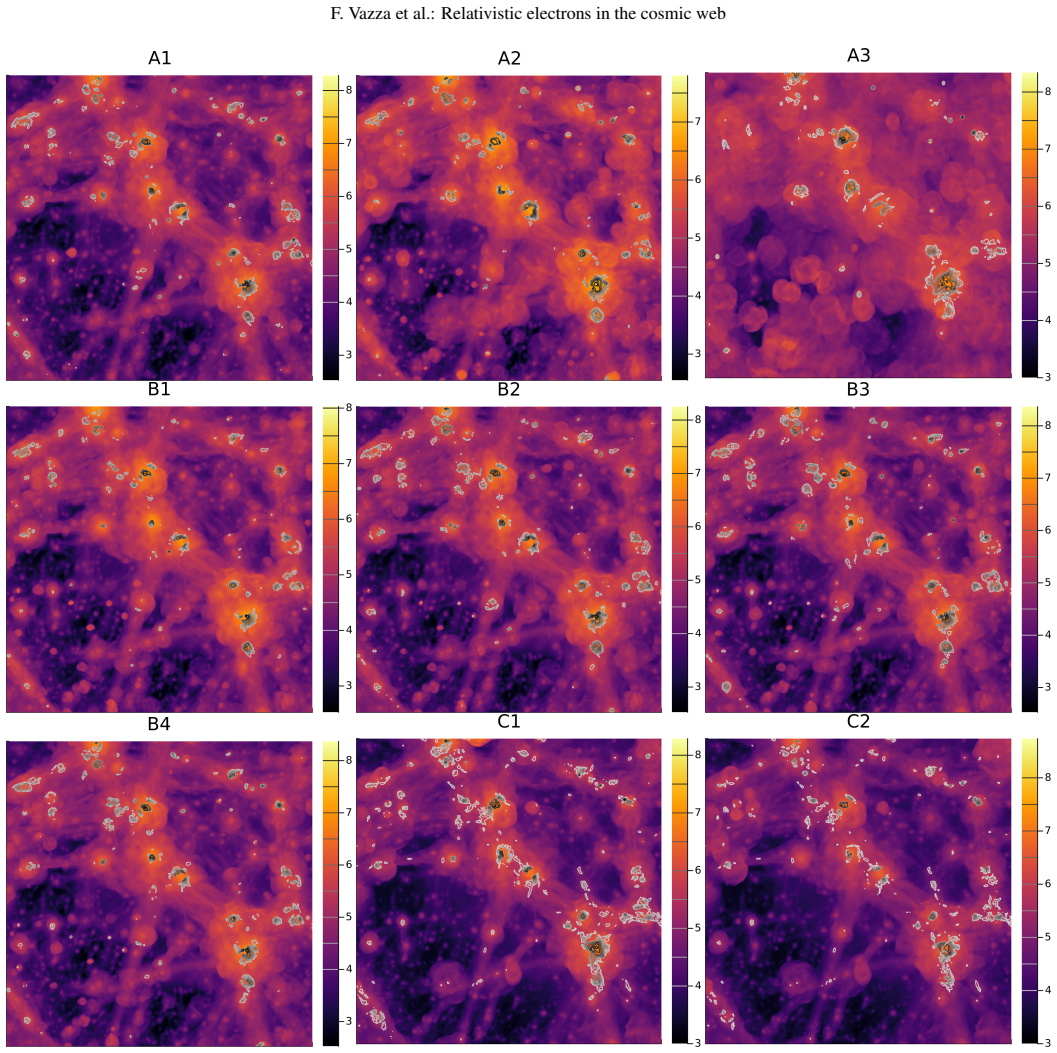
The central claim is that structure-formation shocks, with Mach numbers of order a few, inject cosmic ray electrons everywhere in the cosmic web, and that this mechanism, not AGN or star formation, sets the fossil relativistic electron budget in halos. In the best-calibrated model, the number of shock-injected electrons per thermal proton inside halos is about $5.5\times10^{-4}$ for massive halos and $6.3\times10^{-4}$ for small halos at $z=0$, roughly an order of magnitude above the AGN contribution and two orders above star formation. The paper derives an approximate formula (Eqs. 5-6) giving the injected electron budget as a linear combination of the three injection efficiencies. It further claims that all astrophysical seeding combined fills at most a few tens of percent of the volume with magnetic fields above $10^{-15}$ G, and that the residual Faraday rotation observed by LOFAR rises to $1\text{--}3$ rad/m$^2$ only when a primordial field of $B_{1\,\mathrm{Mpc}}=0.37$ nG is included, so galaxy formation alone cannot explain the signal.
Load-bearing premise
The entire electron budget rests on assumed efficiency fractions for AGN jets and star-forming winds ($\xi_{\mathrm{AGN}}=10^{-3}$, $\xi_{\mathrm{SF}}=10^{-5}$), which are calibrated after the fact to reproduce observed radio luminosity functions; if real acceleration is much less efficient, the claim that combined seeding is 'more than enough' weakens.
Editorial extensions
If this is right
- Radio emission from cluster outskirts and filaments should be powered mostly by pre-existing fossil electrons re-energised by weak shocks or turbulence rather than by freshly accelerated thermal electrons.
- The total number of relic electrons per proton in a halo is a linear combination of the three injection efficiencies (Eqs. 5-6), so future work only needs to pin down those efficiencies to predict the seed population.
- If the LOFAR residual Faraday rotation is real, an astrophysical-only explanation is excluded at the simulated level, and a primordial magnetic field of order $0.37$ nG on megaparsec scales is required.
- Deep radio surveys should see a nearly connected, faint synchrotron web from shock-seeded electrons, with the strongest connection when a primordial field supplies the magnetisation.
Reading between the lines
- Because the budget formula is linear in the three efficiencies, a natural test is to plug efficiencies measured from higher-resolution or kinetic-plasma simulations into Eqs. 5-6 and see whether the predicted seed populations shift by less than the model-to-model scatter.
- If the fossil reservoir is as large as claimed, faint diffuse radio emission from old shock electrons should be present even in regions with no currently visible shock; existing stacking limits are close to this predicted level.
- The same age-tracking machinery could be applied to cross-correlate predicted synchrotron emission with thermal Sunyaev-Zeldovich maps, which would isolate the shock-seeded component from galactic confusion without extra spectral-ageing assumptions.
Editorial analysis
A structured set of objections, weighed in public.
Referee Report
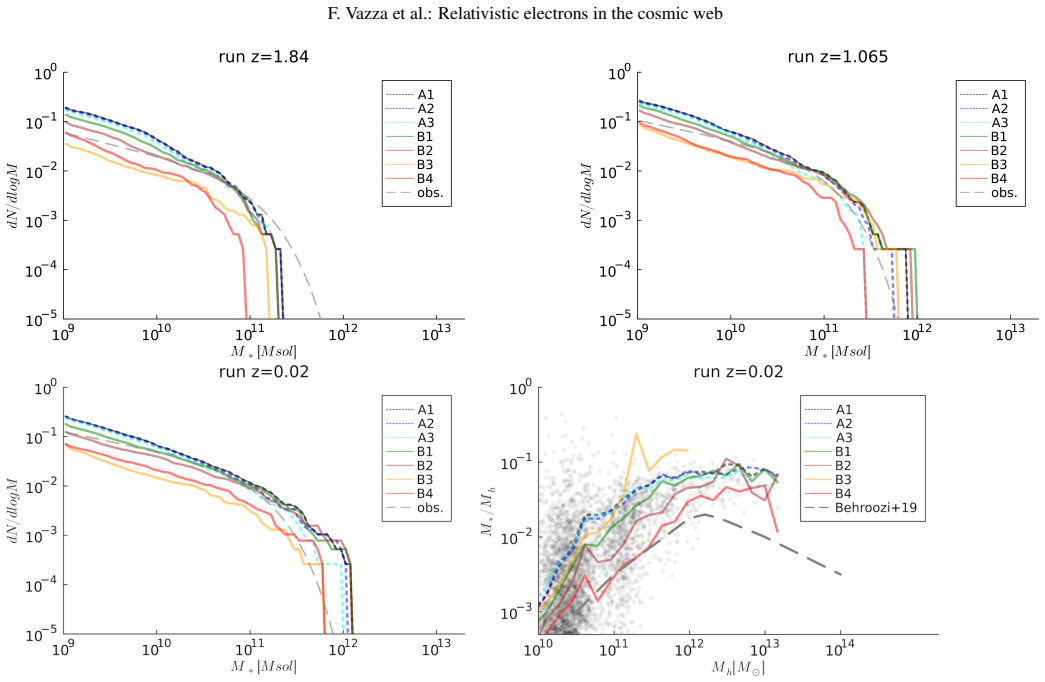
Summary. This paper presents a new suite of ENZO MHD cosmological simulations (42.5 Mpc box, 1024^3 cells) that simultaneously track, at run time, the injection and advection of cosmic-ray electrons (CRe) from three mechanisms: structure-formation shocks, AGN feedback, and star-formation feedback, together with magnetic-field injection from the latter two. A mirror-fluid technique is used to estimate the age of CRe since last injection, and post-processing with pre-tabulated ROGER spectra converts the CRe fields into synchrotron and Faraday-rotation predictions. The sub-grid galaxy-formation models are calibrated against the cosmic star formation history, stellar mass functions, and AGN radio luminosity functions, with run B4 identified as the best overall. The main claims are that shocks dominate the volume-filling and halo budget of fossil CRe, that AGN dominate over star formation as a CRe source, that astrophysical sources alone cannot explain the LOFAR residual Faraday rotation, and that the combined seeding is more than sufficient to fuel large-scale diffuse radio emission.
Significance. If the central claims hold, this would be a valuable step: it is one of the first cosmological simulations to evolve CRe and magnetic fields from multiple astrophysical injection channels at run time, and it introduces a cheap and elegant age-tracing method that could be reused by other groups. The paper also makes a concrete, falsifiable statement about the maximum contribution of galaxy formation to cosmic magnetisation, and it provides a simple fitting formula for the fossil CRe budget in halos. The authors are commendably explicit about many limitations, including the ad hoc nature of several efficiencies and the failure of the star-formation radio luminosity function. However, the headline shock-dominance claim and the quantitative budget formulas are more sensitive to uncalibrated parameters than the text suggests, and the evidence presented is partly in number density rather than energy density.
major comments (5)
- [§2.4, Eq. (3); §5, Eq. (5)] The claim that shocks dominate the fossil CRe budget is not robust to the injection momentum parameter x_inj in Eq. (3). In the strong-shock limit (alpha_inj -> 4), Eq. (3) gives xi_e proportional to x_inj^3 exp(-x_inj^2), so changing x_inj from 3.5 to 4.0 reduces xi_e by roughly a factor of 30, and changing it to 3.0 increases it by roughly a factor of 16. With x_inj = 4.0, the shock coefficient in Eq. (5) drops from 5.51e-4 to about 2e-5, which is below the AGN coefficient 4.9e-5; the central result that shocks dominate halo CRe would then no longer hold. The paper does not provide a sensitivity scan in x_inj, and no shock-related observable is used to anchor this parameter. Please add such a test, or substantially soften the dominance claim.
- [Abstract; §3.5, Figs. 19–20] The abstract claims that shocks dominate the energy density of fossil relativistic electrons in halos, but the quantitative evidence shown in Figs. 19 and 20 is the ratio of CRe number density to thermal-proton number density. Because the injected electrons start at Lorentz factors of only a few to a few tens and the spectra are steep, the number density can be dominated by the low-energy cutoff while the energy density is dominated by a different population or by another mechanism. The paper does not show an energy-density comparison, and no argument is given that number-density ratios track energy-density ratios across the three injection channels. Please present energy-density ratios, or revise the claim to refer to number density.
- [§2.6 and §3.3] The star-formation CRe model is calibrated to the high-luminosity end of the radio luminosity function, but Sec. 3.3 states that the resulting luminosity function underpredicts low-power galaxies and overpredicts high-luminosity objects, and that the mismatch is larger than any realistic observational bias. Since the quantitative budget in Eq. (5) includes the star-formation term with xi_SF = 1e-5, and since the paper's conclusion that the combination of mechanisms is sufficient to fuel radio emission depends on the total budget, a component whose calibration demonstrably fails at the population level cannot be treated as a robust prediction. The authors should either remove the SF term from the headline budget, quantify how the SF mismatch propagates into the total, or provide a calibration that reproduces the observed SF radio luminosity function more closely.
- [§4 and §3.6] The paper's conclusion that galaxy formation alone cannot explain the LOFAR residual Faraday rotation depends on the simulated volume filling factors of astrophysical magnetic fields, yet Sec. 4 explicitly states that the convergence of the volume filling factor of magnetic fields and CRe injected by galaxies has not been assessed. Given that the dynamo and feedback prescriptions are sub-grid and resolution-dependent, the filling factors in Fig. 18 and the resulting RM comparison in Fig. 22 could change with resolution or with the assumed dynamo threshold. Please provide a resolution study (even at lower volume) or explicitly restrict the RM conclusion to the tested resolution regime.
- [§5, Eqs. (5)–(6)] The normalization of the shock term in the fitting formula appears inconsistent with Eq. (3). For x_inj = 3.5 and strong shocks, Eq. (3) gives xi_e of order 1.3–1.5e-4 depending on Mach number, whereas Eqs. (5)–(6) normalize the shock coefficient to xi_e,M>=5 = 4.6e-4. This factor-of-three discrepancy is not explained; if xi_e,M>=5 is intended as an effective calibrated value that includes a Mach-number distribution or other physics, that should be stated explicitly. As written, the fitting formula mixes a nominally theoretical injection efficiency with a differently normalized coefficient, which makes its predictive content unclear.
minor comments (5)
- [§2.3, near Eq. (1)] The citation 'Sarazin e.g. 1999' should read 'Sarazin 1999'.
- [§1] The phrase 'By an large' should be 'By and large'.
- [§3.6] The in-text reference to 'Figure 3.5' should be 'Figure 23'.
- [§3.3] The symbol 'R500 3' in the first paragraph appears to be a formatting artifact; it should read 'R500' or 'R_{500}'.
- [References] There are several typographical issues in the reference list, e.g., 'Vog elsberger' should be 'Vogelsberger' and 'Fanaro ff-Riley' should be 'Fanaroff-Riley'.
Circularity Check
Fossil CRe budget predictions for AGN and star formation reduce to a posteriori calibrated efficiencies; shock-dominance claim retains independent content.
-
fitted input called prediction
[Sec. 2.5, Sec. 2.6, and Sec. 5, Eq. (5)]
"This specific value of ξAGN has been calibrated a-posteriori, based on the comparison between the simulated radio luminosity function of our AGN with the observed one (Sec. 3.3) ... we calibrate a reasonable value for such "macroscopic" injection efficiency to ξSF = 10−5 as fiducial value, as this ensures that the synchrotron emission from star forming galaxies in the high luminosity end of our distribution is in line with observations ... NCRe/Nth = 5.51·10−4 ξe,M≥5/4.6·10−4 + 4.9·10−5 ξAGN/2·10−4 + 6·10−6 ξSF/10−5."
In Eq. (5), the predicted fossil CRe budget from AGN and from star formation is written as a direct rescaling of ξAGN and ξSF, the same efficiencies that were calibrated a posteriori to reproduce the observed radio luminosity functions (Secs. 2.5, 2.6, 3.3). Because the radio luminosity in Sec. 2.7 is computed by normalizing template synchrotron spectra to the actual CRe number density injected with n_CRe,AGN = ξAGN n_jet and n_CRe,SF = ξSF n_g, the radio luminosity and the fossil CRe number are proportional to the same fitted parameters. Thus the AGN and SF terms in the final Eq. (5) are not independent predictions from first principles; they are restatements of the calibration inputs.
full rationale
The paper's headline result that shocks are the most volume-filling and dominant source of fossil CRe does not reduce to a fit by construction: the shock injection efficiency in Eq. (3) follows from DSA with a fixed injection momentum x_inj = 3.5, cited to kinetic PIC simulations, and is not calibrated a posteriori to radio luminosity functions. The volume-filling and halo-budget comparisons (Figs. 19-20) are simulation outputs rather than definitions. However, the paper also presents as a prediction the total fossil CRe budget in Eq. (5), and for the AGN and star formation contributions this budget is linearly proportional to ξAGN and ξSF, which the paper explicitly states were calibrated a posteriori to match observed radio luminosity functions. Since the radio luminosity used for that calibration is itself computed from the same CRe densities (Sec. 2.7), the AGN and SF terms of Eq. (5) merely re-express the fitted inputs. This is fitted-input-called-prediction circularity for those terms. The 'more than enough' conclusion is only partially affected because the dominant shock term carries independent content. No other circularity was found: the self-citation to Vazza & Botteon (2024) for the required CRe budget in observed radio halos is an external, equipartition-based estimate and is not derived from the present model; the cited prior simulations and PIC results are used as ordinary external evidence.
Assumptions & free parameters
free parameters (5)
- xi_e (shock CRe injection efficiency as function of Mach number) =
4.6e-4 normalization applied at M >= 5; injection model from Kang (2024) with xinj = 3.5
- xi_AGN (fraction of jet gas injected as CRe) =
10^-3
- xi_SF (fraction of gas in star forming cells injected as CRe) =
10^-5
- epsilon_dyn (dynamo conversion factor) =
Federrath et al. 2014 prescription
- B_1Mpc (primordial magnetic field normalization for C1 and C2 runs) =
0.37 nG
assumptions (5)
- standard math Standard MHD equations with an ideal gas and primordial composition cooling
- domain assumption Diffusive shock acceleration injection model with xinj = 3.5 and M threshold 2.3
- domain assumption SMBH mass is assigned via a gas mass scaling relation and Bondi accretion with ad hoc boosts
- domain assumption Cosmic ray electrons are passively advected with no diffusion, streaming, or reacceleration
- ad hoc to paper Sub-grid dynamo amplification is active only above 10 times the cosmic mean density
invented entities (1)
-
Mirror fluid for age determination of CRe
Cite this review
Pith. "Pith review of The evolution of cosmic ray electrons in the cosmic web: seeding by AGN, star formation and shocks." pith.science (2026). https://pith.science/paper/GJ4HCGDV
@misc{pith2026250119041,
  author       = {Pith},
  title        = {Pith review of: The evolution of cosmic ray electrons in the cosmic web: seeding by AGN, star formation and shocks},
  year         = {2026},
  howpublished = {\url{https://pith.science/paper/GJ4HCGDV}},
  note         = {Machine review of arXiv:2501.19041}
}
read the original abstract
Several processes in the Universe convert a fraction of gas kinetic energy into the acceleration of relativistic electrons, making them observable at radio wavelengths, or contributing to a dormant reservoir of low-energy cosmic rays in cosmic structures. We present a new suite of cosmological simulations, with simple galaxy formation models calibrated to work at a specific spatial resolution, tailored to study all most important processes of injection of relativistic electrons in evolving large-sale structures: accretion and merger shocks, feedback from active galactic nuclei and winds from star forming regions. We also follow the injection of magnetic fields by active galactic nuclei and star formation, and compute the observational signatures of these mechanisms. We find that the injection of cosmic ray electrons by shocks is the most volume filling process, and that it also dominates the energy density of fossil relativistic electrons in halos. The combination of the seeding mechanisms studied in this work, regardless of the uncertainties related to physical or numerical uncertainties, is more than enough to fuel large-scale radio emissions with a large amount of seed fossil electrons. We derive an approximated formula to predict the number of fossil cosmic ray electrons injected by z=0 by the total activity of shocks, AGN and star formation in the volume of halos. By looking at the maximum possible contribution to the magnetisation of the cosmic web by all our simulated sources, we conclude that galaxy formation-related processes, alone, cannot explain the values of Faraday Rotation of background polarised sources recently detected using LOFAR.
Figures


Figures from the paper (21 more)





Forward citations
Cited by 4 Pith papers
-
Cosmic ray heating of cold streams: Implications for the gas supply and growth of massive galaxies
Externally entrained cosmic-web CRs weakly heat dense cold-stream cores but can strongly heat diffuse and mixed interface gas in massive haloes, adding selectivity to cold accretion.
-
CRESCENDO II: Spectral cosmic rays with improved energy losses and realistic supernova seeding
CRESCENDO's spectral cosmic-ray solver now includes improved energy-loss processes, non-ultra-relativistic energy/pressure integrals, and supernova-remnant template injection.
-
Mapping Diffuse Radio Sources Using TUNA: A Transformer-Based Deep Learning Approach
A Transformer-based deep learning network, TUNA, detects faint diffuse radio sources (halos, bridges, megahalos) directly from LOFAR survey images without source subtraction or re-imaging.
-
Forward cascade of large-scale primordial magnetic fields during structure formation
A flux-conservation advection equation reproduces the qualitative forward cascade of primordial magnetic field spectra during structure formation.
Reference graph
Works this paper leans on
-
[1]
, " * write output.state after.block = add.period write newline
ENTRY address archiveprefix author booktitle chapter edition editor howpublished institution eprint journal key month note number organization pages publisher school series title type volume year label extra.label sort.label short.list INTEGERS output.state before.all mid.sentence after.sentence after.block FUNCTION init.state.consts #0 'before.all := #1 ...
-
[2]
write newline
" write newline "" before.all 'output.state := FUNCTION n.dashify 't := "" t empty not t #1 #1 substring "-" = t #1 #2 substring "--" = not "--" * t #2 global.max substring 't := t #1 #1 substring "-" = "-" * t #2 global.max substring 't := while if t #1 #1 substring * t #2 global.max substring 't := if while FUNCTION word.in bbl.in " " * FUNCTION format....
-
[3]
& Saveliev , A
Alves Batista , R. & Saveliev , A. 2021, Universe, 7, 223
2021
-
[4]
& Hoshino , M
Amano , T. & Hoshino , M. 2007, , 661, 190
2007
-
[5]
& Hoshino , M
Amano , T. & Hoshino , M. 2022, , 927, 132
2022
-
[6]
2021, , 505, 5038
Ar \'a mburo-Garc \' a , A., Bondarenko , K., Boyarsky , A., et al. 2021, , 505, 5038
2021
-
[7]
& Zeković, V
Arbutina, B. & Zeković, V. 2020
2020
-
[8]
& Zeković, V
Arbutina, B. & Zeković, V. 2021, Astroparticle Physics, 127
2021
Show all 168 references
-
[9]
C., & Jiang , Y.-F
Armillotta , L., Ostriker , E. C., & Jiang , Y.-F. 2021, , 922, 11
2021
-
[10]
2021, , 503, 4016
Banfi , S., Vazza , F., & Gheller , C. 2021, , 503, 4016
2021
-
[11]
2020, , 496, 3648
Banfi , S., Vazza , F., & Wittor , D. 2020, , 496, 3648
2020
-
[12]
S., Dubois , Y., Guillard , P., et al
Beckmann , R. S., Dubois , Y., Guillard , P., et al. 2019, , 631, A60
2019
-
[13]
2023, arXiv e-prints, arXiv:2306.03764
Beduzzi , L., Vazza , F., Brunetti , G., et al. 2023, arXiv e-prints, arXiv:2306.03764
2023 arXiv
-
[14]
H., Hearin , A
Behroozi , P., Wechsler , R. H., Hearin , A. P., & Conroy , C. 2019, , 488, 3143
2019
-
[15]
2024, , 529, 4325
Bermejo , R., Wilding , G., van de Weygaert , R., et al. 2024, , 529, 4325
2024
-
[16]
2000, physrep, 327, 109
Bhattacharjee , P. 2000, physrep, 327, 109
2000
-
[17]
2021, , 2021, 061
Biagetti , M., Cole , A., & Shiu , G. 2021, , 2021, 061
2021
-
[18]
2021 a , , 650, A170
Biava , N., Brienza , M., Bonafede , A., et al. 2021 a , , 650, A170
2021
-
[19]
2021 b , , 650, A170
Biava , N., Brienza , M., Bonafede , A., et al. 2021 b , , 650, A170
2021
-
[20]
Bohdan, A., Niemiec, J., Kobzar, O., & Pohl, M. 2017
2017
-
[21]
Bohdan, A., Niemiec, J., Pohl, M., et al. 2019
2019
-
[22]
Bohdan, A., Pohl, M., Niemiec, J., et al. 2020
2020
-
[23]
2022, , 660, A80
Bondarenko , K., Boyarsky , A., Korochkin , A., et al. 2022, , 660, A80
2022
-
[24]
Booth , C. M. & Schaye , J. 2009, , 398, 53
2009
-
[25]
M., Dolag , K., Steinwandel , U
B \"o ss , L. M., Dolag , K., Steinwandel , U. P., et al. 2023 a , arXiv e-prints, arXiv:2310.13734
2023 arXiv
-
[26]
M., Steinwandel , U
B \"o ss , L. M., Steinwandel , U. P., & Dolag , K. 2023 b , , 957, L16
2023
-
[27]
M., Steinwandel , U
B \"o ss , L. M., Steinwandel , U. P., Dolag , K., & Lesch , H. 2023 c , , 519, 548
2023
-
[28]
J., Brunetti , G., et al
Botteon , A., van Weeren , R. J., Brunetti , G., et al. 2020, , 499, L11
2020
-
[29]
J., Brunetti , G., et al
Botteon , A., van Weeren , R. J., Brunetti , G., et al. 2022, Science Advances, 8, eabq7623
2022
-
[30]
Bourne , M. A. & Yang , H.-Y. K. 2023, Galaxies, 11, 73
2023
-
[31]
2022, arXiv e-prints, arXiv:2201.04591
Brienza , M., Lovisari , L., Rajpurohit , K., et al. 2022, arXiv e-prints, arXiv:2201.04591
2022 arXiv
-
[32]
W., de Gasperin , F., et al
Brienza , M., Shimwell , T. W., de Gasperin , F., et al. 2021, Nature Astronomy, 5, 1261
2021
-
[33]
2011, , 740, L28+
Brown , S., Emerick , A., Rudnick , L., & Brunetti , G. 2011, , 740, L28+
2011
-
[34]
Brown , S. D. 2011, Journal of Astrophysics and Astronomy, 32, 577
2011
-
[35]
& Kaiser , C
Br \"u ggen , M. & Kaiser , C. R. 2002, , 418, 301
2002
-
[36]
& Jones , T
Brunetti , G. & Jones , T. W. 2014, International Journal of Modern Physics D, 23, 1430007
2014
-
[37]
& Lazarian , A
Brunetti , G. & Lazarian , A. 2010, , 1371
2010
-
[38]
L., Norman , M
Bryan , G. L., Norman , M. L., O'Shea , B. W., et al. 2014, , 211, 19
2014
-
[39]
M., Dolag , K., & Durret , F
Bykov , A. M., Dolag , K., & Durret , F. 2008, , 134, 119
2008
-
[40]
M., Vazza , F., Kropotina , J
Bykov , A. M., Vazza , F., Kropotina , J. A., Levenfish , K. P., & Paerels , F. B. S. 2019, , 215, 14
2019
-
[41]
2012, , 7, 38
Caprioli , D. 2012, , 7, 38
2012
-
[42]
& Spitkovsky , A
Caprioli , D. & Spitkovsky , A. 2014, , 783, 91
2014
-
[43]
P., Vacca , V., et al
Carretti , E., O'Sullivan , S. P., Vacca , V., et al. 2023, , 518, 2273
2023
-
[44]
P., et al
Carretti , E., Vacca , V., O'Sullivan , S. P., et al. 2022, , 512, 945
2022
-
[45]
P., et al
Carretti , E., Vazza , F., O'Sullivan , S. P., et al. 2024, arXiv e-prints, arXiv:2411.13499
2024 arXiv
-
[46]
K., Kondapally , R., Best , P
Cochrane , R. K., Kondapally , R., Best , P. N., et al. 2023, , 523, 6082
2023
-
[47]
H., Hardcastle , M
Croston , J. H., Hardcastle , M. J., Birkinshaw , M., Worrall , D. M., & Laing , R. A. 2008, , 386, 1709
2008
-
[48]
H., Ineson , J., & Hardcastle , M
Croston , J. H., Ineson , J., & Hardcastle , M. J. 2018, , 476, 1614
2018
-
[49]
2022, , 609, 911
Cuciti , V., de Gasperin , F., Br \"u ggen , M., et al. 2022, , 609, 911
2022
-
[50]
2024, arXiv e-prints, arXiv:2403.12600
Damiano , A., Valentini , M., Borgani , S., et al. 2024, arXiv e-prints, arXiv:2403.12600
2024 arXiv
-
[51]
2019, , 486, 2827
Dav \'e , R., Angl \'e s-Alc \'a zar , D., Narayanan , D., et al. 2019, , 486, 2827
2019
-
[52]
A., van Weeren , R
de Gasperin , F., Ogrean , G. A., van Weeren , R. J., et al. 2015, , 448, 2197
2015
-
[53]
2018, , 477, 4738
de Regt , R., Apunevych , S., von Ferber , C., Holovatch , Y., & Novosyadlyj , B. 2018, , 477, 4738
2018
-
[54]
2017, Galaxies, 5, 35
Dolag , K., Mevius , E., & Remus , R.-S. 2017, Galaxies, 5, 35
2017
-
[55]
2018, , 214, 122
Donnert , J., Vazza , F., Br \"u ggen , M., & ZuHone , J. 2018, , 214, 122
2018
-
[56]
Dorfi , E. A. 2004, , 289, 337
2004
-
[57]
2012, , 420, 2662
Dubois , Y., Devriendt , J., Slyz , A., & Teyssier , R. 2012, , 420, 2662
2012
-
[58]
2018, , 121, 021102
Evoli , C., Blasi , P., Morlino , G., & Aloisio , R. 2018, , 121, 021102
2018
-
[59]
2010, , 401, 1670
Fabjan , D., Borgani , S., Tornatore , L., et al. 2010, , 401, 1670
2010
-
[60]
Federrath , C., Schober , J., Bovino , S., & Schleicher , D. R. G. 2014, , 797, L19
2014
-
[61]
2019, , 884, 169
Gaspari , M., Eckert , D., Ettori , S., et al. 2019, , 884, 169
2019
-
[62]
2012, , 746, 94
Gaspari , M., Ruszkowski , M., & Sharma , P. 2012, , 746, 94
2012
-
[63]
2022, , 510, 3917
Girichidis , P., Pfrommer , C., Pakmor , R., & Springel , V. 2022, , 510, 3917
2022
-
[64]
2019, Science, 364, 981
Govoni , F., Orr \`u , E., Bonafede , A., et al. 2019, Science, 364, 981
2019
-
[65]
G., Swadling , G
Grassi , A., Rinderknecht , H. G., Swadling , G. F., et al. 2023, , 958, L32
2023
-
[66]
G., Schmidt , W., & Schleicher , D
Grete , P., Vlaykov , D. G., Schmidt , W., & Schleicher , D. R. G. 2016, Physics of Plasmas, 23, 062317
2016
-
[67]
2014 a , , 794, 153
Guo , X., Sironi , L., & Narayan , R. 2014 a , , 794, 153
2014
-
[68]
2014 b , , 797, 47
Guo , X., Sironi , L., & Narayan , R. 2014 b , , 797, 47
2014
-
[69]
2024, , 976, 10
Gupta , S., Caprioli , D., & Spitkovsky , A. 2024, , 976, 10
2024
-
[70]
Ha , J.-H., Ryu , D., Kang , H., & van Marle , A. J. 2018, , 864, 105
2018
-
[71]
2022, , 511, 3751
Habouzit , M., Onoue , M., Ba \ n ados , E., et al. 2022, , 511, 3751
2022
-
[72]
2014, Phys
Harari, D., Mollerach, S., & Roulet, E. 2014, Phys. Rev. D, 89, 123001
2014
-
[73]
L., Br \"u ggen , M., et al
Heesen , V., Klocke , T. L., Br \"u ggen , M., et al. 2023, , 669, A8
2023
-
[74]
N., Br \"u ggen , M., Zhang , X., et al
Hoang , D. N., Br \"u ggen , M., Zhang , X., et al. 2023, , 523, 6320
2023
-
[75]
2021, , 38, e047
Hodgson , T., Vazza , F., Johnston-Hollitt , M., & McKinley , B. 2021, , 38, e047
2021
-
[76]
& Br \"u ggen , M
Hoeft , M. & Br \"u ggen , M. 2007, , 375, 77
2007
-
[77]
F., Butsky , I
Hopkins , P. F., Butsky , I. S., Panopoulou , G. V., et al. 2022, , 516, 3470
2022
-
[78]
Jaffe , W. J. 1977, , 212, 1
1977
-
[79]
W., Porter , D
Jones , T. W., Porter , D. H., Ryu , D., & Cho , J. 2011, , 82, 588
2011
-
[80]
2011, Journal of Korean Astronomical Society, 44, 49
Kang , H. 2011, Journal of Korean Astronomical Society, 44, 49
2011
-
[81]
2018, Journal of Korean Astronomical Society, 51, 185
Kang , H. 2018, Journal of Korean Astronomical Society, 51, 185
2018
-
[82]
2020, Journal of Korean Astronomical Society, 53, 59
Kang , H. 2020, Journal of Korean Astronomical Society, 53, 59
2020
-
[83]
2021, Journal of Korean Astronomical Society, 54, 103
Kang , H. 2021, Journal of Korean Astronomical Society, 54, 103
2021
-
[84]
2024, Journal of The Korean Astronomical Society , 57 , 155
Kang, H. 2024, Journal of The Korean Astronomical Society , 57 , 155
2024
-
[85]
Kang , H., Ryu , D., Cen , R., & Ostriker , J. P. 2007, , 669, 729
2007
-
[86]
Kang , H., Ryu , D., & Jones , T. W. 2012, , 756, 97
2012
-
[87]
Kennicutt , Jr., R. C. 1998, , 498, 541
1998
-
[88]
H., Alvarez , M
Kim , J.-h., Wise , J. H., Alvarez , M. A., & Abel , T. 2011, , 738, 54
2011
-
[89]
N., Cochrane , R
Kondapally , R., Best , P. N., Cochrane , R. K., et al. 2022, , 513, 3742
2022
-
[90]
Kravtsov , A. V. 2003, , 590, L1
2003
-
[91]
2023, Frontiers in Astronomy and Space Sciences, 10
Lazarian, A., Xu, S., & Hu, Y. 2023, Frontiers in Astronomy and Space Sciences, 10
2023
-
[92]
L., Ruszkowski , M., et al
Li , Y., Bryan , G. L., Ruszkowski , M., et al. 2015, , 811, 73
2015
-
[93]
& Dickinson , M
Madau , P. & Dickinson , M. 2014, , 52, 415
2014
-
[94]
& Vikhlinin , A
Markevitch , M. & Vikhlinin , A. 2007, , 443, 1
2007
-
[95]
N., & Hoshino, M
Matsumoto, Y., Amano, T., Kato, T. N., & Hoshino, M. 2017, Physical Review Letters, 119
2017
-
[96]
J., McLure , R
McLeod , D. J., McLure , R. J., Dunlop , J. S., et al. 2021, , 503, 4413
2021
-
[97]
J., Jones , T
Mendygral , P. J., Jones , T. W., & Dolag , K. 2012, , 750, 166
2012
-
[98]
H., Best , P
Mingo , B., Croston , J. H., Best , P. N., et al. 2022, , 511, 3250
2022
-
[99]
2015, , 800, 60
Miniati , F. 2015, , 800, 60
2015
-
[100]
2000, , 542, 608
Miniati , F., Ryu , D., Kang , H., et al. 2000, , 542, 608
2000
-
[101]
Modak , S., Quataert , E., Jiang , Y.-F., & Thompson , T. A. 2023, , 524, 6374
2023
-
[102]
M., Hearn , N., Haiman , Z., et al
Molnar , S. M., Hearn , N., Haiman , Z., et al. 2009, , 696, 1640
2009
-
[103]
K., Kondapally , R., Best , P
Morabito , L. K., Kondapally , R., Best , P. N., et al. 2025, , 536, L32
2025
-
[104]
2024, arXiv e-prints, arXiv:2406.16230
Mtchedlidze , S., Dom \' nguez-Fern \'a ndez , P., Du , X., et al. 2024, arXiv e-prints, arXiv:2406.16230
2024 arXiv
-
[105]
& Vovk , I
Neronov , A. & Vovk , I. 2010, Science, 328, 73
2010
-
[106]
W., O'Neill , B
Nolting , C., Jones , T. W., O'Neill , B. J., & Mendygral , P. J. 2019, , 876, 154
2019
-
[107]
E., Gelszinnis , J., Hoeft , M., & Yepes , G
Nuza , S. E., Gelszinnis , J., Hoeft , M., & Yepes , G. 2017, , 470, 240
2017
-
[108]
Oei , M. S. S. L., van Weeren , R. J., Vazza , F., et al. 2022, , 662, A87
2022
-
[109]
P., Br \"u ggen , M., Vazza , F., et al
O'Sullivan , S. P., Br \"u ggen , M., Vazza , F., et al. 2020, , 495, 2607
2020
-
[110]
2023, , 523, 5738
Ouellette , A., Holder , G., & Kerman , E. 2023, , 523, 5738
2023
-
[111]
& Finelli , F
Paoletti , D. & Finelli , F. 2019, , 2019, 028
2019
-
[112]
2015, Physical Review Letters, 114
Park, J., Caprioli, D., & Spitkovsky, A. 2015, Physical Review Letters, 114
2015
-
[113]
& L \'o pez-Miralles , J
Perucho , M. & L \'o pez-Miralles , J. 2023, arXiv e-prints, arXiv:2306.05864
2023 arXiv
-
[114]
M., & Springel , V
Pfrommer , C., Pakmor , R., Simpson , C. M., & Springel , V. 2017, , 847, L13
2017
-
[115]
A., & Jubelgas , M
Pfrommer , C., Springel , V., En lin , T. A., & Jubelgas , M. 2006, , 367, 113
2006
-
[116]
P., & Pfrommer , C
Pinzke , A., Oh , S. P., & Pfrommer , C. 2013, , 435, 1061
2013
-
[117]
Planck Collaboration , Ade , P. A. R., Aghanim , N., et al. 2016, , 594, A13
2016
-
[118]
& Quilis , V
Planelles , S. & Quilis , V. 2013, , 428, 1643
2013
-
[119]
P., O'Sullivan , S
Pomakov , V. P., O'Sullivan , S. P., Br \"u ggen , M., et al. 2022, , 515, 256
2022
-
[120]
& Seymour , N
Prandoni , I. & Seymour , N. 2015, in Advancing Astrophysics with the Square Kilometre Array (AASKA14), 67
2015
-
[121]
2008, , 687, L53
Puchwein , E., Sijacki , D., & Springel , V. 2008, , 687, L53
2008
-
[122]
2008, Science, 320, 909
Ryu , D., Kang , H., Cho , J., & Das , S. 2008, Science, 320, 909
2008
-
[123]
2019 a , , 883, 60
Ryu , D., Kang , H., & Ha , J.-H. 2019 a , , 883, 60
2019
-
[124]
2019 b , , 883, 60
Ryu , D., Kang , H., & Ha , J.-H. 2019 b , , 883, 60
2019
-
[125]
Ryu , D., Kang , H., Hallman , E., & Jones , T. W. 2003, , 593, 599
2003
-
[126]
N., Hardcastle , M
Sabater , J., Best , P. N., Hardcastle , M. J., et al. 2019, , 622, A17
2019
-
[127]
Sarazin , C. L. 1999, , 520, 529
1999
-
[128]
2016, , 461, 4441
Schaal , K., Springel , V., Pakmor , R., et al. 2016, , 461, 4441
2016
-
[129]
2024, arXiv e-prints, arXiv:2404.07252
Scharr \'e , L., Sorini , D., & Dav \'e , R. 2024, arXiv e-prints, arXiv:2404.07252
2024 arXiv
-
[130]
2018, Journal of Korean Astronomical Society, 51, 37
Seo , J., Kang , H., & Ryu , D. 2018, Journal of Korean Astronomical Society, 51, 37
2018
-
[131]
2022, , 932, 86
Shalaby , M., Lemmerz , R., Thomas , T., & Pfrommer , C. 2022, , 932, 86
2022
-
[132]
W., Hallman , E
Skillman , S. W., Hallman , E. J., O'Shea , B. W., et al. 2011, , 735, 96
2011
-
[133]
C., Wittor , D., Vazza , F., & Br \"u ggen , M
Smolinski , D. C., Wittor , D., Vazza , F., & Br \"u ggen , M. 2023, , 526, 4234
2023
-
[134]
K., Hirschmann , M., Dolag , K., et al
Steinborn , L. K., Hirschmann , M., Dolag , K., et al. 2018, , 481, 341
2018
-
[135]
Sunyaev , R. A. & Zeldovich , Y. B. 1972, , 20, 189
1972
-
[136]
J., & Angl \'e s-Alc \'a zar , D
Thomas , N., Dav \'e , R., Jarvis , M. J., & Angl \'e s-Alc \'a zar , D. 2021, , 503, 3492
2021
-
[137]
2024, , 963, 135
Tjemsland , J., Meyer , M., & Vazza , F. 2024, , 963, 135
2024
-
[138]
R., Oonk , J
Tremblay , G. R., Oonk , J. B. R., Combes , F., et al. 2016, , 534, 218
2016
-
[139]
2017, , 470, 1121
Tremmel , M., Karcher , M., Governato , F., et al. 2017, , 470, 1121
2017
-
[140]
Tsizh , M., Novosyadlyj , B., Holovatch , Y., & Libeskind , N. I. 2020, , 495, 1311
2020
-
[141]
2023, , 522, 2697
Tsizh , M., Tymchyshyn , V., & Vazza , F. 2023, , 522, 2697
2023
-
[142]
V \" o lk , H. J. & Atoyan , A. M. 2000, , 541, 88
2000
-
[143]
2024, Nature Astronomy, 8, 1195
Vall \'e s-P \'e rez , D., Quilis , V., & Planelles , S. 2024, Nature Astronomy, 8, 1195
2024
-
[144]
J., Andrade-Santos , F., Dawson , W
van Weeren , R. J., Andrade-Santos , F., Dawson , W. A., et al. 2017, Nature Astronomy, 1, 0005
2017
-
[145]
& Botteon , A
Vazza , F. & Botteon , A. 2024, Galaxies, 12, 19
2024
-
[146]
2017, Classical and Quantum Gravity
Vazza, F., Brueggen, M., Gheller, C., et al. 2017, Classical and Quantum Gravity
2017
-
[147]
2012, , 2518
Vazza , F., Br \"u ggen , M., Gheller , C., & Brunetti , G. 2012, , 2518
2012
-
[148]
2014, , 445, 3706
Vazza , F., Br \"u ggen , M., Gheller , C., & Wang , P. 2014, , 445, 3706
2014
-
[149]
2011, , 418, 960
Vazza , F., Dolag , K., Ryu , D., et al. 2011, , 418, 960
2011
-
[150]
& Feletti , A
Vazza , F. & Feletti , A. 2020, Frontiers in Physics, 8, 491
2020
-
[151]
2015, , 580, A119
Vazza , F., Ferrari , C., Br \"u ggen , M., et al. 2015, , 580, A119
2015
-
[152]
2021 a , Galaxies, 9, 109
Vazza , F., Locatelli , N., Rajpurohit , K., et al. 2021 a , Galaxies, 9, 109
2021
-
[153]
2021 b , , 500, 5350
Vazza , F., Paoletti , D., Banfi , S., et al. 2021 b , , 500, 5350
2021
-
[154]
2021 c , , 653, A23
Vazza , F., Wittor , D., Brunetti , G., & Br \"u ggen , M. 2021 c , , 653, A23
2021
-
[155]
2023, , 669, A50
Vazza , F., Wittor , D., Di Federico , L., et al. 2023, , 669, A50
2023
-
[156]
2022, , 660, A81
Venturi , T., Giacintucci , S., Merluzzi , P., et al. 2022, , 660, A81
2022
-
[157]
M., Rudnick , L., & Andernach , H
Vernstrom , T., Gaensler , B. M., Rudnick , L., & Andernach , H. 2019, , 878, 92
2019
-
[158]
2021, , 505, 4178
Vernstrom , T., Heald , G., Vazza , F., et al. 2021, , 505, 4178
2021
-
[159]
2023, Science Advances, 9, eade7233
Vernstrom , T., West , J., Vazza , F., et al. 2023, Science Advances, 9, eade7233
2023
-
[160]
2020, Nature Reviews Physics, 2, 42
Vogelsberger , M., Marinacci , F., Torrey , P., & Puchwein , E. 2020, Nature Reviews Physics, 2, 42
2020
-
[161]
2010, , 15, 581
Wang , P., Abel , T., & Kaehler , R. 2010, , 15, 581
2010
-
[162]
2017, , 470, 4530
Weinberger , R., Ehlert , K., Pfrommer , C., Pakmor , R., & Springel , V. 2017, , 470, 4530
2017
-
[163]
2020, , 37, e002
Weltman , A., Bull , P., Camera , S., et al. 2020, , 37, e002
2020
-
[164]
Wen , Z. L. & Han , J. L. 2015, , 807, 178
2015
-
[165]
2021, , 508, 4072
Werhahn , M., Pfrommer , C., & Girichidis , P. 2021, , 508, 4072
2021
-
[166]
2017, , 464, 4448
Wittor , D., Vazza , F., & Br \"u ggen , M. 2017, , 464, 4448
2017
-
[167]
2020, , 897, L41
Xu , R., Spitkovsky , A., & Caprioli , D. 2020, , 897, L41
2020
-
[168]
A., Markevitch , M., Brunetti , G., & Giacintucci , S
ZuHone , J. A., Markevitch , M., Brunetti , G., & Giacintucci , S. 2013, , 762, 78
2013
Reviewed August 9, 2026 · model on record in the stance chip above.
Discussion (0). Continue with ORCID to comment.