REVIEW 3 major objections 3 minor 14 references
Reconstructing hypergraph matching polynomials
T0 review · 3 major / 3 minor · reviewed 2026-08-09 · deepseek-v4-flash
Pith's one-line read The matching polynomial of every k-uniform hypergraph is uniquely determined by its induced subhypergraphs on floor((k-1)n/k)+1 vertices.
desk verdict Real and likely correct generalization of Godsil's matching polynomial reconstruction, but with a fillable gap in the deck-to-polynomial step and an unproved bijection in the sharpness section. read the letter →
The pith
A machine-rendered reading of the paper's core claim, the machinery that carries it, and where it could break.
The reading
What carries the argument
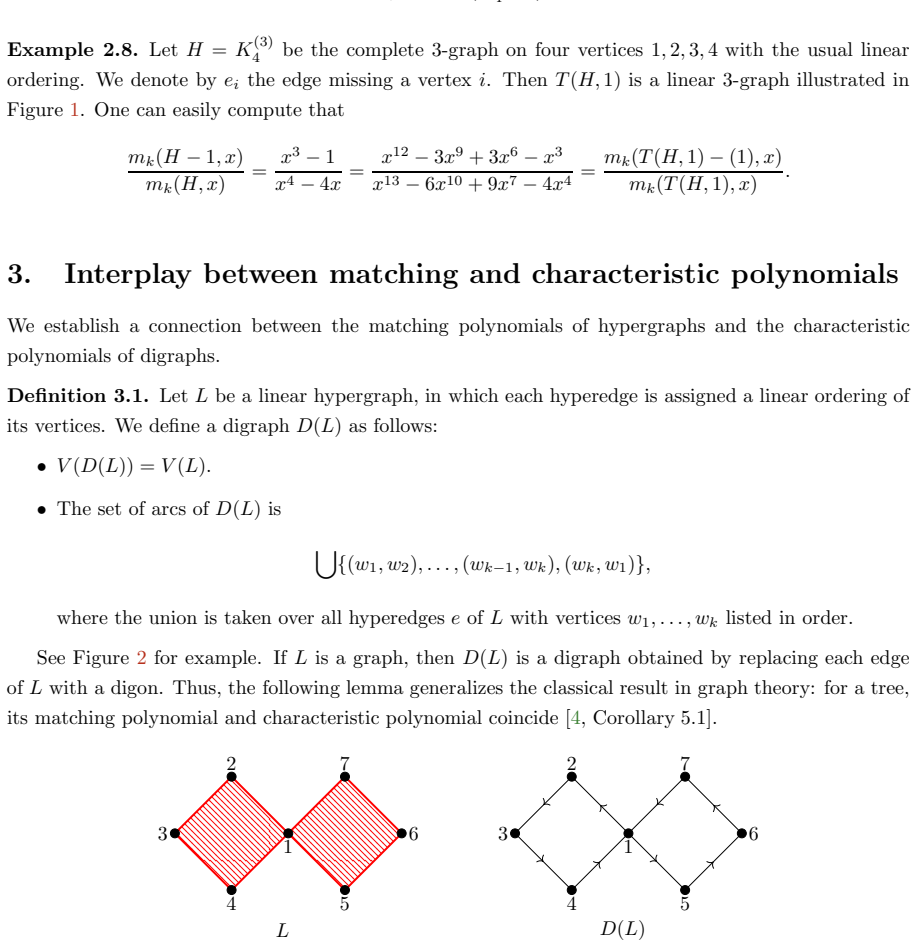
The load-bearing object is the rooted k-walk-tree $T(H,v)$: its vertices are the conflict-free walks starting at $v$, and its hyperedges are formed by extending such walks through a hyperedge of $H$. The hypergraph analogue of the classical walk-tree identity (Theorem 2.7) says $m_k(H-v,x)/m_k(H,x) = m_k(T(H,v)-(v),x)/m_k(T(H,v),x)$. A second identity (Lemma 3.2) converts matching polynomials of ordered k-trees into characteristic polynomials of digraphs: each hyperedge with ordered vertices $w_1,\ldots,w_k$ becomes the directed cycle $w_1 \to w_2 \to \cdots \to w_k \to w_1$. Together with the closed-walk generating function of a digraph, this makes the logarithmic derivative of $m_k(H,x)$ equal to the sum over all vertices of the closed-walk counts in $D(H,v)$. The support bound $|\pi(V(C))| \leq \lfloor (k-1)|E(C)|/k\rfloor+1$ for a closed walk $C$ is what reduces the needed data to induced subhypergraphs on $n'$ vertices.
What would settle it
Search for two n-vertex k-uniform hypergraphs with identical decks $C(H, \lfloor (k-1)n/k\rfloor+1)$ but different matching polynomials; Theorem 1.4 predicts none exists. A cheaper local test: compute the vertex-ordered walk tallies $d_{H'}(v,\ell,m)$ for a small hypergraph $H'$ under two different vertex orderings and check whether the sums over the unlabeled deck are invariant; any mismatch would pinpoint a gap in the double-counting step.
Extended reading notes
Core claim
The central claim is Theorem 1.4: if two n-vertex k-uniform hypergraphs have the same multiset of induced subhypergraphs on $n' = \lfloor (k-1)n/k\rfloor+1$ vertices, then they have the same matching polynomial $m_k(H,x)$. Its proof starts from the hypergraph analogue of the classical walk-tree identity, which expresses the ratio $m_k(H-v,x)/m_k(H,x)$ as the same ratio for a rooted k-walk-tree $T(H,v)$. For a k-tree whose hyperedges carry an ordering, the matching polynomial equals the characteristic polynomial of the associated digraph (each hyperedge becomes a directed cycle), and the logarithmic derivative of $m_k(H,x)$ then equals the generating function of closed walks in these digraphs, summed over all vertices. A support lemma bounds the number of vertices visited by a closed walk of length $\ell$ by $\lfloor (k-1)\ell/k\rfloor+1$, which is exactly why the deck of size $n'$ suffices: every closed-walk count needed to determine the power sums of the roots—hence the polynomial via the standard power-sum identities—can be recovered from that deck by double counting. The final section gives aligned- and misaligned-'teeth' hypergraphs that share the deck of size $\lfloor (k-1)n/k\rfloor$ but have different matching polynomials, proving the threshold is sharp for n divisible by k.
Load-bearing premise
The proof assumes that the multiset of unlabeled induced subhypergraphs on $\lfloor (k-1)n/k\rfloor+1$ vertices determines the double-counted closed-walk tallies $d_{H'}(v,\ell,m)$, even though those tallies are defined using an arbitrary ordering of each subhypergraph's vertices and the deck itself carries no ordering information.
Editorial extensions
If this is right
- For any k-uniform hypergraph, the number of matchings of every size—including perfect matchings—can be read off from induced subhypergraphs on $\lfloor (k-1)n/k\rfloor+1$ vertices.
- For any fixed k-vertex graph F, the F-tiling polynomial, and in particular the number of perfect F-tilings (F-factors), is reconstructible from induced subgraphs on the same fraction of vertices.
- The threshold $\lfloor (k-1)n/k\rfloor+1$ is best possible for all n divisible by k: the aligned- and misaligned-teeth constructions share the smaller deck but differ in whether they have a perfect matching.
- The proof supplies an alternative derivation of the sharpness example for ordinary graphs, via the same explicit bijection between vertex subsets.
- Because full hypergraph reconstruction fails for every uniformity $k \geq 3$, this shows matching polynomials are a well-behaved exception: a linear-size fraction of the vertex set, rather than almost all of it, determines all matching counts.
Reading between the lines
- The closed-walk support bound is the engine here; the same mechanism could plausibly reconstruct other polynomials whose coefficients count spanning structures, provided a comparable bound on the vertex set visited by the relevant walks can be proved.
- The double-counting step in §4 assumes the unlabeled deck supplies the ordered-walk tallies $d_{H'}(v,\ell,m)$; since the deck carries no vertex ordering, the cleanest way to test this step is to compute these tallies for one small hypergraph under two different orderings and see whether the aggregated sums agree.
- For F-tilings with F not a single edge, the optimal fraction may be smaller than $(k-1)/k$; the paper's Problem 6.1 asks for the best constant $c_F$, and the teeth construction suggests how to hunt for lower bounds.
- The paper's conjectured analogue for Hamilton cycles would follow from a walk bound in a suitable auxiliary digraph, so a natural next step is to search for such a bound.
Signed reviews
Editorial analysis
A structured set of objections, weighed in public.
Referee Report
Summary. The paper claims that for every n-vertex k-uniform hypergraph H, the matching polynomial m_k(H,x) is uniquely determined by the multiset of induced subhypergraphs on n' = floor((k-1)n/k)+1 vertices (Theorem 1.4), generalizing Godsil's theorem for graphs. The proof combines the hypergraph Godsil identity (Theorem 2.7, from the second author's earlier paper [9]) with a matching/characteristic-polynomial equality for k-trees (Lemma 3.2) and a closed-walk double-counting argument in Section 4. The paper also derives a corollary on reconstructing F-tiling polynomials (Corollary 1.6) and constructs aligned/misaligned teeth hypergraphs to show the stated deck size is best possible (Theorem 5.1).
Significance. If the proof were complete, Theorem 1.4 would be a notable result: it extends Godsil's half-deck reconstruction of matching polynomials to all uniformities, despite the known failure of the hypergraph reconstruction conjecture for k >= 3. The use of the second author's hypergraph Godsil identity as a tool is legitimate, and the closed-walk machinery is well chosen. However, the manuscript currently has load-bearing gaps: the passage from the unlabeled deck to the double-counting sums is unjustified, the proof of Lemma 3.2 relies on a false structural assertion about k-trees, and the sharpness construction in Section 5 contains serious errors. With substantial revision the approach may be salvageable, but as written I cannot regard the main claims as proved.
major comments (3)
- [§4, proof of Theorem 1.4] The step from the double-counting identity to deck-computability is not justified. The quantity d_{H'}(v,ell,m) is defined through conflict-free walks (Definitions 2.5 and 2.6) and hence depends on a strict linear ordering of the vertices of H' and on the choice of a distinguished vertex v, via the digraph D(H',v). The identity (n-m choose n'-m) d_H(v,ell,m) = sum_{H'} d_{H'}(v,ell,m) sums over induced subhypergraphs H' that contain the fixed labeled vertex v of the original H. The deck C(H,n') is a multiset of unlabeled induced subhypergraphs: it supplies neither a vertex ordering for each H' nor the identity of v inside each copy. Consequently the sentence 'Therefore, from C(H,n'), we derive the matching polynomial' does not follow. A repair would require summing the identity over all v and proving that sum_{w in V(H')} d_{H'}(w,ell,m) is independent of the ordering chosen for H'; neither step appears in the manuscript.
- [§3, Lemma 3.2] The proof of Lemma 3.2 begins with the assertion that every k-tree contains a hyperedge e in which all but one vertex have degree one. This is false for k-trees as defined in §2.1 (k-graphs with no Berge-cycle). For instance, the 3-uniform hypergraph with edges {a,b,c}, {b,d,e}, and {a,f,g} has no Berge-cycle and no hyperedge with two degree-one vertices. The induction in the lemma requires the k-1 vertices other than the chosen vertex v to be leaves so that Lemma 2.2 can delete their incident arcs, so the proof as written collapses. Since Lemma 3.2 is used in §4 to replace the matching polynomial of the walk tree by the characteristic polynomial of the associated digraph, this gap is load-bearing.
- [§5, proof of Theorem 5.1] The proof of Theorem 5.1 does not define a valid bijection eta. For a subset J of V(H1) with |J|=s, the image must be a subset of V(H2) of size s. In Case 1, eta(J)=X1 union phi(J\X1) is a subset of V(H2) but has size |X1|+|J\X1|=|J|+|X1\J|, which exceeds |J| whenever X1 is not contained in J. In Case 2, eta(J)=(J\X2) union phi(X2) mixes vertices of H1 (from J\X2) with vertices of H2 (from phi(X2)), so it is not even a subset of V(H2) in general. These flaws invalidate the equality C(H1,s)=C(H2,s) as proved. Moreover, X2 is defined using the nonexistent edge e_{ell+1} of AT(k,ell). The sharpness theorem therefore needs a corrected proof.
minor comments (3)
- [§5, Definition 5.3] The formula for V(f_j) uses b_{j-1}, but the vertex set of MT(k,ell) begins at b_1; this appears to be a typo, since the proof's isomorphism claim for phi depends on the corrected indexing f_j={b_j,c_j,b_{j+1}}.
- [§5, proof of Theorem 5.1] The set X2 is defined using the edge e_{ell+1}, which does not exist in AT(k,ell); it should presumably refer to a defined edge such as e_ell.
- [Throughout] There are several typos: 'uni form' in the abstract, 'desried' in the proof of Lemma 3.3, and 'algined/misalgined' in Figure 3; these should be corrected in revision.
Circularity Check
No circularity: the proof has an unlabeled-deck gap, but the result does not reduce to its inputs by construction.
full rationale
The paper's central derivation is not circular. Theorem 1.4 is obtained by expressing the matching polynomial through power sums of its roots, then through closed-walk counts in the digraph D(H,v), and finally through a double-counting identity over induced subhypergraphs. The hypergraph Godsil identity (Theorem 2.7) is imported from the second author's earlier paper [9], but it is a separately stated and proved identity whose assumptions do not include the reconstruction claim of the present paper; using it as a tool does not make the argument circular. Lemma 3.2 is proved in-line, and the Newton-identity step is standard. The only serious issue is the final inference from the double-counting identity: the quantities d_{H'}(v,ell,m) are defined for a labeled vertex v and require a linear ordering of the vertices of H', while C(H,n') is a multiset of unlabeled induced subhypergraphs. The paper does not prove that the relevant sums can be computed from the unlabeled deck. That is a correctness gap in the proof, not a circular reduction of the theorem to its inputs. No equation in the paper is equivalent by construction to the input deck, and no fitted parameter is renamed as a prediction. Therefore the circularity score is 0.
Assumptions & free parameters
assumptions (4)
- domain assumption Hypergraph Godsil's identity (Theorem 2.7): m_k(H-v,x)/m_k(H,x) = m_k(T(H,v)-V,x)/m_k(T(H,v),x), where T(H,v) is the conflict-free walk tree.
- standard math Folklore generating function for closed walks in a digraph (Lemma 2.3): 1/x * chi(D-v, x^{-1})/chi(D,x^{-1}) is the generating function of closed walks starting at v.
- standard math Recursive formula for hypergraph matching polynomial (Lemma 2.4): m_k(H,x) = x * m_k(H-v,x) - sum_e m_k(H-V(e),x).
- domain assumption Every hypergraph is equipped with a strict linear ordering of its vertices (Section 2.1).
Cite this review
Pith. "Pith review of Reconstructing hypergraph matching polynomials." pith.science (2026). https://pith.science/paper/E2TFK47E
@misc{pith2026250119081,
  author       = {Pith},
  title        = {Pith review of: Reconstructing hypergraph matching polynomials},
  year         = {2026},
  howpublished = {\url{https://pith.science/paper/E2TFK47E}},
  note         = {Machine review of arXiv:2501.19081}
}
abstract
By utilizing the recently developed hypergraph analogue of Godsil's identity by the second author, we prove that for all $n \geq k \geq 2$, one can reconstruct the matching polynomial of an $n$-vertex $k$-uniform hypergraph from the multiset of all induced sub-hypergraphs on $\lfloor \frac{k-1}{k}n \rfloor + 1$ vertices. This generalizes the well-known result of Godsil on graphs in 1981 to every uniform hypergraph. As a corollary, we show that for every graph $F$, one can reconstruct the number of $F$-factors in a graph under analogous conditions. We also constructed examples that imply the number $\lfloor \frac{k-1}{k}n \rfloor + 1$ is the best possible for all $n\geq k \geq 2$ with $n$ divisible by $k$.
Figures


Reference graph
Works this paper leans on
-
[9]
Random matchings in linear hypergraphs
Hyunwoo Lee. “Random matchings in linear hypergraphs”. arXiv:2406.06421. 2024
arXiv 2024
-
[1]
Almost every graph has reconstruction number three
B´ ela Bollob´ as. “Almost every graph has reconstruction number three”. In: J. Graph Theory 14.1 (1990), pp. 1–4
work page 1990
-
[2]
On Ulam’s conjecture for separable graphs
John A. Bondy. “On Ulam’s conjecture for separable graphs”. I n: Pacific J. Math. 31 (1969), pp. 281–288
work page 1969
-
[3]
Chris D. Godsil. “Matchings and walks in graphs”. In: J. Graph Theory 5.3 (1981), pp. 285–297
work page 1981
-
[4]
On the theory of the matching polynomial
Chris D. Godsil and Ivan Gutman. “On the theory of the matching polynomial”. In: J. Graph Theory 5.2 (1981), pp. 137–144
work page 1981
-
[5]
Spectral conditions for the reconstructibility of a graph
Chris D. Godsil and Brendan D. McKay. “Spectral conditions for the reconstructibility of a graph”. In: J. Combin. Theory Ser. B 30.3 (1981), pp. 285–289
work page 1981
-
[6]
A survey of the reconstruction conjecture
Frank Harary. “A survey of the reconstruction conjecture” . In: Graphs and combinatorics (Proc. Capital Conf., George Washington Univ., Washington, D.C., 1973). Vol. 406. Lecture Notes in Math. Springer, Berlin-New York, 1974, pp. 18–28
work page 1973
-
[7]
A congruence theorem for trees
Paul J. Kelly. “A congruence theorem for trees”. In: Pacific J. Math. 7 (1957), pp. 961–968
work page 1957
Show all 14 references
-
[8]
A family of nonreconstructible hypergraphs
William L. Kocay. “A family of nonreconstructible hypergraphs”. I n: J. Combin. Theory Ser. B 42.1 (1987), pp. 46–63
1987
-
[10]
Reconstructibility and perfect graphs
Michael von Rimscha. “Reconstructibility and perfect graphs” . In: Discrete Math. 47.2-3 (1983), pp. 283–291
1983
-
[11]
Reconstruction from th e deck of k-vertex induced sub- graphs
Hannah Spinoza and Douglas B. West. “Reconstruction from th e deck of k-vertex induced sub- graphs”. In: J. Graph Theory 90.4 (2019), pp. 497–522
2019
-
[12]
The matching polynomials and spectral radii of uniform supertrees
Li Su, Liying Kang, Honghai Li, and Erfang Shan. “The matching polynomials and spectral radii of uniform supertrees”. In: Electron. J. Combin. 25.4 (2018), Paper No. 4.13, 24
2018
-
[13]
All the king’s horses. A guide to reconstruction
William T. Tutte. “All the king’s horses. A guide to reconstruction ”. In: Graph theory and related topics (Proc. Conf., Univ. Waterloo, Waterloo, Ont., 1977) , pp. 15–33
1977
-
[14]
Ulam.A collection of mathematical problems
Stanis/suppress law M. Ulam.A collection of mathematical problems . Vol. no. 8. Interscience Tracts in Pure and Applied Mathematics. Interscience Publishers, New York-Lond on, 1960, pp. xiii+150. 11
1960
Reviewed August 9, 2026 · model on record in the stance chip above.
Discussion (0). Continue with ORCID to comment.