REVIEW 5 major objections 5 minor 1 cited by
Genetic AI: Evolutionary Games for ab initio dynamic Multi-Objective Optimization
T0 review · 5 major / 5 minor · reviewed 2026-08-09 · deepseek-v4-flash
Pith's one-line read Genetic AI can solve any discrete multi-objective problem that can be written as a matrix by simulating gene competition, with no preset weights or training data.
desk verdict A clearly written new evolutionary heuristic whose central claim—that it solves multi-objective problems without external choices—is not supported by the paper's own formalism or examples. read the letter →
The pith
A machine-rendered reading of the paper's core claim, the machinery that carries it, and where it could break.
The reading
What carries the argument
The machinery is a replicator-equation update on the gene fitness vector $\gamma$. Each iteration accumulates per-gene changes from a gene strategy and an organism strategy, $\Delta_j = \sum_i (\Delta^g_{ij} + \Delta^\omega_{ij})$, and updates $\tilde\gamma_j^{(k+1)} = \gamma_j^{(k)}(1+\Delta_j)$, followed by normalization. The four strategies are the central objects: GS-Dominant rewards gene variants above 50 percent, OS-Balanced penalizes genes that dominate an organism's fitness, GS-Altruistic transfers fitness between kin genes based on similarity, and OS-Selfish shifts fitness between related organisms based on fitness gaps. A second replicator loop (Eqs. 58–61) adjusts the mixing coefficients $\alpha$ from measured strategy effects, making the dynamics fully self-consistent. The paper's argument rests on the claim that this iterative process reaches an evolutionarily stable equilibrium in which $\gamma$ reflects true feature relevance.
What would settle it
Run Genetic AI on a large random matrix whose entries are drawn independently from a fixed distribution and inspect the converged gene fitness $\gamma$. An unstructured matrix should yield roughly uniform $\gamma$ at the equilibrium; if $\gamma$ is consistently skewed in a fixed direction across many seeds, the skew comes from the update equations rather than from the data. A second check is to test whether Eq. (18) is violated for any strategy pair on random inputs; if it is, the normalization step is masking an instability in the update that defines the method.
Extended reading notes
Core claim
The paper's central discovery is that a fixed data matrix can be turned into an evolutionary system whose equilibrium solves the optimization problem. In that system, data features are genes, data sets are organisms, and four strategies—Dominant, Altruistic, Balanced, Selfish—govern how fitness flows between them. The simulation iteratively updates the gene fitness vector $\gamma$ and the organism fitness values until a nontrivial evolutionarily stable equilibrium is reached; at that point the converged $\gamma$ is read as feature relevance and the fittest organism as the optimal solution. The paper also shows a self-consistent variant in which the mixing coefficients $\alpha$ of the strategies are themselves updated by replicator equations, so the simulation chooses its own balance of strategies without external tuning.
Load-bearing premise
The load-bearing premise is that the accumulated update $\Delta_j$ always satisfies $-1 \le \Delta_j \le 1$ (Eq. 18); the paper introduces this with "let us assume" and does not prove it, so if the bound fails the gene fitness can leave its valid range and the reported equilibrium could be an artifact of the equation design rather than a property of the data.
Editorial extensions
If this is right
- Any discrete optimization problem representable as a matrix becomes solvable without labeled training data or user-chosen weights; the simulation itself sets the objective weights.
- Because each data package $X_p$ is simulated independently, the optimal solution and feature rankings update dynamically when the input changes, with no retraining step.
- The strategy pair GS-Dominant + OS-Balanced is claimed to expose symmetries in the data, while GS-Altruistic + OS-Selfish exposes correlations; a self-consistent mix yields a single ranking in one run.
- The converged gene fitness vector $\gamma$ provides an interpretable output: an ordering of feature relevance that explains why the winning solution wins.
- The same machinery can, in principle, train an AI model without training data, since the input matrix supplies both the population and the fitness landscape, according to the paper's universality claim.
Reading between the lines
- Editorial inference: If $\gamma$ truly encodes feature relevance, the method offers a new feature-selection heuristic for tabular data, one that can be benchmarked against established importance scores.
- Editorial inference: The unproven bound in Eq. (18) suggests a stress test: run the simulation on random matrices and check whether the equilibrium stays nontrivial and whether $\gamma$ stays uniform; if not, part of the ranking may be an artifact of the update rule.
- Editorial inference: The four strategies can be treated as a basis set and the $\alpha$-replicator loop run over a larger strategy library; the paper sketches this direction but does not test it.
- Editorial inference: Because organisms are never mutated or replaced, the method is closer to a ranking algorithm than to a search-based optimizer; its evolution is the evolution of weights, not of candidate solutions. This may limit its scope to selection among given candidates.
Editorial analysis
A structured set of objections, weighed in public.
Referee Report
Summary. The manuscript introduces 'Genetic AI', an evolutionary-game procedure for discrete matrix-form decision problems. Rows and columns of the input matrix are interpreted as organisms and genes, respectively; a normalized gene-fitness vector γ is updated by replicator equations using four hand-defined strategies (Dominant, Altruistic, Balanced, Selfish), and the organism fitness is the linear score r_i = ω_i·γ. The authors claim that the resulting evolutionary stable equilibrium identifies optimal solutions and feature relevance 'without external parameters', and they illustrate the method on a toy flight-selection problem and a ten-flight example, including a self-consistent scheme that adapts strategy-mixing weights. The paper contains concrete update equations and pseudocode, but the central optimality and parameter-free claims are not established.
Significance. If the central claim were true, this would be a notable contribution: a parameter-free, data-only method that simultaneously ranks discrete solutions and identifies feature relevance would be useful across many applied domains. The paper has some merits: the formal machinery is explicit, the four update rules are stated in enough detail to reproduce the two examples, and the self-consistent mixing extension is a genuine attempt to remove one layer of user choice. However, the manuscript provides no formal definition of optimality, no convergence theorem, no comparison against known optima, and no reproducibility artifact; the reported 'optimal' rankings change with strategy choices. The significance is therefore prospective rather than demonstrated.
major comments (5)
- [Secs. I, IV A, VII] The central claim requires that the ESE of Eqs. (19)–(20) is an optimization result, but no objective function is ever defined and no theorem states that a fixed point of the replicator dynamics corresponds to a minimum, maximum, or Pareto-optimal point of any data-derived criterion. The organism fitness in Eq. (12) is a linear weighted score, yet γ is updated by arbitrary rules, so the final γ⋆ is a fixed point of those rules, not a solution of an optimization problem. The paper's own Sec. VII leaves the question 'why does it work?' open; this is a load-bearing gap, not a cosmetic one.
- [Sec. IV A, Eq. (18)] Eq. (18) assumes −1 ≤ Δ_j ≤ 1, but this bound is not proved for any of the four strategies or for the linear combinations in Eqs. (33)–(34). If Δ_j < −1, the update in Eq. (19) can produce non-positive gene fitness values before normalization; if Δ_j > 1, the update can overshoot and oscillate. The convergence plots in Sec. VI therefore rest on an unverified premise. A proof of the bound, or a numerical check of the bound for all rows and columns and all iterations, is required before the reported ESEs can be interpreted.
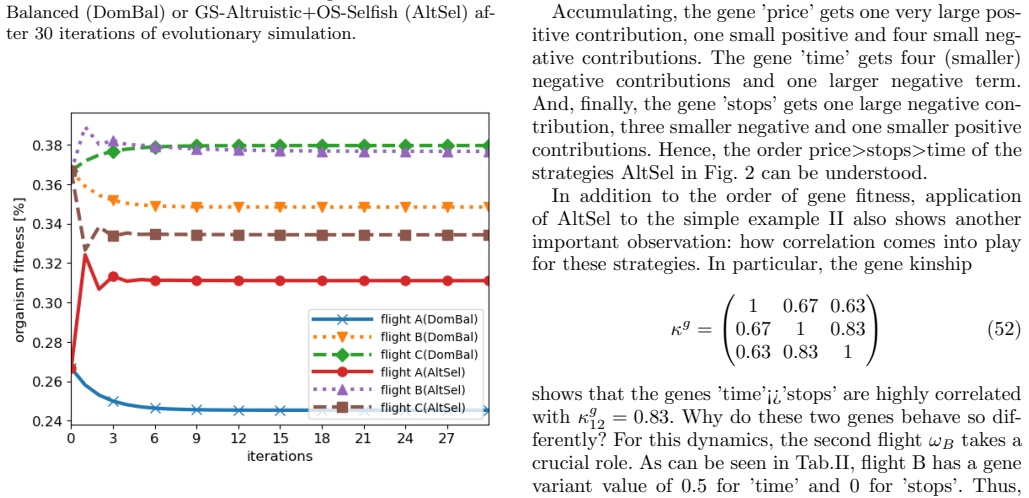
- [Secs. III B, V E, VI A] The claim of 'no external parameters' is contradicted by the design choices required by the method. The gene-variant fitness functions φ_j (Eqs. (6), (36), (37)), the initial gene fitness γ(0), the choice of the strategy pair (GS, OS), and the mixing coefficients in Eqs. (33)–(34) all affect the outcome. The paper itself states in Sec. III B that the choice of φ_j influences the simulation, and Sec. V E 2–3 explicitly reintroduces preferences and training. Even in the 'ab initio' route of Sec. VI C, the strategy sets S_g, S_ω and α(0)=0.5 are user inputs. The simple example in Sec. VI A gives different converged gene-fitness rankings for DomBal and AltSel (Fig. 2), so the claimed 'optimal' result is strategy-dependent.
- [Sec. V D, Eqs. (23) and (31)] Eq. (31) divides by r_i, and Eq. (23) also divides by r_i via µ_ij. For any row of Φ(Xp) that is entirely zero, r_i = 0 by Eq. (12), so OS-Selfish and OS-Balanced are undefined for that organism. The paper claims applicability to all matrix-form problems, but this domain excludes matrices with zero rows unless a special-case rule is supplied. The manuscript does not provide such a rule.
- [Secs. VI D and VII] The convergence claims are heuristic. Sec. VI D asserts that 'it seems plausible' OS-Balanced prevents complete gene-fitness accumulation, and Sec. VII leaves the question 'why does it work?' open. No convergence theorem is given, and the two examples have no known ground-truth optimum against which the reported rankings are checked. As a result, the claimed universality of the method is not supported by the evidence within the manuscript.
minor comments (5)
- [Sec. VI, Eqs. (36) and (37)] The maximum in Eqs. (36) and (37) is written with the bound 1 ≤ ℓ ≤ 1; it should presumably be 1 ≤ ℓ ≤ n. As written, the formula is not a column-wise normalization.
- [Sec. VI A, Eq. (52)] The text says that 'time' and 'stops' are correlated with κg12 = 0.83, but the displayed matrix gives κg12 = 0.67 and κg23 = 0.83. The index is inconsistent with the matrix.
- [Throughout] There are several typographical or typesetting issues: Eq. (12) contains a doubled comma, Eq. (72) is missing a closing bracket, and the sign tuples in Eqs. (51) and (55) are formatted inconsistently, for example '(−−, −)'.
- [Sec. V D, footnote 20] The footnote suggests ρ = max_r_t as an alternative when all initial organism fitness values are equal, but if all r_t are zero then ρ = 0 and the term (r_i − r_t)/ρ in Eq. (30) is still undefined.
- [Bibliography, reference [1]] Reference [1] is incomplete: it lacks an author and a title, reading only 'Optimization algorithms (1970) pp. 13–31'.
Circularity Check
The central 'relevance' and 'optimal solution' outputs are the fixed point of the hand-crafted replicator equations that define them; the claimed prediction reduces to the construction.
-
self definitional
[Sec. IV A (discussion after Eq. (11)); Sec. VI A simple example (Eqs. (12), (19)-(20), Fig. 2)]
"What does it mean that one data feature becomes 'fitter' than the others? In many cases, it means that the fitter feature is more relevant wrt. the others for the data analysis at hand."
The paper's target quantity, feature relevance (and the associated optimal organism ranking r_i = omega_i*gamma), is the same variable gamma that the replicator update Eqs. (19)-(20) move, using deltas from hand-chosen strategies Eqs. (21)-(31). No independent objective or external benchmark defines what 'relevant' or 'optimal' means; the ESE gamma* is by construction the fixed point of the authors' chosen equations. The strategy dependence shown in Fig. 2, where DomBal and AltSel give different gene-fitness rankings for the same data, confirms that the outcome is a property of the chosen Delta equations, not a property of the data read off independently.
full rationale
The paper has no self-citation chain or imported uniqueness theorem; the circularity is structural rather than bibliographic. The claimed ab initio result, that converged gamma encodes feature relevance and the fittest organism is the optimum, is not checked against any external ground truth or objective function. Instead, 'relevant' is asserted to mean 'fitter in the simulation,' and the simulation's update rules are consciously designed to produce non-trivial equilibria, e.g., 'we require an organisms strategy that counteracts ... in order to allow for an ESE.' Because the output variable is the evolved gene-fitness vector itself, the successful examples demonstrate that the replicator equations have fixed points, not that those fixed points solve an independently stated optimization problem. This is a genuine self-definitional reduction of the central claim, though the specific dynamical computations are internally consistent and may have heuristic value. Score 6 reflects a partial but central circularity: the predictions reduce by construction, while the paper's specific equation manipulations are not themselves logically inconsistent.
Assumptions & free parameters
free parameters (5)
- Gene variant fitness function phi_j =
boolean, percentage, inverse percentage, overlap
- Initial gene fitness gamma(0) =
uniform 1/m, or asymmetric
- Strategy set and initial mixing alpha(0) =
S_g={dom,alt}, S_w={bal,sel}, alpha=0.5
- Stopping criterion epsilon and max iterations =
not specified
- Normalization factors in strategy equations =
4, 2, 1/n, etc.
assumptions (5)
- domain assumption Data problem can be represented as a fixed n by m matrix with stable column meaning across a problem family
- ad hoc to paper Gene fitness is always normalized to sum to 1 and is interpreted as feature relevance
- ad hoc to paper The update deltas satisfy -1 <= Delta_j <= 1
- domain assumption Evolutionary analogy: data features are genes, data rows are organisms, and evolutionary equilibria reveal data structure
- ad hoc to paper Strategies test symmetry, similarity, and correlation
invented entities (3)
-
gene fitness gamma as a measure of data-feature relevance
-
evolutionary stable equilibrium (ESE) of gene fitness
-
gene kinship and organism kinship
Cite this review
Pith. "Pith review of Genetic AI: Evolutionary Games for ab initio dynamic Multi-Objective Optimization." pith.science (2026). https://pith.science/paper/PXMDY4VQ
@misc{pith2026250119113,
  author       = {Pith},
  title        = {Pith review of: Genetic AI: Evolutionary Games for ab initio dynamic Multi-Objective Optimization},
  year         = {2026},
  howpublished = {\url{https://pith.science/paper/PXMDY4VQ}},
  note         = {Machine review of arXiv:2501.19113}
}
read the original abstract
We introduce Genetic AI, a novel method for multi-objective optimization without external parameters or predefined weights. The method can be applied to all problems that can be formulated in matrix form and allows for a data-less training of AI models. Without employing predefined rules or training data, Genetic AI first converts the input data into genes and organisms. In a simulation from first principles, these genes and organisms compete for fitness, where their behavior is governed by universal evolutionary strategies. We present four evolutionary strategies: Dominant, Altruistic, Balanced and Selfish and show how a linear combination can be employed in a fully self-consistent evolutionary game. Investigating fitness and evolutionary stable equilibriums, Genetic AI helps solving optimization problems with a set of predefined, discrete solutions that change dynamically. We show the universality of the approach on two decision problems.
Figures


Figures from the paper (4 more)


Forward citations
Cited by 1 Pith paper
-
Feature weighting for data analysis via evolutionary simulation
A replicator-type feature-weighting update is claimed to converge globally to weights proportional to 1/(column mean + 1/2), but the convergence proof has a critical gap.
Reference graph
Works this paper leans on
-
[1]
Ab initio approach Taking a closer look at the linear combina- tions (33)+(34) it becomes apparent that the quantities ∆∗ ij have structural similarities with basis functions in solid state physics, e.g. in Kohn-Sham equations [21]. While self-consistency in physical systems seems quite different to our evolutionary picture, it appears natural to look for...
-
[2]
Hence, a predefined mixing of α or other strategies is a convenient choice
Predefined choice In real-world applications, one often understands the dominating behavior of the system the data describes. Hence, a predefined mixing of α or other strategies is a convenient choice. After leaving the strict ab initio rules, we can also customize the initial gene fitness γ(0) to match individual preferences. This provides a very easy me...
-
[3]
Determine the mixing through training Leaving the ab initio approach completely, we can also use training data for a problem to determine the opti- mal mixing α. In this case it pays to use the training data to determine the optimal combination of evolution- ary strategies, but customize γ(0) according to e.g. user preferences. VI. NUMERICAL EXPERIMENTS B...
-
[4]
Yang, Optimization algorithms (1970) pp
X.-S. Yang, Optimization algorithms (1970) pp. 13–31
work page 1970
-
[5]
R. Choi, A. Coyner, J. Kalpathy-Cramer, M. Chiang, and J. Campbell, Introduction to machine learning, neural networks, and deep learning, Translational vision science & technology 9, 14 (2020)
work page 2020
-
[6]
K. Deb, Multi-Objective Optimization Using Evolution- ary Algorithms (John Wiley & Sons, Inc., USA, 2001)
work page 2001
-
[7]
T. Friedrich, T. Kroeger, and F. Neumann, Weighted preferences in evolutionary multi-objective optimization, Int. J. Mach. Learn. Cybern. 4, 139 (2013)
work page 2013
-
[8]
I. H. Sarker, Ai-based modeling: Techniques, applications and research issues towards automation, intelligent and smart systems, SN Comput. Sci. 3, 10.1007/s42979-022- 01043-x (2022)
Show all 27 references
-
[9]
Z. Yuan, Y. Shang, Y. Zhou, Z. Dong, C. Xue, B. Wu, Z. Li, Q. Gu, Y. J. Lee, Y. Yan, B. Chen, G. Sun, and K. Keutzer, Llm inference unveiled: Survey and roofline model insights, ArXiv abs/2402.16363 (2024)
2024 arXiv
-
[10]
The argumentation follows the- ories in solid state physics which aim to compute proper- ties of materials without external parameters [21, 23, 24]
We are using the expressions ’ab initio’ and ’from first principles’ in this paper. The argumentation follows the- ories in solid state physics which aim to compute proper- ties of materials without external parameters [21, 23, 24]. Quite similar, in Genetic AI, we aim to gain...
-
[11]
Maynard Smith and G
J. Maynard Smith and G. R. Price, The logic of animal conflict, Nature 246, 15 (1973)
1973
-
[12]
Hofbauer and K
J. Hofbauer and K. Sigmund, Evolutionary game dynam- ics, Bulletin of the American Mathematical Society 40, 479 (2011)
2011
-
[13]
De Jong, D
K. De Jong, D. Fogel, and H.-P. Schwefel, A history of evolutionary computation (1997) pp. A2.3:1–12. 14
1997
-
[14]
Galv´ an and P
E. Galv´ an and P. Mooney, Neuroevolution in deep neu- ral networks: Current trends and future challenges, IEEE Transactions on Artificial Intelligence 2, 476 (2021)
2021
-
[15]
Maynard Smith, The theory of games and the evolu- tion of animal conflicts, Journal of Theoretical Biology 47, 209 (1974)
J. Maynard Smith, The theory of games and the evolu- tion of animal conflicts, Journal of Theoretical Biology 47, 209 (1974)
1974
-
[16]
J. M. Smith, Will a sexual population evolve to an ess?, The American Naturalist 117, 1015 (1981), https://doi.org/10.1086/283788
1981 doi
-
[17]
Axelrod, The Evolution of Cooperation (Basic, New York, 1984)
R. Axelrod, The Evolution of Cooperation (Basic, New York, 1984)
1984
-
[18]
Berger, Fictitious play in 2 × n games, Journal of Economic Theory 120, 139 (2005)
U. Berger, Fictitious play in 2 × n games, Journal of Economic Theory 120, 139 (2005)
2005
-
[19]
Dawkins, The Selfish Gene: 30Th Anniversary edition (Oxford University Press, London, England, 2006)
R. Dawkins, The Selfish Gene: 30Th Anniversary edition (Oxford University Press, London, England, 2006)
2006
-
[20]
In LDA, one neglects (some) correlations by replacing complex electronic orbitals by a single func- tion, the electronic density
Note that the approximation of taking a linear organism fitness shows similarities to applying the local density approximation (LDA) in physical and chemical simula- tions [23, 24]). In LDA, one neglects (some) correlations by replacing complex electronic orbitals by a single ...
-
[21]
One usually wants a non-trivial ESE, where not all gene fitness is transferred to a single gene
-
[22]
Note that the quadratic dependence to the gene fitness has fascinating analogies to formulas of electric charge interaction and methods to describe charge densities
-
[23]
In the case of equal organism fitness values, an alternative choice is ρ = max1≤t≤n r(0) t
-
[24]
Kohn and L
W. Kohn and L. J. Sham, Self-consistent equations in- cluding exchange and correlation effects, Phys. Rev. 140, A1133 (1965)
1965
-
[25]
3, represents an example for a weighted approach as e.g
Note that the results for i = 0 in Fig. 3, represents an example for a weighted approach as e.g. in some variants EMO[4], but with equal weights for all objectives. In con- trast to EMO, where optimal solutions are investigated, we focus on the evolutionary dynamics of the wei...
-
[26]
Hohenberg and W
P. Hohenberg and W. Kohn, Inhomogeneous electron gas, Phys. Rev. 136, B864 (1964)
1964
-
[27]
K. Held, I. A. Nekrasov, N. Bl¨ umer, V. I. Anisimov, and D. Vollhardt, Realistic modeling of strongly correlated electron systems: an introduction to the lda+dmft ap- proach, International Journal of Modern Physics B 15, 2611 (2001)
2001
Reviewed August 9, 2026 · model on record in the stance chip above.
Discussion (0). Continue with ORCID to comment.