REVIEW 3 major objections 5 minor 1 cited by
Lifting the Winding Number: Precise Discontinuities in Neural Fields for Physics Simulation
T0 review · 3 major / 5 minor · reviewed 2026-08-09 · deepseek-v4-flash
Pith's one-line read Wind Lifter represents sharp discontinuities in neural fields without storing the cut in the weights.
desk verdict A genuinely new discontinuity-by-lifting construction with sound math; the real question is how far the learned field interpolates in winding-number coordinates. read the letter →
The pith
A machine-rendered reading of the paper's core claim, the machinery that carries it, and where it could break.
The reading
What carries the argument
The winding graph $L_\alpha(x) = (x, H_\alpha(x))$, where $H_\alpha$ is the generalized winding number of the portion $\Gamma_\alpha$ of the cut curve that has been made so far and $\alpha$ is the fraction of the curve length cut. The generalized winding number is a harmonic scalar field that jumps by a constant across an open curve, so the graph smoothly separates the two sides of the cut in 3D. Evaluating the continuous network $\tilde{f}_\theta$ on this graph converts an easy learning task—fitting a smooth volumetric field—into a representation of a discontinuous planar field; updating the cut at runtime is just recomputing $H_\alpha$.
What would settle it
Take the trained network for a clockwise helical cut and run the same simulation with a counter-clockwise helical cut, comparing displacement fields against a full-order FEM reference; the paper's Figure 8 shows the deformation diverges in exactly this test. A quantitative version would sweep the gap between training and test winding-number distributions and measure reconstruction MSE, checking whether error grows monotonically with that gap.
Extended reading notes
Core claim
Restricting a continuous volumetric neural field to the winding-number graph of a cut polyline yields a 2D field with exact, strict discontinuities along that polyline: $f_\alpha(x) = \tilde{f}_\theta(x, H_\alpha(x))$. The key move is to make the jump live in the input coordinates rather than in the network weights, so the network only ever fits a smooth function on $\Omega \times \mathbb{R}$. Since $H_\alpha$ is computed analytically from the current cut curve, the same frozen network can represent a whole family of cut geometries and progressions; the paper demonstrates this by training on one set of cuts and simulating qualitatively different cuts with the weights untouched, and by training the basis without any simulation data using only elastic energy.
Load-bearing premise
The central assumption is that the trained continuous network gives physically correct values on winding-number coordinates it never saw during training; the construction guarantees a sharp discontinuity for any cut, but not that the deformation on an out-of-distribution cut is the right one.
Editorial extensions
If this is right
- A cut can be lengthened, moved, or reshaped during a simulation by re-evaluating the winding graph, with no retraining and no remeshing.
- A single trained network generalizes to cut placements not present in the training distribution, as demonstrated on one-shot tests and interactive editing.
- Data-free training is possible: minimizing elastic energy alone produces a cut-aware basis, which prior mesh-free data-free methods could not do.
- Reduced simulation with cut changes runs at interactive rates (roughly 28–42 fps with cut updates, 62–166 fps without), giving a 30×–183× speedup over the full-space solver used for comparison.
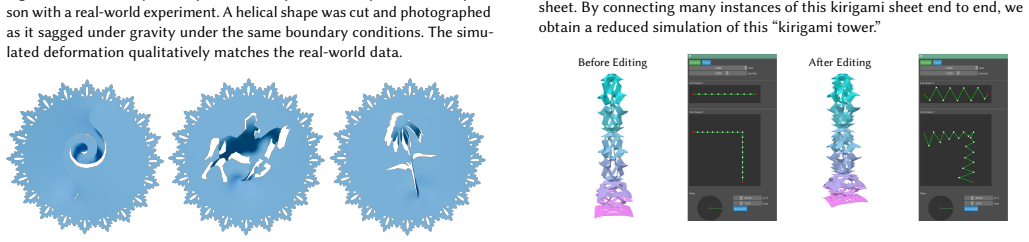
- The representation also generalizes to external forces unseen during training, and the simulated sagging of a cut paper helix qualitatively matches a physical experiment.
Reading between the lines
- The lifting construction is not tied to winding numbers in principle; any analytically computable jump function would separate the sides of a cut, so the same idea may transfer to discontinuities in other settings, such as fluid interface jumps or 3D crack surfaces.
- The paper's own out-of-distribution test suggests the practical limit is interpolation in winding-number space, not the sharpness of the discontinuity; this points to a testable extension where training on a family of winding graphs rather than one would widen the range of editable cuts.
- Because cut geometry is an explicit polyline, the representation could be plugged into derivative-based design tools, where optimizing a cut shape for a target deformation becomes an optimization over a few control points with the neural basis held fixed.
Editorial analysis
A structured set of objections, weighed in public.
Referee Report
Summary. The paper introduces "Wind Lifter," a method for representing fields with strict discontinuities along curves using continuous neural fields. The key idea (Section 3, Eq. 3) is to append a generalized winding number H_α(x) as a third input coordinate, forming a graph L_α(x)=(x, H_α(x)) in 3D, and to define the 2D field as the restriction f = f̃_θ ∘ L_α of a learned continuous volumetric field to this graph. Because H_α is discontinuous across the cut Γ_α, the restriction is strictly discontinuous there, while the neural network itself remains continuous. The authors apply this construction to reduced-order modeling of thin shells, training the volumetric field either data-driven (Eq. 8) or data-free by minimizing elastic energy (Eq. 9). They demonstrate progressive cutting, runtime editing of cut polylines, generalization to held-out cut shapes and unseen loads, and interactive design, and compare against LiCROM, DANN, and Simplicits baselines (Figure 14).
Significance. The central mathematical construction is elegant and likely correct: it cleanly decouples the geometry of the discontinuity (encoded in the analytically computed winding graph) from the learnable continuous part, so the location of the jump is exact by construction without re-training. The paper also makes a useful contribution by showing that lifting is compatible with both data-driven and data-free training of reduced bases, and it demonstrates real-time interactive cut editing, which is not available in prior mesh-based or weight-encoded neural ROMs. The empirical results on the demonstrated examples are promising and show clear improvements over the baselines. If the generalization behavior is confirmed by a broader quantitative study, the work would be a substantive advance in reduced-order modeling of cutting. The paper is honest about its limitation (Section 6, Out-of-Distribution Challenges), though the abstract and contributions state the generalization claim more strongly than the evidence currently supports.
major comments (3)
- [Section 5.2, Figure 14; Section 6] The claim of generalization to "cut placements not seen during training" (Section 1) rests on exactly one held-out test shape (Figure 14, MSE=0.20% versus 0.02% on the training shape) and on qualitative results (Figures 7 and 8). The paper's own Section 6 acknowledges that performance decreases "when tested on winding number distributions significantly different from the training data," and Figure 8 shows that a counter-clockwise helix yields a deformation different from the training-case result. This does not invalidate the construction—Eq. (3) guarantees the location and existence of a strict jump for any Γ_α—but it means the central generalization claim is currently supported only in an unquantified neighborhood of the training distribution. I request one of the following: (i) a systematic error study across multiple random held-out cut polylines with varying geometric deviation, including error bars over network initializations; (ii) an explicit characterization of the region in cut-parameter space (or winding-number-coordinate space) in which the reconstruction error is below a stated tolerance; or (iii) a training augmentation, such as superimposing the loss on multiple winding graphs per epoch, that demonstrably covers the intended test distribution.
- [Section 3, Eq. (3); Section 4.1, Eqs. (8)–(9)] The construction f = f̃_θ ∘ L_α makes the location and existence of the discontinuity rigorous, but it makes no statement about the correctness of the field values on lifted coordinates that were absent from training. The losses in Eqs. (8) and (9) are evaluated only on the winding graphs of the training cuts; for a test cut Γ_test, the third coordinate H_test(x) can lie outside the range of H seen in training, and the loss does not constrain those regions. Therefore, both the magnitude of the jump and the deformed shape on an unseen cut depend on interpolation behavior of the trained volumetric network, not on the lifting construction. This is a gap between the mathematical statement and the empirical generalization claim, not a circularity: the held-out test in Figure 14 does produce nontrivial errors (0.20% versus 0.02%), which shows the test is not a restatement of fitted values. To make the claim load-bearing, the revision should either characterize the interpolation error on out-of-distribution winding-number coordinates (e.g., by plotting the training and test distributions of the lifted coordinate z and reporting errors as a function of distribution distance), or train with a distribution of winding graphs broad enough to cover the editing and generalization scenarios advertised in Sections 1 and 5.
- [Section 5.2, Figure 14; Table 1] The quantitative comparison reports a single MSE value per method and condition, with no variance across training runs or across multiple test cuts. Because the headline contribution is generalization to unseen cuts, the evaluation should report mean and standard deviation over at least three to five independent network initializations and over several randomly generated held-out cut shapes. As written, it is impossible to tell whether the 0.20% test error for the single unseen cut is representative or a favorable draw, particularly since the same figure shows the baselines at 2.10%–2.74%.
minor comments (5)
- [Section 4.3, Strain singularity at crack tip; Section 5] The smoothing kernel width ε and the winding-number scaling factor of 32 are free parameters; please state how they were chosen and, if possible, include a brief sensitivity study to show that the reported results are not sensitive to their exact values.
- [Section 4.1, Eq. (9)] Equation (9) has a punctuation issue: the equation is followed by a comma before "where." Also, the notation L_data-free = E_elas is not written as an explicit function of the network parameters θ and the cut parameter α; clarifying this would help the reader.
- [Figure 12] The y-axis label "MSE (%)" is ambiguous because the axis ranges from about 10^-1 to 10^0; please specify whether these are percentages and what the normalization is (for example, relative to what reference deformation).
- [Section 5.2, Figure 14] The baseline "DANN" is named in Figure 14 but not described in the text beyond the citation to Belhe et al. [2023]; add a one-sentence description of the method so the comparison is self-contained.
- [Section 5.1, Figure 7] The data-free generalization test with three held-out cut shapes is presented only qualitatively; adding quantitative errors for these cases would help support the generalization claim.
Circularity Check
No significant circularity: the lifting construction is a definitional mechanism; held-out cut tests and the paper's own OOD caveat confirm the generalization claim is not a restatement of the training fit.
full rationale
The Wind Lifter construction (Eq. 3: f = f_tilde_theta ∘ L) is an explicit definitional device, not a fitted input masquerading as a prediction: the discontinuity location is inserted analytically via H_alpha (Eqs. 4-5), and the network only learns the volumetric field f_tilde_theta. The central generalization claim is supported by held-out experiments (Figure 7; Figure 14 bottom: MSE 0.20% on a test cut vs 0.02% on a training cut), which are genuine evaluations across different cut geometries, so the result does not reduce to the training fit. Self-citations to LiCROM [Chang et al. 2023] for the training loss (Eq. 8), the subspace update (Eq. 10), and the data-free baseline [Modi et al. 2024] (Eq. 9) are methodological reuse; they are not used to establish the lifting construction or to forbid alternative representations, so they are not load-bearing. The paper's own Section 6 out-of-distribution caveat (Figure 8: 'our method's performance decreases when tested on winding number distributions significantly different from the training data') is a genuine limitation on extrapolation, not circularity; if anything, the observed degradation confirms that the held-out tests are not tautological. No step in the derivation chain is equivalent by construction to its inputs.
Assumptions & free parameters
free parameters (4)
- Winding number scaling factor =
32
- Crack-tip smoothing kernel width ε =
not specified in main text
- Number of reduced basis modes k =
18 (data-free), 20 (data-driven)
- Neural network architecture hyperparameters =
5-layer, 128-channel SIREN, positional encoding up to frequency 23
assumptions (6)
- standard math The generalized winding number H_α(x) from Eq. 5 is a well-defined analytic function on Ω∖Γ_α with a fixed jump across the cut line Γ_α.
- domain assumption Displacement is a linear combination of k reduced modes, u = z^T Φ_α, and the reduced configuration z evolves by the optimization in Eq. 10.
- domain assumption The elastic energy Ψ is a hyperelastic density (StVK in data-free, stable Neo-Hookean in data-driven) evaluated with deformation gradients from automatic differentiation of the neural basis.
- ad hoc to paper For runtime edits and unseen cut shapes, the network must interpolate accurately on winding-number values outside its training distribution.
- domain assumption Cut geometry is limited to piecewise-linear polylines, and progressive cutting is parameterized by the first α-fraction of polyline arc length.
- ad hoc to paper The crack-tip strain singularity can be smoothed by multiplying the winding number with a cubic spline in an ε-neighborhood without materially changing the simulated deformation.
invented entities (2)
-
Lifted winding-number coordinate z = H_α(x)
-
Winding graph
Cite this review
Pith. "Pith review of Lifting the Winding Number: Precise Discontinuities in Neural Fields for Physics Simulation." pith.science (2026). https://pith.science/paper/KOBRKZAS
@misc{pith2026250200626,
  author       = {Pith},
  title        = {Pith review of: Lifting the Winding Number: Precise Discontinuities in Neural Fields for Physics Simulation},
  year         = {2026},
  howpublished = {\url{https://pith.science/paper/KOBRKZAS}},
  note         = {Machine review of arXiv:2502.00626}
}
read the original abstract
Cutting thin-walled deformable structures is common in daily life, but poses significant challenges for simulation due to the introduced spatial discontinuities. Traditional methods rely on mesh-based domain representations, which require frequent remeshing and refinement to accurately capture evolving discontinuities. These challenges are further compounded in reduced-space simulations, where the basis functions are inherently geometry- and mesh-dependent, making it difficult or even impossible for the basis to represent the diverse family of discontinuities introduced by cuts. Recent advances in representing basis functions with neural fields offer a promising alternative, leveraging their discretization-agnostic nature to represent deformations across varying geometries. However, the inherent continuity of neural fields is an obstruction to generalization, particularly if discontinuities are encoded in neural network weights. We present Wind Lifter, a novel neural representation designed to accurately model complex cuts in thin-walled deformable structures. Our approach constructs neural fields that reproduce discontinuities precisely at specified locations, without baking in the position of the cut line. Crucially, our approach does not embed the discontinuity in the neural network's weights, opening avenues to generalization of cut placement. Our method achieves real-time simulation speeds and supports dynamic updates to cut line geometry during the simulation. Moreover, the explicit representation of discontinuities makes our neural field intuitive to control and edit, offering a significant advantage over traditional neural fields, where discontinuities are embedded within the network's weights, and enabling new applications that rely on general cut placement.
Figures


Figures from the paper (7 more)




Forward citations
Cited by 1 Pith paper
-
Precise Gradient Discontinuities in Neural Fields for Subspace Physics
Augmenting neural field inputs with a clamped distance function lets a single network represent gradient discontinuities at material interfaces and creases, enabling discretization-agnostic reduced-order physics simulation.
Reference graph
Works this paper leans on
-
[2009]
Graph.28, 3, Article 50 (jul 2009), 10 pages
Enrichment textures for detailed cutting of shells.ACM Trans. Graph.28, 3, Article 50 (jul 2009), 10 pages. https://doi.org/10.1145/1531326.1531356 Byungsoo Kim, Vinicius C Azevedo, Nils Thuerey, Theodore Kim, Markus Gross, and Barbara Solenthaler. 2019. Deep fluids: A generative network for parameterized fluid simulations. InComputer Graphics Forum, Vol....
arXiv 2024
-
[2016]
The material point method for simulating continuum materials. InAcm siggraph 2016 courses. 1–52. Peter Kaufmann, Sebastian Martin, Mario Botsch, Eitan Grinspun, and Markus Gross
work page 2016
-
[2018]
Graph.37, 4, Article 60 (jul 2018), 14 pages
Tetrahedral meshing in the wild.ACM Trans. Graph.37, 4, Article 60 (jul 2018), 14 pages. https://doi.org/10.1145/3197517.3201353 Alec Jacobson, Ladislav Kavan, and Olga Sorkine-Hornung. 2013. Robust inside-outside segmentation using generalized winding numbers.ACM Trans. Graph.32, 4, Article 33 (jul 2013), 12 pages. https://doi.org/10.1145/2461912.2461916...
arXiv 2018
-
[2019]
David Grangier, Pierre Ablin, and Awni Hannun
Latent-space Dynamics for Reduced Deformable Simulation.Computer Graphics Forum(2019). David Grangier, Pierre Ablin, and Awni Hannun. 2023. Adaptive training distributions with scalable online bilevel optimization.arXiv preprint arXiv:2311.11973(2023). Yixin Hu, Qingnan Zhou, Xifeng Gao, Alec Jacobson, Denis Zorin, and Daniele Panozzo
arXiv 2019
-
[2020]
Fourier Features Let Networks Learn High Frequency Functions in Low Dimensional Domains. InAdvances in Neural Information Processing Systems, Vol. 33. 7537–7547. Yuanyuan Tao, Ivan Puhachov, Derek Nowrouzezahrai, and Paul Kry. 2024. Neural Implicit Reduced Fluid Simulation. InSIGGRAPH Asia 2024 Conference Papers. 1–11. Quoc-Minh Ton-That, Paul G. Kry, and...
arXiv 2024
-
[2021]
On Self-Contact and Human Pose. InProceedings IEEE/CVF Conf. on Computer Vision and Pattern Recogßnition (CVPR). Octavi Obiols-Sales, Abhinav Vishnu, Nicholas Malaya, and Aparna Chandramowlish- waran. 2023. ADARNet: Deep Learning Predicts Adaptive Mesh Refinement. In Proceedings of the 52nd International Conference on Parallel Processing. 524–534. Shaowu ...
arXiv 2022
-
[2024]
Lars Mescheder, Michael Oechsle, Michael Niemeyer, Sebastian Nowozin, and Andreas Geiger
Accelerate Neural Subspace-Based Reduced-Order Solver of Deformable Simulation by Lipschitz Optimization.ACM Transactions on Graphics (TOG)43, 6 (2024), 1–10. Lars Mescheder, Michael Oechsle, Michael Niemeyer, Sebastian Nowozin, and Andreas Geiger. 2019. Occupancy networks: Learning 3d reconstruction in function space. InProceedings of the IEEE/CVF confer...
2024
Reviewed August 9, 2026 · model on record in the stance chip above.
Discussion (0). Continue with ORCID to comment.