REVIEW 2 major objections 5 minor 81 references
Exploring the capability of the HH 80-81 protostellar jet to accelerate relativistic particles
T0 review · 2 major / 5 minor · reviewed 2026-08-09 · deepseek-v4-flash
Pith's one-line read After 15 years of Fermi-LAT data, the paper argues that the gamma-ray excess above 300 MeV in this region most probably comes from the HH 80-81 protostellar jet, not from the neighboring radio source J1819, and that the spectrum can be…
desk verdict A useful, honest Fermi-LAT study of HH 80-81, but the source association rests on a circular localization and an unpropagated diffuse-systematic, so the central claim remains conditional. read the letter →
The pith
A machine-rendered reading of the paper's core claim, the machinery that carries it, and where it could break.
The reading
What carries the argument
The physical mechanism assumed is diffusive shock acceleration, in which charged particles gain energy by crossing the shocks formed where the jet rams into dense interstellar material; the paper leans on the existing detection of polarized non-thermal radio emission from HH 80-81 as evidence that this acceleration is happening. The modeling machinery is a power-law-with-exponential-cutoff particle distribution, $\phi(E) = \phi_0 (E / 1\ \mathrm{GeV})^{-\Gamma} \exp(-E/E_{\mathrm{cutoff}})$, with the gamma-ray photon index carried over to the particle index and with cutoff energies set by cooling: about $3$ TeV for electrons (synchrotron) and about $12$ TeV for protons (pion decay at $100\ \mathrm{cm}^{-3}$). Radiative fitting then compares relativistic bremsstrahlung and proton-proton pion decay against the Fermi-LAT spectrum, and the decisive diagnostic is the implied total energy and injection time relative to the jet's known lifetime.
What would settle it
Track the >300 MeV excess with an instrument of better angular resolution than Fermi-LAT, such as one of the next-generation imaging atmospheric Cherenkov arrays: if the centroid is resolved onto J1819, or if the flux varies on month-to-year timescales in step with J1819's radio flaring, the paper's association fails. A matched hard-X-ray observation of J1819 that detects emission at or above the level expected for an AGN would also remove the paper's strongest alternative candidate.
Extended reading notes
Core claim
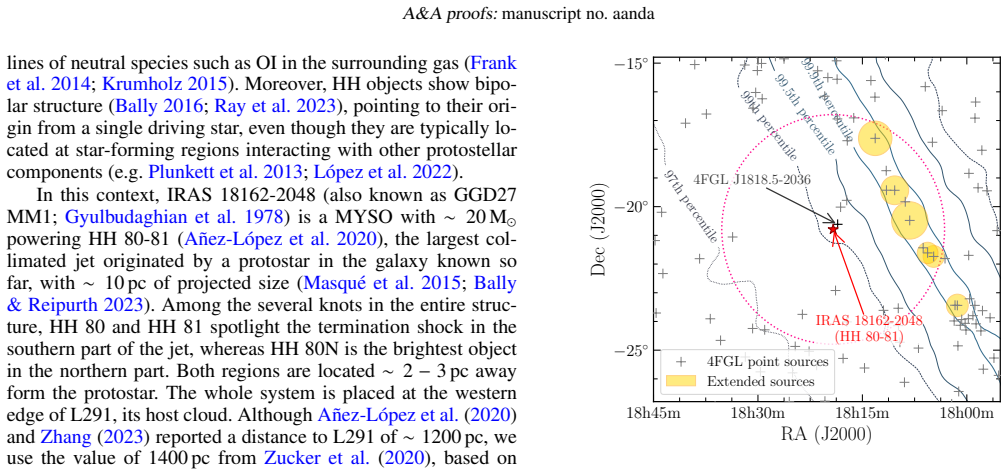
On its own terms, the paper's central claim is that the gamma-ray excess detected above 300 MeV is real and belongs to HH 80-81. After swapping the catalog source 4FGL J1818.5-2036 for a point-like source at the protostar's coordinates, the likelihood improves substantially, and the source has a test statistic $\mathrm{TS}\approx 29$ above 300 MeV (about $5\sigma$) and a power-law spectrum with photon index $\Gamma = 2.62 \pm 0.12$, harder than the previous detection. The source is stable over 15 years, pointing away from a blazar interpretation, and the compact radio source J1819 sits outside the $2\sigma$ containment while the protostar sits inside the $1\sigma$ region. Both a leptonic model (relativistic bremsstrahlung) and a hadronic model ($\pi^0$ decay from proton-proton collisions) fit the spectrum, with inverse Compton scattering ruled out energetically; the required particle energies are $(1.4 \pm 0.3)\times 10^{46}$ erg and $(2.9 \pm 0.5)\times 10^{47}$ erg for a density of $100\ \mathrm{cm}^{-3}$, and the corresponding injection times, about $10^3$ yr and $2\times 10^4$ yr, are compatible with the jet lifetime of about $4\times 10^4$ yr. The paper therefore concludes that HH 80-81 is the most probable counterpart, while leaving the hadronic-versus-leptonic question open.
Load-bearing premise
The load-bearing premise is the association of the gamma-ray excess with HH 80-81 itself, which rests on positional overlap within one sigma, the absence of variability, and the lack of X-ray detection of the alternate candidate J1819; if the excess is actually powered by J1819 or is an artifact of the Galactic diffuse template, the conclusion that the protostellar jet accelerates relativistic particles does not follow.
Editorial extensions
If this is right
- The gamma-ray excess above 300 MeV is a genuine point-like detection at about 5 sigma, so HH 80-81 can be studied as a gamma-ray-emitting protostellar jet and not merely as a catalog coincidence.
- Because both hadronic and leptonic models fit, the particle accelerator at the termination shock can supply either relativistic electrons or protons, and the injected energy is consistent with a few percent of the jet's kinetic power.
- The 100-300 MeV band is too contaminated by Galactic diffuse emission for reliable spectral measurements; future analyses of this source should start at 300 MeV or higher.
- Inverse Compton scattering is effectively excluded as the dominant gamma-ray mechanism under the assumed IR photon density, narrowing the radiative channels to bremsstrahlung and pion decay.
- A future gamma-ray flare coincident with a radio or infrared flare from the jet would settle the association between young stellar objects and gamma-ray emission.
Reading between the lines
- If the excess is hadronic, the implied proton energy of roughly $3\times10^{47}$ erg accumulated over about $2\times10^4$ years makes HH 80-81 a non-negligible local source of cosmic rays; extrapolating to the population of massive protostellar jets would require knowing their duty cycle, which this paper does not address.
- The modeling degeneracy could be broken by the predicted cutoffs: electrons should run out of energy near $3$ TeV and protons near $12$ TeV, so a future imaging atmospheric Cherenkov telescope detection above a few hundred GeV with a measured cutoff would discriminate the two populations.
- The paper's spatial coincidence between the gamma-ray excess and the L291 molecular gas suggests a hadronic contribution, because pion decay scales with target density; mapping the excess with better angular resolution could test whether the emission follows the dense gas rather than the jet axis.
- A direct extension would be to use the gamma-ray flux as a calorimeter: combining the measured total energy with an assumed cosmic-ray injection spectrum yields an estimate of the jet's mechanical feedback on its host cloud, a step the paper does not take.
Editorial analysis
A structured set of objections, weighed in public.
Referee Report
Summary. The paper analyzes 15 years of Fermi-LAT data toward the HH 80-81 protostellar jet, reports a gamma-ray excess above 300 MeV, and uses positional, variability, and multiwavelength arguments to associate it with HH 80-81. It then fits the gamma-ray SED with leptonic (relativistic Bremsstrahlung) and hadronic (π0 decay) models, finding both compatible and deriving total particle energies and injection times that are consistent with the jet lifetime.
Significance. If the association with HH 80-81 holds, this would be an important piece of evidence that protostellar jets accelerate particles to relativistic energies and may contribute to Galactic cosmic rays. The paper uses the full 15-year Fermi-LAT dataset and openly documented analysis tools (fermipy, naima, GAMERA). The radiative modeling is clearly described, the authors acknowledge the leptonic/hadronic degeneracy, and they give quantitative energy and timescale arguments. However, the central source identification has not been properly confronted with the principal alternative, the compact radio source J1819, and the detection claim relies on a diffuse-model assumption that is not tested for systematics.
major comments (2)
- [Sect. 2.1 (Table 1, Fig. 2)] The exclusion of all data below 300 MeV is justified by the statement that a roughly 1% variation in the Galactic diffuse template corresponds to the measured source flux, yet no systematic uncertainty from the diffuse model is propagated into the detection significance or the spectral index. This is load-bearing because the claimed 5σ excess and the hard spectrum (Γ=2.62±0.12) are derived with a fixed gll_iem_v07 template. Please repeat the likelihood analysis with alternative diffuse-model normalizations or different interstellar emission templates and report how the TS and spectral index change. If the excess does not survive at >5σ under reasonable diffuse-model variations, the central detection claim is not robust.
- [Sect. 3 (Fig. 5, Table 3)] The association with HH 80-81 is not actually tested against the J1819 hypothesis. The localization is computed after replacing 4FGL J1818.5-2036 with a point source fixed at the IRAS coordinates, so the resulting best-fit position is biased toward those coordinates. To make the identification discriminating, the authors should fit a point source at the J1819 coordinates and compare the maximum likelihood (or TS) with the IRAS-centered model, and also show the localization result when the test source is initialized at J1819. Given that the LAT PSF is several degrees for the bulk of the 1445 predicted counts and the separation is only about 0.2 deg, the statement that J1819 is outside the 2σ region cannot by itself exclude this alternative. The non-variability argument is also weak: the light curve in Fig. 4 is dominated by non-detections and upper limits, and many flat-spectrum radio quasars do not show variability in Fermi data on 15-year timescales.
minor comments (5)
- [Abstract and throughout] There are numerous typographical and rendering errors (e.g., 'di ffusive' in the abstract, 'spacial' in Sect. 2.1, 'loosing' for 'losing' in Sect. 4, and square symbols that replace minus signs, degree signs, and other LaTeX constructs in the provided text). These should be corrected before publication.
- [Sect. 2.2] The cross-reference to 'Table 3' appears before that table is introduced; Table 3 is in Sect. 3. Use a forward reference or restructure.
- [Sect. 3] The placeholder 'GGD catalog (?)' should be replaced with a proper catalog name or citation.
- [References] The Araudo et al. (2008) reference is incomplete: 'arXiv preprint arXiv: . . . [arXiv:arXiv:0806.2306v1]' needs a full bibliographic entry.
- [Abstract] The phrase 'the detected spectrum can be explained by both hadronic and leptonic particle components' is a fitted consequence rather than a test, as the paper itself acknowledges the degeneracy in Sect. 4. Consider rephrasing to indicate that the data are consistent with both models without implying a unique physical conclusion.
Circularity Check
No significant circularity: the Fermi-LAT analysis, source association, and radiative modeling are fits validated against external data, not predictions that reduce to their inputs.
full rationale
The paper's central claim is that the gamma-ray excess above 300 MeV is most plausibly associated with the HH 80-81 protostellar jet. The derivation chain is not circular. In Section 2, the authors build a standard Fermi-LAT ROI model using the 4FGL catalog and replace the catalog source 4FGL J1818.5-2036 with a point source at the IRAS 18162-2048 coordinates, reporting a likelihood-ratio improvement of ~42. This is a direct model comparison between two candidate positions, not a consequence of assuming the conclusion. The source identification in Section 3 is based on this comparison, on the localize fit, and on external multiwavelength data (X-ray upper limits, radio properties, variability), so it does not reduce to an input assumption. The radiative modeling in Section 4 is explicitly described as 'fitting' the LAT SED with naima and GAMERA; the conclusion that both leptonic and hadronic models can reproduce the spectrum is a fit result, and the paper itself notes the 'considerable degeneracy intrinsic to the problem.' The energetics estimates use literature values (jet lifetime, density, magnetic field, kinetic luminosity) and compare derived injection times to the jet lifetime; this is a consistency check, not a fitted input renamed as a prediction. The only self-citations (e.g., de Oña Wilhelmi et al. 2023) are motivational examples of MYSO flaring and are not load-bearing for the central association or spectral conclusions. No equation or claimed prediction is equivalent to its input by construction.
Assumptions & free parameters
free parameters (9)
- Gamma-ray spectral index Gamma =
2.62 +/- 0.12
- Power-law normalization phi0 =
(7.6 +/- 2.2) x 10^-13 MeV^-1 cm^-2 s^-1
- Ambient gas density n =
100 cm^-3
- Magnetic field B =
0.1 mG
- IR photon density U_IR =
3 eV cm^-3
- Acceleration efficiency eta =
5%
- Jet kinetic luminosity L_jet =
about 1e37 erg s^-1
- Shock velocity v_sh =
400 km s^-1
- Jet lifetime t_jet =
4 x 10^4 yr
assumptions (6)
- standard math The Fermi-LAT likelihood formalism and TS distribution as chi-square are valid for assessing detection significance.
- domain assumption The Galactic diffuse template gll_iem_v07 and isotropic template iso_P8R3_SOURCE_V3_v1 accurately describe the background.
- ad hoc to paper The gamma-ray excess can be modeled as a point-like source centered on IRAS 18162-2048.
- domain assumption Diffusive shock acceleration operates in the HH 80-81 termination shocks with the assumed shock velocity and Bohm diffusion.
- domain assumption The jet kinetic power is about 1e37 erg s^-1 and 5% of it goes into particle acceleration.
- domain assumption The ambient density of 100 cm^-3 and magnetic field of 0.1 mG characterize the emission region.
Cite this review
Pith. "Pith review of Exploring the capability of the HH 80-81 protostellar jet to accelerate relativistic particles." pith.science (2026). https://pith.science/paper/6YQ7ZVYP
@misc{pith2026250201261,
  author       = {Pith},
  title        = {Pith review of: Exploring the capability of the HH 80-81 protostellar jet to accelerate relativistic particles},
  year         = {2026},
  howpublished = {\url{https://pith.science/paper/6YQ7ZVYP}},
  note         = {Machine review of arXiv:2502.01261}
}
abstract
Context. Protostellar jets driven by massive protostars are collimated outflows producing high-speed shocks through dense interstellar medium. Fast shocks can accelerate particles up to relativistic energies via diffusive shock acceleration, producing non-thermal emission that can originate ${\gamma}$-ray photons. HH 80-81 is one of the most powerful collimated protostellar jets in our galaxy, with non-thermal emission detected in radio, X-ray, and ${\gamma}$-ray bands. Characterize the ${\gamma}$-ray emission originated by the accelerated particles of the region is crucial for demonstrating the capability of protostars to accelerate cosmic rays. Aims. Our goal is to determine the particle distribution that is producing the ${\gamma}$-ray spectrum of HH 80-81 in order to ascertain the leptonic/hadronic origin of the ${\gamma}$-ray emission. We aim at associating the high-energy emission in the region with the HH 80-81 system, characterize its spectrum, and elaborate emission models based on what we expect from the diffusive shock acceleration. Methods. We use the 15 yr database provided by the Fermi-LAT satellite to study the high-energy emission of the jet, spanning from 300 MeV to 100 GeV. In addition, we perform a source association based on positional arguments. Then, we employ the naima and Gamera softwares to analyze the possible mechanisms that are producing ${\gamma}$-rays considering the ambient conditions. We perform a radiative fitting and study the nature of the particles behind the ${\gamma}$-ray emission. Results. By analyzing all the candidates to produce the ${\gamma}$-ray emission that we detect, we conclude that HH 80-81 is the most probable candidate to explain the ${\gamma}$-ray emission in the region. The detected spectrum can be explained by both hadronic and leptonic particle components.
Figures


Figures from the paper (5 more)


Reference graph
Works this paper leans on
-
[1]
2020, ApJ, 888, 41
Añez-López, N., Osorio, M., Busquet, G., et al. 2020, ApJ, 888, 41
2020
-
[2]
2022, The Astrophysical Journal Sup- plement Series, 260, 53
Abdollahi, S., Acero, F., Baldini, L., et al. 2022, The Astrophysical Journal Sup- plement Series, 260, 53
2022
-
[3]
2020, ApJ, 892, 105
Ajello, M., Angioni, R., Axelsson, M., et al. 2020, ApJ, 892, 105
2020
-
[4]
F., & Carrasco-González, C
Anglada, G., Rodríguez, L. F., & Carrasco-González, C. 2018, A&A Rev., 26, 3
2018
-
[5]
T., Padovani, M., & Marcowith, A
Araudo, A. T., Padovani, M., & Marcowith, A. 2021, MNRAS, 504, 2405
work page 2021
-
[6]
Araudo, A. T., Romero, G. E., Bosch-Ramon, V ., & Paredes, J. M. 2007, A&A, 476, 1289
work page 2007
-
[7]
Non-thermal emission from massive YSOs. Exploring the spectrum at high energies
Araudo, A. T., Romero, G. E., Bosch-Ramon, V ., & Paredes, J. M. 2008, arXiv preprint arXiv: . . . [arXiv:arXiv:0806.2306v1]
work page Pith review arXiv 2008
-
[8]
2022, MNRAS, 510, 2277
Araya, M., Gutiérrez, L., & Kerby, S. 2022, MNRAS, 510, 2277
2022
Show all 81 references
-
[9]
J., Stern, D., Noirot, G., et al
Assef, R. J., Stern, D., Noirot, G., et al. 2018, ApJS, 234, 23
2018
-
[10]
2013, arXiv e-prints, arXiv:1303.3514
Atwood, W., Albert, A., Baldini, L., et al. 2013, arXiv e-prints, arXiv:1303.3514
2013 arXiv
-
[11]
2023, A&A, 671, A13
Backs, F., Poorta, J., Rab, C., et al. 2023, A&A, 671, A13
2023
-
[12]
H., Lott, B., & collaboration, T
Ballet, J., Bruel, P., Burnett, T. H., Lott, B., & collaboration, T. F.-L. 2024, Fermi Large Area Telescope Fourth Source Catalog Data Release 4 (4FGL-DR4)
2024
-
[13]
2016, ARA&A, 54, 491
Bally, J. 2016, ARA&A, 54, 491
2016
-
[14]
& Reipurth, B
Bally, J. & Reipurth, B. 2023, ApJ, 958, 99
2023
-
[15]
G., Ellison, D
Baring, M. G., Ellison, D. C., Reynolds, S. P., Grenier, I. A., & Goret, P. 1999, ApJ, 513, 311
1999
-
[16]
S., Burns, R
Bayandina, O. S., Burns, R. A., Caratti o Garatti, A., et al. 2024, A&A, 684, A86
2024
-
[17]
Bell, A. R. 1978, MNRAS, 182, 147 Beltrán, M. T. & de Wit, W. J. 2016, A&A Rev., 24, 6
1978
-
[18]
Blandford, R. D. & Ostriker, J. P. 1978, ApJ, 221, L29
1978
-
[19]
D., Wolfire, M., & Leroy, A
Bolatto, A. D., Wolfire, M., & Leroy, A. K. 2013, ARA&A, 51, 207
2013
-
[20]
E., Araudo, A
Bosch-Ramon, V ., Romero, G. E., Araudo, A. T., & Paredes, J. M. 2010, A&A, 511, A8
2010
-
[21]
M., Estalella, R., et al
Busquet, G., Girart, J. M., Estalella, R., et al. 2019, A&A, 623, L8 Cantó, J., Raga, A. C., & D’Alessio, P. 2000, MNRAS, 313, 656 Caratti o Garatti, A., Eislöffel, J., Froebrich, D., et al. 2009, A&A, 502, 579 Caratti o Garatti, A., Stecklum, B., Garcia Lopez, R., et al. 2017...
2019
-
[22]
2018, A&A, 612, A103
Cesaroni, R., Moscadelli, L., Neri, R., et al. 2018, A&A, 612, A103
2018
-
[23]
S., Gordon, D., et al
Charlot, P., Jacobs, C. S., Gordon, D., et al. 2020, A&A, 644, A159
2020
-
[24]
2021, ApJ, 922, 90
Chen, Z., Sun, W., Chini, R., et al. 2021, ApJ, 922, 90
2021
-
[25]
C., Stone, E
Cummings, A. C., Stone, E. C., Heikkila, B. C., et al. 2016, ApJ, 831, 18
2016
-
[26]
M., Hartmann, D., & Thaddeus, P
Dame, T. M., Hartmann, D., & Thaddeus, P. 2001, ApJ, 547, 792 de Oña Wilhelmi, E., López-Coto, R., & Su, Y . 2023, MNRAS, 523, 105
2001
-
[27]
T., Lower, M
Ding, H., Deller, A. T., Lower, M. E., et al. 2020, MNRAS, 498, 3736
2020
-
[28]
A., Liimets, T., Zinnecker, H., et al
Djupvik, A. A., Liimets, T., Zinnecker, H., et al. 2016, A&A, 587, A75
2016
-
[29]
R., & Tully, R
Ebeling, H., Mullis, C. R., & Tully, R. B. 2002, ApJ, 580, 774
2002
-
[30]
P., Price, S
Egan, M. P., Price, S. D., & Kraemer, K. E. 2003, in American Astronomical So- ciety Meeting Abstracts, V ol. 203, American Astronomical Society Meeting Abstracts, 57.08
2003
-
[31]
2023, A&A, 676, A107
Fedriani, R., Caratti o Garatti, A., Cesaroni, R., et al. 2023, A&A, 676, A107
2023
-
[32]
2018, A&A, 616, A126
Fedriani, R., Caratti o Garatti, A., Coffey, D., et al. 2018, A&A, 616, A126
2018
-
[33]
Fedriani, R., Caratti o Garatti, A., Purser, S. J. D., et al. 2019, Nature Communi- cations, 10, 3630 Fermi Science Support Development Team. 2019, Fermitools: Fermi Science
2019
-
[34]
M., et al
Tools, Astrophysics Source Code Library, record ascl:1905.011 Fernández-López, M., Curiel, S., Girart, J. M., et al. 2011, AJ, 141, 72 Fernández-López, M., Girart, J. M., López-Vázquez, J. A., et al. 2023, ApJ, 956, 82
1905
-
[35]
& Safi-Harb, S
Ferrand, G. & Safi-Harb, S. 2012, Advances in Space Research, 49, 1313
2012
-
[36]
Finkbeiner, D. P. 2003, ApJS, 146, 407
2003
-
[37]
P., Cabrit, S., et al
Frank, A., Ray, T. P., Cabrit, S., et al. 2014, in Protostars and Planets VI, ed. H. Beuther, R. S. Klessen, C. P. Dullemond, & T. Henning, 451–474
2014
-
[38]
J., Oudmaijer, R
Frost, A. J., Oudmaijer, R. D., de Wit, W. J., & Lumsden, S. L. 2019, A&A, 625, A44
2019
-
[39]
Green, D. A. 2019, Journal of Astrophysics and Astronomy, 40, 36
2019
-
[40]
M., Schlafly, E., Zucker, C., Speagle, J
Green, G. M., Schlafly, E., Zucker, C., Speagle, J. S., & Finkbeiner, D. 2019, ApJ, 887, 93
2019
-
[41]
R., Wright, A
Griffith, M. R., Wright, A. E., Burke, B. F., & Ekers, R. D. 1994, ApJS, 90, 179 Güver, T. & Özel, F. 2009, MNRAS, 400, 2050
1994
-
[42]
L., Glushkov, Y
Gyulbudaghian, A. L., Glushkov, Y . I., & Denisyuk, E. K. 1978, ApJ, 224, L137 H. E. S. S. Collaboration, Abdalla, H., Abramowski, A., et al. 2018, A&A, 612, A1
1978
-
[43]
2015, in International Cosmic Ray Conference, V ol
Hahn, J. 2015, in International Cosmic Ray Conference, V ol. 34, 34th Interna- tional Cosmic Ray Conference (ICRC2015), 917
2015
-
[44]
2022, GAMERA: Source modeling in gamma astronomy, Astrophysics Source Code Library, record ascl:2203.007
Hahn, J., Romoli, C., & Breuhaus, M. 2022, GAMERA: Source modeling in gamma astronomy, Astrophysics Source Code Library, record ascl:2203.007
2022
-
[45]
Heathcote, S., Reipurth, B., & Raga, A. C. 1998, AJ, 116, 1940
1998
-
[46]
Herbig, G. H. 1951, ApJ, 113, 697 HI4PI Collaboration, Ben Bekhti, N., Flöer, L., et al. 2016, A&A, 594, A116
1951
-
[47]
W., & Omukai, K
Hosokawa, T., Yorke, H. W., & Omukai, K. 2010, ApJ, 721, 478
2010
-
[48]
R., Brogan, C
Hunter, T. R., Brogan, C. L., MacLeod, G., et al. 2017, ApJ, 837, L29
2017
-
[49]
M., & Vila, G
Kafexhiu, E., Aharonian, F., Taylor, A. M., & Vila, G. S. 2014, Phys. Rev. D, 90, 123014
2014
-
[50]
Kahn, F. D. 1974, A&A, 37, 149
1974
-
[51]
M., Tremonti, C., et al
Kauffmann, G., Heckman, T. M., Tremonti, C., et al. 2003, MNRAS, 346, 1055 Kölligan, A. & Kuiper, R. 2018, A&A, 620, A182
2003
-
[52]
Krumholz, M. R. 2015, arXiv e-prints, arXiv:1511.03457
2015 arXiv
-
[53]
2010, ApJ, 722, 1556
Kuiper, R., Klahr, H., Beuther, H., & Henning, T. 2010, ApJ, 722, 1556
2010
-
[54]
J., Immer, K., Reid, M
Li, J. J., Immer, K., Reid, M. J., et al. 2022, ApJS, 262, 42 López, R., Estalella, R., Beltrán, M. T., et al. 2022, A&A, 661, A106 López-Santiago, J., Bonito, R., Orellana, M., et al. 2015, ApJ, 806, 53
2022
-
[55]
N., Hobbs, G
Manchester, R. N., Hobbs, G. B., Teoh, A., & Hobbs, M. 2005, AJ, 129, 1993 Article number, page 10 of 11 J. Méndez-Gallego et al.: Exploring the capability of HH 80-81 protostellar jet to accelerate relativistic particles
2005
-
[56]
F., & Reipurth, B
Marti, J., Rodriguez, L. F., & Reipurth, B. 1993, ApJ, 416, 208
1993
-
[57]
F., & Reipurth, B
Marti, J., Rodriguez, L. F., & Reipurth, B. 1995, ApJ, 449, 184 Martí, J., Rodríguez, L. F., & Reipurth, B. 1998, ApJ, 502, 337 Masqué, J. M., Girart, J. M., Estalella, R., Rodríguez, L. F., & Beltrán, M. T. 2012, ApJ, 758, L10 Masqué, J. M., Rodríguez, L. F., Araudo, A., et a...
1995
-
[58]
2023, A&A, 672, A113
Massi, F., Caratti o Garatti, A., Cesaroni, R., et al. 2023, A&A, 672, A113
2023
-
[59]
2016, A&A, 585, A71
Moscadelli, L., Sánchez-Monge, Á., Goddi, C., et al. 2016, A&A, 585, A71
2016
-
[60]
M., & Romero, G
Munar-Adrover, P., Paredes, J. M., & Romero, G. E. 2011, A&A, 530, A72
2011
-
[61]
O., Lumsden, S
Obonyo, W. O., Lumsden, S. L., Hoare, M. G., et al. 2019, MNRAS, 486, 3664
2019
-
[62]
E., Petriella, A., & Paron, S
Ortega, M. E., Petriella, A., & Paron, S. 2024, A comprehensive analysis toward the Fermi-LAT source 4FGL J1846.9-0227: Jets of a proto-planetary nebula producing gamma-rays?
2024
-
[63]
M., Phillips, C., & Horiuchi, S
Petrov, L., de Witt, A., Sadler, E. M., Phillips, C., & Horiuchi, S. 2019, MNRAS, 485, 88 Planck Collaboration, Adam, R., Ade, P. A. R., et al. 2016, A&A, 594, A10
2019
-
[64]
L., Arce, H
Plunkett, A. L., Arce, H. G., Corder, S. A., et al. 2013, ApJ, 774, 22
2013
-
[65]
H., Tsuboi, Y ., & Maeda, Y
Pravdo, S. H., Tsuboi, Y ., & Maeda, Y . 2004, ApJ, 605, 259
2004
-
[66]
H., Tsuboi, Y ., Suzuki, Y ., Thompson, T
Pravdo, S. H., Tsuboi, Y ., Suzuki, Y ., Thompson, T. J., & Rebull, L. 2009, ApJ, 690, 850
2009
-
[67]
Purser, S. J. D., Lumsden, S. L., Hoare, M. G., & Kurtz, S. 2021, MNRAS, 504, 338
2021
-
[68]
2019, ApJ, 871, 141
Qiu, K., Wyrowski, F., Menten, K., Zhang, Q., & Güsten, R. 2019, ApJ, 871, 141
2019
-
[69]
P., McCaughrean, M
Ray, T. P., McCaughrean, M. J., Caratti o Garatti, A., et al. 2023, Nature, 622, 48 Rodríguez-Kamenetzky, A., Carrasco-González, C., Araudo, A., et al. 2017, ApJ, 851, 16 Rodríguez-Kamenetzky, A., Carrasco-González, C., González-Martín, O., et al. 2019, MNRAS, 482, 4687
2023
-
[70]
C., Günther, H
Schneider, P. C., Günther, H. M., & Ustamujic, S. 2022, in Handbook of X-ray and Gamma-ray Astrophysics, ed. C. Bambi & A. Sangangelo, 57
2022
-
[71]
J., Odegard, N., Arendt, R
Sodroski, T. J., Odegard, N., Arendt, R. G., et al. 1997, ApJ, 480, 173
1997
-
[72]
2021, A&A, 646, A161
Stecklum, B., Wolf, V ., Linz, H., et al. 2021, A&A, 646, A161
2021
-
[73]
W., Moskalenko, I
Strong, A. W., Moskalenko, I. V ., & Ptuskin, V . S. 2007, Annual Review of Nuclear and Particle Science, 57, 285
2007
-
[74]
C., Beltrán, M
Tan, J. C., Beltrán, M. T., Caselli, P., et al. 2014, in Protostars and Planets VI, ed. H. Beuther, R. S. Klessen, C. P. Dullemond, & T. Henning, 149–172
2014
-
[75]
S., Mandal, S., Tej, A., & Ghosh, S
Vig, S., Veena, V . S., Mandal, S., Tej, A., & Ghosh, S. K. 2018, MNRAS, 474, 3808
2018
-
[76]
2024, A&A, 688, A8
Wolf, V ., Stecklum, B., Caratti o Garatti, A., et al. 2024, A&A, 688, A8
2024
-
[77]
Wolfire, M. G. & Cassinelli, J. P. 1987, ApJ, 319, 850
1987
-
[78]
2017, Fermipy: An open-source Python package for analysis of Fermi-LAT Data
Wood, M., Caputo, R., Charles, E., et al. 2017, Fermipy: An open-source Python package for analysis of Fermi-LAT Data
2017
-
[79]
H., Zhou, J
Yan, D. H., Zhou, J. N., & Zhang, P. F. 2022, Research in Astronomy and Astro- physics, 22 [arXiv:1908.10994]
2022 arXiv
-
[80]
2015, Proc
Zabalza, V . 2015, Proc. of International Cosmic Ray Conference 2015, 922
2015
-
[81]
S., Schlafly, E
Zucker, C., Speagle, J. S., Schlafly, E. F., et al. 2020, A&A, 633, A51 Article number, page 11 of 11
2020
Reviewed August 9, 2026 · model on record in the stance chip above.
Discussion (0). Continue with ORCID to comment.