REVIEW 2 major objections 3 minor 50 references
Intraseasonal atmospheric variability under climate trends
T0 review · 2 major / 3 minor · reviewed 2026-08-09 · deepseek-v4-flash
Pith's one-line read Applying snapshot-attractor analysis to a three-variable model of the mid-latitude circulation, this paper finds that the jet speed does not always follow the sign of the change in the equator-to-pole temperature contrast, while the…
desk verdict Worth engaging: the paper applies snapshot attractors to Lorenz-84 under linear climate trends and finds non-intuitive jet/eddy responses, but the unbounded-forcing attractor assumption is tested only where it is weakest and the quantitative support is thin. read the letter →
The pith
A machine-rendered reading of the paper's core claim, the machinery that carries it, and where it could break.
The reading
What carries the argument
The central object is the snapshot attractor—a 'snapshot', at a fixed observation time t, of the pattern formed by a large ensemble of trajectories, each started from different initial conditions at a common earlier time, after the transient has decayed. For purely periodic forcing this snapshot set is a nonautonomous forward attractor, and the paper relies on the assumption that, for the trend-forced system, the forward and pullback ensembles converge to the same set (a necessary but not sufficient condition for a uniform attractor). The machinery also includes the autonomous bifurcation analysis (a double-fold saddle-node at a_c=0.179 and a Hopf bifurcation at F_H=1.28) used to pick the parameter values and to frame the comparison, plus heat-map projections of the invariant measure on the (Y,Z)-plane, with 500-600 bins per direction, to quantify changes of the attractor's shape and the first four moments of X and $Y^{2}$+$Z^{2}$. The model itself is the forced-dissipative Lorenz-84 system, dX/dt = -$Y^{2}$-$Z^{2}$-aX+aF, dY/dt = XY-bXZ-Y+G, dZ/dt = bXY+XZ-Z, where X is the jet speed, (Y,Z) are the two wave components, and F is the equator-to-pole thermal contrast.
What would settle it
Run the same seasonal-plus-trend forcing with the pullback method: integrate the model from initial times pushed back progressively farther (say 50, 100, 200 years before the observation time) and check whether the snapshot at year 100 of the trend—especially the vanishing of the fixed point at F=1.99 and the suppression of chaos—converges to the same heat map as the forward-run ensemble. If the pullback and forward ensembles fail to converge to the same set, the uniform-attractor assumption fails and the reported regime changes could be finite-time transients.
Extended reading notes
Core claim
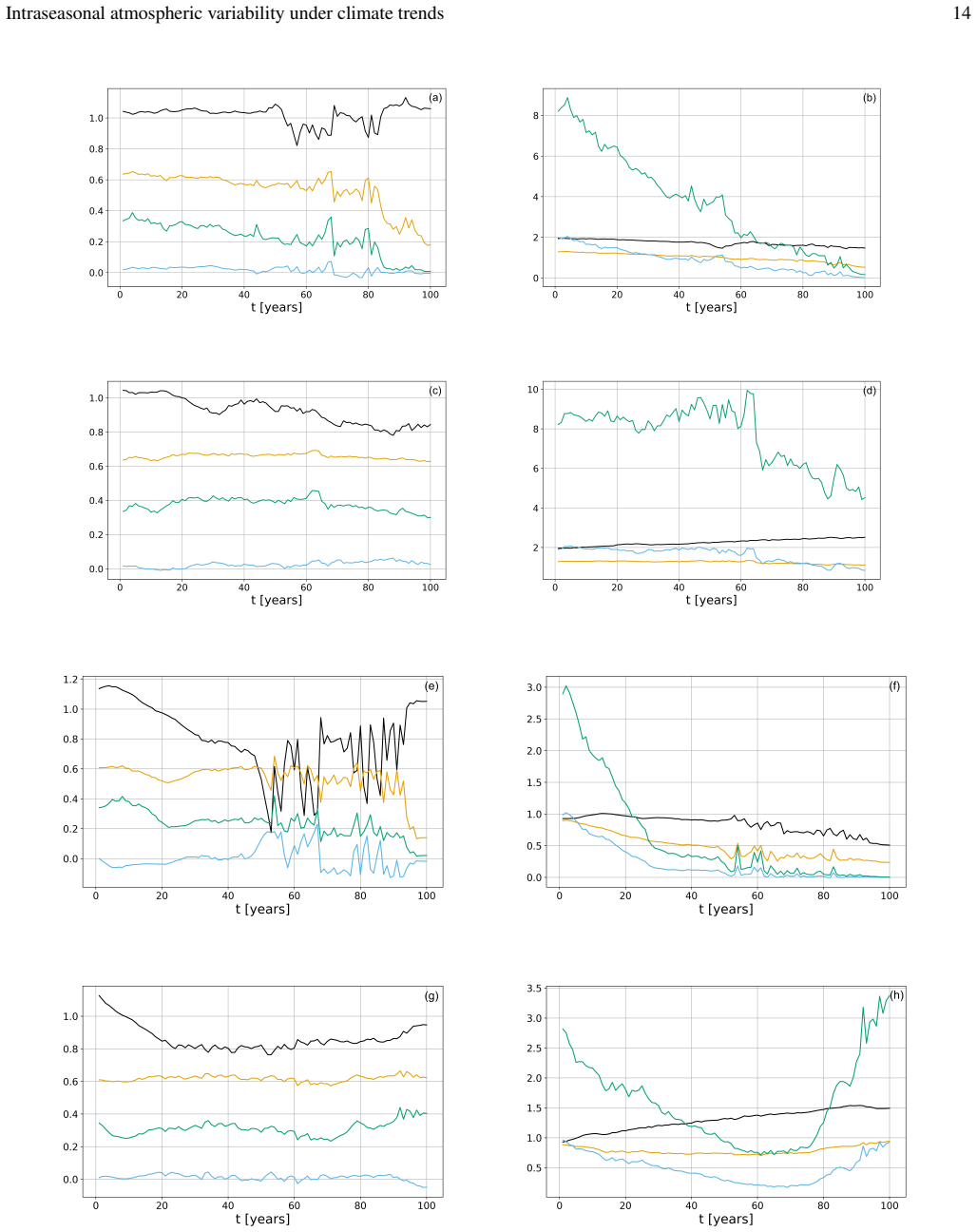
The central claim is that the response of a mid-latitude atmospheric circulation to a slow climate trend cannot be read off from the autonomous, constant-forcing attractors traditionally used in climate analysis. When the Lorenz-84 model is run with a time-dependent forcing—seasonal plus a linear century-scale trend—the snapshot attractor shows that the mean jet speed X is not a monotone function of the thermal contrast F: in the January negative-trend case the mean fluctuates and drops sharply before recovering, while in July positive-trend the wave activity becomes more vigorous and irregular. The eddy-transported energy $Y^{2}$+$Z^{2}$, however, does follow the sign of the trend, as do the higher moments, especially kurtosis, which signals changes in the frequency of extreme events. In one extreme case (July of year 150 under a negative trend, when F=1.99), a coexisting fixed point that attracts 98% of the autonomous system's orbits disappears in the seasonally and trend-forced snapshot, leaving only a thickened limit cycle. The authors interpret these results as evidence that time-dependent forcing can qualitatively change variability and predictability, and warn that such results must be tested with more detailed models.
Load-bearing premise
The whole analysis rests on the assumption that the ensemble of trajectories run forward in time has converged to a single, well-defined snapshot attractor for the century-long trend forcing, so that the reported disappearances and regime changes are properties of the forced system and not just remnants of the finite ensemble and finite integration time.
Editorial extensions
If this is right
- If the jet speed can be decoupled from the sign of the thermal-contrast change in this low-order system, then attributing jet-strength changes to Arctic amplification or upper-tropospheric warming based purely on the sign of the gradient is not safe even in principle; the seasonal cycle and the history of the forcing matter.
- Under seasonal forcing alone, the summer circulation loses its periodic predictability and the winter attractor favors one wave phase over the other, implying that subseasonal-to-seasonal prediction skill could change seasonally even without a trend.
- Chaos can be completely suppressed to a regular periodic motion, or the reverse, depending on the direction and phase of the trend; in the model, the century-scale trend in F by ±2 units can move the system from chaotic to periodic behavior in some seasons.
- Circulation regimes can suddenly disappear: the fixed point that attracts 98% of the autonomous orbits at F=1.99 is absent in the July snapshot with a negative trend, meaning that a regime that is dominant in a steady climate may be unobservable in a changing one, and vice versa.
- The first four moments of X and of Y^2+Z^2, especially kurtosis, change with time under both trend directions; the paper connects this to changes in the distribution of extreme events, so the method offers a way to follow how the frequency of extremes evolves along a trajectory of forcing.
Reading between the lines
- Beyond the paper, the same snapshot-attractor technique could be applied to identify 'transient tipping points' in intermediate-complexity climate models, where a regime that is stable in the autonomous system disappears only because of the seasonal cycle riding on a trend.
- Beyond the paper, the reported kurtosis changes imply the frequency of extreme wave-energy events shifts under the trend; a testable extension is to compute return-time statistics of large Y^2+Z^2 values at fixed calendar months over the ensemble, rather than only the fourth moment.
- Beyond the paper, the paper's insistence on comparing transient snapshots with time-invariant attractors suggests that interpreting time slices of a transient simulation as if they were equilibria under the same boundary conditions may be misleading even for qualitative features such as 'the jet strengthens.' This is an inference, not a paper claim.
Signed reviews
Editorial analysis
A structured set of objections, weighed in public.
Referee Report
Summary. The paper studies the Lorenz-84 low-order model of mid-latitude atmospheric circulation from the perspective of nonautonomous dynamical systems. It first performs a bifurcation analysis of the autonomous model in the parameters a and F, confirming known saddle-node and Hopf bifurcations and the coexistence of multiple attractors. It then introduces seasonal forcing and, subsequently, linear climate trends in the equator-to-pole thermal forcing F, and computes snapshot attractors from ensembles of trajectories. The central claims are that under a climate trend the jet speed (X) does not always follow the sign of the change in thermal contrast, while the eddy energy (Y^2+Z^2) does; that chaotic behavior can be suppressed in favor of periodic behavior and vice versa; and that circulation patterns can disappear and rebuild. The paper also reports that seasonal forcing changes the summer attractor from periodic to chaotic and distorts the winter attractor.
Significance. If the claims hold, the paper provides a clear and instructive demonstration that a low-order model with time-dependent forcing can exhibit non-monotonic, non-intuitive responses that differ from what the autonomous, constant-forcing analysis would suggest, with implications for how internal variability changes under climate trends. The manuscript has notable strengths: the bifurcation analysis is cross-checked with continuation (BifurcationKit.jl), the ensemble computations are described in detail (RK4, dt=0.025, NR=10^4 to 5*10^4), and the code is made publicly available. The paper does not fit parameters to its target claims; all parameter values come from earlier Lorenz-84 work and the stated convergence time of about 5 years is independently confirmed. The main weakness is that the central quantitative results under the unbounded linear trend rest on an attractor concept whose validity in exactly that regime is not demonstrated.
major comments (2)
- [Sec. IV.A, Appendix A] The central results of Secs. IV.C and IV.D (Figs. 10–13) concern the snapshot attractor under the linear, unbounded trend in Eq. (4). The existence and uniqueness of this object is the load-bearing premise. In Sec. IV.A you state that you 'may assume that the attractor is uniform, having checked that, numerically, the pullback and forward approach yield the same results,' but the numerical checks were performed only for periodic and for aperiodic but bounded forcing. Appendix A states that boundedness of the forcing seems necessary for snapshot attractors to exist, and the trend in Eq. (4) is unbounded in the forward limit. Thus the regime in which the assumption is most fragile (unbounded trend, near bifurcations) is exactly the regime not tested. With NR = 10^4 and a 100-year integration window, the disappearance of the fixed point (Fig. 13), the sharp drop in July mean X (Fig. 12e), and the chaos-suppression events could in principle be finite-time ensemble transients. Please provide numerical evidence for convergence in the trend case: e.g., increase the pullback interval |t−s| at fixed observation t for several t values, test sensitivity to ensemble size, and report the ensemble spread or contraction rate. Without such evidence, the claim that these are properties of a well-defined attractor is not yet supported.
- [Sec. IV.C, Fig. 12] The central quantitative claim—that the jet speed does not always follow the sign of the change in equator-to-pole thermal contrast while the eddy energy does—rests on visual inspection of the moment curves in Fig. 12, with no uncertainty quantification. For an ensemble of NR = 10^4, sampling fluctuations in the mean, variance, skewness, and kurtosis can be sizable, especially near bifurcations and for the aggregated monthly snapshots. Please add error bars or confidence intervals (e.g., sub-ensemble bootstrap) and state which of the described features—the 'sharp drop at roughly 50 years' in panel (e), the 'sharp decrease in the last decade' in panel (e), and the kurtosis changes in panels (b), (d), (f), (h)—are significant relative to these fluctuations. This is needed to distinguish genuine attractor changes from finite-ensemble artifacts.
minor comments (3)
- [Fig. 5 caption] The caption states 'a = 25', but the text and all other figures use a = 0.25; this appears to be a typo and should be corrected.
- [Section V] The sentence 'the change in the mean intensity of the westerlies ... shows a sharp drop for January and a negative trend (panel (e))' refers to Fig. 12 panel (e), which is the July, negative-trend case, not January; please correct the panel reference.
- [Section V] The phrase 'a substantial distortion with respect to Fig. 8(b)' in the discussion of the winter comparison is confusing; the comparison is between the autonomous panel (a) and the nonautonomous panel (b), so the text should read 'with respect to Fig. 8(a)' or be reworded.
Circularity Check
No significant circularity: the model results are emergent from a prescribed low-order model with fixed Lorenz (1984) parameters, and the self-citations are supporting only.
full rationale
The paper's central claims — that the jet speed does not always follow the sign of the equator-to-pole thermal-contrast trend, that eddy-transported energy does, and that chaotic behavior can be suppressed or restored — are numerical outcomes of integrating the prescribed Lorenz-84 system, Eqs. (2), with the seasonal and linear-trend forcing of Eqs. (3)–(4). The model parameters (a = 0.25, b = 4, G = 1) are taken from the original Lorenz (1984) model and are not fitted to the target claims. The bifurcation analysis in Section III is a diagnostic of the autonomous system, not a fitted prediction of the nonautonomous results. The convergence time tc ≃ 5 years is taken from Drótos, Bódai, and Tél (2015) and independently confirmed by the authors, as stated in Section IV.A: 'our results confirmed the convergence time of tc ≃ 5 years of the latter authors.' The self-citations to Ghil, Chekroun, and Simonnet (2008), Chekroun, Simonnet, and Ghil (2011), and Charó, Ghil, and Sciamarella (2023) are used for defining pullback and snapshot attractors and for numerical practice, not as the evidential basis for the paper's new findings. The most fragile premise is the assumption that the attractor is uniform for the unbounded linear trend, with the authors explicitly acknowledging in Section IV.A that the numerical checks were 'for periodic, as well as for aperiodic but bounded forcing' and in Appendix A that 'boundedness of the forcing, though, seems to be necessary for snapshot attractors to exist.' This is an honest, stated limitation and a correctness/robustness concern; it is not a circular reduction because the reported attractor changes are not defined in terms of the assumption itself. No fitted parameter is renamed as a prediction, no central claim reduces to an input by construction, and the self-citations are not load-bearing for the climate-trend results. Hence the paper is self-contained against its own numerical benchmarks and should receive a low circularity score.
Assumptions & free parameters
free parameters (4)
- Seasonal forcing amplitude A =
1 (inferred from F(t1)=6 and F(t2)=8); 2 in Fig. 1
- Mean forcing F0 (trend runs) =
7
- Trend slope alpha =
2/100 per year (i.e., +/-2 forcing units per century)
- Observation times t1 and t2 (F=6 and F=8 epochs) =
t1 = 48.6 time units (summer), t2 = 12 time units (winter)
assumptions (4)
- domain assumption For bounded time-dependent forcing, the L84 system has a uniform attractor, so that forward and pullback attraction coincide.
- domain assumption The L84 Galerkin truncation captures the essential interaction between the westerly jet and baroclinic eddies in the mid-latitude atmosphere.
- standard math Standard existence and uniqueness of solutions for smooth ODE systems.
- domain assumption The convergence time to the snapshot attractor is about 5 years, as established by Drótos et al. (2015).
Cite this review
Pith. "Pith review of Intraseasonal atmospheric variability under climate trends." pith.science (2026). https://pith.science/paper/BQSGQ6IR
@misc{pith2026250201279,
  author       = {Pith},
  title        = {Pith review of: Intraseasonal atmospheric variability under climate trends},
  year         = {2026},
  howpublished = {\url{https://pith.science/paper/BQSGQ6IR}},
  note         = {Machine review of arXiv:2502.01279}
}
read the original abstract
Low-order climate models can play an important role in understanding low-frequency variability in the atmospheric circulation and how forcing consistent with anthropogenic climate change may affect this variability. Here, we study a conceptual model of the mid-latitudes' atmospheric circulation from the perspective of nonautonomous dynamical systems. First, a bifurcation analysis is carried out under time-independent forcing in order to identify different types of behavior in the autonomous model's parameter space. Next, we focus on the study of the nonautonomous system in which the cross-latitudinal heat flux varies seasonally, according to insolation changes. The forward attractor of the seasonally forced model is compared with the attractor of the autonomous one. The seasonal forcing results in a clear change of the attractor's shape. The summer attractor loses its periodicity, and hence predictability, when the forcing is seasonal, while the winter attractor favors energy transport through one of the model's two wave components. Climate change forcing produces several remarkable effects. Thus, the analysis of the model's snapshot attractor under climate trends suggests that the jet speed does not always follow the sign of the change in equator-to-pole thermal contrast, while the change in the energy transported by the eddies does. Chaotic behavior can be completely suppressed in favor of a regular periodic one and vice-versa. Circulation patterns can change, suddenly disappear, and rebuild. The model's snapshot attractor proves to be a robust tool to study its changes in internal variability due to climate trends, both positive and negative.
Figures


Figures from the paper (10 more)




Reference graph
Works this paper leans on
-
[1]
author author Anguiano , M. \ and\ author Caraballo , T. ,\ title title Asymptotic behaviour of a non-autonomous Lorenz-84 system , \ @noop journal journal Discrete and Continuous Dynamical Systems \ volume 34 ,\ pages 3901--3920 ( year 2014 ) NoStop
work page 2014
-
[2]
author author Bach , E. ,\ title title parasweep: A template-based utility for generating, dispatching, and post-processing of parameter sweeps , \ @noop journal journal SoftwareX \ volume 13 ,\ pages 100631 ( year 2021 ) NoStop
work page 2021
-
[3]
author author Blackport , R. \ and\ author Screen , J. A. ,\ title title Insignificant effect of arctic amplification on the amplitude of midlatitude atmospheric waves , \ 10.1126/sciadv.aay2880 journal journal Science Advances \ volume 6 ( year 2020 ),\ 10.1126/sciadv.aay2880 NoStop
-
[4]
author author B\'odai , T. \ and\ author T\'el , T. ,\ title title Annual variability in a conceptual climate model: Snapshot attractors, hysteresis in extreme events, and climate sensitivity , \ http://dx.doi.org/10.1063/1.3697984 journal journal Chaos: An Interdisciplinary Journal of Nonlinear Science \ volume 22 ,\ eid 023110 ( year 2012 ) NoStop
-
[5]
author author Broer , H. , author Simó , C. , \ and\ author Vitolo , R. ,\ title title Bifurcations and strange attractors in the lorenz-84 climate model with seasonal forcing , \ 10.1088/0951-7715/15/4/312 journal journal Nonlinearity \ volume 15 ,\ pages 1205 ( year 2002 ) NoStop
-
[6]
author author Caraballo , T. \ and\ author Han , X. ,\ 10.1007/978-3-319-49247-6 title Applied Nonautonomous and Random Dynamical Systems ,\ SpringerBriefs in Mathematics\ ( publisher Springer Cham ,\ year 2016 ) NoStop
-
[7]
author author Charó , G. D. , author Ghil , M. , \ and\ author Sciamarella , D. ,\ title title Random templex encodes topological tipping points in noise-driven chaotic dynamics , \ 10.1063/5.0140660 journal journal Chaos: An Interdisciplinary Journal of Nonlinear Science \ volume 33 ,\ pages 103141 ( year 2023 ) ,\ note special Collection: Theory-informe...
-
[8]
author author Chekroun , M. D. , author Simonnet , E. , \ and\ author Ghil , M. ,\ title title Stochastic climate dynamics: Random attractors and time-dependent invariant measures , \ 10.1016/j.physd.2011.06.005 journal journal Physica D \ volume 240 ,\ pages 1685--1700 ( year 2011 ) NoStop
Show all 50 references
-
[9]
\ and\ author Flandoli , F
author author Crauel , H. \ and\ author Flandoli , F. ,\ title title Attractors for random dynamical systems , \ @noop journal journal Probability Theory and Related Fields \ volume 100 ,\ pages 365--393 ( year 1994 ) NoStop
1994
-
[10]
,\ title title DynamicalSystems
author author Datseris , G. ,\ title title DynamicalSystems. jl: A Julia software library for chaos and nonlinear dynamics , \ @noop journal journal Journal of Open Source Software \ volume 3 ,\ pages 598 ( year 2018 ) NoStop
2018
-
[11]
\ and\ author Parlitz , U
author author Datseris , G. \ and\ author Parlitz , U. ,\ @noop title Nonlinear Dynamics: A Concise Introduction Interlaced with Code \ ( publisher Springer Nature ,\ year 2022 ) NoStop
2022
-
[12]
, author Rossi , K
author author Datseris , G. , author Rossi , K. L. , \ and\ author Wagemakers , A. ,\ title title Framework for global stability analysis of dynamical systems , \ 10.1063/5.0159675 journal journal Chaos: An Interdisciplinary Journal of Nonlinear Science \ volume 33 ( year 2023...
-
[13]
author author Dettinger , M. D. , author Ghil , M. , author Strong , C. M. , author Weibel , W. , \ and\ author Yiou , P. ,\ title title Software expedites singular-spectrum analysis of noisy time series , \ 10.1029/EO076i002p00012 journal journal Eos, Transactions American Ge...
-
[14]
author author Dijkstra , H. A. ,\ 10.1017/CBO9781139034135 title Nonlinear Climate Dynamics \ ( publisher Cambridge University Press ,\ year 2013 )\ note doi:10.1017/CBO9781139034135 NoStop
2013 doi
-
[15]
, author Bódai , T
author author Drótos , G. , author Bódai , T. , \ and\ author Tél , T. ,\ title title Probabilistic concepts in a changing climate: A snapshot attractor picture , \ 10.1175/JCLI-D-14-00459.1 journal journal Journal of Climate \ volume 28 ,\ pages 3275--3288 ( year 2015 ) NoStop
-
[16]
, author Pappalettera , U
author author Flandoli , F. , author Pappalettera , U. , \ and\ author Tonello , E. ,\ title title Nonautonomous attractors and Young measures , \ @noop journal journal Stochastics and Dynamics \ volume 22 ,\ pages 2240003 (22 pages) ( year 2022 ) NoStop
2022
-
[17]
author author Freire , J. G. , author Bonatto , C. , author DaCamara , C. C. , \ and\ author Gallas , J. A. C. ,\ title title Multistability, phase diagrams, and intransitivity in the lorenz-84 low-order atmospheric circulation model , \ 10.1063/1.2953589 journal journal Chaos...
-
[18]
,\ title title Hilbert problems for the geosciences in the 21st century , \ @noop journal journal Nonlin
author author Ghil , M. ,\ title title Hilbert problems for the geosciences in the 21st century , \ @noop journal journal Nonlin. Processes Geophys. \ volume 8 ,\ pages 211--222 ( year 2001 ) NoStop
2001
-
[19]
author author Ghil , M. ,\ 10.5281/zenodo.4765865 title Mathematical Problems in Climate Dynamics, IV: Nonlinear & stochastic models--Random dynamical systems , https://doi.org/10.5281/zenodo.4765865 , \ howpublished Zenodo ( year 2021 ) NoStop
-
[20]
, author Allen , M
author author Ghil , M. , author Allen , M. R. , author Dettinger , M. D. , author Ide , K. , author Kondrashov , D. , author Mann , M. E. , author Robertson , A. W. , author Saunders , A. , author Tian , Y. , author Varadi , F. , \ and\ author Yiou , P. ,\ title title Advance...
-
[21]
, author Chekroun , M
author author Ghil , M. , author Chekroun , M. D. , \ and\ author Simonnet , E. ,\ title title Climate dynamics and fluid mechanics: Natural variability and related uncertainties , \ 10.1016/j.physd.2008.03.036 journal journal Physica D: Nonlinear Phenomena \ volume 237 ,\ pag...
2008 doi
-
[22]
\ and\ author Childress , S
author author Ghil , M. \ and\ author Childress , S. ,\ @noop title Topics in Geophysical Fluid Dynamics: Atmospheric Dynamics, Dynamo Theory, and Climate Dynamics; reprinted as an eBook by Springer in 2012 \ ( publisher Springer Science+Business Media ,\ address Berlin/Heidel...
2012
-
[23]
, author Groth , A
author author Ghil , M. , author Groth , A. , author Kondrashov , D. , \ and\ author Robertson , A. W. ,\ title title Extratropical sub-seasonal to seasonal oscillations and multiple regimes: The dynamical systems view , \ in\ 10.1016/B978-0-12-811714-9.00006-1 booktitle Sub-S...
-
[24]
\ and\ author Lucarini , V
author author Ghil , M. \ and\ author Lucarini , V. ,\ title title The physics of climate variability and climate change , \ 10.1103/revmodphys.92.035002 journal journal Reviews of Modern Physics \ volume 92 ,\ pages 035002 ( year 2020 ) NoStop
-
[25]
, author Ott , E
author author Grebogi , C. , author Ott , E. , \ and\ author Yorke , J. A. ,\ title title Chaos, strange attractors, and fractal basin boundaries in nonlinear dynamics , \ @noop journal journal Science \ volume 238 ,\ pages 632--638 ( year 1987 ) NoStop
1987
-
[26]
\ and\ author Holmes , P
author author Guckenheimer , J. \ and\ author Holmes , P. ,\ 10.1007/978-1-4612-1140-2 title Nonlinear Oscillations, Dynamical Systems, and Bifurcations of Vector Fields \ ( publisher Springer ,\ year 1983 ) NoStop
1983 doi
-
[27]
,\ 10.1017/s0308210500017091 title Systèmes dynamiques dissipatifs et applications, Research in Applied Mathematics ,\ series Research in Applied Mathematics , Vol
author author Haraux , A. ,\ 10.1017/s0308210500017091 title Systèmes dynamiques dissipatifs et applications, Research in Applied Mathematics ,\ series Research in Applied Mathematics , Vol. volume 17 \ ( publisher Masson, Paris ,\ address Paris ,\ year 1991 ) NoStop
-
[28]
author author Held , I. M. ,\ title title The gap between simulation and understanding in climate modeling , \ @noop journal journal Bull. Am. Meteorol. Soc. \ volume 86 ,\ pages 1609--1614 ( year 2005 ) NoStop
2005
-
[29]
,\ @noop title Atmospheric Modeling, Data Assimilation and Predictability \ ( publisher Cambridge University Press ,\ address Cambridge, UK ,\ year 2003 ) NoStop
author author Kalnay , E. ,\ @noop title Atmospheric Modeling, Data Assimilation and Predictability \ ( publisher Cambridge University Press ,\ address Cambridge, UK ,\ year 2003 ) NoStop
2003
-
[30]
\ and\ author Yang , M
author author Kloeden , P. \ and\ author Yang , M. ,\ @noop title An Introduction to Nonautonomous Dynamical Systems and Their Attractors ,\ Vol. volume 21 \ ( publisher World Scientific ,\ year 2020 ) NoStop
2020
-
[31]
,\ 10.1007/978-1-4757-2421-9 title Elements of Applied Bifurcation Theory \ ( publisher Springer New York ,\ year 1995 ) NoStop
author author Kuznetsov , Y. ,\ 10.1007/978-1-4757-2421-9 title Elements of Applied Bifurcation Theory \ ( publisher Springer New York ,\ year 1995 ) NoStop
1995 doi
-
[32]
author author Lorenz , E. N. ,\ title title Deterministic nonperiodic flow , \ @noop journal journal J. Atmos. Sci. \ volume 20 ,\ pages 130--141 ( year 1963 ) NoStop
1963
-
[33]
author author Lorenz , E. N. ,\ @noop title The Nature and Theory of the General Circulation of the Atmosphere \ ( publisher World Meteorological Organization ,\ year 1967 ) NoStop
1967
-
[34]
author author Lorenz , E. N. ,\ title title Irregularity: A fundamental property of the atmosphere , \ 10.3402/tellusa.v36i2.11473 journal journal Tellus A: Dynamic Meteorology and Oceanography \ volume 36 ,\ pages 98--110 ( year 1984 ) NoStop
-
[35]
author author Lorenz , E. N. ,\ title title Can chaos and intransitivity lead to interannual variability? \ 10.1034/j.1600-0870.1990.t01-2-00005.x journal journal Tellus A \ volume 42 ,\ pages 378--389 ( year 1990 ) NoStop
1990
-
[36]
author author Lorenz , E. N. ,\ title title The general circulation of the atmosphere: an evolving problem , \ 10.3402/tellusb.v43i4.15394 journal journal Tellus \ volume 43 ,\ pages 8--15 ( year 1991 ) NoStop
1991 doi
-
[37]
, author Mazzega , P
author author Mangiarotti , S. , author Mazzega , P. , author Hiernaux , P. , \ and\ author Mougin , E. ,\ title title Predictability of vegetation cycles over the semi-arid region of gourma (mali) from forecasts of avhrr-ndvi signals , \ 10.1016/j.rse.2012.03.011 journal jour...
-
[38]
, author Ott , E
author author Namenson , A. , author Ott , E. , \ and\ author Antonsen , T. M. ,\ title title Fractal dimension fluctuations for snapshot attractors of random maps , \ @noop journal journal Physical Review E \ volume 53 ,\ pages 2287 ( year 1996 ) NoStop
1996
-
[39]
\ and\ author Ghil , M
author author Pierini , S. \ and\ author Ghil , M. ,\ title title Tipping points induced by parameter drift in an excitable ocean model , \ 10.1038/s41598-021-90138-1 journal journal Scientific Reports \ volume 11 ,\ pages 11126 ( year 2021 ) NoStop
-
[40]
, author Rosenblum , M
author author Pikovsky , A. , author Rosenblum , M. , \ and\ author Kurths , J. ,\ 10.1017/CBO9780511755743 title Synchronization: A Universal Concept in Nonlinear Sciences ,\ series Cambridge Nonlinear Science Series \ No. number 12 \ ( publisher Cambridge University Press ,\...
-
[41]
, author Mitsui , T
author author Riechers , K. , author Mitsui , T. , author Boers , N. , \ and\ author Ghil , M. ,\ title title Orbital insolation variations, intrinsic climate variability, and Quaternary glaciations , \ 10.5194/cp-18-863-2022 journal journal Climate of the Past \ volume 18 ,\ ...
-
[42]
, author Nicolis , G
author author Shil'nikov , A. , author Nicolis , G. , \ and\ author Nicolis , C. ,\ title title Bifurcation and predictability analysis of a low-order atmospheric circulation model , \ 10.1142/S0218127495001253 journal journal International Journal of Bifurcation and Chaos \ v...
-
[43]
, author Francis , J
author author Stendel , M. , author Francis , J. , author White , R. , author Williams , P. D. , \ and\ author Woollings , T. ,\ title title The jet stream and climate change , \ in\ 10.1016/B978-0-12-821575-3.00015-3 booktitle Climate Change: Observed Impacts on Planet Earth,...
-
[44]
, author B \'o dai , T
author author T \'e l , T. , author B \'o dai , T. , author Dr \'o tos , G. , author Haszpra , T. , author Herein , M. , author Kasz \'a s , B. , \ and\ author Vincze , M. ,\ title title The theory of parallel climate realizations: A new framework of ensemble methods in a chan...
2020
-
[45]
author author Van Veen , L. ,\ title title Baroclinic low and the Lorenz-84 model , \ 10.1142/S0218127403007904 journal journal International Journal of Bifurcation and Chaos \ volume 13 ,\ pages 2117--2139 ( year 2003 ) NoStop
2003 doi
-
[46]
, author Opsteegh , T
author author Van Veen , L. , author Opsteegh , T. , \ and\ author Verhulst , F. ,\ title title Active and passive ocean regimes in a low-order climate model , \ @noop journal journal Tellus \ volume 53A ,\ pages 616--628 ( year 2001 ) NoStop
2001
-
[47]
,\ https://hal.archives-ouvertes.fr/hal-02902346 title BifurcationKit.jl , \ ( year 2020 ) NoStop
author author Veltz , R. ,\ https://hal.archives-ouvertes.fr/hal-02902346 title BifurcationKit.jl , \ ( year 2020 ) NoStop
2020
-
[48]
author author Vishik , M. I. ,\ @noop title Asymptotic Behaviour of Solutions of Evolutionary Equations \ ( publisher Cambridge University Press ,\ year 1992 ) NoStop
1992
-
[49]
\ and\ author Robertson , A
author author Vitart , F. \ and\ author Robertson , A. W. ,\ title title Introduction: Why sub-seasonal to seasonal prediction (S2S)? \ in\ 10.1016/B978-0-12-811714-9.00001-2 booktitle Sub-Seasonal to Seasonal Prediction: The Gap Between Weather and Climate Forecasting ,\ edit...
-
[50]
\ and\ author Friendly , M
author author Wilkinson , L. \ and\ author Friendly , M. ,\ title title The history of the cluster heat map , \ 10.1198/tas.2009.0033 journal journal The American Statistician \ volume 63 ,\ pages 179--184 ( year 2009 ) NoStop
2009
Reviewed August 9, 2026 · model on record in the stance chip above.
Discussion (0). Continue with ORCID to comment.