REVIEW 3 major objections 3 minor 23 references
Reductions in local certification
T0 review · 3 major / 3 minor · reviewed 2026-08-09 · deepseek-v4-flash
Pith's one-line read The paper introduces local hardness reductions for local certification and proves a quantitative transfer theorem that turns one lower bound for non-3-colorability into polynomial lower bounds for many classical graph properties.
desk verdict A genuinely useful reduction framework for local certification, with a clean transfer theorem and many applications, but the write-up has slip-ups in the Section 3 counting and a complement mix-up in Section 8 that should be fixed. read the letter →
The pith
A machine-rendered reading of the paper's core claim, the machinery that carries it, and where it could break.
The reading
What carries the argument
The load-bearing mechanism is the local reduction $f_{P,P'}$ with local expansion $\alpha$ and global expansion $\beta$: a graph transformation preserving the property, with six conditions (R1)-(R3f) that make the verification simulation airtight. Conditions (R3d) and (R3e) are the core of soundness: the set of source vertices that hold a given certificate must be connected so that the certificate is globally consistent, and the closed neighborhood of any vertex being simulated must be covered by certificates held by the simulating vertex and its neighbors. The proof of the transfer theorem constructs, from any certificate assignment on the source, a certificate assignment on the target by reading the common table entries; the verifier of $P'$ then accepts everywhere on $G'$, proving $G$ satisfies $P$.
What would settle it
Check that construction on the smallest nontrivial index sets: if two distinct choices $A,B$ produce a 3-colorable graph even when $A \cap \bar{B} \neq \emptyset$, or if the special-vertex subgraph changes with $A,B$, the pigeonhole step used in Theorems 3.2 and 3.3 fails. Alternatively, run one of the Section 5 reductions on a small non-3-colorable graph and look for a certificate assignment that makes every vertex of the target property's verifier accept on the transformed graph; such an assignment would falsify soundness and undo the transferred lower bound.
Extended reading notes
Core claim
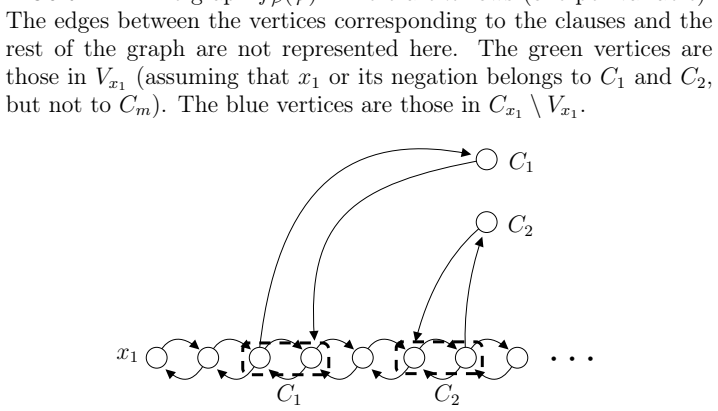
The central claim is that local reductions, defined by six conditions, transfer certification lower bounds from a base property to a target property without redoing the lower-bound proof. For each vertex $u$ of the original graph $G$, the reduction asks for a small set $C_u$ of vertices of the transformed graph $G'$ whose certificates $u$ will receive, and a subset $V_u \subseteq C_u$ of vertices whose local verification $u$ can simulate; the conditions ensure that certificates for the same transformed vertex agree across all holders, and that every neighbor of a vertex in $V_u$ has its certificate available within $u$'s neighborhood. The proof of the transfer theorem then pastes the certification scheme of the target property into tables and runs the target verifier locally in the source graph. With the base lower bound for non-3-colorability as the root, the paper obtains the lower bounds of Table 1, including bounded-degree variants, a 3-SAT version, and a bounded-degree relaxation that lowers the degree threshold for non-$k$-colorability. It also proves a limit of the method by showing a coNP-hard property with only logarithmic local complexity, and gives reductions for polynomial-time properties such as forbidden induced subgraphs.
Load-bearing premise
Every transferred lower bound rests on the base construction for non-3-colorability having the four structural properties listed in Section 3-especially that the built graph is 3-colorable exactly when two index sets intersect and that the subgraph induced by the special vertices is independent of the index sets.
Editorial extensions
If this is right
- Any property that can be locally reduced from non-3-colorability inherits a polynomial certificate lower bound, so the problems in Table 1 are all hard to certify locally even when restricted to bounded-degree graphs.
- The quantitative form of the transfer gives a design target: a reduction with local expansion $O(n^\delta)$ and global expansion $O(n^\gamma)$ yields a lower bound of about $n^{(2-\delta)/\gamma}/\log n$ from the quadratic base, so keeping both expansions small is what preserves strong bounds.
- The 3-SAT variant means future reductions can be written from satisfiability problems rather than graph coloring, which is often more convenient and gives the same lower bounds for Hamiltonian cycle and edge-coloring.
- The framework also transfers upper bounds: an efficient certification scheme for the target property would produce an efficient scheme for the source, giving a reusable route for positive results.
- The logarithmic complexity example for a coNP-hard property sets a boundary: polynomial local complexity is not implied by coNP-hardness alone, so the reductions, not the decision complexity, are doing the work.
Reading between the lines
- [Editorial inference] The reduction conditions are likely to be reusable as a checklist for turning classical NP-hardness reductions into local lower-bound proofs; the open cases named in Section 8 (bandwidth, disk graphs, unit-disk graphs) are natural candidates where a sufficiently local reduction would settle the question.
- [Editorial inference] Because the definition is symmetric under complementation, one could try to use it for upper bounds: if a target property has a cheap certification scheme, then any property that reduces to it inherits cheap certificates, which may be a convenient way to prove logarithmic upper bounds without constructing schemes from scratch.
- [Editorial inference] The bounded-degree relaxation in Section 7 suggests that locality is not a single threshold: allowing dependence on a constant-radius ball rather than the immediate neighborhood still preserves the transfer, which may apply to other problems where natural gadgets are two-local but not one-local.
Signed reviews
Editorial analysis
A structured set of objections, weighed in public.
Referee Report
Summary. The paper introduces a formal notion of local hardness reduction between graph properties in the context of local certification, proves a transfer theorem showing that a certification scheme for the target property yields one for the source property, and uses this to derive polynomial lower bounds for several classical coNP-hard properties by reducing from non-3-colorability. A variant for reductions from 3-SAT is also given, with applications to non-Hamiltonicity and chromatic index. The main theoretical contribution is Theorem 5.2, and the paper includes detailed gadget constructions for the applications.
Significance. If the technical issues identified below are resolved, the paper would provide a valuable unifying framework for lower bounds in local certification, analogous to reductions in classical complexity. The central transfer theorem is clean and the applications cover a diverse set of properties, with several gadget proofs spelled out in detail. The paper also honestly identifies limitations, such as the coNP-hard problem with logarithmic complexity in Section 8 and the open problems on bandwidth and disk graphs. However, the current manuscript contains load-bearing inconsistencies in the base counting argument of Section 3 and in the statements of the main corollaries, so the results are not yet fully supported as written.
major comments (3)
- [Section 3, Theorems 3.1-3.3] The parameterization of the Göös-Suomela construction is inconsistent as printed. With I={1,...,2k} and A,B subsets of I×I, the number of choices for A is 2^{(2k)^2}. If G_{A,B} has n=Theta(2^k) vertices, then (2k)^2 = Theta((log n)^2), so the number of choices is 2^{Theta((log n)^2)}, not 2^{Omega(n^2)} as used in the proof of Theorem 3.1. Similarly, in Theorem 3.2 the proof states H_{A,B} has n=Theta(2^{2k}) vertices and then uses 2^{(2k)^2}=2^{Omega(n)} choices, which is false: with n=Theta(2^{2k}), (2k)^2=Theta((log n)^2). In Theorem 3.3 the same type of mismatch occurs: n=O(2^{4k}) does not give 2^{Omega(sqrt n)} choices. These counting steps are the base of every transferred lower bound in the paper, so the correct size of G_{A,B} must be stated and the pigeonhole bounds re-derived from [15].
- [Section 3, Theorem 3.2] The claim that the special vertex sets S_A and S_B remain of size O(log n) after applying the degree-reduction f is not justified by the properties listed in Section 3. The proof says this follows from item (3), but item (3) only bounds the number of edges between S_A and S_B. The size of f(S_A) depends on the total degree of the vertices in S_A inside V_A, which is not bounded by the stated properties. Moreover, item (3) says there are at most O(k) cross edges, while the proof of Theorem 3.2 uses O(log n) cross edges; these two statements are compatible only under one of the conflicting size conventions. The authors need an explicit bound on the total degree of the special vertices in G_{A,B}, or a different argument that the special vertices remain O(log n) after the reduction.
- [Corollaries 5.3 and 6.4] The statements of Corollary 5.3 and Corollary 6.4 are false as written. Corollary 5.3 claims that a local reduction from k-colorability to P implies a lower bound for P. But k-colorability has O(log n) local complexity, and the identity reduction from k-colorability to itself satisfies the hypotheses with alpha=beta=1, so the conclusion would give Omega(n^2/log n), a contradiction. The proof of the corollary actually uses a reduction from non-k-colorability to P, not from k-colorability. The statement must be corrected to say either that a reduction from non-k-colorability to P implies a lower bound for P, or that a reduction from k-colorability to P implies a lower bound for the complement of P. The same issue applies to Corollary 6.4 for reductions from 3-SAT. The applications in Sections 5 and 6 construct reductions from the positive properties (e.g., (k+1)-colorability, 3-colorability) to positive target properties, while the stated lower bounds concern the complements; the authors must explicitly invoke the complement symmetry of Remark 5.1 to make the logical chain valid.
minor comments (3)
- [Section 7, Theorem 7.1] In the construction after the display defining the new endpoints, the text says 'for each vertex u, we detach the edges of u incident to its ceil(sqrt k) neighbors having smallest identifiers', but the formal definition detaches the edges to the k neighbors of smallest identifier. The informal sentence should be corrected to match the formal construction.
- [Remark 5.1] The displayed statement of the symmetry property has garbled overlines: it reads 'there exists a local reduction from P to P' if and only if there exists a local reduction from P to P''. This should read 'from P to P' if and only if from complement of P to complement of P''. Since the applications rely on this symmetry, the corrected statement should be printed explicitly.
- [Section 6.1] In the verification that the non-Hamiltonicity reduction satisfies the locality conditions, condition (S3f) is asserted to follow from the definitions, but this is not immediately obvious because C_{x_i} includes entry/exit nodes and first/last row vertices of all variables. Please provide a short explicit argument that these sets and the relevant local subgraphs depend only on the clauses containing x_i.
Circularity Check
No significant circularity: Theorem 5.2 is proved from the local-reduction definitions and the transferred lower bounds bottom out in the external Göös–Suomela [15] construction.
full rationale
The central claim, Theorem 5.2, is a direct simulation argument: if P' has certificates of size s and P reduces locally to P' with expansion α/β, the paper constructs P-certificates of size O(α(n)s(β(n))). The proof uses only the local-reduction conditions (R1)–(R3f) and the given P' scheme; it does not assume the P lower bound it transfers. Every lower bound in Table 1 is then obtained by applying this theorem (or Corollary 5.3) to the Göös–Suomela non-3-colorability lower bound, which is cited as an external result ([15]) and not re-derived in this paper. The paper explicitly acknowledges that it does not fully reproduce that construction ('The full description of the construction in [15] takes over 6 pages ... we do not describe it completely here'), but reliance on an external cited result is not circularity. The self-citations do not create circularity: [2] is used only for an auxiliary identifier-renaming lemma in the proof of Theorem 5.2, and [1] is used in the final illustrative section for an already-known H-freeness lower bound; neither supplies the main lower-bound content nor is equivalent to the paper's conclusions. The Section 3 counting concern (n=Θ(2^k) printed while 2^{(2k)^2}=2^{Ω(n^2)} is claimed) is a correctness/presentation issue in transcribing the external construction, not a circular reduction: the pigeonhole counting is inherited from [15], not from the paper's own input. No self-definitional, fitted-input, self-citation-load-bearing, or imported-uniqueness circularity is present.
Assumptions & free parameters
assumptions (4)
- domain assumption Göös-Suomela lower bound: non-3-colorability has local complexity Ω(n^2/log n), with the structural properties (1)-(4) of the graph GA,B.
- domain assumption Standard NP-completeness reductions used for applications: Garey-Johnson [14], Sipser [21], Holyer [17], Emden-Weinert et al. [6], Molloy-Reed [18].
- domain assumption The local certification model with unique identifiers in {1,...,poly(n)} and computationally unbounded verifiers.
- domain assumption Graphs are simple, loopless, undirected, and connected.
Cite this review
Pith. "Pith review of Reductions in local certification." pith.science (2026). https://pith.science/paper/6ISUWYUU
@misc{pith2026250201551,
  author       = {Pith},
  title        = {Pith review of: Reductions in local certification},
  year         = {2026},
  howpublished = {\url{https://pith.science/paper/6ISUWYUU}},
  note         = {Machine review of arXiv:2502.01551}
}
abstract
Local certification is a topic originating from distributed computing, where a prover tries to convince the vertices of a graph $G$ that $G$ satisfies some property $\mathcal{P}$. To convince the vertices, the prover gives a small piece of information, called certificate, to each vertex, and the vertices then decide whether the property $\mathcal{P}$ is satisfied by just looking at their certificate and the certificates of their neighbors. When studying a property $\mathcal{P}$ in the perspective of local certification, the aim is to find the optimal size of the certificates needed to certify $\mathcal{P}$, which can be viewed a measure of the local complexity of $\mathcal{P}$. A certification scheme is considered to be efficient if the size of the certificates is polylogarithmic in the number of vertices. While there have been a number of meta-theorems providing efficient certification schemes for general graph classes, the proofs of the lower bounds on the size of the certificates are usually very problem-dependent. In this work, we introduce a notion of hardness reduction in local certification, and show that we can transfer a lower bound on the certificates for a property $\mathcal{P}$ to a lower bound for another property $\mathcal{P}'$, via a (local) hardness reduction from $\mathcal{P}$ to $\mathcal{P}'$. We then give a number of applications in which we obtain polynomial lower bounds for many classical properties using such reductions.
Figures


Figures from the paper (19 more)




Reference graph
Works this paper leans on
-
[15]
Locally checkable proofs in distributed computing.Theory Comput., 12(1):1–33, 2016
Mika Göös and Jukka Suomela. Locally checkable proofs in distributed computing.Theory Comput., 12(1):1–33, 2016
work page 2016
-
[1]
Local certification of forbidden subgraphs.CoRR, abs/2402.12148, 2024
Nicolas Bousquet, Linda Cook, Laurent Feuilloley, Théo Pierron, and Sébastien Zeitoun. Local certification of forbidden subgraphs.CoRR, abs/2402.12148, 2024
arXiv 2024
-
[2]
Renaming in distributed certification
Nicolas Bousquet, Louis Esperet, Laurent Feuilloley, and Sébastien Zeitoun. Renaming in distributed certification. CoRR, abs/2409.15404, 2024
-
[3]
Heinz Breu and David G. Kirkpatrick. Unit disk graph recognition is np-hard.Comput. Geom., 9(1-2):3–24, 1998
work page 1998
-
[4]
Local certification of geometric graph classes
Oscar Defrain, Louis Esperet, Aurélie Lagoutte, Pat Morin, and Jean-Florent Raymond. Local certification of geometric graph classes. In Rastislav Královic and Antonín Kucera, editors, 49th International Symposium on Mathematical Foundations of Computer Science, MFCS 2024, August 26-30, 2024, Bratislava, Slovakia , volume 306 of LIPIcs, pages 48:1–48:14. S...
work page 2024
-
[5]
On the power of the congested clique model
Andrew Drucker, Fabian Kuhn, and Rotem Oshman. On the power of the congested clique model. In Magnús M. Halldórsson and Shlomi Dolev, editors,ACM Symposium on Principles of Distributed Computing, PODC ’14, Paris, France, July 15-18, 2014 , pages 367–376. ACM, 2014
work page 2014
-
[6]
Uniquely colourable graphs and the hardness of colouring graphs of large girth.Comb
Thomas Emden-Weinert, Stefan Hougardy, and Bernd Kreuter. Uniquely colourable graphs and the hardness of colouring graphs of large girth.Comb. Probab. Comput. , 7(4):375–386, 1998
work page 1998
-
[7]
Local certification of graphs on surfaces.Theoretical Computer Science, 909:68–75, 2022
Louis Esperet and Benjamin Lévêque. Local certification of graphs on surfaces.Theoretical Computer Science, 909:68–75, 2022
work page 2022
Show all 23 references
-
[8]
Introduction to local certification.Discret
Laurent Feuilloley. Introduction to local certification.Discret. Math. Theor. Comput. Sci. , 23(3), 2021
2021
-
[9]
What can be certified compactly? Compact local certification of MSO properties in tree-like graphs
Laurent Feuilloley, Nicolas Bousquet, and Théo Pierron. What can be certified compactly? Compact local certification of MSO properties in tree-like graphs. In Alessia Milani and Philipp Woelfel, editors, PODC ’22: ACM Symposium on Principles of Distributed Com- puting, Salerno...
2022
-
[10]
Compact distributed certification of planar graphs.Algorithmica, 83(7):2215– 2244, 2021
Laurent Feuilloley, Pierre Fraigniaud, Pedro Montealegre, Ivan Rapaport, Éric Rémila, and Ioan Todinca. Compact distributed certification of planar graphs.Algorithmica, 83(7):2215– 2244, 2021
2021
-
[11]
Discrete Applied Mathematics, 325:9–36, 2023
Laurent Feuilloley, Pierre Fraigniaud, Pedro Montealegre, Ivan Rapaport, Éric Rémila, and IoanTodinca.Localcertificationofgraphswithboundedgenus. Discrete Applied Mathematics, 325:9–36, 2023. REDUCTIONS IN LOCAL CERTIFICATION 37
2023
-
[12]
Distributed certification for classes of dense graphs
Pierre Fraigniaud, Frédéric Mazoit, Pedro Montealegre, Ivan Rapaport, and Ioan Todinca. Distributed certification for classes of dense graphs. In Rotem Oshman, editor,37th Inter- national Symposium on Distributed Computing, DISC 2023, October 10-12, 2023, L’Aquila, Italy, volu...
2023
-
[13]
A meta-theorem for distributed certification
Pierre Fraigniaud, Pedro Montealegre, Ivan Rapaport, and Ioan Todinca. A meta-theorem for distributed certification. In Merav Parter, editor,Structural Information and Communication Complexity - 29th International Colloquium, SIROCCO 2022, Paderborn, Germany, June 27- 29, 2022...
2022
-
[14]
Garey, David S
Michael R. Garey, David S. Johnson, and Larry J. Stockmeyer. Some simplified NP-complete graph problems. Theor. Comput. Sci. , 1(3):237–267, 1976
1976
-
[16]
Representing graphs by disks and balls (a survey of recognition-complexity results)
Petr Hlinený and Jan Kratochvíl. Representing graphs by disks and balls (a survey of recognition-complexity results). Discret. Math., 229(1-3):101–124, 2001
2001
-
[17]
The NP-completeness of edge-coloring.SIAM J
Ian Holyer. The NP-completeness of edge-coloring.SIAM J. Comput. , 10(4):718–720, 1981
1981
-
[18]
Colouring graphs when the number of colours is almost the maximum degree
Michael Molloy and Bruce Reed. Colouring graphs when the number of colours is almost the maximum degree. J. Comb. Theory, Ser. B , 109:134–195, 2014
2014
-
[19]
The power of distributed verifiers in interactive proofs
Moni Naor, Merav Parter, and Eylon Yogev. The power of distributed verifiers in interactive proofs. In Shuchi Chawla, editor,Proceedings of the 2020 ACM-SIAM Symposium on Discrete Algorithms, SODA 2020, Salt Lake City, UT, USA, January 5-8, 2020 , pages1096–115.SIAM, 2020
2020
-
[20]
Papadimitriou
Christos H. Papadimitriou. The np-completeness of the bandwidth minimization problem. Computing, 16(3):263–270, 1976
1976
-
[21]
Introduction to the theory of computation
Michael Sipser. Introduction to the theory of computation . PWS Publishing Company, 1997
1997
-
[22]
Iain A. Stewart. Deciding whether a planar graph has a cubic subgraph is NP-complete. Discret. Math., 126(1-3):349–357, 1994
1994
-
[23]
Iain A. Stewart. On locating cubic subgraphs in bounded-degree connected bipartite graphs. Discret. Math., 163(1-3):319–324, 1997. (L. Esperet)Univ. Grenoble Alpes, CNRS, Laboratoire G-SCOP, Grenoble, France Email address: louis.esperet@grenoble-inp.fr (S. Zeitoun) CNRS, INSA ...
1997
Reviewed August 9, 2026 · model on record in the stance chip above.
Discussion (0). Continue with ORCID to comment.