REVIEW 4 major objections 6 minor 83 references
V498 Hya, a new candidate for a period bouncer Cataclysmic Variable
T0 review · 4 major / 6 minor · reviewed 2026-08-09 · deepseek-v4-flash
Pith's one-line read V498 Hya has evolved past the period minimum and is a 'period bouncer,' with a brown-dwarf donor of 0.043 solar masses.
desk verdict A candid, well-documented single-object study proposing V498 Hya as a period-bouncer candidate—plausible but not robust, because the orbital period is subjectively chosen and the SED mass ratio is not independent of that choice. read the letter →
The pith
A machine-rendered reading of the paper's core claim, the machinery that carries it, and where it could break.
The reading
What carries the argument
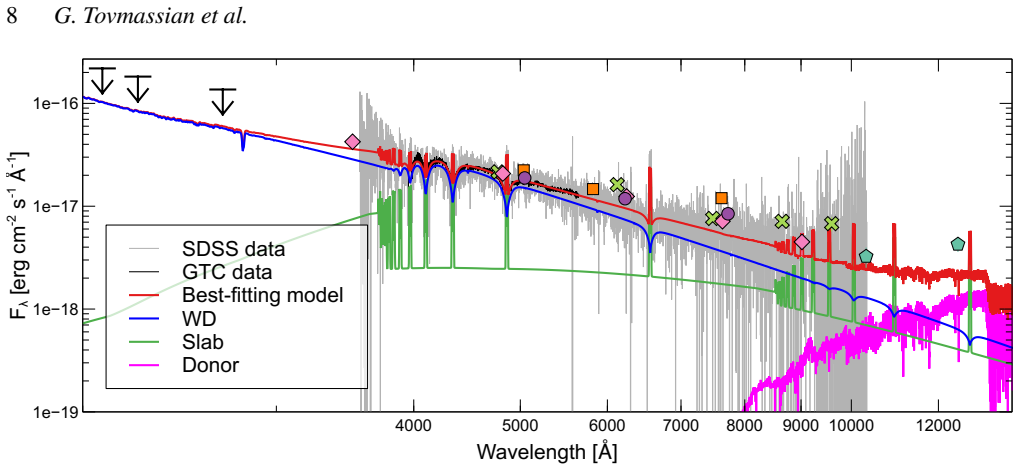
The argument rides on three linked measurements. First, the superhump period excess: the known superhump period $P_{\rm sh} = 0.06036\,{\rm d}$ and the new S-wave orbital period $P_{\rm orb} = 86.053\,{\rm min}$ give $\epsilon = P_{\rm sh}/P_{\rm orb} - 1 = 0.010$, which through Kato's (2022) relation yields a mass ratio $q \approx 0.048$, with a range $q = 0.034$ to $0.078$ allowed as a flat prior. Second, the gravitational redshift of the white dwarf's Mg II 4481 absorption line: a measured offset of $62.5\,{\rm km\,s^{-1}}$ translates, via a mass-radius relation, into $M_{\rm WD} \approx 0.89\,M_\odot$. Third, an MCMC spectral energy distribution fit combines tlusty/synspec white dwarf models, BT-SETTL donor models, and an isothermal slab accretion disk model, with the parallax-based distance as a prior, to give the best-fit donor mass of $0.043 \pm 0.004\,M_\odot$.
What would settle it
A high-resolution, time-resolved spectroscopic campaign that resolves the wings of the Balmer lines would measure the true orbital semi-amplitude and period. If the true period is near 88.07 minutes (the $16.35\,{\rm d}^{-1}$ alias), the period excess becomes about 1.8%, and the derived donor mass rises to roughly $0.074\,M_\odot$, straddling the period-bounce boundary and undermining the paper's central classification.
Extended reading notes
Core claim
The central claim is that V498 Hya is a period bouncer: its donor star has passed through the period minimum, become degenerate, and the binary is now evolving to longer orbital periods. The evidence is a best-fit donor mass of $0.043 \pm 0.004\,M_\odot$ ($q = 0.048 \pm 0.003$) and a white dwarf mass of about $0.89\,M_\odot$, derived from the combination of the superhump period excess, the gravitational redshift of the Mg II 4481 absorption line, and an MCMC fit to the spectral energy distribution. The paper argues that even when the alternative superhump period is considered, the donor mass remains low enough to keep V498 Hya on the post-bounce side of the period minimum.
Load-bearing premise
The 86.053-minute orbital period is derived from a subset of radial-velocity points chosen by eye to form a smooth sine wave, assumed to trace the hot spot; the paper itself calls this procedure 'somewhat arbitrary' and notes that a 1-day alias would give a different period and a larger donor mass.
Editorial extensions
If this is right
- V498 Hya joins the small list of confirmed period bouncers, providing a new empirical point for the donor mass at and after the period minimum.
- The lack of a near-IR excess in the SED is consistent with a brown-dwarf donor, strengthening the post-bounce interpretation.
- The system's hot white dwarf (18,100 K) and position in the HR diagram place it inside the region previously defined for known period bouncers by SDSS-V.
- If the adopted orbital period is correct, the donor mass of $0.043\,M_\odot$ is well below the period-bounce boundary of about $0.075\,M_\odot$, making the classification robust to the exact boundary choice.
- Further high-resolution spectroscopy can refine the orbital period and systemic velocity, and would test whether V498 Hya remains a period bouncer under the alternative period solutions.
Reading between the lines
- If the true orbital period is the 1-day alias at 88.07 minutes, the period excess would be about 0.018 and the donor mass derived from $q$ would rise to roughly $0.074\,M_\odot$, near the period-bounce boundary; the classification would then depend on the boundary model.
- The paper's procedure for selecting hot-spot radial velocities is explicitly 'somewhat arbitrary,' so any individual period-bouncer candidate identified by the same method may need an independent period check before its status is assumed.
- A direct detection of the donor star's photospheric features in the near-infrared would be a decisive confirmation that the donor is a brown dwarf, and would set a firm lower limit on the white dwarf mass from the mass ratio.
- The high white dwarf mass ($0.89\,M_\odot$) relative to the typical CV white dwarf may point to an evolutionary history with significant mass accretion; comparing the white dwarf mass distribution of confirmed period bouncers would test whether such high masses are common in post-bounce systems.
Editorial analysis
A structured set of objections, weighed in public.
Referee Report
Summary. The paper presents a multi-wavelength study of the cataclysmic variable V498 Hya and argues that it is a period bouncer, i.e., a CV that has evolved past the orbital-period minimum. Using time-resolved GTC/OSIRIS spectroscopy, the authors measure a spectroscopic period of 86.053 min from an S-wave component attributed to the hot spot, a systemic velocity of about -13 km/s, and a gravitational redshift of the Mg II 4481 Å line of about 62.5 km/s, leading to a white-dwarf mass of about 0.89 M_sun. They then fit the spectral energy distribution with a model including a white dwarf, an accretion-disk slab, and a donor star, obtaining a mass ratio q = 0.048 ± 0.003 and a donor mass M_donor = 0.043 ± 0.004 M_sun. This donor mass, together with the orbital period, places V498 Hya below the period-bounce boundary, and the authors classify it as a new period-bouncer candidate. The paper is explicit about several limitations, but the abstract and conclusions present the period-bouncer classification as the main result.
Significance. If the classification is correct, V498 Hya would add to the small sample of confirmed period bouncers and would be relevant for testing CV population models, which predict a large fraction of period bouncers that is not yet observed. The paper makes good use of a diverse data set: GTC and SDSS-V spectroscopy, Swift UVOT upper limits, and multi-band photometry, and it applies a physically motivated SED fitting procedure with an MCMC implementation. The authors also provide a candid discussion of the weaknesses in their own measurements, which is valuable. However, the central claim rests on a chain of inferences—orbital period, superhump-period calibration, gravitational redshift, and SED mass ratio—whose weakest links are not quantitatively propagated into the final donor mass. Therefore the significance is conditional: the object is a promising candidate, but the presented analysis does not yet robustly establish its period-bouncer status.
major comments (4)
- [Section 3.3, Fig. 6, Table 1] The adopted orbital period is not uniquely determined. The Lomb-Scargle periodogram shows a wide FAP<0.01 peak spanning 16.58 < f < 16.86 d^-1, and Fig. 6 shows only an insignificant difference between the minimum residuals and the maximum amplitude; the selection of the hot-spot RVs is also explicitly described as 'somewhat arbitrary,' with inclusion of the last two RVs on JD 86.235 shifting the period by Δf≈0.02 d^-1. This ambiguity is load-bearing: using the 1 d^-1 alias at f=16.35 d^-1 (from the one-Gaussian fit described in Section 3.2) together with the alternative superhump period P'_sh=89.716 min gives q=0.094 (Table 1) and, for M_wd≈0.89 M_sun, M_donor≈0.084 M_sun, which is above the period-bounce boundary shown in Fig. 13. The paper needs to either exclude the alias with additional data or present a sensitivity analysis of M_donor across the full allowed P_orb range before claiming the period-bouncer classification is robust.
- [Section 3.5, Table 3] The SED fit does not independently constrain q. The prior range for q (0.04–0.073 in Table 3, or 0.034–0.078 in the text) is derived from the same superhump-period-excess and orbital-period choices that the fit is supposed to test, so the posterior q=0.048±0.003 cannot be used to validate those choices. This posterior is also formally inconsistent with the superhump-derived q=0.066 for the preferred periods in Table 1 by roughly 6σ, and the donor contribution to the SED (magenta component in Fig. 11) is very small, meaning the quoted M_donor=0.043±0.004 M_sun is prior-dominated rather than data-dominated. The authors should quantify the SED likelihood for q values spanning the full 0.034–0.094 range and explain why the fit prefers q=0.048 when the superhump analysis for the same periods gives q=0.066.
- [Section 3.4, Section 3.2] The gravitational-redshift mass measurement is not a firm anchor. The value v_grav=62.5 km/s comes from a single, low-resolution (R=2165) observation of the Mg II 4481 Å line, and the systemic velocity γ=-13 km/s used to correct it is derived from an RV fit that the authors themselves call 'inadequate' (Section 3.2). The formal ±13 km/s uncertainty on ν_obs does not include systematics from the line-profile shape, the choice of γ, or the blend with He I, all of which are mentioned in the text. Since M_wd enters the donor mass linearly through M_donor=q M_wd, the quoted M_wd=0.89±0.07 (Table 3) needs to be accompanied by a propagation that varies γ and v_grav over their full plausible ranges before the conclusion that the period-bouncer status 'remains robust' is justified.
- [Section 3.1] The superhump-period calibration is itself uncertain. The preferred superhump period P_sh=0.06036 d was measured during Stage B, and the paper notes that the q–ε relation for Stage B is 'not as reliable' and 'difficult to formulate.' The alternative period P'_sh=89.716 min cannot be conclusively excluded, and the q values in Table 1 differ by a factor of ~1.5 depending on which superhump and orbital periods are combined. A conservative treatment should present the final donor mass as a range across the Stage A/Stage B and P_sh / P'_sh possibilities, rather than a single value with statistical errors only.
minor comments (6)
- [Fig. 7 caption] The caption states 'Pbest = 80.0529 [min]'; this should be 86.0529 min.
- [Fig. 3 caption] The caption refers to 'V489Hya'; this should be 'V498 Hya'.
- [Section 3.3] The phrase 'hence the smallest mass q <0.73 ratios' appears to contain a typo; it should likely be 'q < 0.073'.
- [Table 3 and Section 3.5] The q prior range is given as 0.04–0.073 in Table 3 but as 0.034–0.078 in the text; please reconcile and state explicitly how this range was derived from Section 3.1.
- [References] The entries Patterson (2011a) and Patterson (2011b) have identical journal, volume, and page numbers; please confirm they are distinct works or correct the reference list.
- [Section 3.5, Table 3] The best-fit distance is quoted as 768±6 pc, which is extremely precise compared with the Gaia parallax (3.4±1.9 mas) and the distance prior (912+708−454 pc). Please explain how the SED fit achieves this precision and whether the quoted uncertainty includes the parallax systematics.
Circularity Check
Partial circularity: the SED-fit mass ratio q is assigned a prior derived from the same superhump/orbital-period solution that the period-bouncer conclusion depends on, so the reported donor mass is not an independent measurement.
-
fitted input called prediction
[Section 3.5 (SED fit), Table 3, step (i); Conclusions]
"To account for the uncertainty of the mass ratio (see Section 3.1), we included it as a free parameter in our fitting procedure and assumed a flat prior in the range q=0.034−0.078. Table 3: 'q ... Free flat prior within the range defined in Section 3.1.' '(i) the mass of the donor is given by M_donor=q M_wd;' Conclusions: 'The inferred donor mass (M_donor = 0.043± 0.004 Msun) supports the classification of V498 Hya as a period bouncer.'"
The SED q-prior is taken from Section 3.1, where q is derived from the same superhump period excess and the adopted S-wave orbital period (Table 1). Because the donor is not detectable ('Since the donor is not detectable in the spectrum, we have to use an indirect method'), the SED cannot independently measure q; the posterior q=0.048 and the resulting M_donor=q M_wd largely return the prior set by the preferred period solution. The prior excludes the alternative alias combinations (q=0.08–0.094 in Table 1) that would put M_donor above the period-bounce boundary, so the period-bouncer classification is effectively assumed before the fit.
full rationale
The paper's derivation is mostly self-contained: the superhump period is an external photometric measurement (Kato et al. 2009, re-analysed with Kato's data), the orbital period comes from new GTC radial velocities, the white-dwarf mass comes from the Mg II gravitational redshift, and the SED fit uses SDSS/GTC/UKIDSS photometry. The main circularity concern is the SED mass-ratio q: its flat prior is set by the same superhump-period-excess and period choice that already imply a low q, and since the donor is not detected the SED cannot independently confirm that prior. The reported M_donor=0.043±0.004 is thus partly a restatement of the adopted period solution rather than an independent prediction. The paper is transparent about the arbitrary S-wave selection and the alternative period, and it labels the result tentative, which mitigates the severity. No load-bearing self-citation chain is present; Inight et al. (2023b) is used only for a consistency ellipse. Score 4 reflects this partial circularity in the q-prior/donor-mass step while acknowledging that the central claim still has independent observational content.
Assumptions & free parameters
free parameters (6)
- q (mass ratio) =
0.048 ± 0.003
- v_grav (gravitational redshift velocity) =
62.5 km/s
- T_wd (white dwarf temperature) =
18100 ± 110 K
- Slab disk parameters (T_slab, pressure, rotational velocity, height) =
6400 K, 140 dyn/cm2, 1000 km/s, 2e8 cm
- d (distance) =
768 ± 6 pc
- T_donor (donor temperature) =
1818 ± 250 K
assumptions (7)
- domain assumption Kato (2022) relation between superhump period excess and mass ratio
- domain assumption White dwarf mass-radius relationship (La Plata group, Camisassa et al. 2016)
- domain assumption The Mg II 4481 absorption line originates in the white dwarf photosphere
- domain assumption Systemic velocity gamma = -13 km/s from the double-Gaussian method
- standard math Roche-lobe geometry and Kepler's laws relating donor radius to orbital separation
- domain assumption Distance prior from Pala et al. (2020) with an exponentially decreasing volume density and 450 pc scale height
- domain assumption Isothermal, isobaric pure-hydrogen slab model for the accretion disk
Cite this review
Pith. "Pith review of V498 Hya, a new candidate for a period bouncer Cataclysmic Variable." pith.science (2026). https://pith.science/paper/TOT5SSRB
@misc{pith2026250201561,
  author       = {Pith},
  title        = {Pith review of: V498 Hya, a new candidate for a period bouncer Cataclysmic Variable},
  year         = {2026},
  howpublished = {\url{https://pith.science/paper/TOT5SSRB}},
  note         = {Machine review of arXiv:2502.01561}
}
read the original abstract
V498 Hya (SDSS J084555.07+033929.2) was identified as a short-period cataclysmic variable (CV) by the Catalina Real-Time Transient Survey (CRTS) in 2008. The superhump period was measured during the detected single superoutburst of V498 Hya. The quiescent spectrum subsequently taken by the \SDSSV\ Milky Way Mapper survey suggested that the CV donor may be a brown dwarf. We present time-resolved follow-up spectroscopy of V498 Hya in quiescence, obtained with the GTC OSIRIS spectrograph, from which we derived the 86.053 min spectroscopic period, systemic radial velocity, and the gravitational redshift of the Mg II line. We also modeled the spectral energy distribution to constrain the system parameters, including the > 0.82 Ms mass of the white dwarf and the best-fit value 0.043 +/- 0.004 Ms of the donor star mass. This combination of parameters implies that V498 Hya has evolved past the period minimum and is a relatively rare ``period bouncer''.
Figures


Figures from the paper (7 more)




Reference graph
Works this paper leans on
-
[1]
write newline
" write newline "" before.all 'output.state := FUNCTION fin.entry write newline FUNCTION new.block output.state before.all = 'skip after.block 'output.state := if FUNCTION new.sentence output.state after.block = 'skip output.state before.all = 'skip after.sentence 'output.state := if if FUNCTION not #0 #1 if FUNCTION and 'skip pop #0 if FUNCTION or pop #1...
-
[2]
H., Schweitzer A., Alexander D
Allard F., Guillot T., Ludwig H.-G., Hauschildt P. H., Schweitzer A., Alexander D. R., Ferguson J. W., 2003, Symposium - International Astronomical Union, https://ui.adsabs.harvard.edu/abs/2003IAUS..211..325A 211, 325
2003
-
[3]
Almeida A., et al., 2023, @doi [ ] 10.3847/1538-4365/acda98 , https://ui.adsabs.harvard.edu/abs/2023ApJS..267...44A 267, 44
-
[4]
Amantayeva A., Zharikov S., Page K. L., Pavlenko E., Sosnovskij A., Khokhlov S., Ibraimov M., 2021, @doi [ ] 10.3847/1538-4357/ac0e36 , https://ui.adsabs.harvard.edu/abs/2021ApJ...918...58A 918, 58
-
[5]
Bailer-Jones C. A. L., 2015, @doi [Publications of the Astronomical Society of the Pacific] 10.1086/683116 , 127, 994
doi:10.1086/683116 2015
-
[6]
R., 2023, in , Handbook of X-ray and Gamma-ray Astrophysics
Belloni D., Schreiber M. R., 2023, in , Handbook of X-ray and Gamma-ray Astrophysics. Edited by Cosimo Bambi and Andrea Santangelo. Springer Nature Singapore, p. 129, @doi 10.1007/978-981-16-4544-0_98-1
-
[7]
R., Zorotovic M., I kiewicz K., Hurley J
Belloni D., Schreiber M. R., Zorotovic M., I kiewicz K., Hurley J. R., Giersz M., Lagos F., 2018, @doi [ ] 10.1093/mnras/sty1421 , https://ui.adsabs.harvard.edu/abs/2018MNRAS.478.5626B 478, 5626
-
[8]
Belloni D., Schreiber M. R., Pala A. F., G \"a nsicke B. T., Zorotovic M., Rodrigues C. V., 2020, @doi [ ] 10.1093/mnras/stz3413 , https://ui.adsabs.harvard.edu/abs/2020MNRAS.491.5717B 491, 5717
Show all 83 references
-
[9]
J., Breeveld A., Roming P
Brown P. J., Breeveld A., Roming P. W. A., Siegel M., 2016, @doi [VizieR Online Data Catalog] 10.26093/cds/vizier.51520102 , https://ui.adsabs.harvard.edu/abs/2016yCat..51520102B p. J/AJ/152/102
2016 doi
-
[10]
G., Steffen M., Freytag B., Bonifacio P., 2011, @doi [ ] 10.1007/s11207-010-9541-4 , https://ui.adsabs.harvard.edu/abs/2011SoPh..268..255C 268, 255
Caffau E., Ludwig H. G., Steffen M., Freytag B., Bonifacio P., 2011, @doi [ ] 10.1007/s11207-010-9541-4 , https://ui.adsabs.harvard.edu/abs/2011SoPh..268..255C 268, 255
2011 doi
-
[11]
E., Althaus L
Camisassa M. E., Althaus L. G., Córsico A. H., Vinyoles N., Serenelli A. M., Isern J., Bertolami M. M. M., García–Berro E., 2016, @doi [The Astrophysical Journal] 10.3847/0004-637X/823/2/158 , 823, 158
2016 doi
-
[12]
Casali M., et al., 2007, @doi [ ] 10.1051/0004-6361:20066514 , https://ui.adsabs.harvard.edu/abs/2007A&A...467..777C 467, 777
2007 doi
-
[13]
Cepa J., et al., 2003, in Iye M., Moorwood A. F. M., eds, Society of Photo-Optical Instrumentation Engineers (SPIE) Conference Series Vol. 4841, Instrument Design and Performance for Optical/Infrared Ground-based Telescopes. pp 1739--1749, @doi 10.1117/12.460913
2003 doi
-
[15]
S., et al., 2013, @doi [ ] 10.1088/0004-6256/145/1/10 , https://ui.adsabs.harvard.edu/abs/2013AJ....145...10D 145, 10
Dawson K. S., et al., 2013, @doi [ ] 10.1088/0004-6256/145/1/10 , https://ui.adsabs.harvard.edu/abs/2013AJ....145...10D 145, 10
2013 doi
-
[16]
J., et al., 2009, @doi [ ] 10.1088/0004-637X/696/1/870 , https://ui.adsabs.harvard.edu/abs/2009ApJ...696..870D 696, 870
Drake A. J., et al., 2009, @doi [ ] 10.1088/0004-637X/696/1/870 , https://ui.adsabs.harvard.edu/abs/2009ApJ...696..870D 696, 870
2009 doi
-
[17]
Dye S., et al., 2018, @doi [ ] 10.1093/mnras/stx2622 , https://ui.adsabs.harvard.edu/abs/2018MNRAS.473.5113D 473, 5113
2018 doi
-
[18]
Echevarr \' a J., Zharikov S., Mora Zamora I., 2023, @doi [ ] 10.1093/mnras/stad2988 , https://ui.adsabs.harvard.edu/abs/2023MNRAS.526.5110E 526, 5110
2023 doi
-
[19]
W., Lang D., Goodman J., 2013, @doi [ ] 10.1086/670067 , https://ui.adsabs.harvard.edu/abs/2013PASP..125..306F 125, 306
Foreman-Mackey D., Hogg D. W., Lang D., Goodman J., 2013, @doi [ ] 10.1086/670067 , https://ui.adsabs.harvard.edu/abs/2013PASP..125..306F 125, 306
2013 doi
-
[20]
T., Beuermann K., Thomas H
G \"a nsicke B. T., Beuermann K., Thomas H. C., 1997, @doi [ ] 10.1093/mnras/289.2.388 , https://ui.adsabs.harvard.edu/abs/1997MNRAS.289..388G 289, 388
1997 doi
-
[21]
T., Sion E
G \"a nsicke B. T., Sion E. M., Beuermann K., Fabian D., Cheng F. H., Krautter J., 1999, , http://adsabs.harvard.edu/abs/1999A
1999
-
[22]
T., et al., 2009, @doi [ ] 10.1111/j.1365-2966.2009.15126.x , https://ui.adsabs.harvard.edu/abs/2009MNRAS.397.2170G 397, 2170
G \"a nsicke B. T., et al., 2009, @doi [ ] 10.1111/j.1365-2966.2009.15126.x , https://ui.adsabs.harvard.edu/abs/2009MNRAS.397.2170G 397, 2170
2009
-
[23]
Goliasch J., Nelson L., 2015, @doi [ ] 10.1088/0004-637X/809/1/80 , https://ui.adsabs.harvard.edu/abs/2015ApJ...809...80G 809, 80
2015 doi
-
[24]
M., Schlafly E., Zucker C., Speagle J
Green G. M., Schlafly E., Zucker C., Speagle J. S., Finkbeiner D., 2019, @doi [ ] 10.3847/1538-4357/ab5362 , https://ui.adsabs.harvard.edu/abs/2019ApJ...887...93G 887, 93
2019 doi
-
[25]
L., Trimble V., 1967, , https://ui.adsabs.harvard.edu/abs/1967AJ.....72Q.301G 72, 301
Greenstein J. L., Trimble V., 1967, , https://ui.adsabs.harvard.edu/abs/1967AJ.....72Q.301G 72, 301
1967
-
[27]
N., et al., 2018, @doi [The Astronomical Journal] 10.3847/1538-3881/aae47f , 156, 241
Heinze A. N., et al., 2018, @doi [The Astronomical Journal] 10.3847/1538-3881/aae47f , 156, 241
2018 doi
-
[28]
S., Tovmassian G., Zharikov S., G \"a nsicke B
Hern \'a ndez M. S., Tovmassian G., Zharikov S., G \"a nsicke B. T., Steeghs D., Aungwerojwit A., Rodr \' guez-Gil P., 2021, @doi [ ] 10.1093/mnras/stab301 , https://ui.adsabs.harvard.edu/abs/2021MNRAS.503.1431H 503, 1431
2021 doi
-
[29]
C., Warren S
Hewett P. C., Warren S. J., Leggett S. K., Hodgkin S. T., 2006, @doi [ ] 10.1111/j.1365-2966.2005.09969.x , https://ui.adsabs.harvard.edu/abs/2006MNRAS.367..454H 367, 454
2006
-
[30]
R., 1986, @doi [ ] 10.1093/mnras/218.4.761 , https://ui.adsabs.harvard.edu/abs/1986MNRAS.218..761H 218, 761
Horne K., Marsh T. R., 1986, @doi [ ] 10.1093/mnras/218.4.761 , https://ui.adsabs.harvard.edu/abs/1986MNRAS.218..761H 218, 761
1986 doi
-
[31]
Hubeny I., 1988, @doi [ https://ui.adsabs.harvard.edu/abs/1988CoPhC..52..103H blue CoPhC ] 10.1016/0010-4655(88)90177-4 , https://ui.adsabs.harvard.edu/abs/1988CoPhC..52..103H 52, 103
1988 doi
-
[32]
Hubeny I., Lanz T., 1995, @doi [ https://ui.adsabs.harvard.edu/abs/1995ApJ...439..875H blue ] 10.1086/175226 , https://ui.adsabs.harvard.edu/abs/1995ApJ...439..875H 439, 875
1995 doi
-
[33]
Inight K., et al., 2023a, @doi [ ] 10.1093/mnras/stad2018 , https://ui.adsabs.harvard.edu/abs/2023MNRAS.524.4867I 524, 4867
-
[34]
Inight K., et al., 2023b, @doi [ ] 10.1093/mnras/stad2409 , https://ui.adsabs.harvard.edu/abs/2023MNRAS.525.3597I 525, 3597
-
[35]
Kato T., 2015, @doi [ ] 10.1093/pasj/psv077 , https://ui.adsabs.harvard.edu/abs/2015PASJ...67..108K 67, 108
2015 doi
- [36]
-
[37]
Kato T., Nogami D., Baba H., Matsumoto K., Arimoto J., Tanabe K., Ishikawa K., 1996, @doi [ ] 10.1093/pasj/48.2.L21 , https://ui.adsabs.harvard.edu/abs/1996PASJ...48L..21K 48, L21
1996 doi
-
[38]
Kato T., et al., 2009, @doi [ ] 10.1093/pasj/61.sp2.S395 , https://ui.adsabs.harvard.edu/abs/2009PASJ...61S.395K 61, S395
2009 doi
-
[39]
Kato T., Maehara H., Uemura M., 2012, @doi [ ] 10.1093/pasj/64.3.63 , https://ui.adsabs.harvard.edu/abs/2012PASJ...64...63K 64, 63
2012 doi
-
[40]
Knigge C., Baraffe I., Patterson J., 2011, @doi [ ] 10.1088/0067-0049/194/2/28 , https://ui.adsabs.harvard.edu/abs/2011ApJS..194...28K 194, 28
2011 doi
-
[41]
Koester D., 2010, , https://ui.adsabs.harvard.edu/abs/2010MmSAI..81..921K 81, 921
2010
-
[42]
Kolb U., 1993, , https://ui.adsabs.harvard.edu/abs/1993A&A...271..149K 271, 149
1993
-
[43]
Kolb U., Baraffe I., 1999, @doi [ ] 10.1046/j.1365-8711.1999.02926.x , https://ui.adsabs.harvard.edu/abs/1999MNRAS.309.1034K 309, 1034
1999
- [44]
-
[45]
Lawrence A., et al., 2007, @doi [ ] 10.1111/j.1365-2966.2007.12040.x , https://ui.adsabs.harvard.edu/abs/2007MNRAS.379.1599L 379, 1599
2007
-
[46]
Lenz P., Breger M., 2005, @doi [Communications in Asteroseismology] 10.1553/cia146s53 , https://ui.adsabs.harvard.edu/abs/2005CoAst.146...53L 146, 53
2005 doi
-
[47]
Lindegren L., et al., 2021, @doi [ ] 10.1051/0004-6361/202039709 , https://ui.adsabs.harvard.edu/abs/2021A&A...649A...2L 649, A2
2021 doi
-
[48]
Luri X., et al., 2018, @doi [ ] 10.1051/0004-6361/201832964 , https://ui.adsabs.harvard.edu/abs/2018A&A...616A...9L 616, A9
2018 doi
-
[49]
R., Horne K., 1988, @doi [ ] 10.1093/mnras/235.1.269 , https://ui.adsabs.harvard.edu/abs/1988MNRAS.235..269M 235, 269
Marsh T. R., Horne K., 1988, @doi [ ] 10.1093/mnras/235.1.269 , https://ui.adsabs.harvard.edu/abs/1988MNRAS.235..269M 235, 269
1988 doi
-
[50]
J., et al., 2017, @doi [ ] 10.1093/mnras/stx253 , https://ui.adsabs.harvard.edu/abs/2017MNRAS.467.1024M 467, 1024
McAllister M. J., et al., 2017, @doi [ ] 10.1093/mnras/stx253 , https://ui.adsabs.harvard.edu/abs/2017MNRAS.467.1024M 467, 1024
2017 doi
-
[51]
McAllister M., et al., 2019, @doi [ ] 10.1093/mnras/stz976 , https://ui.adsabs.harvard.edu/abs/2019MNRAS.486.5535M 486, 5535
2019 doi
-
[52]
M., 2001, @doi [ ] 10.1046/j.1365-8711.2001.04487.x , https://ui.adsabs.harvard.edu/abs/2001MNRAS.325..761M 325, 761
Montgomery M. M., 2001, @doi [ ] 10.1046/j.1365-8711.2001.04487.x , https://ui.adsabs.harvard.edu/abs/2001MNRAS.325..761M 325, 761
2001
-
[53]
Muñoz-Giraldo D., Stelzer B., Schwope A., 2024, @doi [Research Notes of the AAS] 10.3847/2515-5172/ad8fad , 8, 279
2024 doi
-
[54]
V., M \"a ntynen I., 2023, @doi [ ] 10.1093/mnras/stad1730 , https://ui.adsabs.harvard.edu/abs/2023MNRAS.523.6114N 523, 6114
Neustroev V. V., M \"a ntynen I., 2023, @doi [ ] 10.1093/mnras/stad1730 , https://ui.adsabs.harvard.edu/abs/2023MNRAS.523.6114N 523, 6114
2023 doi
-
[55]
V., Zharikov S
Neustroev V. V., Zharikov S. V., 2020, @doi [ ] 10.1051/0004-6361/201936597 , https://ui.adsabs.harvard.edu/abs/2020A&A...642A.100N 642, A100
2020 doi
-
[56]
Neustroev V., Knigge C., Zharikov S., 2017, in The Golden Age of Cataclysmic Variables and Related Objects IV. p. 34, @doi 10.22323/1.315.0034
2017 doi
-
[57]
Ochsenbein F., 1996, The VizieR database of astronomical catalogues, @doi 10.26093/CDS/VIZIER , https://vizier.cds.unistra.fr
1996 doi
-
[58]
Ochsenbein F., Bauer P., Marcout J., 2000, @doi [ ] 10.1051/aas:2000169 , https://ui.adsabs.harvard.edu/abs/2000A&AS..143...23O 143, 23
2000 doi
-
[59]
Paczynski B., Krzeminski W., 1979, @doi [International Astronomical Union Colloquium] 10.1017/S0252921100076545 , 53, 504–504
1979 doi
-
[60]
F., et al., 2017, @doi [ ] 10.1093/mnras/stw3293 , https://ui.adsabs.harvard.edu/abs/2017MNRAS.466.2855P 466, 2855
Pala A. F., et al., 2017, @doi [ ] 10.1093/mnras/stw3293 , https://ui.adsabs.harvard.edu/abs/2017MNRAS.466.2855P 466, 2855
2017 doi
-
[61]
F., Schmidtobreick L., Tappert C., G \"a nsicke B
Pala A. F., Schmidtobreick L., Tappert C., G \"a nsicke B. T., Mehner A., 2018, @doi [ ] 10.1093/mnras/sty2434 , https://ui.adsabs.harvard.edu/abs/2018MNRAS.481.2523P 481, 2523
2018 doi
-
[62]
F., et al., 2019, @doi [ ] 10.1093/mnras/sty3174 , https://ui.adsabs.harvard.edu/abs/2019MNRAS.483.1080P 483, 1080
Pala A. F., et al., 2019, @doi [ ] 10.1093/mnras/sty3174 , https://ui.adsabs.harvard.edu/abs/2019MNRAS.483.1080P 483, 1080
2019 doi
-
[63]
F., et al., 2020, @doi [ ] 10.1093/mnras/staa764 , https://ui.adsabs.harvard.edu/abs/2020MNRAS.494.3799P 494, 3799
Pala A. F., et al., 2020, @doi [ ] 10.1093/mnras/staa764 , https://ui.adsabs.harvard.edu/abs/2020MNRAS.494.3799P 494, 3799
2020 doi
-
[64]
F., et al., 2022, @doi [ ] 10.1093/mnras/stab3449 , https://ui.adsabs.harvard.edu/abs/2022MNRAS.510.6110P 510, 6110
Pala A. F., et al., 2022, @doi [ ] 10.1093/mnras/stab3449 , https://ui.adsabs.harvard.edu/abs/2022MNRAS.510.6110P 510, 6110
2022 doi
-
[65]
Patterson J., 1979, @doi [ ] 10.1086/112483 , https://ui.adsabs.harvard.edu/abs/1979AJ.....84..804P 84, 804
1979 doi
-
[66]
Patterson J., 1984, @doi [ ] 10.1086/190940 , https://ui.adsabs.harvard.edu/abs/1984ApJS...54..443P 54, 443
1984 doi
-
[67]
Patterson J., 1998, @doi [ ] 10.1086/316233 , https://ui.adsabs.harvard.edu/abs/1998PASP..110.1132P 110, 1132
1998 doi
-
[69]
Patterson J., 2011b, @doi [Monthly Notices of the Royal Astronomical Society] 10.1111/j.1365-2966.2010.17881.x , 411, 2695
2010
-
[70]
T., Coleman L., Africano J
Patterson J., McGraw J. T., Coleman L., Africano J. L., 1981, @doi [ ] 10.1086/159236 , https://ui.adsabs.harvard.edu/abs/1981ApJ...248.1067P 248, 1067
1981 doi
-
[71]
A., Skillman D
Patterson J., Augusteijn T., Harvey D. A., Skillman D. R., Abbott T. M. C., Thorstensen J., 1996, @doi [ ] 10.1086/133798 , https://ui.adsabs.harvard.edu/abs/1996PASP..108..748P 108, 748
1996 doi
-
[72]
J., 2006, @doi [ ] 10.1111/j.1365-2966.2006.10631.x , https://ui.adsabs.harvard.edu/abs/2006MNRAS.371..235P 371, 235
Pearson K. J., 2006, @doi [ ] 10.1111/j.1365-2966.2006.10631.x , https://ui.adsabs.harvard.edu/abs/2006MNRAS.371..235P 371, 235
2006
-
[73]
Roming P. W. A., et al., 2005, @doi [ ] 10.1007/s11214-005-5095-4 , https://ui.adsabs.harvard.edu/abs/2005SSRv..120...95R 120, 95
2005 doi
-
[74]
P., Young P., 1980, @doi [ ] 10.1086/158059 , https://ui.adsabs.harvard.edu/abs/1980ApJ...238..946S 238, 946
Schneider D. P., Young P., 1980, @doi [ ] 10.1086/158059 , https://ui.adsabs.harvard.edu/abs/1980ApJ...238..946S 238, 946
1980 doi
-
[75]
R., Belloni D., van Roestel J., 2023, @doi [ ] 10.1051/0004-6361/202347766 , https://ui.adsabs.harvard.edu/abs/2023A&A...679L...8S 679, L8
Schreiber M. R., Belloni D., van Roestel J., 2023, @doi [ ] 10.1051/0004-6361/202347766 , https://ui.adsabs.harvard.edu/abs/2023A&A...679L...8S 679, L8
2023 doi
-
[76]
J., et al., 2014, @doi [ ] 10.1088/0004-637X/788/1/48 , https://ui.adsabs.harvard.edu/abs/2014ApJ...788...48S 788, 48
Shappee B. J., et al., 2014, @doi [ ] 10.1088/0004-637X/788/1/48 , https://ui.adsabs.harvard.edu/abs/2014ApJ...788...48S 788, 48
2014 doi
-
[77]
A., et al., 2013, @doi [ ] 10.1088/0004-6256/146/2/32 , https://ui.adsabs.harvard.edu/abs/2013AJ....146...32S 146, 32
Smee S. A., et al., 2013, @doi [ ] 10.1088/0004-6256/146/2/32 , https://ui.adsabs.harvard.edu/abs/2013AJ....146...32S 146, 32
2013 doi
-
[78]
C., 1998, arXiv e-prints, https://ui.adsabs.harvard.edu/abs/1998astro.ph..6141S pp astro--ph/9806141
Spruit H. C., 1998, arXiv e-prints, https://ui.adsabs.harvard.edu/abs/1998astro.ph..6141S pp astro--ph/9806141
1998
-
[79]
C., Rutten R
Spruit H. C., Rutten R. G. M., 1998, @doi [ ] 10.1046/j.1365-8711.1998.01809.x , https://ui.adsabs.harvard.edu/abs/1998MNRAS.299..768S 299, 768
1998
-
[80]
Stolz B., Schoembs R., 1984, , https://ui.adsabs.harvard.edu/abs/1984A&A...132..187S 132, 187
1984
-
[81]
Tampo Y., et al., 2024, @doi [ ] 10.1093/pasj/psae082 , https://ui.adsabs.harvard.edu/abs/2024PASJ..tmp...86T
2024 doi
-
[82]
L., ed., Society of Photo-Optical Instrumentation Engineers (SPIE) Conference Series Vol
Tody D., 1986, in Crawford D. L., ed., Society of Photo-Optical Instrumentation Engineers (SPIE) Conference Series Vol. 627, Instrumentation in astronomy VI. p. 733, @doi 10.1117/12.968154
1986 doi
-
[83]
J., Brissenden R
Tody D., 1993, in Hanisch R. J., Brissenden R. J. V., Barnes J., eds, Astronomical Society of the Pacific Conference Series Vol. 52, Astronomical Data Analysis Software and Systems II. p. 173
1993
-
[84]
F., Hern \'a ndez M
Tovmassian G., Gonz \'a lez J. F., Hern \'a ndez M. S., Gonz \'a lez Buitrago D., Zharikov S., Hern \'a ndez Santisteban J. V., 2018, @doi [ ] 10.3847/1538-4357/aaec02 , https://ui.adsabs.harvard.edu/abs/2018ApJ...869...22T 869, 22
2018 doi
-
[85]
C., Contreras-Quijada A., 2021, @doi [ ] 10.1093/mnras/staa3711 , https://ui.adsabs.harvard.edu/abs/2021MNRAS.502.5668V 502, 5668
Vogt N., Puebla E. C., Contreras-Quijada A., 2021, @doi [ ] 10.1093/mnras/staa3711 , https://ui.adsabs.harvard.edu/abs/2021MNRAS.502.5668V 502, 5668
2021 doi
-
[86]
A., 2008, Central Bureau Electronic Telegrams, https://ui.adsabs.harvard.edu/abs/2008CBET.1631....1Y 1631, 1
Yamaoka H., Itagaki K., Miyashita A., Koff R. A., 2008, Central Bureau Electronic Telegrams, https://ui.adsabs.harvard.edu/abs/2008CBET.1631....1Y 1631, 1
2008
Reviewed August 9, 2026 · model on record in the stance chip above.
Discussion (0). Continue with ORCID to comment.