REVIEW 4 major objections 6 minor 73 references
Gravitational Waves beyond the Linear Approximation and Gravitational Wave Reflection
T0 review · 4 major / 6 minor · reviewed 2026-08-09 · deepseek-v4-flash
Pith's one-line read Metric perturbations obey a massive Klein-Gordon equation, so gravitons are massive, black holes scatter gravitational waves, and density interfaces reflect them.
desk verdict A clear, ambitious paper that fails at its first technical step: Eq. (6) is not the variation of the Ricci tensor, so the massive Klein-Gordon field and all its consequences are unsupported. read the letter →
The pith
A machine-rendered reading of the paper's core claim, the machinery that carries it, and where it could break.
The reading
What carries the argument
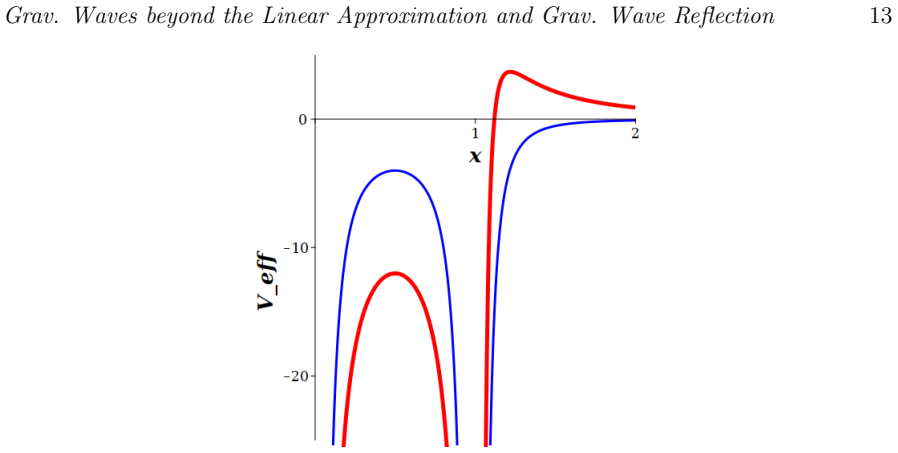
The load-bearing object is the scalar trace field $\psi = g^{\sigma\nu}\delta g_{\sigma\nu}$, the metric-contracted amplitude of the perturbation, together with the contraction identity $g^{\sigma\nu}\delta R_{\sigma\nu} = -\Box\,\psi$ (Eq. 7) that turns the tensor perturbation equations into a single scalar equation, and the mass term $m^2 = \Lambda - \tfrac{1}{2}\kappa T$ that emerges from varying the material-content tensor under the dust assumption. An argument that $\psi$ is invariant under coordinate transformations is what prevents it from being gauged away in the manner of the transverse-traceless gauge of linearized gravity, so the scalar channel cannot be discarded and carries the whole wave dynamics. From there the machinery is mechanical: on Schwarzschild space-time the ansatz $\Psi(x) = N\,\mathrm{e}^{-\ln(x\sqrt{F})}\chi(x)$ eliminates the first-derivative term and produces the effective Schrödinger problem with the potential $V_{\mathrm{eff}}(l,x)$ of Eq. (41), whose positive barrier outside the horizon is the reflection mechanism; in the Newtonian limit replacing the curved d'Alembertian by the weak-field operator $(-n^2\partial_{ct}^2 + \Delta + \mu^2)$ produces the index of refraction $n = 1 - 2\Phi/c^2$ and the Fresnel-style reflection coefficient $R = |n_1 - n_2|/(n_1 + n_2)$.
What would settle it
Recompute $g^{\sigma\nu}\delta R_{\sigma\nu}$ from the full Palatini identity, keeping the cross terms $\nabla_\alpha\nabla_\sigma\delta g^\alpha{}_\nu + \nabla_\alpha\nabla_\nu\delta g^\alpha{}_\sigma$ and the background-curvature terms that Eq. (6) drops; wherever these do not vanish, the contracted identity (7) fails, and with it the massive Klein-Gordon equation (25), the black-hole barrier, and the mirror predictions. The paper's own binary experiment supplies the observational half: a stack with an even number of sharp density interfaces reflects a nonzero fraction of a gravitational wave under the Fresnel-style boundary conditions but exactly zero under the quantum-gluing conditions, so a single measurement decides which boundary condition — and hence which theory — is right.
Extended reading notes
Core claim
On the author's own terms, the central discovery is that contracting the varied Einstein equations produces a free, massive, Lorentz-covariant wave equation for the scalar amplitude $\psi = g^{\sigma\nu}\delta g_{\sigma\nu}$ on any curved background: $\Box\psi + m^2\psi = 0$, where $\Box$ is the curved-space d'Alembertian and $m^2 = \Lambda - \tfrac{1}{2}\kappa T$. Because $\Lambda$ is positive, the effective mass $m_g = (\hbar/c)\sqrt{\Lambda - \tfrac{1}{2}\kappa T}$ stays real in vacuum, so gravitational waves remain stable and oscillatory, and the paper assigns dark energy the dynamical role of keeping the graviton mass real where matter is absent. Solving the equation on a Schwarzschild background and removing the first-derivative term by a change of dependent variable yields an effective Schrödinger equation whose geometric potential is purely attractive for zero angular momentum (bound standing waves) but develops a positive barrier just outside the event horizon for $l \geq 1$; the paper reads this barrier as a scattering potential, so black holes reflect part of any incoming gravitational radiation, which it presents as an unambiguous testable prediction of black-hole existence. In the Newtonian limit the same equation gives gravitational waves an index of refraction $n = 1 - 2\Phi/c^2$, so propagation slows in gravitational potentials and an interface between regions of different density reflects a small fraction of the power; a hemispherical stack of alternating high- and low-density layers can then break the symmetry of a symmetric emitter and produce directed thrust without violating Newton's third law.
Load-bearing premise
The derivation assumes that when the Ricci tensor is perturbed, only two terms survive — one that becomes the wave operator acting on $\psi$ and one that vanishes on contraction — with all other pieces of the standard variation dropping out; if those extra pieces do not vanish on a curved background, the massive wave equation for $\psi$ and every later prediction fails to follow.
Editorial extensions
If this is right
- Gravitons acquire a mass $m_g = (\hbar/c)\sqrt{\Lambda - \tfrac{1}{2}\kappa T}$, making gravitational waves dispersive with a minimal frequency $\nu_{\mathrm{min}} = (c/2\pi)\sqrt{\Lambda - \tfrac{1}{2}\kappa T}$ below which no radiation propagates.
- Black holes scatter gravitational waves: incoming waves with $l \geq 1$ encounter a positive potential barrier just outside the horizon and are partially reflected, giving a direct and unambiguous observational test of black-hole existence.
- In the Newtonian limit gravitational waves travel slower than light with index of refraction $n = 1 - 2\Phi/c^2$, and each sharp density interface reflects a fraction $R \approx V|\rho_1 - \rho_2|/(r c^2)$ of the incident power.
- Stacking many alternating dense and sparse layers (for example iridium and aluminum) adds these small reflections nearly linearly, producing a gravitational-wave mirror; a hemispherical mirror around a symmetric quadrupole emitter converts emission into directed thrust while conserving momentum, so Newton's third law is never violated.
- Dark matter is re-interpreted as an apparent effect of the non-vanishing graviton mass rather than a new particle species, with the $\Lambda$CDM cosmological model recovered, and the cosmological term is assigned the role of keeping the graviton mass real in empty space.
Reading between the lines
- Extension: the same barrier that reflects incoming waves should also produce gravitational-wave echoes — delayed, weaker replicas of a merger's ringdown — because part of the wave is temporarily trapped between the barrier and the horizon; the paper does not compute the delay, but the potential in Eq. (41) implies it.
- Extension: since $m^2 = \Lambda - \tfrac{1}{2}\kappa T$ depends on local density, the effective graviton mass varies with environment, so gravitational waves passing through different matter columns should accumulate a density-dependent phase; comparing the dispersion of a single event along different lines of sight would probe this, a consequence the paper leaves implicit.
- Extension: if $\psi$ is a real gauge-invariant radiation channel, then detector analyses that model only the two transverse-traceless tensor polarizations are missing a scalar signal; re-analyzing existing merger and ringdown waveforms for a scalar-polarization component is a direct, data-only test of the paper's premise.
Editorial analysis
A structured set of objections, weighed in public.
Referee Report
Summary. The paper derives an equation for the trace of the metric perturbation ψ = g^{σν}δg_{σν} by varying the Einstein field equations. The authors claim this yields a massive Klein-Gordon equation □ψ + m²ψ = 0 with m² = Λ − (1/2)κT, implying a density-dependent graviton mass. They then solve this equation on a Schwarzschild background, finding an effective potential that binds l=0 modes and gives a repulsive barrier for l≥1, which they interpret as gravitational wave reflection off black holes. In the Newtonian limit they obtain an index of refraction n = 1 − 2Φ/c² and propose layered-density gravitational wave mirrors and a propulsion scheme. The paper also suggests that the massive graviton could account for dark matter.
Significance. If the central derivation were correct, the paper would offer a striking unification: an effective graviton mass emerging directly from the cosmological constant and local matter density, with testable predictions for gravitational wave reflection by black holes and by laboratory density interfaces. The manuscript is clearly written in parts and engages with the massive-gravity literature. However, the main result depends on an incorrect expression for the first-order variation of the Ricci tensor, and the subsequent gauge-invariance claim and boundary-condition discussion contain additional serious flaws. Because these errors occur at the very first step and propagate through all applications, the paper's predictions are unsupported. The work does not provide numerical simulations, machine-checked derivations, or new observational analyses that could rescue the conclusions.
major comments (4)
- [§2.1, Eq. (6)-(7)] The expression for the first-order variation of the Ricci tensor is incomplete. Using the Palatini identity (3) and the standard Christoffel variation (5), one obtains δR_{σν} = (1/2)(∇^β∇_νδg_{σβ} + ∇^β∇_σδg_{βν} − □δg_{σν} − ∇_σ∇_νψ). Equation (6) omits the first two cross terms. Their metric trace contributes ∇^α∇^βδg_{αβ}, so Eq. (7) should read g^{σν}δR_{σν} = ∇^α∇^βδg_{αβ} − □ψ, not −□ψ. Consequently the contracted field equation (22) and the massive Klein-Gordon equation (25) are missing the term ∇^α∇^βδg_{αβ}; this term cannot be discarded unless the perturbation is transverse, a condition that is incompatible with the paper's claim that ψ is coordinate-invariant. Since Eqs. (29)-(41) and (52)-(55) all follow from Eq. (25), the central predictions are unsupported.
- [§2.2, Eq. (13)-(14)] The variation of the dust stress-energy tensor is not correctly evaluated. From T_{σν}=ρu_σu_ν, the trace variation is δT = δ(g^{σν}T_{σν}) = T_{σν}δg^{σν} + g^{σν}δT_{σν}. Even if g^{σν}δT_{σν}=0 as claimed in Eq. (13), the first term equals −ρ u^αu^βδg_{αβ} (up to the sign convention for δg), which is generically nonzero. The statement in Eq. (14) that δT=0 because the equation of state does not depend on the metric is therefore invalid: the trace is a metric-dependent contraction. Since δT appears in the source J in Eq. (23), the derivation of Eq. (22) and the subsequent mass formula (24) are not established.
- [§2.3] The proof that ψ = g^{σν}δg_{σν} is gauge invariant does not apply to the standard gauge freedom of metric perturbation theory. In linearized gravity an infinitesimal coordinate change x^μ→x^μ+ξ^μ sends the perturbation to h_{μν}+∇_μξ_ν+∇_νξ_μ, so the trace transforms to ψ+2∇·ξ, which is not invariant. The paper instead treats δg_{σν} as an arbitrary tensor field under an active diffeomorphism and subtracts the Lie derivative of the background metric; this is a different operation and does not correspond to the gauge freedom used in the TT gauge. The claim that ψ 'cannot be made to vanish by the choice of the gauge condition' is therefore incorrect, and the interpretation of ψ as a coordinate-invariant physical scalar field is unsupported.
- [§5.1] The derivation of the gravitational wave reflection coefficient is internally inconsistent. The 'quantum mechanical gluing' conditions (62)-(63) lead to R_{12} = (k_1−k_2)/(k_1+k_2) and, by the same argument, R_{21} = −R_{12} in Eqs. (66) and (69). The paper then replaces this antisymmetric result by the symmetric Fresnel-like formula (72) with R_{12}=R_{21}=|n_1−n_2|/(n_1+n_2), based on an unproved phase-shift assumption. The paper itself acknowledges this is an open question, but Sections 5 and 6 nevertheless assume the symmetric form to construct the mirror and the propulsion device. Without a physical derivation of the correct boundary conditions, the reflection and propulsion predictions are not established.
minor comments (6)
- [Abstract and Section 1] The title and Section 1 describe the work as 'beyond the linear approximation', but the derivation keeps only terms first order in δg_{σν}; no quadratic or higher-order terms are retained. The paper should temper this claim or include the nonlinear terms.
- [Throughout] There are numerous typographical errors, e.g., 'd'Alambert' for 'd'Alembert' (after Eq. 7), 'insted' for 'instead' (Section 5.1), and 'Schwatzschild' for 'Schwarzschild' (Section 1).
- [References] Reference [8] appears to misspell the author name ('John T. Goblin Jr.' should likely be 'John T. Giblin Jr.').
- [Section 5] The notation switches from ψ to ϕ to χ without explanation; using a single symbol for the perturbation amplitude would improve readability.
- [Section 4] The claim that gravitational wave scattering off a potential barrier provides an 'unambiguous testable prediction of black hole existence' (Section 4) overstates the case, since any sufficiently compact mass distribution would produce a similar effective potential; the paper does not provide a background-independent observable or an amplitude estimate.
- [§2.5, Eq. (24)] Equation (24) says the effective mass is 'defined as a square root of (20)', but only m^2 is defined; define m = sqrt(M) explicitly.
Circularity Check
No significant circularity: the central scalar wave equation is derived algebraically from stated inputs, and the resulting predictions are not imposed by construction.
full rationale
The paper's central equation (22) is obtained by contracting the perturbed Einstein equation (19) with the metric; the effective mass m^2 = Lambda - (1/2) kappa T is a combination of the cosmological term and the stress-energy trace, not a parameter fitted to the black-hole or reflection outcomes. The Schwarzschild analysis, effective potential (41), index of refraction (52), and reflection coefficients (55)/(66) are all derived algebraically from that equation and standard separation and gluing assumptions; none of these predictions is defined in terms of the input parameters in a way that makes the prediction tautological. The self-citations ([12], [72], [73]) occur in peripheral contexts (exotic equations of state, electrical driving of a proposed emitter) and are not used to justify the main derivation or to forbid alternatives. The paper itself flags open issues, such as the absence of initial or boundary conditions for quantization in Section 4 and the unresolved boundary-condition choice in Section 5.1; these are limitations, not circular reductions. A separate, independent mathematical concern is that Eq. (6) drops the standard cross terms involving gradients of delta g, so the traced relation (7) and hence the Klein-Gordon equation (22) may be incorrect; that is a correctness risk, not an equivalence of inputs and outputs by construction.
Assumptions & free parameters
assumptions (5)
- standard math Einstein field equations in the form R_{sigma nu} = kappa(T_{sigma nu} - (1/2) g_{sigma nu} T) + g_{sigma nu} Lambda (Eq. 1)
- domain assumption Metric perturbation delta g_{sigma nu} is small and treated to first order in the expansion around the background metric
- ad hoc to paper The variation of the stress-energy trace for dust is zero, delta T = 0, because the equation of state does not depend on the metric (Eq. 14)
- ad hoc to paper The trace psi = g^{sigma nu} delta g_{sigma nu} is a coordinate-invariant scalar that cannot be gauged away (Section 2.3)
- ad hoc to paper Reflection at material interfaces obeys Fresnel-like boundary conditions with R = |n1 - n2| / (n1 + n2) (Eq. 55)
invented entities (1)
-
Massive graviton with density-dependent mass m_g = (hbar/c) sqrt(Lambda - (1/2) kappa T)
Cite this review
Pith. "Pith review of Gravitational Waves beyond the Linear Approximation and Gravitational Wave Reflection." pith.science (2026). https://pith.science/paper/ICAGY5P7
@misc{pith2026250201687,
  author       = {Pith},
  title        = {Pith review of: Gravitational Waves beyond the Linear Approximation and Gravitational Wave Reflection},
  year         = {2026},
  howpublished = {\url{https://pith.science/paper/ICAGY5P7}},
  note         = {Machine review of arXiv:2502.01687}
}
read the original abstract
We derive a relativistic field equation for the trace of the metric perturbation beyond the weak field approximation to the Einstein field equations. The dynamics is governed by a massive Klein-Gordon equation on curved space-time, where the effective mass of the field is associated with the material and the dark energy content via the cosmological term. We solve the equation in the case of a Schwarzschild black hole and show that it can be cast into an effective Schr\"odinger form with an effective geometric potential which binds the zero angular momentum states. The non-zero angular momentum states experience a positive potential peak before the event horizon pointing to gravitational waves scattering. Black holes scatter gravitational waves and thus we provide an unambiguous testable prediction of black hole existence. The Newtonian limit for this equation points to the possibility of reflecting gravitational waves at interfaces with sharp density boundary, thus opening up gravitational wave propulsion physics. We discuss this type of propulsion in the light of Newton's third law of Mechanics. Compelling questions such as the existence of quanta of this field which may account for the dark matter content are also addressed.
Figures


Figures from the paper (1 more)

Reference graph
Works this paper leans on
-
[1]
Albert Einstein, Jahrbuch der Radioaktivit¨ at,4 411 (1907)
work page 1907
-
[2]
Document 31: Ideas and Methods. II. The theory of General Relativity,
Albert Einstein, “Document 31: Ideas and Methods. II. The theory of General Relativity,” in Michel Janssen et al. (eds.), The Collected Papers of Albert Einstein. Volume 7: The Berlin Years: Writings, 1918–1921 (Princeton University Press, 2002)
work page 1918
-
[3]
Albert Einstein, Feldgleichungen der Gravitation , Preussische Akademie der Wissenschaften, Sitzungsberichte, 844–847 (1915)
work page 1915
-
[4]
C.W.F. Everitt et al., The Gravity Probe B test of General Relativity , Classical and Quantum Gravity 32, 224001 (2015)
work page 2015
-
[5]
B. P. Abbott et al., Phys. Rev. Lett. 116 (2016) 061102
work page 2016
-
[6]
Charles W. Misner, Kip S. Thorne and John Archibald Wheeler, Gravitation (Princeton Univ. Press, 2017)
work page 2017
-
[7]
Sean Carroll, Spacetime and Geometry: An Introduction to General Relativity , Addison-Wesley (2003)
work page 2003
-
[8]
John T. Goblin Jr., James B. Mertens, Glenn D. Starkman, and Chi Tian, Limited accuracy of linearized gravity., Phys. Rev. D 99, 023527 (2019)
work page 2019
Show all 73 references
-
[9]
E. T. Newman and R. Penrose. An Approach to Gravitational Radiation by a Method of Spin Coefficients. J. Math. Phys, 3:566, 1962
1962
-
[10]
Teukolsky, Perturbations of a Rotating Black Hole
S. Teukolsky, Perturbations of a Rotating Black Hole. I. Fundamental Equations for Gravitational, Electromagnetic, and Neutrino-Field Perturbations, Astrophysical Journal, Vol. 185, pp. 635-648 (1973)
1973
-
[11]
Palatini, Deduzione invariantiva delle equazioni gravitazionali dal principio di Hamilton
A. Palatini, Deduzione invariantiva delle equazioni gravitazionali dal principio di Hamilton. Rend. Circ. Matem. Palermo 43, 203 (1919)
1919
-
[12]
Atanasov and A
V. Atanasov and A. Saxena, Class. Quantum Grav. 41 075015, (2024)
2024
-
[13]
D. J. Rowan and G. Stephenson, Solutions of the time-dependent Klein-Gordon equation in a Schwarzschild background space., J. Phys. A: Math. Gen. 9, 1631 (1976). Grav. Waves beyond the Linear Approximation and Grav. Wave Reflection 23
1976
-
[14]
D. J. Rowan and G. Stephenson, The Klein-Gordon equation in a Kerr-Newman background space., J. Phys. A: Math. Gen. 10, 15 (1977)
1977
-
[15]
R. D. Lehn, S. S. Chabysheva, and J. R. Hiller, Klein–Gordon equation in curved space-time., Eur. J. Phys., 39 045405 (2018)
2018
-
[16]
Elizalde, Exact solutions of the massive Klein-Gordon-Schwarzschild equation
E. Elizalde, Exact solutions of the massive Klein-Gordon-Schwarzschild equation. , Phys. Rev. D 37, 2127 (1988)
1988
-
[17]
Elizalde, Series solutions for the Klein-Gordon equation in Schwarzschild space-time
E. Elizalde, Series solutions for the Klein-Gordon equation in Schwarzschild space-time. , Phys. Rev. D 36, 1269 (1987)
1987
-
[18]
V. B. Bezerra, H. S. Vieira and A. A. Costa, The Klein–Gordon equation in the spacetime of a charged and rotating black hole , Class. Quantum Grav. 31, 045003 (2014)
2014
-
[19]
Derezi´ nski and D
J. Derezi´ nski and D. Siemssen, An evolution equation approach to the Klein-Gordon operator on curved spacetime., Pure and Applied Analysis, 1, 215 (2019). doi: 10.2140/paa.2019.1.215
2019 doi
-
[20]
Englert, and R
F. Englert, and R. Brout, Phys. Rev. Lett. 13, 321 (1964)
1964
-
[21]
Higgs, Phys
P.W. Higgs, Phys. Rev. Lett. 13, 508 (1964)
1964
-
[22]
G. S. Guralnik, C. R. Hagen, and T. W. B. Kibble, Phys. Rev. Lett. 13, 585 (1964)
1964
-
[23]
Chatrchyan et al., Observation of a new boson at a mass of 125 GeV with the CMS experiment at the LHC , Phys
S. Chatrchyan et al., Observation of a new boson at a mass of 125 GeV with the CMS experiment at the LHC , Phys. Lett. B, 716, 30-61 (2012)
2012
-
[24]
Aad et al., Observation of a new particle in the search for theStandard Model Higgs boson with the ATLAS detector at the LHC , Phys
G. Aad et al., Observation of a new particle in the search for theStandard Model Higgs boson with the ATLAS detector at the LHC , Phys. Lett. B, 716, 1-29 (2012)
2012
-
[25]
Bargmann and E
V. Bargmann and E. P. Wigner, Group Theoretical Discussion of Relativistic Wave Equations , PNAS 34, 211 (1948)
1948
-
[26]
Weinberg and E
S. Weinberg and E. Witten, Limits on massless particles , Phys. Lett. B, 96, 59 (1980). doi: 10.1016/0370-2693(80)90212-9
1980 doi
-
[27]
A. H. Chamseddine and V. Mukhanov, JHEP 8, 011 (2010)
2010
-
[28]
Ellithi, Modified gravity/entropic gravity correspondence due to graviton mass, Annals of Physics, 169717 (2024)
Kimet Jusufi, Ahmed Farag Ali, Abdelrahman Yasser, Nader Inan, A.Y. Ellithi, Modified gravity/entropic gravity correspondence due to graviton mass, Annals of Physics, 169717 (2024). doi.org/10.1016/j.aop.2024.169717
2024
-
[29]
Capozziello, A
S. Capozziello, A. Stabile, and A. Troisi, Phys. Rev. D 76, 104019 (2007), arXiv:0708.0723 [gr-qc]
2007 arXiv
-
[30]
Capozziello, G
S. Capozziello, G. Lambiase, M. Sakellariadou, and A. Stabile, Phys. Rev. D 91, 044012 (2015)
2015
-
[31]
De Martino and M
I. De Martino and M. De Laurentis, Phys. Lett. B 770, 440 (2017)
2017
-
[32]
Benisty and S
D. Benisty and S. Capozziello, Phys. Dark Univ. 39, 101175 (2023)
2023
-
[33]
Fierz and W
M. Fierz and W. Pauli, On Relativistic Wave Equations for Particles of Arbitrary Spin in an Electromagnetic Field, Proc. Roy. Soc. Lond. A 173, 211 (1939)
1939
-
[34]
Massive and mass- less Yang-Mills and gravitational fields,
H. van Dam and M. J. G. Veltman, “Massive and mass- less Yang-Mills and gravitational fields,” Nucl. Phys. B 22, 397 (1970); V. I. Zakharov, “Linearized gravita- tion theory and the graviton mass,” JETP Lett. 12, 312 (1970) [Pisma Zh. Eksp. Teor. Fiz. 12, 447 (1970)]
1970
-
[35]
To the problem of nonvanishing grav- itation mass,
A. I. Vainshtein, “To the problem of nonvanishing grav- itation mass,” Phys. Lett. B 39, 393 (1972)
1972
-
[36]
Can gravitation have a finite range?
D. G. Boulware and S. Deser, “Can gravitation have a finite range?”, Phys. Rev. D 6, 3368 (1972)
1972
-
[37]
de Rham, G
C. de Rham, G. Gabadadze and A. J. Tolley, Phys.Lett. B 711, 190 (2012)
2012
-
[38]
Bimetric Gravity from Ghost-free Massive Gravity,
S. F. Hassan and R. A. Rosen, “Bimetric Gravity from Ghost-free Massive Gravity,” JHEP 2, 126 (2012)
2012
-
[39]
Theoretical Aspects of Massive Gravity
K. Hinterbichler, “Theoretical Aspects of Massive Gravity”, Rev. Mod. Phys. 84, 671 (2012)
2012
- [40]
-
[41]
De Felice, S
A. De Felice, S. Mukohyama, and J.-P. Uzan, Gen. Rel. Grav. 50, 21 (2018)
2018
-
[42]
De Felice, S
A. De Felice, S. Mukohyama, M. Oliosi, and Y. Watanabe, Phys. Rev. D 97, 024050 (2018)
2018
-
[43]
Aoki and S
K. Aoki and S. Mukohyama, Phys. Rev. D 96, 104039 (2017)
2017
-
[44]
Agazie et al
G. Agazie et al. (NANOGrav), Astrophys. J. Lett. 951, L8 (2023)
2023
-
[45]
Wu, Z.-C
Y.-M. Wu, Z.-C. Chen, Y.-C. Bi, and Q.-G. Huang, (2023), arXiv:2310.07469 [astro-ph.CO]
2023 arXiv
-
[46]
Hellings and G.S
R.W. Hellings and G.S. Downs, Upper limits on the isotropic gravitational radiation background from pulsar timing analysis The Astrophysical Journal. 265, L39 (1983). Grav. Waves beyond the Linear Approximation and Grav. Wave Reflection 24
1983
-
[47]
Dark Universe phenomenology from Yukawa potential?,
K. Jusufi, G. Leon, and A. D. Millano, “Dark Universe phenomenology from Yukawa potential?,” Phys. Dark Univ. 42, 101318 (2023)
2023
-
[48]
Observational constraints on Yukawa cosmology and con- nection with black hole shadows,
E. Gonz´ alez, K. Jusufi, G. Leon and E. N. Saridakis, “Observational constraints on Yukawa cosmology and con- nection with black hole shadows,” Phys. Dark Univ. 42, 101304 (2023)
2023
-
[49]
Testing Yukawa cosmology at the Milky Way and M31 galactic scales,
R. D’Agostino, K. Jusufi and S. Capozziello, “Testing Yukawa cosmology at the Milky Way and M31 galactic scales,” Eur. Phys. J. C 84, 386 (2024)
2024
-
[50]
P. J. E. Peebles, Astrophys. J. 277, 470 (1984)
1984
-
[51]
Trimble, Ann
V. Trimble, Ann. Rev. Astron. Astrophys. 25, 425 (1987)
1987
-
[52]
Weinberg, Rev
S. Weinberg, Rev. Mod. Phys. 61, 1 (1989)
1989
-
[53]
Zlatev, L.-M
I. Zlatev, L.-M. Wang, and P. J. Steinhardt, Phys. Rev. Lett. 82, 896 (1999)
1999
-
[54]
Padmanabhan, Phys
T. Padmanabhan, Phys. Rept. 380, 235 (2003)
2003
-
[55]
Aghanim et al
N. Aghanim et al. (Planck), Astron. Astrophys. 641, A6 (2020), [Erratum: Astron. Astrophys. 652, C4 (2021)], arXiv:1807.06209 [astro-ph.CO]
2020 arXiv
-
[56]
D. G. Boulware and S. Deser, Can gravitation have a finite range? , Phys. Rev. D 6, 3368 (1972)
1972
-
[57]
de Rham, G
C. de Rham, G. Gabadadze and A. J. Tolley, Phys. Lett. B 711, 190 (2012)
2012
-
[58]
S. F. Hassan and R. A. Rosen, Bimetric Gravity from Ghost-free Massive Gravity, JHEP 2 (2012), 126
2012
-
[59]
Hinterbichler, Theoretical Aspects of Massive Gravity , Rev
K. Hinterbichler, Theoretical Aspects of Massive Gravity , Rev. Mod. Phys. 84, 671 (2012)
2012
-
[60]
Rickles, and C´ ecile M
D. Rickles, and C´ ecile M. DeWitt, (2011). An Expanded Version of the Remarks by R.P. Feynman on the Reality of Gravitational Waves. In: The Role of Gravitation in Physics: Report from the 1957 Chapel Hill Conference. doi: 10.34663/9783945561294-34
2011 doi
-
[61]
Weinberg, Gravitation and Cosmology , Wiley, New York, (1972)
S. Weinberg, Gravitation and Cosmology , Wiley, New York, (1972)
1972
-
[62]
Minter, K
S.J. Minter, K. Wegter-McNelly, and R.Y. Chiao,Do mirrors for gravitational waves exist? Physica E 42, 234 (2010). doi:10.1016/j.physe.2009.06.056
2010 doi
-
[63]
Inan, J.J
N.A. Inan, J.J. Thompson, and R.Y. Chiao, Interaction of gravitational waves with superconductors. Fortschritte Der Physik, 65, 1600066 (2016). doi:10.1002/prop.201600066
2016 doi
-
[64]
Event Horizon Telescope Collaboration et al., ApJL 930 L12 (2022)
2022
-
[65]
Abramowitz and I.A
M. Abramowitz and I.A. Stegun, Handbook of Mathematical Functions with Formulas, Graphs, and Mathematical Tables., Dover Publications (1964)
1964
-
[66]
Arfken and H.J
G.B. Arfken and H.J. Weber, Mathematical Methods for Physicists. Elsevier Academic Press (2005)
2005
-
[67]
Motte, and N
Isaac Newton, A. Motte, and N. W. Chittenden, Newton ’s Principia. The mathematical principles of natural philosophy , New-York, D. Adee, (1848)
-
[68]
Die Grundlagen der Physik
David Hilbert, “Die Grundlagen der Physik” [Foundations of Physics], Nachrichten von der Gesellschaft der Wissenschaften zu G¨ ottingen – Mathematisch-Physikalische Klasse (in German), 3, 395 (1915)
1915
-
[69]
Feynman, Feynman Lectures on Gravitation
Richard P. Feynman, Feynman Lectures on Gravitation. Addison-Wesley (1995)
1995
-
[70]
Introduction to solid state physics (8th ed.) ch.22
Kittel, Charles (2005). Introduction to solid state physics (8th ed.) ch.22. New York: Wiley. ISBN 978-0-471-68057-4
2005
-
[71]
Shabalin, I.L. (2014). Iridium. In: Ultra-High Temperature Materials I. Springer, Dordrecht
2014
-
[72]
Atanasov and A
V. Atanasov and A. Saxena, Mass Oscillations in Superconducting Junctions for Gravitational Wave Emission and Detection , Annals of Physics (in press)
-
[73]
Atanasov, Gravitational wave emission from quadrupole Josephson junction device , Phys
V. Atanasov, Gravitational wave emission from quadrupole Josephson junction device , Phys. Lett. A 384, 126042 (2020)
2020
Reviewed August 9, 2026 · model on record in the stance chip above.
Discussion (0). Continue with ORCID to comment.