REVIEW 3 major objections 6 minor 11 references
Robust virtual element methods for 3D stress-assisted diffusion problems
T0 review · 3 major / 6 minor · reviewed 2026-08-09 · deepseek-v4-flash
Pith's one-line read This paper proves that the 3D virtual element method for stress-assisted diffusion is well-posed and attains the optimal order of convergence on polyhedral meshes.
desk verdict A reasonable 3D VEM extension whose displayed discrete equations accidentally omit the stabilization term the whole analysis depends on. read the letter →
The pith
A machine-rendered reading of the paper's core claim, the machinery that carries it, and where it could break.
The reading
What carries the argument
The machinery that carries the argument is the parameter-weighted saddle-point formulation of the coupled system together with the 3D virtual element spaces V_{h,k1}^1 (a Stokes-like enhanced space for displacement) and V_{h,k2}^2 (an H(div) intersect H(curl) space for flux), each defined by local problems on polyhedra. These spaces come with polynomial projection operators Pi^epsilon and $Pi^{0}$ and Fortin interpolators Pi^F that commute with div and are claimed to satisfy the approximation bounds of Lemmas 1 and 2. Stabilisation terms S^P_1 and $S^{{u_h,p_h,P}}$_2 restore coercivity on the kernels of the projections, converting the continuous well-posedness of Theorem 1 into a discrete well-posedness with the same parameter-robust structure.
What would settle it
Compute the discrete inf-sup constant for the proposed V_{h,k1}^1 times Q_{h,k1}^1 and V_{h,k2}^2 times Q_{h,k2}^2 spaces on a sequence of 3D polyhedral meshes with decreasing h; if the constant is not bounded below independently of h, the well-posedness and the error estimate in Theorem 2 cannot hold.
Extended reading notes
Core claim
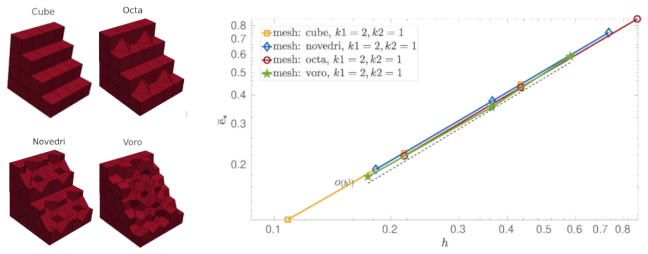
The central claim is Theorem 2: for solutions with regularity u in $H^{{s1+1}}$, p in $H^{{s1}}$, zeta in $H^{{s2}}$, and phi in $H^{{s2}}$, the virtual element solution satisfies e_h less than or similar to h^s with s = min{s1, s2}, with constants independent of the physical parameters under a data smallness condition. The proof structure follows the 2D robust analysis: parameter-weighted norms make the perturbed saddle-point formulation uniformly coercive, a Banach fixed-point argument handles the nonlinear coefficient M(epsilon(u),p) and the active stress term l(phi), and the 3D virtual element spaces are constructed so that Fortin-type interpolators and polynomial projections provide the needed approximation and inf-sup stability. The numerical experiments with lowest-order elements (k1 = 2, k2 = 1) confirm linear convergence on several polyhedral meshes and reproduce a lithiation simulation in a perforated cylindrical anode.
Load-bearing premise
The whole convergence analysis rests on the assertion, made without proof, that the 3D approximation, interpolation, and discrete inf-sup estimates in Lemmas 1 and 2 are direct extensions of the 2D results in [8]; if any of these three-dimensional bounds fails, Theorem 2 collapses.
Editorial extensions
If this is right
- The scheme is applicable to general polyhedral meshes in 3D, not just tetrahedral or hexahedral meshes, without losing the predicted convergence order.
- For the lowest-order case (k1 = 2, k2 = 1), the method converges linearly in the total error norm, as the numerical experiments confirm.
- The error constant is independent of the physical parameters, so the method is robust in the parameter regimes covered by the assumptions (1 ≤ mu, 1 ≤ lambda, theta ≤ M^{-1}).
- The fixed-point iteration used in the simulations only rebuilds the nonlinear blocks each step, which improves computational performance.
Reading between the lines
- If the asserted 3D interpolation estimates hold as claimed, the same construction should extend to other coupled saddle-point problems, such as poroelasticity or mixed Biot formulations, on polyhedral meshes.
- The convergence rate s = min{s1, s2} suggests that higher-order elements (k1 > 2, k2 > 1) would deliver higher-order convergence in practice; this remains untested in the paper, as the experiments only cover the lowest-order case.
- The smallness condition couples the Lipschitz constants L_M, L_l with the data size; a testable implication is that for large forcing or boundary concentration the fixed-point iteration may fail to converge or the a priori bound may degrade, which the numerical section does not explore.
Editorial analysis
A structured set of objections, weighed in public.
Referee Report
Summary. This paper develops a virtual element discretization for a three-dimensional coupled stress-assisted diffusion problem, combining a Herrmann-type mixed elasticity formulation with a mixed reaction-diffusion equation. The continuous problem is formulated in parameter-weighted spaces, and Theorem 1 states continuous well-posedness; the discrete method (3.3) is defined using enhanced 3D VEM spaces, and Theorem 2 asserts an optimal-order a priori error estimate. The proofs of these results are largely delegated to the companion paper [8]. Two numerical examples are reported: a manufactured solution on polyhedral meshes showing linear convergence, and a lithium-battery anode simulation.
Significance. If the stated a priori estimate is valid, the paper provides a useful extension of the 2D analysis in [8] to 3D polyhedral meshes, with potential applications in battery and hydrogen-diffusion modeling. The numerical experiments, especially the convergence study implemented in VEM++, are a positive feature. However, the correctness of the main theorem cannot currently be assessed from the manuscript alone because the 3D estimates and discrete stability conditions are referenced rather than proved, and the discrete formulation as printed has a stabilization term that vanishes identically.
major comments (3)
- [Section 3, Eq. (3.3) and following sentence] The sentence immediately after (3.3) redefines u_h, v_h, ζ_h, and ξ_h as their own projections: u_h := Π_ε,k1^1 u_h, v_h := Π_ε,k1^1 v_h, ζ_h := Π_0,k2^2 ζ_h, ξ_h := Π_0,k2^2 ξ_h. Substituting these definitions into the stabilization terms yields S_1^P(u_h-u_h, v_h-v_h) = S_1^P(0,0) = 0 in (3.3a) and S_2^{u_h,p_h,P}(ζ_h-ζ_h, ξ_h-ζ_h) = S_2^{u_h,p_h,P}(0, Πξ_h-Πζ_h) = 0 in (3.3c). The discrete problem therefore contains no stabilization on the complement of the polynomial projection, and the coercivity and inf-sup arguments invoked for Theorem 2 do not apply to the equations as displayed. Please correct the notation (e.g., use \bar{u}_h = Π u_h and \bar{ζ}_h = Π ζ_h for the projected quantities) and verify that the stabilized scheme is the one actually analyzed and implemented.
- [Section 3, 'Approximation and interpolation estimates' and the paragraph after (3.3)] Lemma 1, Lemma 2, and the discrete inf-sup condition are stated for the 3D case, but their proofs are not given; the text says the estimates 'arise as consequence of classical estimates' and that the robust 3D estimates 'follow similarly' from [8, Section 4]. The discrete well-posedness is likewise asserted as an 'extension of [8, Section 4]'. Because Theorem 2 depends directly on these interpolation estimates and on the discrete inf-sup condition, this is a load-bearing gap: the 3D VEM spaces involve face and edge degrees of freedom subject to Assumptions (M1)-(M3), and the extension from 2D is not a purely cosmetic repetition. The manuscript should either include the proofs of the 3D estimates or provide a precise statement of how the arguments in [8] adapt, including the polyhedral constants.
- [Section 2, Eq. (2.1b) versus Eq. (1.1b)] The strong equation (1.1b) is p = -λ div u + ℓ(φ), which yields the weak identity -∫_Ω q div u - λ^{-1}∫_Ω p q = -λ^{-1}∫_Ω ℓ(φ) q. The displayed weak form (2.1b) has the opposite sign on the right-hand side, +λ^{-1}∫_Ω ℓ(φ) q, and the same sign appears in (3.3b). Thus the weak formulation does not correspond to the stated strong form unless ℓ is redefined with a sign change. This inconsistency affects the fixed-point analysis and the interpretation of the numerical experiments, so it must be resolved before the convergence claim can be accepted.
minor comments (6)
- [Section 4, Example 1] The text says 'Figure 4 confirms the linear convergence rate' but the figure is numbered Figure 4.1; please correct the cross-reference.
- [Section 3, Eq. (3.3a)] The term -∫_Ω p_h div v_h appears inside the sum over P in T_h; for consistency with the other terms it should be -∫_P p_h div v_h.
- [Section 4, Example 1] The value of the parameter M is printed as 'M = 2 × 10', which appears truncated; please state the exact value.
- [Abstract] The phrase 'operators that ensures the well-posedness' should be 'operators that ensure the well-posedness'.
- [Section 4, Example 2] The text contains typos: 'perfored cylindrical particle' should be 'perforated cylindrical particle' and 'radious' should be 'radius'.
- [References] Reference [8] is listed as 'in press' with no DOI or arXiv identifier; if available, please add a stable link so that readers can access the companion analysis.
Circularity Check
Stabilization terms vanish under the paper's own redefinition of u_h and ζ_h, and the 3D error analysis is deferred to same-author [8]; Theorem 2 as printed does not apply to the displayed scheme.
-
self definitional
[Section 3, 'The virtual element formulation for the stress-assisted diffusion problem', equations (3.3a) and (3.3c) and the sentence immediately after (3.3)]
"for given f, g, φD, find (uh, ph, ζh, φh) ... such that Σ_P [2µ ∫_P ε(uh):ε(vh) + S^P_1(uh − uh, vh − vh) − ∫_Ω ph div vh] = ... ; Σ_P [∫_P M(uh, ph)^{-1}ζh·ξh + S^{uh,ph,P}_2(ζh − ζh, ξh − ζh) + ∫_P φh div ξh] = ..., with uh := Πε,k1_1 uh, vh := Πε,k1_1 vh, f := Π0,k1−2_1 f, ζh := Π0,k2_2 ζh, ξh := Π0,k2_2 ξh."
Substituting the displayed definitions into (3.3a) and (3.3c) gives S^P_1(u_h − u_h, v_h − v_h) = S^P_1(0,0) = 0 and S^{u_h,p_h,P}_2(ζ_h − ζ_h, ξ_h − ζ_h) = S^{u_h,p_h,P}_2(0, ξ_h − ζ_h) = 0. The stabilization that is supposed to control the projection-kernel complement is therefore identically zero by construction. The very next sentence requires that stabilization to be spectrally equivalent on that kernel, and Theorem 2's discrete well-posedness and error estimate inherit that requirement from [8, Section 4]. Hence, as written, the displayed discrete problem is not the stabilized scheme whose convergence is asserted; the property that carries the proof has been defined out of existence.
-
self citation load bearing
[Section 3, 'Approximation and interpolation estimates' and 'The virtual element formulation for the stress-assisted diffusion problem' (before Theorem 2)]
"This paragraph collects all the results involving approximation and interpolation estimates needed for the discrete formulation. We recall that arise as consequence of classical estimates and for the robust version of the estimates we refer to [8, Section 4] pointing out that the extension to the 3D estimates follow similarly. ..."
Lemma 1, Lemma 2, and the discrete inf-sup condition are not proved in this paper; they are asserted to 'follow similarly' from [8], an in-press SISC paper by Khot, Rubiano, and Ruiz-Baier. The present author is a coauthor of [8], and the parameter-weighted spaces, fixed-point argument, and stability theory used throughout are imported from that source. Since Theorem 2's error estimate depends exactly on those unproved 3D estimates and on the discrete inf-sup condition, the central convergence claim is supported by a same-author citation chain rather than by a self-contained derivation.
full rationale
As printed, the stabilization terms in (3.3) are annihilated by the paper's own redefinition of the unknowns: with u_h := Πε,k1_1 u_h and ζ_h := Π0,k2_2 ζ_h, the expressions u_h − u_h and ζ_h − ζ_h are zero, so the positive-definite stabilization required by the subsequent paragraph and by the [8]-based inf-sup analysis does not act on the displayed equations. This is a self-definitional collapse of the scheme's stability mechanism, and it makes Theorem 2 inapplicable to the problem as stated unless the notation is corrected to distinguish projected from unprojected functions. Separately, the 3D approximation and interpolation estimates (Lemmas 1 and 2) and the discrete inf-sup condition are not proved here but deferred with 'follow similarly' to [8], a same-author in-press paper; these are exactly the load-bearing ingredients of the a priori error estimate. The numerical experiments in Section 4 provide some external evidence of convergence and applicability, so the paper is not wholly circular, but the central theorem for the displayed scheme is not independently established. I score 6: partial circularity by construction plus a load-bearing same-author citation chain.
Assumptions & free parameters
assumptions (5)
- ad hoc to paper The 3D approximation and interpolation estimates of Lemma 1 and Lemma 2 follow from the 2D analysis in [8] and classical estimates.
- domain assumption The continuous problem is well-posed under the smallness condition C1 Lℓ sqrt(2µ) M^2 C2^2 L_M(||φ_D||_{1/2,ΓD} + ||g||_{0,Ω}) < 1.
- domain assumption The nonlinear coefficients M and ℓ are symmetric, positive semi-definite, uniformly bounded, and Lipschitz continuous.
- domain assumption The mesh satisfies the regularity conditions (M1)-(M3), including that every edge has length at least ρ h_P.
- standard math The discrete Fortin interpolation operators with the commutative property exist and satisfy the approximation estimates.
Cite this review
Pith. "Pith review of Robust virtual element methods for 3D stress-assisted diffusion problems." pith.science (2026). https://pith.science/paper/2IDJQO2Y
@misc{pith2026250201851,
  author       = {Pith},
  title        = {Pith review of: Robust virtual element methods for 3D stress-assisted diffusion problems},
  year         = {2026},
  howpublished = {\url{https://pith.science/paper/2IDJQO2Y}},
  note         = {Machine review of arXiv:2502.01851}
}
read the original abstract
This paper presents an initial exploration of stress-assisted diffusion problems in three dimensions within the framework of the virtual element method (VEM). Hilbert spaces enriched with parameter-weighted norms, the extended Babu\v{s}ka-Brezzi-Braess theory for perturbed saddle-point problems, and Banach fixed-point theory play a crucial role in performing a robust analysis of the fully coupled non-linear system. The proposed virtual element formulations are provided with appropriate projection, interpolation, and stabilisation operators that ensures the well-posedness of the discrete problem. Numerical simulations are conducted to show the accuracy, performance, and applicability of the method.
Figures

Reference graph
Works this paper leans on
-
[8]
R. Khot, A. E. Rubiano, and R. Ruiz-Baier. Robust virtual element methods for coupled stress-assisted diffusion problems. SIAM Journal on Scientific Computing, 1:in press, 2024
work page 2024
-
[1]
L. Beir˜ ao da Veiga, F. Brezzi, L. D. Marini, and A. Russo. H(div) and H(curl)-conforming VEM. Numerische Mathematik , 133:303–332, 06 2016
work page 2016
-
[2]
L. Beir˜ ao da Veiga, D. Mora, and G. Vacca. The Stokes complex for vir- tual elements with application to Navier–Stokes flows. Journal of Scientific Computing, 81, 11 2019. doi: 10.1007/s10915-019-01049-3
-
[3]
L. Beir˜ ao da Veiga, F. Dassi, and G. Vacca. The stokes complex for virtual elements in three dimensions. Mathematical Models and Methods in Applied Sciences, 30(03):477–512, 2020
work page 2020
-
[4]
C. Cherubini, S. Filippi, A. Gizzi, and R. Ruiz-Baier. A note on stress- driven anisotropic diffusion and its role in active deformable media. Journal of Theoretical Biology, 430(7):221–228, 2017. doi: 10.1016/j.jtbi.2017.07.013
-
[5]
F. Dassi. VEM++, a C++ library to handle and play with the virtual element method, 2023. URL https://arxiv.org/abs/2310.05748
arXiv 2023
- [6]
-
[7]
P. Grigoreva, E. N. Vilchevskaya, and W. H. M¨ uller. Stress and Diffusion Assisted Chemical Reaction Front Kinetics in Cylindrical Structures , pages 53–72. Springer International Publishing, Cham, 2019
work page 2019
Show all 11 references
-
[9]
J. Meng, L. Beir˜ ao da Veiga, and L. Mascotto. Stability and interpolation properties for stokes-like virtual element spaces. Journal of Scientific Com- puting, 94:e56, 2023
2023
-
[10]
J. D. Murray and J. D. Murray. Mathematical Biology: II: Spatial Models and Biomedical Applications, volume 3. Springer, 2003
2003
-
[11]
M. Taralov. Simulation of Degradation Processes in Lithium-Ion Batter- ies. Phd thesis, Technische Universit¨ at Kaiserslautern, 2015. URL https: //nbn-resolving.de/urn:nbn:de:hbz:386-kluedo-40855 . 10
2015
Reviewed August 9, 2026 · model on record in the stance chip above.
Discussion (0). Continue with ORCID to comment.