REVIEW 3 major objections 5 minor 88 references
Tomographic halo model of the unWISE-Blue galaxies using cross-correlations with BOSS CMASS galaxies
T0 review · 3 major / 5 minor · reviewed 2026-08-09 · deepseek-v4-flash
Pith's one-line read A new cross-correlation method measures how unWISE-Blue galaxy halos evolve with redshift, finding lower bias, lower mean halo mass, and fewer satellite galaxies at higher redshift.
desk verdict Solid tomographic HOD work whose central unWISE-Blue evolution result is conditional on an untested occupation-correlation assumption; worth refereeing, not desk-rejecting. read the letter →
The pith
A machine-rendered reading of the paper's core claim, the machinery that carries it, and where it could break.
The reading
What carries the argument
The load-bearing object is the halo occupation distribution (HOD), the mean number of central and satellite galaxies in a dark-matter halo of mass $M$, parametrized by $M_{\min}$, $M_1$, $M_0$, $\alpha$, and $\sigma_{\log M}$. The paper extends this HOD to the cross-correlation of two tracer populations by adding occupation correlation coefficients $R_{\mathrm{cs}}$, $R_{\mathrm{ss}}$, and $R_{\mathrm{sc}}$ between the two samples' centrals and satellites, here fixed to zero. Geometrically, the method replaces the Limber approximation with a post-Limber integral suited to narrow spectroscopic bins, adds linear redshift-space distortions, incorporates halo exclusion so that overlapping halos are not counted twice, and adds a lensing-magnification term evaluated at the halo model's linear bias. These pieces let the model predict the angular cross-correlation of a broad photometric sample with a narrow spectroscopic bin at scales from $0.1$ to $10\,h^{-1}\,\mathrm{Mpc}$.
What would settle it
Measure the clustering of the two populations inside the same halos, for example using a group or cluster catalog to compare the fraction of CMASS host halos that also contain unWISE-Blue galaxies with the uncorrelated-model prediction. If allowing the occupation correlation coefficients to be nonzero moves the inferred unWISE-Blue bias or mean halo mass by more than the quoted errors in any redshift bin, the central trend would not hold.
Extended reading notes
Core claim
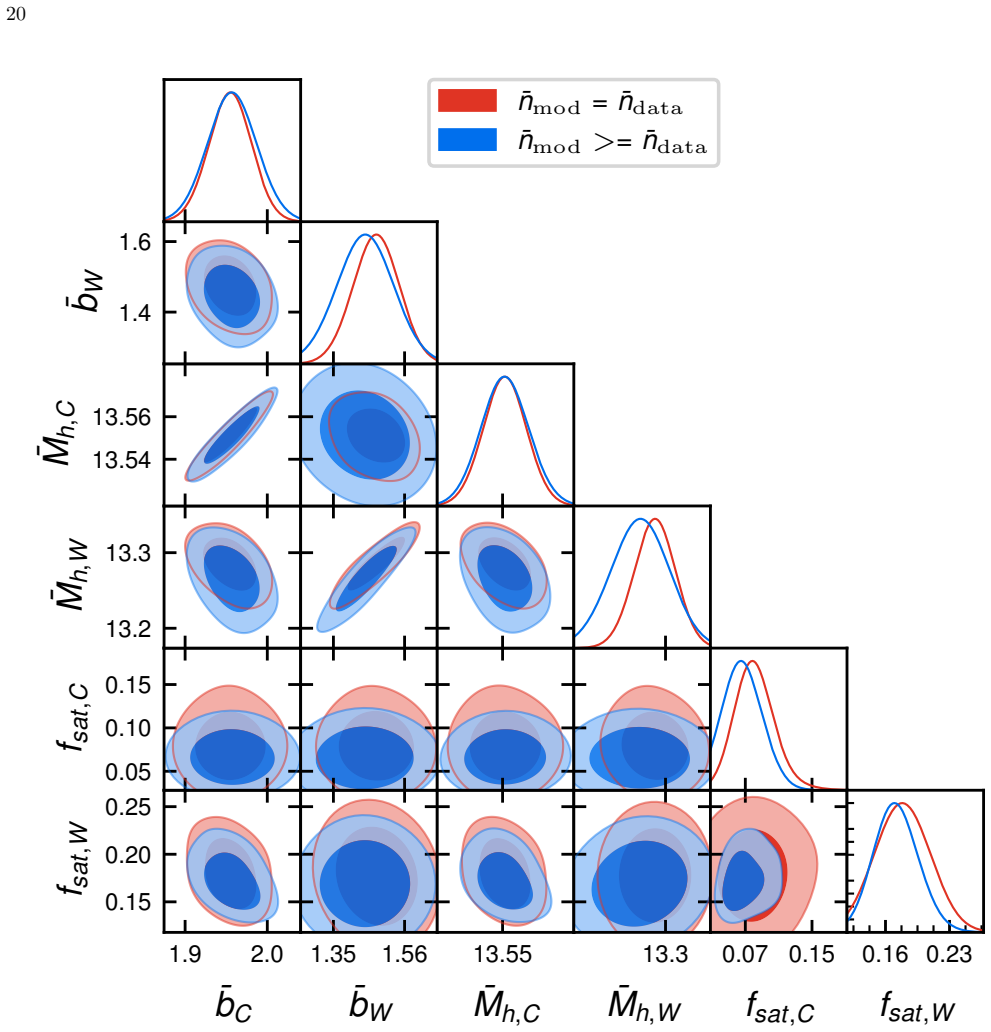
The central claim is that a redshift-independent halo occupation distribution cannot describe unWISE-Blue galaxies; their HOD evolves modestly but detectably across $0.45 < z < 0.75$. In the baseline model, the mean halo mass falls from $\log_{10}(M_{\mathrm{h}}/M_\odot) \sim 13.4$ to $\sim 13.1$ and the linear bias from $\sim 1.6$ to $\sim 1.4$ between $z \sim 0.5$ and $z \sim 0.7$, with the satellite fraction declining from $\sim 20\%$ to $\sim 10\%$. The same analysis finds strong evolution in the CMASS HOD, with $M_{\min}$ increasing from $\log_{10}(M_{\min}/M_\odot) \sim 13.28$ to $\sim 14.67$ while the mean halo mass stays near $\log_{10}(M_{\mathrm{h}}/M_\odot) \sim 13.55$ because the evolving halo mass function cancels the HOD shift. The enabling discovery is the method itself: a halo model for photometric-spectroscopic cross-correlations that includes post-Limber corrections, redshift-space distortions, halo exclusion, and lensing magnification, and fits both the CMASS autocorrelation and the CMASS-unWISE cross-correlation from $0.1$ to $10\,h^{-1}\,\mathrm{Mpc}$.
Load-bearing premise
The analysis assumes that CMASS and unWISE-Blue galaxies occupy dark-matter halos independently, so that the correlation coefficients $R_{\mathrm{cs}}$, $R_{\mathrm{ss}}$, and $R_{\mathrm{sc}}$ between their central and satellite occupations, fixed to zero, do not bias the inferred halo masses.
Editorial extensions
If this is right
- If the central claim holds, mock catalogs of unWISE-Blue should assign galaxies to halos using an HOD that changes across $0.45 < z < 0.75$, not a single redshift-independent occupation.
- Any single-number summary of unWISE-Blue clustering, such as one bias value or one mean halo mass, is a redshift-averaged quantity that hides the measured decline in halo mass and satellite fraction.
- The same post-Limber, RSD-inclusive halo model should apply to other photometric-spectroscopic cross-correlation pairs, including clustering-redshift measurements where narrow spectroscopic bins make the Limber approximation inadequate.
- For CMASS, the near-constant mean halo mass combined with strongly changing $M_{\min}$ and $\sigma_{\log M}$ shows that redshift evolution in the HOD can be masked by the evolving halo mass function, so number-density evolution alone would be a misleading proxy.
Reading between the lines
- If the occupation independence assumption were relaxed, allowing CMASS and unWISE-Blue galaxies to prefer or avoid sharing halos, the inferred unWISE-Blue halo masses could shift and the apparent decline with redshift could shrink or steepen.
- The unWISE-Blue color selection itself may track a stellar-mass range that evolves with redshift, so part of the measured drop in halo mass could be a selection effect rather than a change in host halos; cross-correlating with a lower-redshift spectroscopic sample would test whether the decline continues below $z = 0.45$.
- Because the method needs only a broad photometric kernel, it offers a route to measure HODs for other all-sky photometric samples that lack accurate photometric redshifts, effectively turning a spectroscopic tracer into a tomographic probe.
- The strong degeneracy between $M_{\min}$ and $\sigma_{\log M}$ suggests that the individually reported parameters are less secure than the derived combinations such as bias and mean halo mass, which are the quantities that drive the paper's main conclusion.
Signed reviews
Editorial analysis
A structured set of objections, weighed in public.
Referee Report
Summary. The paper develops a tomographic halo-model analysis of the unWISE-Blue galaxy sample using its cross-correlation with BOSS CMASS galaxies in six narrow redshift bins between z=0.45 and z=0.75. The authors extend the HALOMOD code to include post-Limber corrections, redshift-space distortions, halo exclusion, and magnification bias, and jointly fit CMASS autocorrelations and CMASS-unWISE cross-correlations with a 10-parameter HOD model. They report that the CMASS HOD evolves strongly with redshift while the unWISE-Blue HOD evolves modestly, with mean bias and halo mass decreasing from b~1.6 and log M_h~13.4 at z~0.5 to b~1.4 and log M_h~13.1 at z~0.7, and satellite fraction dropping from ~20% to ~10%. The method is presented as a general tool for tomographic cross-correlation HOD fitting.
Significance. If the results hold, this is a useful methodological advance: it demonstrates that photometric-spectroscopic cross-correlations can be used to infer redshift-resolved HODs for broad-redshift photometric samples, with direct applications to clustering redshifts and mock catalog construction. The paper is careful in treating many observational systematics (fiber collisions, imaging systematics, magnification, integral constraint), and it releases publicly available fitting code. The unWISE-Blue HOD constraints, if robust, would improve understanding of an important all-sky infrared-selected sample and inform its use in CMB lensing and other cross-correlation analyses. The fit quality is good, with chi-square per degree of freedom between 0.6 and 1.8 across redshift bins.
major comments (3)
- [Section 4.2, Eq. (26)] Section 4.2, Eq. (26): The cross-correlation occupation coefficients Rcs, Rss, and Rsc are fixed to zero, which is the uncorrelated-occupation assumption. This assumption directly enters the 1-halo cross-power spectrum P12^1h(k) in Eq. (26), where the mixed moments such as <Nc,1 Ns,2> factorize only under this assumption. Because CMASS and unWISE-Blue occupy halos of similar mass (mean halo masses ~13.55 and ~13.3 in Tables 2 and 3), correlated occupation is physically plausible, and nonzero values of these coefficients would change the small-scale cross-correlation amplitude. Since the paper does not include an unWISE autocorrelation measurement, the cross-correlation data alone cannot break the degeneracy between the unWISE satellite HOD parameters and the occupation-correlation coefficients. The paper explicitly leaves this to future work, but the claimed redshift evolution of the unWISE-Blue HOD (Section 5.2.1) is the central science result and depends on this untested assumption. I request that the authors quantify the impact, for example by repeating the fits with Rcs/Rss/Rsc set to extreme values (e.g., +1, -1) or by marginalizing over them with reasonable priors, and report how the derived bias, mean halo mass, and satellite fraction shift.
- [Section 2.1, Eq. (38)] The unWISE-Blue redshift distribution n(z) is measured from the COSMOS2015 catalog in the 2 deg^2 COSMOS field and assumed to be representative of the full sky. This n(z) enters the likelihood through the number-density constraint in Eq. (38) and through the projection of the model correlation function. The paper accounts only for Poisson fluctuations in the COSMOS counts (Fig. 1), but not for cosmic variance or field-to-field variations, which are known to be significant for a 2 deg^2 field at z~0.5. A biased n(z) would directly shift the inferred HOD parameters, especially Mmin and sigma_logM, and could thereby contaminate the claimed redshift evolution of the unWISE-Blue HOD. Please estimate the cosmic-variance contribution to sigma_nbar, or test robustness by adopting alternative n(z) priors or by marginalizing over the n(z) shape within a broader family of distributions.
- [Section 5.2.1, Table 3] The abstract states that the unWISE-Blue bias and mean halo mass 'drop' from b~1.6 and log M_h~13.4 at z~0.5 to b~1.4 and log M_h~13.1 at z~0.7, but the measured derived parameters in Table 3 are non-monotonic: the bias is 1.53, 1.63, 1.48, 1.37, 1.43, 1.64 in the six bins, and the mean halo mass is 13.40, 13.43, 13.29, 13.14, 13.11, 13.20. The final bin is consistent with the first two bins in bias, and the apparent decline is driven by the middle bins. The paper states that the best-fit HOD in any bin is strongly ruled out in other bins, but this claim is not shown quantitatively. Please provide a significance test for the redshift evolution of the derived parameters (e.g., chi-square of a constant-bias or constant-mass model against the six measurements, accounting for correlations between bins if available), and adjust the abstract and conclusions so that the characterization of the evolution matches the actual trend in the data.
minor comments (5)
- [Section 4.3.5] Typo: 'magnificantion' should be 'magnification' in the sentence introducing the binned model.
- [Fig. 9 caption] Typo: 'occurr' should be 'occur' in the caption.
- [Section 1] Typo: 'background' is misspelled as 'backgpround' in the sentence about the cosmic infrared background.
- [Section 3] The Davis-Peebles estimator in Eq. (2) is used instead of Landy-Szalay because of the computational cost of the RR term for the dense unWISE sample; the paper does not discuss the well-known bias of the Davis-Peebles estimator on small scales. A short justification or a reference demonstrating that this bias is negligible for the scales and densities here would be helpful.
- [Section 4.3.4] The notation in Eq. (30) for the magnification contributions (w_mu1_g2, w_g1_mu2, w_mu1_mu2) is clear, but the text immediately after uses 'w_g_mu' and 'w_mu1_mu2' without explicitly connecting these to the three terms in Eq. (30). A consistent labelling would improve readability.
Circularity Check
No circularity: the HOD parameters are fitted to the clustering data, and the quoted bias, mean halo mass, and satellite fraction are transformations of those fits, not independent predictions; the external inputs are independent measurements, and no step reduces a claimed result to its own input by construction.
full rationale
The derivation chain is a standard likelihood fit: the ten HOD parameters (five for CMASS, five for unWISE-Blue) are adjusted to reproduce the joint data vector of CMASS autocorrelations and CMASS-unWISE cross-correlations, with Gaussian or step-function number-density constraints. The headline quantities (bias, mean halo mass, satellite fraction) are computed from the fitted occupation functions via the halo-model integrals; they are reparameterizations of the fit rather than a priori predictions, but the paper consistently presents them as measurements ('we find') and does not mislabel them as independent predictions. The fixed-zero occupation correlations Rcs/Rss/Rsc in Section 4.2 and Eq. 26 are an acknowledged modeling assumption that could bias the inferred unWISE-Blue HOD and its redshift evolution, but this is a systematic or model-degeneracy concern, not circularity: the paper does not define the target quantities in terms of these coefficients, and it explicitly flags the impact as future work. The unWISE redshift distribution and magnification slope s are taken from Krolewski et al. (2020), and the CMASS magnification slopes from Farren et al. (2024); these are independent, externally measurable inputs (COSMOS photometric redshifts and the response of number counts to photometric perturbations), not consequences of the target HOD. Footnote 8 correctly states that predicting the unWISE autocorrelation or CMB-lensing cross-correlation would require HOD constraints outside the fitted redshift range; that is a stated limitation, not a circular step. No equation reduces a claimed result to a fitted parameter renamed as a prediction, and no load-bearing conclusion is imported solely through a self-citation.
Assumptions & free parameters
free parameters (11)
- CMASS Mmin =
13.28 to 14.69 across bins
- CMASS M1 =
14.03 to 14.54
- CMASS alpha =
0.77 to 1.50
- CMASS M0 =
12.5 to 13.7
- CMASS sigma_logM =
0.67 to 1.13
- unWISE-Blue Mmin =
12.20 to 12.99 (default case)
- unWISE-Blue M1 =
13.16 to 13.50
- unWISE-Blue alpha =
0.89 to 1.30
- unWISE-Blue M0 =
12.2 to 13.0
- unWISE-Blue sigma_logM =
0.22 to 1.15
- unWISE-Blue finc =
0.48 to 0.95 (incompleteness case)
assumptions (6)
- domain assumption Zheng et al. (2007) HOD functional form with erf central and power-law satellite terms
- domain assumption Halo model ingredients: NFW profile, Tinker mass function and bias, Duffy concentration-mass relation, Planck 2015 cosmology
- standard math Simon (2007) post-Limber approximation for narrow redshift bins
- standard math Kaiser (1987) linear redshift-space distortion model
- ad hoc to paper Cross-correlation occupation coefficients Rcs=Rss=Rsc=0
- ad hoc to paper unWISE-Blue redshift distribution from COSMOS2015 is representative of the full sky
Cite this review
Pith. "Pith review of Tomographic halo model of the unWISE-Blue galaxies using cross-correlations with BOSS CMASS galaxies." pith.science (2026). https://pith.science/paper/ZT4WBI3P
@misc{pith2026250202744,
  author       = {Pith},
  title        = {Pith review of: Tomographic halo model of the unWISE-Blue galaxies using cross-correlations with BOSS CMASS galaxies},
  year         = {2026},
  howpublished = {\url{https://pith.science/paper/ZT4WBI3P}},
  note         = {Machine review of arXiv:2502.02744}
}
abstract
The halo model offers a framework for investigating galaxy clustering, and for understanding the growth of galaxies and the distribution of galaxies of different types. Here, we use the halo model to study the small-scale clustering and halo occupation distribution (HOD) of the unWISE-Blue galaxy sample, an infrared-selected sample of $\sim$100 million galaxies across the entire extragalactic sky at $z\sim 0.5$ $-$ similar redshifts to the Baryon Oscillation Spectroscopic Survey (BOSS) CMASS sample. Although the photometric unWISE galaxies cannot be easily split in redshift, we use their cross-correlation with the BOSS CMASS sample to tomographically probe the HOD of the unWISE galaxies at $0.45 < z < 0.75$. To do so, we develop a new method for applying the halo model to cross-correlations between a photometric sample and a spectroscopic sample in narrow redshift bins, incorporating halo exclusion, post-Limber corrections, and redshift-space distortions. We reveal strong evolution in the CMASS HOD, and modest evolution in the unWISE-Blue HOD. For unWISE-Blue, we find that the average bias and mean halo mass drop from $b = 1.6$ and $\log_{10}(M_{\mathrm{h}}/M_{\odot}) \sim 13.4$ at $z \sim 0.5$ to $b = 1.4$ and $\log_{10}(M_{\mathrm{h}}/M_{\odot}) \sim 13.1$ at $z \sim 0.7$, and that the satellite fraction drops modestly from $\sim$20% to $\sim$10% in the same range. These results are useful for creating mock samples of the unWISE-Blue galaxies. Furthermore, the techniques developed to obtain these results are applicable to other tomographic cross-correlations between photometric samples and narrowly-binned spectroscopic samples, such as clustering redshifts.
Figures


Figures from the paper (8 more)


Reference graph
Works this paper leans on
-
[1]
2011, ApJS, 193, 29
Aihara, H., Allende Prieto, C., An, D., et al. 2011, ApJS, 193, 29
2011
-
[2]
2017, MNRAS, 465, 4853
Alam, S., Miyatake, H., More, S., Ho, S., & Mandelbaum, R. 2017, MNRAS, 465, 4853
2017
-
[3]
J., & Heymans, C
Asgari, M., Mead, A. J., & Heymans, C. 2023, The Open Journal of Astrophysics, 6, 39
2023
-
[4]
A., Weinberg, D
Berlind, A. A., Weinberg, D. H., Benson, A. J., et al. 2003, ApJ, 593, 1
2003
-
[5]
2013, MNRAS, 429, 3604 7 There have been a large number of works studying the CMASS HOD (Guo et al
Beutler, F., Blake, C., Colless, M., et al. 2013, MNRAS, 429, 3604 7 There have been a large number of works studying the CMASS HOD (Guo et al. 2013, 2014; Favole et al. 2016; Zhai et al. 2017; Yuan et al. 2020, 2021, 2022; Zhai et al. 2023), but we focus on comparing to White et al. (2011), Reid et al. (2014), Saito et al. (2016), and Alam et al. (2017) ...
2011
- [6]
-
[7]
2015, ApJS, 221, 15
Bundy, K., Leauthaud, A., Saito, S., et al. 2015, ApJS, 221, 15
2015
-
[8]
Coil, A. L. 2013, in Planets, Stars and Stellar Systems. Volume 6: Extragalactic Astronomy and Cosmology, ed. T. D. Oswalt & W. C. Keel, Vol. 6, 387
2013
Show all 88 references
-
[9]
& Sheth, R
Cooray, A. & Sheth, R. 2002, Phys. Rep., 372, 1
2002
-
[10]
& Peebles, P
Davis, M. & Peebles, P. J. E. 1983, ApJ, 267, 465
1983
-
[11]
S., Schlegel, D
Dawson, K. S., Schlegel, D. J., Ahn, C. P., et al. 2013, AJ, 145, 10
2013
-
[12]
& Schneider, M
Dodelson, S. & Schneider, M. D. 2013, Phys. Rev. D, 88, 063537
2013
-
[13]
2010, AJ, 139, 1628
Doi, M., Tanaka, M., Fukugita, M., et al. 2010, AJ, 139, 1628
2010
-
[14]
R., Schaye, J., Kay, S
Duffy, A. R., Schaye, J., Kay, S. T., & Dalla Vecchia, C. 2008, MNRAS, 390, L64
2008
-
[15]
J., Weinberg, D
Eisenstein, D. J., Weinberg, D. H., Agol, E., et al. 2011, AJ, 142, 72
2011
-
[16]
S., Krolewski, A., MacCrann, N., et al
Farren, G. S., Krolewski, A., MacCrann, N., et al. 2024, ApJ, 966, 157
2024
-
[17]
S., Sherwin, B
Farren, G. S., Sherwin, B. D., Bolliet, B., et al. 2023, arXiv e-prints, arXiv:2311.04213
2023 arXiv
-
[18]
K., Eisenstein, D
Favole, G., McBride, C. K., Eisenstein, D. J., et al. 2016, MNRAS, 462, 2218
2016
-
[19]
E., et al
Fukugita, M., Ichikawa, T., Gunn, J. E., et al. 1996, AJ, 111, 1748 17 Gaia Collaboration, Brown, A. G. A., Vallenari, A., et al. 2018, A&A, 616, A1 G´ orski, K. M., Hivon, E., Banday, A. J., et al. 2005, ApJ, 622, 759
1996
-
[20]
E., Carr, M., Rockosi, C., et al
Gunn, J. E., Carr, M., Rockosi, C., et al. 1998, AJ, 116, 3040
1998
-
[21]
E., Siegmund, W
Gunn, J. E., Siegmund, W. A., Mannery, E. J., et al. 2006, AJ, 131, 2332
2006
-
[22]
2013, ApJ, 767, 122
Guo, H., Zehavi, I., Zheng, Z., et al. 2013, ApJ, 767, 122
2013
-
[23]
2014, MNRAS, 441, 2398
Guo, H., Zheng, Z., Zehavi, I., et al. 2014, MNRAS, 441, 2398
2014
-
[24]
2007, A&A, 464, 399
Hartlap, J., Simon, P., & Schneider, P. 2007, A&A, 464, 399
2007
-
[25]
Howlett, C., Lewis, A., Hall, A., & Challinor, A. 2012, J. Cosmology Astropart. Phys., 1204, 027
2012
-
[26]
1987, MNRAS, 227, 1
Kaiser, N. 1987, MNRAS, 227, 1
1987
-
[27]
L., Franz, B
Kelsall, T., Weiland, J. L., Franz, B. A., et al. 1998, ApJ, 508, 44
1998
-
[28]
M., Martin, C., Neill, J
Krause, E., Hirata, C. M., Martin, C., Neill, J. D., & Wyder, T. K. 2013, MNRAS, 428, 2548
2013
-
[29]
& Ferraro, S
Krolewski, A. & Ferraro, S. 2022, J. Cosmology Astropart. Phys., 2022, 033
2022
-
[30]
F., & White, M
Krolewski, A., Ferraro, S., Schlafly, E. F., & White, M. 2020, J. Cosmology Astropart. Phys., 2020, 047
2020
-
[31]
Krolewski, A., Ferraro, S., & White, M. 2021, J. Cosmology Astropart. Phys., 2021, 028
2021
-
[32]
Krywonos, J., Muir, J., & Johnson, M. C. 2024, Phys. Rev. D, 110, 083533
2024
-
[33]
C., & Krolewski, A
Kusiak, A., Bolliet, B., Ferraro, S., Hill, J. C., & Krolewski, A. 2021, Phys. Rev. D, 104, 043518
2021
-
[34]
Kusiak, A., Bolliet, B., Krolewski, A., & Hill, J. C. 2022, Phys. Rev. D, 106, 123517
2022
-
[35]
J., Ilbert, O., et al
Laigle, C., McCracken, H. J., Ilbert, O., et al. 2016, ApJS, 224, 24
2016
-
[36]
2016, MNRAS, 457, 4021
Leauthaud, A., Bundy, K., Saito, S., et al. 2016, MNRAS, 457, 4021
2016
-
[37]
2000, ApJ, 538, 473
Lewis, A., Challinor, A., & Lasenby, A. 2000, ApJ, 538, 473
2000
-
[38]
Limber, D. N. 1953, ApJ, 117, 134
1953
-
[39]
E., Ivezi´ c, Z., Knapp, G
Lupton, R., Gunn, J. E., Ivezi´ c, Z., Knapp, G. R., & Kent, S. 2001, in Astronomical Society of the Pacific Conference Series, Vol. 238, Astronomical Data Analysis Software and Systems X, ed. J. Harnden, F. R., F. A. Primini, & H. E. Payne, 269
2001
-
[40]
& Fry, J
Ma, C.-P. & Fry, J. N. 2000, ApJ, 543, 503
2000
-
[41]
M., et al
Mainzer, A., Bauer, J., Cutri, R. M., et al. 2014, ApJ, 792, 30
2014
-
[42]
2011, ApJ, 731, 53
Mainzer, A., Bauer, J., Grav, T., et al. 2011, ApJ, 731, 53
2011
-
[43]
& White, M
McQuinn, M. & White, M. 2013, MNRAS, 433, 2857
2013
-
[44]
J., Brieden, S., Tr¨ oster, T., & Heymans, C
Mead, A. J., Brieden, S., Tr¨ oster, T., & Heymans, C. 2021, MNRAS, 502, 1401
2021
-
[45]
M., Lang, D., & Schlegel, D
Meisner, A. M., Lang, D., & Schlegel, D. J. 2017, AJ, 153, 38 M´ enard, B., Scranton, R., Schmidt, S., et al. 2013, arXiv e-prints, arXiv:1303.4722
2017 arXiv
-
[46]
L., & Aceves, H
Miyaji, T., Krumpe, M., Coil, A. L., & Aceves, H. 2011, ApJ, 726, 83
2011
-
[47]
Mohammad, F. G. & Percival, W. J. 2022, MNRAS, 514, 1289
2022
-
[48]
2021, Astronomy and Computing, 36, 100487
Murray, S., Diemer, B., Chen, Z., et al. 2021, Astronomy and Computing, 36, 100487
2021
-
[49]
D., Outram, P
Myers, A. D., Outram, P. J., Shanks, T., et al. 2005, MNRAS, 359, 741
2005
-
[50]
F., Frenk, C
Navarro, J. F., Frenk, C. S., & White, S. D. M. 1997, ApJ, 490, 493
1997
-
[51]
Newman, J. A. 2008, ApJ, 684, 88
2008
-
[52]
& Holder, G
Ouellette, A. & Holder, G. 2024, Phys. Rev. D, 110, 103025
2024
-
[53]
J., Finkbeiner, D
Padmanabhan, N., Schlegel, D. J., Finkbeiner, D. P., et al. 2008, ApJ, 674, 1217
2008
-
[54]
Peacock, J. A. & Smith, R. E. 2000, MNRAS, 318, 1144
2000
-
[55]
J., Friedrich, O., Sellentin, E., & Heavens, A
Percival, W. J., Friedrich, O., Sellentin, E., & Heavens, A. 2022, MNRAS, 510, 3207
2022
-
[56]
J., Ross, A
Percival, W. J., Ross, A. J., S´ anchez, A. G., et al. 2014, MNRAS, 439, 2531
2014
-
[57]
R., Munn, J
Pier, J. R., Munn, J. A., Hindsley, R. B., et al. 2003, AJ, 125, 1559 Planck Collaboration, Ade, P. A. R., Aghanim, N., et al. 2016, A&A, 594, A13
2003
-
[58]
2016, MNRAS, 455, 1553
Reid, B., Ho, S., Padmanabhan, N., et al. 2016, MNRAS, 455, 1553
2016
-
[59]
A., Seo, H.-J., Leauthaud, A., Tinker, J
Reid, B. A., Seo, H.-J., Leauthaud, A., Tinker, J. L., & White, M. 2014, MNRAS, 444, 476
2014
-
[60]
& Eales, S
Roche, N. & Eales, S. A. 1999, MNRAS, 307, 703
1999
-
[61]
Rocher, A., Ruhlmann-Kleider, V., Burtin, E., et al. 2023, J. Cosmology Astropart. Phys., 2023, 016
2023
-
[62]
P., et al
Saito, S., Leauthaud, A., Hearin, A. P., et al. 2016, MNRAS, 460, 1457
2016
-
[63]
F., Meisner, A
Schlafly, E. F., Meisner, A. M., & Green, G. M. 2019, ApJS, 240, 30
2019
-
[64]
2000, MNRAS, 318, 203
Seljak, U. 2000, MNRAS, 318, 203
2000
-
[65]
& Heavens, A
Sellentin, E. & Heavens, A. F. 2016, MNRAS, 456, L132
2016
-
[66]
A., Gunn, J
Smee, S. A., Gunn, J. E., Uomoto, A., et al. 2013, AJ, 146, 32
2013
-
[67]
A., Tucker, D
Smith, J. A., Tucker, D. L., Kent, S., et al. 2002, AJ, 123, 2121
2002
-
[68]
E., Peacock, J
Smith, R. E., Peacock, J. A., Jenkins, A., et al. 2002, Monthly Notices of the Royal Astronomical Society, 341, 1311
2002
-
[69]
2012, Astrophysical Journal, 761
Takahashi, R., Sato, M., Nishimichi, T., Taruya, A., & Oguri, M. 2012, Astrophysical Journal, 761
2012
-
[70]
V., Klypin, A., et al
Tinker, J., Kravtsov, A. V., Klypin, A., et al. 2008, ApJ, 688, 709
2008
-
[71]
L., Brownstein, J
Tinker, J. L., Brownstein, J. R., Guo, H., et al. 2017, ApJ, 839, 121
2017
-
[72]
L., Robertson, B
Tinker, J. L., Robertson, B. E., Kravtsov, A. V., et al. 2010, ApJ, 724, 878
2010
-
[73]
L., Weinberg, D
Tinker, J. L., Weinberg, D. H., Zheng, Z., & Zehavi, I. 2005, ApJ, 631, 41
2005
-
[74]
& Lewis, A
Torrado, J. & Lewis, A. 2021, J. Cosmology Astropart. Phys., 2021, 057
2021
-
[75]
2024, MNRAS, 527, 1760
Wenzl, L., Chen, S.-F., & Bean, R. 2024, MNRAS, 527, 1760
2024
-
[76]
2011, ApJ, 728, 126
White, M., Blanton, M., Bolton, A., et al. 2011, ApJ, 728, 126
2011
-
[77]
L., Eisenhardt, P
Wright, E. L., Eisenhardt, P. R. M., Mainzer, A. K., et al. 2010, AJ, 140, 1868
2010
-
[78]
S., & van Waerbeke, L
Yan, Z., Maniyar, A. S., & van Waerbeke, L. 2024, J. Cosmology Astropart. Phys., 2024, 058
2024
-
[79]
G., Adelman, J., Anderson, Jr., J
York, D. G., Adelman, J., Anderson, Jr., J. E., et al. 2000, AJ, 120, 1579
2000
-
[80]
J., & Leauthaud, A
Yuan, S., Eisenstein, D. J., & Leauthaud, A. 2020, MNRAS, 493, 5551
2020
-
[81]
H., Hadzhiyska, B., Bose, S., & Eisenstein, D
Yuan, S., Garrison, L. H., Hadzhiyska, B., Bose, S., & Eisenstein, D. J. 2022, MNRAS, 510, 3301
2022
-
[82]
J., & Guo, H
Yuan, S., Hadzhiyska, B., Bose, S., Eisenstein, D. J., & Guo, H. 2021, MNRAS, 502, 3582
2021
-
[83]
2022, MNRAS, 509, 3119
Zacharegkas, G., Chang, C., Prat, J., et al. 2022, MNRAS, 509, 3119
2022
-
[84]
H., et al
Zehavi, I., Zheng, Z., Weinberg, D. H., et al. 2005, ApJ, 630, 1
2005
-
[85]
J., & Guo, H
Zhai, Z., Percival, W. J., & Guo, H. 2023, MNRAS, 523, 5538
2023
-
[86]
L., Hahn, C., et al
Zhai, Z., Tinker, J. L., Hahn, C., et al. 2017, ApJ, 848, 76
2017
-
[87]
L., & Zehavi, I
Zheng, Z., Coil, A. L., & Zehavi, I. 2007, ApJ, 667, 760
2007
-
[88]
Zhou, R., Ferraro, S., White, M., et al. 2023, J. Cosmology Astropart. Phys., 2023, 097 APPENDIX Here we present additional tables and plots. In Tables 4 and 5, we give the marginalized constraints on the HOD and derived parameters for both CMASS and unWISE-Blue, allowing the ...
2023
Reviewed August 9, 2026 · model on record in the stance chip above.
Discussion (0). Continue with ORCID to comment.