REVIEW 3 major objections 5 minor 84 references
A high-resolution microresonator-frequency-comb spectrometer
T0 review · 3 major / 5 minor · reviewed 2026-08-09 · deepseek-v4-flash
Pith's one-line read A microresonator frequency comb, scanned by radio-frequency sidebands and read out in parallel by a VIPA-grating CCD, delivers 200-kHz spectral resolution over a 4-THz bandwidth in minutes.
desk verdict A credible microcomb spectrometer with a useful parallel-detection scheme, but the headline 200-kHz resolution is inferred from the laser linewidth, not demonstrated by the data. read the letter →
The pith
A machine-rendered reading of the paper's core claim, the machinery that carries it, and where it could break.
The reading
What carries the argument
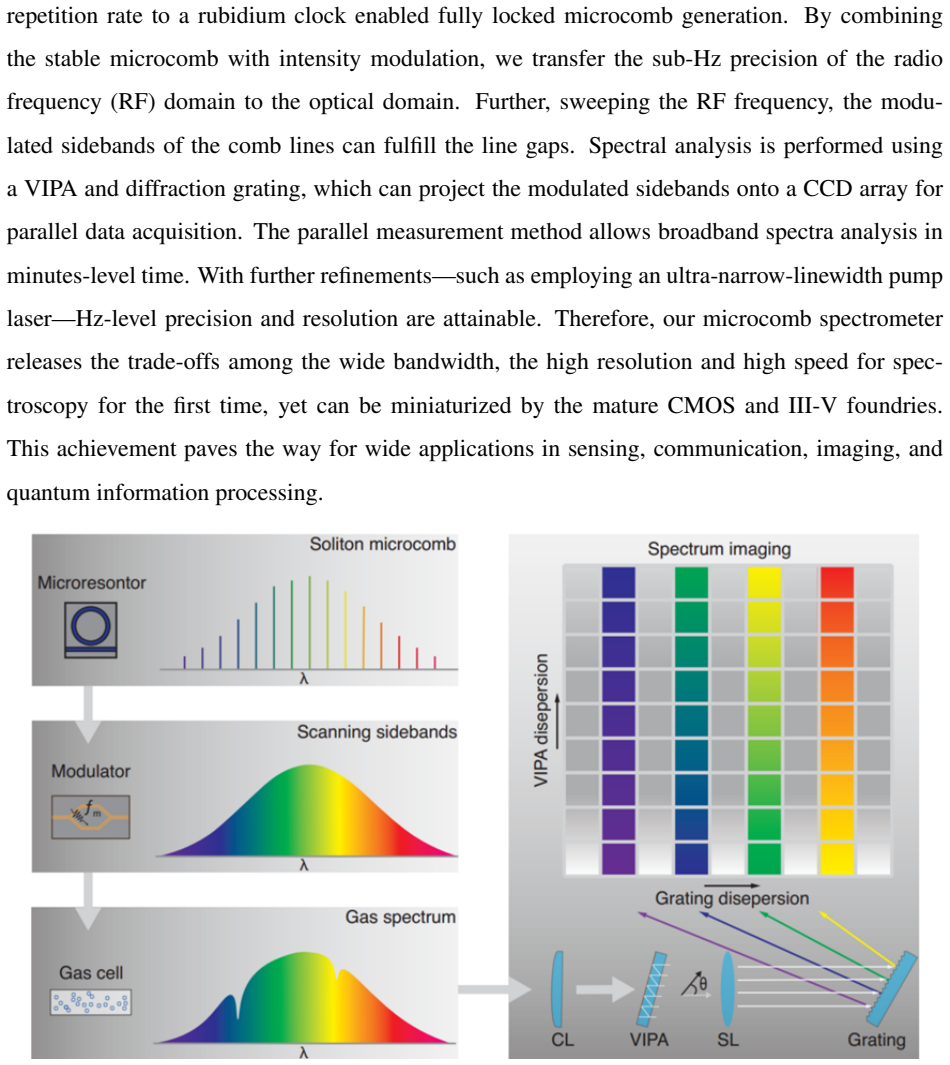
The central mechanism is radio-frequency-swept double-sideband scanning of a fully stabilized soliton microcomb. A soliton microcomb is a broadband frequency comb produced by dissipative Kerr solitons in a high-quality silicon nitride microresonator, with a repetition rate of 19.98 GHz. An electro-optic intensity modulator suppresses each comb line's carrier and creates two sidebands separated by $f_m$; changing $f_m$ moves the sidebands continuously through the frequency gaps between comb lines, transferring the precision of the RF domain to the optical domain. A virtually imaged phased array (VIPA) combined with a diffraction grating projects the comb lines onto a two-dimensional CCD, so all spectral components are recorded in parallel; the VIPA's 61-GHz free spectral range, about three times the comb spacing, separates the comb lines into three rows of spots. The spectral resolution is set by the pump laser linewidth, about 200 kHz, and the scan step $f_{\rm step}$, while frequency accuracy comes from the locked comb and a wavelength-meter-calibrated pixel map.
What would settle it
Measure a device with two known absorption features separated by 200 to 400 kHz, or a cavity resonance with a true linewidth below 200 kHz, and check whether the microcomb spectrometer resolves them; if the fitted width is set by the instrument rather than the true width, or if the two features merge into one, the claimed resolution is not reached.
Extended reading notes
Core claim
The paper's central claim is that a dissipative-Kerr-soliton microcomb, fully stabilized by locking the pump laser to a reference cavity and the repetition rate to a rubidium clock, can act as the basis of a high-resolution spectrometer whose resolution is limited not by the comb mode spacing but by the linewidth of the comb itself, approximately 200 kHz. The key move is to intensity-modulate each comb line so that the carrier is suppressed and two sidebands appear at $\nu_n \pm f_m$; sweeping the modulation frequency $f_m$ from 1.5 to 8.5 GHz, and thermally shifting the pump by about 4 GHz to cover the blind spots, lets the sidebands sample every frequency between the comb lines. The VIPA-grating system disperses all comb lines onto a CCD simultaneously, so a single measurement cycle records the whole spectrum instead of scanning line by line. Demonstrations with an HCN gas cell, a silicon nitride microresonator, and an ultra-high-Q whispering-gallery-mode resonator yield fitted linewidths of 2.00 GHz, 45 MHz, and 1.8 MHz, respectively, which the authors present as evidence of sub-MHz resolution across a 4-THz span.
Load-bearing premise
The load-bearing assumption is that the measured spectral resolution is actually set by the 200-kHz pump laser linewidth and the scan step, rather than by extra broadening or crosstalk introduced by the VIPA-grating CCD imaging system; the data show a 1.8-MHz fitted resonance, not two features separated by 200 kHz, so the resolution claim is inferred rather than directly demonstrated.
Editorial extensions
If this is right
- If the claim holds, a single instrument can deliver both wide bandwidth and high resolution without long sequential scans, so gas-cell spectra spanning 4 THz can be measured in seconds to minutes.
- Because the accuracy is set by an RF reference and a locked comb, the spectrometer offers frequency traceability without an optical frequency comb stabilizer at the output; the reference chain is the same one used in metrology.
- The optical core, including the laser, amplifier, microresonator, and modulator, can be integrated on a chip using established silicon nitride and III-V fabrication, moving laboratory-grade spectroscopy toward field instruments for astronomy, trace-gas detection, and isotope analysis.
- Replacing the 200-kHz pump laser with an ultra-narrow-linewidth laser would, on the authors' argument, push resolution toward hertz level while keeping the same wide bandwidth.
- The parallel CCD readout means the measurement time is set by the number of RF steps and camera readout, not by the number of comb lines; finer frequency steps trade time for resolution in a predictable way.
Reading between the lines
- The authors infer 200-kHz resolution from the 200-kHz pump linewidth and a 200-kHz scan step; the narrowest feature they actually fit is 1.8 MHz wide, so a direct two-line resolution test would settle whether the VIPA-CCD path adds broadening.
- The scheme scans only to $f_r/2$ and then relies on a 2 °C thermal shift of the microcomb to cover the remaining frequencies; a modulator with bandwidth beyond $f_r$ or a second modulation stage could in principle cover the full gap continuously, which the paper leaves untested.
- If the VIPA-grating imaging truly adds no broadening, then narrowing the pump laser linewidth should improve resolution proportionally; verifying that scaling directly would confirm the resolution model.
Signed reviews
Editorial analysis
A structured set of objections, weighed in public.
Referee Report
Summary. The manuscript reports a spectrometer built around a soliton microcomb, electro-optic double-sideband modulation, and VIPA-grating CCD parallel detection. The comb is repetition-rate locked and the pump laser is PDH-locked to a Fabry-Perot cavity; scanning the RF modulation frequency fills the 20-GHz comb-line spacing, while the VIPA-grating system detects many comb lines simultaneously. Three demonstrations are presented: a 4-THz-spanning HCN transmission spectrum acquired with fstep = 50 MHz and compared to HITRAN, a Si3N4 microresonator spectrum acquired with fstep = 1 MHz, and a ultrahigh-Q WGM resonator spectrum acquired with fstep = 200 kHz, whose narrowest fitted resonance has a 1.8-MHz FWHM. The abstract and conclusion claim 200-kHz resolution across a 4-THz bandwidth with minutes-level processing time, with the resolution attributed to the pump-laser linewidth and the scan step.
Significance. If fully supported, the architecture would be significant because it combines the broad bandwidth of a microcomb with RF-domain frequency stepping and parallel CCD readout, offering a path toward miniaturized high-resolution spectrometers. The paper has real strengths: the repetition-rate locking is quantified (σ = 52 Hz), the pump-laser linewidth is measured by heterodyne beat with a reference comb (approximately 200 kHz), the HCN result is checked against an external HITRAN database, and three different devices are measured. The core idea of scanning modulated sidebands across comb-line gaps while using VIPA-grating parallel detection is coherent and internally consistent. The main gap is that the headline resolution is inferred rather than directly demonstrated, and the wide-bandwidth and fine-resolution numbers come from separate measurements.
major comments (3)
- [Measurement of transmission spectra; Spectral frequency determination] The central claim of 200-kHz resolution is not directly demonstrated. The narrowest measured feature is the 1.8-MHz WGM resonance in Fig. 3(f), and a 1.8-MHz-wide feature would appear 1.8-MHz wide on a much finer instrument; therefore the data support at most 1.8-MHz instrument resolution, not 200 kHz. No measurement resolves two spectral features separated by 200 kHz, and no direct characterization of the instrument response at the 200-kHz scale (e.g., the VIPA-CCD point-spread function or the linewidth of a modulated sideband) is provided. The statement in 'Spectral frequency determination' that 'the ultimate spectral resolution is limited by the laser linewidth, which is 200 KHz' is load-bearing and unvalidated by any reported experiment. The authors should either measure a sub-200-kHz reference feature, resolve two features 200 kHz apart, or characterize the instrument function with a narrow-linewidth calibration source; absent that, the demonstrated resolution should be stated as at best 1.8 MHz.
- [Measurement of transmission spectra; Abstract] The abstract's simultaneous claim of 200-kHz resolution across a 4-THz bandwidth is not supported by any single dataset. The 4-THz HCN scan in Fig. 3(a) used fstep = 50 MHz, so its spectral sampling interval is 50 MHz; the 200-kHz-step WGM scan in Fig. 3(e) spans only 1545.3779 to 1545.4001 nm, approximately 2.8 GHz. To claim 200-kHz resolution across 4 THz, the paper must either present a single measurement over the full bandwidth with fine sampling or clearly state that the 4-THz bandwidth and the 200-kHz resolution were achieved in separate configurations with different fstep values.
- [Supplementary Note 2; Spectral frequency determination] The resolution claim assumes that the comb-line linewidth and the EOM-modulated sideband linewidth are equal to the 200-kHz pump-laser linewidth, but only the pump-laser linewidth is measured (Supplementary Note 2). The comb lines are locked via repetition-rate feedback, and the sidebands are generated by intensity modulation; both processes can add phase noise or broadening beyond the free-running pump linewidth. A direct measurement of a comb-line or sideband linewidth (for example, by heterodyning an individual sideband against a narrow reference laser, or by using a reference cavity with a sub-200-kHz linewidth) is needed. Without such a measurement, the statement that resolution is 'constrained only by the comb-line linewidth' remains an assumption.
minor comments (5)
- [Spectral frequency determination] The phrase 'the ultimate spectral resolution is limited by the laser linewidth, which is 200 KHz' uses 'KHz' with incorrect capitalization; it should be '200 kHz'.
- [Measurement of transmission spectra] In the sentence describing the HCN line at 1554.56 nm, 'V oigt' contains a stray space and should read 'Voigt'.
- [Spectral frequency determination] The term 'sample resolution' is used for fstep, but fstep is a sampling grid interval, not by itself the spectral resolution; the resolution also depends on the linewidths of the source and the VIPA-CCD instrument function. Please clarify this distinction in the text.
- [Supplementary Note 2] The pump-laser long-term stability is reported as a standard deviation of σ = 0.026 MHz; specifying the measurement gate time and averaging bandwidth would make this quantitative result more useful.
- [Supplementary Note 3] The HCN/HITRAN comparison is described only qualitatively as 'agreeable'; adding a residual plot or an RMS frequency-error estimate would allow readers to judge the frequency-axis accuracy independently.
Circularity Check
No significant circularity: the spectrometer claim is an experimental demonstration with external calibration (tunable laser plus locked comb, HITRAN comparison); the 200-kHz resolution is inferred from the measured pump linewidth and scan step, not derived from a fitted parameter or self-citation chain.
full rationale
This is an experimental measurement paper rather than a theoretical derivation, and I found no load-bearing step that reduces to its own inputs. The frequency axis is established by a one-to-one pixel-to-wavelength calibration with a tunable laser, combined with a rubidium-referenced repetition rate and a wavelength-meter measurement of the pump frequency; each sideband frequency is then determined from the locked comb parameters and the known microwave modulation frequency. The HCN transmission spectrum is compared directly with the HITRAN database, providing an external, independently generated reference. The 200-kHz resolution claim is not a fitted parameter renamed as a prediction: it is stated as 'The ultimate spectral resolution is limited by the laser linewidth, which is 200 KHz in our system,' and the WGM measurement uses fstep = 200 kHz, 'corresponding to the laser linewidth.' The narrowest measured feature is 1.8 MHz, so the paper infers, rather than directly demonstrates, 200-kHz instrument resolution; this is a soundness or validation concern about possible extra broadening from the VIPA-CCD readout, modulation noise, or comb-line excess linewidth, not a circularity. Self-citations appear (e.g., the vector spectrum analyzer used for resonator characterization, and the group's own prior microcomb work), but they are not used to justify the central spectrometer claim; the central claim rests on the reported measurements, calibration procedure, and external HITRAN comparison. Therefore the appropriate finding is no significant circularity, score 0.
Assumptions & free parameters
free parameters (1)
- CCD pixel-to-frequency calibration =
tunable-laser calibration in 0.02 nm steps
assumptions (3)
- domain assumption Comb line frequencies are exactly νn = νp ± n fr, with fr locked to 19.9759150 GHz and νp determined by wavemeter.
- domain assumption The intensity modulator generates sidebands at νn ± fm with negligible residual carrier and no additional frequency shifts.
- domain assumption The VIPA-grating system maps each sideband frequency to a stable CCD position, and the measured spot intensity is proportional to the DUT transmission at that sideband frequency.
Cite this review
Pith. "Pith review of A high-resolution microresonator-frequency-comb spectrometer." pith.science (2026). https://pith.science/paper/RWRFSNQT
@misc{pith2026250202878,
  author       = {Pith},
  title        = {Pith review of: A high-resolution microresonator-frequency-comb spectrometer},
  year         = {2026},
  howpublished = {\url{https://pith.science/paper/RWRFSNQT}},
  note         = {Machine review of arXiv:2502.02878}
}
read the original abstract
Spectral analysis is one of the most powerful technologies for studying and understanding matter. As the devices for spectral analysis, spectrometers are widely used in material detection, isotope analysis, trace gas detection, and the study of atomic and molecular hyperfine structures. While high resolution, wide bandwidth and fast speed are essential factors, they are always trade-offs for conventional spectrometers. Here, we present a soliton-microcomb-based spectrometer that overcomes these challenges by integrating dissipative Kerr solitons (DKSs) with double-sideband modulation and parallelized detection. Leveraging a high-quality silicon nitride microresonator, we generate a broadband, fully stabilized soliton microcomb and employ radio-frequency-modulated double sidebands to scan the optical spectrum with the resolution constrained only by the comb-line linewidth. By projecting the comb lines onto a two-dimensional charge-coupled device (CCD) via a virtually imaged phased array (VIPA)-grating system, we enable parallel processing of all spectral components, circumventing sequential scanning delays. The resulting spectrometer achieves 200-kHz resolution across a 4-THz bandwidth with minutes-level processing time while maintaining robustness against environmental fluctuations. Being promising for miniaturization, this work bridges the gap between laboratory-grade performance and field-deployable practicality, unlocking new possibilities for spectroscopy in astronomy, metrology, and integrated photonics.
Figures


Figures from the paper (1 more)

Reference graph
Works this paper leans on
-
[1]
& Loewen, E
Palmer, C. & Loewen, E. G. Diffraction grating handbook. Newport Corporation New York (2005)
2005
-
[2]
Griffiths, P. R. Fourier transform infrared spectrometry. Science 222, 297–302 (1983). URL https://www.science.org/doi/abs/10.1126/science.6623077. https: //www.science.org/doi/pdf/10.1126/science.6623077
-
[3]
Fabry-perot interferometers
Hern ´andez, G. Fabry-perot interferometers. Cambridge University Press (1988)
1988
-
[4]
Udem, T., Holzwarth, R. & H ¨ansch, T. W. Optical frequency metrology. Nature 416, 233 (2002). URL http://dx.doi.org/10.1038/416233a
doi:10.1038/416233a 2002
-
[5]
Cundiff, S. T. & Ye, J. Colloquium: Femtosecond optical frequency combs. Rev. Mod. Phys. 75, 325–342 (2003). URL https://link.aps.org/doi/10.1103/RevModPhys. 75.325
-
[6]
& Baumann, E
Fortier, T. & Baumann, E. 20 years of developments in optical frequency comb technology and applications. Communications Physics 2, 153 (2019). URL https://doi.org/10. 1038/s42005-019-0249-y
2019
-
[7]
& Swann, W
Coddington, I., Newbury, N. & Swann, W. Dual-comb spectroscopy. Optica 3, 414 (2016). URL https://www.osapublishing.org/abstract.cfm?URI= optica-3-4-414
2016
-
[8]
Picqu ´e, N. & H ¨ansch, T. W. Frequency comb spectroscopy. Nature Photonics 13, 146–157 (2019). URL https://doi.org/10.1038/s41566-018-0347-5
Show all 84 references
-
[9]
A., Vahala, K
Diddams, S. A., Vahala, K. & Udem, T. Optical frequency combs: Coherently uniting the electromagnetic spectrum. Science 369, eaay3676 (2020). URL https://science. sciencemag.org/content/369/6501/eaay3676. 12
2020
-
[10]
L., Holzwarth, R
Del’Haye, P., Arcizet, O., Gorodetsky, M. L., Holzwarth, R. & Kippenberg, T. J. Frequency comb assisted diode laser spectroscopy for measurement of microcavity dispersion. Na- ture Photonics 3, 529–533 (2009). URL http://dx.doi.org/10.1038/nphoton. 2009.138
2009 doi
-
[11]
R., Coddington, I., Baumann, E., Swann, W
Giorgetta, F. R., Coddington, I., Baumann, E., Swann, W. C. & Newbury, N. R. Fast high- resolution spectroscopy of dynamic continuous-wave laser sources. Nature Photonics 4, 853– 857 (2010). URL https://doi.org/10.1038/nphoton.2010.228
2010 doi
-
[12]
Shi, B. et al. An alkali-referenced vector spectrum analyzer for visible-light integrated pho- tonics. arXiv:2406.13323 (2024). URL https://arxiv.org/abs/2406.13323
2024 arXiv
-
[13]
& Yao, J
Tang, Z., Pan, S. & Yao, J. A high resolution optical vector network analyzer based on a wideband and wavelength-tunable optical single-sideband modulator. Opt. Express 20, 6555–6560 (2012). URL https://opg.optica.org/oe/abstract.cfm?URI= oe-20-6-6555
2012
-
[14]
& Xue, M
Pan, S. & Xue, M. Ultrahigh-resolution optical vector analysis based on optical single- sideband modulation. Journal of Lightwave Technology 35, 836–845 (2017)
2017
-
[15]
& Pan, S
Qing, T., Li, S., Tang, Z., Gao, B. & Pan, S. Optical vector analysis with attometer resolution, 90-db dynamic range and thz bandwidth. Nature Communications 10, 5135 (2019). URL https://doi.org/10.1038/s41467-019-13129-x
2019 doi
-
[16]
Li, J., Lee, H., Yang, K. Y . & Vahala, K. J. Sideband spectroscopy and dispersion mea- surement in microcavities. Opt. Express 20, 26337–26344 (2012). URL http://www. opticsexpress.org/abstract.cfm?URI=oe-20-24-26337
2012
-
[17]
Twayana, K. et al. Frequency-comb-calibrated swept-wavelength interferometry. Opt. Ex- press 29, 24363–24372 (2021). URL https://opg.optica.org/oe/abstract. cfm?URI=oe-29-15-24363. 13
2021
-
[18]
Luo, Y .-H. et al. A wideband, high-resolution vector spectrum analyzer for integrated pho- tonics. Light: Science & Applications 13 (2024). URL https://doi.org/10.1038/ s41377-024-01435-z
2024
-
[19]
& Hasan, T
Yang, Z., Albrow-Owen, T., Cai, W. & Hasan, T. Miniaturization of optical spectrometers.Sci- ence 371, eabe0722 (2021). URL https://www.science.org/doi/abs/10.1126/ science.abe0722
2021
-
[20]
Li, A. et al. Advances in cost-effective integrated spectrometers. Light: Science & Applica- tions 11, 174 (2022). URL https://doi.org/10.1038/s41377-022-00853-1
2022 doi
-
[21]
Ryckeboer, E. et al. Silicon-on-insulator spectrometers with integrated gainassb photodiodes for wide-band spectroscopy from 1510 to 2300 nm.Opt. Express 21, 6101–6108 (2013). URL https://opg.optica.org/oe/abstract.cfm?URI=oe-21-5-6101
2013
-
[22]
Pohl, D. et al. An integrated broadband spectrometer on thin-film lithium niobate.Nature Pho- tonics 14, 24–29 (2020). URL https://doi.org/10.1038/s41566-019-0529-9
2020 doi
-
[23]
Yang, Z. et al. Single-nanowire spectrometers. Science 365, 1017–1020 (2019). URLhttps: //www.science.org/doi/abs/10.1126/science.aax8814
2019 doi
-
[24]
Yoon, H. H. et al. Miniaturized spectrometers with a tunable van der waals junction. Sci- ence 378, 296–299 (2022). URL https://www.science.org/doi/abs/10.1126/ science.add8544
2022
-
[25]
Zhang, Z. et al. Integrated scanning spectrometer with a tunable micro-ring resonator and an arrayed waveguide grating. Photon. Res. 10, A74–A81 (2022). URL https://opg. optica.org/prj/abstract.cfm?URI=prj-10-5-A74
2022
-
[26]
Ni, Y . et al. Computational spectropolarimetry with a tunable liquid crystal metasurface. eLight 2, 23 (2022). URL https://doi.org/10.1186/s43593-022-00032-0. 14
2022 doi
-
[27]
Li, Y . et al. A platform for integrated spectrometers based on solution-processable semicon- ductors. Light: Science & Applications 12, 184 (2023). URL https://doi.org/10. 1038/s41377-023-01231-1
2023
-
[28]
Cen, Q. et al. Microtaper leaky-mode spectrometer with picometer resolution. eLight 3, 9 (2023). URL https://doi.org/10.1186/s43593-023-00041-7
2023 doi
-
[29]
& Herkommer, A
Toulouse, A., Drozella, J., Thiele, S., Giessen, H. & Herkommer, A. 3d-printed miniature spectrometer for the visible range with a 100 × 100µm 2 footprint. Light: Advanced Manu- facturing 2, 20–30 (2021). URL https://www.light-am.com/en/article/doi/ 10.37188/lam.2021.002
2021 doi
-
[30]
& Tsang, H
Xu, H., Qin, Y ., Hu, G. & Tsang, H. K. Breaking the resolution-bandwidth limit of chip-scale spectrometry by harnessing a dispersion-engineered photonic molecule. Light: Science & Applications 12, 64 (2023). URL https://doi.org/10.1038/ s41377-023-01102-9
2023
-
[31]
Herr, T. et al. Temporal solitons in optical microresonators. Nature Photonics 8, 145 (2013). URL https://doi.org/10.1038/nphoton.2013.343
2013 doi
-
[32]
J., Gaeta, A
Kippenberg, T. J., Gaeta, A. L., Lipson, M. & Gorodetsky, M. L. Dissipative Kerr soli- tons in optical microresonators. Science 361, eaan8083 (2018). URL http://science. sciencemag.org/content/361/6402/eaan8083
2018
-
[33]
L., Lipson, M
Gaeta, A. L., Lipson, M. & Kippenberg, T. J. Photonic-chip-based frequency combs. Nature Photonics 13, 158–169 (2019). URL https://doi.org/10.1038/ s41566-019-0358-x
2019
-
[34]
Xue, X. et al. Mode-locked dark pulse Kerr combs in normal-dispersion microresonators. Na- ture Photonics 9, 594 (2015). URL http://dx.doi.org/10.1038/nphoton.2015. 137. 15
2015 doi
-
[35]
Y ., Suh, M.-G
Yi, X., Yang, Q.-F., Yang, K. Y ., Suh, M.-G. & Vahala, K. Soliton frequency comb at microwave rates in a high- Q silica microresonator. Optica 2, 1078–1085 (2015). URL http://www.osapublishing.org/optica/abstract.cfm?URI= optica-2-12-1078
2015
-
[36]
Brasch, V . et al. Photonic chip–based optical frequency comb using soliton Cherenkov ra- diation. Science 351, 357–360 (2016). URL http://science.sciencemag.org/ content/351/6271/357
2016
-
[37]
Joshi, C. et al. Thermally controlled comb generation and soliton modelocking in microres- onators. Opt. Lett. 41, 2565–2568 (2016). URL http://ol.osa.org/abstract. cfm?URI=ol-41-11-2565
2016
-
[38]
Liang, W. et al. High spectral purity Kerr frequency comb radio frequency photonic os- cillator. Nature Communications 6, 7957 (2015). URL https://doi.org/10.1038/ ncomms8957
2015
-
[39]
Yang, K. Y . et al. Bridging ultrahigh-q devices and photonic circuits. Nature Photonics 12, 297–302 (2018). URL https://doi.org/10.1038/s41566-018-0132-5
2018 doi
-
[40]
He, Y . et al. Self-starting bi-chromatic linbo3 soliton microcomb. Optica 6, 1138–1144 (2019). URL http://www.osapublishing.org/optica/abstract.cfm?URI= optica-6-9-1138
2019
-
[41]
Wang, C. et al. Monolithic lithium niobate photonic circuits for kerr frequency comb genera- tion and modulation. Nature Communications 10, 978 (2019). URL https://doi.org/ 10.1038/s41467-019-08969-6
2019 doi
-
[42]
Bao, H. et al. Laser cavity-soliton microcombs. Nature Photonics 13, 384–389 (2019). URL https://doi.org/10.1038/s41566-019-0379-5
2019 doi
-
[43]
Liu, X. et al. Aluminum nitride nanophotonics for beyond-octave soliton microcomb gen- eration and self-referencing. Nature Communications 12, 5428 (2021). URL https: //doi.org/10.1038/s41467-021-25751-9. 16
2021 doi
-
[44]
& Yvind, K
Pu, M., Ottaviano, L., Semenova, E. & Yvind, K. Efficient frequency comb generation in algaas-on-insulator. Optica 3, 823–826 (2016). URL http://www.osapublishing. org/optica/abstract.cfm?URI=optica-3-8-823
2016
-
[45]
A., Lukin, D
Guidry, M. A., Lukin, D. M., Yang, K. Y ., Trivedi, R. & Vu ˇckovi´c, J. Quantum optics of soliton microcombs. Nature Photonics 16, 52–58 (2022). URL https://doi.org/10. 1038/s41566-021-00901-z
2022
-
[46]
Jung, H. et al. Tantala kerr nonlinear integrated photonics. Optica 8, 811–817 (2021). URL https://opg.optica.org/optica/abstract.cfm?URI=optica-8-6-811
2021
-
[47]
Xia, D. et al. Integrated chalcogenide photonics for microresonator soliton combs. Laser & Photonics Reviews n/a, 2200219 (2022). URL https://doi.org/10.1002/lpor. 202200219
2022 doi
-
[48]
Yao, B.-C. et al. Interdisciplinary advances in microcombs: bridging physics and in- formation technology. eLight 4, 19 (2024). URL https://doi.org/10.1186/ s43593-024-00071-9
2024
-
[49]
Marin-Palomo, P. et al. Microresonator-based solitons for massively parallel coherent op- tical communications. Nature 546, 274 (2017). URL https://doi.org/10.1038/ nature22387
2017
-
[50]
Trocha, P. et al. Ultrafast optical ranging using microresonator soliton frequency combs. Science 359, 887–891 (2018). URL http://science.sciencemag.org/content/ 359/6378/887
2018
-
[51]
& Vahala, K
Suh, M.-G. & Vahala, K. J. Soliton microcomb range measurement. Science 359, 884–887 (2018). URL http://science.sciencemag.org/content/359/6378/884
2018
-
[52]
Obrzud, E. et al. A microphotonic astrocomb. Nature Photonics 13, 31–35 (2019). URL https://doi.org/10.1038/s41566-018-0309-y. 17
2019 doi
-
[53]
Suh, M.-G. et al. Searching for exoplanets using a microresonator astrocomb. Nature Photon- ics 13, 25–30 (2019). URL https://doi.org/10.1038/s41566-018-0312-3
2019 doi
-
[54]
Dutt, A. et al. On-chip dual-comb source for spectroscopy. Science Advances 4, e1701858. URL https://doi.org/10.1126/sciadv.1701858
-
[55]
Yang, Q.-F. et al. Vernier spectrometer using counterpropagating soliton microcombs.Science 363, 965–968 (2019). URL https://science.sciencemag.org/content/363/ 6430/965
2019
-
[56]
Feldmann, J. et al. Parallel convolutional processing using an integrated photonic tensor core. Nature 589, 52–58 (2021). URL https://doi.org/10.1038/ s41586-020-03070-1
2021
-
[57]
Xu, X. et al. 11 tops photonic convolutional accelerator for optical neural networks. Nature 589, 44–51 (2021). URL https://doi.org/10.1038/s41586-020-03063-0
2021 doi
-
[58]
Spencer, D. T. et al. An optical-frequency synthesizer using integrated photonics. Nature 557, 81–85 (2018). URL https://doi.org/10.1038/s41586-018-0065-7
2018 doi
-
[59]
Newman, Z. L. et al. Architecture for the photonic integration of an optical atomic clock. Optica 6, 680–685 (2019). URL http://www.osapublishing.org/optica/ abstract.cfm?URI=optica-6-5-680
2019
-
[60]
Shu, H. et al. Microcomb-driven silicon photonic systems. Nature 605, 457–463 (2022). URL https://doi.org/10.1038/s41586-022-04579-3
2022 doi
-
[61]
Stern, B., Ji, X., Okawachi, Y ., Gaeta, A. L. & Lipson, M. Battery-operated integrated fre- quency comb generator. Nature 562, 401–405 (2018). URL https://doi.org/10. 1038/s41586-018-0598-9
2018
-
[62]
Xiang, C. et al. Laser soliton microcombs heterogeneously integrated on silicon. Science 373, 99–103 (2021). URL https://doi.org/10.1126/science.abh2076. 18
2021 doi
-
[63]
Liu, J. et al. Monolithic piezoelectric control of soliton microcombs. Nature 583, 385–390 (2020). URL https://doi.org/10.1038/s41586-020-2465-8
2020 doi
-
[64]
Churaev, M. et al. A heterogeneously integrated lithium niobate-on-silicon nitride photonic platform. Nature Communications 14, 3499 (2023). URL https://doi.org/10.1038/ s41467-023-39047-7
2023
-
[65]
de Beeck, C. O. et al. Heterogeneous III-V on silicon nitride amplifiers and lasers via micro- transfer printing. Optica 7, 386–393 (2020). URL http://www.osapublishing.org/ optica/abstract.cfm?URI=optica-7-5-386
2020
-
[66]
Sun, W. et al. A chip-integrated comb-based microwave oscillator. arXiv 2403.02828 (2024). URL https://arxiv.org/abs/2403.02828
2024 arXiv
-
[67]
A., Hollberg, L
Diddams, S. A., Hollberg, L. & Mbele, V . Molecular fingerprinting with the resolved modes of a femtosecond laser frequency comb. Nature 445, 627–630 (2007). URL https://doi. org/10.1038/nature05524
2007 doi
-
[68]
& Vahala, K
Bao, C., Suh, M.-G. & Vahala, K. Microresonator soliton dual-comb imaging. Optica 6, 1110–1116 (2019). URL https://opg.optica.org/optica/abstract.cfm? URI=optica-6-9-1110
2019
-
[69]
Y ., Yi, X
Suh, M.-G., Yang, Q.-F., Yang, K. Y ., Yi, X. & Vahala, K. J. Microresonator soliton dual-comb spectroscopy. Science 354, 600–603 (2016). URL https:// science.sciencemag.org/content/354/6312/600. https://science. sciencemag.org/content/354/6312/600.full.pdf
2016
-
[70]
Guo, H. et al. Universal dynamics and deterministic switching of dissipative kerr solitons in optical microresonators. Nature Physics 13, 94–102 (2017). URL https://doi.org/ 10.1038/nphys3893
2017 doi
-
[71]
Qing, T. et al. Vector spectrometer with hertz-level resolution and super-recognition capability. arXiv:2402.09752 (2024). URL https://arxiv.org/abs/2402.09752. 19
2024 arXiv
-
[72]
& Lin, C
Xiao, S., Weiner, A. & Lin, C. A dispersion law for virtually imaged phased-array spectral dispersers based on paraxial wave theory. IEEE Journal of Quantum Electronics 40, 420–426 (2004)
2004
-
[73]
Thomson, D. et al. Roadmap on silicon photonics. Journal of Optics 18, 073003 (2016). URL https://doi.org/10.1088%2F2040-8978%2F18%2F7%2F073003
2016
-
[74]
The commercialization of silicon photonics
Rickman, A. The commercialization of silicon photonics. Nature Photonics 8, 579–582 (2014). URL https://doi.org/10.1038/nphoton.2014.175
2014 doi
-
[75]
& Bowers, J
Xiang, C. & Bowers, J. E. Building 3D integrated circuits with electronics and pho- tonics. Nature Electronics 7, 422–424 (2024). URL https://doi.org/10.1038/ s41928-024-01187-z
2024
-
[76]
Liu, J. et al. High-yield, wafer-scale fabrication of ultralow-loss, dispersion-engineered silicon nitride photonic circuits. Nature Communications 12, 2236 (2021). URL https://doi. org/10.1038/s41467-021-21973-z
2021 doi
-
[77]
Chang, L. et al. Heterogeneous integration of lithium niobate and silicon nitride waveguides for wafer-scale photonic integrated circuits on silicon. Opt. Lett. 42, 803–806 (2017). URL http://ol.osa.org/abstract.cfm?URI=ol-42-4-803
2017
-
[78]
Roelkens, G. et al. Present and future of micro-transfer printing for heterogeneous photonic in- tegrated circuits. APL Photonics 9, 010901 (2024). URL https://doi.org/10.1063/ 5.0181099
2024
-
[79]
& Michel, J
Zhou, Z., Yin, B. & Michel, J. On-chip light sources for silicon photonics. Light: Science & Applications 4, e358–e358 (2015). URL https://doi.org/10.1038/lsa.2015. 131
2015 doi
-
[80]
Zhou, Z. et al. Prospects and applications of on-chip lasers. eLight 3, 1 (2023). URL https: //doi.org/10.1186/s43593-022-00027-x. 20
2023 doi
-
[81]
An integrated space-to-ground quantum communication network over 4,600 kilometres
Chen, Y .-A.et al. An integrated space-to-ground quantum communication network over 4,600 kilometres. Nature 589, 214–219 (2021)
2021
-
[82]
de Beeck, C. O. et al. III/V-on-lithium niobate amplifiers and lasers. Optica 8, 1288– 1289 (2021). URL https://opg.optica.org/optica/abstract.cfm?URI= optica-8-10-1288
2021
-
[83]
Liu, Y . et al. Ultrastable vacuum-gap fabry–perot cavities operated in air. Optica 11, 1205–1211 (2024). URL https://opg.optica.org/optica/abstract.cfm? URI=optica-11-9-1205
2024
-
[84]
Jin, N. et al. Micro-fabricated mirrors with finesse exceeding one million. Optica 9, 965–970 (2022). URL https://opg.optica.org/optica/abstract.cfm?URI= optica-9-9-965. Acknowledgements:This research was supported by National Natural Science Foundation of China (Grant No. 421...
2022 arXiv
Reviewed August 9, 2026 · model on record in the stance chip above.
Discussion (0). Continue with ORCID to comment.