REVIEW 3 major objections 5 minor 1 cited by
Gaps in stellar streams as a result of globular cluster fly-bys
T0 review · 3 major / 5 minor · reviewed 2026-08-09 · deepseek-v4-flash
Pith's one-line read Globular cluster flybys can carve the gaps seen in stellar streams.
desk verdict The core claim—globular cluster flybys can create gaps in Palomar 5's stream—is credible and worth taking seriously, but the quantitative gap rates rest on unvalidated backward orbits and a constant-mass cluster model. read the letter →
The pith
A machine-rendered reading of the paper's core claim, the machinery that carries it, and where it could break.
The reading
What carries the argument
The machinery is a particle-test (restricted three-body) simulation in which Palomar 5 is modeled as a Plummer sphere -- a spherical cluster model with an analytic density profile -- with its present-day mass and half-mass radius, orbiting an axisymmetric Galactic potential (Pouliasis et al. 2017, Model II) together with the other 164 globular clusters, each also a Plummer sphere with catalog mass and radius. Gaps are found by comparing each full simulation to a reference run that omits cluster-cluster interactions, working in a tail coordinate system aligned with the cluster orbit, and flagging stream regions that are under-dense by more than two standard deviations. The responsible perturbers are identified by locating peaks of the gravitational acceleration each cluster exerts along Palomar 5's orbit in the $(t,\tau)$ plane, where $\tau$ is the orbital-time coordinate along the stream.
What would settle it
A targeted search of Palomar 5's outer leading tail, beyond the currently observed length, for the thin gap that the NGC 2808 flyby should have imprinted about 200 Myr ago: if that gap is absent where the full-cluster simulation predicts it, the flyby mechanism as modeled would be contradicted. Similarly, a realistic N-body model of Palomar 5 that includes mass loss and reproduces the observed inner density profile could check whether the predicted inner-tail gap rate of about $0.015\ \mathrm{km\,s^{-1}\,kpc^{-2}}$ survives.
Extended reading notes
Core claim
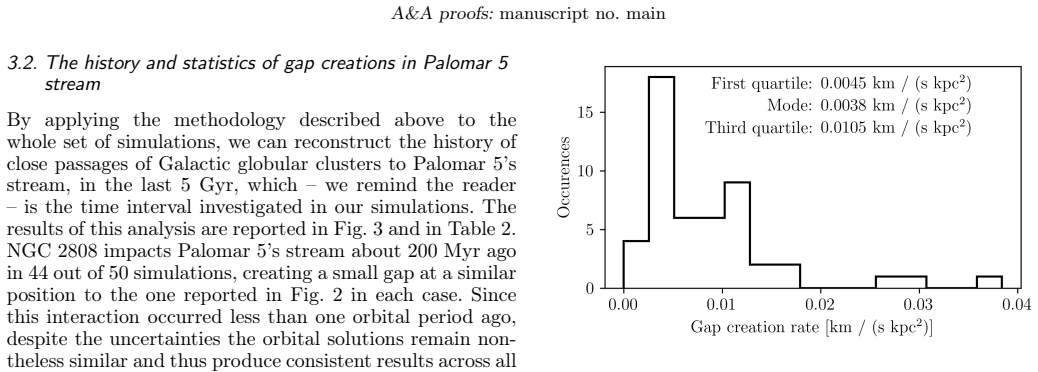
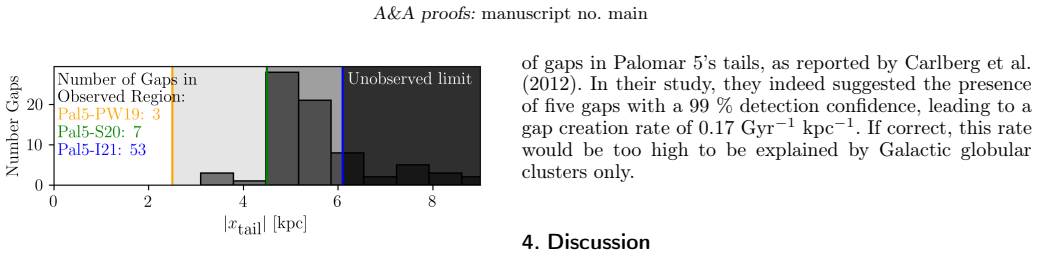
Across 50 Monte Carlo realizations of Palomar 5's tidal tails evolved for 5 Gyr with the full system of Galactic globular clusters included, the paper reports 73 gaps, an average of 1.5 per simulation, produced by 18 different perturber clusters. NGC 2808 alone generates 44 of these gaps through a single close passage roughly 200 Myr ago; NGC 7078 and NGC 104 each produce a wide (about 1 kpc) gap in the leading tail in the reference realization. The paper also derives a gap creation rate of about $0.015\ \mathrm{km\,s^{-1}\,kpc^{-2}}$, shows that no gaps form for impact parameters above about 300 pc, and finds an unexpected asymmetry: 65 of the 73 gaps lie in the leading tail.
Load-bearing premise
The load-bearing premise is that Palomar 5 can be modeled for the full 5 Gyr as a Plummer sphere with its present-day mass and half-mass radius held constant, ignoring internal evolution and mass loss; the paper notes this produces a stream that is longer than observed and artificially thin within about 3 kpc of the cluster, suppressing gap formation there.
Editorial extensions
If this is right
- Gap creation rates attributed to dark matter subhalos must be corrected for the baryonic contribution; for Palomar 5 the paper's rate is about $0.015\ \mathrm{km\,s^{-1}\,kpc^{-2}}$, enough to matter.
- The observed portion of Palomar 5's tails is not a clean probe of dark matter substructure, because the cluster system can produce gaps there too.
- Streams on orbits similar to Palomar 5's (inner about 20 kpc, pericenter about 6 kpc) are the most affected; streams at larger radii would be cleaner.
- Predicted gaps in the unobserved outer parts of Palomar 5's tails are concrete targets for future deep imaging or Gaia-based searches.
Reading between the lines
- If Palomar 5's mass and radius are allowed to evolve, the inner 3 kpc of the tails would be thicker and populated by recent mass loss, so gaps that are suppressed in the current model might appear closer to the cluster, changing the predicted gap count in the observed region.
- The leading-tail asymmetry (65 of 73 gaps) hints that orbital geometry, not just encounter probability, selects which tail records an impact; comparing gap counts in leading versus trailing tails across a sample of streams could test this.
- The same full-cluster simulation machinery could be applied to streams like GD-1 to map phase-space regions where baryonic flybys are negligible, which would sharpen dark matter subhalo constraints.
Editorial analysis
A structured set of objections, weighed in public.
Referee Report
Summary. The manuscript simulates the tidal tails of Palomar 5 over 5 Gyr using a test-particle method, with the Galactic potential plus the full population of 165 globular clusters as Plummer perturbers, and compares the resulting stream density to reference simulations without cluster perturbers. It reports that cluster flybys create density gaps: 73 gaps across 50 Monte Carlo realizations, produced by 18 different clusters, with NGC 2808 responsible for 44 of them. Single-perturber reruns confirm that the identified clusters reproduce the corresponding gaps. The paper concludes that globular cluster flybys are a baryonic source of stream gaps that should be included when interpreting gaps as dark matter subhalo encounters.
Significance. If the results hold, the paper establishes a concrete baryonic channel for stream gaps in an inner-halo cluster, complementing earlier work on the bar and giant molecular clouds. Strengths include a full-versus-reference comparison that is not fitted to observed gap positions, a Monte Carlo treatment of catalog uncertainties, publicly available simulation code, and single-perturber attribution runs. The main limitations are the fixed present-day model of Palomar 5, which the authors themselves note affects the stream thickness and gap locations, and the absence of a reverse-integration validation for the full (mutually interacting) cluster orbits that seed the stream integration.
major comments (3)
- [Section 2.1, 'Numerical Stability'] The reverse-integrability check is described only for the reference simulations, yet the full simulations—the ones generating the 73-gap census and the NGC 2808 attribution in Sec. 3.2—use backward orbits of all 165 clusters integrated with mutual Plummer interactions (Eq. 1). Since the full system is chaotic and can include close encounters, the stored forward trajectories could drift from the true orbits, and the paper's impact-threshold argument in Sec. 3.3 uses roughly 300 pc as the maximum gap-forming impact parameter. Please add a quantitative closure test for the full-system backward orbits (e.g., re-integrate the stored trajectories forward and report the distribution of position errors compared to the initial conditions, and to the 300 pc scale), or explicitly restrict the quantitative claims that rest on these orbits.
- [Sections 2.1 and 3.4] The model keeps Palomar 5's mass and half-mass radius fixed at present-day values for the entire 5 Gyr, and the text states this makes the inner ~3 kpc of the tails artificially thin and suppresses gaps there. Because the comparison to observed gaps (Fig. 8) and the gap-creation-rate estimates in Sec. 3.3 are derived from this stream model, the numerical values (73 gaps, 1.5 gaps/simulation) are not robust against this modeling choice. Please quantify the effect of an evolving Palomar 5 model (or of a higher initial mass) on the gap census and gap locations, or clearly rephrase the central claim as qualitative.
- [Appendix A and Section 3.2] Gap detection uses the S/N threshold from Eq. A.1, but the text also states that the quantitative analysis 'serves as an aid to visual inspection rather than a complete substitute for it,' and that 1D marginalization erases oblique gaps such as those from NGC 2808. Since the central result is the census of 73 gaps, the paper should provide a sensitivity analysis of the gap list to the smoothing length, S/N threshold, and the treatment of oblique gaps, so that the reader can judge how many of the 73 gaps are robust.
minor comments (5)
- [Introduction] The Introduction contains the sentence 'Here's an improved version with clearer phrasing and better flow:' followed by the paragraph; this looks like an editorial artifact and should be removed.
- [Appendix B] The clusters 'NGC 7808' and 'NGC C7078' appear; these should be 'NGC 2808' and 'NGC 7078'.
- [Table 1] The caption and the following sentence 'whereNp is the number of particles,Nts is the number of time-steps saved...' lack spaces after commas and after 'where'; please fix the formatting.
- [Appendix A] The phrase 'about one hundred measly megabytes' is informal and should be rephrased for a journal article.
- [Section 3.3] The definitions of W∥ and W⊥ are used before the formal definitions in Appendix C; consider introducing them explicitly in the main text to avoid confusion.
Circularity Check
No significant circularity; the simulated gaps are forward-model outputs verified by single-perturber reruns, with only minor method self-citations.
-
other
[Sec. 2, 'Numerical Methodology']
"Instead, we opt for solving the restricted-three body problem, or as known as the particle-test method as we did for Ferrone et al. (2023), which we describe here for completeness. As demonstrated by Mastrobuono-Battisti et al. (2012), although the restricted three-body problem neglects the internal evolution of the cluster, it still reproduces very similar stream properties."
These are self-citations for the numerical method, not for the target result. The test-particle method is described in the paper and is a standard approach; the citation is not used to forbid alternatives or to define the gap statistic. The central claim (GC flybys produce gaps) is a forward-model output, so this self-citation is not load-bearing. Flagged only for completeness under the minor-self-citation category.
full rationale
The paper's derivation chain is a forward simulation: (1) observed GC positions, masses, and radii from Baumgardt & Vasiliev (2021) are integrated backward; (2) Palomar 5 test particles are integrated forward with full cluster forces (Eqs. 1-2); (3) gaps are detected as >2-sigma underdensities relative to reference simulations without cluster perturbers (Appendix A); (4) candidate perturbers are identified from acceleration peaks in (t,tau) space and verified by single-perturber re-simulations (Fig. 2, Appendix B). No parameter is fitted to observed gap positions or rates. The '73 gaps, 1.5 per simulation, 44 from NGC 2808' statistics are emergent outputs, not inputs. The single-perturber confirmation removes the concern that gap attribution is just a restatement of the full-vs-reference comparison. The only self-citations (Ferrone et al. 2023 for the tstrippy code; Mastrobuono-Battisti et al. 2012 for the test-particle method) concern the numerical method, not the target claim, and the method is described in the paper. Stated limitations include reverse integrability being checked only for reference simulations (Sec. 'Numerical Stability') and Palomar 5 being modeled with constant present-day mass/radius, producing an artificially thin inner stream (Sec. 3.4). These are correctness/validation concerns, not circularity. No step reduces Eq. X to Eq. Y by construction; the central result is not true by definition.
Assumptions & free parameters
free parameters (2)
- Palomar 5 present-day mass and half-mass radius held constant for 5 Gyr =
M = 1.34e4 Msun, half-mass radius from Baumgardt catalog
- Constant masses and radii for all 165 perturbing clusters over 5 Gyr =
Present-day catalog values (Baumgardt & Vasiliev 2021)
assumptions (4)
- domain assumption The Milky Way can be represented by a static, axisymmetric potential (Pouliasis et al. 2017, Model II) over 5 Gyr
- domain assumption Stream stars are test particles that do not feel self-gravity
- ad hoc to paper Globular clusters are Plummer spheres with fixed mass and scale radius
- domain assumption The Baumgardt & Vasiliev (2021) catalog is complete and its phase-space coordinates at the present day are accurate enough to reconstruct 5 Gyr of orbits
Cite this review
Pith. "Pith review of Gaps in stellar streams as a result of globular cluster fly-bys." pith.science (2026). https://pith.science/paper/NBD6TUSI
@misc{pith2026250203941,
  author       = {Pith},
  title        = {Pith review of: Gaps in stellar streams as a result of globular cluster fly-bys},
  year         = {2026},
  howpublished = {\url{https://pith.science/paper/NBD6TUSI}},
  note         = {Machine review of arXiv:2502.03941}
}
read the original abstract
Thin stellar streams, such as those resulting from the tidal disruption of globular clusters, have long been known and used as probes of the gravitational potential of our Galaxy, both its visible and dark contents. In particular, the presence of under-density regions, or gaps, along these streams is commonly interpreted as being due to the close passage of dark matter sub-halos. In this work, we investigate the perturbations induced on streams by the passage of dense stellar systems, such as globular clusters themselves, to test the possibility that they may cause the formation of gaps as well. In particular, we focus on the study of the stream of Palomar 5, a well-known globular cluster in the Galactic halo, which has particularly long tidal tails. For this purpose, we used a particle-test code to simulate Palomar 5's tidal tails when subjected to the Galaxy's gravitational field plus its whole system of globular clusters. Our study shows that the tails of Palomar 5 can be strongly perturbed by the close passage of other clusters, in particular of NGC 2808, NGC 7078, NGC 104, and that these perturbations induce the formation of gaps in the tails. These results show that globular clusters are capable of inducing gaps in streams--as other baryonic components such as giant molecular clouds and the galactic bar have been shown to do in other works. Therefore, when searching to construct the distribution function of dark matter sub halos within the Milky Way, the gap contribution from globular clusters must be included.
Figures


Figures from the paper (6 more)


Forward citations
Cited by 1 Pith paper
-
Tracing Red Giant Members of the Globular Cluster Palomar 5 with APOGEE and Gaia
No new red giant members of the Palomar 5 cluster are found, consistent with the surveys' magnitude limits and known stream density variations.
Reference graph
Works this paper leans on
-
[1]
, " * write output.state after.block = add.period write newline
ENTRY address archiveprefix author booktitle chapter edition editor howpublished institution eprint journal key month note number organization pages publisher school series title type volume year label extra.label sort.label short.list INTEGERS output.state before.all mid.sentence after.sentence after.block FUNCTION init.state.consts #0 'before.all := #1 ...
-
[2]
write newline
" write newline "" before.all 'output.state := FUNCTION n.dashify 't := "" t empty not t #1 #1 substring "-" = t #1 #2 substring "--" = not "--" * t #2 global.max substring 't := t #1 #1 substring "-" = "-" * t #2 global.max substring 't := while if t #1 #1 substring * t #2 global.max substring 't := if while FUNCTION word.in bbl.in " " * FUNCTION format....
-
[3]
Amorisco , N. C. 2021, arXiv e-prints, arXiv:2111.01148
arXiv 2021
-
[4]
C., G \'o mez , F
Amorisco , N. C., G \'o mez , F. A., Vegetti , S., & White , S. D. M. 2016, , 463, L17
2016
-
[5]
P., Tollerud , E
Astropy Collaboration , Robitaille , T. P., Tollerud , E. J., et al. 2013, , 558, A33
2013
-
[6]
& Bovy , J
Banik , N. & Bovy , J. 2019, , 484, 2009
2019
-
[7]
Banik , N., Bovy , J., Bertone , G., Erkal , D., & de Boer , T. J. L. 2021, , 2021, 043
2021
-
[8]
& Hilker , M
Baumgardt , H. & Hilker , M. 2018, , 478, 1520
2018
Show all 109 references
-
[9]
2019, , 482, 5138
Baumgardt , H., Hilker , M., Sollima , A., & Bellini , A. 2019, , 482, 5138
2019
-
[10]
2020, , 37, e046
Baumgardt , H., Sollima , A., & Hilker , M. 2020, , 37, e046
2020
-
[11]
& Vasiliev , E
Baumgardt , H. & Vasiliev , E. 2021, , 505, 5957
2021
-
[12]
W., Irwin , M
Belokurov , V., Evans , N. W., Irwin , M. J., Hewett , P. C., & Wilkinson , M. I. 2006, , 637, L29
2006
-
[13]
J., Ferguson , A
Bernard , E. J., Ferguson , A. M. N., Schlafly , E. F., et al. 2014, , 443, L84
2014
-
[14]
J., Ferguson , A
Bernard , E. J., Ferguson , A. M. N., Schlafly , E. F., et al. 2016, , 463, 1759
2016
-
[15]
& Tremaine , S
Binney , J. & Tremaine , S. 2008, Galactic Dynamics: Second Edition (Princeton University Press)
2008
-
[16]
W., et al
Bonaca , A., Conroy , C., Hogg , D. W., et al. 2020 a , , 892, L37
2020
-
[17]
2012, , 760, L6
Bonaca , A., Geha , M., & Kallivayalil , N. 2012, , 760, L6
2012
-
[18]
& Hogg , D
Bonaca , A. & Hogg , D. W. 2018, , 867, 101
2018
-
[19]
W., Price-Whelan , A
Bonaca , A., Hogg , D. W., Price-Whelan , A. M., & Conroy , C. 2019, , 880, 38
2019
-
[20]
M., et al
Bonaca , A., Pearson , S., Price-Whelan , A. M., et al. 2020 b , , 889, 70
2020
-
[21]
& Price-Whelan , A
Bonaca , A. & Price-Whelan , A. M. 2025, , 100, 101713
2025
-
[22]
2015, , 216, 29
Bovy , J. 2015, , 216, 29
2015
-
[23]
K., & Kallivayalil , N
Bovy , J., Bahmanyar , A., Fritz , T. K., & Kallivayalil , N. 2016, , 833, 31
2016
-
[24]
Carlberg , R. G. 2012, , 748, 20
2012
-
[25]
Carlberg , R. G. & Grillmair , C. J. 2013, , 768, 171
2013
-
[26]
G., Grillmair , C
Carlberg , R. G., Grillmair , C. J., & Hetherington , N. 2012, , 760, 75
2012
-
[27]
A., et al
Chen , B., Stoughton , C., Smith , J. A., et al. 2001, , 553, 184
2001
-
[28]
Davidon, W. C. 1991, SIAM Journal on optimization, 1, 1
1991
-
[29]
2020, in American Astronomical Society Meeting Abstracts, Vol
de Boer , T., Gieles , M., & Erkal , D. 2020, in American Astronomical Society Meeting Abstracts, Vol. 235, American Astronomical Society Meeting Abstracts \#235, 336.07
2020
-
[30]
de Boer , T. J. L., Belokurov , V., Koposov , S. E., et al. 2018, , 477, 1893
2018
-
[31]
K., & Rix , H.-W
Dehnen , W., Odenkirchen , M., Grebel , E. K., & Rix , H.-W. 2004, , 127, 2753
2004
-
[32]
& Hattori , K
Doke , Y. & Hattori , K. 2022, , 941, 129
2022
-
[33]
& Belokurov , V
Erkal , D. & Belokurov , V. 2015, , 450, 1136
2015
-
[34]
E., & Belokurov , V
Erkal , D., Koposov , S. E., & Belokurov , V. 2017, , 470, 60
2017
-
[35]
2023, , 673, A44
Ferrone , S., Di Matteo , P., Mastrobuono-Battisti , A., et al. 2023, , 673, A44
2023
-
[36]
Gaia Collaboration , Prusti , T., de Bruijne , J. H. J., et al. 2016, , 595, A1
2016
-
[37]
2021, Nature Astronomy, 5, 957
Gieles , M., Erkal , D., Antonini , F., Balbinot , E., & Pe \ n arrubia , J. 2021, Nature Astronomy, 5, 957
2021
-
[38]
M., Hofmann , S., & Schwarz , D
Green , A. M., Hofmann , S., & Schwarz , D. J. 2005, , 2005, 003
2005
-
[39]
Grillmair , C. J. 2009, , 693, 1118
2009
-
[40]
Grillmair , C. J. 2014, , 790, L10
2014
-
[41]
Grillmair , C. J. 2017, , 847, 119
2017
-
[42]
J., Cutri , R., Masci , F
Grillmair , C. J., Cutri , R., Masci , F. J., et al. 2013, , 769, L23
2013
-
[43]
Grillmair , C. J. & Dionatos , O. 2006 a , , 641, L37
2006
-
[44]
Grillmair , C. J. & Dionatos , O. 2006 b , , 643, L17
2006
-
[45]
J., Freeman , K
Grillmair , C. J., Freeman , K. C., Irwin , M., & Quinn , P. J. 1995, , 109, 2553
1995
-
[46]
J., Hetherington , L., Carlberg , R
Grillmair , C. J., Hetherington , L., Carlberg , R. G., & Willman , B. 2015, , 812, L26
2015
-
[47]
M., Webb , J
Grondin , S. M., Webb , J. J., Lane , J. M. M., Speagle , J. S., & Leigh , N. W. C. 2024, , 528, 5189
2024
-
[48]
Hattori , K., Erkal , D., & Sanders , J. L. 2016, , 460, 497
2016
-
[49]
2004, , 351, 643
Helmi , A. 2004, , 351, 643
2004
-
[50]
& Koppelman , H
Helmi , A. & Koppelman , H. H. 2016, , 828, L10
2016
-
[51]
2021, , 507, 1999
Hermans , J., Banik , N., Weniger , C., Bertone , G., & Louppe , G. 2021, , 507, 1999
2021
-
[52]
E., et al
Hilmi , T., Erkal , D., Koposov , S. E., et al. 2024, arXiv e-prints, arXiv:2404.02953
2024 arXiv
-
[53]
2021, , 914, 123
Ibata , R., Malhan , K., Martin , N., et al. 2021, , 914, 123
2021
-
[54]
2024, , 967, 89
Ibata , R., Malhan , K., Tenachi , W., et al. 2024, , 967, 89
2024
-
[55]
A., Gilmore , G., & Irwin , M
Ibata , R. A., Gilmore , G., & Irwin , M. J. 1994, , 370, 194
1994
-
[56]
A., Lewis , G
Ibata , R. A., Lewis , G. F., Irwin , M. J., & Quinn , T. 2002, , 332, 915
2002
-
[57]
A., Lewis , G
Ibata , R. A., Lewis , G. F., & Martin , N. F. 2016, , 819, 1
2016
-
[58]
A., Lewis , G
Ibata , R. A., Lewis , G. F., Thomas , G., Martin , N. F., & Chapman , S. 2017, , 842, 120
2017
-
[59]
A., Malhan , K., & Martin , N
Ibata , R. A., Malhan , K., & Martin , N. F. 2019, , 872, 152
2019
-
[60]
A., Malhan , K., Martin , N
Ibata , R. A., Malhan , K., Martin , N. F., & Starkenburg , E. 2018, , 865, 85
2018
-
[61]
2023 a , , 673, A152
Ishchenko , M., Sobolenko , M., Berczik , P., et al. 2023 a , , 673, A152
2023
-
[62]
2023 b , , 678, A69
Ishchenko , M., Sobolenko , M., Berczik , P., et al. 2023 b , , 678, A69
2023
-
[63]
P., Li , T
Ji , A. P., Li , T. S., Hansen , T. T., et al. 2020, , 160, 181
2020
-
[64]
V., Law , D
Johnston , K. V., Law , D. R., & Majewski , S. R. 2005, , 619, 800
2005
-
[65]
Keenan , D. W. & Innanen , K. A. 1975, , 80, 290
1975
-
[66]
E., Irwin , M., Belokurov , V., et al
Koposov , S. E., Irwin , M., Belokurov , V., et al. 2014, , 442, L85
2014
-
[67]
B., Da Costa , G
Kuzma , P. B., Da Costa , G. S., Keller , S. C., & Maunder , E. 2015, , 446, 3297
2015
-
[68]
R., Johnston , K
Law , D. R., Johnston , K. V., & Majewski , S. R. 2005, , 619, 807
2005
-
[69]
Law , D. R. & Majewski , S. R. 2010, , 718, 1128
2010
-
[70]
H., Lee , H
Lee , K. H., Lee , H. M., Fahlman , G. G., & Lee , M. G. 2003, , 126, 815
2003
-
[71]
& Scholz , R
Lehmann , I. & Scholz , R. D. 1997, , 320, 776
1997
-
[72]
2000, , 359, 907
Leon , S., Meylan , G., & Combes , F. 2000, , 359, 907
2000
-
[73]
S., Ji , A
Li , T. S., Ji , A. P., Pace , A. B., et al. 2022, , 928, 30
2022
-
[74]
S., Koposov , S
Li , T. S., Koposov , S. E., Erkal , D., et al. 2021, , 911, 149
2021
-
[75]
S., Koposov , S
Li , T. S., Koposov , S. E., Zucker , D. B., et al. 2019, , 490, 3508
2019
-
[76]
& Ibata , R
Malhan , K. & Ibata , R. A. 2018, , 477, 4063
2018
-
[77]
& Ibata , R
Malhan , K. & Ibata , R. A. 2019, , 486, 2995
2019
-
[78]
A., & Martin , N
Malhan , K., Ibata , R. A., & Martin , N. F. 2018, , 481, 3442
2018
-
[79]
2012, , 546, L7
Mastrobuono-Battisti , A., Di Matteo , P., Montuori , M., & Haywood , M. 2012, , 546, L7
2012
-
[80]
2023, , 520, 5225
Mateu , C. 2023, , 520, 5225
2023
-
[81]
McMillan , P. J. 2017, , 465, 76
2017
-
[82]
A., Palomares-Ruiz , S., & Prada , F
Molin \'e , \'A ., S \'a nchez-Conde , M. A., Palomares-Ruiz , S., & Prada , F. 2017, , 466, 4974
2017
-
[83]
2007, , 659, 1212
Montuori , M., Capuzzo-Dolcetta , R., Di Matteo , P., Lepinette , A., & Miocchi , P. 2007, , 659, 1212
2007
-
[84]
N., et al
Nibauer , J., Bonaca , A., Spergel , D. N., et al. 2024, arXiv e-prints, arXiv:2410.21174
2024 arXiv
-
[85]
K., Dehnen , W., et al
Odenkirchen , M., Grebel , E. K., Dehnen , W., et al. 2002, in American Astronomical Society Meeting Abstracts, Vol. 200, American Astronomical Society Meeting Abstracts \#200, 10.01
2002
-
[86]
K., Dehnen , W., et al
Odenkirchen , M., Grebel , E. K., Dehnen , W., et al. 2003, , 126, 2385
2003
-
[87]
K., Rockosi , C
Odenkirchen , M., Grebel , E. K., Rockosi , C. M., et al. 2001, , 548, L165
2001
-
[88]
Pearson , S., Bonaca , A., Chen , Y., & Gnedin , O. Y. 2024, , 976, 54
2024
-
[89]
M., & Johnston , K
Pearson , S., Price-Whelan , A. M., & Johnston , K. V. 2017, Nature Astronomy, 1, 633
2017
-
[90]
2018, , 473, 4077
Pillepich , A., Springel , V., Nelson , D., et al. 2018, , 473, 4077
2018
-
[91]
2017, , 598, A66
Pouliasis , E., Di Matteo , P., & Haywood , M. 2017, , 598, A66
2017
-
[92]
M., Mateu , C., Iorio , G., et al
Price-Whelan , A. M., Mateu , C., Iorio , G., et al. 2019, , 158, 223
2019
-
[93]
M., Sesar , B., Johnston , K
Price-Whelan , A. M., Sesar , B., Johnston , K. V., & Rix , H.-W. 2016, , 824, 104
2016
-
[94]
J., Menten , K
Reid , M. J., Menten , K. M., Brunthaler , A., et al. 2014, , 783, 130
2014
-
[95]
L., Bovy , J., & Erkal , D
Sanders , J. L., Bovy , J., & Erkal , D. 2016, , 457, 3817
2016
-
[96]
2012, , 427, 274
Sch \"o nrich , R. 2012, , 427, 274
2012
-
[97]
Siegel , M. H. 2001, in American Astronomical Society Meeting Abstracts, Vol. 199, American Astronomical Society Meeting Abstracts, 109.06
2001
-
[98]
2020, , 495, 2222
Sollima , A. 2020, , 495, 2222
2020
-
[99]
R., et al
Sollima , A., Mart \' nez Delgado , D., Mu \ n oz , R. R., et al. 2018, , 476, 4814
2018
-
[100]
2011, , 726, 47
Sollima , A., Mart \' nez-Delgado , D., Valls-Gabaud , D., & Pe \ n arrubia , J. 2011, , 726, 47
2011
-
[101]
2008, , 391, 1685
Springel , V., Wang , J., Vogelsberger , M., et al. 2008, , 391, 1685
2008
-
[102]
R., Andreon , S., et al
Testa , V., Zaggia , S. R., Andreon , S., et al. 2000, , 356, 127
2000
-
[103]
F., Ibata , R., Famaey , B., Martin , N
Thomas , G. F., Ibata , R., Famaey , B., Martin , N. F., & Lewis , G. F. 2016, , 460, 2711
2016
-
[104]
A., Ji , A
Usman , S. A., Ji , A. P., Li , T. S., et al. 2024, , 529, 2413
2024
-
[105]
Varghese , A., Ibata , R., & Lewis , G. F. 2011, , 417, 198
2011
-
[106]
& Baumgardt , H
Vasiliev , E. & Baumgardt , H. 2021, , 505, 5978
2021
-
[107]
J., McKean , J
Vegetti , S., Lagattuta , D. J., McKean , J. P., et al. 2012, , 481, 341
2012
-
[108]
E., et al
Virtanen , P., Gommers , R., Oliphant , T. E., et al. 2020, Nature Methods, 17, 261
2020
-
[109]
2016, , 458, 1450
Wang , L., Spurzem , R., Aarseth , S., et al. 2016, , 458, 1450
2016
Reviewed August 9, 2026 · model on record in the stance chip above.
Discussion (0). Continue with ORCID to comment.