REVIEW 5 major objections 5 minor 14 references
Exploring Group Convolutional Networks for Sign Problem Mitigation via Contour Deformation
T0 review · 5 major / 5 minor · reviewed 2026-08-08 · deepseek-v4-flash
Pith's one-line read Group convolutional networks learn Hubbard contour deformations more accurately and with fewer parameters than fully connected networks, and transfer learning between nearby parameter values works only for small steps.
desk verdict First G-CNN comparison for contour-deformation sign-problem mitigation, but the 'surpass fully connected' claim rests on validation MSE and only one architecture wins on statistical power. read the letter →
The pith
A machine-rendered reading of the paper's core claim, the machinery that carries it, and where it could break.
The reading
What carries the argument
The central object is the group equivariant convolutional neural network (G-CNN), where each convolution kernel is transformed under a symmetry group $G$ so that the convolution commutes with the group action; the transformed kernels create a stack of feature maps, one per group element, sharing parameters. The network is inserted into the ansatz $\varphi^* = \varphi_R + i N(\varphi_R)$, learning the imaginary part of the flowed manifold from the real part of the field, with training data produced by finite-time holomorphic flow toward the Lefschetz thimbles. For the triangle the authors use the $C_3$ rotations (equivalent to translations on the 3-site ring), temporal translation, and real sign flip, giving a $3 \times 16 \times 2$ fold symmetry; for the square they use $C_4$ or $D_4$ spatial symmetries plus temporal translation and sign flip, up to $2 \times 4 \times 16 \times 2$ fold. The effectiveness of a trained contour is measured by the statistical power $\Sigma = |\langle e^{-i S_I}\rangle_R|$, the magnitude of the average reweighting phase, which determines whether stochastic estimates converge at usable rates.
What would settle it
On the 3-site triangle at $N_t = 16$, compute the exact flowed manifold to high precision and test whether any line of constant real part intersects it more than once; a single multi-valued crossing would falsify the ansatz $\varphi^* = \varphi_R + iN(\varphi_R)$ that all the paper's networks are trained on.
Extended reading notes
Core claim
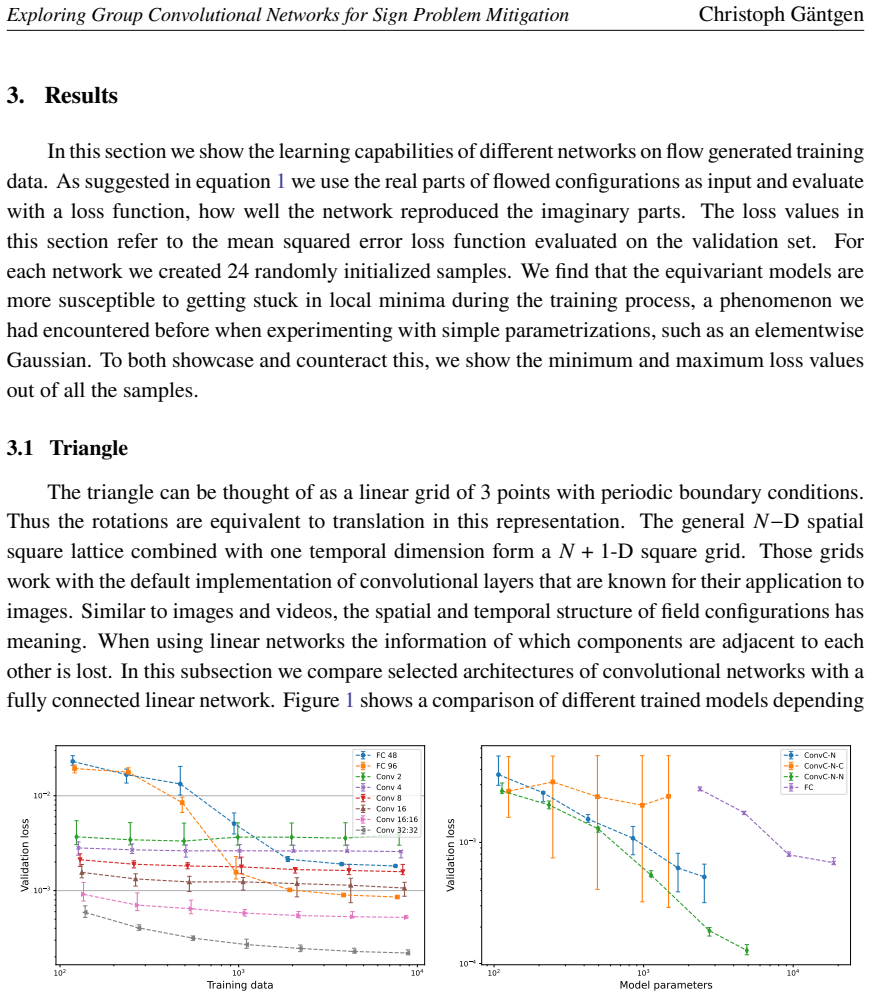
The authors report that group equivariant convolutional networks surpass fully connected neural networks at the task of learning the imaginary part $\varphi_I = N(\varphi_R)$ of a deformed integration contour that mitigates the sign problem in Hybrid Monte Carlo. The network is trained on configurations generated by integrating holomorphic flow equations for finite flow time, which approximate the contributing Lefschetz thimbles, and the network's convolution kernels are transformed under the lattice symmetry group so that equivariance is guaranteed by construction rather than left to training. On the 3-site triangle the convolutional networks achieve lower validation loss with far fewer tunable parameters, and some architectures push the statistical power $\Sigma = |\langle e^{-i S_I}\rangle_R|$ above the best constant-offset shift of $\Sigma = 0.13$. On a square with an induced sign problem, convolutional models perform as well as fully connected networks with a fraction of the parameters, and the $D_4$-equivariant model is slightly ahead of the $C_4$-equivariant one. The authors also report that the equivariant models are more susceptible to local minima, so their comparisons show minimum and maximum loss across 24 random samples, and that transfer learning between $\beta$ and $U$ values has potential but is unreliable, with the conclusion that its applicability is situational and best for fine scans over a parameter range.
Load-bearing premise
The whole comparison rests on the assumption that the deformed integration contour is a single-valued graph over the real field components, meaning each real configuration has exactly one imaginary value, so a network of the form $\varphi^* = \varphi_R + iN(\varphi_R)$ can represent the true thimble; if a real configuration has multiple imaginary values (a fold) or the target is non-smooth, both the ansatz and the network comparisons inherit this limitation.
Editorial extensions
If this is right
- If the claim is correct, learned contour deformations from symmetry-aware networks can go beyond optimized constant shifts: the best convolutional model on the triangle reaches $\Sigma = 0.230 \pm 0.020$, above the constant-offset value $0.13$, expanding the measurable parameter space for sign-problem-plagued systems.
- Group-convolutional models need fewer parameters and less training data to match or beat fully connected networks, so the upfront training cost of the contour-deformation method drops, and the built-in equivariance removes the risk of the network learning an unphysical, symmetry-breaking deformation.
- Transfer learning across $\beta$ and $U$ is situational rather than general: small transfer steps (e.g., $\beta = 7 \to 8$) can be competitive, but larger steps (e.g., $\beta = 6 \to 8$) lose ground, so the method is best reserved for fine scans over a parameter range.
- Iteratively refining a model by generating new training data from its own learned transformation can produce very good models but is unreliable; the authors recommend starting from an offset and flowing further with higher precision instead.
- Because the convolutional design allows varying input and output dimensions, the architecture is a candidate for large symmetric lattices such as fullerenes, where fully connected scaling was the main weakness.
Reading between the lines
- Beyond the paper, the same group-convolutional treatment should transfer to other sign-problem-mitigating contour deformations, including Thirring-model and finite-density fermion calculations, wherever the Lefschetz-thimble flow has the same lattice symmetries.
- A testable extension is to condition the network explicitly on the physical parameters (feeding $\beta$ and $U$ as inputs) instead of fine-tuning between values; if contour topology changes continuously with parameters, such a conditional network might turn the situational transfer result into a reliable interpolation.
- The single-valued ansatz $\varphi^* = \varphi_R + iN(\varphi_R)$ may be the real bottleneck for larger systems; allowing the network to output a small set of imaginary values per real configuration, or to predict flow time rather than the manifold directly, could represent folded thimbles and should be checked on a tiny lattice where the exact thimble is computable.
- Beyond the paper, if weight sharing reduces sample complexity roughly in proportion to the symmetry-group size, then high-symmetry targets (fullerenes, square and triangular lattices) are precisely where G-CNNs will show the largest advantage over fully connected nets on larger lattices.
Editorial analysis
A structured set of objections, weighed in public.
Referee Report
Summary. This paper investigates whether group-equivariant convolutional networks improve over fully connected neural networks for learning contour deformations that mitigate the Hubbard-model sign problem. The authors train networks to map real field components to the imaginary part of a flowed manifold, compare validation MSE and statistical power on a three-site triangle and a four-site square, and test transfer learning across β and U. They report that group-convolutional models achieve lower validation loss with fewer parameters and that one architecture yields higher statistical power than a fully connected network, while transfer learning is only situationally useful.
Significance. If fully established, the result would be practically useful: encoding lattice symmetries via G-CNNs could reduce training cost and parameter count for contour-deformation-based sign-problem mitigation, and the paper's negative transfer-learning result is an honest caveat. The paper provides explicit comparisons to constant-shift baselines and reports 24 random seeds for the architecture study. However, the current evidence is incomplete: the physical metric (statistical power) is evaluated for only one system and a few architectures, and several headline comparisons rely on validation MSE rather than on Σ. The manuscript therefore needs either additional experiments or substantially softened claims before the central 'surpass' statement is justified.
major comments (5)
- [§3.1, Table 1; §5] The headline claim that convolutional networks 'surpass' fully connected networks is not supported by the statistical-power data as presented. In Table 1 only the Conv 32:32 architecture (Σ=0.230±0.020) exceeds Fully-Connected 96 (Σ=0.158±0.017); the other two convolutional models (Σ=0.117±0.021 and 0.129±0.018) are worse than FC, and the latter is consistent with the constant-shift baseline Σ=0.13. Given that several architectures were compared, reporting a single favorable configuration as a general conclusion is overstatement. The summary and Section 5 should either be restricted to the specific Conv 32:32 architecture or supplemented with a systematic comparison showing a consistent trend.
- [§3.1, Eq. (4), Figs. 1-2] The central comparisons in Figures 1 and 2 use validation MSE on the parametrization of Eq. (5), but the physical objective is the statistical power Σ defined after Eq. (4). The paper nowhere demonstrates that lower validation MSE translates into higher Σ; in fact Table 1 shows that the mapping is not self-evident, since one convolutional architecture falls below a simple constant shift. The claim that informed models 'excel for limited training data' is based solely on MSE (Fig. 1 left) and has no Σ evaluation at reduced training-set sizes. Either provide direct Σ measurements for the small-data regime or explicitly reframe the claim as one about parametrization accuracy rather than sign-problem mitigation.
- [Table 1, §3.1] The statistical-power evaluation procedure is not described. The reader is not told how many configurations were used, what flow time was chosen, how the quoted errors were obtained, or whether the same configurations were used for each model. Without this information the apparent advantage of Conv 32:32 over FC 96 cannot be assessed, especially in a multi-architecture comparison. Please specify the estimator, sample size, decorrelation, and error propagation, or provide bootstrap distributions.
- [Eq. (5), §1] The parametrization φ* = φ_R + i N(φ_R) assumes the deformed contour is a single-valued graph over the real field components. This is a substantive restriction: if multiple imaginary values correspond to a single real configuration, the network cannot represent the target. The paper also states that temporal reversal is omitted, so the symmetry list does not fully specify the target. This limitation is common to all compared models, so it does not invalidate the architectural comparison, but it should be stated explicitly and ideally tested, e.g., by checking the flowed configurations for multivaluedness or by reporting flow-time dependence.
- [Figs. 1-2, §3] Figures 1 and 2 show only the minimum and maximum validation loss over 24 seeds, as the text itself notes. This presentation cannot support statements such as 'the convolutional model has an advantage' in the limited-data regime, because the median or mean and a measure of spread are not provided. Please report the full distribution (e.g., box plots or mean±std) or at least the median and interquartile range, and state the number of seeds used for each curve.
minor comments (5)
- [§3.1] The sentence 'As suggested in equation 1 we use the real parts of flowed configurations' appears to refer to Eq. (2) (the action), not Eq. (1) (the Hamiltonian); please correct the cross-reference.
- [§2, Abstract] The manuscript contains typos, e.g., 'convolutionl neural network' in Section 2 and 'efficacysystematically' in the abstract; a careful proofread is needed.
- [§3.2] The text states that 'for the chosen system the generation of training data was extremely difficult, so the quality of which became a limiting factor'; this caveat should be taken into account when interpreting Figure 2's equivalence claim.
- [§4, Fig. 3] The transfer-learning results in Figure 3 are presented without error bars or uncertainty estimates, and the protocol for generating the new training data and retraining is not specified; a brief description would improve interpretability.
- [§3.1] The constant-shift baselines Σ=0.13 and Σ=0.03 are stated without uncertainties; please clarify whether these are exact or estimated values.
Circularity Check
No significant circularity: the architectural comparison is empirical and self-contained, with self-citations only as background and baselines.
full rationale
The paper does not derive any result from a fitted parameter or from a self-referential definition. The central comparison between group convolutional and fully connected networks is empirical: the networks are trained to minimize validation MSE on the parametrization phi* = phi_R + i N(phi_R) (Eq. 5), and the resulting statistical power Sigma is evaluated on independently generated configurations (Table 1 and Figures 1-3). No fitted parameter is renamed as a prediction; in particular, the optimized constant-shift baseline (Sigma = 0.13, Section 3.1) is explicitly a comparison point, not the source of the claim that convolutional networks surpass fully connected networks. Self-citations to the authors' earlier works [5,9,11,13] describe the contour-deformation pipeline and constant-shift baselines, but the present architectural comparison does not load-bear on those papers' conclusions; the group-equivariant architecture itself is defined externally by Cohen and Welling [12]. The transfer-learning section reports a negative result ('with few exceptions the transfer learned models could not keep up with the original training method'), which further shows the claims are not forced by construction. Even if the statistical evidence for the headline claim is limited, that is a weakness in evidence, not circularity. The single-valued-graph assumption in Eq. 5 is a modeling limitation that would affect all compared networks equally and is not a circular reduction.
Assumptions & free parameters
free parameters (2)
- Constant shift offset (baseline) =
not reported numerically; yields Sigma=0.13
- Neural network weights =
not shipped; model sizes 979 to 9360 parameters
assumptions (5)
- standard math Hubbard-Stratonovich transformation yields the complex action S of Eq. 2 with real auxiliary field and fermion determinant.
- domain assumption Holomorphic flow at finite flow time produces a manifold that approximates the dominant Lefschetz thimble and improves the sign problem.
- domain assumption The target manifold is a single-valued function phi* = phi_R + i N(phi_R) and its only relevant symmetries are spatial geometry, temporal translation, temporal reversal, and complex conjugation.
- domain assumption The symmetries of the action imply the same symmetries of the flowed manifold that the network must reproduce.
- ad hoc to paper MSE validation loss is a suitable proxy for the final goal of increasing statistical power.
Cite this review
Pith. "Pith review of Exploring Group Convolutional Networks for Sign Problem Mitigation via Contour Deformation." pith.science (2026). https://pith.science/paper/VIYAIGQ6
@misc{pith2026250204104,
  author       = {Pith},
  title        = {Pith review of: Exploring Group Convolutional Networks for Sign Problem Mitigation via Contour Deformation},
  year         = {2026},
  howpublished = {\url{https://pith.science/paper/VIYAIGQ6}},
  note         = {Machine review of arXiv:2502.04104}
}
read the original abstract
The sign problem that arises in Hybrid Monte Carlo calculations can be mitigated by deforming the integration manifold. While simple transformations are highly efficient for simulation, their efficacy systematically decreases with decreasing temperature and increasing interaction. Machine learning models have demonstrated the ability to push further, but require additional computational effort and upfront training. While neural networks possess the capacity to learn physical symmetries through proper training, there are anticipated advantages associated with encoding them into the network's structure. These include enhanced accuracy, accelerated training, and improved stability. The objective of the present study is twofold. First, we investigate the benefits of group convolutional models in comparison to fully connected networks, with a specific focus on the effects on the sign problem and on computational aspects. Second, we examine their capabilities for transfer learning, demonstrating the ability to further reduce training cost. We perform our investigations on the Hubbard model on select low-dimensional systems.
Figures


Reference graph
Works this paper leans on
-
[1]
Hubbard,Calculation of Partition Functions,Phys
J. Hubbard,Calculation of Partition Functions,Phys. Rev. Lett.3 (1959) 77
work page 1959
-
[2]
Stratonovich,On a Method of Calculating Quantum Distribution Functions, Sov
R.L. Stratonovich,On a Method of Calculating Quantum Distribution Functions, Sov. Phys. Dokl. 2 (1957) 416
work page 1957
-
[3]
Quantum Monte Carlo Calculations for Carbon Nanotubes
T. Luu and T.A. Lähde,Quantum Monte Carlo Calculations for Carbon Nanotubes, Phys. Rev. B93(2015) 155106 [1511.04918]
work page Pith review arXiv 2015
- [4]
-
[5]
Leveraging Machine Learning to Alleviate Hubbard Model Sign Problems
J.-L. Wynen, E. Berkowitz, S. Krieg, T. Luu and J. Ostmeyer,Leveraging Machine Learning to Alleviate Hubbard Model Sign Problems,Phys. Rev. B103 (2021) 125153 [2006.11221v1]
work page Pith review arXiv 2021
-
[6]
Fermions at Finite Density in (2+1)d with Sign-Optimized Manifolds
A. Alexandru, P.F. Bedaque, H. Lamm, S. Lawrence and N.C. Warrington,Fermions at Finite Density in 2+1 Dimensions with Sign-Optimized Manifolds,Phys. Rev. Lett.121 (2018) 191602 [1808.09799]
work page Pith review arXiv 2018
-
[7]
Rev.D88(2013) 051501 [1303.7204]
M.Cristoforetti, F.DiRenzo, A.MukherjeeandL.Scorzato, MonteCarlosimulationsonthe Lefschetz thimble: Taming the sign problem, Phys. Rev.D88(2013) 051501 [1303.7204]
arXiv 2013
-
[8]
W. Detmold, G. Kanwar, M.L. Wagman and N.C. Warrington,Path integral contour deformations for noisy observables, Phys. Rev. D102 (2020) 014514 [2003.05914]
arXiv 2020
Show all 14 references
-
[9]
Rodekamp, E
M. Rodekamp, E. Berkowitz, C. Gäntgen, S. Krieg, T. Luu and J. Ostmeyer,Mitigating the Hubbard Sign Problem with Complex-Valued Neural Networks,Phys. Rev. B106(2022) 125139 [2203.00390v2]
2022 arXiv
-
[10]
Lefschetz,On Certain Numerical Invariants of Algebraic Varieties with Application to Abelian Varieties, Trans
S. Lefschetz,On Certain Numerical Invariants of Algebraic Varieties with Application to Abelian Varieties, Trans. Amer. Math. Soc.22(1921) 327
1921
-
[11]
Alexandru, G
A. Alexandru, G. Basar, P.F. Bedaque, G.W. Ridgway and N.C. Warrington,Monte Carlo calculations of the finite density Thirring model, Phys. Rev. D95 (2017) [1609.01730v2]
2017 arXiv
-
[12]
Cohen and M
T.S. Cohen and M. Welling,Group Equivariant Convolutional Networks, Proceedings of the International Conference on Machine Learning (ICML), 2016(2016) [1602.07576]
2016 arXiv
-
[13]
Gäntgen, E
C. Gäntgen, E. Berkowitz, T. Luu, J. Ostmeyer and M. Rodekamp,Fermionic Sign Problem Minimization by Constant Path Integral Contour Shifts, Phys. Rev. B109 (2023) [2307.06785v1]
2023 arXiv
-
[14]
Rodekamp, E
M. Rodekamp, E. Berkowitz, C. Gäntgen, S. Krieg, T. Luu, J. Ostmeyer et al.,Single Particle Spectrum of DopedC20H12-Perylene, 2406.06711. 8
Reviewed August 8, 2026 · model on record in the stance chip above.
Discussion (0). Continue with ORCID to comment.