REVIEW 2 major objections 6 minor 1 references
Hidden assumptions of integer ratio analyses in bioacoustics and music
T0 review · 2 major / 6 minor · reviewed 2026-08-08 · deepseek-v4-flash
Pith's one-line read Standard integer-ratio rhythm tests secretly assume a Poisson process generates the intervals.
desk verdict A correct and useful diagnosis of the implicit Poisson null in rhythm-ratio binning, slightly overstated in its necessity claim but well worth refereeing. read the letter →
The pith
A machine-rendered reading of the paper's core claim, the machinery that carries it, and where it could break.
The reading
What carries the argument
The load-bearing object is the rhythm ratio $r_k = i_k/(i_k+i_{k+1})$, which maps any pair of adjacent intervals to $[0,1]$ and is invariant to tempo. The mathematical identity that carries the argument is the change-of-variables formula giving the density of $r_k$ from the interval density $p_I$, together with the fact that $r_k$ is uniform when $p_I$ is exponential. The paper also derives the normalization constant $\hat{w}_{I,u,v} = \int_u^v p_S(s) ds$ that replaces bin width when the chosen null is not uniform.
What would settle it
Simulate surrogate interval sequences that preserve the observed marginal distribution and autocorrelation but contain no deliberate integer-ratio structure, then run the width-normalized bin test; if these surrogates reject more than the nominal rate, the Poisson-null interpretation of the test does not describe real data.
Extended reading notes
Core claim
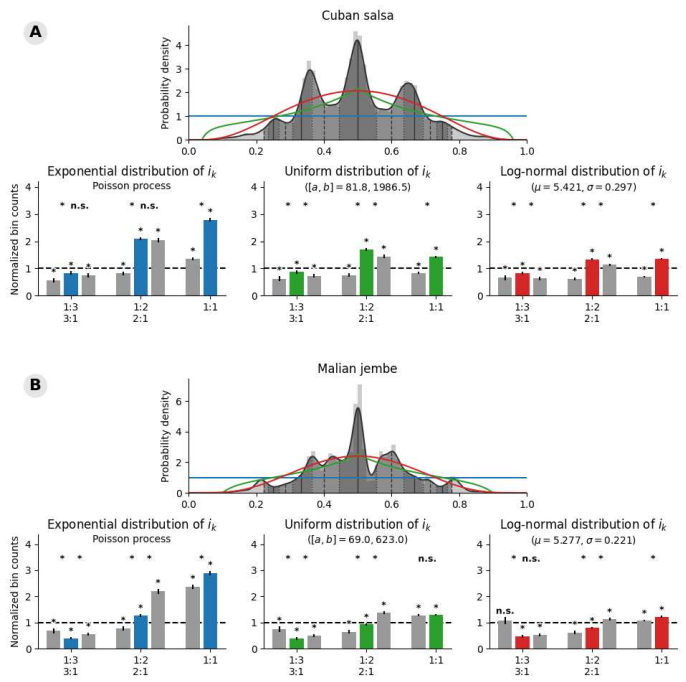
The paper's central claim is that when empirical ratios $r_k = i_k/(i_k+i_{k+1})$ are binned and each bin count is divided by its width, the test compares the data against a uniform distribution of ratios on $[0,1]$, and that uniform distribution is exactly what a homogeneous Poisson point process produces for exponentially distributed intervals. The authors therefore state that most prior integer-ratio analyses have de facto tested the null hypothesis that the binned rhythm ratios were generated by a Poisson process, a maximally random baseline with no upper or lower bound on interval duration. They then show that any scale-invariant ratio formula must depend only on the interval fraction $q = i_2/i_1$, derive the general density $p_R(r)=r^{-2} \int_0^\infty t p_I(t) p_I(t(1-r)/r) dt$, and provide two equivalent ways to test an arbitrary null distribution: transform the ratio so that the null becomes uniform, or normalize bin counts by the null's expected probability mass inside each bin. Reapplying the method to thrush nightingale, zebra finch, Cuban salsa, and Malian jembe data, they report that some 1:1 peaks, such as the zebra finch result, cease to be significant under a uniform-interval null, while other ratio peaks survive.
Load-bearing premise
The identification of bin-width normalization with a Poisson null holds only if the intervals are independent draws from a single exponential distribution; real recordings have temporal dependencies and overlapping adjacent ratios, so the effective null may differ.
Editorial extensions
If this is right
- Results of past integer-ratio studies should be reread as evidence against a Poisson process, not against rhythm-free behavior in general.
- Future empirical work should state an explicit null distribution and, when it is not uniform, normalize bin counts by expected probability mass under that null.
- The rhythm ratio $r_k$ remains a defensible default because it is scale-invariant, bounded, symmetric around 1:1, and maps Poisson-generated intervals to a uniform distribution.
- Choosing a different ratio formula or reweighting the same $r_k$ can change which integer-ratio peaks reach significance, as the zebra finch 1:1 example shows.
- For nulls such as uniform or log-normal intervals, the paper supplies closed-form densities and normalization constants, and for other nulls a Monte Carlo approximation.
Reading between the lines
- The same bin-width critique should apply to any analysis that bins ratios of adjacent intervals and normalizes by width—for example gait kinematics or speech timing—so the reweighting recipe may be directly portable to those fields.
- A natural testable extension is to estimate the interval distribution per species or piece from data and compare integer-ratio models against that empirical null using likelihood or goodness-of-fit, which would make the null choice data-driven rather than assumed.
- Because any scale-invariant ratio discards tempo, the framework says nothing about tempo drift within a performance; studying tempo drift would require a separate statistic that keeps the absolute scale.
- If the independence assumption fails, a bootstrap that resamples individual $r_k$ values will not reflect the true null; a block or pair-resampling scheme would be more appropriate.
Editorial analysis
A structured set of objections, weighed in public.
Referee Report
Summary. The paper examines the statistical assumptions underlying integer-ratio analyses of temporal sequences in bioacoustics and music, focusing on the rhythm ratio r_k = i_k/(i_k+i_{k+1}). It derives the density of r_k for arbitrary interval distributions (Eq. 7), shows that exponentially distributed intervals (a Poisson process) yield a uniform r_k distribution (Eq. 10), and argues that the common practice of normalizing bin counts by bin width implicitly tests a uniform null, which the authors equate with a Poisson null. The paper further derives normalization factors for alternative null hypotheses (uniform and log-normal interval distributions) and reanalyzes four datasets from Roeske et al. (2020) to illustrate how the choice of null changes the statistical conclusions. The takeaway message is that researchers should make their null hypothesis explicit.
Significance. The paper addresses a real and timely problem: the popular method for detecting integer-ratio rhythms has not had its null hypothesis carefully examined. The central derivations are correct and clearly presented; Eq. (7) is a standard change of variables, and Eq. (10) correctly shows that the r_k ratio of independent exponential intervals is uniform. The proposed normalization formula (Eq. 16) and the worked examples provide a practical toolkit for researchers. The paper also makes a falsifiable point—that bounded or log-normal interval distributions can create spurious 1:1 peaks—which is independent of the stronger Poisson-process claim. However, as detailed below, the interpretation of the implicit null as 'de facto Poisson' goes beyond what the mathematics establishes, and the reanalysis has some methodological weaknesses. Overall, the core contribution is valuable, but the framing needs revision.
major comments (2)
- [Section 5 (paragraph 2) and Section 8] The statement that bin-width normalization 'de facto tests the implicit null hypothesis that the (binned) empirical rhythm ratios have been generated by a Poisson process' is stronger than the derivations support. Equations (7) and (10) show that if the intervals i_k are independent and exponentially distributed, then r_k is uniform; they do not show the converse, that a uniform r_k distribution implies a Poisson process. The test based on normalized bin counts directly tests uniformity of the r_k values. A Poisson process is a sufficient but not necessary condition for that uniformity, so the claim that 'almost all of past research' has tested a Poisson null is not justified. Additionally, the r_k sequence from adjacent intervals is not independent (r_k and r_{k+1} share i_{k+1}), so even under a Poisson process the joint distribution of the binned counts is not that of iid draws; the paper should either present a rigorous argument for the equivalence or rephrase the claim as 'the null hypothesis is a uniform distribution of r_k, which is the distribution generated by a Poisson process.'
- [Section 7.3, null-fitting and bootstrap] The reanalysis fits the uniform bounds (a,b) to the observed min/max durations and the log-normal parameters (µ,σ) to the observed intervals in the same datasets used for the subsequent tests. Fitting null-distribution parameters to the test data can make the null artificially close to the data, biasing the comparison towards non-significance. The paper should either fix the null parameters a priori (e.g., from theoretical constraints) or account for parameter estimation in the null distribution. Furthermore, the bootstrap resamples r_k values with replacement, treating them as exchangeable, but overlapping ratios induce dependence; this affects the confidence intervals. The authors should acknowledge these limitations or use a resampling scheme that preserves dependence (e.g., resampling intervals).
minor comments (6)
- [Throughout] Pervasive empty citation placeholders '()' appear throughout (e.g., Section 1, paragraphs 1-2; Section 2, paragraph after equation (1); Section 3, paragraph 5; Section 5, paragraph 2; Section 6.3, last paragraph before Eq. (16); Section 7.3, paragraphs 1-2). These must be completed before the manuscript can be evaluated.
- [Figure 1 caption] The caption contains 'a a trumpet'; this should be 'a trumpet'.
- [Section 8] In the first paragraph, 'statically' should be 'statistically'.
- [Table S3 caption] The caption says 'Cuban salsa finch dataset'; this should be 'Cuban salsa dataset'.
- [Section 7.1] The phrasing 'we can deduce the exact ratio distribution' is informal; consider 'we now derive'.
- [Section 7 (bins)] The notation for bin edges, e.g., '0.444...' for 4/9, is unconventional; using fractions such as 4/9 would improve clarity.
Circularity Check
No significant circularity; the mathematical derivation is self-contained and the reanalysis caveats are explicit.
full rationale
The central derivation chain is independent of the claims it criticizes: equation (7) follows from a standard change of variables for the ratio of two independent interval draws, and equation (10) is a direct calculation for exponentially distributed intervals (a Poisson process). The claim that bin-width normalization 'de facto tests the implicit null hypothesis that the (binned) empirical rhythm ratios have been generated by a Poisson process' is a logical-consequence claim about what the uniform null means; even if one thinks it overstates the converse (uniform r marginals do not by themselves imply a Poisson process), that is a question of inferential strength, not circularity. The reanalysis in Section 7 fits a uniform or log-normal null to the observed interval data, but the paper explicitly labels this a demonstration and uses the fitted distributions only to illustrate how to change the null hypothesis; no fitted value is renamed as a prediction. Prior self-citations appear only as examples of empirical applications or as descriptions of the method under critique, and none is load-bearing for the mathematical results, which rest on standard probability calculus.
Assumptions & free parameters
free parameters (3)
- sigma (log-normal null shape) =
fitted to observed intervals, not reported numerically in the text
- a, b (uniform null bounds) =
set to observed minimum and maximum interval durations
- outlier percentile (1-99) =
1st and 99th percentiles
assumptions (3)
- standard math Change-of-variables formula for probability densities (Eq. 6)
- domain assumption Independent and identically distributed interval durations under the null
- domain assumption Tempo invariance is a desirable property of a rhythm ratio
Cite this review
Pith. "Pith review of Hidden assumptions of integer ratio analyses in bioacoustics and music." pith.science (2026). https://pith.science/paper/7D5MRKUB
@misc{pith2026250204464,
  author       = {Pith},
  title        = {Pith review of: Hidden assumptions of integer ratio analyses in bioacoustics and music},
  year         = {2026},
  howpublished = {\url{https://pith.science/paper/7D5MRKUB}},
  note         = {Machine review of arXiv:2502.04464}
}
read the original abstract
Rhythm is ubiquitous in human culture and in nature, but hard to capture in all its complexity. A key dimension of rhythm, integer ratio categories occur when the relationship between temporal intervals can be expressed as small-integer ratios. Recent work has found integer ratio categories in most human musical cultures and some animal species' vocalizations or behavioral displays. But biological systems are noisy, and empirically measured intervals rarely form an exact small-integer ratio. Here, we mathematically assess whether the leading integer ratio analysis method makes valid statistical and biological assumptions. In particular, we (1) make the temporal properties of empirical ratios explicit, both in general and for the typical use in the literature; (2) show how the choice of ratio formula affects the probability distribution of rhythm ratios and ensuing statistical results; (3) guide the reader to carefully consider the assumptions and null hypotheses of the statistical analysis; (4) present a comprehensive methodology to statistically test integer ratios for any null hypothesis of choice. Our observations have implications for both past and future research in music cognition and animal behavior: They suggest how to interpret past findings and provide tools to choose the correct null hypotheses in future empirical work.
Figures


Figures from the paper (2 more)

Reference graph
Works this paper leans on
-
[1]
C., Tchernichovski, O., Poeppel, D., & Jacoby, N
Roeske, T. C., Tchernichovski, O., Poeppel, D., & Jacoby, N. (2020). Categorical rhythms are shared between songbirds and humans. Current Biology , 30 (18), 3544–3555.e6. https://doi.org/10.1016/j.cub.2020.06.072 11
Reviewed August 8, 2026 · model on record in the stance chip above.
Discussion (0). Continue with ORCID to comment.