REVIEW 5 major objections 9 minor 1 cited by
Potential Nitrogen Enrichment via Direct-Collapse Wolf-Rayet Stars in a $z=4.7$ Star-Forming Galaxy
T0 review · 5 major / 9 minor · reviewed 2026-08-08 · deepseek-v4-flash
Pith's one-line read This paper reports that the $z=4.6928$ star-forming galaxy ID60001 has a nitrogen excess, $\log(\mathrm{N/O})=-0.76$, and argues that the excess comes from massive Wolf-Rayet stars that collapse directly to black holes before they can…
desk verdict The N/O excess is defensible and the Cloudy density result is useful, but the direct-collapse Wolf-Rayet story leans on one barely resolved He II line and an undetected blue bump; it deserves review with revisions. read the letter →
The pith
A machine-rendered reading of the paper's core claim, the machinery that carries it, and where it could break.
The reading
What carries the argument
The load-bearing mechanism is the direct-collapse Wolf-Rayet channel: in low-metallicity stellar populations, stars more massive than about 25 solar masses pass through a Wolf-Rayet phase in which nitrogen-rich winds eject newly synthesized nitrogen into the ISM, and then collapse directly to black holes instead of exploding as core-collapse supernovae, so no compensating oxygen is added and the N/O ratio stays elevated for roughly 10 Myr. Observationally, the channel is recognized through a set of tracers: the moderately broad He II $\lambda4686$ emission line from WR winds (FWHM about 410 km s$^{-1}$, EW$_0$ 6.7 angstroms), the broad/outflow components in H$\beta$, [O III], and H$\alpha$ that the authors attribute to stellar winds, the clumpy emission-line morphology seen in broadband continuum-subtracted images, and the absence of AGN signatures in BPT, VO87, and He2-N2 diagnostics. On the abundance side, the N/O ratio is obtained from [N II] $\lambda6584$ and [O II], [O III] with an ionization correction factor, using electron temperature from [O III] $\lambda4363/5007$ and electron density from [S II] $\lambda6716/6731$; the paper's photoionization models show that these optical N/O diagnostics shift by about 0.2 dex if the density is wrong.
What would settle it
A decisive test would be a deep rest-frame ultraviolet and X-ray/mid-infrared observation of ID60001: a stellar origin predicts the [Fe III] $\lambda4658$ blue bump accompanying He II $\lambda4686$ and no X-ray or [Ne V] excess, while detection of AGN indicators would break the Wolf-Rayet attribution. Alternatively, a measurement placing the electron density of the N$^+$ zone above a few thousand cm$^{-3}$ would shift the optical N/O estimate by about 0.2 dex and could erase the claimed excess.
Extended reading notes
Core claim
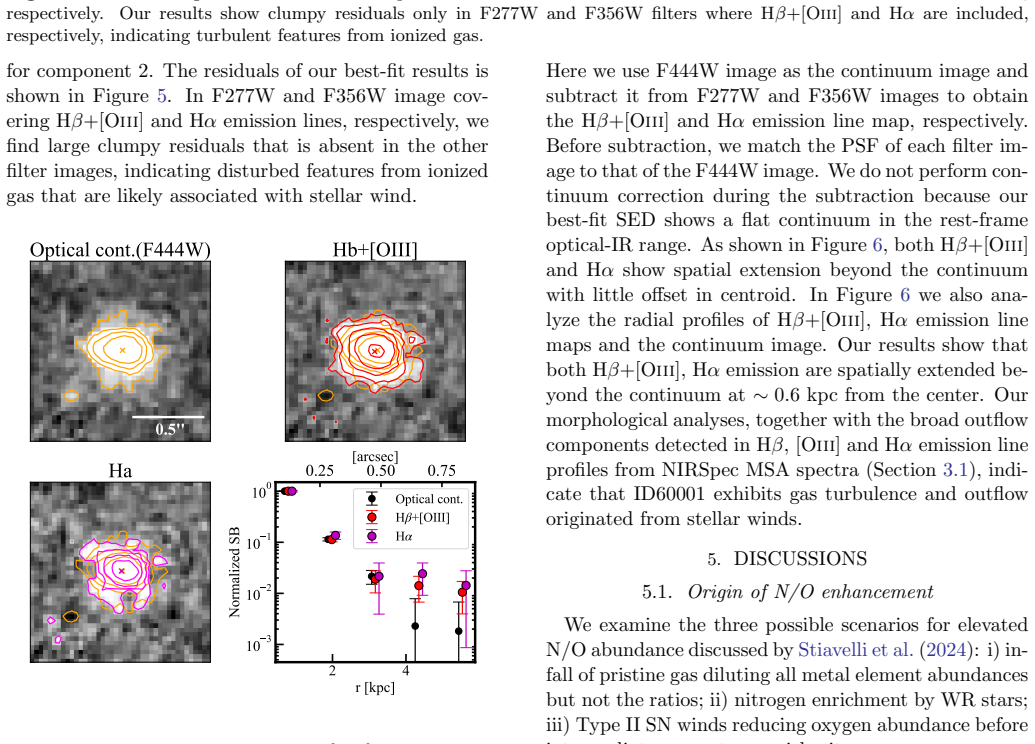
The central discovery, stated on the paper's own terms, is that ID60001 is a star-forming galaxy whose interstellar medium carries a real nitrogen overabundance: $\log(\mathrm{N/O})=-0.76\pm0.03$ at $12+\log(\mathrm{O/H})=7.75\pm0.01$, about $0.1$ dex above the local relation at the same metallicity. The evidence assembled for the Wolf-Rayet origin is multi-wavelength: a moderately broad He II $\lambda4686$ line (FWHM $\approx410$ km s$^{-1}$, rest-frame equivalent width 6.7 angstroms) consistent with stellar winds, no AGN signatures in four optical emission-line diagnostics, a very young stellar population ($\log(\mathrm{age/yr}) \le 6.8$), and spatially extended, turbulent ionized gas with outflow features in H$\beta$, [O III], and H$\alpha$. The authors conclude that massive ($>25\,M_\odot$) Wolf-Rayet stars at low metallicity, which collapse directly to black holes without a core-collapse supernova, are the most likely source of the nitrogen enrichment. They also find that had the electron density been assumed rather than measured, the optical N/O value could shift by roughly $0.2$ dex, which would change the classification of many high-redshift galaxies.
Load-bearing premise
The argument assumes the moderately broad helium emission line at 4686 angstroms comes from winds of very massive young stars rather than from an active black hole at the galaxy's center; observations that could rule out an active nucleus are not yet available, and the supporting iron emission features normally seen with such stellar winds are not detected.
Editorial extensions
If this is right
- ID60001 provides a rest-frame optical measurement of elevated N/O at $z>4$, placing at least one nitrogen-rich galaxy on the same abundance scale as local calibrations rather than on the UV-line scale used for most earlier detections.
- If direct-collapse Wolf-Rayet stars are responsible, the N/O excess is naturally long-lived (about 10 Myr), so the galaxy does not require a finely tuned or intermittent star-formation history.
- The scenario offers a non-exotic stellar explanation for nitrogen-rich galaxies at low metallicity, reducing the need to invoke very massive or supermassive stars in every case.
- Reliable electron density measurements become a prerequisite for optical N/O abundance work; without them, derived N/O values can be off by about 0.2 dex.
- Future observations that cover both UV and optical nitrogen lines, together with carbon lines, can test which enrichment mechanism operates in other high-redshift galaxies.
Reading between the lines
- Beyond the paper, if the direct-collapse WR channel is common in low-metallicity dwarfs, the apparent abundance of nitrogen-rich galaxies at high redshift may be partly a phase-selection effect: rest-frame optical surveys catch galaxies during the brief ~10 Myr window while the WR winds are visible, biasing the reported N/O distribution upward.
- Beyond the paper, the density sensitivity quantified here implies that N/O values derived from UV and optical lines cannot be compared directly without a common density assumption; re-deriving published z>4 N/O measurements with consistent electron densities could change which galaxies are classified as nitrogen-enhanced.
- Beyond the paper, a testable prediction is that N-rich galaxies attributed to this channel should show the [Fe III] $\lambda4658$ blue bump and broader He II $\lambda4686$ in deeper spectra, and should lack X-ray and mid-infrared AGN signatures; observing the small known sample of N-rich galaxies would determine how often this channel operates.
Editorial analysis
A structured set of objections, weighed in public.
Referee Report
Summary. The paper presents JWST/NIRSpec MSA spectroscopy and NIRCam photometry of ID60001, a star-forming galaxy at z=4.6928. From rest-frame optical emission lines, the authors derive Te([OIII]) ~ 1.6-1.7 x 10^4 K, ne ~ 350 cm^-3, 12+log(O/H) = 7.75, and log(N/O) = -0.76, and argue that the N/O ratio is elevated relative to local galaxies at comparable metallicity. After using optical diagnostic diagrams to argue against an AGN, they attribute the nitrogen enhancement to massive (>25 solar masses) Wolf-Rayet stars that directly collapse to black holes, based on a moderately broad He II lambda4686 line, broad H-alpha and outflow components, and a young stellar age from SED fitting. They also use Cloudy models to argue that optical N/O diagnostics are sensitive to gas density.
Significance. If the abundance measurement and the WR interpretation hold, this is a valuable data point for nitrogen enrichment channels at z>4, particularly because it uses rest-frame optical lines rather than the UV lines used for most high-z N-rich galaxies. The paper is careful in its line decomposition, uses Te-based abundances, applies multiple AGN diagnostics, and provides a useful demonstration with Cloudy that optical N/O diagnostics depend on electron density. The main weakness is that the conclusion rests heavily on the interpretation of He II lambda4686 as a stellar-wind feature; this is currently under-supported, and the authors themselves note the absence of the WR blue bump and the need for X-ray, UV, and mid-IR data.
major comments (5)
- [Section 5.1 and Table 1] The WR scenario stands on the claim that He II lambda4686 is a moderately broad stellar-wind line with FWHM=410 km/s, but Table 1 gives only flux and EW0 for this line; no FWHM, its uncertainty, or an LSF-deconvolved width is reported. At the G235M resolution (~300 km/s at 4686 Å), 410 km/s is only marginally resolved and could be a narrow nebular He II line convolved with the LSF. Please provide a two-component fit (narrow plus broad) with a BIC comparison, or at least an LSF-removed width with a confidence interval. This is load-bearing because it is the only direct spectroscopic evidence for WR stars, and the authors state in Section 5.1 that the WR blue-bump lines, including [Fe III] lambda4658, are not detected.
- [Section 3.3] The choice A(V)=0.0 is derived using narrow Balmer components, while the authors note that using total H-alpha fluxes gives A(V)=1.09 (Stiavelli et al. 2024). The decomposition into narrow, outflow, and broad components is therefore load-bearing for the extinction correction, yet no systematic error from this choice is propagated into the quoted abundances. Please report how 12+log(O/H) and log(N/O) change for A(V)=0.5 and 1.0 under the SMC and Calzetti extinction laws, and include this in the error budget.
- [Section 3.5 and Table 2] The quoted uncertainties on 12+log(O/H) (given as +/-0.01 in the abstract but +/-0.03 in Table 2) and log(N/O) of +/-0.03 are random fitting errors only; they exclude ICF uncertainties (including the log(ICF)=0.09 correction for N/O), the assumed Te for Balmer emissivity, density systematics, and extinction. Please state explicitly which terms are included in the error bars and provide a systematic-error estimate. As written, the formal significance of the N/O enhancement is not established.
- [Section 5.1] The claim that the N/O ratio is 'significantly elevated' would be strengthened by quantifying the offset from the local N/O-O/H relation in units of its intrinsic scatter. With [N/O]=0.10 relative to solar and typical local scatter of order 0.15-0.2 dex in log(N/O) at fixed O/H, the excess may be marginal once the systematics above are included. Please report the offset (e.g., Delta log(N/O) at fixed O/H) and the scatter of the comparison sample.
- [Section 4.1] The SED fit uses Gaussian priors centered on the spectroscopically inferred A(V), log U, and metallicity, and the resulting young age/SFH is then used in Section 5.1 as support for the WR scenario. This is not circular for the abundance measurement, but the age constraint is not fully independent of the spectroscopic ISM properties. Please show how the SFR and age posteriors change if the priors are broadened or removed.
minor comments (9)
- [Table 1] The flux unit is given as 10^-19 erg s^-1 cm^-3; it should be erg s^-1 cm^-2.
- [Section 3.4 and Table 2] Te([OIII]) is reported as (1.69 +/- 0.03) x 10^4 K in Section 3.4 but (1.61 +/- 0.04) x 10^4 K in Table 2; please unify and specify which value is used for the abundance derivation.
- [Abstract and Table 2] The abstract states 12+log(O/H)=7.75 +/- 0.01 while Table 2 gives 7.75 +/- 0.03; the quoted uncertainty should be consistent throughout.
- [Section 3.3] There is a typo: 'resonable' should be 'reasonable'.
- [Section 2.2] The text contains 'NIRSPec MSA'; this should be 'NIRSpec MSA'.
- [Section 5.1] The comparison of EW0(H-alpha)=800 Å with STARBURST99 ages should state which stellar population synthesis parameters (IMF, metallicity, SFH) are used and whether the narrow-component EW was adopted.
- [Figure 7] The caption lists line styles for nH=100, 400, 2000, and 20000 cm^-3, but the text refers to 'nH=2000' and 'nH=20000' grids in a way that is easy to confuse; please check that the colors and line styles in the figure match the caption.
- [Title] The title has a spacing issue: 'W olf-Rayet' should be 'Wolf-Rayet'.
- [Section 6] There is a typo: 'prinstine gas infall' should be 'pristine gas infall'.
Circularity Check
No significant circularity: the N/O abundance is measured from observed optical line ratios with literature ICFs, and the WR/direct-collapse interpretation is a separate, independent argument rather than a fitted or self-referential prediction.
full rationale
The central abundance claim, log(N/O) = -0.76 at 12+log(O/H) = 7.75, is derived from directly measured emission-line fluxes ([N II] λ6548, [O II], [O III], [S II]) using PyNeb with Te([O III]) and ne([S II]) determined from observed line ratios, then converted to element abundances using literature ICFs (Izotov et al. 2006; Amayo et al. 2021). No parameter in this chain is fitted to match the claimed N/O value, and the measurement does not depend on the WR hypothesis. The WR/direct-collapse attribution is presented as an interpretation supported by independent observables: a moderately broad He II λ4686 line, EW0(Hα)-based young stellar age, outflow/turbulence signatures, and galaxy morphology. None of these is constructed from the N/O target value. The SED fitting does use Gaussian priors centered on spectroscopically inferred A_V, log U, and metallicity, but the paper does not use the SED to re-derive or validate N/O; the host properties are ancillary and the stellar-age argument is based on EW0(Hα) compared with STARBURST99, not on the SED. Self-citations to Stiavelli et al. (2024) and Morishita et al. (2024a,c) provide empirical context and comparison relations, but they are not invoked as unverified uniqueness theorems and the main abundance result would remain intact without them. The weakest point is that the He II λ4686 width is not tabulated with uncertainty and the WR blue bump is not detected, which is an evidentiary and interpretation concern rather than circularity.
Assumptions & free parameters
free parameters (5)
- Electron density ne from [S II] =
345+184-172 cm^-3
- SED stellar mass M* =
log(M*/M_sun) = 9.34+0.08-0.10
- SED 10 Myr star formation rate =
13.49+1.94-2.33 M_sun/yr
- SED priors on AV, log U, and metallicity =
AV prior center 0.0, sigma 0.2; log U prior center -2.3, sigma 0.5; log Z/Z_sun prior center -0.95, sigma 0.5
- Outflow and broad line profile parameters =
FWHM_out ~ 645 km/s, FWHM_broad ~ 2175 km/s, tied flux ratios f_o/n between H-beta/H-alpha and [O III] lines
assumptions (6)
- domain assumption Case B recombination at Te = 15000 K describes the Balmer line emissivities used for dust and abundance work.
- domain assumption The ionization correction factors of Izotov et al. (2006) and Amayo et al. (2021) are valid for ID60001.
- domain assumption The [S II] 6716/6731 ratio measures the density of the same gas phase as the [O II] and [N II] zones.
- domain assumption ID60001 is not an AGN, based on optical diagnostic diagrams.
- domain assumption STARBURST99 EW0(H-alpha)-to-age mapping and the Watanabe et al. (2024) direct-collapse Wolf-Rayet timescale apply to this galaxy.
- domain assumption BPASS and Cloudy photoionization grids represent the ionizing spectrum and geometry of high-redshift star-forming galaxies.
Cite this review
Pith. "Pith review of Potential Nitrogen Enrichment via Direct-Collapse Wolf-Rayet Stars in a $z=4.7$ Star-Forming Galaxy." pith.science (2026). https://pith.science/paper/HGRLZY4Z
@misc{pith2026250204817,
  author       = {Pith},
  title        = {Pith review of: Potential Nitrogen Enrichment via Direct-Collapse Wolf-Rayet Stars in a $z=4.7$ Star-Forming Galaxy},
  year         = {2026},
  howpublished = {\url{https://pith.science/paper/HGRLZY4Z}},
  note         = {Machine review of arXiv:2502.04817}
}
abstract
We present analyses of a nitrogen-enriched star-forming galaxy, ID60001, at $z=4.6928$ based on JWST/NIRSpec MSA spectroscopy and NIRCam photometry. From rest-frame optical emission lines we derive the nitrogen-to-oxygen (N/O) abundance ratio of ID60001 to be $\log({\rm N/O})=-0.76_{-0.03}^{+0.03}$ ($[{\rm N/O}]=0.10_{-0.03}^{+0.03}$), which is significantly elevated at the corresponding metallicity $12+\log({\rm O/H})=7.75_{-0.01}^{+0.01}$ ($Z/Z_\odot = 0.12$) compared to local counterparts. We discuss possible scenarios for elevated N/O abundance in ID60001, including pristine gas inflow, Wolf-Rayet (WR) stars, and Oxygen depletion by Type II supernova winds. Based on the moderately broadened He{\sc ii}$\lambda$4686 emission line, galaxy morphology, and star-formation history, we conclude that the elevated N/O abundance of ID60001 is likely originated from massive ($>25\,M_\odot$) WR stars that directly collapse into a black hole. We also stress the importance of reliable electron density measurements when deriving N/O abundance with rest-frame optical emission lines.
Figures


Figures from the paper (4 more)



Forward citations
Cited by 1 Pith paper
-
Extremely UV-bright starbursts at the end of cosmic reionization
Very UV-bright galaxies at z~6 are ~6-Myr-old starbursts with high ionizing-photon efficiency, and one example shows evidence that dusty outflows push dust beyond the stars and boost its UV brightness.
Reference graph
Works this paper leans on
-
[1]
2021, MNRAS, 505, 2361, doi: 10.1093/mnras/stab1467 Astropy Collaboration, Robitaille, T
Amayo, A., Delgado-Inglada, G., & Stasi´ nska, G. 2021, MNRAS, 505, 2361, doi: 10.1093/mnras/stab1467 Astropy Collaboration, Robitaille, T. P., Tollerud, E. J., et al. 2013, A&A, 558, A33, doi: 10.1051/0004-6361/201322068 Astropy Collaboration, Price-Whelan, A. M., Sip˝ ocz, B. M., et al. 2018, AJ, 156, 123, doi: 10.3847/1538-3881/aabc4f
-
[2]
Berg, D. A., Erb, D. K., Henry, R. B. C., Skillman, E. D., & McQuinn, K. B. W. 2019, ApJ, 874, 93, doi: 10.3847/1538-4357/ab020a
-
[3]
Berg, D. A., Pogge, R. W., Skillman, E. D., et al. 2020, ApJ, 893, 96, doi: 10.3847/1538-4357/ab7eab
-
[4]
1996, A&AS, 117, 393, doi: 10.1051/aas:1996164
Bertin, E., & Arnouts, S. 1996, A&AS, 117, 393, doi: 10.1051/aas:1996164
-
[5]
2023, larrybradley/lacosmic: 1.1.0, 1.1.0, Zenodo, doi: 10.5281/zenodo.10145563
Bradley, L. 2023, larrybradley/lacosmic: 1.1.0, 1.1.0, Zenodo, doi: 10.5281/zenodo.10145563
-
[6]
2022, grizli, 1.5.0, Zenodo, Zenodo, doi: 10.5281/zenodo.6672538
Brammer, G., Strait, V., Matharu, J., & Momcheva, I. 2022, grizli, 1.5.0, Zenodo, Zenodo, doi: 10.5281/zenodo.6672538
- [7]
-
[8]
Bunker, A. J., Saxena, A., Cameron, A. J., et al. 2023, A&A, 677, A88, doi: 10.1051/0004-6361/202346159
Show all 57 references
-
[9]
C., et al
Calzetti, D., Armus, L., Bohlin, R. C., et al. 2000, ApJ, 533, 682, doi: 10.1086/308692
2000 doi
-
[10]
J., Katz, H., Rey, M
Cameron, A. J., Katz, H., Rey, M. P., & Saxena, A. 2023, MNRAS, 523, 3516, doi: 10.1093/mnras/stad1579
2023 doi
-
[11]
A., Clayton, G
Cardelli, J. A., Clayton, G. C., & Mathis, J. S. 1989, ApJ, 345, 245, doi: 10.1086/167900
1989 doi
-
[12]
2003, PASP, 115, 763, doi: 10.1086/376392
Chabrier, G. 2003, PASP, 115, 763, doi: 10.1086/376392
2003 doi
-
[13]
2023, RMxAA, 59, 327, doi: 10.22201/ia.01851101p.2023.59.02.12
Chatzikos, M., Bianchi, S., Camilloni, F., et al. 2023, RMxAA, 59, 327, doi: 10.22201/ia.01851101p.2023.59.02.12
2023 doi
-
[14]
2017, ApJ, 838, 159, doi: 10.3847/1538-4357/aa679f
Choi, J., Conroy, C., & Byler, N. 2017, ApJ, 838, 159, doi: 10.3847/1538-4357/aa679f
2017 doi
-
[15]
2016, ApJ, 823, 102, doi: 10.3847/0004-637X/823/2/102
Choi, J., Dotter, A., Conroy, C., et al. 2016, ApJ, 823, 102, doi: 10.3847/0004-637X/823/2/102
2016 doi
-
[16]
Conroy, C., & Gunn, J. E. 2010, ApJ, 712, 833, doi: 10.1088/0004-637X/712/2/833
2010 doi
-
[17]
E., & White, M
Conroy, C., Gunn, J. E., & White, M. 2009, ApJ, 699, 486, doi: 10.1088/0004-637X/699/1/486
2009 doi
-
[18]
A., Hadfield, L
Crowther, P. A., Hadfield, L. J., Clark, J. S., Negueruela, I., & Vacca, W. D. 2006, MNRAS, 372, 1407, doi: 10.1111/j.1365-2966.2006.10952.x
2006
-
[19]
D., Clayton, G
Gordon, K. D., Clayton, G. C., Misselt, K. A., Landolt, A. U., & Wolff, M. J. 2003, ApJ, 594, 279, doi: 10.1086/376774
2003 doi
-
[20]
G., Izotov, Y
Guseva, N. G., Izotov, Y. I., & Thuan, T. X. 2000, ApJ, 531, 776, doi: 10.1086/308489
2000 doi
-
[21]
2023, ApJ, 959, 39, doi: 10.3847/1538-4357/ad029e
Harikane, Y., Zhang, Y., Nakajima, K., et al. 2023, ApJ, 959, 39, doi: 10.3847/1538-4357/ad029e
2023 doi
-
[22]
2023a, ApJ, 956, 139, doi: 10.3847/1538-4357/acf376
Isobe, Y., Ouchi, M., Nakajima, K., et al. 2023a, ApJ, 956, 139, doi: 10.3847/1538-4357/acf376
-
[23]
2023b, ApJ, 959, 100, doi: 10.3847/1538-4357/ad09be
Isobe, Y., Ouchi, M., Tominaga, N., et al. 2023b, ApJ, 959, 100, doi: 10.3847/1538-4357/ad09be
-
[24]
Thuan, T. X. 2006, A&A, 448, 955, doi: 10.1051/0004-6361:20053763
2006 doi
- [25]
-
[26]
D., Leja, J., Conroy, C., & Speagle, J
Johnson, B. D., Leja, J., Conroy, C., & Speagle, J. S. 2021, ApJS, 254, 22, doi: 10.3847/1538-4365/abef67 12
2021 doi
-
[27]
M., Tremonti, C., et al
Kauffmann, G., Heckman, T. M., Tremonti, C., et al. 2003, MNRAS, 346, 1055, doi: 10.1111/j.1365-2966.2003.07154.x
2003
-
[28]
J., Dopita, M
Kewley, L. J., Dopita, M. A., Sutherland, R. S., Heisler, C. A., & Trevena, J. 2001, ApJ, 556, 121, doi: 10.1086/321545
2001 doi
-
[29]
J., Maier, C., Yabe, K., et al
Kewley, L. J., Maier, C., Yabe, K., et al. 2013, ApJL, 774, L10, doi: 10.1088/2041-8205/774/1/L10
2013 doi
-
[30]
2024, ApJL, 962, L6, doi: 10.3847/2041-8213/ad1de1
Kobayashi, C., & Ferrara, A. 2024, ApJL, 962, L6, doi: 10.3847/2041-8213/ad1de1
2024 doi
-
[31]
2017, PASJ, 69, 44, doi: 10.1093/pasj/psx017
Kojima, T., Ouchi, M., Nakajima, K., et al. 2017, PASJ, 69, 44, doi: 10.1093/pasj/psx017
2017 doi
-
[32]
2024, arXiv e-prints, arXiv:2407.04777, doi: 10.48550/arXiv.2407.04777
Kokubo, M., & Harikane, Y. 2024, arXiv e-prints, arXiv:2407.04777, doi: 10.48550/arXiv.2407.04777
2024 doi
-
[33]
L., Finkelstein, S
Larson, R. L., Finkelstein, S. L., Kocevski, D. D., et al. 2023, ApJL, 953, L29, doi: 10.3847/2041-8213/ace619
2023 doi
-
[34]
Speagle, J. S. 2019, ApJ, 876, 3, doi: 10.3847/1538-4357/ab133c
2019 doi
-
[35]
Luridiana, V., Morisset, C., & Shaw, R. A. 2015, A&A, 573, A42, doi: 10.1051/0004-6361/201323152
2015 doi
- [36]
-
[37]
2024, A&A, 691, A145, doi: 10.1051/0004-6361/202347640
Maiolino, R., Scholtz, J., Curtis-Lake, E., et al. 2024, A&A, 691, A145, doi: 10.1051/0004-6361/202347640
2024 doi
-
[38]
2024, A&A, 681, A30, doi: 10.1051/0004-6361/202347411
Marques-Chaves, R., Schaerer, D., Kuruvanthodi, A., et al. 2024, A&A, 681, A30, doi: 10.1051/0004-6361/202347411
2024 doi
-
[39]
2023, A&A, 678, A159, doi: 10.1051/0004-6361/202346732
Upadhyaya, A. 2023, A&A, 678, A159, doi: 10.1051/0004-6361/202346732
2023 doi
- [40]
-
[41]
2024b, ApJ, 963, 9, doi: 10.3847/1538-4357/ad1404
Morishita, T., Stiavelli, M., Chary, R.-R., et al. 2024b, ApJ, 963, 9, doi: 10.3847/1538-4357/ad1404
-
[42]
2024c, ApJ, 971, 43, doi: 10.3847/1538-4357/ad5290
Morishita, T., Stiavelli, M., Grillo, C., et al. 2024c, ApJ, 971, 43, doi: 10.3847/1538-4357/ad5290
-
[43]
2023, ApJS, 269, 33, doi: 10.3847/1538-4365/acd556
Nakajima, K., Ouchi, M., Isobe, Y., et al. 2023, ApJS, 269, 33, doi: 10.3847/1538-4365/acd556
2023 doi
-
[44]
C., Sutherland, R
Nicholls, D. C., Sutherland, R. S., Dopita, M. A., Kewley, L. J., & Groves, B. A. 2017, MNRAS, 466, 4403, doi: 10.1093/mnras/stw3235
2017 doi
-
[46]
Rogers, N. S. J., Strom, A. L., Rudie, G. C., et al. 2024, ApJL, 964, L12, doi: 10.3847/2041-8213/ad2f37
2024 doi
-
[47]
L., Shapley, A
Sanders, R. L., Shapley, A. E., Topping, M. W., Reddy, N. A., & Brammer, G. B. 2024, ApJ, 962, 24, doi: 10.3847/1538-4357/ad15fc
2024 doi
- [48]
-
[49]
F., & Finkbeiner, D
Schlafly, E. F., & Finkbeiner, D. P. 2011, ApJ, 737, 103, doi: 10.1088/0004-637X/737/2/103
2011 doi
-
[50]
J., Finkbeiner, D
Schlegel, D. J., Finkbeiner, D. P., & Davis, M. 1998, ApJ, 500, 525, doi: 10.1086/305772
1998 doi
-
[51]
2012, MNRAS, 421, 1043, doi: 10.1111/j.1365-2966.2012.20439.x
Shirazi, M., & Brinchmann, J. 2012, MNRAS, 421, 1043, doi: 10.1111/j.1365-2966.2012.20439.x
2012
-
[52]
R., & Eldridge, J
Stanway, E. R., & Eldridge, J. J. 2018, MNRAS, 479, 75, doi: 10.1093/mnras/sty1353
2018 doi
- [53]
-
[54]
W., Stark, D
Topping, M. W., Stark, D. P., Senchyna, P., et al. 2024, MNRAS, 529, 3301, doi: 10.1093/mnras/stae682
2024 doi
-
[55]
A., Heckman, T
Tremonti, C. A., Heckman, T. M., Kauffmann, G., et al. 2004, ApJ, 613, 898, doi: 10.1086/423264 van Dokkum, P. G. 2001, PASP, 113, 1420, doi: 10.1086/323894
2004 doi
-
[56]
Veilleux, S., & Osterbrock, D. E. 1987, ApJS, 63, 295, doi: 10.1086/191166
1987 doi
-
[57]
2024, ApJ, 962, 50, doi: 10.3847/1538-4357/ad13ff
Watanabe, K., Ouchi, M., Nakajima, K., et al. 2024, ApJ, 962, 50, doi: 10.3847/1538-4357/ad13ff
2024 doi
-
[58]
2024, ApJ, 970, 19, doi: 10.3847/1538-4357/ad47f4
Zhang, Y., Ouchi, M., Nakajima, K., et al. 2024, ApJ, 970, 19, doi: 10.3847/1538-4357/ad47f4
2024 doi
Reviewed August 8, 2026 · model on record in the stance chip above.
Discussion (0). Continue with ORCID to comment.