REVIEW 2 major objections 4 minor 26 references
Detection efficiency and spatial resolution of Monolithic Active Pixel Sensors bent to different radii
T0 review · 2 major / 4 minor · reviewed 2026-08-08 · deepseek-v4-flash
Pith's one-line read Silicon pixel chips bent to radii of 18–30 mm still track particles with 99.9% efficiency and about 5-micrometer precision, matching flat sensors.
desk verdict Solid ITS3 testbeam R&D: bent ALPIDEs match flat performance at 18/24/30 mm, but the April 2021 threshold calibration needs to be rechecked before the headline numbers are final. read the letter →
The pith
A machine-rendered reading of the paper's core claim, the machinery that carries it, and where it could break.
The reading
What carries the argument
The load-bearing object is the ALPIDE chip, a $50~\mu$m-thick monolithic active pixel sensor with a $1024\times512$ binary-pixel matrix, bent around a cylindrical 3D-printed jig with a window behind the active area to reduce multiple scattering. The argument is carried by a test-beam telescope in which flat reference sensors define tracks through a broken-lines fit, a global alignment step, and a region-of-interest analysis that selects tracks passing through the jig window; efficiency is the fraction of tracks with a matched cluster on the bent device, and spatial resolution comes from track-to-hit residuals after subtracting the approximately $3.2~\mu$m tracking uncertainty in quadrature. The quantitative comparison of bent and flat sensors uses average cluster size as a function of threshold as the common operating-point variable.
What would settle it
Re-run bent ALPIDE chips at radii of 18, 24, and 30 mm in a test beam with the threshold measured directly by the built-in pulsing circuit, and compare the efficiency-versus-threshold and resolution-versus-threshold curves with the published ones; a systematic offset larger than the quoted uncertainties, or a visible dependence on bending radius under direct calibration, would disprove the claim.
Extended reading notes
Core claim
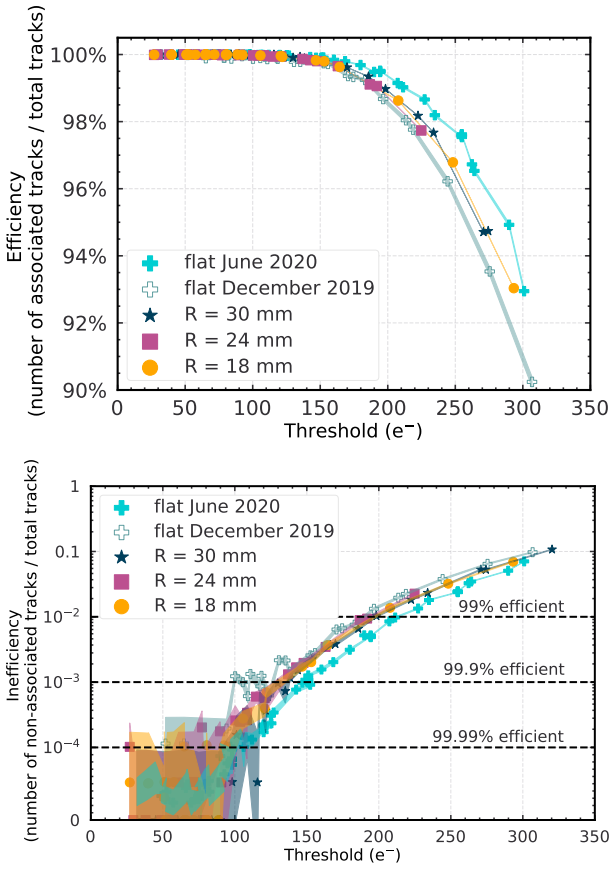
The central claim is that ALPIDE monolithic active pixel sensors bent to radii of $18$, $24$, and $30$ mm—slightly smaller than the radii planned for the ITS3 layers—preserve full detection performance relative to flat sensors. At nominal thresholds, corresponding to average cluster sizes of $2.5$--$3.5$ pixels, the efficiency exceeds $99.9\%$ and the space-point resolution is about $5~\mu$m in both the bending direction and perpendicular to it, and the observed differences between radii are not significant. The result holds with the readout periphery bent together with the sensor and with electrical bonding performed after bending through a flexible printed circuit. In a grazing configuration, where particles cross the sensor tangentially over up to about 3 mm, mean cluster sizes exceed 100 pixels, matching the length expected from geometry.
Load-bearing premise
For one of the test-beam datasets, the sensor threshold was not read directly from its calibration circuit but reconstructed from the average size of the particle-hit clusters, using a formula fitted to flat sensors; if that indirect calibration is off, the claimed efficiency and resolution at the nominal threshold would shift.
Editorial extensions
If this is right
- A fully cylindrical inner tracker using bent sensors near the planned radii can be operated at the same nominal threshold as flat sensors without losing efficiency or resolution.
- Bonding after bending, with the readout periphery curved and connected through a flexible printed circuit, is a viable assembly route for the final detector.
- Bent-sensor performance can be specified by the same operating point used for flat chips: a threshold of roughly 100–150 electrons, corresponding to average cluster sizes of 2.5–3.5 pixels.
- The independence of efficiency and resolution on bending radius means the three planned layer radii can be treated as interchangeable in performance simulations.
- Grazing-incidence clusters several millimeters long support the development of pixel-chamber active targets, an application the paper identifies as a next step.
Reading between the lines
- Inference: because the tested radii of 18, 24, and 30 mm are slightly smaller than the planned layer radii of 19, 25.2, and 31.5 mm, the demonstrated range leaves a small safety margin for the nominal geometry.
- Inference: the threshold-mapping difficulty in the April 2021 campaign means the strongest support for the radius-independence claim comes from the July 2021 campaign with direct threshold calibration; re-analysing the April data with direct calibration would be a quick robustness test.
- Inference: the observed grazing-cluster length formula $l = 2\sqrt{2 b r}$ could be inverted to estimate the local charge-collecting thickness $b$ of the bent sensor from cluster lengths, giving a non-destructive probe of the sensitive layer.
- Inference: because the analysis window selects nearly perpendicular incidence ($80^\circ < \theta < 100^\circ$), the claim of radius independence may not extend to strongly inclined tracks; widening the region of interest in a future test beam would test this limit.
Signed reviews
Editorial analysis
A structured set of objections, weighed in public.
Referee Report
Summary. The paper reports test-beam measurements of 50-µm-thick ALPIDE monolithic active pixel sensors bent to cylindrical radii of 18, 24, and 30 mm, using a new assembly procedure in which chips are bent before wire bonding. Detection efficiency and spatial resolution are measured as functions of charge threshold with high-energy electrons at DESY and pions/protons/muons at the CERN SPS, using reference-plane telescopes and the Corryvreckan reconstruction framework. The headline results are an efficiency above 99.9% and a spatial resolution around 5 µm at nominal operating conditions, with no observed dependence on bending radius, in line with flat ALPIDE sensors. A novel grazing-beam geometry is also explored, where particles traverse the chip laterally over distances up to about 3 mm, and elongated clusters of up to 100 pixels are reported.
Significance. If the results hold, they constitute an important milestone for the ALICE ITS3 project, demonstrating that wafer-size MAPS bent to the radii foreseen for the inner tracker preserve the electrical and particle-detection performance of flat sensors. The paper provides the first determination of spatial resolution for bent MAPS as a function of threshold, extends earlier studies to three radii and a different bending axis, and validates a new bonding-after-bending assembly method. Notable strengths are the direct efficiency and resolution measurements, the cross-check between two beam facilities with different particle species and momenta, and the explicit treatment of multiple scattering via a region-of-interest selection. The grazing-beam study adds a qualitatively new data set relevant for future pixel-chamber concepts. However, the central claim of >99.9% efficiency at nominal threshold and independence from bending radius relies in part on an indirect threshold calibration for the April 2021 DESY campaign, whose systematic uncertainty is not fully quantified.
major comments (2)
- [Sec. 5.1, Appendix A, Eq. (A.1)] The April 2021 threshold values are not measured by internal pulsing but reconstructed from the average associated cluster size using the 16-parameter double-exponential fit of Eq. (A.1), calibrated on flat-sensor data. The fit parameters a-p are not reported with uncertainties, and the mapping is applied to bent sensors for which footnote 1 and Appendix A item 4 acknowledge a systematic cluster-size excess at fixed threshold (about 30% of the observed effect attributed to rotation). Because Figs. 6 and 7 do not identify which entries come from April 2021 versus July 2021, the reader cannot isolate the directly calibrated data. The authors should reproduce the headline efficiency, spatial resolution, and radius-independence statements using only the July 2021 data with measured thresholds, and should either provide the April 2021 points with a conservative systematic threshold uncertainty or omit them from the central conclusions. A cross-check of the mapping on the June 2020 directly calibrated flat data would also help quantify the bias.
- [Sec. 5.1 and Abstract] The claim that efficiency and resolution are 'independent of the bending radius' is stronger than the data support, as the text itself notes that the ROI restricts incidence angles to 80-100 degrees and that the expected radius-dependent efficiency increase is not significant over this limited range. The measurements directly compare three radii, but the sensitivity to radius-dependent effects is limited by the small range of incidence angles. The abstract and summary should be qualified to state that no dependence is observed within the tested angular range, rather than asserting a general independence of bending radius.
minor comments (4)
- [Appendix A, Eq. (A.1)] The text says the fit parameters are 'a-h', but the displayed formula contains 16 parameters a through p; this should be corrected.
- [Fig. 5 caption] The caption contains a typo: 'six bent senors' should read 'six bent sensors'.
- [Figs. 6 and 7] The figures would be much easier to interpret if the April 2021 and July 2021 data were distinguished by marker style or color, since their threshold calibrations are different.
- [Sec. 5.2] The subtraction of the track propagation uncertainty (approximately 3.2 um) is described as based on a simplified Monte Carlo, but no uncertainty on this value is given; a short statement of its sensitivity would strengthen the resolution claim.
Circularity Check
No significant circularity: the headline efficiency and resolution are independent testbeam measurements; the April 2021 threshold reconstruction is a disclosed calibration caveat, not a derivation loop.
full rationale
The paper's central claims (efficiency >99.9%, spatial resolution ~5 um, and independence from bending radius) are direct measurements: tracks are reconstructed from reference planes, propagated to the DUTs, and efficiency is the fraction of tracks with an associated cluster, while resolution is obtained from track-to-hit residuals after subtracting a simulated telescope uncertainty. These observables are not defined in terms of the quantities they are said to validate, so there is no equation-level circularity. The only potentially circular element is the April 2021 threshold axis, which was reconstructed from average cluster size using the flat-sensor fit of Eq. A.1 because internal pulsing was not reliable. This is a calibration from an external observable, not a fit of the headline result: efficiency and resolution are measured independently of Eq. A.1. The authors explicitly flag the limitation in footnote 1 and Appendix A, noting that bent sensors show slightly larger cluster sizes at a given threshold due to non-zero incidence angles; this could bias the April 2021 threshold mapping and is correctly treated as a systematic/correctness concern, not as circular reasoning. The July 2021 SPS campaign used direct internal-pulsing thresholds and independently supports the abstract claims. Self-citations to prior ALICE work supply context and earlier demonstrations rather than a load-bearing uniqueness or derivation step, and the comparison to flat sensors is internal to the paper's own measurements. No step reduces to its own input by construction.
Assumptions & free parameters
free parameters (2)
- Threshold mapping fit parameters (a through p) =
16 phenomenological coefficients, values not quoted
- Track propagation uncertainty =
3.2 um
assumptions (4)
- domain assumption Bent sensors share the same cluster-size-to-threshold relation as flat sensors.
- domain assumption The bent chip geometry is perfectly cylindrical to within 50 um.
- domain assumption The simplified Monte Carlo of the telescope accurately predicts the 3.2 um track resolution at the DUT.
- standard math Standard track reconstruction and alignment methods are unbiased for this setup.
Cite this review
Pith. "Pith review of Detection efficiency and spatial resolution of Monolithic Active Pixel Sensors bent to different radii." pith.science (2026). https://pith.science/paper/UAPKW67D
@misc{pith2026250204941,
  author       = {Pith},
  title        = {Pith review of: Detection efficiency and spatial resolution of Monolithic Active Pixel Sensors bent to different radii},
  year         = {2026},
  howpublished = {\url{https://pith.science/paper/UAPKW67D}},
  note         = {Machine review of arXiv:2502.04941}
}
abstract
Bent monolithic active pixel sensors are the basis for the planned fully cylindrical ultra low material budget tracking detector ITS3 of the ALICE experiment. This paper presents results from testbeam campaigns using high-energy particles to verify the performance of 50 um thick bent ALPIDE chips in terms of efficiency and spatial resolution. The sensors were bent to radii of 18, 24 and 30 mm, slightly smaller than the foreseen bending radii of the future ALICE ITS3 layers. An efficiency larger than $99.9\%$ and a spatial resolution of approximately 5 um, in line with the nominal operation of flat ALPIDE sensors, is obtained at nominal operating conditions. These values are found to be independent of the bending radius and thus constitute an additional milestone in the demonstration of the feasibility of the planned ITS3 detector. In addition, a special geometry in which the beam particles graze the chip and traverse it laterally over distances of up to 3 mm is investigated.
Figures


Figures from the paper (6 more)




Reference graph
Works this paper leans on
- [3]
-
[1]
URL https://cds.cern.ch/record/2703140
ALICE Collaboration, Letter of Intent for an ALICE ITS Upgrade in LS3, Tech.Rep.CERN-LHCC-2019-018.LHCC-I-034, CERN,Geneva(Dec 2019). URL https://cds.cern.ch/record/2703140
arXiv 2019
-
[2]
rep., CERN, Geneva, co-project Manager: Magnus Mager, mag- nus.mager@cern.ch (2024)
ALICE Collaboration, Technical Design report for the ALICE Inner Track- ing System 3 - ITS3 ; A bent wafer-scale monolithic pixel detector, Tech. rep., CERN, Geneva, co-project Manager: Magnus Mager, mag- nus.mager@cern.ch (2024). URL https://cds.cern.ch/record/2890181
arXiv 2024
-
[4]
URL https://doi.org/10.1088%2F0954-3899%2F41%2F8%2F087002
ALICE Collaboration, Technical design report for the upgrade of the AL- ICE inner tracking system, Journal of Physics G: Nuclear and Particle Physics 41 (8) (2014) 087002.doi:10.1088/0954-3899/41/8/087002. URL https://doi.org/10.1088%2F0954-3899%2F41%2F8%2F087002
-
[5]
Šuljić, ALPIDE: the Monolithic Active Pixel Sensor for the ALICE ITS upgrade, J
M. Šuljić, ALPIDE: the Monolithic Active Pixel Sensor for the ALICE ITS upgrade, J. Instrum. 11 (11) (2016) C11025–C11025.doi:10.1088/ 1748-0221/11/11/c11025
work page 2016
-
[6]
G. Aglieri Rinella, The ALPIDE pixel sensor chip for the upgrade of the ALICE Inner Tracking System, Nucl. Instrum. Methods Phys. Res. A 845 (2017) 583 – 587, proceedings of the Vienna Conference on Instrumentation
work page 2017
-
[7]
Mager, ALPIDE, the Monolithic Active Pixel Sensor for the ALICE ITS upgrade, Nucl
M. Mager, ALPIDE, the Monolithic Active Pixel Sensor for the ALICE ITS upgrade, Nucl. Instrum. Methods Phys. Res. A 824 (2016) 434 – 438, fron- tier Detectors for Frontier Physics: Proceedings of the 13th Pisa Meeting on Advanced Detectors. doi:https://doi.org/10.1016/j.nima.2015. 09.057
-
[8]
TowerJazz, http://www.towersemi.com/, Last accessed on 20/12/2024. URL http://www.towersemi.com/
work page 2024
Show all 26 references
-
[9]
Kim, et al., Front end optimization for the monolithic active pixel sensor of the ALICE Inner Tracking System upgrade, J
D. Kim, et al., Front end optimization for the monolithic active pixel sensor of the ALICE Inner Tracking System upgrade, J. Instrum. 11 (02) (2016) C02042–C02042. doi:10.1088/1748-0221/11/02/c02042
2016 doi
-
[10]
Diener, et al., The DESY II test beam facility, Nucl
R. Diener, et al., The DESY II test beam facility, Nucl. Instrum. Methods Phys. Res. A 922 (2019) 265 – 286. doi:https://doi.org/10.1016/j. nima.2018.11.133. 15
2019 doi
-
[11]
Siddhanta, et al., A readout system for single alpide sensors of the alice inner tracking system upgrade, in: 2020 IEEE NSS/MIC, 2020, pp
S. Siddhanta, et al., A readout system for single alpide sensors of the alice inner tracking system upgrade, in: 2020 IEEE NSS/MIC, 2020, pp. 1–3. doi:10.1109/NSS/MIC42677.2020.9508095
2020
-
[12]
Ahlburg, et al., EUDAQ — a data acquisition software framework for common beam telescopes, J
P. Ahlburg, et al., EUDAQ — a data acquisition software framework for common beam telescopes, J. Instrum. 15 (01) (2020) P01038–P01038.doi: 10.1088/1748-0221/15/01/p01038
2020 doi
-
[13]
Dannheim, et al., Corryvreckan: a modular 4D track reconstruction and analysis software for test beam data, J
D. Dannheim, et al., Corryvreckan: a modular 4D track reconstruction and analysis software for test beam data, J. Instrum. 16 (03) (2021) P03008. doi:10.1088/1748-0221/16/03/p03008
2021 doi
-
[14]
Blobel, C
V. Blobel, C. Kleinwort, F. Meier, Fast alignment of a complex tracking detector using advanced track models, Computer Physics Communications 182 (9) (2011) 1760–1763, computer Physics Communications Special Edi- tion for Conference on Computational Physics Trondheim, Norway, ...
2011 doi
-
[15]
Reidt, Upgrade of the ALICE ITS detector, Nucl
F. Reidt, Upgrade of the ALICE ITS detector, Nucl. Instrum. Methods Phys. Res. A 1032 (2022) 166632. doi:https://doi.org/10.1016/j. nima.2022.166632
2022
-
[16]
Mager, last accessed on 20/12/2024
M. Mager, last accessed on 20/12/2024. [link]. URL http://mmager.web.cern.ch/telescope/tracking.html
2024
-
[17]
Mulliri, et al., Pixel chamber: A solid-state active-target for 3d imaging of charm and beauty, Nucl
A. Mulliri, et al., Pixel chamber: A solid-state active-target for 3d imaging of charm and beauty, Nucl. Instrum. Methods Phys. Res. A 1047 (2023) 167724. doi:https://doi.org/10.1016/j.nima.2022.167724. 16 Appendix A. Threshold mapping for April 2021 test beam The threshold in...
2023
-
[19]
This explanation was excluded by measuring the voltages close to the chip on the FPC when pulsing
A drop in the supply voltage due to the longer supply lines in the bent setup, namely the FPC and flex cable, could lead to an altered charge injection. This explanation was excluded by measuring the voltages close to the chip on the FPC when pulsing
-
[20]
This effect should be larger for a larger number of pixels being pulsed simultaneously and should vary for different decoupling setups
An influence of additional resistivity and inductance in the bent setup on power draw could bias the injected charge during threshold pulsing. This effect should be larger for a larger number of pixels being pulsed simultaneously and should vary for different decoupling setups...
-
[21]
An off-center placement of the setup could cause larger incident angles and thus larger cluster sizes due to the larger charge deposit. A detailed investigation of the beam spot position from the first to the last reference plane determined the maximal angular displacement (ro...
-
[22]
This rotation inx-axis was determined to be up to4◦ and does increase the incident angle and therefore the cluster size
An inter-layer rotation between the30 mmand 18 mmlayer has been ob- served by studying the correlation between DUTs. This rotation inx-axis was determined to be up to4◦ and does increase the incident angle and therefore the cluster size. This effect was clearly measurable and ...
-
[23]
They could be attributed to an insufficiently tightened mounting screw, however with negligible in- fluence on the cluster size
AdditionalrotationsoftheDUTaroundthe z-axiswerefoundtobedeviat- ing less than1.3◦ from the nominal90◦ rotation. They could be attributed to an insufficiently tightened mounting screw, however with negligible in- fluence on the cluster size. 17
-
[24]
No difference in the cluster sizes was observed
To rule out fundamental differences between bent and flat sensors,55Fe source measurements were performed in the laboratory. No difference in the cluster sizes was observed
-
[25]
The correct value for the pulsing capacitance could be confirmed to be230 aFand is valid for all ALPIDE sensors
In literature, different values for the pulsing capacitance were found due to the use of an outdated graphics in several cases. The correct value for the pulsing capacitance could be confirmed to be230 aFand is valid for all ALPIDE sensors
-
[26]
Beam contamination with higher ionizing stray particles was ruled out by looking on an event-by-event basis at the average cluster size of the reference planes that was consistent with MIPS. Since detailed investigation did not reveal the origin of the problem, the most likely...
2021
-
[2016]
doi:https://doi.org/10.1016/j.nima.2016.05.016
2016 doi
Reviewed August 8, 2026 · model on record in the stance chip above.
Discussion (0). Continue with ORCID to comment.