REVIEW 3 major objections 5 minor 1 cited by
Exploring the Generalizability of Geomagnetic Navigation: A Deep Reinforcement Learning approach with Policy Distillation
T0 review · 3 major / 5 minor · reviewed 2026-08-08 · deepseek-v4-flash
Pith's one-line read A policy distilled from four deep-reinforcement-learning teachers can navigate unexplored geomagnetic regions with over 94% success, while individually trained policies fall below 70%.
desk verdict Plausible combination of TD3 and multi-teacher distillation for geomagnetic navigation, but the generalization claim rests on interpolation within one IGRF map rather than true transfer. read the letter →
The pith
A machine-rendered reading of the paper's core claim, the machinery that carries it, and where it could break.
The reading
What carries the argument
The load-bearing mechanism is TD3-STEPD, Twin Delayed Deep Deterministic Policy Gradient with Separate Training and Ensemble Policy Distillation. Teacher networks, one per corner training region, are trained with a mixed reward $r_t = r^e_t + r^i_t$: the extrinsic part $r^e_t$ rewards the weighted decrease of the normalized geomagnetic objective $F(B,t)$, and the intrinsic part $r^i_t$ rewards keeping the chosen heading close to a predicted heading that would make each field component converge to its destination value at proportional rates, per Eq. (16). The student network then learns by minimizing the mean squared error between its own deterministic actions and those of each teacher on replayed state-action data, interleaved across teachers, producing a single policy whose semantics are agent-centric rather than tied to one environment.
What would settle it
Train and evaluate the same procedure with corner boxes drawn from one latitude band and test in a different latitude band, a different reference-field epoch, or an anomaly-containing zone; if success there drops toward the untrained baselines, the generalization claim is limited to the tested map. A simpler check is to measure whether Eq. (16) holds along sampled navigation trajectories in the unknown region.
Extended reading notes
Core claim
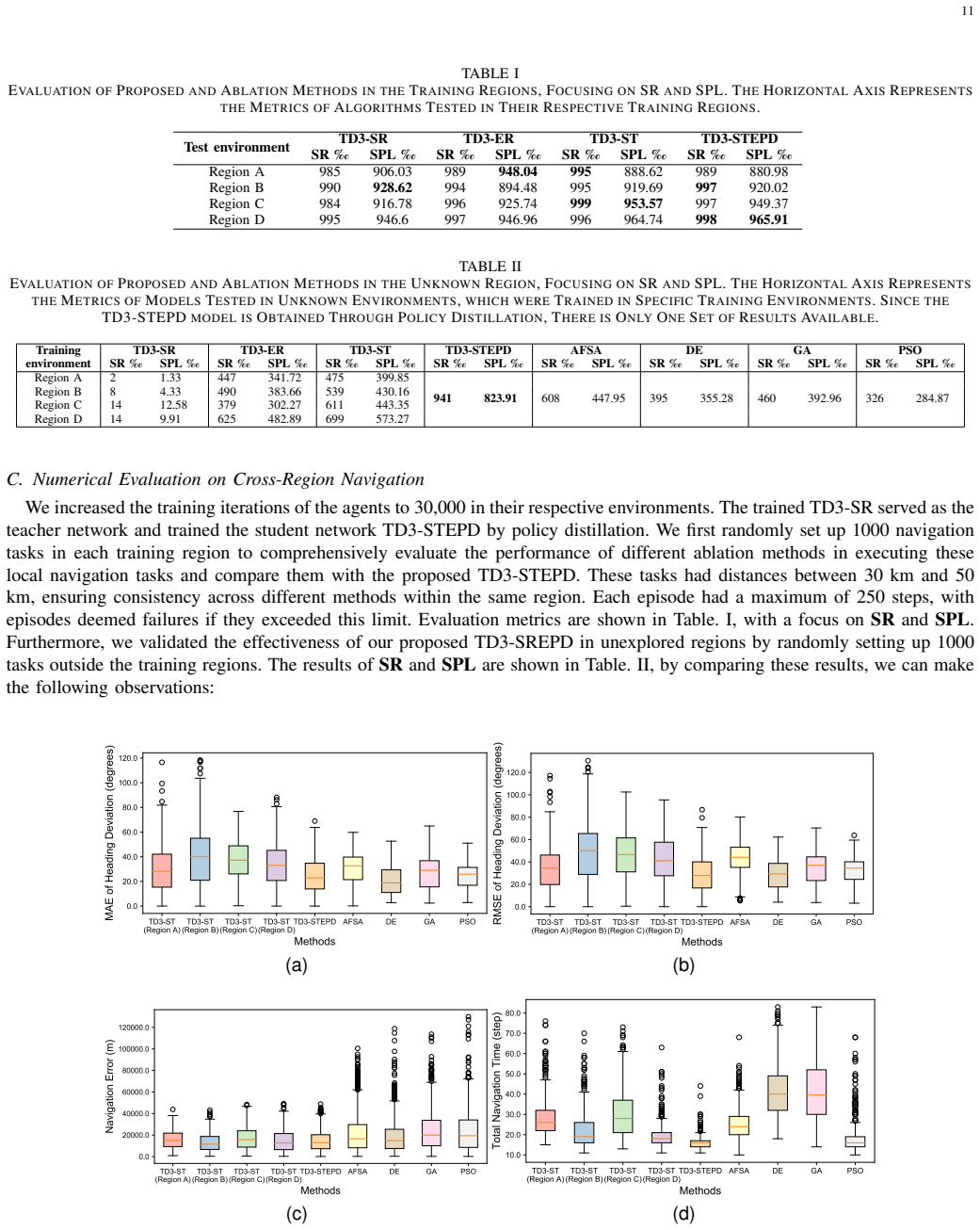
On the paper's own terms, the central discovery is that generalizability of a learned geomagnetic navigation model is achievable through multi-teacher policy distillation: four TD3 agents trained in dispersed sub-regions each learn a localized strategy, and a student network trained to match their deterministic actors (minimizing mean squared error between teacher and student actions) merges them into one agent-centric policy that transfers to unexplored parts of the same geomagnetic map. The paper reports that this distilled policy sustains a success rate over 94% in the unknown interior while the individually trained ablations and the evolutionary baselines generally stay below 70%, with smaller heading deviation and shorter navigation time.
Load-bearing premise
The load-bearing premise is that four 5-degree corner boxes of one reference-field map are representative of the whole 45-by-25-degree region, so its interior can stand in for "unknown territory"; if genuinely new areas have different gradient structure, the distilled policy may fail, and the paper does not validate Eq. (16) on which the intrinsic heading reward rests.
Editorial extensions
If this is right
- Within the simulated region, the distilled TD3-STEPD policy navigates unseen interior areas with success above 94%, while individually trained TD3 variants and evolutionary baselines generally stay below 70%.
- The mixed reward makes training markedly faster: the TD3-ST teacher first reaches its destination within tens to a few hundred episodes, versus hundreds to thousands for sparse or extrinsic-only rewards.
- In training regions, TD3-STEPD is comparable to, though not always better than, its best teacher, indicating that distillation costs little local accuracy while buying cross-domain robustness.
- The distillation step is not tied to TD3; the authors state the same procedure applies to other off-policy reinforcement learning algorithms.
Reading between the lines
- A sharper test of true generalization would be to run the same distilled policy on a region with a different latitude band, a different reference-field epoch, or known magnetic anomalies; the paper leaves anomaly handling to future work, so "unexplored areas" currently means the interior of one map.
- Because the student is trained to imitate teacher actions, part of the gain may come from distillation acting as regularization of a single policy rather than from genuine domain coverage; comparing a one-teacher distillation against the four-teacher ensemble would isolate that effect.
- The proportionality assumption in Eq. (16) is used without validation; checking it along real or simulated trajectories, or replacing it with learned local gradients, is a direct way to harden the intrinsic reward.
Editorial analysis
A structured set of objections, weighed in public.
Referee Report
Summary. The paper proposes TD3-STEPD, a deep reinforcement learning approach to geomagnetic navigation with cross-area generalization as the central goal. Four TD3 teacher policies are trained in four 5-degree corner subregions of a single 45-by-25-degree IGRF map, using a mixed reward that combines a potential-based extrinsic term with an intrinsic heading reward derived from a proportional-convergence assumption. A student policy is then trained by multi-teacher policy distillation using an MSE loss between teacher and student actions. Simulation results report that the distilled student attains over 94% success in the map interior designated as the 'unknown region', while the individually trained teachers and evolutionary baselines fall below 70%, and the paper interprets this as evidence that the distilled knowledge transfers to unexplored navigation areas.
Significance. If the generalization claim were fully supported, the paper would make a useful contribution to learned geomagnetic navigation: policy distillation across spatially separated training domains is a sensible mechanism for obtaining a single policy that is less overfit to one local field structure, and the proposed intrinsic reward is a novel attempt to inject heading information into a sparse-reward problem. The paper also includes extensive comparisons with ablation variants and four evolutionary baselines, which is appropriate for the research question. However, the current evidence does not yet establish generalization to genuinely unexplored geomagnetic regions: the test area is the interior of the same smooth IGRF model used to define the training corners, and the intrinsic-reward derivation rests on an unvalidated assumption. The paper does not provide code, seeds, confidence intervals, or the numerical values of several reward parameters, so the strength of the headline quantitative claim cannot currently be independently assessed.
major comments (3)
- [§IV.A.1, §IV.B, Table II] The central generalization claim is not yet supported by the evaluation design. The 'unknown region' is the interior of the same 45×25-degree IGRF environment whose four 5-degree corner subregions are used for training; every test field value is produced by the same spherical-harmonic coefficient set as the training corners. A policy that learns the smooth latitudinal and longitudinal gradients of this one field model can succeed in the interior by interpolation, without exhibiting any ability to generalize to a genuinely unexplored navigation area. To substantiate the abstract's claim of transfer to 'new navigation areas', the authors should evaluate in a geographically disjoint region, a different latitude band, a different IGRF epoch, or a field with added anomaly structure; Section V explicitly defers anomaly handling, so this gap is acknowledged rather than closed.
- [§III.C, Eqs. (16)–(20)] The intrinsic-heading reward, which the paper credits for the improved exploration efficiency of TD3-ST, rests entirely on the assumption in Eq. (16) that all geomagnetic components converge toward their destination values at proportional rates. This assumption is asserted without derivation, without empirical validation against IGRF gradients, and without a sensitivity study. Because the reward shaping is a core contribution and the comparison between TD3-ST and the ablation methods in Fig. 4 depends on it, the authors should either justify Eq. (16) from the structure of the geomagnetic field or clearly label it as a heuristic and test how the results change when the intrinsic term is varied or removed.
- [§IV.A.2, §IV.B, Tables I–II] The quantitative comparison lacks the information needed to establish that the 94% versus below-70% success gap is reliable. The reward weights α and β, the destination reward r_goal, and the success threshold ζ are not reported, and no random seeds, multiple training runs, confidence intervals, or significance tests are provided. The reported success rates appear to come from a single training run per method, so the headline comparison may reflect seed-dependent variability. In addition, the caption of Fig. 4 gives training-region coordinates (90–95E, -15 to -10; 130–135E, -15 to -10; etc.) that contradict the text of §IV.A.1, which says the simulation region spans 10N to 35N; the actual coordinates of the training and test areas must be clarified.
minor comments (5)
- [§III.B, Eq. (14)] The distillation loss in Eq. (14) is written as the mean of (πTk(si) − πS(si)) without a square; based on the text it should be a mean squared error, so the equation needs to be corrected to include the square.
- [General] There are numerous typos and corrupted symbols throughout the text, including 'inforcement' instead of 'reinforcement', 'generalizabiltiy', 'DNSS-denied' instead of 'GNSS-denied', and sequences of /uni0000... escape codes in the PDF rendering of several figures; these should be cleaned up before resubmission.
- [§IV.C] The text refers to 'TD3-SREPD' in the paragraph after Table II; this appears to be a typo for 'TD3-STEPD' and should be corrected.
- [§IV.A.3, §IV.D] The paper repeatedly refers to Eq. (8) as the normalized objective function F, but Eq. (8) is the expected-return objective J(π); the actual definition of F is Eq. (6). These cross-references should be fixed.
- [§II.B, Eq. (6)] The definition of F in Eq. (6) is ambiguous because the notation f_i(B,j) and f'_i(B,j) is not consistent with the summation that follows; the authors should rewrite the equation so that the normalized sub-functions are clearly defined.
Circularity Check
No circularity: the distilled-policy generalization claim is evaluated empirically on held-out interior locations and does not reduce by construction to the training objective or to a self-citation chain.
full rationale
The paper's claimed derivation chain is not circular. Teacher policies are trained with a TD3 objective whose reward combines an extrinsic term based on the normalized geomagnetic objective F and an intrinsic heading reward; the student is then trained by minimizing MSE against teacher actions over replay-buffer samples. The central claim—that the distilled student generalizes to the unvisited interior of the IGRF region—is an empirical result, not a consequence of the definitions. The same F appears as reward signal, as baseline fitness, and as the success criterion F<ζ, but that is a consistent objective choice rather than a derivation equivalence: the generalization result could have failed even with that reward, and the paper reports that non-distilled TD3-ST indeed degrades below 70% in the unknown region. The reward weights α and β are tuned with Optuna on the training regions and not reported, which is a reproducibility and evaluation-fairness concern, not a circular reduction. Self-citations such as [2], [8], and [32] appear only as related work and motivation, and are not load-bearing for the generalization result; the paper does not invoke a uniqueness theorem or prior author-derived ansatz to force its choice. Equation (16), the proportional-convergence assumption behind the intrinsic reward, is asserted without validation, but an unvalidated assumption is a correctness threat, not circularity. No quoted equation or fitted parameter is shown to be equivalent by construction to the reported cross-region success, so the appropriate finding is no significant circularity.
Assumptions & free parameters
free parameters (4)
- alpha (extrinsic reward weight)
- beta (intrinsic reward weight)
- r_goal (destination reward) =
200 (inferred from reward curves)
- zeta (success threshold)
assumptions (4)
- domain assumption The geomagnetic field parameters uniquely identify position in the navigation region, so convergence of F(B,j) to zero implies arrival at the destination.
- ad hoc to paper All geomagnetic components converge toward the destination values at proportional rates, (B_{j+1,i} - B_{j,i}) proportional to (B_{T,i} - B_{j,i}).
- domain assumption The four corner training regions are representative of the whole test region's geomagnetic structure.
- domain assumption IGRF provides a sufficiently accurate model of real geomagnetic fields for navigation-scale decisions.
Cite this review
Pith. "Pith review of Exploring the Generalizability of Geomagnetic Navigation: A Deep Reinforcement Learning approach with Policy Distillation." pith.science (2026). https://pith.science/paper/JAJWPBL4
@misc{pith2026250205069,
  author       = {Pith},
  title        = {Pith review of: Exploring the Generalizability of Geomagnetic Navigation: A Deep Reinforcement Learning approach with Policy Distillation},
  year         = {2026},
  howpublished = {\url{https://pith.science/paper/JAJWPBL4}},
  note         = {Machine review of arXiv:2502.05069}
}
read the original abstract
The advancement in autonomous vehicles has empowered navigation and exploration in unknown environments. Geomagnetic navigation for autonomous vehicles has drawn increasing attention with its independence from GPS or inertial navigation devices. While geomagnetic navigation approaches have been extensively investigated, the generalizability of learned geomagnetic navigation strategies remains unexplored. The performance of a learned strategy can degrade outside of its source domain where the strategy is learned, due to a lack of knowledge about the geomagnetic characteristics in newly entered areas. This paper explores the generalization of learned geomagnetic navigation strategies via deep reinforcement learning (DRL). Particularly, we employ DRL agents to learn multiple teacher models from distributed domains that represent dispersed navigation strategies, and amalgamate the teacher models for generalizability across navigation areas. We design a reward shaping mechanism in training teacher models where we integrate both potential-based and intrinsic-motivated rewards. The designed reward shaping can enhance the exploration efficiency of the DRL agent and improve the representation of the teacher models. Upon the gained teacher models, we employ multi-teacher policy distillation to merge the policies learned by individual teachers, leading to a navigation strategy with generalizability across navigation domains. We conduct numerical simulations, and the results demonstrate an effective transfer of the learned DRL model from a source domain to new navigation areas. Compared to existing evolutionary-based geomagnetic navigation methods, our approach provides superior performance in terms of navigation length, duration, heading deviation, and success rate in cross-domain navigation.
Figures


Figures from the paper (1 more)
Forward citations
Cited by 1 Pith paper
-
Fine-tuning for Data-enabled Predictive Control of Noisy Systems by Reinforcement Learning
A SARSA reinforcement learning agent is trained offline and deployed online to adaptively set the DeePC regularization hyperparameter, with simulations showing competitive or better tracking under Gaussian and uniform noise.
Reference graph
Works this paper leans on
-
[1]
Long-distance geomagnetic navigation: Imitations of animal migration based on a new assumption,
Z. Zhao, T. Hu, W. Cui, J. Huangfu, C. Li, and L. Ran, “Long-distance geomagnetic navigation: Imitations of animal migration based on a new assumption,” IEEE Transactions on Geoscience and Remote Sensing , vol. 52, no. 10, pp. 6715–6723, 2014
work page 2014
-
[2]
Hardware-in-the-loop simulation testbed for geomagnetic navigation,
S. Yang, S. Zhang, Q. Zhang, X. Zhang, and X. Ma, “Hardware-in-the-loop simulation testbed for geomagnetic navigation,” CoRR, vol. abs/2412.11882,
-
[3]
Geographic true navigation based on real-time measurements of geomagnetic fields,
X. Qi, K. Xu, Z. Xu, H. Li, and L. Ran, “Geographic true navigation based on real-time measurements of geomagnetic fields,” IEEE Transactions on Geoscience and Remote Sensing , 2023
work page 2023
-
[4]
Geomagnetic vector pattern recognition navigation method based on probabilistic neural network,
Z. Chen, K. Liu, Q. Zhang, Z. Liu, D. Chen, M. Pan, J. Hu, and Y . Xu, “Geomagnetic vector pattern recognition navigation method based on probabilistic neural network,” IEEE Transactions on Geoscience and Remote Sensing , 2023
work page 2023
-
[5]
Geomagnetic gradient-assisted evolutionary algorithm for long-range underwater navigation,
J. Zhang, T. Zhang, H.-S. Shin, J. Wang, and C. Zhang, “Geomagnetic gradient-assisted evolutionary algorithm for long-range underwater navigation,” IEEE Transactions on Instrumentation and Measurement , vol. 70, pp. 1–12, 2020
work page 2020
-
[6]
Magnetic navigation on an F-16 aircraft using online calibration,
A. J. Canciani, “Magnetic navigation on an F-16 aircraft using online calibration,” IEEE Transactions on Aerospace and Electronic Systems , vol. 58, no. 1, pp. 420–434, 2021
work page 2021
-
[7]
E. Karshakov, B. Pavlov, I. Papusha, and M. Tkhorenko, “Promising aircraft navigation systems with use of physical fields: Stationary magnetic field gradient, gravity gradient, alternating magnetic field,” in 2020 27th Saint Petersburg International Conference on Integrated Navigation Systems (ICINS) . IEEE, 2020, pp. 1–9
work page 2020
-
[8]
A Bionic Data-driven Approach for Long-distance Underwater Navigation with Anomaly Resistance
S. Yang, X. Zhang, S. Zhang, X. Ma, W. Bai, Y . Li, and T. Huang, “A bionic data-driven approach for long-distance underwater navigation with anomaly resistance,” CoRR, vol. abs/2403.08808, 2024
work page Pith review arXiv 2024
Show all 55 references
-
[9]
Adaptive robust tracking control with active learning for linear systems with ellipsoidal bounded uncertainties,
X. Ma, S. Zhang, Y . Li, F. Qian, Z. Sun, and T. Huang, “Adaptive robust tracking control with active learning for linear systems with ellipsoidal bounded uncertainties,” IEEE Trans. Autom. Control. , vol. 69, no. 11, pp. 8096–8103, 2024. [Online]. Available: https://doi.org/1...
2024
-
[10]
Adaptive dual control with online outlier detection for uncertain systems,
X. Ma, F. Qian, S. Zhang, L. Wu, and L. Liu, “Adaptive dual control with online outlier detection for uncertain systems,” ISA Transactions, vol. 129, pp. 157–168, 2022. [Online]. Available: https://www.sciencedirect.com/science/article/pii/S0019057822000386
2022
-
[11]
Dual control for stochastic systems with multiple uncertainties,
X. Ma, F. Qian, and S. Zhang, “Dual control for stochastic systems with multiple uncertainties,” in 2020 39th Chinese Control Conference (CCC) , 2020, pp. 1001–1006
2020
-
[12]
Robust quadratic optimal control of linear systems with ellipsoid-set learning,
X. Ma, Y . Chen, S. Zhang, Y . Li, F. Qian, and Z. Sun, “Robust quadratic optimal control of linear systems with ellipsoid-set learning,” in European Control Conference, ECC 2024, Stockholm, Sweden, June 25-28, 2024 . IEEE, 2024, pp. 2125–2131. [Online]. Available: https://doi...
2024
-
[13]
An outlier detection scheme for dynamical sequential datasets,
S. Zhang, H. Cao, Z. Ye, Y . Zhang, and X. Hei, “An outlier detection scheme for dynamical sequential datasets,” Commun. Stat. Simul. Comput. , vol. 48, no. 5, pp. 1450–1502, 2019. [Online]. Available: https://doi.org/10.1080/03610918.2017.1414249
2019
-
[14]
Sequential outlier criterion for sparsification of online adaptive filtering,
S. Zhang, H. Cao, S. Yang, Y . Zhang, and X. Hei, “Sequential outlier criterion for sparsification of online adaptive filtering,” IEEE Trans. Neural Networks Learn. Syst. , vol. 29, no. 11, pp. 5277–5291, 2018. [Online]. Available: https://doi.org/10.1109/TNNLS.2018.2795719
2018
-
[15]
Natural orthogonal component analysis of international geomagnetic reference field models and its application to historical geomagnetic models,
W.-Y . Xu, “Natural orthogonal component analysis of international geomagnetic reference field models and its application to historical geomagnetic models,” Geophysical Journal International , vol. 152, no. 3, pp. 613–619, 2003
2003
-
[16]
Deep reinforcement learning based mobile robot navigation: A review,
K. Zhu and T. Zhang, “Deep reinforcement learning based mobile robot navigation: A review,” Tsinghua Science and Technology , vol. 26, no. 5, pp. 674–691, 2021
2021
-
[17]
Simulation of single element geomagnetic matching navigation based on intensified mad,
L. Jia, Y .-G. Wang, B. Shan, and T. Yan, “Simulation of single element geomagnetic matching navigation based on intensified mad,” Journal of Modern Defence Technology, vol. 40, no. 1, pp. 90–94, 2012
2012
-
[18]
A fast algorithm of the geomagnetic correlation matching based on msd,
W. Xie, Z. Qu, and Q. Li, “A fast algorithm of the geomagnetic correlation matching based on msd,” in Third International Conference on Control, Automation and Systems Engineering (CASE-13) . Atlantis Press, 2013, pp. 59–62
2013
-
[19]
A new geomagnetic matching navigation method based on multidimensional vector elements of earth’s magnetic field,
Z. Chen, Q. Zhang, M. Pan, D. Chen, C. Wan, F. Wu, and Y . Liu, “A new geomagnetic matching navigation method based on multidimensional vector elements of earth’s magnetic field,” IEEE Geoscience and Remote Sensing Letters , vol. 15, no. 8, pp. 1289–1293, 2018
2018
-
[20]
An innovative PSO-ICCP matching algorithm for geomagnetic navigation,
N. Xu, L. Wang, T. Wu, and Z. Yao, “An innovative PSO-ICCP matching algorithm for geomagnetic navigation,” Measurement, vol. 193, p. 110958, 2022
2022
-
[21]
Magnetoreception in birds: two receptors for two different tasks,
W. Wiltschko and R. Wiltschko, “Magnetoreception in birds: two receptors for two different tasks,” Journal of ornithology , vol. 148, pp. 61–76, 2007
2007
-
[22]
Orientation and open-sea navigation in sea turtles,
K. J. Lohmann and C. M. Lohmann, “Orientation and open-sea navigation in sea turtles,” Journal of Experimental Biology , vol. 199, no. 1, pp. 73–81, 1996
1996
-
[23]
Inherited magnetic maps in salmon and the role of geomagnetic change,
N. F. Putman, “Inherited magnetic maps in salmon and the role of geomagnetic change,” Integrative and comparative biology, vol. 55, no. 3, pp. 396–405, 2015
2015
-
[24]
True navigation and magnetic maps in spiny lobsters,
L. C. Boles and K. J. Lohmann, “True navigation and magnetic maps in spiny lobsters,” Nature, vol. 421, no. 6918, pp. 60–63, 2003
2003
-
[25]
Bio-inspired navigation based on geomagnetic,
M. Liu, K. Liu, P. Yang, X. Lei, and H. Li, “Bio-inspired navigation based on geomagnetic,” in 2013 IEEE International Conference on Robotics and Biomimetics (ROBIO). IEEE, 2013, pp. 2339–2344
2013
-
[26]
Bio-inspired geomagnetic navigation method for autonomous underwater vehicle,
H. Li, M. Liu, and K. Liu, “Bio-inspired geomagnetic navigation method for autonomous underwater vehicle,” Journal of Systems Engineering and Electronics, vol. 28, no. 6, pp. 1203–1209, 2017
2017
-
[27]
Bionic geomagnetic navigation method for auv based on differential evolution algorithm,
Y . Zhou, Y . Niu, and M. Liu, “Bionic geomagnetic navigation method for auv based on differential evolution algorithm,” in OCEANS 2022, Hampton Roads. IEEE, 2022, pp. 1–5
2022
-
[28]
Artificial intelligence-assisted geomagnetic navigation framework,
A. Cuenca, H. Moncayo, and G. Gavilanez, “Artificial intelligence-assisted geomagnetic navigation framework,” IEEE Transactions on Aerospace and Electronic Systems, pp. 1–14, 2024. 15
2024
-
[29]
Geomagnetic navigation for AUV based on deep reinforcement learning algorithm,
C. Wang, Y . Niu, M. Liu, T. Shi, J. Li, and L. You, “Geomagnetic navigation for AUV based on deep reinforcement learning algorithm,” in 2019 IEEE International Conference on Robotics and Biomimetics (ROBIO) . IEEE, 2019, pp. 2571–2575
2019
-
[30]
Q-learning based linear quadratic regulator with balanced exploration and exploitation for unknown systems,
X. Ma, S. Zhang, F. Qian, J. Wang, and L. Yan, “Q-learning based linear quadratic regulator with balanced exploration and exploitation for unknown systems,” in 2022 China Automation Congress (CAC) , 2022, pp. 446–451
2022
-
[31]
Geomagnetic navigation with adaptive search space for AUV based on deep double-Q-network,
C. Wang, M. Liu, Y . Niu, Y . He, L. You, and T. Shi, “Geomagnetic navigation with adaptive search space for AUV based on deep double-Q-network,” in Global Oceans 2020: Singapore–US Gulf Coast . IEEE, 2020, pp. 1–6
2020
-
[32]
Long-distance geomagnetic navigation in gnss-denied environments with deep reinforcement learning,
W. Bai, X. Zhang, S. Zhang, S. Yang, Y . Li, and T. Huang, “Long-distance geomagnetic navigation in gnss-denied environments with deep reinforcement learning,” vol. abs/2410.15837, 2024
2024 arXiv
-
[33]
Research on geomagnetic perceiving navigation method based on deep reinforcement learning,
L. Hong et al., “Research on geomagnetic perceiving navigation method based on deep reinforcement learning,” 2024
2024
-
[34]
Magnetic anomalies as a reference for ground-speed and map-matching navigation,
C. Tyr ´en, “Magnetic anomalies as a reference for ground-speed and map-matching navigation,” The Journal of navigation , vol. 35, no. 2, pp. 242–254, 1982
1982
-
[35]
The magnetic poles of the earth,
E. Dawson and L. Newitt, “The magnetic poles of the earth,” Journal of geomagnetism and geoelectricity , vol. 34, no. 4, pp. 225–240, 1982
1982
-
[36]
Multi-goal reinforcement learning: Challenging robotics environments and request for research,
M. Plappert, M. Andrychowicz, A. Ray, B. McGrew, B. Baker, G. Powell, J. Schneider, J. Tobin, M. Chociej, P. Welinder et al., “Multi-goal reinforcement learning: Challenging robotics environments and request for research,” arXiv preprint arXiv:1802.09464 , 2018
2018 arXiv
-
[37]
Addressing function approximation error in actor-critic methods,
S. Fujimoto, H. Hoof, and D. Meger, “Addressing function approximation error in actor-critic methods,” in International conference on machine learning. PMLR, 2018, pp. 1587–1596
2018
-
[38]
Deterministic policy gradient algorithms,
D. Silver, G. Lever, N. Heess, T. Degris, D. Wierstra, and M. Riedmiller, “Deterministic policy gradient algorithms,” in International conference on machine learning. Pmlr, 2014, pp. 387–395
2014
-
[39]
Policy distillation,
A. A. Rusu, S. G. Colmenarejo, C. Gulcehre, G. Desjardins, J. Kirkpatrick, R. Pascanu, V . Mnih, K. Kavukcuoglu, and R. Hadsell, “Policy distillation,” arXiv preprint arXiv:1511.06295 , 2015
2015 arXiv
-
[40]
Multi-agent reinforcement learning: An overview,
L. Bus ¸oniu, R. Babuˇska, and B. De Schutter, “Multi-agent reinforcement learning: An overview,” Innovations in multi-agent systems and applications-1 , pp. 183–221, 2010
2010
-
[41]
Distilling the knowledge in a neural network,
G. Hinton, O. Vinyals, and J. Dean, “Distilling the knowledge in a neural network,” arXiv preprint arXiv:1503.02531 , 2015
2015 arXiv
-
[42]
Magnetic sensitivity of cryptochrome 4 from a migratory songbird,
J. Xu, L. E. Jarocha, T. Zollitsch, M. Konowalczyk, K. B. Henbest, S. Richert, M. J. Golesworthy, J. Schmidt, V . D ´ejean, D. J. Sowood et al., “Magnetic sensitivity of cryptochrome 4 from a migratory songbird,” Nature, vol. 594, no. 7864, pp. 535–540, 2021
2021
-
[43]
Coordinated formation guidance law for fixed-wing uavs based on missile parallel approach method,
Z. Gong, Z. Zhou, Z. Wang, Q. Lv, J. Xu, and Y . Jiang, “Coordinated formation guidance law for fixed-wing uavs based on missile parallel approach method,” Aerospace, vol. 9, no. 5, p. 272, 2022
2022
-
[44]
International geomagnetic reference field: The 12th generation,
E. Th ´ebault, C. C. Finlay, C. D. Beggan, P. Alken, J. Aubert, O. Barrois, F. Bertrand, T. Bondar, A. Boness, L. Brocco et al., “International geomagnetic reference field: The 12th generation,” Earth, Planets and Space , vol. 67, pp. 1–19, 2015
2015
-
[45]
Optuna: A next-generation hyperparameter optimization framework,
T. Akiba, S. Sano, T. Yanase, T. Ohta, and M. Koyama, “Optuna: A next-generation hyperparameter optimization framework,” in Proceedings of the 25th ACM SIGKDD international conference on knowledge discovery & data mining , 2019, pp. 2623–2631
2019
-
[46]
Particle swarm optimization,
J. Kennedy and R. Eberhart, “Particle swarm optimization,” in Proceedings of ICNN’95-international conference on neural networks , vol. 4. IEEE, 1995, pp. 1942–1948
1995
-
[47]
Fuzzy adaptive artificial fish swarm algorithm,
D. Yazdani, A. Nadjaran Toosi, and M. R. Meybodi, “Fuzzy adaptive artificial fish swarm algorithm,” in AI 2010: Advances in Artificial Intelligence: 23rd Australasian Joint Conference, Adelaide, Australia, December 7-10, 2010. Proceedings 23 . Springer, 2011, pp. 334–343
2010
-
[48]
Differential evolution–a simple and efficient heuristic for global optimization over continuous spaces,
R. Storn and K. Price, “Differential evolution–a simple and efficient heuristic for global optimization over continuous spaces,” Journal of global optimization, vol. 11, pp. 341–359, 1997
1997
-
[49]
Adaptation in natural and artificial systems,
J. Holland, “Adaptation in natural and artificial systems,” Univ. of mich. press, Ann Arbor , vol. 7, pp. 390–401, 1975
1975
-
[50]
A novel neural multi-store memory network for autonomous visual navigation in unknown environment,
H. Sang, R. Jiang, Z. Wang, Y . Zhou, and B. He, “A novel neural multi-store memory network for autonomous visual navigation in unknown environment,” IEEE Robotics and Automation Letters , vol. 7, no. 2, pp. 2039–2046, 2022
2022
-
[51]
Objectnav revisited: On evaluation of embodied agents navigating to objects,
D. Batra, A. Gokaslan, A. Kembhavi, O. Maksymets, R. Mottaghi, M. Savva, A. Toshev, and E. Wijmans, “Objectnav revisited: On evaluation of embodied agents navigating to objects,” arXiv preprint arXiv:2006.13171 , 2020
2006 arXiv
-
[52]
A low-cost dead reckoning navigation system for an auv using a robust AHRS: Design and experimental analysis,
M. T. Sabet, H. M. Daniali, A. Fathi, and E. Alizadeh, “A low-cost dead reckoning navigation system for an auv using a robust AHRS: Design and experimental analysis,” IEEE Journal of Oceanic Engineering , vol. 43, no. 4, pp. 927–939, 2017
2017
-
[53]
IPAPRec: A promising tool for learning high-performance mapless navigation skills with deep reinforcement learning,
W. Zhang, Y . Zhang, N. Liu, K. Ren, and P. Wang, “IPAPRec: A promising tool for learning high-performance mapless navigation skills with deep reinforcement learning,” IEEE/ASME Transactions on Mechatronics , vol. 27, no. 6, pp. 5451–5461, 2022
2022
-
[54]
Towards deviation-robust agent navigation via perturbation-aware contrastive learning,
B. Lin, Y . Long, Y . Zhu, F. Zhu, X. Liang, Q. Ye, and L. Lin, “Towards deviation-robust agent navigation via perturbation-aware contrastive learning,” IEEE Transactions on Pattern Analysis and Machine Intelligence , 2023
2023
- [2024]
Reviewed August 8, 2026 · model on record in the stance chip above.
Discussion (0). Continue with ORCID to comment.