REVIEW 3 major objections 3 minor 1 cited by
JAGB 2.0: Improved Constraints on the J-region Asymptotic Giant Branch-based Hubble Constant from an Expanded Sample of JWST Observations
T0 review · 3 major / 3 minor · reviewed 2026-08-08 · deepseek-v4-flash
Pith's one-line read An expanded JWST JAGB sample gives H0 = 73.3 ± 1.4 (stat) ± 2.0 (sys) km/s/Mpc, with JAGB distances agreeing with Cepheids to within 0.03 mag.
desk verdict A careful, transparent extension of JAGB distances with a headline H0 that is shakier than the Cepheid cross-check; the paper deserves serious referee attention. read the letter →
The pith
A machine-rendered reading of the paper's core claim, the machinery that carries it, and where it could break.
The reading
What carries the argument
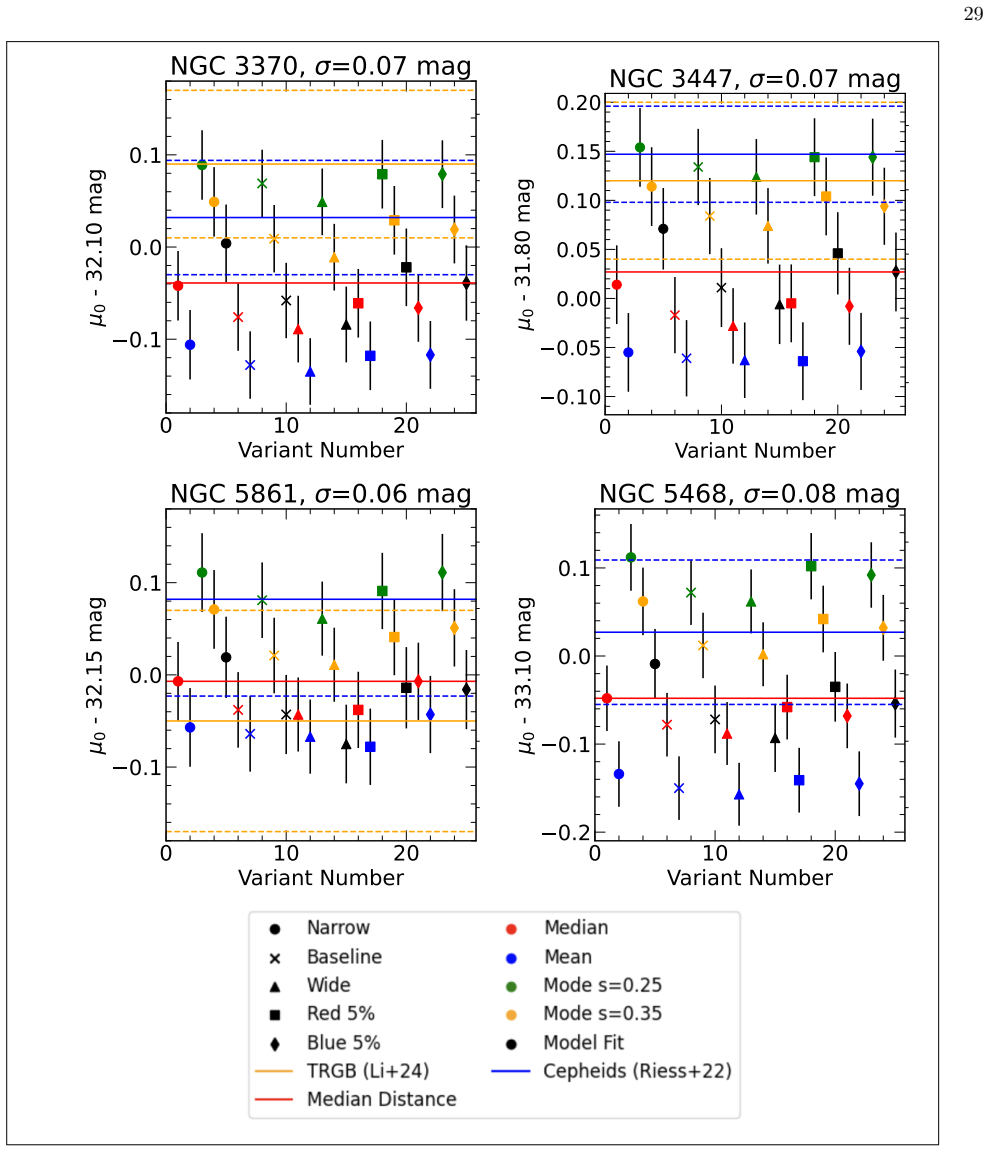
The object that carries the argument is the J-region luminosity function: the near-infrared brightness distribution of carbon-rich asymptotic giant branch stars selected in a color-magnitude box (F150W versus F150W−F277W, color cuts 1.0–1.5 mag, magnitude cuts about 5σ around the clump). The machinery is the comparison of 25 measurement variants—five statistics (median, clipped mean, mode with 0.25 and 0.35 mag smoothing, and a Gaussian-plus-quadratic model fit) crossed with five color ranges—measured identically in the anchor and each host. Distances are formed by subtracting the anchor JAGB from each host JAGB and adding the NGC 4258 maser distance; this relative, differential construction is what lets part of the luminosity-function asymmetry cancel along the ladder, and the spread across variants is what sets the systematic uncertainty.
What would settle it
A decisive check would be to measure JAGB in two or more widely separated outer-disk fields of a single non-anchor SN Ia host at similar galactocentric radius: if the two fields disagree by more than about 0.1 mag, as the NGC 4258 inner and outer fields do, the single-value calibration premise fails. Alternatively, a galaxy with a geometric distance independent of the distance ladder—such as a second water-maser galaxy—could be used to require anchor-field JAGB zero-points to agree to well under 0.05 mag.
Extended reading notes
Core claim
The paper's central claim is that the JAGB standard candle, measured with JWST in 15 galaxies hosting 18 Type Ia supernovae and anchored to the water-maser galaxy NGC 4258, gives distances consistent with HST Cepheids and a Hubble constant of H0 = 73.3 ± 1.4 (stat) ± 2.0 (sys) km/s/Mpc. The authors report a weighted mean JAGB-minus-Cepheid distance difference of −0.03 ± 0.02 (stat) ± 0.05 (sys) mag—that is, no significant offset between the two distance indicators. They also report that the dominant systematic is internal to the anchor: the JAGB mode measured in two NGC 4258 fields differs by 0.11 ± 0.022 mag, and J-region luminosity functions vary in skew, color slope, and mode-minus-mean offset from galaxy to galaxy, so different measurement statistics shift H0 by about 4 km/s/Mpc. The authors adopt the middle of all measurement variants as the baseline distance and conservatively assign 0.06 mag (roughly 2 km/s/Mpc) of intrinsic variation to the error budget.
Load-bearing premise
The load-bearing premise is that, after cutting to the outer disk, a fixed color range, and a magnitude window, the clump of carbon-rich stars used as the standard candle has the same characteristic brightness in the anchor galaxy NGC 4258 and in every supernova host galaxy.
Editorial extensions
If this is right
- JAGB distances to 15 galaxies hosting 18 Type Ia supernovae agree with HST Cepheid distances at a weighted mean of −0.03 ± 0.02 (stat) ± 0.05 (sys) mag.
- The middle JAGB measure calibrates SNe Ia to H0 = 73.3 ± 1.4 (stat) ± 2.0 (sys) km/s/Mpc, while using only the mode gives 71.2 ± 1.4 km/s/Mpc.
- The largest systematic in JAGB-based H0 is the 0.11 ± 0.02 mag field-to-field difference of the JAGB mode in NGC 4258, motivating a conservative 0.06 mag intrinsic-variation uncertainty corresponding to about 2 km/s/Mpc.
- JWST observations at about 40 Mpc (NGC 5468 and NGC 3147) approach the practical incompleteness limit, and one of the two targets cannot yield a robust JAGB measurement at the current exposure depth.
- No standardizing relation between JAGB luminosity-function skew, color dependence, and distance is found in the current sample.
Reading between the lines
- If the field-to-field JAGB variation seen in NGC 4258 is an intrinsic property of galaxies rather than a measurement artifact, then anchoring to any single galaxy imposes a floor on absolute calibration that more host statistics cannot remove; a multi-anchor approach using other geometric calibrators would be a direct test.
- The presence of carbon Miras in the J-region suggests a stellar-physics route to standardization: if the Mira fraction can be measured or removed through variability or period-luminosity information, part of the luminosity-function asymmetry and the resulting variant spread could shrink.
- The failure to find a skew-based standardizer may be sample-size limited; with roughly a dozen distances, a modest correlation between skew and JAGB offset would be difficult to detect, and targeted JWST observations of additional hosts could reveal one.
- The 0.05 mag distance offset between the authors' remeasurement of the comparison-program hosts and the published modes is tied directly to the NGC 4258 calibration choice, implying that future JAGB comparisons should report anchor-field-specific distances rather than a single averaged anchor value.
Editorial analysis
A structured set of objections, weighed in public.
Referee Report
Summary. This paper extends JAGB-based distance measurements to new JWST Cycle 2 SN Ia hosts, combines them with published JAGB samples from the SH0ES and CCHP programs, and uses the combined sample to calibrate SNe Ia and measure the Hubble constant. The authors report no significant mean offset between JAGB and HST Cepheid distances (-0.03 ± 0.02 stat ± 0.05 sys mag), but find significant field-to-field differences in the JAGB zero-point within NGC 4258, the maser anchor, and galaxy-to-galaxy variations in the JAGB luminosity function shape and skew. Their nominal result, H0 = 73.3 ± 1.4 (stat) ± 2.0 (sys) km/s/Mpc, is obtained by taking the "middle" of 25 measurement variants; using only the mode gives H0 = 71.2 ± 1.4 km/s/Mpc. The paper is transparent about these variant differences and about the failure to recover a robust JAGB measurement in NGC 3147.
Significance. If the reported result holds, this is a significant step in using JAGB as an independent rung on the distance ladder: the expanded JWST sample nearly triples the number of JAGB-calibrated SN Ia hosts and provides the first consistency check at distances beyond 32 mag. The paper is also valuable for its detailed treatment of incompleteness, crowding corrections, and the explicit documentation of field-to-field and method-to-method variation in the JAGB zero-point. The finding that JAGB distances agree with HST Cepheids at the ~0.05 mag level is an important cross-check of the Cepheid-based ladder. However, the central H0 value is sensitive to the arbitrary choice of the "middle" of variants, and the adopted systematic uncertainty is smaller than the measured NGC 4258 field-to-field offset, so the paper's headline number is not yet on as firm a footing as its valuable observational and methodological contributions.
major comments (3)
- [Sec. 4.1 / Sec. 2.5] The nominal H0 = 73.3 km/s/Mpc is derived from the "middle" of 25 measurement variants, but the paper does not provide a physical or statistical justification for why this statistic should equal the true universal JAGB zero-point. The sensitivity is large: replacing the middle with the mode changes H0 from 73.3 to 71.2 km/s/Mpc, a shift equal to the entire quoted systematic. Moreover, Sec. 5.2 and Fig. 11 show that the mode is the measure that best matches HST Cepheid distances in F150W. The choice of the middle therefore directly determines the central claim, and the paper's own cross-check favors a different measure; this needs either a defended physical rationale or an expansion of the systematic error budget that fully covers the mode-middle difference.
- [Sec. 4.2 / Sec. 5.1.1 / Fig. 7] The adopted systematic floor of 0.06 mag (Sec. 4.2) is smaller than the measured 0.11 ± 0.022 mag difference between the CCHP Inner and Outer fields of NGC 4258 (Sec. 5.1.1, Fig. 9), and Fig. 7 shows comparable dispersion among SH0ES East/West fields. The paper argues that non-mode measures reduce the field-to-field difference, but this is an argument in favor of a specific measure, not an estimate of the uncertainty in the zero-point transfer. Because the systematic is estimated from the same data that define the variants, and because the field-to-field offset is three times larger than the quoted systematic, the quoted 0.06 mag does not appear to cover the dominant source of absolute calibration error identified by the authors themselves.
- [Sec. 2.5 / Sec. 5.1.3 / Sec. 4.2] The distance ladder step in Sec. 2.5 assumes that after outer-disk, color, and magnitude cuts, the JAGB zero-point is identical in NGC 4258 and in every SN Ia host. The paper's own diagnostics stress this assumption: Sec. 5.1.3 reports tilted J-regions with slopes up to 7 sigma, Fig. 2/Fig. 4 show galaxy-to-galaxy variation in skew and mode-mean differences, and Sec. 4.2 states that no standardizing relation is found. Partial cancellation of LF asymmetry along the ladder is not guaranteed when the anchor is a large, nearby galaxy observed with only partial field coverage, while distant hosts are observed with different spatial coverage and different completeness properties. The central claim would be more robust if the H0 result were demonstrated to be stable under a physically motivated subset of variants or under an explicit treatment of the field-to-field zero-point uncertainty.
minor comments (3)
- [Sec. 1 / Sec. 2.2] There are several typographical errors: "photometery" (Sec. 2.2), "aysmpototic" (Sec. 5.1.2), and "as-of-yet unpublished" in the footnote of Sec. 5.2 should be "as-yet unpublished." These do not affect the science but should be corrected.
- [Appendix B / Table 6] The galaxy NGC 5468 is referred to as "NGC 5458" in at least one place in Appendix B and as "NGC 5468" elsewhere; this should be made consistent.
- [Sec. 2.5 / Eq. (1)] Equation (1) adds the statistical uncertainties sigma_stat,N4258 and sigma_stat,host as if they are independent, but the text notes that the maximum statistical uncertainty across variants is used. It would be clearer to state explicitly whether the maximum or the standard error of the mean is adopted for each term, and to define sigma_var as the standard deviation of the middle values in distance space rather than in magnitude space.
Circularity Check
No significant circularity: the JAGB distances are differential against NGC 4258 and compared with independent Cepheid and SN Ia data; the self-citations provide methodology and comparison distances but are not load-bearing inputs to the central result.
full rationale
The paper's distance construction is explicitly differential: host JAGB measurements are tied to the NGC 4258 JAGB and the external maser distance (Reid et al. 2019), and the Hubble constant is obtained by calibrating SNe Ia with those distances and the published Hubble-diagram intercept (Section 4.1, Eq. 2). No equation in the derivation is defined in terms of the quantity it is used to predict. The JAGB-Cepheid comparison uses published HST Cepheid distances (Riess et al. 2022, 2024a) that were not fitted from the JAGB measurements; the paper reports both middle-based and mode-based differences, both consistent with zero, and the mode variant that best matches Cepheids is not the one adopted for the nominal H0. Self-citations to Li et al. (2024a) supply the measurement-variant framework and prior JAGB distances, but these are methodological antecedents rather than circular inputs: the new host measurements are new photometry, and the CCHP JAGB modes are independently remeasured from published photometry with <0.01 mag agreement. The paper's own internal diagnostics, such as the 0.11 +/- 0.022 mag field-to-field offset in NGC 4258 and the failure to find a standardizing relation for LF skew, are reported as systematics and stress the universality assumption, but they do not make the derivation circular; they are correctness risks. The score reflects the presence of same-team citations and shared analysis infrastructure, not a demonstrated reduction of any prediction to its own input.
Assumptions & free parameters
free parameters (6)
- Fiducial JAGB estimator ("middle of variants") =
H0 = 73.3 km/s/Mpc baseline
- Mode smoothing scale =
s = 0.25 and 0.35 mag
- Baseline color window =
1.0 < F150W - F277W < 1.5 mag
- Intrinsic variation systematic floor =
0.06 mag (about 2.0 km/s/Mpc)
- Completeness robustness threshold =
SNR > 10 at JAGB + 1 mag
- NGC 3370 crowd cut adjustment =
crowd < 0.4 in F277W
assumptions (6)
- domain assumption The JAGB is a universal standard candle: the intrinsic J-region luminosity function has the same reference magnitude in the outer disks of all galaxies.
- domain assumption The geometric maser distance to NGC 4258, 29.398 mag from Reid et al. (2019), is correct.
- domain assumption DOLPHOT artificial star tests provide unbiased crowding and completeness corrections.
- domain assumption Type Ia supernova standardization and the Hubble diagram intercept aB = 0.71448 from Riess et al. (2022) apply to this sample.
- domain assumption Foreground extinction from Schlafly & Finkbeiner (2011) with the Fitzpatrick (1999) Rv = 3.1 law is correct for these fields.
- domain assumption Variable carbon Miras either do not dominate the J-region or their effect is captured by the variant spread and systematic floor.
Cite this review
Pith. "Pith review of JAGB 2.0: Improved Constraints on the J-region Asymptotic Giant Branch-based Hubble Constant from an Expanded Sample of JWST Observations." pith.science (2026). https://pith.science/paper/PEFWBKXO
@misc{pith2026250205259,
  author       = {Pith},
  title        = {Pith review of: JAGB 2.0: Improved Constraints on the J-region Asymptotic Giant Branch-based Hubble Constant from an Expanded Sample of JWST Observations},
  year         = {2026},
  howpublished = {\url{https://pith.science/paper/PEFWBKXO}},
  note         = {Machine review of arXiv:2502.05259}
}
abstract
The J-region Asymptotic Giant Branch (JAGB) is an overdensity of stars in the near-infrared, attributed to carbon-rich asymptotic giant branch stars, and recently used as a standard candle for measuring extragalactic distances and the Hubble constant. Using JWST in Cycle 2, we extend JAGB measurements to 6 hosts of 9 Type Ia supernovae (SNe Ia) (NGC 2525, NGC 3147, NGC 3370, NGC 3447, NGC 5468, and NGC 5861), with two at $D \sim 40$ Mpc, all calibrated by the maser host NGC 4258. We investigate the effects of incompleteness and find that we are unable to recover a robust JAGB measurement in one of the two most distant hosts at $R \sim 40$ Mpc, NGC 3147. We compile all JWST JAGB observations in SNe Ia hosts, 15 galaxies hosting 18 SNe Ia, from the SH0ES and CCHP programs and employ all literature measures (mode, mean, median, model). We find no significant mean difference between these distances and those from HST Cepheids, $-0.03\pm0.02$ (stat) $\pm$ 0.05 (sys) mag. We find a difference of 0.11 $\pm$ 0.02 mag between JAGB mode measurements in the CCHP analyses of two fields in NGC 4258, a feature also seen in two SH0ES fields (see field-to-field variations in Li et al. 2024a), indicating significant field-to-field variation of JAGB measurements in NGC 4258 which produce a large absolute calibration uncertainty. Variations are also seen in the shape of the JAGB LF across galaxies so that different measures produce different values of the Hubble constant. We look for but do not (yet) find a standardizing relation between JAGB LF skew or color dependence and the apparent variation. Using the middle result of all JAGB measures to calibrate SNe Ia yields a Hubble constant of $H_0$ = 73.3 $\pm$ 1.4 (stat) $\pm$ 2.0 (sys) km/s/Mpc with the systematic dominated by apparent differences across NGC 4258 calibrating fields or their measures.
Figures


Figures from the paper (15 more)


Forward citations
Cited by 1 Pith paper
-
Absolute Calibration of Cluster Mira Variables to Provide a New Anchor for the Hubble Constant Determination
Mira variables in globular clusters are used as a new, independent distance anchor, yielding a 3.7% Hubble constant of 73.06 ± 2.67 km/s/Mpc.
Reference graph
Works this paper leans on
-
[1]
, " * write output.state after.block = add.period write newline
ENTRY address archivePrefix author booktitle chapter doi edition editor eprint howpublished institution journal key month number organization pages publisher school series title misctitle type volume year version url label extra.label sort.label short.list INTEGERS output.state before.all mid.sentence after.sentence after.block FUNCTION init.state.consts ...
-
[2]
write newline
" write newline "" before.all 'output.state := FUNCTION format.url url empty "" new.block "" url * "" * if FUNCTION format.eprint eprint empty "" archivePrefix empty "" archivePrefix "arXiv" = new.block " " eprint * " " * new.block " " eprint * " " * if if if FUNCTION format.doi doi empty "" " " doi * " " * if FUNCTION format.pid doi empty eprint empty ur...
-
[3]
Y<Q =.> X@ (9Bfxx0@l ߴ)qy p,
thebibliography [1] 20pt to REFERENCES 6pt =0pt -12pt 10pt plus 3pt =0pt =0pt =1pt plus 1pt =0pt =0pt -12pt =13pt plus 1pt =20pt =13pt plus 1pt \@M =10000 =-1.0em =0pt =0pt 0pt =0pt =1.0em @enumiv\@empty 10000 10000 `\.\@m \@noitemerr \@latex@warning Empty `thebibliography' environment \@ifnextchar \@reference \@latexerr Missing key on reference command E...
2021
-
[4]
2022, , 664, A45, 10.1051/0004-6361/202243595
Abia , C., de Laverny , P., Romero-G \'o mez , M., & Figueras , F. 2022, , 664, A45, 10.1051/0004-6361/202243595
-
[5]
Anand , G. S., Riess , A. G., Yuan , W., et al. 2024, , 966, 89, 10.3847/1538-4357/ad2e0a
-
[6]
Astropy Collaboration , Robitaille , T. P., Tollerud , E. J., et al. 2013, , 558, A33, 10.1051/0004-6361/201322068
-
[7]
Astropy Collaboration , Price-Whelan , A. M., Sip o cz , B. M., et al. 2018, , 156, 123, 10.3847/1538-3881/aabc4f
-
[8]
Astropy Collaboration , Price-Whelan , A. M., Lim , P. L., et al. 2022, , 935, 167, 10.3847/1538-4357/ac7c74
Show all 65 references
-
[9]
2005, , 442, 159, 10.1051/0004-6361:20053357
Battinelli , P., & Demers , S. 2005, , 442, 159, 10.1051/0004-6361:20053357
2005 doi
-
[10]
S., et al
Breuval , L., Riess , A., Anand , G. S., et al. 2023, A 1\
2023
-
[11]
G., Casertano , S., et al
Breuval , L., Riess , A. G., Casertano , S., et al. 2024, , 973, 30, 10.3847/1538-4357/ad630e
2024 doi
-
[12]
H., Aaronson , M., & Norris , J
Cook , K. H., Aaronson , M., & Norris , J. 1986, , 305, 634, 10.1086/164277
1986 doi
-
[13]
2021, Classical and Quantum Gravity, 38, 153001, 10.1088/1361-6382/ac086d
Di Valentino , E., Mena , O., Pan , S., et al. 2021, Classical and Quantum Gravity, 38, 153001, 10.1088/1361-6382/ac086d
2021 doi
-
[14]
2016, DOLPHOT: Stellar photometry , Astrophysics Source Code Library, record ascl:1608.013
Dolphin , A. 2016, DOLPHOT: Stellar photometry , Astrophysics Source Code Library, record ascl:1608.013. 1608.013
2016
-
[15]
Dolphin , A. E. 2000, , 112, 1383, 10.1086/316630
2000 doi
-
[16]
2002, , 332, 91, 10.1046/j.1365-8711.2002.05271.x
---. 2002, , 332, 91, 10.1046/j.1365-8711.2002.05271.x
2002
-
[17]
Fitzpatrick , E. L. 1999, , 111, 63, 10.1086/316293
1999 doi
-
[18]
L., & Madore , B
Freedman , W. L., & Madore , B. F. 2020, , 899, 67, 10.3847/1538-4357/aba9d8
2020 doi
-
[19]
L., Madore , B
Freedman , W. L., Madore , B. F., Hoyt , T., et al. 2021, Answering the Most Important Problem in Cosmology Today: Is the Tension in the Hubble Constant Real? , JWST Proposal. Cycle 1, ID. \#1995
2021
-
[20]
L., Madore , B
Freedman , W. L., Madore , B. F., Jang , I. S., et al. 2024, arXiv e-prints, arXiv:2408.06153. 2408.06153
2024 arXiv
-
[21]
L., Madore , B
Freedman , W. L., Madore , B. F., Hoyt , T., et al. 2020, , 891, 57, 10.3847/1538-4357/ab7339
2020 doi
-
[22]
B., et al
Graczyk , D., Pietrzy \'n ski , G., Thompson , I. B., et al. 2020, , 904, 13, 10.3847/1538-4357/abbb2b
2020 doi
-
[23]
Karakas , A. I. 2014, , 445, 347, 10.1093/mnras/stu1727
2014 doi
-
[24]
Lee , A. J. 2023, , 956, 15, 10.3847/1538-4357/acee69
2023 doi
-
[25]
J., Freedman , W
Lee , A. J., Freedman , W. L., Jang , I. S., Madore , B. F., & Owens , K. A. 2024 a , , 961, 132, 10.3847/1538-4357/ad12c7
2024 doi
- [26]
-
[27]
2021 a , , 907, 112, 10.3847/1538-4357/abd253
---. 2021 a , , 907, 112, 10.3847/1538-4357/abd253
2021 doi
-
[28]
J., Freedman , W
Lee , A. J., Freedman , W. L., Madore , B. F., Owens , K. A., & Sung Jang , I. 2021 b , , 923, 157, 10.3847/1538-4357/ac2f4c
2021 doi
-
[29]
J., Rousseau-Nepton , L., Freedman , W
Lee , A. J., Rousseau-Nepton , L., Freedman , W. L., et al. 2022, , 933, 201, 10.3847/1538-4357/ac7321
2022 doi
-
[30]
J., Monson , A
Lee , A. J., Monson , A. J., Freedman , W. L., et al. 2024 c , , 967, 22, 10.3847/1538-4357/ad32c7
2024 doi
-
[31]
G., Casertano , S., et al
Li , S., Riess , A. G., Casertano , S., et al. 2024 a , , 966, 20, 10.3847/1538-4357/ad2f2b
2024 doi
-
[32]
G., Scolnic , D., et al
Li , S., Riess , A. G., Scolnic , D., et al. 2023, , 956, 32, 10.3847/1538-4357/acf4fb
2023 doi
- [33]
-
[34]
M., Ngeow , C.-C., Kanbur , S
Macri , L. M., Ngeow , C.-C., Kanbur , S. M., Mahzooni , S., & Smitka , M. T. 2015, , 149, 117, 10.1088/0004-6256/149/4/117
2015 doi
-
[35]
F., & Freedman , W
Madore , B. F., & Freedman , W. L. 2020, , 899, 66, 10.3847/1538-4357/aba045
2020 doi
-
[36]
F., Freedman , W
Madore , B. F., Freedman , W. L., Lee , A. J., & Owens , K. 2022, , 938, 125, 10.3847/1538-4357/ac92fd
2022 doi
-
[37]
2010, , 405, 1025, 10.1111/j.1365-2966.2010.16486.x
M \'e nard , B., Scranton , R., Fukugita , M., & Richards , G. 2010, , 405, 1025, 10.1111/j.1365-2966.2010.16486.x
2010
-
[38]
H., Cannon , R
Morgan , D. H., Cannon , R. D., Hatzidimitriou , D., & Croke , B. F. W. 2003, , 341, 534, 10.1046/j.1365-8711.2003.06424.x
2003
-
[39]
S., Riess , A
Murakami , Y. S., Riess , A. G., Stahl , B. E., et al. 2023, , 2023, 046, 10.1088/1475-7516/2023/11/046
2023 doi
-
[40]
2021, , 501, 933, 10.1093/mnras/staa3750
Parada , J., Heyl , J., Richer , H., Ripoche , P., & Rousseau-Nepton , L. 2021, , 501, 933, 10.1093/mnras/staa3750
2021 doi
- [41]
-
[42]
2019, , 567, 200, 10.1038/s41586-019-0999-4
Pietrzy \'n ski , G., Graczyk , D., Gallenne , A., et al. 2019, , 567, 200, 10.1038/s41586-019-0999-4
2019 doi
-
[43]
2020, , 641, A6, 10.1051/0004-6361/201833910
Planck Collaboration , Aghanim , N., Akrami , Y., et al. 2020, , 641, A6, 10.1051/0004-6361/201833910
2020 doi
-
[44]
J., Richer , H
Pritchet , C. J., Richer , H. B., Schade , D., Crabtree , D., & Yee , H. K. C. 1987, , 323, 79, 10.1086/165808
1987 doi
-
[45]
J., Pesce , D
Reid , M. J., Pesce , D. W., & Riess , A. G. 2019, , 886, L27, 10.3847/2041-8213/ab552d
2019 doi
-
[46]
Richer , H. B. 1981, , 243, 744, 10.1086/158642
1981 doi
-
[47]
B., Crabtree , D
Richer , H. B., Crabtree , D. R., & Pritchet , C. J. 1984, , 287, 138, 10.1086/162671
1984 doi
-
[48]
B., Pritchet , C
Richer , H. B., Pritchet , C. J., & Crabtree , D. R. 1985, , 298, 240, 10.1086/163602
1985 doi
-
[49]
I., Breuval , L., et al
Riess , A., Anderson , R. I., Breuval , L., et al. 2021, Uncrowding the Cepheids for an Improved Determination of the Hubble Constant , JWST Proposal. Cycle 1, ID. \#1685
2021
-
[50]
2023, Scrutinizing the Dirtiest Cepheids, a Test of the Hubble Tension , JWST Proposal
---. 2023, Scrutinizing the Dirtiest Cepheids, a Test of the Hubble Tension , JWST Proposal. Cycle 2, ID. \#2875
2023
-
[51]
G., Yuan , W., Macri , L
Riess , A. G., Yuan , W., Macri , L. M., et al. 2022, , 934, L7, 10.3847/2041-8213/ac5c5b
2022 doi
- [52]
-
[53]
G., Anand , G
Riess , A. G., Anand , G. S., Yuan , W., et al. 2024 b , , 962, L17, 10.3847/2041-8213/ad1ddd
2024 doi
-
[54]
2020, , 495, 2858, 10.1093/mnras/staa1346
Ripoche , P., Heyl , J., Parada , J., & Richer , H. 2020, , 495, 2858, 10.1093/mnras/staa1346
2020 doi
-
[55]
F., & Finkbeiner , D
Schlafly , E. F., & Finkbeiner , D. P. 2011, , 737, 103, 10.1088/0004-637X/737/2/103
2011 doi
-
[56]
2022, , 938, 113, 10.3847/1538-4357/ac8b7a
Scolnic , D., Brout , D., Carr , A., et al. 2022, , 938, 113, 10.3847/1538-4357/ac8b7a
2022 doi
-
[57]
G., Wu , J., et al
Scolnic , D., Riess , A. G., Wu , J., et al. 2023, , 954, L31, 10.3847/2041-8213/ace978
2023 doi
-
[58]
2011, ;login: The USENIX Magazine, 36, 42
Tange, O. 2011, ;login: The USENIX Magazine, 36, 42. http://www.gnu.org/s/parallel
2011
-
[59]
A., Burns , C
Uddin , S. A., Burns , C. R., Phillips , M. M., et al. 2024, , 970, 72, 10.3847/1538-4357/ad3e63
2024 doi
- [60]
- [61]
-
[62]
R., Dolphin , A
Weisz , D. R., Dolphin , A. E., Savino , A., et al. 2024, , 271, 47, 10.3847/1538-4365/ad2600
2024 doi
-
[63]
G., et al
Wu , J., Scolnic , D., Riess , A. G., et al. 2023, , 954, 87, 10.3847/1538-4357/acdd7b
2023 doi
-
[64]
M., He , S., et al
Yuan , W., Macri , L. M., He , S., et al. 2017, , 154, 149, 10.3847/1538-3881/aa86f1
2017 doi
-
[65]
2021, , 916, 19, 10.3847/1538-4357/ac04b2
Zgirski , B., Pietrzy \'n ski , G., Gieren , W., et al. 2021, , 916, 19, 10.3847/1538-4357/ac04b2
2021 doi
Reviewed August 8, 2026 · model on record in the stance chip above.
Discussion (0). Continue with ORCID to comment.