REVIEW 5 major objections 6 minor 39 references
Optimizing Fine-Grained Parallelism Through Dynamic Load Balancing on Multi-Socket Many-Core Systems
T0 review · 5 major / 6 minor · reviewed 2026-08-08 · deepseek-v4-flash
Pith's one-line read The paper claims that replacing GNU OpenMP's global task lock and centralized barrier with a lock-less task queue and a distributed tree barrier removes the dominant synchronization cost of fine-grained tasking, yielding up to 1522.8x…
desk verdict A solid engineering contribution with a plausible central claim, but the headline speedups rest on an unverified barrier invariant and fitted DLB parameters; worth a serious referee, not yet worth citing. read the letter →
The pith
A machine-rendered reading of the paper's core claim, the machinery that carries it, and where it could break.
The reading
What carries the argument
The load-bearing mechanism is a combination of two lock-less data structures. XQueue replaces GOMP's global priority queue: each worker has one master SPSC queue and one auxiliary SPSC queue per other worker; producers round-robin push task pointers to target queues, consumers drain their master queue then auxiliaries, and no atomic instructions are used, only cache-friendly reads and writes. The distributed tree barrier organizes workers in a binary tree; a worker is gathered when all workers have entered the barrier, the worker is idle, its current task has no unfinished dependencies, and all of its children are gathered, and it then atomically sets a per-parent complete flag, with release performed as a lock-less tree broadcast of flags. Around these, the lock-less messaging protocol uses a 64-bit request cell (40-bit round number plus 24-bit worker ID) and a round cell per victim so thieves can ask a victim to redirect or hand over tasks without locks or atomics; the victim validates the request by matching round numbers and increments its round after handling.
What would settle it
Instrument the runtime to record, for each worker, the barrier-exit timestamp and the global task count plus any pending dependency counters, then run the nine BOTS workloads at 192 threads. If any worker exits the team barrier while the global task count is nonzero, while a dependency on any in-flight task remains unresolved, or while any other worker has not yet reached the barrier and could still enqueue new work, the gather conditions are insufficient and the central claim collapses.
Extended reading notes
Core claim
The authors claim that the dominant cost in GNU OpenMP for fine-grained, short-running tasks is not the task computation itself but the runtime's synchronization: a single global priority task queue protected by a global task lock, and a centralized team barrier that atomically tracks a global task count. They integrate XQueue, a lock-less multi-producer/multi-consumer queue in which each worker owns an SPSC master queue and per-worker auxiliary queues with round-robin push, into GOMP, converting the global count to an atomic and removing the lock. They then replace the centralized barrier with a hybrid distributed tree barrier that gathers lock-free and releases lock-less, with a theoretical lower bound of half the atomic memory operations. On 192 cores, XQueue alone gives up to 96.5x over GOMP, and the queue plus tree barrier gives up to 1522.8x for NQueens. Finally, two lock-less NUMA-aware load-balancing strategies — redirect push (NA-RP) and batch work stealing (NA-WS) — communicate via lock-less request and round cells and improve performance up to 4x over the static round-robin XQueue schedule, with substantial gains in task locality.
Load-bearing premise
The whole result rests on the unproven assumption that the tree barrier's four gather conditions correctly detect when every task is finished, so a worker never leaves the barrier while another worker could still create work.
Editorial extensions
If this is right
- With XGOMPTB, fine-grained workloads that were more than 1000x slower in stock GOMP become practical at 192 threads, so OpenMP task directives can now be used for tasks lasting tens of cycles without paying prohibitive runtime overhead.
- The distributed tree barrier's theoretical lower bound of half the atomic memory access operations means barrier cost scales with tree depth and per-node flags rather than with a single contended global counter.
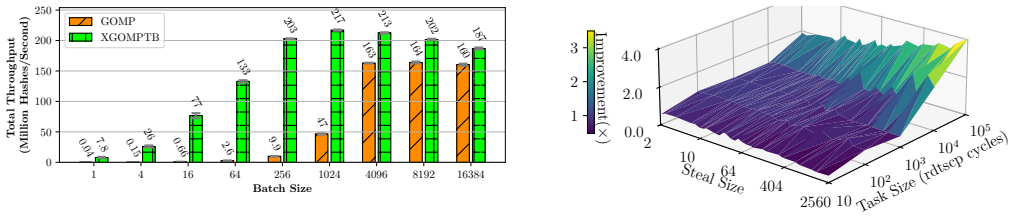
- NA-RP is best for large tasks (above roughly 10^4 rdtscp cycles) and can deliver about 4x over static load balancing, while NA-WS improves all nine tested benchmarks and is described as a well-rounded, less sensitive default.
- The tuning guidelines in Table IV let practitioners choose a strategy, NUMA-local probability, and steal size from measured task size, with the observed pattern that small tasks want small steal sizes and full NUMA locality.
- The PoSp case study shows a 195x throughput gain at batch size 1 and a 32% peak-throughput gain over stock GOMP when batch sizes are chosen optimally.
Reading between the lines
- Editorial inference: if the barrier's correctness premise holds, the same lock-less queue-plus-tree-barrier recipe could be ported to other lock-based OpenMP runtimes, since nothing in the design is specific to GCC's internals.
- Editorial inference: the headline 1522.8x figure is a single-benchmark, single-machine upper bound; on workloads with large tasks or low lock contention the gains shrink considerably, so expected speedups should be predicted from task-size histograms rather than from the headline number.
- Editorial inference: the tree barrier's correctness is asserted by design rather than proven, so a randomized dependency-DAG stress test or a formal model of the gather conditions would directly test whether the speedups hide a correctness assumption.
- Editorial inference: the lock-less messaging protocol uses a 40-bit round number per victim, so after 2^40 handled requests the round wraps; on extremely long-running fine-grained workloads that wrap is a concrete scalability limit worth testing.
Signed reviews
Editorial analysis
A structured set of objections, weighed in public.
Referee Report
Summary. The paper proposes three optimizations to GNU OpenMP (GOMP) for fine-grained task parallelism on many-core NUMA systems: (1) integration of XQueue, a lock-less MPMC task queue, replacing GOMP's priority queue and global task lock; (2) a hybrid lock-free/lock-less distributed tree barrier to replace GOMP's centralized barrier; and (3) two NUMA-aware lock-less dynamic load balancing strategies, NA-RP and NA-WS. The authors evaluate the resulting XGOMP and XGOMPTB runtimes on nine BOTS benchmarks on a 192-core Intel Skylake machine and claim speedups over GOMP of up to 1522.8x, with additional up-to-4x gains from the load balancers over XGOMPTB. They also present profiling tools, parameter-tuning guidelines, and a Proof-of-Space blockchain application case study.
Significance. If the results are substantiated, the paper would demonstrate that GOMP's synchronization overhead is the dominant cost for fine-grained tasking on many-core systems and that a lock-less queue, distributed tree barrier, and NUMA-aware load balancing can remove that cost. The XQueue integration and the proposed DLB strategies are concrete and potentially useful engineering contributions, and the paper includes a real application (PoSp) plus profiling infrastructure. Credit is due for evaluating against external GOMP, LOMP, and XLOMP baselines, which makes the main XGOMPTB comparisons non-circular. However, the significance is conditional: the central correctness invariant of the distributed tree barrier is unproven, the DLB gains are selected from per-benchmark parameter sweeps, and the empirical claims rest on a single machine with no released artifact or raw data. These issues must be resolved before the headline speedups can be considered reliable.
major comments (5)
- [Section III-B] The safe-release invariant of the distributed tree barrier is not established. The paper replaces GOMP's centralized barrier, which releases only when the last worker has entered and the global task count is zero, with a tree barrier whose gather conditions are (i) all workers entered, (ii) the worker is idle, (iii) the current task has no unfinished dependencies, and (iv) all children barriers are gathered. Because XQueue is explicitly MPMC and the NA-RP/NA-WS strategies in Section IV can push or steal tasks into arbitrary workers' auxiliary queues, it is possible for a worker that has reported 'idle' to receive a task from another worker before the root completes the release. The paper provides no proof, model check, or stress test that these local conditions imply the global invariant that no task exists and none can be created. Since every headline speedup in Figs. 4 and 5 depends on this barrier releasing correctly, this is a load-bearing gap. Please add a formal correctness argument or, failing that, a randomized dependency-coupled stress test with assertion checks.
- [Section VI-B1 and Table II] The NQueens discussion is internally contradictory. The text states 'For NQueens, NA-RP is the best performing strategy' and then, in the same subsection, 'We see in Table II that NA-RP yields the worst average performance.' Table II reports NQueens NA-RP 26.5 s versus NA-WS 23.2 s, and Table III reports SLB 23.8 s, so on the reported averages NA-RP is not the best strategy. The subsequent explanation invoking profiling overhead is not supported by any presented data. Please correct the prose and reconcile the figure and table numbers.
- [Section VI-B and Table I] The DLB speedups are selected maxima over per-benchmark parameter sweeps. For each benchmark, the authors sweep Nvictim, Nsteal, Tinterval, and Plocal and then report the best configuration; the 'up to 4x' claim is therefore a best-case fitted value, not a prediction of expected behavior. Table I shows that the optimal parameters vary widely across benchmarks, and the tuning guidelines in Section VIII are derived from the same data used to select those optima. The paper should either validate the guidelines on held-out benchmarks or inputs, or report the full distribution of configuration results and a sensitivity analysis. Without this, the DLB comparison risks overfitting and does not support the strength of the claimed gains.
- [Section IV-B, Algorithm 1] The request construction 'newReq ← (tidi << 40) & round' cannot encode a request as described. With the 40-bit round occupying bits 0-39 and the 24-bit worker ID in bits 40-63, the bitwise AND of the shifted ID with the round value is identically zero. This should be a bitwise OR (or an explicit bit-field merge). As printed, the lock-less messaging protocol is not well defined, and the victim logic in Algorithm 2 cannot operate as described.
- [Section VI and reproducibility] The empirical claims are not reproducible from the manuscript. The paper reports speedups of up to 1522.8x based on BOTS measurements on a single machine, with no released code, no released raw data, and no reported variance for most of the central comparisons (Figs. 4-6). The statement in Section VI that the larger and smaller experiments 'yield similar results' is not accompanied by data. Given the magnitude of the claims, the authors should provide an artifact (code, scripts, raw logs, and configurations) and at least confidence or variance information for the main speedup figures.
minor comments (6)
- [Figure 10 caption] The caption reads 'A-WS (work-stealing)' but the strategy is named NA-WS throughout the paper.
- [Equation (1) and Section VIII] The definition of Ssteal mixes Nvictim, Nsteal, and a log-scaled Tinterval, but the units and the intended meaning of 'steal size' for NA-RP versus NA-WS are not clarified; please define the quantity precisely and explain why this combination is a meaningful independent variable.
- [Table II and Figure 7] Table II reports average times that appear inconsistent with the bars in Figure 7 (e.g., Fib NA-RP 9.9 s in Table II versus the corresponding bar in Figure 7). Please reconcile the two presentations or explain the difference.
- [Section III-B] The claim that the hybrid tree barrier 'yields a theoretical lower bound of half the atomic memory access operations' is asserted without a model or derivation; please provide the counting argument and state the assumptions.
- [Section IV-B, Algorithms 1-3] The symbol ctidthief is used before it is introduced, and the relationship between req, round, and the 64-bit request cell layout is not fully defined; please define all bit-field sizes and variable scopes where the algorithms are first presented.
- [Table IV] Entries such as 'Best Ssteal 100-101' are ambiguous; they presumably mean 10^0-10^1, but the exponent formatting should be explicit.
Circularity Check
No load-bearing circularity: speedups are direct measurements against external GOMP/LOMP/XLOMP baselines; DLB 'up to 4x' is an explicitly best-case sweep result, not a fitted prediction.
full rationale
The central claims in this paper are empirical, not derived. XGOMP and XGOMPTB are compared with unmodified GNU OpenMP, LLVM OpenMP, and XLOMP on the BOTS suite and a separate PoSp application, so the headline improvements (up to 96.5x, 1522.8x, and 4x) are measured against external baselines rather than obtained by substituting a definition into itself. The XQueue structure and the lock-less messaging protocol come from the authors' prior work [4,10], but the present paper integrates XQueue into GOMP and re-measures it; these self-citations are to published, code-backed artifacts and are not used as an argument to forbid alternatives, so they are not load-bearing. The distributed tree barrier's gather conditions in Section III-B are asserted without a formal proof or model check that they imply the global 'no task can still be enqueued' invariant; this is a genuine omitted-proof/correctness risk, but it is not a circularity because the paper does not define 'gathered' in terms of the speedup it later claims. The DLB evaluation in Section VI-B sweeps Nvictim, Nsteal, Tinterval, and Plocal per benchmark and reports the best observed configuration; the paper is explicit that this is 'with optimal settings' and later validates the resulting guidelines on larger inputs (Section VIII, Fig. 11), so the 'up to 4x' is a best-case selection rather than a fitted parameter renamed as a prediction. The asserted validation that scaled-down and full-size experiments give similar results is not shown with data, but that is a missing-evidence limitation, not a circular step. Overall, no derivation chain reduces to its own inputs; score 2 reflects only the presence of minor non-load-bearing self-citations.
Assumptions & free parameters
free parameters (4)
- Nvictim =
1 to 24, per benchmark (Table I)
- Nsteal =
1 to 32, per benchmark (Table I)
- Tinterval =
1e3 to 1e5 cycles, per benchmark (Table I)
- Plocal =
0.03 to 1.0, per benchmark (Table I)
assumptions (4)
- domain assumption XQueue and its underlying B-queue are correct lockless MPMC and SPSC queues.
- domain assumption Converting GOMP's global task count to an atomic variable with acquire-release ordering preserves tasking correctness.
- domain assumption The hybrid tree barrier's gather conditions guarantee deadlock-free and correct barrier release.
- domain assumption The lockless round/request messaging protocol prevents lost or stale steal requests despite non-atomic writes.
Cite this review
Pith. "Pith review of Optimizing Fine-Grained Parallelism Through Dynamic Load Balancing on Multi-Socket Many-Core Systems." pith.science (2026). https://pith.science/paper/CN75B3BV
@misc{pith2026250205293,
  author       = {Pith},
  title        = {Pith review of: Optimizing Fine-Grained Parallelism Through Dynamic Load Balancing on Multi-Socket Many-Core Systems},
  year         = {2026},
  howpublished = {\url{https://pith.science/paper/CN75B3BV}},
  note         = {Machine review of arXiv:2502.05293}
}
abstract
Achieving efficient task parallelism on many-core architectures is an important challenge. The widely used GNU OpenMP implementation of the popular OpenMP parallel programming model incurs high overhead for fine-grained, short-running tasks due to time spent on runtime synchronization. In this work, we introduce and analyze three key advances that collectively achieve significant performance gains. First, we introduce XQueue, a lock-less concurrent queue implementation to replace GNU's priority task queue and remove the global task lock. Second, we develop a scalable, efficient, and hybrid lock-free/lock-less distributed tree barrier to address the high hardware synchronization overhead from GNU's centralized barrier. Third, we develop two lock-less and NUMA-aware load balancing strategies. We evaluate our implementation using Barcelona OpenMP Task Suite (BOTS) benchmarks. We show that the use of XQueue and the distributed tree barrier can improve performance by up to 1522.8$\times$ compared to the original GNU OpenMP. We further show that lock-less load balancing can improve performance by up to 4$\times$ compared to GNU OpenMP using XQueue.
Figures


Figures from the paper (7 more)




Reference graph
Works this paper leans on
-
[1]
Welcome to the documentation of OpenMP in LLVM! — LLVM/OpenMP 20.0.0git documentation
“Welcome to the documentation of OpenMP in LLVM! — LLVM/OpenMP 20.0.0git documentation.” [Online]. Available: https://openmp.llvm.org/
-
[2]
Cilk: an efficient multithreaded runtime system,
R. D. Blumofe, C. F. Joerg, B. C. Kuszmaul, C. E. Leiserson, K. H. Randall, and Y . Zhou, “Cilk: an efficient multithreaded runtime system,” in 5th ACM SIGPLAN Symposium on Principles and Practice of Parallel Programming , ser. PPOPP ’95. New York, NY , USA: Association for Computing Machinery, 1995, p. 207–216. [Online]. Available: https://doi.org/10.114...
-
[3]
Berkeley UPC - Unified Parallel C
“Berkeley UPC - Unified Parallel C.” [Online]. Available: https: //upc.lbl.gov/
-
[4]
P. Nookala, P. Dinda, K. C. Hale, K. Chard, and I. Raicu, “Enabling extremely fine-grained parallelism via scalable concurrent queues on modern many-core architectures,” in 29th International Symposium on Modeling, Analysis, and Simulation of Computer and Telecommunication Systems. Houston, TX, USA: IEEE, Nov. 2021, p. 1–8. [Online]. Available: https://ie...
-
[5]
Synchronization strategies on many-core SMT systems,
A. Navarro-Torres, J. Alastruey-Bened ´e, P. Ib ´a˜nez-Mar´ın, and M. Carpen-Amarie, “Synchronization strategies on many-core SMT systems,” in IEEE 33rd International Symposium on Computer Architecture and High Performance Computing (SBAC-PAD) , Oct. 2021, pp. 54–63, iSSN: 2643-3001. [Online]. Available: https://ieeexplore.ieee.org/document/9651585/?arnum...
-
[6]
Everything you always wanted to know about synchronization but were afraid to ask,
T. David, R. Guerraoui, and V . Trigonakis, “Everything you always wanted to know about synchronization but were afraid to ask,” in 24th ACM Symposium on Operating Systems Principles , ser. SOSP ’13. New York, NY , USA: Association for Computing Machinery, Nov. 2013, p. 33–48. [Online]. Available: https://dl.acm.org/doi/10. 1145/2517349.2522714
arXiv 2013
-
[7]
A. Morrison, “Scaling synchronization in multicore programs: Advanced synchronization methods can boost the performance of multicore software.” Queue, vol. 14, no. 4, pp. 56–79, Aug. 2016. [Online]. Available: https://dl.acm.org/doi/10.1145/2984629.2991130
-
[8]
A. Duran, X. Teruel, R. Ferrer, X. Martorell, and E. Ayguade, “Barcelona OpenMP Tasks Suite: A set of benchmarks targeting the exploitation of task parallelism in OpenMP,” in International Conference on Parallel Processing , ser. ICPP ’09. USA: IEEE Computer Society, Sep. 2009, p. 124–131. [Online]. Available: https://doi.org/10.1109/ICPP.2009.64
Show all 39 references
-
[9]
ISO/IEC/IEEE 9945,
“ISO/IEC/IEEE 9945,” https://www.iso.org/standard/50516.html
-
[10]
X-OpenMP — eXtreme fine-grained tasking using lock-less work stealing,
P. Nookala, K. Chard, and I. Raicu, “X-OpenMP — eXtreme fine-grained tasking using lock-less work stealing,” Future Generation Computer Systems , vol. 159, pp. 444–458, 2024. [Online]. Available: https://www.sciencedirect.com/science/article/pii/S0167739X24002541
2024
-
[11]
Libfork: Portable continuation-stealing with stackless coroutines,
C. J. Williams and J. Elliott, “Libfork: Portable continuation-stealing with stackless coroutines,” arXiv:2402.18480, no. arXiv:2402.18480, Feb. 2024. [Online]. Available: http://arxiv.org/abs/2402.18480
2024 arXiv
-
[12]
Designs, lessons and advice from building large dis- tributed systems,
J. Dean, “Designs, lessons and advice from building large dis- tributed systems,” 2009, https://www.cs.cornell.edu/projects/ladis2009/ talks/dean-keynote-ladis2009.pdf
2009
-
[13]
RDTSCP — Read Time-Stamp Counter and Processor ID
“RDTSCP — Read Time-Stamp Counter and Processor ID.” [Online]. Available: https://www.felixcloutier.com/x86/rdtscp
-
[14]
Charac- terizing and mitigating work time inflation in task parallel programs,
S. L. Olivier, B. R. De Supinski, M. Schulz, and J. F. Prins, “Charac- terizing and mitigating work time inflation in task parallel programs,” Scientific Programming, vol. 21, no. 3-4, pp. 123–136, 2013
2013
-
[15]
A NUMA-aware provably- efficient task-parallel platform based on the work-first principle,
J. Deters, J. Wu, Y . Xu, and I.-T. A. Lee, “A NUMA-aware provably- efficient task-parallel platform based on the work-first principle,” in 2018 IEEE International Symposium on Workload Characterization (IISWC), Sep. 2018, p. 59–70, arXiv:1806.11128 [cs]. [Online]. Available: ...
2018 arXiv
-
[16]
Proofs of space,
S. Dziembowski, S. Faust, V . Kolmogorov, and K. Pietrzak, “Proofs of space,” in Advances in Cryptology - CRYPTO 2015 . Springer, 2015, pp. 585–605
2015
-
[17]
The chia network blockchain,
B. Cohen and K. Pietrzak, “The chia network blockchain,” White Paper, Chia. net, vol. 9, 2019
2019
-
[18]
Blake3: One function to rule them all,
J. O’Connor et al. , “Blake3: One function to rule them all,” https: //github.com/BLAKE3-team/BLAKE3-specs, 2019, accessed: 2025-01- 21
2019
-
[19]
OpenMP application programming interface version 5.0,
O. A. R. Board, “OpenMP application programming interface version 5.0,” https://www.openmp.org/specifications/, November 2018, accessed: 2025-01-21
2018
-
[20]
Chia green paper,
C. Network, “Chia green paper,” https://docs.chia.net/files/ ChiaGreenPaper 20241008.pdf, October 2024, accessed: 2025-01- 21
2024
-
[21]
K-sizes in chia documentation,
“K-sizes in chia documentation,” https://docs.chia.net/k-sizes/, accessed: 2025-01-21
2025
-
[22]
Charm++: A portable concurrent object oriented system based on C++,
L. V . Kale and S. Krishnan, “Charm++: A portable concurrent object oriented system based on C++,” in 8th Annual Conference on Object- oriented Programming Systems, Languages, and Applications, 1993, pp. 91–108
1993
-
[23]
Swift/T: Large-scale application composition via distributed- memory dataflow processing,
J. M. Wozniak, T. G. Armstrong, M. Wilde, D. S. Katz, E. Lusk, and I. T. Foster, “Swift/T: Large-scale application composition via distributed- memory dataflow processing,” in 13th IEEE/ACM International Sympo- sium on Cluster, Cloud, and Grid Computing. IEEE, 2013, pp. 95–102
2013
-
[24]
Optimizing a parallel runtime system for multicore clusters: A case study,
C. Mei, G. Zheng, F. Gioachin, and L. V . Kal ´e, “Optimizing a parallel runtime system for multicore clusters: A case study,” in TeraGrid Conference , ser. TG ’10. New York, NY , USA: Association for Computing Machinery, 2010. [Online]. Available: https://doi.org/10.1145/1838...
-
[25]
Lock contention management in multithreaded MPI,
A. Amer, H. Lu, P. Balaji, M. Chabbi, Y . Wei, J. Hammond, and S. Matsuoka, “Lock contention management in multithreaded MPI,” ACM Transactions on Parallelel Computing , vol. 5, no. 3, Jan. 2019. [Online]. Available: https://doi.org/10.1145/3275443
2019 doi
-
[26]
An efficient abortable- locking protocol for multi-level NUMA systems,
M. Chabbi, A. Amer, S. Wen, and X. Liu, “An efficient abortable- locking protocol for multi-level NUMA systems,” SIGPLAN Notices , vol. 52, no. 8, p. 61–74, Jan. 2017. [Online]. Available: https: //doi.org/10.1145/3155284.3018768
2017
-
[27]
Productive programming of GPU clusters with OmpSs,
J. Bueno, J. Planas, A. Duran, R. M. Badia, X. Martorell, E. Ayguade, and J. Labarta, “Productive programming of GPU clusters with OmpSs,” in International Parallel and Distributed Processing Symposium , 2012
2012
-
[28]
PaRSEC: A programming paradigm exploiting heterogeneity for enhancing scalability,
G. Bosilca, A. Bouteiller, A. Danalis, M. Faverge, T. H´erault, and J. Don- garra, “PaRSEC: A programming paradigm exploiting heterogeneity for enhancing scalability,” Computing in Science and Engineering , vol. 15, no. 6, 2013
2013
-
[29]
StarPU: A unified platform for task scheduling on heterogeneous multicore architectures,
C. Augonnet, S. Thibault, R. Namyst, and P.-A. Wacrenier, “StarPU: A unified platform for task scheduling on heterogeneous multicore architectures,” Concurrency and Computation: Practice and Experience, Special Issue: Euro-Par 2009 , vol. 23, 2011
2009
-
[30]
Design and analysis of scheduling strategies for multi-CPU and multi- GPU architectures,
J. V . Ferreira Lima, T. Gautier, V . Danjean, B. Raffin, and N. Maillard, “Design and analysis of scheduling strategies for multi-CPU and multi- GPU architectures,” Parallel Computing, vol. 44, pp. 37–52, 2015
2015
-
[31]
The data locality of work stealing,
U. A. Acar, G. E. Blelloch, and R. D. Blumofe, “The data locality of work stealing,” Theory of Computing Systems , vol. 35, no. 3, pp. 321– 347, 2002
2002
-
[32]
Legion: Express- ing locality and independence with logical regions,
M. Bauer, S. Treichler, E. Slaughter, and A. Aiken, “Legion: Express- ing locality and independence with logical regions,” in International Conference on High Performance Computing, Networking, Storage and Analysis, ser. SC ’12. Washington, DC, USA: IEEE Computer Society Press...
2012
-
[33]
Memory-aware scheduling of tasks sharing data on multiple GPUs with dynamic runtime systems,
M. Gonthier, L. Marchal, and S. Thibault, “Memory-aware scheduling of tasks sharing data on multiple GPUs with dynamic runtime systems,” in IEEE International Parallel and Distributed Processing Symposium , 2022
2022
-
[34]
Locality-Aware Scheduling of Independent Tasks for Runtime Systems,
——, “Locality-Aware Scheduling of Independent Tasks for Runtime Systems,” in 5th Workshop on Data Locality - 27th International European Conference on Parallel and Distributed Computing . Lisbon, Portugal: Springer, Aug. 2021, pp. 1–12. [Online]. Available: https://hal.science...
2021
-
[35]
Scalable work stealing,
J. Dinan, D. B. Larkins, P. Sadayappan, S. Krishnamoorthy, and J. Nieplocha, “Scalable work stealing,” in Conference on High Perfor- mance Computing Networking, Storage and Analysis, ser. SC ’09. New York, NY , USA: Association for Computing Machinery, 2009
2009
-
[36]
Work-first and help-first scheduling policies for terminally strict parallel programs,
Y . Guo, R. Barik, R. Raman, and V . Sarkar, “Work-first and help-first scheduling policies for terminally strict parallel programs,” in 23rd IEEE International Parallel and Distributed Processing Symposium , vol. 10, 2009
2009
-
[37]
Hierarchical work-stealing,
J.-N. Quintin and F. Wagner, “Hierarchical work-stealing,” in Euro-Par 2010 - Parallel Processing , P. D’Ambra, M. Guarracino, and D. Talia, Eds. Berlin, Heidelberg: Springer Berlin Heidelberg, 2010, pp. 217– 229
2010
-
[38]
Almost deterministic work stealing,
S. Shiina and K. Taura, “Almost deterministic work stealing,” in In- ternational Conference for High Performance Computing, Networking, Storage and Analysis , ser. SC ’19. New York, NY , USA: Association for Computing Machinery, 2019
2019
-
[39]
Mystic: Programmable sys- tems research testbed to explore a stack-wide adaptive system fabric,
A. Orhean, A. Ballmer, T. Koehring, K. Hale, X. Sun, O. Trigalo, N. Hardavellas, S. Kapoor, and I. Raicu, “Mystic: Programmable sys- tems research testbed to explore a stack-wide adaptive system fabric,” in 8th Greater Chicago Area Systems Research Workshop (GCASR) , 2019
2019
Reviewed August 8, 2026 · model on record in the stance chip above.
Discussion (0). Continue with ORCID to comment.