REVIEW 3 major objections 5 minor 50 references
The Type Ia Supernova and Asymptotic Giant Branch Stellar Ejecta-regulated Interstellar Medium of Massive Galaxies
T0 review · 3 major / 5 minor · reviewed 2026-08-08 · deepseek-v4-flash
Pith's one-line read In massive elliptical galaxies, Type Ia supernovae and AGB stellar mass loss—not AGN feedback—can set the thermodynamic state of the inner few kiloparsecs, making it a pressure-confined extension of the surrounding circumgalactic medium.
desk verdict Resolved-SNIa simulations that make a solid qualitative case for CGM pressure setting the ISM state in massive ellipticals, but the quantitative match to NGC 1399 is partly built in and the fixed outer boundary deserves a caveat. read the letter →
The pith
A machine-rendered reading of the paper's core claim, the machinery that carries it, and where it could break.
The reading
What carries the argument
The load-bearing mechanism is the combination of AGB stellar mass return, discrete SNIa injection resolved down to the remnant fade radius r_fade ~ 17.3 pc (n/0.3 $cm^{-3}$)^(-1/3) (T/1.5e7 K)^(-1/3), and a fixed pressure boundary at 10 kpc representing the inner CGM. Individual supernova remnants reach pressure equilibrium with the hot ISM and then rise buoyantly, which transports energy to larger radii; the resulting large-scale flow is a highly subsonic breeze whose velocity adjusts to the bounding CGM pressure. This pressure confinement is what allows the ISM to become a hydrostatic extension of the CGM even though the mass source interior to the galaxy (AGB winds) is completely different from the mass source exterior to it.
What would settle it
Run the same NGC 1399 setup with a live, evolving CGM, for example by allowing the outer boundary to respond to cooling, inflows, or AGN-driven shocks, and compare the inner density and entropy profiles and black-hole accretion rate at 100 Myr. If the ISM state ceases to track the CGM pressure or the two steady-state solutions disappear, the central claim is falsified; alternatively, a systematic X-ray survey showing no correlation between inner ISM entropy and CGM entropy across massive ellipticals would also contradict the prediction.
Extended reading notes
Core claim
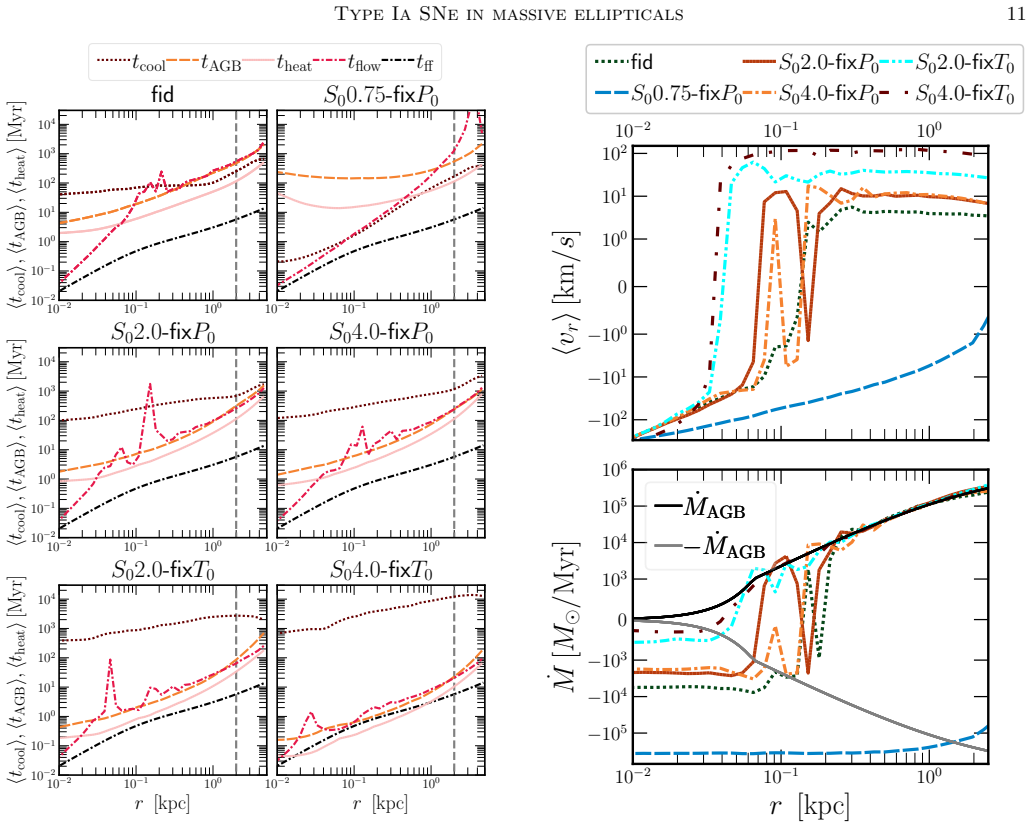
The central claim is that the interstellar medium on galaxy scales is an AGB/SNIa-regulated system whose state is set primarily by the confining pressure of the surrounding CGM, not by the detailed initial conditions of the galaxy core. With each Type Ia supernova resolved down to its fade radius of roughly 20 pc, the remnants reach pressure equilibrium and rise buoyantly, redistributing energy away from their injection sites. For a fixed galaxy, two quasi-steady solutions emerge: a subsonic 'breeze' carrying AGB ejecta outward when the supernova heating time is shorter than the cooling time, with the ISM inheriting the CGM's entropy and density, or a cooling inflow when the cooling time is shorter than both the heating time and the AGB mass-injection time. The simulations reproduce the observed profiles of NGC 1399, and the black-hole accretion rate varies by orders of magnitude across the two branches, being largest in the cooling-flow solution and smallest in the low-density, high-entropy non-cool-core-like solution.
Load-bearing premise
The outer boundary at 10 kpc is held at fixed density and temperature for the entire simulation, effectively acting as a rigid, unchanging CGM pressure reservoir; if the real CGM cools, is shock-heated by AGN jets, or develops inflows, the pressure-confinement loop that makes the ISM inherit CGM properties may be weaker or time dependent.
Editorial extensions
If this is right
- For the same central galaxy, a low-pressure, high-entropy CGM produces a low-density, high-entropy ISM, while a high-pressure, cool-core-like CGM produces a dense, low-entropy ISM; the system preserves cool-core versus non-cool-core character.
- Black-hole accretion increases with CGM pressure, being roughly 30 times larger in the cooling-flow branch than in the cool-core-like solution and another factor of about 10 larger still relative to the highest-entropy non-cool-core-like solution.
- Resolving individual SNIa remnants is essential: uniform heating overheats the core and flattens the entropy profile, while clustered, more energetic supernovae underheat the inner kiloparsec and can trigger a cooling flow, so approximate treatments give incorrect ISM profiles and incorrect black-hole accretion rates.
- In the fiducial solution, AGB ejecta enrich the inner kiloparsec to a mass fraction near unity, which can explain the near-solar metallicities in massive ellipticals, with SNIa ejecta peaking around 1 kpc.
- At radii beyond about 10 kpc, stellar heating may be insufficient to balance cooling, and the long-duration simulation shows the onset of a cooling inflow there, implying AGN feedback is still needed at large radii while SNIa act on kiloparsec scales.
Reading between the lines
- If the pressure-confinement logic holds, the inner ISM entropy and density of massive ellipticals should correlate tightly with the entropy and density of the inner CGM across a galaxy sample; a strong observed correlation would support CGM-driven regulation even without directly detecting the subsonic breeze.
- The model implies that black-hole accretion in quiescent ellipticals may be set largely by CGM pressure communicated through the hydrostatic, stellar-heated ISM, rather than by local Bondi physics alone.
- The fixed outer boundary is an important simplification; coupling the simulation to a live, evolving CGM would test whether time-dependent pressure changes, such as those from AGN outbursts or CGM cooling, are communicated inward on the roughly 100 Myr timescale relevant to the ISM.
- Because uniform SNIa heating overpredicts core entropy, large cosmological simulations that treat supernova feedback as a smooth, density-proportional heating term may systematically underestimate black-hole accretion in massive ellipticals.
Signed reviews
Editorial analysis
A structured set of objections, weighed in public.
Referee Report
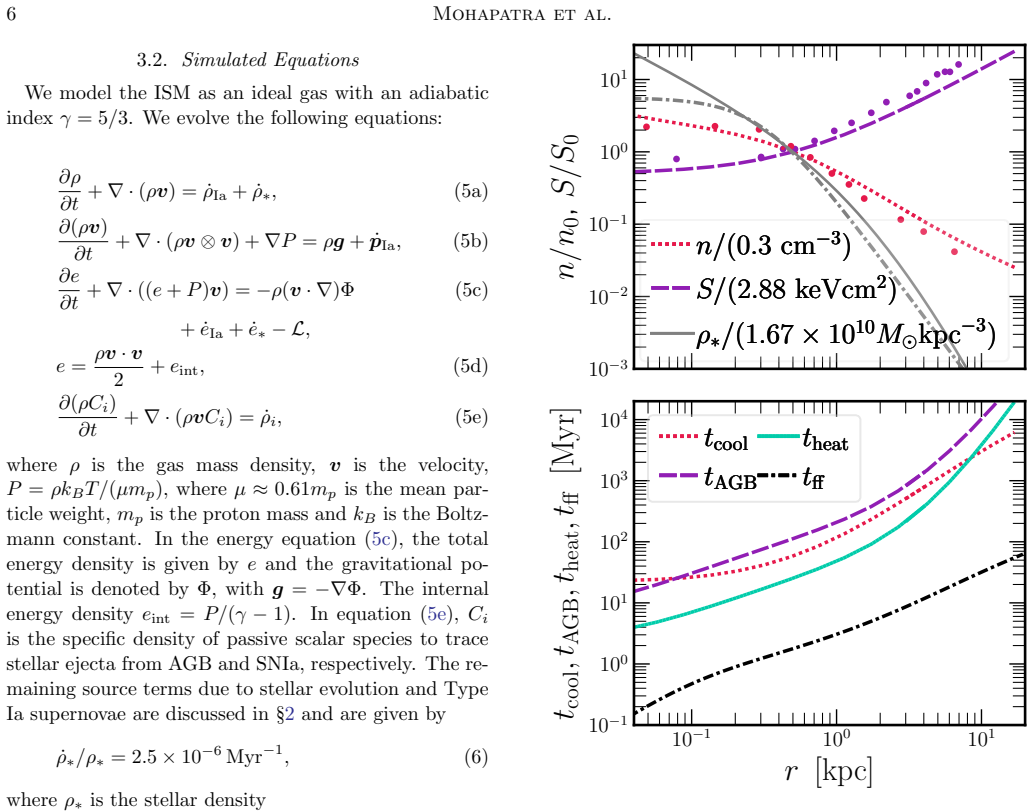
Summary. This paper presents 3D hydrodynamic simulations of the central few kiloparsecs of massive elliptical galaxies, with a gravitational potential set by stars, dark matter, and a central black hole, and with gas physics including radiative cooling, smooth AGB mass/energy injection, and Type Ia supernovae injected as resolved discrete events. The fiducial model is initialized to match the observed density and entropy profiles of NGC 1399. The authors identify two classes of quasi-steady solutions over 100 Myr: when SNIa heating exceeds cooling, a subsonic 'breeze' expels most AGB ejecta, with the inner ISM profile set by the confining CGM pressure (giving cool-core-like or non-cool-core-like states); when cooling dominates, a cooling flow develops with a much larger black hole accretion rate. A parameter study varies the initial entropy, pressure, SNIa rate, and SNIa injection method, showing that resolved SNIa produce different density/entropy profiles and accretion rates than uniform or clustered injection schemes.
Significance. If the central claim holds, this is a valuable numerical demonstration of the Voit et al. (2020) picture in which the galaxy-scale ISM is a pressure-confined, stellar-heated system whose thermodynamic state is inherited from the surrounding CGM even though its mass is predominantly AGB ejecta. The resolved treatment of individual SNIa remnants (fade radius resolved by at least 4 cells) is a genuine improvement over smooth-heating models, and the systematic parameter survey provides a useful map of the solution branches and their dependence on CGM pressure and SNIa rate. The most robust quantitative results are the convergence of different initial entropy profiles at fixed pressure (Fig. 5) and the monotonic variation of the black hole accretion rate with CGM pressure and SNIa rate. The paper is also unusually candid about its limitations, including the late-time cooling at large radii and the absence of AGN feedback.
major comments (3)
- [§3.6 and Eq. (3)] The outer boundary at 10 kpc fixes density and temperature to their initial values for the entire run. This is not a neutral buffer: the analytic argument in §2, especially Eq. (3), predicts that the outflow velocity scales inversely with the CGM density, so fixing ρ_CGM and T_CGM at the boundary imposes the pressure-confinement effect that is the paper's headline result. The simulations therefore demonstrate that the inner ISM adjusts to a maintained CGM pressure, but they do not test whether a realistic, time-dependent CGM would maintain that pressure while receiving AGB ejecta and SNIa energy from the galaxy. The one long, large-domain run ('outer-uni20-long', §6) uses uniform heating and shows cooling at r ≳ 10 kpc beginning within 1.2 Gyr; because the heating is not resolved, this run cannot exclude the possibility that discrete SNIa delay or alter the cooling. I recommend either adding a resolved-SN run with a larger outer boundary or implementing a simple live/responding CGM boundary to show that the inheritance of CGM properties is not purely built into the boundary condition.
- [§3.1 and footnote 3] The fiducial run's agreement with NGC 1399 is partly built in. The entropy normalization S0, slope α_S, and density n0 are chosen to match the Werner et al. (2012) profiles, and the SNIa rate is set (footnote 3) to a value that makes net stellar heating exceed radiative cooling, thereby selecting the heating-dominated branch. Consequently, the abstract's statement that the simulations 'reproduce its observed density and entropy profiles well' describes a tuned consistency check rather than an independent prediction. The more compelling results are the convergence of different S0 runs at fixed pressure and the pressure dependence of the final profiles (Figs. 5–7). I ask the authors to rephrase the reproduction claim as calibration and to place the primary evidentiary weight on the parameter study.
- [§4.4 and Table 1] The two-class classification rests mainly on runs of 100 Myr, which is comparable to or shorter than the cooling time at the outer boundary. The paper itself states that the 'double-SN' run has not reached a statistical steady state by 100 Myr, and the 'fid' run lies in the intermediate regime theat < tcool < tAGB (Fig. 6). Given that the only 1.2 Gyr run shows a late-time transition to cooling inflow at r ≳ 10 kpc (§6), it is not established that the inner quasi-steady states persist over multiple boundary cooling times. A convergence diagnostic, such as the time evolution of the radial mass flux and entropy profiles over several tAGB, or an explicit estimate of the steady-state timescale based on tcool at the boundary, would substantiate the 'quasi-steady-state' terminology.
minor comments (5)
- [§1] The sentence following the reference 'Fabian 2012' is missing a space ('...Fabian 2012)he supermassive black holes'); the reference list also contains a LaTeX encoding artifact in 'B¨ ohringer'.
- [§6 and Figure 10] The long-duration run is labeled 'outer-uni20-long' in Table 1 but is referred to as 'uni20' in the Figure 10 caption and in the text; please unify the naming.
- [§3.2] The abstract says 'with black hole accretion at small radii', but the accretion rate is first quantified only in §4.2 via Fig. 7; a brief pointer in §3.6 describing how ˙M is measured from the sink would improve readability.
- [§1 and §3.2] The introduction cites the near-balance of SNIa heating and cooling as motivation, while footnote 3 sets the fiducial rate so that heating exceeds cooling; these statements are compatible, but an explicit reconciliation (e.g., the balance is approximate and the paper deliberately biases toward the heating-dominated branch) would avoid apparent tension.
- [§9 / Software section] The software list includes 'LLaMA (Grattafiori et al. 2024)' alongside numerical and plotting libraries; if a language model was used for writing or analysis, the journal's AI-use disclosure policy may require a separate statement in the acknowledgments.
Circularity Check
Partial circularity: the NGC 1399 match and outflow-branch placement are partly tuned inputs, and the CGM-pressure inheritance is imposed by the fixed outer boundary; resolved-SN physics provides independent content.
-
fitted input called prediction
[Section 3.1 (Galaxy Model and Initial Conditions), with the claimed 'reproduction' in the Abstract and Section 4.2]
"We set the initial radial profile of gas entropy (S) at t = 0 as: S = S0(1 + r/rS)^αS, where S0 = 2.88 keVcm2, rS = 0.5 kpc, and αS = 1.1 (since the observed profiles in Werner et al. 2012 scale roughly as r1 and flatten towards the center). The density and entropy profiles at t = 0 are shown in Fig. 3 and are in rough agreement with the X-ray observations of Werner et al. (2012)."
The abstract's claim that the simulations 'reproduce' NGC 1399's observed density and entropy profiles is not an independent prediction: the initial conditions are fitted to those same Werner et al. (2012) profiles, and the fixed outer boundary holds the density and temperature at their initial values. The fiducial run therefore starts on the observed profiles and is not pushed away from them; remaining close after 100 Myr is a consistency check, not a forecast. The convergence of the S02 and S04 fixed-pressure runs to a common profile is independent, but the fiducial match itself is partly built in.
-
self definitional
[Section 3.6 (Boundary conditions) and Section 2 (Theoretical Background)]
"We fix the values of density and temperature to their initial values for radii beyond the outer boundary at r = router (at 10 kpc for our fiducial model). The discussion in §2 motivates why such a boundary condition is reasonable. ... §2: the effect of Type Ia supernovae is to regulate the ISM on galactic scales to be a hydrostatic extension of the CGM/ICM, i.e., to satisfy dP/dr ∼ −ρg with the boundary condition that n ∼ nCGM and P ∼ PCGM at r ∼ Re."
The headline result that the galaxy-scale ISM 'inherits' the thermodynamic properties of the CGM is inserted through the boundary condition: n and T at 10 kpc are permanently reset to their initial CGM values. The simulations therefore demonstrate that a maintained CGM pressure produces a corresponding inner ISM, but they do not demonstrate that the real CGM would maintain that pressure when AGB mass loss and SNIa energy cross the boundary. The paper's own outer-uni20-long run shows cooling at r≳10 kpc by 1.2 Gyr, indicating that the reservoir is not guaranteed. This is an imposed physical assumption rather than a fitted parameter, but it makes the pressure-confinement loop partly definitional.
1 more flagged steps
-
fitted input called prediction
[Section 3.2 (Simulated Equations), footnote; branch assignment in Section 4.4 and Section 7]
"Note that we use a slightly higher value of the Ia rate (compared to previous studies), such that the net stellar heating is larger than the net radiative cooling. This value is still consistent with Maoz & Graur (2017). Furthermore, we test the effects of different Ia rates on our results in § 4.4."
The fiducial SNIa rate is explicitly chosen to put the system in the regime where stellar heating exceeds cooling, and the heating-versus-cooling ratio is the criterion that selects the outflow branch rather than the cooling-flow branch. Thus the placement of the fiducial NGC 1399 model on the outflow branch is partly an input choice rather than a prediction. The half-SN and double-SN runs do probe the transition and provide independent information, so this is partial rather than complete circularity.
full rationale
Score 5 reflects partial circularity, not a self-citation chain. The fiducial NGC 1399 'reproduction' is partly built in: the initial entropy and density profiles are taken from the Werner et al. (2012) observations, and the SNIa rate is raised so that net heating exceeds cooling, placing the fiducial model on the outflow branch. The pressure-confinement conclusion is also loaded by fixing n and T at 10 kpc to their initial values for the entire run; the paper's own outer-uni20-long run shows cooling at r≳10 kpc by 1.2 Gyr, weakening the assumption that the CGM maintains that pressure. However, the paper has substantial independent content: the fixed-pressure S02/S04 runs converge to a common profile, the half/double SNIa-rate runs show an emergent threshold, and the differences between resolved, uniform, and clustered SNIa heating are not contained in the fitted inputs. Self-citations such as Mohapatra & Quataert (2024) and Guo et al. (2023) are methodological and not load-bearing. The core physics of resolved SNIa remnants and the cooling-flow transition is genuinely emergent, so this is not a case where the derivation is equivalent to its inputs.
Assumptions & free parameters
free parameters (5)
- Initial entropy normalization S0 =
2.88 keV cm^2
- Entropy slope alpha_S =
1.1
- Initial gas density n0 at rS =
0.3 cm^-3
- SNIa rate normalization =
600 kpc^-3 Myr^-1 per 10^10 Msun kpc^-3
- Outer boundary density and temperature =
Fixed to initial values at 10 kpc
assumptions (5)
- domain assumption AGB wind material shocks, thermalizes, and mixes with the ISM
- domain assumption Solar-metallicity cooling function applies to the ISM, with ejecta not altering cooling
- domain assumption The gravitational potential is static and fixed to observed stellar, dark matter, and black hole masses
- domain assumption Each SNIa injects 1 Msun and 10^51 erg at the fade radius according to a Sedov-like prescription
- standard math Ideal gas with gamma = 5/3 and constant mean molecular weight
Cite this review
Pith. "Pith review of The Type Ia Supernova and Asymptotic Giant Branch Stellar Ejecta-regulated Interstellar Medium of Massive Galaxies." pith.science (2026). https://pith.science/paper/6SYLR3XS
@misc{pith2026250205329,
  author       = {Pith},
  title        = {Pith review of: The Type Ia Supernova and Asymptotic Giant Branch Stellar Ejecta-regulated Interstellar Medium of Massive Galaxies},
  year         = {2026},
  howpublished = {\url{https://pith.science/paper/6SYLR3XS}},
  note         = {Machine review of arXiv:2502.05329}
}
abstract
Observations and theory suggest that Type Ia supernovae (SNIa) heating and mass loss from asymptotic giant branch (AGB) stars play a crucial role in the interstellar medium (ISM) of massive galaxies. We perform 3D hydrodynamic simulations of the central few kiloparsecs of massive galaxies, including radiative cooling and mass and energy injection from AGB winds and SNIa (resolving each SNIa remnant, a few $\times10~\mathrm{pc}$ in size), excluding black hole feedback. We study systems with different initial core thermodynamic profiles, focusing on NGC 1399. Our simulations reproduce its observed density and entropy profiles well. Over $100~\mathrm{Myr}$, two steady-state profiles emerge, depending on the inner circumgalactic medium (CGM) pressure and the ratio of Ia heating to cooling: (i) if SNIa heating is less than cooling, a cooling flow develops; (ii) if SNIa heating is comparable to or exceeds cooling, SNIa heating drives a slow subsonic outflow of AGB ejecta, with black hole accretion at small radii. This outflow, pressure-confined by the CGM, adapts the ISM to the CGM properties: a low entropy CGM results in a dense, low entropy ISM with higher black hole accretion, while a high entropy CGM leads to a less dense, high entropy ISM with lower accretion. This suggests that the AGB-SNIa regulated ISM connects CGM and galaxy scales, potentially influencing black hole feedback in massive halos. Approximate methods of modeling Ia heating, such as clustered SNIa and smoothly distributed heating, produce unrealistic ISM profiles over $100~\mathrm{Myr}$, highlighting the importance of resolving SNIa in simulations.
Figures


Figures from the paper (6 more)




Reference graph
Works this paper leans on
-
[1]
Anderson, M. E., Gaspari, M., White, S. D. M., Wang, W., & Dai, X. 2015, MNRAS, 449, 3806, doi: 10.1093/mnras/stv437 Astropy Collaboration, Price-Whelan, A. M., Sip˝ ocz, B. M., et al. 2018, AJ, 156, 123, doi: 10.3847/1538-3881/aabc4f B¨ ohringer, H., Matsushita, K., Churazov, E., Ikebe, Y., &
-
[2]
2002, A&A, 382, 804, doi: 10.1051/0004-6361:20011708
Chen, Y. 2002, A&A, 382, 804, doi: 10.1051/0004-6361:20011708
-
[3]
1952, MNRAS, 112, 195, doi: 10.1093/mnras/112.2.195
Bondi, H. 1952, MNRAS, 112, 195, doi: 10.1093/mnras/112.2.195
-
[4]
2002, MNRAS, 336, 409, doi: 10.1046/j.1365-8711.2002.05746.x Cant´ o, J., Raga, A
Borgani, S., Governato, F., Wadsley, J., et al. 2002, MNRAS, 336, 409, doi: 10.1046/j.1365-8711.2002.05746.x Cant´ o, J., Raga, A. C., & Rodr ´ ıguez, L. F. 2000, ApJ, 536, 896, doi: 10.1086/308983
arXiv 2002
-
[5]
Chevalier, R. A., & Clegg, A. W. 1985, Nature, 317, 44, doi: 10.1038/317044a0
doi:10.1038/317044a0 1985
-
[6]
Cho, H., Prather, B. S., Narayan, R., et al. 2023, ApJL, 959, L22, doi: 10.3847/2041-8213/ad1048
-
[7]
1991, ApJ, 376, 380, doi: 10.1086/170289
Ciotti, L., D’Ercole, A., Pellegrini, S., & Renzini, A. 1991, ApJ, 376, 380, doi: 10.1086/170289
doi:10.1086/170289 1991
-
[8]
Ciotti, L., & Ostriker, J. P. 1997, ApJL, 487, L105, doi: 10.1086/310902 —. 2001, ApJ, 551, 131, doi: 10.1086/320053
doi:10.1086/310902 1997
Show all 50 references
-
[9]
2013, Python and HDF5 (O’Reilly)
Collette, A. 2013, Python and HDF5 (O’Reilly)
2013
-
[10]
E., & White, M
Conroy, C., Gunn, J. E., & White, M. 2009, ApJ, 699, 486, doi: 10.1088/0004-637X/699/1/486
2009 doi
-
[11]
G., & Kravtsov, A
Conroy, C., van Dokkum, P. G., & Kravtsov, A. 2015, ApJ, 803, 77, doi: 10.1088/0004-637X/803/2/77
2015 doi
-
[13]
E., O’Connell, R
Donahue, M., de Messi` eres, G. E., O’Connell, R. W., et al. 2011, ApJ, 732, 40, doi: 10.1088/0004-637X/732/1/40
2011 doi
-
[14]
Draine, B. T. 2011, Physics of the Interstellar and Intergalactic Medium (Princeton University Press)
2011
-
[15]
Dunn, R. J. H., Allen, S. W., Taylor, G. B., et al. 2010, MNRAS, 404, 180, doi: 10.1111/j.1365-2966.2010.16314.x
2010
-
[16]
Fabian, A. C. 1994, Annual Review of Astronomy and Astrophysics, 32, 277
1994
-
[17]
Fabian, A. C. 2012, ARA&A, 50, 455, doi: 10.1146/annurev-astro-081811-125521
2012 doi
-
[18]
S., Dennerl, K., et al
Gatuzz, E., Sanders, J. S., Dennerl, K., et al. 2023a, MNRAS, 520, 4793, doi: 10.1093/mnras/stad447 —. 2023b, MNRAS, 525, 6394, doi: 10.1093/mnras/stad2716
-
[19]
C., & Metzger, B
Generozov, A., Stone, N. C., & Metzger, B. D. 2015, MNRAS, 453, 775, doi: 10.1093/mnras/stv1607
2015 doi
- [20]
-
[21]
M., Kim, C.-G., & Quataert, E
Guo, M., Stone, J. M., Kim, C.-G., & Quataert, E. 2023, ApJ, 946, 26, doi: 10.3847/1538-4357/acb81e
2023 doi
-
[22]
R., Millman, K
Harris, C. R., Millman, K. J., van der Walt, S. J., et al. 2020, Array programming with NumPy, Nature Research, doi: 10.1038/s41586-020-2649-2
2020 doi
-
[23]
Hunter, J. D. 2007, Computing in Science Engineering, 9, 90, doi: 10.1109/MCSE.2007.55
2007 doi
-
[24]
N., & Stone, J
Lemaster, M. N., & Stone, J. M. 2009, ApJ, 691, 1092, doi: 10.1088/0004-637X/691/2/1092
2009 doi
-
[25]
L., Ostriker, E
Li, M., Li, Y., Bryan, G. L., Ostriker, E. C., & Quataert, E. 2020a, ApJ, 894, 44, doi: 10.3847/1538-4357/ab86b4 —. 2020b, ApJ, 898, 23, doi: 10.3847/1538-4357/ab9c22
-
[26]
L., & Quataert, E
Li, Y., Bryan, G. L., & Quataert, E. 2019, ApJ, 887, 41, doi: 10.3847/1538-4357/ab4bca
2019 doi
-
[27]
2017, ApJ, 848, 25, doi: 10.3847/1538-4357/aa8b6e
Maoz, D., & Graur, O. 2017, ApJ, 848, 25, doi: 10.3847/1538-4357/aa8b6e
2017 doi
- [28]
-
[29]
G., & Loewenstein, M
Mathews, W. G., & Loewenstein, M. 1986, ApJL, 306, L7, doi: 10.1086/184693
1986 doi
-
[30]
R., & Nulsen, P
McNamara, B. R., & Nulsen, P. E. J. 2007, ARA&A, 45, 117, doi: 10.1146/annurev.astro.45.051806.110625 —. 2012, New Journal of Physics, 14, 055023, doi: 10.1088/1367-2630/14/5/055023
2007 arXiv
-
[31]
2001, MNRAS, 320, L30, doi: 10.1046/j.1365-8711.2001.04165.x
Merritt, D., & Ferrarese, L. 2001, MNRAS, 320, L30, doi: 10.1046/j.1365-8711.2001.04165.x
2001
-
[32]
2024, ApJ, 965, 105, doi: 10.3847/1538-4357/ad2940
Mohapatra, R., & Quataert, E. 2024, ApJ, 965, 105, doi: 10.3847/1538-4357/ad2940
2024 doi
-
[33]
2014, MNRAS, 445, 1351, doi: 10.1093/mnras/stu1834
Negri, A., Posacki, S., Pellegrini, S., & Ciotti, L. 2014, MNRAS, 445, 1351, doi: 10.1093/mnras/stu1834
2014 doi
-
[34]
2017, in Proceedings of Workshop on Machine Learning Systems (LearningSys) in The Thirty-first Annual Conference on Neural Information Processing Systems (NIPS)
Okuta, R., Unno, Y., Nishino, D., Hido, S., & Loomis, C. 2017, in Proceedings of Workshop on Machine Learning Systems (LearningSys) in The Thirty-first Annual Conference on Neural Information Processing Systems (NIPS). http: //learningsys.org/nips17/assets/papers/paper 16.pdf
2017
-
[35]
2018, MNRAS, 473, 4077, doi: 10.1093/mnras/stx2656
Pillepich, A., Springel, V., Nelson, D., et al. 2018, MNRAS, 473, 4077, doi: 10.1093/mnras/stx2656
2018 doi
-
[36]
2008, A&A, 478, L23, doi: 10.1051/0004-6361:20078539
Richtler, T., Schuberth, Y., Hilker, M., et al. 2008, A&A, 478, L23, doi: 10.1051/0004-6361:20078539
2008 doi
-
[37]
A., Bower, R
Schaye, J., Crain, R. A., Bower, R. G., et al. 2015, MNRAS, 446, 521, doi: 10.1093/mnras/stu2058
2015 doi
-
[38]
2010, A&A, 513, A52, doi: 10.1051/0004-6361/200912482 20 Mohapatra et al
Schuberth, Y., Richtler, T., Hilker, M., et al. 2010, A&A, 513, A52, doi: 10.1051/0004-6361/200912482 20 Mohapatra et al
2010 doi
-
[39]
2009, A&A, 508, 751, doi: 10.1051/0004-6361/200912495
Vink, J. 2009, A&A, 508, 751, doi: 10.1051/0004-6361/200912495
2009 doi
-
[40]
J., White, S
Shen, S., Mo, H. J., White, S. D. M., et al. 2003, MNRAS, 343, 978, doi: 10.1046/j.1365-8711.2003.06740.x
2003
-
[41]
M., Tomida, K., White, C
Stone, J. M., Tomida, K., White, C. J., & Felker, K. G. 2020, ApJS, 249, 4, doi: 10.3847/1538-4365/ab929b
2020 doi
- [42]
-
[43]
Su, Y., Nulsen, P. E. J., Kraft, R. P., et al. 2017, ApJ, 847, 94, doi: 10.3847/1538-4357/aa8954
2017 doi
-
[44]
D., Lu, Y., & Mo, H
Tang, S., Wang, Q. D., Lu, Y., & Mo, H. J. 2009a, MNRAS, 392, 77, doi: 10.1111/j.1365-2966.2008.14057.x
2008
-
[45]
D., Mac Low, M.-M., & Joung, M
Tang, S., Wang, Q. D., Mac Low, M.-M., & Joung, M. R. 2009b, MNRAS, 398, 1468, doi: 10.1111/j.1365-2966.2009.15206.x
2009
-
[46]
2021, Computing in Science and Engineering, 23, 10, doi: 10.1109/MCSE.2021.3098509 van der Velden, E
Trott, C., Berger-Vergiat, L., Poliakoff, D., et al. 2021, Computing in Science and Engineering, 23, 10, doi: 10.1109/MCSE.2021.3098509 van der Velden, E. 2020, The Journal of Open Source Software, 5, 2004, doi: 10.21105/joss.02004
2021
-
[47]
E., et al
Virtanen, P., Gommers, R., Oliphant, T. E., et al. 2020, Nature Methods, 17, 261, doi: 10.1038/s41592-019-0686-2
2020 doi
-
[48]
M., Donahue, M., O’Shea, B
Voit, G. M., Donahue, M., O’Shea, B. W., et al. 2015, ApJL, 803, L21, doi: 10.1088/2041-8205/803/2/L21
2015 doi
-
[49]
M., Bryan, G
Voit, G. M., Bryan, G. L., Prasad, D., et al. 2020, ApJ, 899, 70, doi: 10.3847/1538-4357/aba42e
2020 doi
-
[50]
2019, MNRAS, 482, 3576, doi: 10.1093/mnras/sty2906
Wang, C., Li, Y., & Ruszkowski, M. 2019, MNRAS, 482, 3576, doi: 10.1093/mnras/sty2906
2019 doi
-
[51]
W., & Simionescu, A
Werner, N., Allen, S. W., & Simionescu, A. 2012, MNRAS, 425, 2731, doi: 10.1111/j.1365-2966.2012.21245.x
2012
Reviewed August 8, 2026 · model on record in the stance chip above.
Discussion (0). Continue with ORCID to comment.