REVIEW 5 major objections 5 minor 60 references
Model Predictive and Reinforcement Learning Methods for Active Flow Control of an Airfoil with Dual-point Excitation of Plasma Actuators
T0 review · 5 major / 5 minor · reviewed 2026-08-08 · deepseek-v4-flash
Pith's one-line read In a near-stall airfoil simulation, reinforcement learning controllers drive dual-point plasma actuators to a lift coefficient of about 1.62 within 2.5 seconds, while adaptive model predictive control stops at 1.60.
desk verdict Competent 2D CFD case study whose central RL-beats-MPC claim is not supported as stated, because MPC is asked to track an infeasible set-point while RL is asked to maximize mean lift. read the letter →
The pith
A machine-rendered reading of the paper's core claim, the machinery that carries it, and where it could break.
The reading
What carries the argument
The carrying mechanism is the dual-point excitation arrangement of DBD plasma actuators combined with an online control loop. Two plasma zones are placed in the flow: one on the suction side at $x/c = 0.35$, just upstream of the baseline separation point near $0.55c$, and one at the trailing edge on the pressure side at $x/c = 0.99$; both shear layers are excited simultaneously, exploiting their interaction. The plasma region follows a linear electric-field-decay body-force model modulated at a 50% duty cycle with excitation frequencies between 0 and 400 Hz. The controllers read the mean lift coefficient over a short window and output a frequency: adaptive MPC fits a linear ARIMAX model online by recursive least squares and solves a generalized predictive control cost, while the RL agents use an $\epsilon$-greedy Q-learning update over the discrete action grid 0:50:400 Hz, with reward emphasizing improvement over the baseline $C_l = 1.44$. The mechanism that makes dual-point excitation effective is periodic forcing that locks onto the separated shear layer, forming coherent vortices and entraining high-momentum fluid, which shrinks the separation bubble and raises lift.
What would settle it
Repeat the dual-point DBD control scenario at $Re=4\times10^5$ and 15 degrees in a three-dimensional wall-resolved large-eddy simulation or a wind-tunnel experiment; the central ranking would be refuted if 100 or 200 Hz excitation does not raise mean lift to about 1.62, or if adaptive MPC can hold 1.62 stably.
Extended reading notes
Core claim
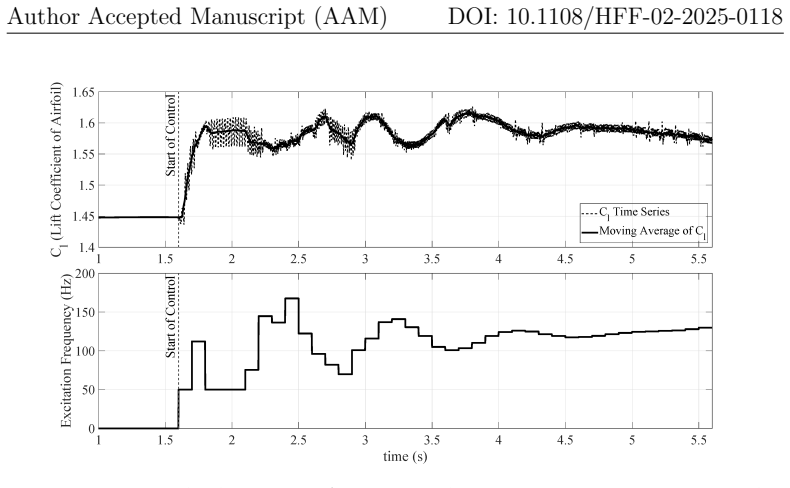
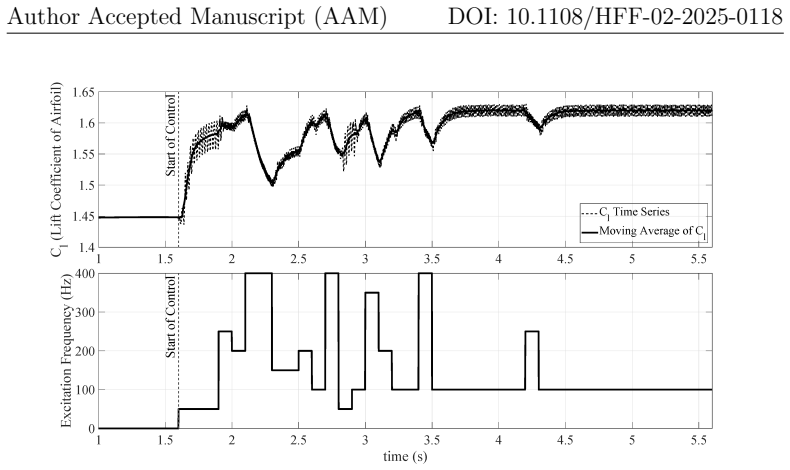
The paper's central claim is that reinforcement learning controllers identify and hold a better operating point than adaptive MPC for the same dual-point dielectric-barrier-discharge plasma actuator system on a NACA 4412 airfoil at 15 degrees and $Re = 4\times10^5$. TDRL, DQL, and DQL with signal processing each converge to a mean lift coefficient of approximately 1.619, with TDRL and the signal-processing variant settling on 200 Hz and DQL on 100 Hz; the two frequencies produce nearly equal mean lift through a 50% duty-cycle averaging effect. Adaptive MPC, a generalized predictive controller with recursive least-squares identification, reaches $C_l = 1.60$ at about 110 Hz ($F^+\approx 3$) but becomes unstable trying to hold $C_l = 1.62$, which lies at the physical limit of the dual-actuator configuration. The paper attributes the RL advantage to online, reward-driven exploration of the discrete frequency space and attributes the improved aerodynamics to shear-layer instability amplification, lock-on, and enhanced mixing that reduce the suction-side separation zone and increase the pressure differential across the airfoil.
Load-bearing premise
The load-bearing premise is that the two-dimensional RANS-SAS simulation with the simplified plasma body-force model faithfully reproduces the near-stall separated-flow dynamics the controllers exploit; the paper validates this setup only for the uncontrolled baseline, not for the controlled cases.
Editorial extensions
If this is right
- If the comparison holds, online RL can control near-stall separation without a pre-trained dataset or an explicit plant model, reaching $C_l\approx 1.62$ within about 2.5 seconds of simulated time.
- Adaptive MPC remains suitable for moderate set-points: it stabilizes $C_l = 1.60$ at about 110 Hz, which is close to the 100 Hz that DQL selects, so both approaches converge on $F^+\approx 3$ as an effective excitation regime.
- The near-identical mean lift at 100 and 200 Hz implies that mean $C_l$ alone cannot distinguish these two operating points; richer feedback, such as lift fluctuation amplitude or spectral content, would be needed to break the tie.
- More complex RL architectures make more decisions yet stabilize the lift in less simulated time, indicating that sequence-aware state representations accelerate convergence.
- Since the dual-actuator configuration saturates near $C_l = 1.62$, further lift improvements would require changing the actuation layout or authority rather than only improving the controller.
Reading between the lines
- An implication the paper leaves implicit is that the 100 Hz versus 200 Hz tie points to a plateau in the lift-versus-frequency landscape; a controller that adds a small dithering sweep could map that plateau and reduce ambiguity.
- Because the results come from a 2D RANS-SAS model with a simplified plasma forcing model, a natural test is whether the same frequency preference survives three-dimensional wall-resolved simulations or wind-tunnel experiments, where spanwise instabilities may shift the optimum.
- The same online state-reward loop could tune other actuation parameters, such as duty cycle, voltage amplitude, or the phase offset between the two plasma zones, since the controller only needs a scalar performance signal.
- For MPC, the failure near $C_l=1.62$ is a set-point-tracking saturation problem; switching to RL or augmenting the identified linear model with a saturation or disturbance model could extend adaptive MPC's useful range.
Editorial analysis
A structured set of objections, weighed in public.
Referee Report
Summary. The paper presents a numerical study of closed-loop active flow control for a NACA 4412 airfoil near static stall (α=15°, Re=4×10^5) using dual-point DBD plasma actuators. Four controllers are compared: adaptive MPC (a generalized predictive controller with recursive least-squares identification), temporal-difference RL, deep Q-learning, and DQL with an LSTM layer. The uncontrolled baseline is validated against external wind-tunnel data (Cp at 14° and trailing-edge wake profiles). The authors report that adaptive MPC tracks a target Cl=1.60 at ~110 Hz but cannot stabilize Cl=1.62, whereas the RL methods reach mean Cl≈1.619 in under 2.5 s at 100 or 200 Hz, and they conclude that RL outperforms MPC for this problem.
Significance. If the central comparison were established, the paper would be a useful contribution: it is among the first to compare MPC with online RL methods for active flow separation control using dual-point DBD plasma actuation, and the baseline validation against external wind-tunnel data is a strength. However, the current evidence does not support the headline claim of RL superiority. The comparison is confounded by different controller objectives, the 'optimal frequency' result is underdetermined by the near-identical means at 100 and 200 Hz, and the controlled-flow simulations rest on a single unverified 2D RANS-SAS setup. The paper is of interest to the active flow control community, but the quantitative comparisons should be regarded as preliminary rather than conclusive.
major comments (5)
- [§5.2–§5.5, Eq. (10), abstract/findings] The headline claim that RL methods outperform adaptive MPC is confounded by asymmetric objectives. The MPC cost in Eq. (10) minimizes tracking error to a reference w(t); in Section 5.2 the Cl=1.62 case is explicitly called 'near the physical limit', and the paper reports only that MPC 'could not stabilize' this set-point, with no time-averaged Cl reported for that run. The RL methods instead maximize a Cl-based reward, and their success metric is a mean Cl of 1.619 (Sections 5.3–5.5), which is below the MPC reference of 1.62. The observed outcome (a tracking controller with an infeasible reference fails, while a maximizing controller returns the maximum feasible mean) does not establish that MPC cannot reach mean Cl=1.619. To support the claim, the authors should either run MPC with the same objective (e.g., tracking 1.619 or maximizing mean Cl) or report the time-averaged Cl for the MPC 1.62 case.
- [§3.1–§3.4, §5.1] The controlled results depend entirely on a single 2D RANS-SAS setup with the Shyy plasma body-force model, but the validation is limited to the uncontrolled baseline: Cp at 14° (Fig. 7) and trailing-edge wake profiles (Fig. 8). No grid-convergence, time-step sensitivity, turbulence-model comparison, or three-dimensionality check is provided for the near-stall 15° separated flow used in all controlled cases (Sections 3.3–3.4; 5.2–5.5). The paper itself concedes in the Conclusions that 'future work could improve turbulence modeling'. Because the central quantitative claims (mean Cl=1.619 at 100/200 Hz, MPC's failure at 1.62) are grounded in this unverified simulation environment, the authors should add at least a grid-refinement and time-step sensitivity study, and preferably a turbulence-model comparison, before drawing conclusions about controller performance at these lift levels.
- [§4 (paragraph before §4.1) and Table 2] The action-space description is internally inconsistent. The text states that the discrete action space lies 'within the superharmonic frequencies of wake, specifically from F+ = 1 to F+ = 6' and that 'frequencies beyond this range do not elicit an effective fluid response' (citing [25]), yet Table 2 specifies Actions 0:50:400. With c=0.4 m and U∞=14.6 m/s, F+=f·c/U∞, so the action set includes 250–400 Hz, corresponding to F+ ≈ 6.85–10.96, which the text itself declares ineffective. The RL agents are therefore allowed to choose frequencies the authors state are ineffective. Either restrict the action set to F+ ≤ 6 (≈219 Hz) or justify the inclusion of 250–400 Hz; as written, the 'optimal frequency' search includes known-irrelevant actions.
- [§5.3–§5.5, Fig. 15] The claim that RL methods 'effectively optimized excitation frequencies' is underdetermined by the authors' own data. Section 5.5 states that the mean Cl at 100 Hz and 200 Hz is 'nearly identical', and Fig. 15 shows the two duty-cycle traces produce almost the same average. The converged frequency (TDRL and signal-processing DQL select 200 Hz; DQL selects 100 Hz) therefore reflects initial exploration and reward-landscape details rather than a distinct physical optimum. The authors should quantify the Cl difference between 100 and 200 Hz (with a tolerance or statistical test), or else weaken the 'optimal frequency' wording to 'a selected frequency among nearly equivalent options'.
- [§4.2–§4.4, §5.3–§5.5] Each RL method is evaluated with a single stochastic run; no seeds, multiple runs, or confidence intervals are reported, and the hyperparameters were chosen 'after multiple initial runs' (Section 4). For a comparison of learning algorithms, single-run outcomes are insufficient to distinguish method performance from run-to-run variance. The authors should report statistics over several independent runs, or at minimum demonstrate insensitivity to exploration seed and to the chosen hyperparameters, before claiming that one RL variant converges faster or more reliably than another.
minor comments (5)
- [Throughout] There are several typographical errors: 'desicion makings' (Sections 5.4 and 5.5), and 'Shy et al.' instead of 'Shyy et al.' (Sections 3.2 and 3.3). These should be corrected.
- [Throughout] The lift coefficient notation is inconsistent: 'Cl' is used in most sections but 'CL' appears in the Conclusions. Please standardize to a single notation.
- [§5.6, Fig. 16] The definition of 'stabilization time' used in Fig. 16 is not given. Please specify the criterion (e.g., time when the moving-average Cl remains within a tolerance band), since the comparison across methods depends on this metric.
- [§5.2] For the MPC Cl=1.60 case, the paper reports that the lift coefficient 'stabilizes' at 2.8 s, but it is unclear whether this refers to the instantaneous value or the moving average shown in Fig. 10. Please clarify what quantity is being used to define stabilization.
- [§3.2] The normalized frequency F+ is defined as F+ = f·c/U∞, but U∞ is not defined until Section 3.3 (14.6 m/s). Please define U∞ at first use and state the resulting F+ values for the action set.
Circularity Check
No significant circularity: the RL-versus-MPC comparison is an empirically measured CFD result, not a derivation from fitted inputs or self-citations.
full rationale
The paper's central claim is a numerical comparison of adaptive MPC and RL controllers on a common CFD baseline, and the reported outcomes (Cl values, convergence times, frequencies) are measured outputs of the simulations rather than quantities obtained by substituting the conclusion into the method definitions. The baseline simulation is validated against external experimental data from Mallor et al. and Tabatabaei et al., and the controlled cases use the same model, so the main comparison is not constructed to force the headline result. Self-citations to the authors' prior dual-point excitation work [36, 43] describe the actuation configuration, but the controller comparison does not reduce to those citations; the dual-point strategy is also independently motivated in the present paper by the baseline dual-shear-layer structure. The MPC set-points were selected using knowledge of the system's performance, and RL hyperparameters were tuned in initial runs; these are in-sample design choices rather than fitted parameters renamed as predictions, because the paper does not claim to predict a separate dataset. The most substantive concern is a fairness confound: MPC tracks a fixed set-point while RL maximizes mean Cl, so the comparison does not perfectly isolate algorithm capability. That is a correctness or experimental-design issue, not a circular reduction, and no equation or fitted value is shown to be equivalent to the conclusion. Therefore, no circular step is identified.
Assumptions & free parameters
free parameters (4)
- RL exploration and learning hyperparameters =
epsilon=0.9, kappa=0.95, alpha=0.4 (TDRL) / 0.01 (DQL), gamma=0.9 (TDRL) / 0.25 (DQL), FoM=0.25
- MPC target lift set-points =
Cl=1.60 and Cl=1.62
- DQL and LSTM network architecture =
4 hidden layers x 4 neurons; LSTM 64 units, 251 input features; SGDM lr=0.01, 100 epochs
- Discrete excitation frequency action set =
0:50:400 Hz (9 actions)
assumptions (5)
- domain assumption RANS-SAS with the stated 2D grid adequately captures the separated shear layers and the controlled-flow lift at Re=4e5 near stall.
- domain assumption The Shyy phenomenological body-force model represents DBD plasma actuation well enough for quantitative lift comparison.
- domain assumption The mean lift coefficient over the FoM window is a sufficient statistic for state and reward in this control problem.
- domain assumption The baseline validation at 14 degrees and wake profiles transfers to the 15-degree near-stall configuration.
- ad hoc to paper Frequencies with F+ above 6 are ineffective (from [25]) while the action space includes 250-400 Hz (F+ up to about 11).
Cite this review
Pith. "Pith review of Model Predictive and Reinforcement Learning Methods for Active Flow Control of an Airfoil with Dual-point Excitation of Plasma Actuators." pith.science (2026). https://pith.science/paper/LIGABFMU
@misc{pith2026250205577,
  author       = {Pith},
  title        = {Pith review of: Model Predictive and Reinforcement Learning Methods for Active Flow Control of an Airfoil with Dual-point Excitation of Plasma Actuators},
  year         = {2026},
  howpublished = {\url{https://pith.science/paper/LIGABFMU}},
  note         = {Machine review of arXiv:2502.05577}
}
read the original abstract
This study investigates the effectiveness of Model Predictive Control (MPC) and Reinforcement Learning (RL) for active flow control over a NACA 4412 airfoil near static stall at Reynolds number 4*10^5. By systematically evaluating these strategies, the research addresses a critical gap in optimizing excitation frequency and improving response time in flow control. The work contributes to understanding RL adaptability and performance versus MPC in aerodynamic flow separation control. Numerical simulations of the Reynolds Averaged Navier-Stokes equations with the Scale-Adaptive Simulation turbulence model are used. Dielectric Barrier Discharge plasma actuators in dual-point excitation mode control flow separation. The study evaluates adaptive MPC, temporal difference RL (TDRL), and deep Q-learning (DQL) for optimizing excitation frequency and expediting stabilization. An integrated signal processing DQL approach is also examined. Adaptive MPC achieved Cl = 1.60 at 110 Hz but struggled near physical limits. RL optimized excitation frequencies, reaching Cl = 1.62 in under 2.5 s at 100 or 200 Hz. The study presents a novel RL - MPC comparison for active flow control with DBD actuators, contrasting with prior work focusing on MPC or RL alone. Using an online learning framework, RL methods dynamically adapt to real-time conditions. Evaluating adaptive MPC and RL together in this setup yields new insights into comparative performance in dynamic environments.
Figures


Figures from the paper (16 more)





Reference graph
Works this paper leans on
-
[25]
S. Shimomura, S. Sekimoto, A. Oyama, K. Fujii, H. Nishida, Closed- loop flow separation control using the deep q network over airfoil, AIAA Journal 58 (10) (2020) 4260–4270
work page 2020
-
[1]
Z. Liu, L. Zhou, H. Tang, Z. Wang, F. Zhao, X. Ji, H. Zhang, Primary instability, sensitivity and active control of flow past two tandem circular cylinders, Ocean Engineering 294 (2024) 116863
work page 2024
-
[2]
H. Ding, Z. Cheng, M. Liu, L. Xiao, S. Zhu, Effects of synthetic jet control parameters on characteristics of flow around a square cylinder at subcritical reynolds number, Ocean Engineering 309 (2024) 118577
work page 2024
-
[3]
A. Seifert, A. Darabi, I. Wyganski, Delay of airfoil stall by periodic excitation, Journal of aircraft 33 (4) (1996) 691–698
work page 1996
-
[4]
Y. Eulalie, E. Fournier, P. Gilotte, D. Holst, S. Johnson, C. N. Nayeri, T. Sch¨ utz, D. Wieser, Active flow control analysis at the rear of an suv, International Journal of Numerical Methods for Heat & Fluid Flow 28 (5) (2018) 1169–1186
work page 2018
-
[5]
A. Rezaeiha, H. Montazeri, B. Blocken, Active flow control for power enhancement of vertical axis wind turbines: Leading-edge slot suction, Energy 189 (2019) 116131
work page 2019
-
[6]
C. J. Bay, J. Annoni, L. A. Mart ´ ınez-Tossas, L. Y. Pao, K. E. Johnson, Flow control leveraging downwind rotors for improved wind power plant operation, in: 2019 American control conference (ACC), Ieee, 2019, pp. 2843–2848
work page 2019
-
[8]
T. Macquart, A. Maheri, K. Busawon, A decoupling control strategy for wind turbine blades equipped with active flow controllers, Wind energy 20 (4) (2017) 569–584
work page 2017
Show all 60 references
-
[9]
S. Das, U. Srinivasan, J. Arakeri, Unsteady separation and vortex shed- ding from a laminar separation bubble over a bluff body, Journal of Fluids and Structures 40 (2013) 233–245
2013
-
[11]
R. L. Simpson, Turbulent boundary-layer separation, Annual Review of Fluid Mechanics 21 (1) (1989) 205–232
1989
-
[12]
F. Eich, C. J. K¨ ahler, Large-scale coherent motions in turbulent bound- ary layers under an adverse pressure gradient up to flow separation, International Journal of Heat and Fluid Flow 85 (2020) 108645
2020
-
[13]
R. B. Kotapati, R. Mittal, O. Marxen, F. Ham, D. You, L. N. CATTAFESTA III, Nonlinear dynamics and synthetic-jet-based control of a canonical separated flow, Journal of Fluid Mechanics 654 (2010) 65–97
2010
-
[14]
E. A. Deem, L. N. Cattafesta III, M. S. Hemati, H. Zhang, C. Rowley, R. Mittal, Adaptive separation control of a laminar boundary layer using online dynamic mode decomposition, Journal of Fluid Mechanics 903 (2020) A21
2020
-
[15]
Ransing, Guest editorial: Data-driven methods for heat transfer and fluid flow, International Journal of Numerical Methods for Heat & Fluid Flow 34 (8) (2024) 2833–2835
R. Ransing, Guest editorial: Data-driven methods for heat transfer and fluid flow, International Journal of Numerical Methods for Heat & Fluid Flow 34 (8) (2024) 2833–2835
2024
-
[16]
Ghalambaz, M
M. Ghalambaz, M. A. Sheremet, M. A. Khan, Z. Raizah, J. Shafi, Physics-informed neural networks (p inns): application categories, trends and impact, International Journal of Numerical Methods for Heat & Fluid Flow 34 (8) (2024) 3131–3165
2024
-
[18]
J. L. Proctor, S. L. Brunton, J. N. Kutz, Dynamic mode decomposition with control, SIAM Journal on Applied Dynamical Systems 15 (1) (2016) 142–161
2016
-
[19]
Dovetta, P
N. Dovetta, P. J. Schmid, D. Sipp, Uncertainty propagation in model extraction by system identification and its implication for control design, Journal of Fluid Mechanics 791 (2016) 214–236
2016
-
[20]
Huang, J
S.-C. Huang, J. Kim, Control and system identification of a separated flow, Physics of Fluids 20 (10) (2008)
2008
-
[21]
Obeid, G
S. Obeid, G. Ahmadi, R. Jha, Narmax identification based closed-loop control of flow separation over naca 0015 airfoil, Fluids 5 (3) (2020) 100
2020
-
[22]
Ishize, H
T. Ishize, H. Omichi, K. Fukagata, Flow control by a hybrid use of machine learning and control theory, International Journal of Numerical Methods for Heat & Fluid Flow 34 (8) (2024) 3253–3277
2024
-
[23]
Hachem, A
E. Hachem, A. Vishwasrao, M. Renault, J. Viquerat, P. M´ eliga, Re- inforcement learning for cooling rate control during quenching, Inter- national Journal of Numerical Methods for Heat & Fluid Flow 34 (8) (2024) 3223–3252
2024
-
[24]
Vignon, J
C. Vignon, J. Rabault, R. Vinuesa, Recent advances in applying deep re- inforcement learning for flow control: Perspectives and future directions, Physics of fluids 35 (3) (2023)
2023
-
[26]
Paris, S
R. Paris, S. Beneddine, J. Dandois, Reinforcement-learning-based actu- ator selection method for active flow control, Journal of Fluid Mechanics 955 (2023) A8
2023
-
[28]
Varela, P
P. Varela, P. Su´ arez, F. Alc´ antara-´Avila, A. Mir´ o, J. Rabault, B. Font, L. M. Garc ´ ıa-Cuevas, O. Lehmkuhl, R. Vinuesa, Deep reinforcement learning for flow control exploits different physics for increasing reynolds number regimes, in: Actuators, Vol. 11, MDPI, 2022, p. 359
2022
-
[29]
F. Ren, J. Rabault, H. Tang, Applying deep reinforcement learning to active flow control in weakly turbulent conditions, Physics of Fluids 33 (3) (2021)
2021
-
[30]
W. Jia, H. Xu, Robust and adaptive deep reinforcement learning for enhancing flow control around a square cylinder with varying reynolds numbers, Physics of Fluids 36 (5) (2024)
2024
-
[31]
B. Font, F. Alc´ antara-´Avila, J. Rabault, R. Vinuesa, O. Lehmkuhl, Ac- tive flow control of a turbulent separation bubble through deep reinforce- ment learning, in: Journal of Physics: Conference Series, Vol. 2753, IOP Publishing, 2024, p. 012022
2024
-
[32]
B. Font, F. Alc´ antara-´Avila, J. Rabault, R. Vinuesa, O. Lehmkuhl, Deep reinforcement learning for active flow control in a turbulent separation bubble (2024)
2024
-
[33]
Javadi, M
K. Javadi, M. Hajipour, Separation control using quasi-radial wall jets, Aerospace Science and Technology 68 (2017) 240–251
2017
-
[34]
Javadi, M
K. Javadi, M. Hajipour, Quasi-radial wall jets as a new concept in boundary layer flow control, Journal of Turbulence 19 (1) (2018) 25– 48
2018
-
[35]
Samimy, N
M. Samimy, N. Webb, M. Crawley, Excitation of free shear-layer instabil- ities for high-speed flow control, AIAA journal 56 (5) (2018) 1770–1791
2018
-
[36]
Ebrahimi, M
A. Ebrahimi, M. Hajipour, Flow separation control over an airfoil using dual excitation of dbd plasma actuators, Aerospace Science and Tech- nology 79 (2018) 658–668
2018
-
[38]
Oveisi, M
S. Oveisi, M. Mani, B. Mojarrad, M. Kazemi, Experimental investiga- tion into the flow structure of plasma induced jet in a 2-d cross-flow, European Journal of Mechanics-B/Fluids 98 (2023) 102–119
2023
-
[39]
Louste, G
C. Louste, G. Artana, E. Moreau, G. Touchard, Sliding discharge in air at atmospheric pressure: electrical properties, Journal of Electrostatics 63 (6-10) (2005) 615–620
2005
-
[40]
Moreau, Airflow control by non-thermal plasma actuators, Journal of physics D: applied physics 40 (3) (2007) 605
E. Moreau, Airflow control by non-thermal plasma actuators, Journal of physics D: applied physics 40 (3) (2007) 605
2007
-
[41]
T. C. Corke, M. L. Post, D. M. Orlov, Single dielectric barrier discharge plasma enhanced aerodynamics: physics, modeling and applications, Experiments in Fluids 46 (2009) 1–26
2009
-
[42]
Hajipour, A
M. Hajipour, A. Ebrahimi, X. Amandolese, Active flow control of a wing section in stall flutter by dielectric barrier discharge plasma actuators, Physics of Fluids 34 (7) (2022)
2022
-
[43]
Ebrahimi, M
A. Ebrahimi, M. Hajipour, K. Ghamkhar, Dual-position excitation tech- nique in flow control over an airfoil at low speeds, International Journal of Numerical Methods for Heat & Fluid Flow 30 (9) (2020) 4141–4154
2020
-
[44]
B. Li, X. Meng, S. Yin, W. Hui, H. Li, Flow separation control over an airfoil using plasma co-flow jet, AIAA Journal 60 (4) (2022) 2195–2206
2022
-
[45]
Samimy, N
M. Samimy, N. Webb, A. Esfahani, Reinventing the wheel: excitation of flow instabilities for active flow control using plasma actuators, Journal of Physics D: Applied Physics 52 (35) (2019) 354002
2019
-
[46]
Gross, H
A. Gross, H. Fasel, Active flow control for naca 6-series airfoil at re= 64,200, AIAA journal 48 (9) (2010) 1889–1902
2010
-
[47]
Darabi, I
A. Darabi, I. Wygnanski, Active management of naturally separated flow over a solid surface. part 1. the forced reattachment process, Journal of Fluid Mechanics 510 (2004) 105–129
2004
-
[49]
Ashcraft, K
T. Ashcraft, K. Decker, J. C. Little, Control of boundary layer separa- tion and the wake of an airfoil using ns-dbd plasma actuators, in: 54th AIAA Aerospace Sciences Meeting, 2016, p. 0839
2016
-
[50]
M. Sato, H. Aono, A. Yakeno, T. Nonomura, K. Fujii, K. Okada, K. Asada, Multifactorial effects of operating conditions of dielectric- barrier-discharge plasma actuator on laminar-separated-flow control, AIAA journal 53 (9) (2015) 2544–2559
2015
-
[51]
Menter, Y
F. Menter, Y. Egorov, A scale adaptive simulation model using two- equation models, in: 43rd AIAA aerospace sciences meeting and exhibit, 2005, p. 1095
2005
-
[52]
W. Shyy, B. Jayaraman, A. Andersson, Modeling of glow discharge- induced fluid dynamics, Journal of applied physics 92 (11) (2002) 6434– 6443
2002
-
[53]
Maden, R
I. Maden, R. Maduta, J. Kriegseis, S. Jakirli´ c, C. Schwarz, S. Grund- mann, C. Tropea, Experimental and computational study of the flow induced by a plasma actuator, International Journal of Numerical Meth- ods for Heat & Fluid Flow 41 (2013) 80–89
2013
-
[54]
Z. Li, B. Hu, S. Lan, J. Zhang, J. Huang, Control of turbulent channel flow using a plasma-based body force, Computers & fluids 119 (2015) 26–36
2015
-
[55]
C. M. Rhie, W.-L. Chow, Numerical study of the turbulent flow past an airfoil with trailing edge separation, AIAA journal 21 (11) (1983) 1525–1532
1983
-
[56]
S. J. Qin, T. A. Badgwell, A survey of industrial model predictive control technology, Control engineering practice 11 (7) (2003) 733–764
2003
-
[57]
Morari, J
M. Morari, J. H. Lee, Model predictive control: past, present and future, Computers & chemical engineering 23 (4-5) (1999) 667–682
1999
-
[58]
J. M. Maciejowski, M. Huzmezan, Predictive control, in: Robust Flight Control: A Design Challenge, Springer, 2007, pp. 125–134
2007
-
[59]
Fernandez-Camacho, C
E. Fernandez-Camacho, C. Bordons-Alba, Model predictive control in the process industry, Springer, 1995. 42 Author Accepted Manuscript (AAM) DOI: 10.1108/HFF-02-2025-0118
1995 doi
-
[60]
E. F. Camacho, C. Bordons, E. F. Camacho, C. Bordons, Constrained model predictive control, Springer, 2007
2007
-
[61]
D. W. Clarke, C. Mohtadi, P. S. Tuffs, Generalized predictive con- trol—part i. the basic algorithm, Automatica 23 (2) (1987) 137–148
1987
-
[62]
R. E. Kalman, A new approach to linear filtering and prediction prob- lems (1960)
1960
-
[63]
V. Mnih, K. Kavukcuoglu, D. Silver, A. A. Rusu, J. Veness, M. G. Bellemare, A. Graves, M. Riedmiller, A. K. Fidjeland, G. Ostrovski, et al., Human-level control through deep reinforcement learning, nature 518 (7540) (2015) 529–533
2015
-
[64]
Schmidhuber, S
J. Schmidhuber, S. Hochreiter, et al., Long short-term memory, Neural Comput 9 (8) (1997) 1735–1780
1997
-
[65]
Mallor, C
F. Mallor, C. S. Vila, M. Hajipour, R. Vinuesa, P. Schlatter, R. ¨Orl¨ u, Experimental characterization of turbulent boundary layers around a naca 4412 wing profile, Experimental Thermal and Fluid Science (2024) 111327
2024
-
[66]
Tabatabaei, M
N. Tabatabaei, M. Hajipour, F. Mallor, R. ¨Orl¨ u, R. Vinuesa, P. Schlat- ter, Rans modelling of a naca4412 wake using wind tunnel measure- ments, Fluids 7 (5) (2022) 153. 43
2022
Reviewed August 8, 2026 · model on record in the stance chip above.
Discussion (0). Continue with ORCID to comment.