REVIEW 3 major objections 5 minor 117 references
The SUPERCOLD-CGM survey: II. [\ion{C}{1}]$(1-0)$ emission and the physical conditions of cold gas in Enormous Ly$\alpha$ nebulae at $z\,\sim\,2$
T0 review · 3 major / 5 minor · reviewed 2026-08-08 · deepseek-v4-flash
Pith's one-line read Atomic-carbon observations of ten quasars at redshift 2 show dense molecular gas and hint at cold circumgalactic gas in nine fields.
desk verdict A genuinely new [C I] survey of ten ELANe QSOs with solid line-ratio results, but the CGM claims rest on a completeness assumption that one source's own size measurement partially contradicts. read the letter →
The pith
A machine-rendered reading of the paper's core claim, the machinery that carries it, and where it could break.
The reading
What carries the argument
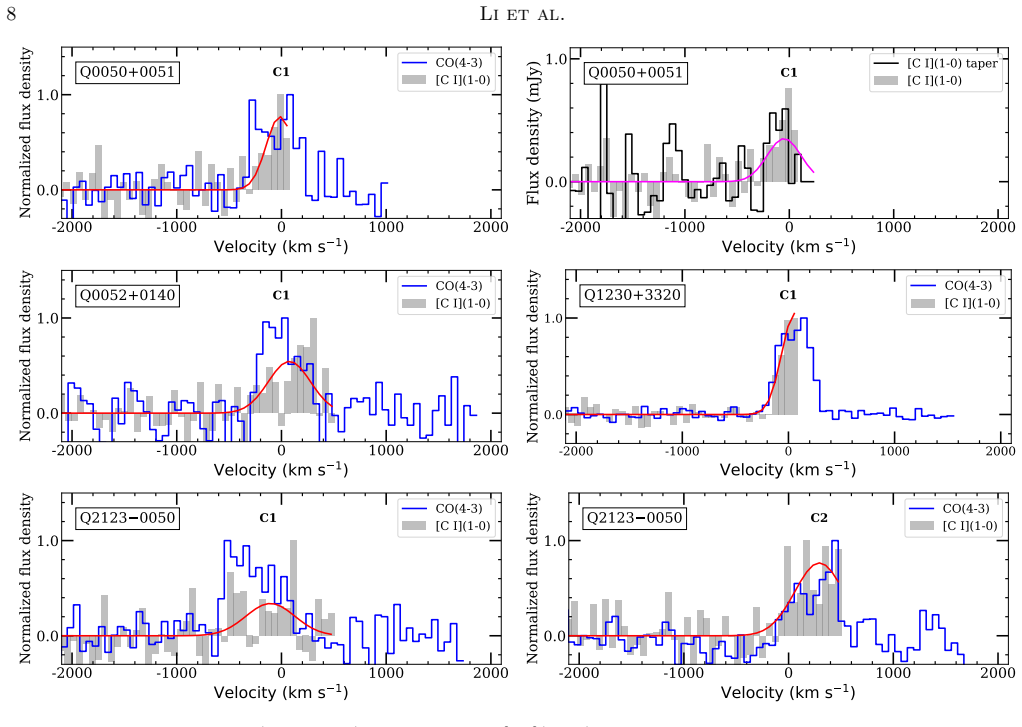
The diagnostic machinery is a pair of line ratios read against a photo-dissociation region model grid: $L'_{\rm [C I]}/L'_{\rm CO(4-3)}$ and $L_{\rm [C I]}/L_{\rm FIR(SF)}$. The first ratio tracks the molecular hydrogen density because CO(4-3) has a much higher critical density ($8.7\times10^4$ cm$^{-3}$) than [C I](1-0) ($470$ cm$^{-3}$); the second tracks the strength of the ambient radiation field $G_0$. To search the CGM, the paper combines the 7 m and 12 m arrays and applies uv-tapering with an 18.75 k$\lambda$ baseline cutoff, reaching beams of about 5 arcsec, so any [C I] flux above the compact 12 m measurement is attributed to emission on 16-40 kpc scales. Molecular gas masses are then derived three ways: from [C I](1-0) with the standard carbon-abundance formula, from CO(4-3) with $\alpha_{\rm CO}$ and $R_{41}$, and from dust continuum with a modified black body at $T_{\rm dust}=47$ K and an assumed dust-to-gas ratio.
What would settle it
A deeper [C I](1-0) map of Q0050+0051 that resolves the 16-40 kpc excess into compact clumps coincident with known companion galaxies, or that reproduces the full tapered flux with a rotating-disk model of the host, would disprove the molecular-CGM interpretation; a stacked detection across all ten fields that does not grow with integration time would similarly undermine it.
Extended reading notes
Core claim
On its own terms, the paper's central claim is that the cold molecular gas in these ten enormous Ly-$\alpha$ nebulae is extreme: the [C I](1-0) and dust detections in all ten QSOs and five companions imply molecular hydrogen densities near $10^{4.4}$-$10^{4.8}$ cm$^{-3}$ and radiation fields near $10^{3.3}$-$10^{3.7}$ in Habing units, higher than in high-redshift main-sequence galaxies and local luminous infrared galaxies, with the quasars at the top of the range. A second claim is that comparing CO(4-3), [C I](1-0), and dust-based gas masses yields a common low conversion factor $\alpha_{\rm CO}\sim0.8$ $\rm M_\odot\,[K\,km/s\,pc^2]^{-1}$, so these systems are starburst-like rather than typical star-forming disks. The third and most consequential claim is circumstantial: after uv-tapering the 7 m + 12 m data, nine of ten QSOs show more [C I](1-0) flux than the compact 12 m measurement, which the paper reads as possible molecular gas in the circumgalactic medium on 16-40 kpc scales; only Q0050+0051 yields a 2.7 $\sigma$ excess with $M_{\rm H_2}=(1.0-2.8)\times10^{10}$ $M_\odot$, while the other fields give 3 $\sigma$ upper limits of $(0.2-1.4)\times10^{10}$ $M_\odot$, corresponding to less than 0.4-3% of the halo's baryons.
Load-bearing premise
The load-bearing assumption is that the 12 m array data recover all the host-galaxy ISM emission, so the extra [C I] flux seen after uv-tapering must come from the CGM rather than from an extended disk or unresolved low-mass companions; with only a single 2.7 sigma detection, that assumption is not directly verified.
Editorial extensions
If this is right
- If the line-ratio interpretation is right, the molecular gas in these redshift-about-2 QSO hosts is denser and more strongly irradiated than in typical high-redshift star-forming galaxies, so the QSO environment itself, not just the starburst, sets the ISM conditions.
- A common $\alpha_{\rm CO}\sim0.8$ for QSOs and companions means CO-based molecular gas masses for such systems should not rely on the Milky Way value of about 3.6; using starburst-like values brings the three tracers into agreement.
- If the uv-tapering excess is CGM emission, then cold molecular gas is present at 16-40 kpc around most of these QSOs but holds less than 3% of the halo baryon budget, so most CGM baryons must be in other phases.
- The tentative CGM detection in Q0050+0051 has a [C I]/CO ratio above 0.8, implying lower-density, less-irradiated gas in the CGM than in the host ISM, a property that can distinguish between infall and outflow origins.
Reading between the lines
- A natural next step, which the paper notes is in preparation, is to stack the [C I] spectra of all ten fields; if the stacked excess is significant, it would convert a set of 0.5-2.7 sigma hints into a statistical detection of a molecular CGM.
- If the CGM masses hold, feedback models of massive halos at cosmic noon should predict that the cold molecular phase is a minor reservoir compared with ionized and atomic gas; otherwise, deeper observations should find much more [C I] than these limits allow.
- The same ratio diagnostics could be applied to the already-detected extended CO(4-3) gas in these fields; a strict upper limit on [C I]/CO in the extended component would directly test whether the CGM gas is denser than the tentative Q0050+0051 detection suggests.
- Because the paper assumes solar or supersolar metallicity for the dust-based masses, a metallicity gradient in the CGM would change the derived baryon fractions; measuring CGM metallicity through absorption lines would be a testable extension.
Editorial analysis
A structured set of objections, weighed in public.
Referee Report
Summary. The paper presents ALMA 12 m and ACA 7 m observations of [C I](1-0) and dust continuum in ten Enormous Lyα Nebulae hosting ultra-luminous Type-1 QSOs at z~2.2-2.5. It reports [C I] detections in all ten QSOs and five companion galaxies, derives gas densities and radiation fields from [C I]/CO(4-3) and [C I]/FIR ratios, compares molecular gas masses from CO(4-3), [C I], and dust, and claims a low CO-to-H2 conversion factor αCO~0.8 for both QSOs and companions. After uv-tapering, nine QSOs show an apparent [C I] flux excess, which the paper interprets as tentative evidence for molecular CGM on 16-40 kpc scales, with one 2.7σ detection in Q0050+0051 and 3σ upper limits elsewhere; these are translated into molecular CGM baryon fractions of <0.4-3%.
Significance. If the CGM interpretation holds, this is one of the first systematic constraints on cold molecular gas in the CGM of z~2 ELANe, and the baryon-fraction limits are a useful step for feedback models. The paper's strengths are the robust [C I] detections in the QSOs and companions, the explicit and careful treatment of the tentative 2.7σ CGM detection, the use of both 12 m and 7 m arrays to address surface-brightness sensitivity, and the detailed tables of fluxes, sizes, and derived masses. The physical-condition result (higher n_H2 and G0 in QSOs than in main-sequence galaxies and local ULIRGs) rests primarily on measured line ratios and is comparatively secure. The main caveats concern the CGM flux-excess interpretation and the partly assumed nature of the αCO conclusion, neither of which undermines the core line detections.
major comments (3)
- [3.2 and Table A1] The CGM interpretation of the uv-tapered flux excess rests on the assumption that the 12 m beam fully recovers the QSO's ISM emission. Table A1 gives a deconvolved [C I] major axis of 3.11±1.18 arcsec (~25±10 kpc) for Q1230+3320, which exceeds the 16 kpc threshold used to define CGM, and the convolved sizes of Q1228+3128 and Q1416+2649 are also ~1.5σ above the beam. Because the 12 m fluxes are measured at the peak pixel rather than integrated over the source, a marginally resolved ISM would produce a spuriously low S_12 and hence a spuriously positive S_taper−S_12. The 22% excess seen in Q1230+3320 is of the order expected from simply recovering missing flux from a ~25 kpc disk, which would invalidate the molecular CGM mass and baryon fraction for that field and weaken the statistical claim of excess in nine QSOs. Please quantify the expected flux recovery from the measured Gaussian sizes, or re-measure the 12 m fluxes by integrating over the source or fitting visibilities; if this cannot be done, the CGM interpretation should be restricted to sources with demonstrably unresolved ISM and the baryon-fraction limits recomputed accordingly.
- [4.3.4 and abstract] The claim that the QSOs and companions display a similarly low αCO~0.8 is partly an input rather than a result. For the QSOs, Eq. (5) is evaluated with αCO=0.8 and R41=0.87, and Eq. (8) with X_CI=8.4×10^-5, so the agreement between M_CO and M_CI is a consistency check of these adopted calibrations against the observed r_CI/CO, not a measurement of αCO. For the companions, the 'starburst' case imposes αCO=0.8, R41=0.85, and X_CI=8.4×10^-5, while the 'star-forming' case imposes αCO=3.6, R41=0.17, and X_CI=3.0×10^-5, so the choice between the two scenarios largely determines the conclusion. I recommend reframing Section 4.3.4 as a calibration-consistency exercise, or fitting the relevant parameter combination (e.g., αCO/R41 or αCO/X_CI) with uncertainties, and softening the abstract claim accordingly.
- [3.2] The companion-galaxy alternative to the CGM interpretation is acknowledged but not quantitatively excluded. The authors note that the excess is 15-78% of S_12 and that one or two companions just below the 3σ limit could produce it, and they argue that CO(4-3) would be detected unless the companions are low-metallicity. Since low-metallicity companions are plausible in the CGM context and the CO argument is indirect, the statement that the excess 'hints at cold CGM in the majority of targets' should be further qualified. A useful addition would be a stacked search for the excess in regions offset from the QSOs and from known companions, or a visibility-based test that distinguishes a central extended component from off-center point sources.
minor comments (5)
- [3.2] The sentence 'Therefore, argue that the contribution from companion galaxies...' is missing a subject; it should read 'Therefore, we argue...'.
- [4.3.5] In the sentence about the CO(4-3) upper limit for Q0050+0051, the units are given as '10^10 L⊙'; this should be '10^10 M⊙'.
- [Figure 5] Figure 5 appears to display only a single labeled point (Q0050+0051) even though the caption refers to red squares in the plural; if all nine QSOs with flux excess are plotted, individual labels or a legend would help the reader assess the scatter.
- [Appendix, Table A1] The statement in the appendix that 'the source sizes agree with the beam sizes within 2σ uncertainties' is correct but should explicitly mention that Q1230+3320 has a deconvolved major axis at ~2.6σ, since this is the source most relevant to the CGM discussion.
- [3.1] In the paragraph on Q1228+3128, the text says the CGM r_CI/CO upper limit is <0.35, but it would be helpful to state the exact [C I] flux limit used so the reader can reproduce the value.
Circularity Check
The QSO alpha_CO ~ 0.8 claim restates an adopted input rather than a measurement; the CGM and PDR-based conclusions remain independent.
-
self definitional
[Section 4.3.4 (Comparing the molecular gas mass in the ISM) and Abstract]
"We adopt αCO = 0.8 M⊙[K km/s pc2]−1 and R41 = 0.87 to estimate the molecular gas mass from the CO(4−3) line, and X[C I] = 8.4 × 10⁻⁵ to derive the molecular gas based on [C I](1 − 0) for the QSOs in our sample ... This suggests that the QSOs and companions are likely starbursts, and both have a low conversion factor of αCO ∼ 0.8 M⊙[K km/s pc2]−1."
For the QSOs, αCO = 0.8 is an adopted input value, described as 'typical for QSOs', rather than a quantity inferred from the observations. The summary claim that the QSOs display αCO ~ 0.8 therefore restates the assumption instead of reporting an independent measurement. The agreement between the CO(4−3)-based and [C I](1−0)-based molecular gas masses is a consistency check between two tracer calibrations that both assume starburst-like parameters, so it cannot by itself confirm a low conversion factor for the QSOs. The companion galaxies are treated differently because the paper explicitly tests both the starburst and star-forming parameter sets, making the companion conclusion non-circular.
full rationale
The paper's core measurements—[C I](1−0) fluxes, luminosities, line ratios, and the tapered-versus-12m flux differences—are new observational quantities. The physical-condition interpretation compares the measured ratios to the external PhotoDissociation Region Toolbox models, and the molecular gas masses use standard, separately published conversion factors. The companion-galaxy alpha_CO conclusion is tested against two explicit scenarios, so it does not reduce to the input. The only mild circular element is the summary statement that QSOs display alpha_CO ~ 0.8, because for the QSOs this value is adopted rather than measured; however, the paper clearly states the adopted values, and the tracer consistency is not mathematically forced. The CGM flux-excess interpretation depends on the assumption that the 12 m array fully recovers the ISM, which the paper acknowledges and qualifies with low significance; the Q1230+3320 deconvolved size above 16 kpc is a robustness tension but not a derivation-circular step. No load-bearing self-citation chain or definitional equivalence drives the central CGM or physical-condition results.
Assumptions & free parameters
free parameters (8)
- alpha_CO (CO-to-H2 conversion factor) =
0.8 Msun (K km/s pc^2)^-1
- R41 (CO(4-3)/CO(1-0) luminosity ratio) =
0.87 (QSOs), 0.85 (starburst companions), 0.17 (star-forming companions)
- X_CI (carbon abundance relative to H2) =
8.4e-5 (starburst/QSO), 3.0e-5 (normal star-forming)
- T_ex (excitation temperature for [C I]) =
29.1 K, giving Q10=0.457
- T_dust (dust temperature) =
47 K (with scenarios at 80 K)
- beta (dust emissivity index) =
1.6
- delta_DGR (dust-to-gas ratio) =
1/100 or 1/50
- Halo mass for baryon fraction calculation =
10^12.5 Msun
assumptions (6)
- domain assumption Flat Lambda-CDM cosmology with H0=70 km/s/Mpc, Omega_M=0.3, Omega_L=0.7.
- domain assumption PhotoDissociation Region Toolbox models (Kaufman et al. 2006) accurately describe the relation between line ratios and gas density/radiation field.
- domain assumption The adopted conversion relations for molecular gas mass (Eqs. 5-12) are valid for these sources.
- ad hoc to paper The excess [C I] flux after uv-tapering is due to CGM emission rather than resolved-out disk emission or unresolved companions.
- ad hoc to paper The definition of the CGM as all [C I] emission on scales greater than 16 kpc is appropriate.
- ad hoc to paper The QSOs and companion galaxies in each field have similar metallicity and dust-to-gas ratio for the dust-based mass comparison.
Cite this review
Pith. "Pith review of The SUPERCOLD-CGM survey: II. [\ion{C}{1}]$(1-0)$ emission and the physical conditions of cold gas in Enormous Ly$\alpha$ nebulae at $z\,\sim\,2$." pith.science (2026). https://pith.science/paper/VG7FE6JC
@misc{pith2026250205805,
  author       = {Pith},
  title        = {Pith review of: The SUPERCOLD-CGM survey: II. [\ionC1]$(1-0)$ emission and the physical conditions of cold gas in Enormous Ly$\alpha$ nebulae at $z\,\sim\,2$},
  year         = {2026},
  howpublished = {\url{https://pith.science/paper/VG7FE6JC}},
  note         = {Machine review of arXiv:2502.05805}
}
abstract
We report ALMA and ACA observations of atomic carbon ([\ion{C}{1}]$(1-0)$) and dust continuum in 10 Enormous Ly$\alpha$ Nebulae hosting ultra-luminous Type-I QSOs at $z=2.2-2.5$, as part of the SUrvey of Protocluster ELANe Revealing CO/CI in the Ly$\alpha$ Detected CGM (SUPERCOLD-CGM). We detect [\ion{C}{1}]$(1-0)$ and dust in all ten QSOs and five companion galaxies. We find that the QSOs and companions have higher gas densities and more intense radiation fields than Luminous Infrared galaxies and high-$z$ main sequence galaxies, with the highest values found in the QSOs. By comparing molecular gas masses derived from [\ion{C}{1}]$(1-0)$, CO(4$-$3) and dust continuum, we find that the QSOs and companions display a similar low CO conversion factor of $\alpha_{\rm CO}$\,$\sim$\,0.8 $\rm M_{\sun}$${[\rm K\,km/s\,pc^2]}^{-1}$. After tapering our data to low resolution, the [\ion{C}{1}]$(1-0)$ flux increases for nine QSOs, hinting at the possibility of [\ion{C}{1}]$(1-0)$ in the circum-galactic medium (CGM) on a scale of 16$-$40 kpc. However, the [\ion{C}{1}]$(1-0)$ sensitivity is too low to confirm this for individual targets, except for a tentative (2.7$\sigma$) CGM detection in Q0050+0051{} with M$_{\rm H_2}$\,=\, ($1.0 - 2.8$)$\times 10^{10}$ $\rm M_{\sun}$. The 3$\sigma$ mass limits of molecular CGM for the remaining QSO fields are ($0.2-1.4$)\,$\times$\,10$^{10}$ $\rm M_{\sun}$. This translates into a baryon fraction of $<$0.4-3$\% $ in the molecular CGM relative to the total baryonic halo mass. Our sample also includes a radio-detected AGN, Q1416+2649{}, which shows [\ion{C}{1}]$(1-0)$ and CO(4$-$3) luminosities an order of magnitude fainter for its far-infrared luminosity than other QSOs in our sample, possibly due to a lower molecular gas mass.
Figures


Figures from the paper (7 more)



Reference graph
Works this paper leans on
-
[1]
, " * write output.state after.block = add.period write newline
ENTRY address archivePrefix author booktitle chapter doi edition editor eprint howpublished institution journal key month number organization pages publisher school series title misctitle type volume year version url label extra.label sort.label short.list INTEGERS output.state before.all mid.sentence after.sentence after.block FUNCTION init.state.consts ...
-
[2]
write newline
" write newline "" before.all 'output.state := FUNCTION format.url url empty "" new.block "" url * "" * if FUNCTION format.eprint eprint empty "" archivePrefix empty "" archivePrefix "arXiv" = new.block " " eprint * " " * new.block " " eprint * " " * if if if FUNCTION format.doi doi empty "" " " doi * " " * if FUNCTION format.pid doi empty eprint empty ur...
-
[3]
ur Astrophysik, Karl-Schwarzschild-Str 1, D-85748 Garching bei M\
thebibliography [1] 20pt to REFERENCES 6pt =0pt -12pt 10pt plus 3pt =0pt =0pt =1pt plus 1pt =0pt =0pt -12pt =13pt plus 1pt =20pt =13pt plus 1pt \@M =10000 =-1.0em =0pt =0pt 0pt =0pt =1.0em @enumiv\@empty 10000 10000 `\.\@m \@noitemerr \@latex@warning Empty `thebibliography' environment \@ifnextchar \@reference \@latexerr Missing key on reference command E...
2021
-
[4]
Aird, J., Nandra, K., Laird, E. S., et al.\ 2010, , 401, 2531. doi:10.1111/j.1365-2966.2009.15829.x
arXiv 2010
-
[5]
Arrigoni Battaia, F., Yang, Y., Hennawi, J. F., et al.\ 2015, , 804, 26. doi:10.1088/0004-637X/804/1/26
-
[6]
Arrigoni Battaia, F., Prochaska, J. X., Hennawi, J. F., et al.\ 2018, , 473, 3907. doi:10.1093/mnras/stx2465
-
[7]
Arrigoni Battaia, F., Chen, C.-C., Liu, H.-Y. B., et al.\ 2022, , 930, 72. doi:10.3847/1538-4357/ac5a4d
-
[8]
L., Jones, G., et al.\ 2017, , 465, 4390
Banerji, M., Carilli, C. L., Jones, G., et al.\ 2017, , 465, 4390. doi:10.1093/mnras/stw3019
Show all 117 references
-
[9]
H., White, R
Becker, R. H., White, R. L., & Helfand, D. J.\ 1995, , 450, 559. doi:10.1086/176166
1995 doi
-
[10]
doi:10.1051/0004-6361/201220866
Bianchi, S.\ 2013, , 552, A89. doi:10.1051/0004-6361/201220866
2013 doi
-
[11]
G., Papadopoulos, P
Bisbas, T. G., Papadopoulos, P. P., & Viti, S.\ 2015, , 803, 37. doi:10.1088/0004-637X/803/1/37
2015 doi
-
[12]
G., van Dishoeck, E
Bisbas, T. G., van Dishoeck, E. F., Papadopoulos, P. P., et al.\ 2017, , 839, 90. doi:10.3847/1538-4357/aa696d
2017 doi
-
[13]
doi:10.1051/0004-6361/202039057
Bischetti, M., Feruglio, C., Piconcelli, E., et al.\ 2021, , 645, A33. doi:10.1051/0004-6361/202039057
2021 doi
-
[14]
G., Benson, A
Bower, R. G., Benson, A. J., Malbon, R., et al.\ 2006, , 370, 645. doi:10.1111/j.1365-2966.2006.10519.x
2006
-
[15]
D., Wolfire, M., & Leroy, A
Bolatto, A. D., Wolfire, M., & Leroy, A. K.\ 2013, , 51, 207. doi:10.1146/annurev-astro-082812-140944
2013 doi
-
[16]
S., Aguirre, J
Bothwell, M. S., Aguirre, J. E., Aravena, M., et al.\ 2017, , 466, 2825. doi:10.1093/mnras/stw3270
2017 doi
-
[17]
doi:10.3847/1538-4357/aa5d14
Cai, Z., Fan, X., Yang, Y., et al.\ 2017, , 837, 71. doi:10.3847/1538-4357/aa5d14
2017 doi
-
[18]
doi:10.3847/2041-8213/aacce6
Cai, Z., Hamden, E., Matuszewski, M., et al.\ 2018, , 861, L3. doi:10.3847/2041-8213/aacce6
2018 doi
-
[19]
X., et al.\ 2019, , 245, 23
Cai, Z., Cantalupo, S., Prochaska, J. X., et al.\ 2019, , 245, 23. doi:10.3847/1538-4365/ab4796
2019 doi
-
[20]
Carilli, C. L. & Walter, F.\ 2013, , 51, 105. doi:10.1146/annurev-astro-082812-140953
2013 doi
-
[21]
doi:10.1088/1538-3873/ac9642
CASA Team, Bean, B., Bhatnagar, S., et al.\ 2022, , 134, 114501. doi:10.1088/1538-3873/ac9642
2022 doi
-
[22]
doi:10.1007/978-3-319-56570-5\_9
Chen, H.-W.\ 2017, Outskirts of Galaxies, 434, 291. doi:10.1007/978-3-319-56570-5\_9
2017 doi
-
[23]
D., et al.\ 2024, , 527, 8950
Chen, Z., Dannerbauer, H., Lehnert, M. D., et al.\ 2024, , 527, 8950. doi:10.1093/mnras/stad3128
2024 doi
-
[24]
doi:10.1051/0004-6361/201424980
Cicone, C., Maiolino, R., Gallerani, S., et al.\ 2015, , 574, A14. doi:10.1051/0004-6361/201424980
2015 doi
-
[25]
doi:10.1051/0004-6361/202141611
Cicone, C., Mainieri, V., Circosta, C., et al.\ 2021, , 654, L8. doi:10.1051/0004-6361/202141611
2021 doi
-
[26]
J., Springel, V., White, S
Croton, D. J., Springel, V., White, S. D. M., et al.\ 2006, , 365, 11. doi:10.1111/j.1365-2966.2005.09675.x
2006
-
[27]
doi:10.1088/2041-8205/714/1/L118
Daddi, E., Elbaz, D., Walter, F., et al.\ 2010, , 714, L118. doi:10.1088/2041-8205/714/1/L118
2010 doi
-
[28]
doi:10.1051/0004-6361/202141853
De Breuck, C., Lundgren, A., Emonts, B., et al.\ 2022, , 658, L2. doi:10.1051/0004-6361/202141853
2022 doi
-
[29]
D., Emonts, B., et al.\ 2017, , 608, A48
Dannerbauer, H., Lehnert, M. D., Emonts, B., et al.\ 2017, , 608, A48. doi:10.1051/0004-6361/201730449
2017 doi
-
[30]
doi:10.3847/1538-4357/ab30fe
Decarli, R., Walter, F., G \'o nzalez-L \'o pez, J., et al.\ 2019, , 882, 138. doi:10.3847/1538-4357/ab30fe
2019 doi
-
[31]
de los Reyes, M. A. C. & Kennicutt, R. C.\ 2019, , 872, 16. doi:10.3847/1538-4357/aafa82
2019 doi
-
[32]
doi:10.1051/0004-6361/201834444
De Vis, P., Jones, A., Viaene, S., et al.\ 2019, , 623, A5. doi:10.1051/0004-6361/201834444
2019 doi
-
[33]
doi:10.3847/1538-4357/aa81d7
D \' az-Santos, T., Armus, L., Charmandaris, V., et al.\ 2017, , 846, 32. doi:10.3847/1538-4357/aa81d7
2017 doi
-
[34]
doi:10.1038/nature03335
Di Matteo, T., Springel, V., & Hernquist, L.\ 2005, , 433, 604. doi:10.1038/nature03335
2005 doi
- [35]
-
[36]
doi:10.1051/0004-6361/201323310
Drouart, G., De Breuck, C., Vernet, J., et al.\ 2014, , 566, A53. doi:10.1051/0004-6361/201323310
2014 doi
-
[37]
doi:10.1093/mnras/stt997
Dubois, Y., Gavazzi, R., Peirani, S., et al.\ 2013, , 433, 3297. doi:10.1093/mnras/stt997
2013 doi
-
[38]
doi:10.1093/mnras/stw2265
Dubois, Y., Peirani, S., Pichon, C., et al.\ 2016, , 463, 3948. doi:10.1093/mnras/stw2265
2016 doi
-
[39]
J., Vlahakis, C., et al.\ 2021, , 501, 2573
Dunne, L., Maddox, S. J., Vlahakis, C., et al.\ 2021, , 501, 2573. doi:10.1093/mnras/staa3526
2021 doi
-
[40]
Emonts, B. H. C., Lehnert, M. D., Villar-Mart \' n, M., et al.\ 2016, Science, 354, 1128. doi:10.1126/science.aag0512
2016 doi
-
[41]
Emonts, B. H. C., Lehnert, M. D., Dannerbauer, H., et al.\ 2018, , 477, L60. doi:10.1093/mnrasl/sly034
2018 doi
-
[42]
Emonts, B. H. C., Lehnert, M. D., Yoon, I., et al.\ 2023, Science, 379, 1323. doi:10.1126/science.abh2150
2023 doi
-
[43]
D., et al.\ 2019, , 621, A27
Falkendal, T., De Breuck, C., Lehnert, M. D., et al.\ 2019, , 621, A27. doi:10.1051/0004-6361/201732485
2019 doi
-
[44]
doi:10.3847/1538-4357/ab480f
Fujimoto, S., Ouchi, M., Ferrara, A., et al.\ 2019, , 887, 107. doi:10.3847/1538-4357/ab480f
2019 doi
-
[45]
D., Bethermin, M., et al.\ 2020, , 900, 1
Fujimoto, S., Silverman, J. D., Bethermin, M., et al.\ 2020, , 900, 1. doi:10.3847/1538-4357/ab94b3
2020 doi
-
[46]
J., Gracia-Carpio, J., et al.\ 2010, , 407, 2091
Genzel, R., Tacconi, L. J., Gracia-Carpio, J., et al.\ 2010, , 407, 2091. doi:10.1111/j.1365-2966.2010.16969.x
2010
-
[47]
doi:10.1093/mnras/stx712
Ginolfi, M., Maiolino, R., Nagao, T., et al.\ 2017, , 468, 3468. doi:10.1093/mnras/stx712
2017 doi
-
[48]
C., B \'e thermin, M., et al.\ 2020, , 633, A90
Ginolfi, M., Jones, G. C., B \'e thermin, M., et al.\ 2020, , 633, A90. doi:10.1051/0004-6361/201936872
2020 doi
-
[49]
doi:10.1051/0004-6361/202142172
Gururajan, G., B \'e thermin, M., Theul \'e , P., et al.\ 2022, , 663, A22. doi:10.1051/0004-6361/202142172
2022 doi
-
[50]
doi:10.1051/0004-6361/202346449
Gururajan, G., Bethermin, M., Sulzenauer, N., et al.\ 2023, , 676, A89. doi:10.1051/0004-6361/202346449
2023 doi
-
[51]
J.\ 1968, , 19, 421
Habing, H. J.\ 1968, , 19, 421
1968
-
[52]
doi:10.3847/1538-4357/aac0f6
Herrera-Camus, R., Sturm, E., Graci \'a -Carpio, J., et al.\ 2018, , 861, 94. doi:10.3847/1538-4357/aac0f6
2018 doi
-
[53]
doi:10.1051/0004-6361/202039704
Herrera-Camus, R., F \"o rster Schreiber, N., Genzel, R., et al.\ 2021, , 649, A31. doi:10.1051/0004-6361/202039704
2021 doi
-
[54]
A., Carilli, C
Hodge, J. A., Carilli, C. L., Walter, F., et al.\ 2012, , 760, 11. doi:10.1088/0004-637X/760/1/11
2012 doi
-
[55]
F., Cox, T
Hopkins, P. F., Cox, T. J., Kere s , D., et al.\ 2008, , 175, 390. doi:10.1086/524363
2008 doi
-
[56]
R., Indebetouw, R., Brogan, C
Hunter, T. R., Indebetouw, R., Brogan, C. L., et al.\ 2023, , 135, 074501. doi:10.1088/1538-3873/ace216
2023 doi
- [57]
-
[58]
P., Rosenberg, M
Israel, F. P., Rosenberg, M. J. F., & van der Werf, P.\ 2015, , 578, A95. doi:10.1051/0004-6361/201425175
2015 doi
-
[59]
doi:10.3847/2041-8213/aa6f0f
Jiao, Q., Zhao, Y., Zhu, M., et al.\ 2017, , 840, L18. doi:10.3847/2041-8213/aa6f0f
2017 doi
-
[60]
doi:10.1093/mnras/stab1035
Jiao, Q., Gao, Y., & Zhao, Y.\ 2021, , 504, 2360. doi:10.1093/mnras/stab1035
2021 doi
-
[61]
doi:10.3847/1538-4357/ab29ed
Jiao, Q., Zhao, Y., Lu, N., et al.\ 2019, , 880, 133. doi:10.3847/1538-4357/ab29ed
2019 doi
-
[62]
C., Maiolino, R., Carniani, S., et al.\ 2023, , 522, 275
Jones, G. C., Maiolino, R., Carniani, S., et al.\ 2023, , 522, 275. doi:10.1093/mnras/stad985
2023 doi
-
[63]
J., Wolfire, M
Kaufman, M. J., Wolfire, M. G., & Hollenbach, D. J.\ 2006, , 644, 283. doi:10.1086/503596
2006 doi
- [64]
-
[65]
C., Hao, C.-N., Calzetti, D., et al.\ 2009, , 703, 1672
Kennicutt, R. C., Hao, C.-N., Calzetti, D., et al.\ 2009, , 703, 1672. doi:10.1088/0004-637X/703/2/1672
2009 doi
-
[66]
Kennicutt, R. C. & De Los Reyes, M. A. C.\ 2021, , 908, 61. doi:10.3847/1538-4357/abd3a2
2021 doi
-
[67]
doi:10.1093/mnras/stad2647
Kolwa, S., De Breuck, C., Vernet, J., et al.\ 2023, , 525, 5831. doi:10.1093/mnras/stad2647
2023 doi
-
[68]
Kormendy, J. & Ho, L. C.\ 2013, , 51, 511. doi:10.1146/annurev-astro-082708-101811
2013 doi
-
[69]
doi:10.1017/S1743921319008500
Kormendy, J.\ 2020, Galactic Dynamics in the Era of Large Surveys, 353, 186. doi:10.1017/S1743921319008500
2020 doi
-
[70]
A., & Sijacki, D.\ 2021, , 503, 3568
Koudmani, S., Henden, N. A., & Sijacki, D.\ 2021, , 503, 3568. doi:10.1093/mnras/stab677
2021 doi
-
[71]
doi:10.1051/0004-6361/202038944
Khusanova, Y., Bethermin, M., Le F \`e vre, O., et al.\ 2021, , 649, A152. doi:10.1051/0004-6361/202038944
2021 doi
-
[72]
A., Chandler, C
Lacy, M., Baum, S. A., Chandler, C. J., et al.\ 2020, , 132, 035001. doi:10.1088/1538-3873/ab63eb
2020 doi
-
[73]
W., Prochaska, J
Lau, M. W., Prochaska, J. X., & Hennawi, J. F.\ 2016, , 226, 25. doi:10.3847/0067-0049/226/2/25
2016 doi
-
[74]
Le Brun, A. M. C., McCarthy, I. G., Schaye, J., et al.\ 2014, , 441, 1270. doi:10.1093/mnras/stu608
2014 doi
-
[75]
doi:10.1093/mnras/stz2684
Li, Q., Narayanan, D., & Dav \'e , R.\ 2019, , 490, 1425. doi:10.1093/mnras/stz2684
2019 doi
-
[76]
Li, J., Emonts, B. H. C., Cai, Z., et al.\ 2021, , 922, L29. doi:10.3847/2041-8213/ac390d
2021 doi
-
[77]
Li, J., Emonts, B. H. C., Cai, Z., et al.\ 2023, , 950, 180. doi:10.3847/1538-4357/accbbd
2023 doi
-
[78]
doi:10.1088/2041-8205/810/2/L14
Liu, D., Gao, Y., Isaak, K., et al.\ 2015, , 810, L14. doi:10.1088/2041-8205/810/2/L14
2015 doi
-
[79]
doi:10.3847/1538-4357/abd3a8
Liu, Y., Wang, R., Momjian, E., et al.\ 2021, , 908, 124. doi:10.3847/1538-4357/abd3a8
2021 doi
-
[80]
& Dickinson, M.\ 2014, , 52, 415
Madau, P. & Dickinson, M.\ 2014, , 52, 415. doi:10.1146/annurev-astro-081811-125615
2014 doi
-
[81]
doi:10.1111/j.1365-2966.2011.19950.x
Martizzi, D., Teyssier, R., & Moore, B.\ 2012, , 420, 2859. doi:10.1111/j.1365-2966.2011.19950.x
2012
-
[82]
J., Spinrad, H., van Breugel, W., et al.\ 1990, , 365, 487
McCarthy, P. J., Spinrad, H., van Breugel, W., et al.\ 1990, , 365, 487. doi:10.1086/169503
1990 doi
-
[83]
P., Waters, B., Schiebel, D., et al.\ 2007, Astronomical Data Analysis Software and Systems XVI, 376, 127
McMullin, J. P., Waters, B., Schiebel, D., et al.\ 2007, Astronomical Data Analysis Software and Systems XVI, 376, 127
2007
-
[84]
A., Walter, F., Cicone, C., et al.\ 2022, , 927, 152
Meyer, R. A., Walter, F., Cicone, C., et al.\ 2022, , 927, 152. doi:10.3847/1538-4357/ac4e94
2022 doi
-
[85]
& De Breuck, C.\ 2008, , 15, 67
Miley, G. & De Breuck, C.\ 2008, , 15, 67. doi:10.1007/s00159-007-0008-z
2008 doi
-
[86]
doi:10.1051/0004-6361/202345924
Mountrichas, G.\ 2023, , 672, A98. doi:10.1051/0004-6361/202345924
2023 doi
-
[87]
J., Condon, J
Murphy, E. J., Condon, J. J., Schinnerer, E., et al.\ 2011, , 737, 67. doi:10.1088/0004-637X/737/2/67
2011 doi
-
[88]
Neufeld, D. A. & Wolfire, M. G.\ 2016, , 826, 183. doi:10.3847/0004-637X/826/2/183
2016 doi
-
[89]
D., Davies, J
Oppenheimer, B. D., Davies, J. J., Crain, R. A., et al.\ 2020, , 491, 2939. doi:10.1093/mnras/stz3124
2020 doi
-
[90]
P., Thi, W.-F., & Viti, S.\ 2004, , 351, 147
Papadopoulos, P. P., Thi, W.-F., & Viti, S.\ 2004, , 351, 147. doi:10.1111/j.1365-2966.2004.07762.x
2004
-
[91]
Papadopoulos, P. P. & Greve, T. R.\ 2004, , 615, L29. doi:10.1086/426059
2004 doi
-
[92]
doi:10.1051/0004-6361/201833880
Planck Collaboration, Aghanim, N., Akrami, Y., et al.\ 2020, , 641, A1. doi:10.1051/0004-6361/201833880
2020 doi
-
[93]
Pound, M. W. & Wolfire, M. G.\ 2008, Astronomical Data Analysis Software and Systems XVII, 394, 654
2008
- [94]
-
[95]
Pound, M. W. & Wolfire, M. G.\ 2023, , 165, 25. doi:10.3847/1538-3881/ac9b1f
2023 doi
-
[96]
doi:10.1086/375619
Reuland, M., van Breugel, W., R \"o ttgering, H., et al.\ 2003, , 592, 755. doi:10.1086/375619
2003 doi
-
[97]
T., Strauss, M
Richards, G. T., Strauss, M. A., Fan, X., et al.\ 2006, , 131, 2766. doi:10.1086/503559
2006 doi
-
[98]
Rosenberg, M. J. F., van der Werf, P. P., Aalto, S., et al.\ 2015, , 801, 72. doi:10.1088/0004-637X/801/2/72
2015 doi
-
[99]
A., Bower, R
Schaye, J., Crain, R. A., Bower, R. G., et al.\ 2015, , 446, 521. doi:10.1093/mnras/stu2058
2015 doi
-
[100]
doi:10.1051/0004-6361/202346945
Schimek, A., Decataldo, D., Shen, S., et al.\ 2024, , 682, A98. doi:10.1051/0004-6361/202346945
2024 doi
-
[101]
P., & Gunn, J
Schmidt, M., Schneider, D. P., & Gunn, J. E.\ 1995, , 110, 68. doi:10.1086/117497
1995 doi
-
[102]
C., et al.\ 2023, , 519, 5246
Scholtz, J., Maiolino, R., Jones, G. C., et al.\ 2023, , 519, 5246. doi:10.1093/mnras/stac3787
2023 doi
-
[103]
doi:10.1051/0004-6361/202244610
Shao, Y., Wang, R., Weiss, A., et al.\ 2022, , 668, A121. doi:10.1051/0004-6361/202244610
2022 doi
-
[104]
doi:10.1093/mnras/stv1340
Sijacki, D., Vogelsberger, M., Genel, S., et al.\ 2015, , 452, 575. doi:10.1093/mnras/stv1340
2015 doi
- [105]
-
[106]
F., Cutri, R
Skrutskie, M. F., Cutri, R. M., Stiening, R., et al.\ 2006, , 131, 1163. doi:10.1086/498708
2006 doi
-
[107]
S., & Werk, J
Tumlinson, J., Peeples, M. S., & Werk, J. K.\ 2017, , 55, 389. doi:10.1146/annurev-astro-091916-055240
2017 doi
-
[108]
E., Daddi, E., et al.\ 2020, , 890, 24
Valentino, F., Magdis, G. E., Daddi, E., et al.\ 2020, , 890, 24. doi:10.3847/1538-4357/ab6603
2020 doi
-
[109]
P., Walter, F., Neeleman, M., et al.\ 2020, , 904, 130
Venemans, B. P., Walter, F., Neeleman, M., et al.\ 2020, , 904, 130. doi:10.3847/1538-4357/abc563
2020 doi
-
[110]
doi:10.1046/j.1365-2966.2003.07090.x
Villar-Mart \' n, M., Vernet, J., di Serego Alighieri, S., et al.\ 2003, , 346, 273. doi:10.1046/j.1365-2966.2003.07090.x
2003
-
[111]
D., Ross, N
White, M., Myers, A. D., Ross, N. P., et al.\ 2012, , 424, 933. doi:10.1111/j.1365-2966.2012.21251.x
2012
-
[112]
doi:10.1088/0004-637X/730/1/18
Walter, F., Wei , A., Downes, D., et al.\ 2011, , 730, 18. doi:10.1088/0004-637X/730/1/18
2011 doi
-
[113]
doi:10.3847/1538-4357/ac49e8
Walter, F., Neeleman, M., Decarli, R., et al.\ 2022, , 927, 21. doi:10.3847/1538-4357/ac49e8
2022 doi
-
[114]
doi:10.3847/1538-4357/ad3fb4
Wang, F., Yang, J., Fan, X., et al.\ 2024, , 968, 9. doi:10.3847/1538-4357/ad3fb4
2024 doi
-
[115]
doi:10.1051/0004-6361:20031337
Wei , A., Henkel, C., Downes, D., et al.\ 2003, , 409, L41. doi:10.1051/0004-6361:20031337
2003 doi
-
[116]
G., Hollenbach, D., & McKee, C
Wolfire, M. G., Hollenbach, D., & McKee, C. F.\ 2010, , 716, 1191. doi:10.1088/0004-637X/716/2/1191
2010 doi
-
[117]
doi:10.1051/0004-6361/201731391
Yang, C., Omont, A., Beelen, A., et al.\ 2017, , 608, A144. doi:10.1051/0004-6361/201731391
2017 doi
Reviewed August 8, 2026 · model on record in the stance chip above.
Discussion (0). Continue with ORCID to comment.