REVIEW 4 major objections 5 minor 130 references
The dispersion measure and scattering of Fast Radio Bursts: contributions from multi-components, and clues for the intrinsic properties
T0 review · 4 major / 5 minor · reviewed 2026-08-08 · deepseek-v4-flash
Pith's one-line read The paper argues that the observed dispersion and scattering of fast radio bursts in the CHIME/FRB catalog can be reproduced by a mixed population of young and old progenitors, and it uses that model to estimate FRB redshifts to about 0.12.
desk verdict A useful FRB population-synthesis paper with real external checks, but the central MCMC likelihood uses an undefined covariance matrix and the scattering model fails its own KS test, so the quoted parameter constraints are not yet statistically grounded. read the letter →
The pith
A machine-rendered reading of the paper's core claim, the machinery that carries it, and where it could break.
The reading
What carries the argument
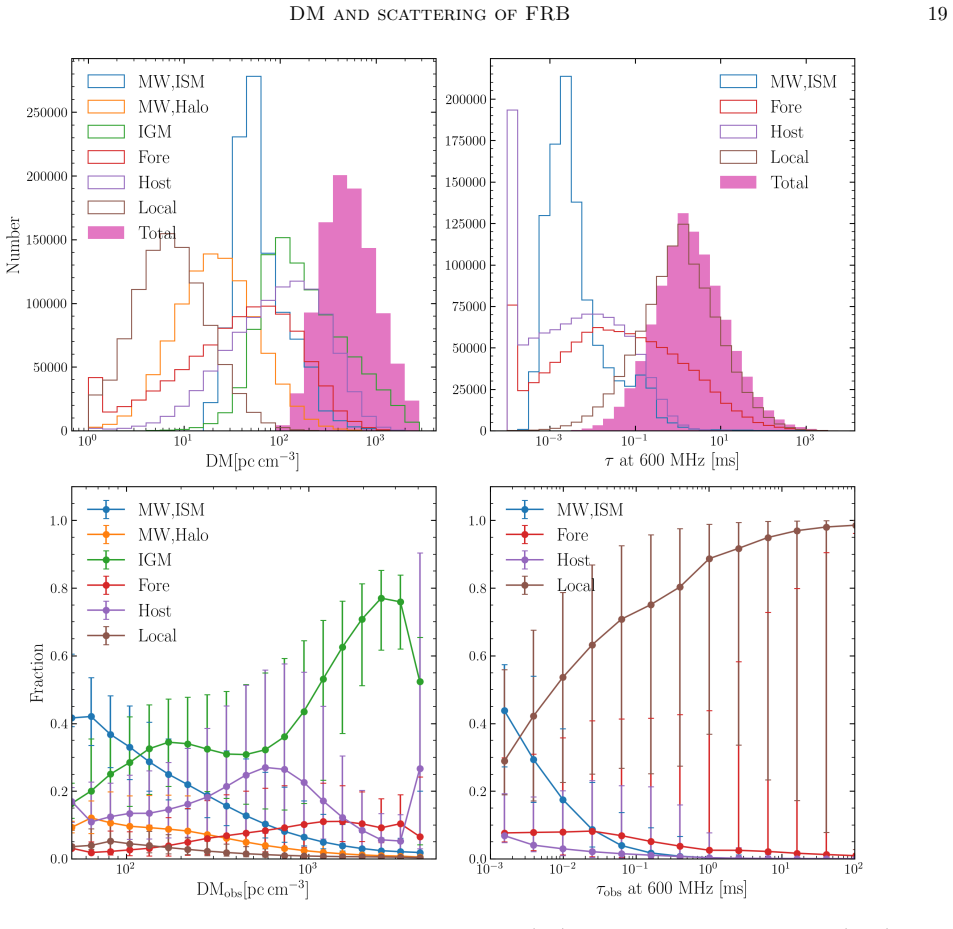
The load-bearing mechanism is a multi-component decomposition of the observed DM and scattering time: $\mathrm{DM}_{\rm obs}$ is the sum of Milky Way ISM and halo, IGM, foreground, host, and local contributions, while $\tau_{\rm obs}$ is the analogous sum with factors of 3 and 6 for extragalactic host and local screens and a frequency scaling $\tau(\nu)\propto\nu^{-4}$. Host and foreground contributions are computed from the electron density, star formation, and stellar mass distributions of simulated galaxies, with unresolved gas assumed to follow Kolmogorov turbulence between inner scale $10^6$ m and outer scale 5 pc. Mock catalogs are then compared with the selection-corrected CHIME/FRB sample through a log-likelihood built on binned DM and $\tau$ distributions, and the free parameters are constrained by Markov chain Monte Carlo sampling.
What would settle it
Measure the electron-density fluctuation spectrum in a foreground galaxy's circumgalactic medium by imaging angular broadening of a background radio source on sub-parsec scales; a spectral index or inner scale that deviates from the assumed turbulence model would change the computed host and foreground scattering and invalidate the fitted Fmax and source-population fractions.
Extended reading notes
Core claim
On the paper's own terms, the central claim is that a single, relatively simple model of FRB sources and their environments can explain the CHIME/FRB data. The model places mock bursts at redshifts drawn from a mixed young/old progenitor population, gives them energies from a Schechter function, and assigns DM and $\tau$ by summing contributions from the Milky Way ISM, the Milky Way halo, the IGM, foreground halos and galaxies, host galaxies and halos, and a local circumburst medium. MCMC fitting of four parameters yields $f_{\rm PSFR}=0.58^{+0.16}_{-0.27}$, $\gamma=-1.60^{+0.11}_{-0.13}$, $\log_{10}E_*=42.27^{+1.17}_{-1.18}$, and $F_{\max}=6.46^{+2.47}_{-2.11}$. The best-fit model reproduces the selection-corrected DM distribution (KS $p=0.42$) and broadly matches the $\tau$ distribution below 10 ms (KS $p\approx2\times10^{-4}$, better than the prior favored model), and it predicts that scattering is dominated by local/host contributions with small associated DM. The same model, applied as a redshift estimator, gives RMS residuals of about 0.11--0.12 on 68 localized FRBs once the extreme event FRB190520B is excluded.
Load-bearing premise
The whole calculation rests on assuming that the fine-grained lumpiness of gas in and around galaxies, which the simulation cannot see, follows a standard turbulence law with a particular inner and outer scale; if real gas is lumpier or smoother on those scales, every fitted parameter and redshift error bar shifts.
Editorial extensions
If this is right
- A mixed source population is sufficient: if the fitted parameters are correct, no exotic single-population model is required to explain the CHIME DM distribution.
- Tau is not a useful distance indicator in this model: because the dominant scattering component carries only about $10\,\mathrm{pc\,cm^{-3}}$ of DM, adding tau to a DM-only estimator changes redshift accuracy by only a few percent.
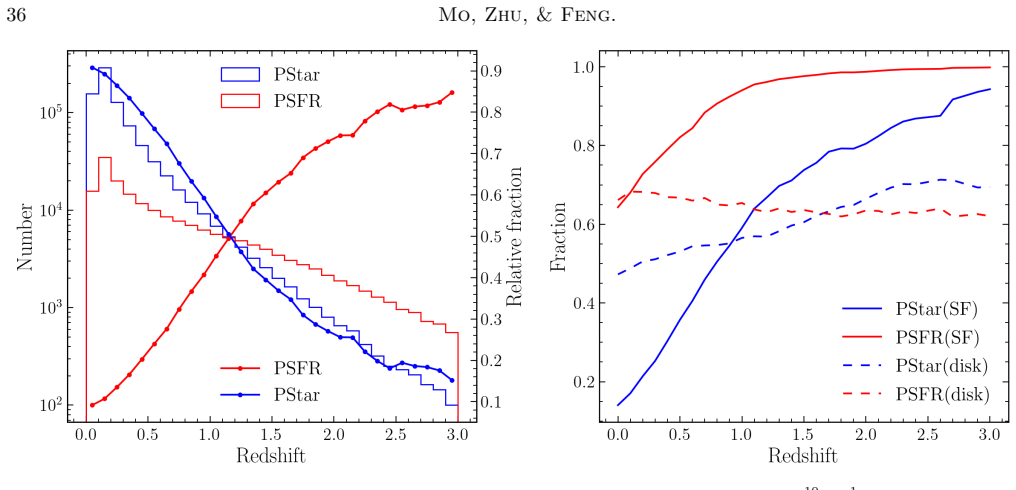
- Host-galaxy demographics become a model test: the authors predict 54% star-forming and 51% disk hosts at $z<0.1$, and 68% and 54% at $z<1.1$, broadly consistent with current localized FRBs.
- The result sets priors for FRB cosmology: the $\mathrm{DM}_{\rm IGM}(z)$ relation with redshift-dependent baryon fraction and foreground halo contributions can be used to convert future DM catalogs into redshift estimates.
- Resolution of the host and foreground scattering is a leading systematic: switching from TNG100 to TNG50 changes $f_{\rm PSFR}$ and $\gamma$ enough to matter, so higher-resolution simulations are the next step.
Reading between the lines
- Because the local scattering screen in this model can absorb unresolved electron clumps up to 100 kpc away, the fitted $F_{\max}$ is not a direct measure of circumburst turbulence unless the host ISM and CGM clump model is trusted.
- A sharper test of the assumed Kolmogorov spectrum would come from angular-broadening measurements of background sources viewed through foreground CGM, which would directly constrain the small-scale electron-density power spectrum that sets $\tau_{\rm Host}$ and $\tau_{\rm Fore}$.
- The paper's host-galaxy prediction implies that a complete sample of roughly 40 local ($z<0.1$) localized FRBs with morphology classifications could constrain $f_{\rm PSFR}$ independently of the CHIME DM fit; the current 18-of-21 disk-host rate is already in tension with the 51% prediction.
- The same mock-catalog machinery could be rerun for other telescopes with different bandwidths and sensitivity curves to predict their DM and tau distributions and optimize future surveys.
Editorial analysis
A structured set of objections, weighed in public.
Referee Report
Summary. The paper presents a forward model for the joint distribution of dispersion measure (DM) and scattering time (tau) of fast radio bursts (FRBs), combining a mixed young/old progenitor population, a Schechter energy function, and multi-component estimates of DM and tau contributions from the Milky Way, IGM, foreground halos, host galaxies/halos, and local environments. The host and foreground contributions are taken from IllustrisTNG simulations, while other terms use empirical models. Model parameters are fit to selection-corrected CHIME/FRB Catalog 1 data via MCMC, using either DM only or DM and tau. The paper then constructs four redshift estimators and tests them on 71 localized FRBs, reporting RMS errors of order 0.11-0.12 after excluding extreme cases. It also compares predicted host-galaxy type fractions with observations.
Significance. If the statistical inference were sound, this would be a valuable contribution: it provides a simulation-informed, multi-component framework for interpreting FRB DM and tau distributions, gives quantitative constraints on the young-progenitor fraction fPSFR and the energy-distribution parameters, and offers a redshift estimator validated against localized FRBs. The paper deserves credit for using TNG100 and TNG50 to inform host and foreground contributions, for checking predictions against 71 localized FRBs, for exploring multiple scenarios (TNG50, extended-local-scattering, larger tau range), and for compiling a substantial table of localized FRB properties. The host-galaxy fraction comparison is a useful external cross-check. However, the central MCMC likelihood is not fully specified because the covariance matrix in Eq. (18) is never defined, and one fitted parameter (log10 E*) is explicitly reported as non-converged. These issues affect the quoted parameter values and error bars, so the quantitative claims are not yet statistically grounded.
major comments (4)
- [Section 3, Eq. (18)] The log-likelihood is written as -0.5*(Ni - ni)^T Cov^{-1}(Ni - ni), but the covariance matrix Cov is never defined anywhere in the text or appendices. It is not stated whether Cov is diagonal with Poisson variances, a bootstrap covariance, or something else, and its dimensions are not specified. All posterior distributions and uncertainties in Figures 9-10 and Table 1 depend on this choice, so the quoted parameter constraints are not reproducible and the error bars are not statistically justified. This affects both the DM-only and the combined DM-tau fits and is therefore load-bearing for the paper's central claim of identifying optimal model parameters.
- [Section 3.1, Figure 9, Table 1] The paper states that log10(E*) 'shows signs of non-convergence toward the end of the MCMC process, displaying a broad range of values from 42 to 44' (Section 3.1). Despite this, the abstract and Table 1 quote log10(E*) = 42.27^{+1.17}_{-1.18} as a meaningful constraint. A non-converged posterior for E* means that the reported median and 1-sigma interval for this parameter are not reliable; the parameter should be reported as poorly constrained or the chains extended until convergence is actually achieved. Because E* is one of the three headline parameters describing the energy distribution, this undermines a central quantitative conclusion.
- [Table 2 and Abstract] The two-sided KS test on the tau distribution gives p = 2e-4, and the AD test gives p = 10^-3 or lower, meaning the model does not reproduce the tau distribution at the 5% significance level. The abstract's phrase 'broadly reproduce the tau distribution' overstates this result. The authors acknowledge the difficulty in Section 3.2 and discuss possible causes, including selection-function uncertainties for highly scattered events, but the discrepancy should be stated with the same prominence as the DM success, and the conclusion should explicitly note that the tau distribution is not statistically reproduced. This is important because the paper's title and framing emphasize the joint DM-tau distribution.
- [Section 2.4.3, Eq. (15)] The variance of DMIGM is modeled as sigma_DMIGM(z) = 0.623 * (-234.3 exp(1.0 z) + 237.2), with the factor 0.623 introduced to 'exclude the effect of baryons in intervening halos based on the results in Zhu & Feng (2021)'. No derivation or quantitative justification is given for this specific factor, and no test is shown that the scaling correctly removes halo variance without double-counting. Since sigma_DMIGM directly enters the likelihood and also affects the redshift estimator, this assumption should either be validated directly against simulation sightlines at multiple redshifts or treated as an additional systematic uncertainty in the fitted parameters.
minor comments (5)
- [Abstract and Section 1] There are several typographical errors, including 'F ast Radio Bursts' in the title area, 'dectected events' in the introduction, and 'the the extragalactic DM' in Section 4. These should be corrected.
- [Section 2.4.3, Eq. (13) usage] The log-normal variance parameter is written as sigma = {ln[1 + (sigma_DMIGM/<DMIGM>)^2]}^2, which appears to be missing a square root; the standard relation is sigma^2 = ln[1 + (sigma_DMIGM/<DMIGM>)^2]. Please check and correct the formula.
- [Section 6, first bullet] The sentence 'More events with robust measurements of tau are needed to to further refine the constraints' contains a duplicated 'to'.
- [Table 2 and Section 5.2] For the Ext-local scenario, the text states that F is drawn from a uniform distribution between 0.5 and 2, while Table 2 lists Fmax = 2; clarify in the table caption or text that the entry 'Fmax' for this scenario is the fixed upper bound of the uniform prior rather than a fitted parameter.
- [General reproducibility] To make the MCMC results reproducible, the paper should state the full likelihood specification, including the definition of Cov, the number of bins used, and the treatment of tau upper limits in the likelihood; currently the treatment of upper limits is described only in the context of sample generation, not in the likelihood itself.
Circularity Check
No significant circularity: the paper's MCMC parameter fits and redshift estimators are standard fitting with external validation; self-citations provide simulation-based inputs rather than circular reductions.
full rationale
The paper's central quantitative claims are obtained by an MCMC fit of a forward model to the selection-corrected CHIME/FRB DM and tau distributions. The parameters fPSFR, gamma, log10(E*), and Fmax are fitted, not derived from the target quantities by definition, so this is ordinary statistical inference rather than circularity. The redshift estimators are built from the mock catalog generated with the fitted model, but they are validated against 68 localized FRBs whose redshifts were not used in the fit, and the host-galaxy-type fractions are checked against independent localized-host catalogs; these are external tests. The self-citations to Mo et al. 2023 and Zhu & Feng 2021 provide TNG-simulation-based distributions of DMHost, tauHost, and turbulence assumptions; these are openly adopted modeling inputs from prior published simulation work with independent content, not uniqueness theorems or redefinitions of the present results. The undefined covariance matrix in Eq. 18 is a serious reproducibility and statistical-validity concern, but it does not make any prediction equivalent by construction to its inputs, so it is a correctness issue rather than circularity. Overall, the derivation chain is self-contained in the sense required by the circularity analysis, and no quoted reduction of a prediction to a fitted input or self-citation chain is present.
Assumptions & free parameters
free parameters (8)
- fPSFR =
0.58+0.19/-0.27 (DM+tau); 0.45+0.25/-0.26 (DM only)
- gamma =
-1.60+0.11/-0.13
- log10(E*/erg) =
42.27+1.17/-1.18
- Fmax =
6.46+2.47/-2.11 (default); 0.17 in Extended-local-scattering; 12.30 for TNG50
- sigma_DMIGM scale factor 0.623 =
0.623
- DMLocal lognormal mu, sigma =
PStar: mu=1.8, sigma=0.8; PSFR: mu=2.8, sigma=0.8
- local screen Deff range =
0.01 to 1 kpc (default); 0.01 to 100 kpc (extended); Deff_max = 3.40+0.92/-0.77 in Ext-local fit
- turbulence scales l0, L0 =
l0 = 1e6 m, L0 = 5 pc
assumptions (8)
- domain assumption Unresolved ISM and CGM in TNG100 follow Kolmogorov turbulence down to 1e6 m, with outer scale 5 pc and density variance approximately n_e^2.
- domain assumption The CHIME selection functions for DM and tau from Hashimoto et al. (2022) are correct and complete.
- domain assumption FRB intrinsic energy distribution is a non-evolving Schechter function with Emin = 1e38 erg, Emax = 1e48 erg, spectral index alpha = 0, and fluence threshold 0.4 Jy ms.
- domain assumption FRB sources trace either the cosmic star formation rate (Madau-Dickinson) or the stellar mass density with return fraction R = 0.27.
- domain assumption TNG100 and TNG50 simulations realistically represent baryon distributions in galaxies and halos, and fb,IGM from excluding Rm200 is an appropriate IGM definition.
- standard math The scattering relations of Macquart & Koay (2013) and Zhu & Feng (2021), Equations A3 to A6, apply to the media considered.
- ad hoc to paper The factor 0.623 reduction of sigma_DMIGM correctly removes foreground halo variance without double counting.
- domain assumption NE2001 and YMW16 Milky Way DM estimates, plus the lognormal DMMW,Halo fit from Mo23, are reliable.
Cite this review
Pith. "Pith review of The dispersion measure and scattering of Fast Radio Bursts: contributions from multi-components, and clues for the intrinsic properties." pith.science (2026). https://pith.science/paper/WCJSJLBH
@misc{pith2026250205838,
  author       = {Pith},
  title        = {Pith review of: The dispersion measure and scattering of Fast Radio Bursts: contributions from multi-components, and clues for the intrinsic properties},
  year         = {2026},
  howpublished = {\url{https://pith.science/paper/WCJSJLBH}},
  note         = {Machine review of arXiv:2502.05838}
}
abstract
Fast radio bursts (FRBs) are luminous, millisecond-duration transients that offer great potential for probing the universe, yet their physical origins remain unclear. The dispersion measure (DM) and scattering time ($\tau$) distributions provide key insights into FRBs' properties, including source population, redshift, and energy distribution. We use a simplified model of FRB source population and intrinsic Schechter function-like energy distribution, coupled with a thorough assessment of various contributors to dispersion and scattering, to replicate the joint distribution of DM and $\tau$ in the CHIME/FRB catalog. A mixed FRB source population, including both young and old progenitors, is considered. Contributions to the DM and $\tau$ from interstellar medium (ISM), circumgalactic medium (CGM) within host and foreground halos are informed by the IllustrisTNG simulation, while contributions from the Milky Way, intergalactic medium (IGM), and local environmental are estimated by updated models. Using MCMC simulations, we identify optimal model that well reproduce the DM distribution and broadly reproduce the $\tau$ distribution in the CHIME/FRB catalog. Our model suggests that the fraction of FRBs tracing star-formation rate is $\rm{f_{PSFR}=0.58^{+0.16}_{-0.27}}$, while $\rm{log_{10}E_*[erg]=42.27^{+1.17}_{-1.18}}$ and $\gamma=-1.60^{+0.11}_{-0.13}$ in the energy distribution function. Scattering predominantly arises from the circumburst medium or the ISM and CGM of hosts, which cause a DM of $\sim 10\, \rm{pc\,cm^{-3}}$. Using our optimal model, we estimate FRB redshifts with two methods: DM-only and combined DM-$\tau$. Evaluation with 68 localized FRBs reveals an RMS error $0.11-0.12$, and incorporation of $\tau$ has a minor effect. We further argue that the host galaxy properties of localized FRBs could be a potential tool to validate our model in the future.
Figures


Figures from the paper (17 more)




Reference graph
Works this paper leans on
-
[1]
, " * write output.state after.block = add.period write newline
ENTRY address archivePrefix author booktitle chapter doi edition editor eprint howpublished institution journal key month number organization pages publisher school series title misctitle type volume year version url label extra.label sort.label short.list INTEGERS output.state before.all mid.sentence after.sentence after.block FUNCTION init.state.consts ...
-
[2]
write newline
" write newline "" before.all 'output.state := FUNCTION format.url url empty "" new.block "" url * "" * if FUNCTION format.eprint eprint empty "" archivePrefix empty "" archivePrefix "arXiv" = new.block " " eprint * " " * new.block " " eprint * " " * if if if FUNCTION format.doi doi empty "" " " doi * " " * if FUNCTION format.pid doi empty eprint empty ur...
-
[3]
thebibliography [1] 20pt to REFERENCES 6pt =0pt -12pt 10pt plus 3pt =0pt =0pt =1pt plus 1pt =0pt =0pt -12pt =13pt plus 1pt =20pt =13pt plus 1pt \@M =10000 =-1.0em =0pt =0pt 0pt =0pt =1.0em @enumiv\@empty 10000 10000 `\.\@m \@noitemerr \@latex@warning Empty `thebibliography' environment \@ifnextchar \@reference \@latexerr Missing key on reference command E...
arXiv 2021
-
[4]
Aggarwal , K., Budav \'a ri , T., Deller , A. T., et al. 2021, , 911, 95, 10.3847/1538-4357/abe8d2
-
[5]
Bannister , K. W., Deller , A. T., Phillips , C., et al. 2019, Science, 365, 565, 10.1126/science.aaw5903
-
[6]
Baptista , J., Prochaska , J. X., Mannings , A. G., et al. 2023, arXiv e-prints, arXiv:2305.07022, 10.48550/arXiv.2305.07022
-
[7]
Bassa , C. G., Tendulkar , S. P., Adams , E. A. K., et al. 2017, , 843, L8, 10.3847/2041-8213/aa7a0c
-
[8]
2019, The Journal of Open Source Software, 4, 1399, 10.21105/joss.01399
Batten , A. 2019, The Journal of Open Source Software, 4, 1399, 10.21105/joss.01399
Show all 130 references
-
[9]
J., Duffy , A
Batten , A. J., Duffy , A. R., Wijers , N. A., et al. 2021, , 505, 5356, 10.1093/mnras/stab1528
2021 doi
- [10]
-
[11]
M., Prochaska , J
Bhandari , S., Sadler , E. M., Prochaska , J. X., et al. 2020 a , , 895, L37, 10.3847/2041-8213/ab672e
2020 doi
-
[12]
W., Lenc , E., et al
Bhandari , S., Bannister , K. W., Lenc , E., et al. 2020 b , , 901, L20, 10.3847/2041-8213/abb462
2020 doi
-
[13]
E., Aggarwal , K., et al
Bhandari , S., Heintz , K. E., Aggarwal , K., et al. 2022, , 163, 69, 10.3847/1538-3881/ac3aec
2022 doi
-
[14]
C., Scott , D
Bhandari , S., Gordon , A. C., Scott , D. R., et al. 2023, , 948, 67, 10.3847/1538-4357/acc178
2023 doi
-
[15]
M., Kaspi , V
Bhardwaj , M., Gaensler , B. M., Kaspi , V. M., et al. 2021 a , , 910, L18, 10.3847/2041-8213/abeaa6
2021 doi
-
[16]
Y., Michilli , D., et al
Bhardwaj , M., Kirichenko , A. Y., Michilli , D., et al. 2021 b , , 919, L24, 10.3847/2041-8213/ac223b
2021 doi
- [17]
-
[18]
D., Ravi , V., Belov , K
Bochenek , C. D., Ravi , V., Belov , K. V., et al. 2020, , 587, 59, 10.1038/s41586-020-2872-x
2020 doi
-
[19]
N., Gordon , A
Caleb , M., Driessen , L. N., Gordon , A. C., et al. 2023, , 524, 2064, 10.1093/mnras/stad1839
2023 doi
-
[20]
M., Ransom , S
Chawla , P., Kaspi , V. M., Ransom , S. M., et al. 2022, , 927, 35, 10.3847/1538-4357/ac49e1
2022 doi
-
[21]
2018, , 863, 48, 10.3847/1538-4357/aad188
CHIME/FRB Collaboration , Amiri , M., Bandura , K., et al. 2018, , 863, 48, 10.3847/1538-4357/aad188
2018 doi
-
[22]
C., Bandura , K., et al
CHIME/FRB Collaboration , Andersen , B. C., Bandura , K., et al. 2019, , 885, L24, 10.3847/2041-8213/ab4a80
2019 doi
-
[23]
C., Bandura , K
CHIME/FRB Collaboration , Andersen , B. C., Bandura , K. M., et al. 2020, , 587, 54, 10.1038/s41586-020-2863-y
2020 doi
-
[24]
C., et al
CHIME/FRB Collaboration , Amiri , M., Andersen , B. C., et al. 2021, , 257, 59, 10.3847/1538-4365/ac33ab
2021 doi
-
[25]
C., Bandura , K., et al
Chime/Frb Collaboration , Andersen , B. C., Bandura , K., et al. 2023, , 947, 83, 10.3847/1538-4357/acc6c1
2023 doi
-
[26]
S., Simha , S., Mannings , A., et al
Chittidi , J. S., Simha , S., Mannings , A., et al. 2021, , 922, 173, 10.3847/1538-4357/ac2818
2021 doi
-
[27]
M., et al
Cho , H., Macquart , J.-P., Shannon , R. M., et al. 2020, , 891, L38, 10.3847/2041-8213/ab7824
2020 doi
-
[28]
2023, , 949, L26, 10.3847/2041-8213/acd3ea
Connor , L., Ravi , V., Catha , M., et al. 2023, , 949, L26, 10.3847/2041-8213/acd3ea
2023 doi
-
[29]
M., Bhardwaj , M., Gaensler , B
Cook , A. M., Bhardwaj , M., Gaensler , B. M., et al. 2023, , 946, 58, 10.3847/1538-4357/acbbd0
2023 doi
-
[30]
M., & Chatterjee , S
Cordes , J. M., & Chatterjee , S. 2019, , 57, 417, 10.1146/annurev-astro-091918-104501
2019 doi
-
[31]
M., & Lazio , T
Cordes , J. M., & Lazio , T. J. W. 2002, arXiv e-prints, astro. astro-ph/0207156
2002 arXiv
- [32]
-
[33]
M., Ocker , S
Cordes , J. M., Ocker , S. K., & Chatterjee , S. 2022, , 931, 88, 10.3847/1538-4357/ac6873
2022 doi
-
[34]
A., & van de Voort , F
Crain , R. A., & van de Voort , F. 2023, , 61, 473, 10.1146/annurev-astro-041923-043618
2023 doi
-
[35]
K., Deller , A
Day , C. K., Deller , A. T., Shannon , R. M., et al. 2020, , 497, 3335, 10.1093/mnras/staa2138
2020 doi
-
[36]
2014, , 783, L35, 10.1088/2041-8205/783/2/L35
Deng , W., & Zhang , B. 2014, , 783, L35, 10.1088/2041-8205/783/2/L35
2014 doi
-
[37]
M., Beck , A
Dolag , K., Gaensler , B. M., Beck , A. M., & Beck , M. C. 2015, , 451, 4277, 10.1093/mnras/stv1190
2015 doi
-
[38]
2021, , 506, 4760, 10.1093/mnras/stab1950
Donnari , M., Pillepich , A., Nelson , D., et al. 2021, , 506, 4760, 10.1093/mnras/stab1950
2021 doi
-
[39]
N., Barr , E
Driessen , L. N., Barr , E. D., Buckley , D. A. H., et al. 2024, , 527, 3659, 10.1093/mnras/stad3329
2024 doi
-
[40]
Faucher-Gigu \`e re , C.-A., & Oh , S. P. 2023, , 61, 131, 10.1146/annurev-astro-052920-125203
2023 doi
-
[41]
2021, , 919, L23, 10.3847/2041-8213/ac242b
Fong , W.-f., Dong , Y., Leja , J., et al. 2021, , 919, L23, 10.3847/2041-8213/ac242b
2021 doi
-
[42]
2016, The Journal of Open Source Software, 1, 24, 10.21105/joss.00024
Foreman-Mackey, D. 2016, The Journal of Open Source Software, 1, 24, 10.21105/joss.00024
2016 doi
-
[43]
W., Lang , D., & Goodman , J
Foreman-Mackey , D., Hogg , D. W., Lang , D., & Goodman , J. 2013, PASP, 125, 306, 10.1086/670067
2013 doi
-
[44]
T., et al
Glowacki , M., Lee-Waddell , K., Deller , A. T., et al. 2023, , 949, 25, 10.3847/1538-4357/acc1e3
2023 doi
-
[45]
C., Fong , W.-f., Kilpatrick , C
Gordon , A. C., Fong , W.-f., Kilpatrick , C. D., et al. 2023 a , , 954, 80, 10.3847/1538-4357/ace5aa
2023 doi
- [46]
-
[47]
Hackstein , S., Br \"u ggen , M., Vazza , F., & Rodrigues , L. F. S. 2020, , 498, 4811, 10.1093/mnras/staa2572
2020 doi
-
[48]
2022, , 511, 662, 10.1093/mnras/stac077
Hagstotz , S., Reischke , R., & Lilow , R. 2022, , 511, 662, 10.1093/mnras/stac077
2022 doi
-
[49]
H., et al
Hashimoto , T., Goto , T., Chen , B. H., et al. 2022, , 511, 1961, 10.1093/mnras/stac065
2022 doi
-
[50]
E., Prochaska , J
Heintz , K. E., Prochaska , J. X., Simha , S., et al. 2020, , 903, 152, 10.3847/1538-4357/abb6fb
2020 doi
-
[51]
W., & Foreman-Mackey , D
Hogg , D. W., & Foreman-Mackey , D. 2018, , 236, 11, 10.3847/1538-4365/aab76e
2018 doi
- [52]
- [53]
-
[54]
W., Prochaska , J
James , C. W., Prochaska , J. X., Macquart , J. P., et al. 2022 a , , 509, 4775, 10.1093/mnras/stab3051
2022 doi
-
[55]
2022 b , , 510, L18, 10.1093/mnrasl/slab117
---. 2022 b , , 510, L18, 10.1093/mnrasl/slab117
2022 doi
-
[56]
W., Ghosh , E
James , C. W., Ghosh , E. M., Prochaska , J. X., et al. 2022 c , , 516, 4862, 10.1093/mnras/stac2524
2022 doi
-
[57]
2019, , 484, 1637, 10.1093/mnras/sty3529
Jaroszynski , M. 2019, , 484, 1637, 10.1093/mnras/sty3529
2019 doi
-
[58]
2020, , 70, 87, 10.32023/0001-5237/70.2.1
Jaroszy \'n ski , M. 2020, , 70, 87, 10.32023/0001-5237/70.2.1
2020 doi
-
[59]
2011, , 730, 61, 10.1088/0004-637X/730/2/61
Karim , A., Schinnerer , E., Mart \' nez-Sansigre , A., et al. 2011, , 730, 61, 10.1088/0004-637X/730/2/61
2011 doi
-
[60]
2022, , 602, 585, 10.1038/s41586-021-04354-w
Kirsten , F., Marcote , B., Nimmo , K., et al. 2022, , 602, 585, 10.1038/s41586-021-04354-w
2022 doi
-
[61]
J., Butler , B
Law , C. J., Butler , B. J., Prochaska , J. X., et al. 2020, , 899, 161, 10.3847/1538-4357/aba4ac
2020 doi
- [62]
- [63]
-
[64]
W., et al
Li , D., Wang , P., Zhu , W. W., et al. 2021, , 598, 267, 10.1038/s41586-021-03878-5
2021 doi
-
[65]
R., Bailes , M., McLaughlin , M
Lorimer , D. R., Bailes , M., McLaughlin , M. A., Narkevic , D. J., & Crawford , F. 2007, Science, 318, 777, 10.1126/science.1147532
2007 doi
-
[66]
R., & Zhang , B
Luo , R., Lee , K., Lorimer , D. R., & Zhang , B. 2018, , 481, 2320, 10.1093/mnras/sty2364
2018 doi
-
[67]
2020, , 494, 665, 10.1093/mnras/staa704
Luo , R., Men , Y., Lee , K., et al. 2020, , 494, 665, 10.1093/mnras/staa704
2020 doi
- [68]
-
[69]
Macquart , J.-P., & Koay , J. Y. 2013, , 776, 125, 10.1088/0004-637X/776/2/125
2013 doi
-
[70]
P., Shannon , R
Macquart , J. P., Shannon , R. M., Bannister , K. W., et al. 2019, , 872, L19, 10.3847/2041-8213/ab03d6
2019 doi
-
[71]
P., Prochaska , J
Macquart , J. P., Prochaska , J. X., McQuinn , M., et al. 2020, , 581, 391, 10.1038/s41586-020-2300-2
2020 doi
-
[72]
2014, , 52, 415, 10.1146/annurev-astro-081811-125615
Madau , P., & Dickinson , M. 2014, , 52, 415, 10.1146/annurev-astro-081811-125615
2014 doi
-
[73]
K., Ekers , R
Mahony , E. K., Ekers , R. D., Macquart , J.-P., et al. 2018, , 867, L10, 10.3847/2041-8213/aae7cb
2018 doi
-
[74]
Maragkoudakis , A., Zezas , A., Ashby , M. L. N., & Willner , S. P. 2017, , 466, 1192, 10.1093/mnras/stw3180
2017 doi
-
[75]
Marcote , B., Nimmo , K., Hessels , J. W. T., et al. 2020, , 577, 190, 10.1038/s41586-019-1866-z
2020 doi
-
[76]
Margalit , B., Berger , E., & Metzger , B. D. 2019, , 886, 110, 10.3847/1538-4357/ab4c31
2019 doi
- [77]
-
[78]
2014, , 780, L33, 10.1088/2041-8205/780/2/L33
McQuinn , M. 2014, , 780, L33, 10.1088/2041-8205/780/2/L33
2014 doi
-
[79]
2023, , 950, 134, 10.3847/1538-4357/accf89
Michilli , D., Bhardwaj , M., Brar , C., et al. 2023, , 950, 134, 10.3847/1538-4357/accf89
2023 doi
-
[80]
2023, , 518, 539, 10.1093/mnras/stac3104
Mo , J.-F., Zhu , W., Wang , Y., Tang , L., & Feng , L.-L. 2023, , 518, 539, 10.1093/mnras/stac3104
2023 doi
-
[81]
2014, HMF: Halo Mass Function calculator , Astrophysics Source Code Library, record ascl:1412.006
Murray , S. 2014, HMF: Halo Mass Function calculator , Astrophysics Source Code Library, record ascl:1412.006. 1412.006
2014
-
[82]
G., Power , C., & Robotham , A
Murray , S. G., Power , C., & Robotham , A. S. G. 2013, Astronomy and Computing, 3, 23, 10.1016/j.ascom.2013.11.001
2013 doi
-
[83]
2018, , 475, 624, 10.1093/mnras/stx3040
Nelson , D., Pillepich , A., Springel , V., et al. 2018, , 475, 624, 10.1093/mnras/stx3040
2018 doi
-
[84]
2021, , 909, L8, 10.3847/2041-8213/abe7f0
Niu , C.-H., Li , D., Luo , R., et al. 2021, , 909, L8, 10.3847/2041-8213/abe7f0
2021 doi
-
[85]
H., Aggarwal , K., Li , D., et al
Niu , C. H., Aggarwal , K., Li , D., et al. 2022, , 606, 873, 10.1038/s41586-022-04755-5
2022 doi
-
[86]
K., Cordes , J
Ocker , S. K., Cordes , J. M., Chatterjee , S., & Gorsuch , M. R. 2022 a , , 934, 71, 10.3847/1538-4357/ac75ba
2022 doi
-
[87]
K., Cordes , J
Ocker , S. K., Cordes , J. M., Chatterjee , S., et al. 2022 b , , 931, 87, 10.3847/1538-4357/ac6504
2022 doi
-
[88]
2000, Theoretical astrophysics: volume 3, galaxies and cosmology, Vol
Padmanabhan, T. 2000, Theoretical astrophysics: volume 3, galaxies and cosmology, Vol. 3 (Cambridge University Press)
2000
-
[89]
Petroff , E., Hessels , J. W. T., & Lorimer , D. R. 2019, , 27, 4, 10.1007/s00159-019-0116-6
2019 doi
-
[90]
2018, , 475, 648, 10.1093/mnras/stx3112
Pillepich , A., Nelson , D., Hernquist , L., et al. 2018, , 475, 648, 10.1093/mnras/stx3112
2018 doi
-
[91]
Planck Collaboration , Ade , P. A. R., Aghanim , N., et al. 2016, , 594, A13, 10.1051/0004-6361/201525830
2016 doi
-
[92]
2019, , 821, 1, 10.1016/j.physrep.2019.06.003
Platts , E., Weltman , A., Walters , A., et al. 2019, , 821, 1, 10.1016/j.physrep.2019.06.003
2019 doi
-
[93]
T., McLaughlin , M
Pol , N., Lam , M. T., McLaughlin , M. A., Lazio , T. J. W., & Cordes , J. M. 2019, , 886, 135, 10.3847/1538-4357/ab4c2f
2019 doi
-
[94]
C., Foster , G., Geyer , M., et al
Price , D. C., Foster , G., Geyer , M., et al. 2019, , 486, 3636, 10.1093/mnras/stz958
2019 doi
- [95]
-
[96]
X., Macquart , J.-P., McQuinn , M., et al
Prochaska , J. X., Macquart , J.-P., McQuinn , M., et al. 2019, Science, 366, 231, 10.1126/science.aay0073
2019 doi
-
[97]
2022, , 2022, 040, 10.1088/1475-7516/2022/01/040
Qiang , D.-C., Li , S.-L., & Wei , H. 2022, , 2022, 040, 10.1088/1475-7516/2022/01/040
2022 doi
-
[98]
M., Farah , W., et al
Qiu , H., Shannon , R. M., Farah , W., et al. 2020, , 497, 1382, 10.1093/mnras/staa1916
2020 doi
-
[99]
2019, , 572, 352, 10.1038/s41586-019-1389-7
Ravi , V., Catha , M., D'Addario , L., et al. 2019, , 572, 352, 10.1038/s41586-019-1389-7
2019 doi
- [100]
-
[101]
2023 b , , 949, L3, 10.3847/2041-8213/acc4b6
---. 2023 b , , 949, L3, 10.3847/2041-8213/acc4b6
2023 doi
-
[102]
2015, , 801, L29, 10.1088/2041-8205/801/2/L29
Renzini , A., & Peng , Y.-j. 2015, , 801, L29, 10.1088/2041-8205/801/2/L29
2015 doi
-
[103]
F., Lotz , J
Rodriguez-Gomez , V., Snyder , G. F., Lotz , J. M., et al. 2019, , 483, 4140, 10.1093/mnras/sty3345
2019 doi
-
[104]
D., Bannister , K
Ryder , S. D., Bannister , K. W., Bhandari , S., et al. 2023, Science, 382, 294, 10.1126/science.adf2678
2023 doi
- [105]
-
[106]
M., Macquart , J
Shannon , R. M., Macquart , J. P., Bannister , K. W., et al. 2018, , 562, 386, 10.1038/s41586-018-0588-y
2018 doi
-
[107]
2023, , 950, 175, 10.3847/1538-4357/accf1d
Sharma , K., Somalwar , J., Law , C., et al. 2023, , 950, 175, 10.3847/1538-4357/accf1d
2023 doi
-
[108]
2024, , 635, 61, 10.1038/s41586-024-08074-9
Sharma , K., Ravi , V., Connor , L., et al. 2024, , 635, 61, 10.1038/s41586-024-08074-9
2024 doi
-
[109]
Z., Farah , W., Pollak , A
Sheikh , S. Z., Farah , W., Pollak , A. W., et al. 2024, , 527, 10425, 10.1093/mnras/stad3630
2024 doi
-
[110]
W., Bhardwaj , M., et al
Shin , K., Masui , K. W., Bhardwaj , M., et al. 2023, , 944, 105, 10.3847/1538-4357/acaf06
2023 doi
-
[111]
G., Cordes , J
Spitler , L. G., Cordes , J. M., Hessels , J. W. T., et al. 2014, , 790, 101, 10.1088/0004-637X/790/2/101
2014 doi
-
[112]
2010, , 401, 791, 10.1111/j.1365-2966.2009.15715.x
Springel , V. 2010, , 401, 791, 10.1111/j.1365-2966.2009.15715.x
2010
-
[113]
P., Bassa , C
Tendulkar , S. P., Bassa , C. G., Cordes , J. M., et al. 2017, , 834, L7, 10.3847/2041-8213/834/2/L7
2017 doi
-
[114]
P., Gil de Paz , A., Kirichenko , A
Tendulkar , S. P., Gil de Paz , A., Kirichenko , A. Y., et al. 2021, , 908, L12, 10.3847/2041-8213/abdb38
2021 doi
-
[115]
2013, Science, 341, 53, 10.1126/science.1236789
Thornton , D., Stappers , B., Bailes , M., et al. 2013, Science, 341, 53, 10.1126/science.1236789
2013 doi
-
[116]
S., & Werk , J
Tumlinson , J., Peeples , M. S., & Werk , J. K. 2017, , 55, 389, 10.1146/annurev-astro-091916-055240
2017 doi
-
[117]
K., & Phinney , E
Vedantham , H. K., & Phinney , E. S. 2019, , 483, 971, 10.1093/mnras/sty2948
2019 doi
-
[118]
Walker , C. R. H., Ma , Y.-Z., & Breton , R. P. 2020, , 638, A37, 10.1051/0004-6361/201833157
2020 doi
-
[119]
R., Chen , P., et al
Xu , H., Niu , J. R., Chen , P., et al. 2022, , 609, 685, 10.1038/s41586-022-05071-8
2022 doi
-
[120]
Xu , J., & Han , J. L. 2015, Research in Astronomy and Astrophysics, 15, 1629, 10.1088/1674-4527/15/10/002
2015 doi
-
[121]
2020, , 888, 105, 10.3847/1538-4357/ab58c4
Yamasaki , S., & Totani , T. 2020, , 888, 105, 10.3847/1538-4357/ab58c4
2020 doi
-
[122]
M., Manchester , R
Yao , J. M., Manchester , R. N., & Wang , N. 2017, , 835, 29, 10.3847/1538-4357/835/1/29
2017 doi
-
[123]
2018, , 867, L21, 10.3847/2041-8213/aae8e3
Zhang , B. 2018, , 867, L21, 10.3847/2041-8213/aae8e3
2018 doi
- [124]
-
[125]
Q., Yu , H., He , J
Zhang , G. Q., Yu , H., He , J. H., & Wang , F. Y. 2020, , 900, 170, 10.3847/1538-4357/abaa4a
2020 doi
-
[126]
2023, , 955, 142, 10.3847/1538-4357/aced0b
Zhang , Y.-K., Li , D., Zhang , B., et al. 2023, , 955, 142, 10.3847/1538-4357/aced0b
2023 doi
-
[127]
J., Yan , K., Li , C
Zhang , Z. J., Yan , K., Li , C. M., Zhang , G. Q., & Wang , F. Y. 2021, , 906, 49, 10.3847/1538-4357/abceb9
2021 doi
-
[128]
2020, , 895, 92, 10.3847/1538-4357/ab8d32
Zhou , Z.-B., Zhu , W., Wang , Y., & Feng , L.-L. 2020, , 895, 92, 10.3847/1538-4357/ab8d32
2020 doi
-
[129]
2021, , 906, 95, 10.3847/1538-4357/abcb90
Zhu , W., & Feng , L.-L. 2021, , 906, 95, 10.3847/1538-4357/abcb90
2021 doi
-
[130]
2018, , 865, 147, 10.3847/1538-4357/aadbb0
Zhu , W., Feng , L.-L., & Zhang , F. 2018, , 865, 147, 10.3847/1538-4357/aadbb0
2018 doi
Reviewed August 8, 2026 · model on record in the stance chip above.
Discussion (0). Continue with ORCID to comment.