REVIEW 4 major objections 5 minor 29 references
Geometric flows and space-periodic solitons on the light-cone
T0 review · 4 major / 5 minor · reviewed 2026-08-08 · deepseek-v4-flash
Pith's one-line read A closed soliton for the third-order curvature flow on the light-cone is either a planar ellipse or a curve $x_{p,q}$ with rotation index $p$ closing after $q$ curvature periods, where $p/q \in (\sqrt{2/3},1)$.
desk verdict A legitimate classification problem with a promising approach, but the headline theorem rests on an unproved monotonicity claim and some equation inconsistencies; worth refereeing, not publishable as is. read the letter →
The pith
A machine-rendered reading of the paper's core claim, the machinery that carries it, and where it could break.
The reading
What carries the argument
The load-bearing machinery is the soliton equation for the curvature $k_g$ of the light-cone curve: $(k_g)_{ss}-\tfrac{3}{2}k_g^2+\tfrac{\lambda}{2}=0$, equivalently $((k_g)_s)^2-k_g^3+\lambda k_g+\mu=0$. Its periodic solutions are Jacobi elliptic sine functions built from the three roots $x_1<x_2<x_3$ of $x^3-\lambda x-\mu=0$. The classification is carried by the angle gain $\Lambda_\Theta(\lambda)=-2\sqrt{\mu}\int_{x_1}^{x_2}\frac{dx}{x\sqrt{x^3-\lambda x-\mu}}$ over one curvature period, which the paper asserts runs monotonically from $2\sqrt{2/3}\,\pi$ to $2\pi$; that monotonicity converts rational numbers $p/q$ in the interval into distinct closed solitons $x_{p,q}$ by matching the rotation index and the number of periods. Killing vector fields on the light-cone determine which rotation axis (time-like, light-like, or space-like) corresponds to which sign of $\mu$.
What would settle it
Evaluate the integral $\Lambda_\Theta(\lambda)$ in (4.1) numerically to high precision over $\lambda \in (3(\mu/2)^{2/3},\infty)$ and test strict monotonicity; finding $\lambda_1<\lambda_2$ with $\Lambda_\Theta(\lambda_1)\ge \Lambda_\Theta(\lambda_2)$ would disprove the claimed one-to-one labeling of closed solitons by rational $p/q$. Checking the derivative $d\Lambda_\Theta/d\lambda$ for a sign change gives a direct test.
Extended reading notes
Core claim
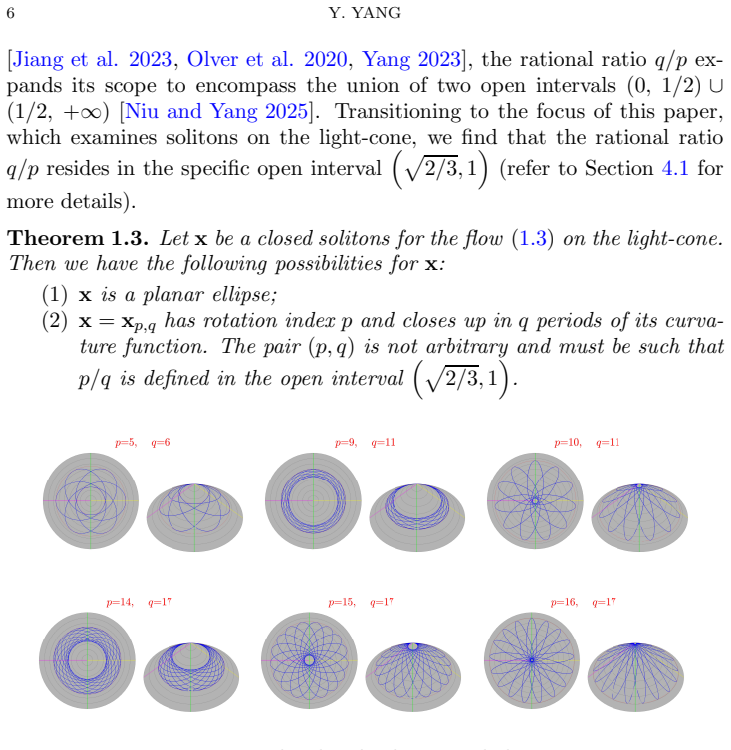
On the paper's own terms, the central discovery is Theorem 1.3: for the flow $\partial r/\partial t = (k_g)_s r - k_g T$ on the light-cone, every closed soliton is either a planar ellipse or a curve $x_{p,q}$ that winds $p$ times around a time-like axis and closes after $q$ periods of its curvature $k_g$, with $p/q \in (\sqrt{2/3},1)$. The periodic soliton curvatures are $k_g = x_1+(x_2-x_1)\,\mathrm{sn}^2\bigl(\tfrac{\sqrt{x_3-x_1}}{2}s, \sqrt{\tfrac{x_2-x_1}{x_3-x_1}}\bigr)$, with $x_1<x_2<x_3$ the three real roots of $x^3-\lambda x-\mu=0$; closed curves occur only when $\mu>0$, and the angle gained over one curvature period increases from $2\sqrt{2/3}\,\pi$ to $2\pi$ as $\lambda$ varies over its range. The paper also presents analytic solutions to the associated second-order ODE $\psi_{ss}-\psi_s^2+\tfrac{1}{2\psi}-f(s)\psi=0$, of the form $(-c_1+c_2\cos\theta+c_3\sin\theta)\psi=f(s)$, and a Harnack inequality for the heat flow.
Load-bearing premise
The classification stands on the unproved assertion, stated in Remark 4.9 from the first terms of the series expansion, that the angle gain $\Lambda_\Theta(\lambda)$ is strictly increasing in $\lambda$ over the whole interval; if that monotonicity fails, the rational ratios $p/q$ would no longer label distinct closed solitons and Theorem 1.3 would fall apart.
Editorial extensions
If this is right
- The full list of closed solitons for the third-order curvature flow on the light-cone is known: planar ellipses plus the $x_{p,q}$ curves, with no other closed soliton.
- Each rational $p/q$ in $(\sqrt{2/3},1)$ labels a closed-soliton shape, so the closed solitons form a countable family indexed by rational numbers.
- The non-closed space-periodic solitons are given explicitly by Jacobi elliptic sine functions, providing exact model waveforms for the KdV-type curvature evolution.
- The analytic solution of the second-order ODE (1.5) follows from the rotation construction, integrating the equation in closed form over the whole parameter range.
- The Harnack inequality gives a quantitative lower bound on the heat-flow curvature quantity, useful for singularity analysis on the light-cone.
Reading between the lines
- If the asserted monotonicity of $\Lambda_\Theta(\lambda)$ is later proved, Theorem 1.3 becomes fully unconditional; a global monotonicity argument for the elliptic integral is the natural next step.
- The rational labeling of closed solitons parallels the Euclidean and affine curvature-flow classifications, so the light-cone result may be the Lorentzian member of a general pattern: closed solitons of constant-speed curvature flows are indexed by rationals in a flow-dependent interval.
- The explicit Jacobi-sine soliton profiles could serve as initial data or comparison solutions for numerical studies of the KdV-type curvature flow on the light-cone, and the Harnack quantity may control singularity formation.
Editorial analysis
A structured set of objections, weighed in public.
Referee Report
Summary. The paper studies curve flows on the right light-cone LC* in Minkowski 3-space. It derives the evolution equations, proves a Harnack inequality for the heat flow (Theorem 1.2), and aims to classify space-periodic solitons of the third-order flow (1.3). The soliton condition is reduced to the ODE system (1.4), whose periodic curvatures are expressed by Jacobi elliptic functions. The main result, Theorem 1.3, asserts that every closed soliton is either a planar ellipse or a curve x_{p,q} with rotation index p that closes after q periods of its curvature, where p/q lies in (sqrt(2/3),1). Theorem 1.4 gives a general solution of the auxiliary ODE (1.5).
Significance. If Theorem 1.3 were established, it would provide a complete Abresch--Langer-type classification for a third-order curvature flow in a Lorentzian light-cone setting and would complement the centro-affine results of Niu and Yang. The paper's strengths are the self-contained Killing-vector reduction leading to the explicit angle-gain integral (4.1), the elliptic-function parametrization of the curvature, and the numerical cross-check in Figure 3. However, the central classification depends on an unproved monotonicity assertion, the curvature formula (2.6) contains a sign error that propagates into the auxiliary ODE, and the endpoint proof of Proposition 4.8 contains a false statement about complete elliptic integrals. As it stands, the main claims are not supported.
major comments (4)
- [Remark 4.9 / §4.1] Theorem 1.3 hinges on the assertion that the angle gain Lambda_Theta(lambda) is strictly increasing on (3(mu/2)^{2/3}, infinity). The justification in Remark 4.9 inspects only finitely many terms of the asymptotic expansion (4.4) as x=(3/lambda)^{3/2} tends to 0; a finite truncation of an asymptotic expansion cannot establish monotonicity on the whole interval. Moreover, the constant term 370345*sqrt(2)/262144*pi in (4.4) is approximately 1.998*pi, not 2*pi, so it does not agree with the endpoint limit stated in Proposition 4.8; the expansion as printed is internally inconsistent. Figure 3 provides numerical agreement, not a proof. Without strict monotonicity, the equation Lambda_Theta(lambda)=2*pi*p/q may have several solutions or none, so the object x_{p,q} in Theorem 1.3 is not uniquely defined and the classification is not established.
- [Eq. (2.6), §2.2] The curvature formula in (2.6) has a sign error. A direct computation from r=(psi,psi cos theta,psi sin theta), T=r_theta/psi, and the Frenet formula (2.5) gives k_g=(2*psi*psi_{theta theta}-3*psi_theta^2-psi^2)/(2*psi^4), not k_g=(-psi^2+3*psi_theta^2-2*psi*psi_{theta theta})/(2*psi^4). The sign of the psi_theta^2 term is wrong. This is not an isolated typo: the same combination feeds into the derivation of the soliton ODE and into Proposition 2.1, so the geometric foundation of Sections 4.1--4.4 is affected.
- [Eq. (1.5), §1 and Remark 4.3] The auxiliary ODE (1.5) does not follow from (2.6) in either the printed or the corrected form. With ds/d theta=psi, the corrected curvature formula becomes k_g=psi_{ss}/(2*psi)-psi_s^2/(2*psi^2)-1/(2*psi^3), which after multiplication by 2*psi yields psi_{ss}-psi_s^2/psi-1/psi^2-2*k_g*psi=0. This is incompatible with the printed psi_{ss}-psi_s^2+1/(2*psi)-k_g*psi=0. Therefore Theorem 1.4 and Corollary 1.5 solve a different equation from the one derived from the geometry, and the claimed analytic solutions do not address the stated problem.
- [Proposition 4.8, §4.1] The proof of the endpoint limits contains a false assertion: the text states that lim_{k^2 -> 1/2} integral_0^{pi/2} d theta / sqrt(1-k^2 sin^2 theta) = 0 and similarly for the integral of sqrt(1-k^2 sin^2 theta). These are the complete elliptic integrals K(1/sqrt(2)) and E(1/sqrt(2)), which are nonzero. The final limit 2*pi might still be true, but the displayed justification is invalid, so the endpoint values that determine the interval (sqrt(2/3),1) are not established as written.
minor comments (5)
- [Title page] The running title on page 1 contains the typo 'SP ACE-PERIODIC'; it should read 'SPACE-PERIODIC'.
- [References] The reference 'Byard and Friedman 1971' should be 'Byrd and Friedman 1971' (Handbook of Elliptic Integrals for Engineers and Scientists).
- [Figure 3] Figure 3 has no axis labels and the caption does not identify which curve is the numerical integral and which is the series expansion, which makes the claimed agreement difficult to verify.
- [Remark 4.9] The reduction to mu=2 is stated without showing the scaling computation; since the substitution changes both k_g and s, the explicit replacement should be given or a reference supplied.
- [Remarks 4.16 and 4.21] The monotonicity of theta(T,lambda) for mu=0 and mu<0 is reported from numerical calculations; if these cases are meant to support a classification claim, analytic proofs are needed, and if not, they should be explicitly labeled as numerical observations only.
Circularity Check
No circular reasoning: the light-cone soliton derivation is self-contained; the unproved monotonicity claim for ΛΘ is a rigor gap, not a circular reduction.
full rationale
The derivation chain is self-contained. The soliton equations (1.4) are obtained by integrating the stationary KdV equation derived from the flow (1.3); periodic curvature solutions are expressed by Jacobi sine functions, and the three Killing-axis cases are each reduced to explicit formulas for ψ and the angle gain ΛΘ (Theorem 4.5, Propositions 4.4, 4.11, 4.17). Theorem 1.3 then identifies closed solitons with solutions of ΛΘ(λ) = 2πp/q, which is a genuine reduction rather than an assumption of the conclusion. The only weak point is Remark 4.9, which asserts monotonicity by writing: "By the first four parts of this equation, we can see that ΛΘ(λ) is monotonically increasing when λ > 3(µ/2)^{2/3}." This is an unsupported inference from finitely many terms of the asymptotic series (4.4) around x = (3/λ)^{3/2} = 0, and the displayed constant term 370345√2/262144 π ≈ 1.998π does not match the endpoint limit 2π of Proposition 4.8; additionally, the limits displayed in Proposition 4.8's proof for the two elliptic integrals are nonzero as written (K(1/√2) and E(1/√2)), so the endpoint computation is not a reliable bridge. These are genuine correctness and rigor defects in the proof of Theorem 1.3, but they are not circularity: the series is computed from the same angle integral (4.1), not used as an input equivalent to the classification being proved. The citation of the author's related work [Niu and Yang 2025] is contextual and not load-bearing; the light-cone computation does not reduce to that centro-affine result. Hence no circular step is present.
Assumptions & free parameters
assumptions (3)
- domain assumption Frenet-Serret formulas for curves on the light-cone (2.5) from [Liu 2004]
- standard math Maximum principle for the parabolic inequality in the Harnack proof
- standard math Elliptic integral identities and series expansions from [Gradshteyn and Ryzhik 2014] and [Byard and Friedman 1971]
Cite this review
Pith. "Pith review of Geometric flows and space-periodic solitons on the light-cone." pith.science (2026). https://pith.science/paper/O34ZDSV5
@misc{pith2026250206035,
  author       = {Pith},
  title        = {Pith review of: Geometric flows and space-periodic solitons on the light-cone},
  year         = {2026},
  howpublished = {\url{https://pith.science/paper/O34ZDSV5}},
  note         = {Machine review of arXiv:2502.06035}
}
abstract
This paper investigates curve flows on the light-cone in the 3-dimensional Minkowski space. We derive the Harnack inequality for the heat flow and present a detailed classification of space-periodic solitons for a third-order curvature flow. The nontrivial periodic solutions to this flow are expressed in terms of the Jacobi elliptic sine function. Additionally, the closed soliton solutions form a family of transcendental curves, denoted by $\mathrm{x}_{p,q}$, which are characterized by a rotation index $p$ and close after $q$ periods of their curvature functions. The ratio $p/q$ satisfies $p/q \in (\sqrt{2/3}, 1)$, where $p$ and $q$ are relatively prime positive integers. Guided by the classification process, we obtain the analytic solutions to a second-order nonlinear ordinary differential equation.
Figures


Figures from the paper (1 more)

Reference graph
Works this paper leans on
-
[1]
[Abresch and Langer 1986] U. Abresch, J. Langer, The normalized curve shorting flow and homothetic solution. J. Differential Geom. , 23 (1986), 175–196. [Andrews 1994] B. Andrews, Harnack inequalities for evolving hypersurfaces, Math. Z. , 217 (1994), 179–197. GEOMETRIC FLOWS AND SPACE-PERIODIC SOLITONS ON THE LIGHT-C ONE 29 [Andrews and Baker 2004] B. Andr...
work page 1986
-
[18]
Nakahara , Geometry, Topology and Physics, Institute of Physics Publishing,
[Nakahara 2003] M. Nakahara , Geometry, Topology and Physics, Institute of Physics Publishing,
work page 2003
- [19]
-
[29]
[Yang 2023] Y. Yang, The maximal curves and heat flow in general-affine geometry . Differential Geom. Appl. , 91 (2023), 102079. [Zabusky and Kruskal 1965] N. J. Zabusky , M. D. Kruskal , Interaction of “Soli- tons” in a Collisionless Plasma and the Recurrence of Initial States, Phys. Rev. Lett., 15, 240–243,
work page 2023
- [93]
-
[1892]
GEOMETRIC FLOWS AND SPACE-PERIODIC SOLITONS ON THE LIGHT-C ONE 31 [Press et al. 2007] W. H. Press, S. A. Teukolsky, W. T. Vetterling, B. P. Flannery, Numerical Recipes: The Art of Scientific Computing (3rd ed.) , Cambridge University Press,
work page 2007
-
[1908]
[Misner et al. 1973] C. W. Misner , K. S. Thorne , J. A. Wheeler , Gravitation, W. H. Freeman,
work page 1973
-
[1927]
[Brakke 1978] K. A. Brakke , The Motion of a Surface by Its Mean Curvature, Princeton University Press,
work page 1978
Show all 29 references
-
[1965]
Penrose, Black Holes, Cosmology and Space-Time Singularities, Nobel Lecture, December 8, 2020, University of Oxford, Oxford , United King- dom
[Penrose 2020] R. Penrose, Black Holes, Cosmology and Space-Time Singularities, Nobel Lecture, December 8, 2020, University of Oxford, Oxford , United King- dom. [Perelman 2002] G. Perelman , The entropy formula for the Ricci flow and its geo- metric applications, arXiv:math/0211159,
2020 arXiv
-
[1967]
Gage, An Isoperimetric Inequality with Application to Curve Shor t- ening, Duke Math
[Gage 1983] M. Gage, An Isoperimetric Inequality with Application to Curve Shor t- ening, Duke Math. J. , 50 (1983), 1225–1229. [Gage 1984] M. Gage , Curve Shortening Makes Convex Curves Circular, Invent. Math., 76 (1984), 357–364. [Gage and Hamilton 1986] M. Gage , R. Hamilto...
1983
-
[1971]
Chow, On Harnack’s inequality and entropy for the Gaussian cur- vature flow, Commun
[Chow 1991] B. Chow, On Harnack’s inequality and entropy for the Gaussian cur- vature flow, Commun. Pure Appl. Math. , 44 (1991), no. 4, 469–483. [Colding and Minicozzi 2003] T. H. Colding , W. P. Minicozzi , Generic mean cur- vature flow in higher dimensions, Ann. of Math. , 16...
1991
-
[1973]
Huisken, Asymptotic behavior for singularities of the mean curvature flow
[Huisken 1990] G. Huisken, Asymptotic behavior for singularities of the mean curvature flow. J. Differential Geom. , 31 (1990), 285–299. [Huisken 1993] G. Huisken, Local and global behavior of hypersurfaces moving by mean curvature . Differential geometry: partial differential equ...
1990
-
[1976]
W alrave, Curves and surfaces in Minkowski space , Thesis (Ph.D.), Katholieke Universiteit
[Walrave 1995] J. W alrave, Curves and surfaces in Minkowski space , Thesis (Ph.D.), Katholieke Universiteit. Leuven (Belgium),
1995
-
[1977]
Sapiro, A
[Sapiro and Tannenbaum 1994] G. Sapiro, A. Tannenbaum, On affine plane curve evolution, J. Funct. Anal. , 119 (1994), 79–120. [Silva and Tenenblat 2023] F. N. da Silva and K. Tenenblat, Self-similar solu- tions to the curvature flow and its inverse on the 2-dimensional light -con...
1994
-
[1978]
[Bryan et al. 2020] M. N. Bryan, M. Ivaki, J. Scheuer Harnack inequalities for curvature flows in Riemannian and Lorentzian manifolds, J. Reine Angew. Math., 764 (2020), 71–109. [Byard and Friedman 1971] P. F. Byard, M. D. Friedman, Handbook of Elliptic Integrals for Engineers ...
2020
-
[1982]
[Hamilton 1989] R. S. Hamilton , Lecture Notes on Heat Equation in Geometry, Honolulu, Hawaii,
1989
-
[1983]
[Olver 2008] P. J. Olver, Invariant submanifold flows. J. Phys. A: Math. Theor. , 41 (2008), 344017. [Olver et al. 2020] P.J. Olver, C.Z. Qu, Y. Yang, Feature matching and heat flow in centro-affine geometry, Symmetry Integrability Geom. Methods Appl. , 16 (2020),
2008
-
[1986]
Liu, Curves in the lightlike cone, Beitr
[Liu 2004] H. Liu, Curves in the lightlike cone, Beitr. Algebra Geom. , 45 (2004), 291–303. [Lima and Montenegro 1999] L. Lopez De Lima, J. F. Montenegro, Classifica- tion of solitons for the affine curvature flow. Commun. Anal. Geom. , 4 (1999), 731–753. [Minkowski 1908] H. Minko...
2004
-
[1989]
[Hamilton 1993] R. S. Hamilton, The Harnack estimate for the Ricci Flow, J. Differential Geom. , 37 (1993), 225–243. [Hamilton 1995a] R. S. Hamilton, Harnack estimate for the mean curvature flow, J. Differential Geom. , 41 (1995), 215–226. [Hamilton 1995b] R. S. Hamilton , The fo...
1993
-
[1991]
[Gardner et al. 1967] C. S. Gardner , J. M. Greene , M. D. Kruskal , R. M. Miura, Method for Solving the Korteweg-de Vries Equation, Phys. Re v. Lett. , 19, 1095–1097,
1967
-
[1994]
Vr ˘anceanu, R
[Vr˘ anceanu and Ro¸ sca 1976]G. Vr ˘anceanu, R. Ros ¸ca, Introduction to Relativity and Pseudo-Riemannian Geometry, Editura Academiei Republicii Socialiste Rom˘ ania,
1976
-
[1995]
Hawking, Occurrence of singularities in open universes, Phys
[Hawking 1965] S.W. Hawking, Occurrence of singularities in open universes, Phys. Rev. Lett. , 15 (1965), 689–690. [Hawking 1966a] S.W. Hawking, The occurrence of singularities in cosmology, Proc. Roy. Soc. (London) A , 294 (1966), 511–521. 30 Y. YANG [Hawking 1966b] S.W. Hawk...
1965
-
[1996]
Einstein , Zur Elektrodynamik bewegter K¨ orper, Ann
[Einstein 1905] A. Einstein , Zur Elektrodynamik bewegter K¨ orper, Ann. Phys. , 332(1905), 891–921. [Evans and Spruck 1991] L. C. Evans and J. Spruck, Motion of level sets by mean curvature, J. Differential Geom. , 33(3), 635–681,
1905
-
[2001]
[Sachs and Wu 1977] R. K. Sachs, H. Wu, General Relativity for Mathematicians, Springer-Verlag,
1977
-
[2003]
[Duggal and Bejancu 1996] K. L. Duggal, A. Bejancu , Lightlike Submanifolds of Semi-Riemannian Manifolds and Applications , Kluwer Academic, Dordrecht,
1996
-
[2004]
[Angenent et al. 1998] S. Angenent, G. Sapiro, A. Tannenbaum, On the affine heat equation for nonconvex curves, J. Amer. Math. Soc. , 11 (1998), 601–634. [Benci and Fortunato 1994] V. Benci, D. Fortunato, On the existence of infinitely many geodesics on space-time manifolds. Adv....
1998
-
[2007]
Rindler , Introduction to Special Relativity, Oxford University Press,
[Rindler 2001] W. Rindler , Introduction to Special Relativity, Oxford University Press,
2001
-
[2014]
[Hamilton 1982] R. S. Hamilton , Three-manifolds with positive Ricci curvature, J. Differential Geom. , 17(2), 255–306,
1982
-
[2015]
Li , S.-T
[Li and Yau 1986] P. Li , S.-T. Yau , On the parabolic kernel of the Schr¨ odinger operator, Acta Math. , 156, 153–201,
1986
Reviewed August 8, 2026 · model on record in the stance chip above.
Discussion (0). Continue with ORCID to comment.