REVIEW 3 major objections 5 minor 99 references
Search for bosons of an extended Higgs sector in b quark final states in proton-proton collisions at $\sqrt{s}$ = 13 TeV
T0 review · 3 major / 5 minor · reviewed 2026-08-08 · deepseek-v4-flash
Pith's one-line read No significant excess of events above the standard model background is observed in the search for neutral Higgs bosons decaying to bottom-quark pairs and produced in association with a bottom quark, and 95% confidence level upper limits…
desk verdict Solid incremental CMS search: best limits to date for b-associated bb resonances; transfer-factor modeling is reasonable but would benefit from a signal-injection closure test. read the letter →
The pith
A machine-rendered reading of the paper's core claim, the machinery that carries it, and where it could break.
The reading
What carries the argument
The analysis reconstructs the candidate Higgs boson from the invariant mass M12 of the two leading jets, both required to be b-tagged. The background is modelled from a control region where the third jet fails a loose b-tag, whose M12 distribution is parameterised by an extended Novosibirsk function and multiplied by a 'transfer factor'—a sum of Chebyshev polynomials up to third degree—to account for small shape differences between control and signal regions. The signal shape is described by a double-sided Crystal Ball function. A simultaneous maximum-likelihood fit of signal plus background to the M12 distributions in the signal region and control region, with transfer-factor coefficients floating, extracts the signal strength, and the discrete profiling method covers the choice of transfer-factor functional form as a systematic uncertainty.
What would settle it
A concrete test would be to inject a simulated signal of known strength into the unblinded signal region at a mass near the boundary of two fit ranges and check whether the extracted cross-section limit recovers the injected value within uncertainties; a bias larger than the quoted systematic would falsify the transfer-factor assumption. Equivalently, comparing the fitted Chebyshev ratio to the directly measured signal-region to control-region ratio in a high-statistics sideband away from the signal peak would reveal any unresolved shape difference.
Extended reading notes
Core claim
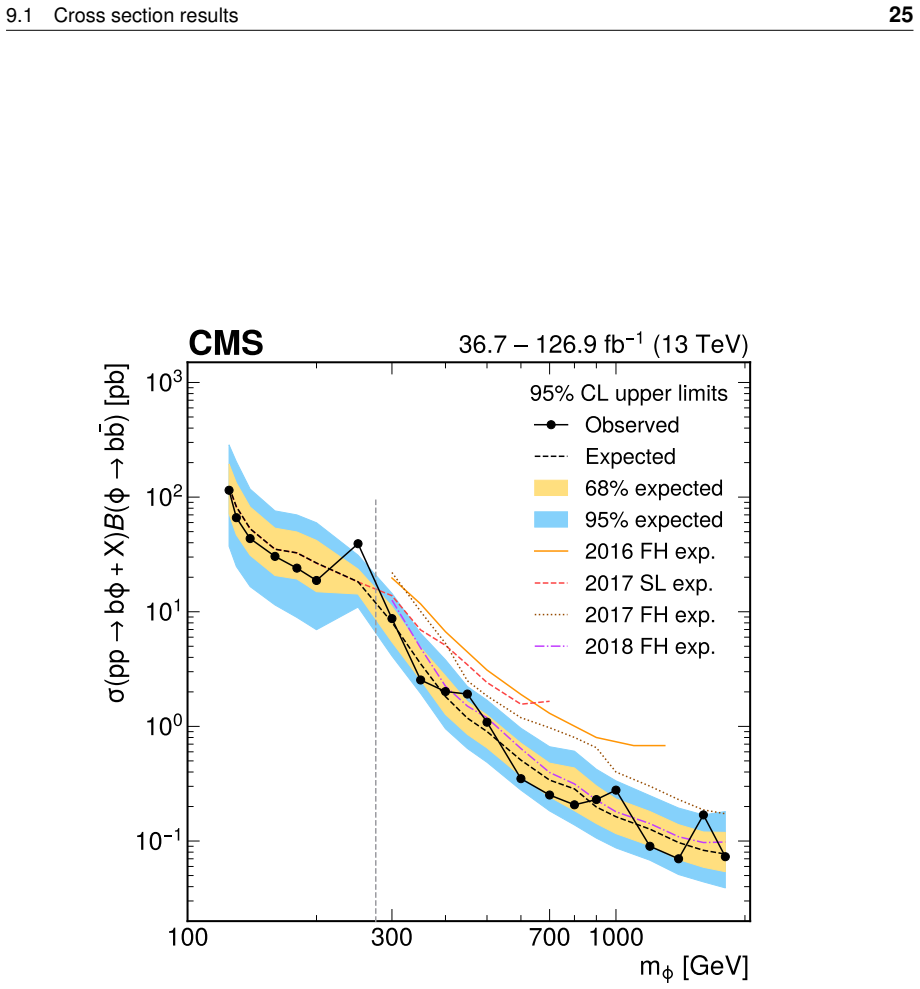
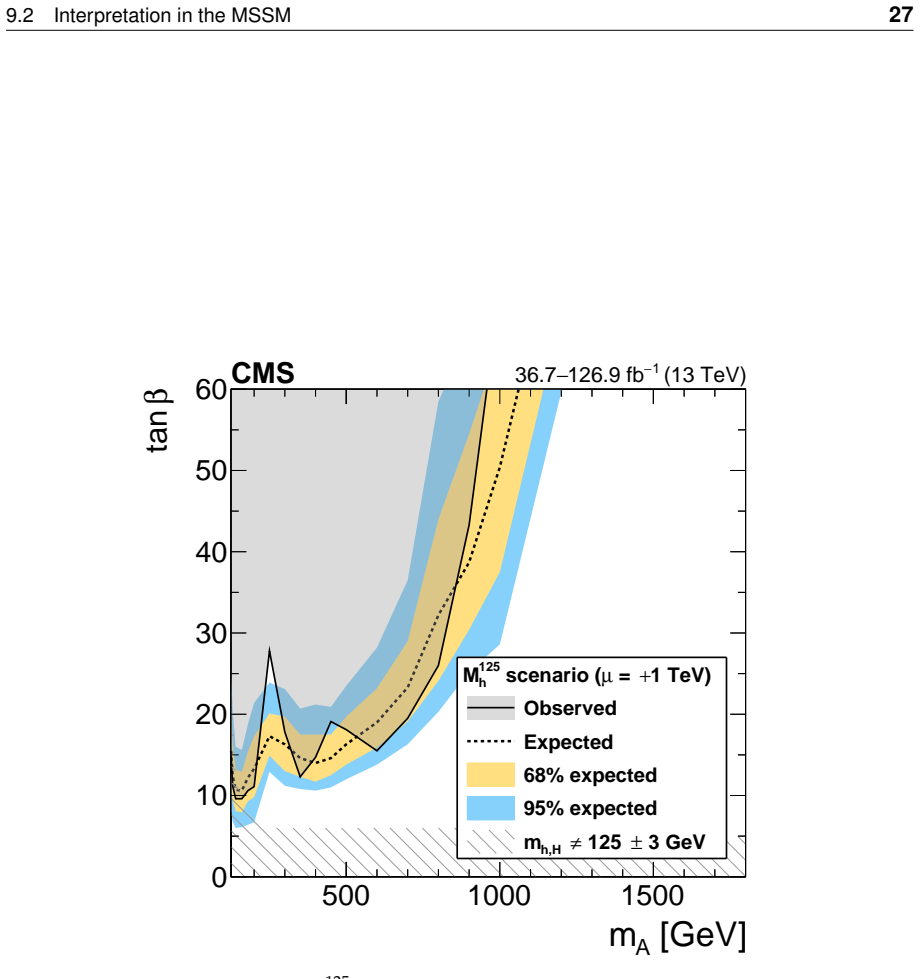
The central result is that the invariant-mass distributions of the two leading b-tagged jets in the search for pp→bφ(→bb)+X are consistent with the standard model background. No significant excess is observed; the largest local (global) significance is 3.2 (2.4) σ at mφ=250 GeV in the semileptonic 2017 channel. Upper limits at 95% CL on σ(pp→bφ+X)B(φ→bb) are set, reaching as low as about 0.07 pb at mφ=1400 GeV. These limits are the most stringent to date in the high-mass regime for this final state, and they exclude values of tanβ down to about 9 at 130–150 GeV in the $M_h^{125}$ MSSM benchmark scenario, with similar exclusions in 2HDM Type-II and Flipped models.
Load-bearing premise
The background in the signal region is modeled by the control-region distribution multiplied by a transfer factor built from Chebyshev polynomials up to third degree, which assumes that the true ratio of signal-region to control-region shapes is smooth enough to be captured by that low-order polynomial.
Editorial extensions
If this is right
- If the result is correct, additional neutral Higgs bosons with masses between 125 and 1800 GeV that decay to bb and are produced with a b jet must have cross sections below the quoted limits, tightening constraints on the MSSM and 2HDM parameter space.
- The strongest exclusions, tanβ values below about 9 at intermediate masses, imply that the b-quark coupling enhancement of heavy Higgs bosons cannot rescue large tanβ in the probed mass range for the considered benchmark scenarios.
- The Flipped 2HDM benchmark, which is difficult to probe in other fermionic final states, is constrained in this dedicated bb channel, ruling out tanβ values above roughly 8–50 depending on mass.
- The methodological improvements—larger luminosity, DeepJet b tagging, and the transfer-factor background approach—establish a template for future Run 3 searches in the same final state, which can reach even lower cross sections.
Reading between the lines
- A natural testable extension is a closure test with simulated signals injected at the edges of each fit range, where the flexibility of the third-degree Chebyshev transfer factor is lowest; a failure there would flag a bias in the extracted limits at the corresponding masses.
- The fully hadronic channel's sensitivity is limited by trigger thresholds, so a future analysis with lower-pT triggers or boosted-object reconstruction could extend the mass reach below 300 GeV.
- The observed 2017 semileptonic excess at 250–300 GeV, with local significance 3.2σ, motivates a dedicated follow-up with the full Run 3 dataset to confirm or refute a real signal.
- The high-mass limit of about 0.07 pb at 1400 GeV is already within a factor of a few of the expected cross section for a heavy Higgs with enhanced b couplings, so Run 3 data may either discover such a boson or push the exclusions to the edge of naturalness.
Editorial analysis
A structured set of objections, weighed in public.
Referee Report
Summary. This paper presents a CMS search for neutral Higgs bosons of an extended Higgs sector, denoted phi (h, H, A), decaying to a bottom-quark pair and produced in association with at least one additional b quark. The search uses 2017 and 2018 proton-proton collision data at 13 TeV, corresponding to an integrated luminosity of 36.7 to 126.9 inverse femtobarns depending on the probed mass range, and is combined with previously published 2016 results. Two selections are used: a fully hadronic triple-b-tag selection and a semileptonic selection requiring a muon inside one of the two leading b jets, together covering Higgs boson masses from 125 to 1800 GeV. The dominant multijet background is estimated from a b-tag-veto control region whose invariant-mass shape is multiplied by a low-order Chebyshev transfer factor to obtain the signal-region background, with the background-shape uncertainty treated by the discrete profiling method. No significant excess over the standard model background is observed, and 95% confidence level upper limits are set on the production cross section times branching fraction sigma(pp to b phi + X) B(phi to bb). The results are interpreted in MSSM benchmark scenarios and in Type-II and Flipped two-Higgs-doublet models.
Significance. If the analysis is correct, it provides the most stringent limits to date in the high-mass regime for b-associated production of neutral Higgs bosons decaying to bottom-quark pairs, and it extends the probed mass range down to 125 GeV and up to 1800 GeV. The paper has several notable strengths: the background model is fully data-driven, with the control-region shape and transfer factor validated in a dedicated validation region; the discrete profiling method is used to cover the choice of transfer-function order; the signal model is built from NLO simulation with careful efficiency corrections; and tabulated results are provided via HEPData. The interpretation in the Flipped 2HDM is a useful addition, and the treatment of negative higgsino mass parameters in the MSSM scenarios is a genuinely new phenomenological element. The main risk to the central exclusion claim, discussed in the major comments, is the possible degeneracy between a broad signal and the floating Chebyshev transfer function, which the current validations only partially address.
major comments (3)
- [Section 7] The transfer-factor coefficients are determined from the simultaneous SR and CR fit, and the discrete profiling method covers only the polynomial order, not the possible absorption of a signal that is broad compared with the fit range. Because the SR/CR ratio is the only handle on the background shape in the SR, a broad signal (for example at m_phi around 1 TeV, where the signal width is about 20-30% of the mass) could be partially absorbed by the Chebyshev polynomial, biasing the extracted limits. I ask the authors to document a signal-injection test: for representative mass points in each fit range, inject simulated signal plus background into SR and CR pseudo-data, refit with the nominal model, and report the fitted signal strength and its uncertainty, together with an explicit check of the coverage of the resulting CLs limits. The validation region described in this section is signal-depleted and therefore tests only background closure, not this degeneracy.
- [Section 9.1, Fig. 15] The post-unblinding SR/CR ratio is shown only for the 2017 SL channel. Since the combined high-mass sensitivity is dominated by the 2017 and 2018 FH channels, the transfer-factor assumption should be validated with the same SR/CR ratio plots for the four FH fit ranges, or the authors should explain why the SL demonstration is sufficient for all channels. As written, the closure check does not cover the kinematic regime in which the most stringent limits are set.
- [Section 8] The systematic uncertainty labelled 'Uncertainty in the choice of background parameterisation' covers different forms of the transfer factor only; the extended Novosibirsk function used for the CR shape is not varied, even though the discrete profiling method is designed for exactly such functional-form uncertainties. The authors should justify this choice quantitatively, for example by showing that alternative CR parameterisations change the expected limits by an amount small compared with the statistical uncertainty, or by including the CR shape choice in the discrete profiling set.
minor comments (5)
- [Figure 15] The caption states that the SR/CR ratio is fitted with Chebyshev polynomials 'up to the second degree', while Section 7 states that the transfer factor is a sum of Chebyshev polynomials 'up to the third degree'; please reconcile this discrepancy.
- [Eq. (1)] The expression in Eq. (1) is typeset in a way that makes the denominators ambiguous, in particular the combination p4 p5 p6; please add parentheses or a clarified definition.
- [Section 5] In the sentence 'In case both of the two leading jets contain a muon, the b jet with the largest muon pT is required to match the muon requirement in the SL trigger', the intended criterion is likely 'the b jet containing the muon with the largest pT'; please rephrase for clarity.
- [Section 9.2] The claim that the results are 'the most stringent limits on tan beta obtained from the bb channel to date' should be qualified by the explicit comparison with the ATLAS result in Ref. [29], which covers only the 450-1400 GeV mass range, and by stating the mass range over which the present limits are stronger.
- [Section 4] The sentence 'These multijet samples are used for studying qualitative features of the background, but not for a quantitative background prediction' would benefit from a cross-reference to Section 7, where the simulation-based choice of the transfer-function order is described.
Circularity Check
No significant circularity: the analysis is a data-driven search whose fitted signal strength is an independent parameter of interest, not a renamed fit input.
full rationale
The paper derives exclusion limits on σ(pp→bφ+X)B(φ→bb) from a simultaneous maximum-likelihood fit to the signal region and control region M12 distributions. The quantity being claimed is the fitted signal strength (or its upper limit), which is an independent parameter of interest; it is not defined in terms of the background-model parameters or any fitted input. The background in the SR is constructed as the CR shape multiplied by a transfer factor whose Chebyshev coefficients are floating in the fit, but this is a data-driven background estimation procedure, not a circular derivation: the exclusion claim is a bound on an external theoretical cross section, and the transfer factor is a modeling device validated by simulation and by a signal-depleted validation region. The transfer factor choice is not presented as a prediction derived from first principles; it is explicitly a parameterization chosen following simulation studies and is covered by discrete profiling. Citations to prior CMS work, including the 2016 dataset combination, the DeepJet algorithm, and internal theses used to justify SR/CR shape similarity, are ancillary or refer to independent data and validated tools; none of them is used as a uniqueness theorem or as the sole justification for the central result. The post-unblinding SR/CR ratio check in Fig. 15 is a consistency check, not a fitted quantity renamed as a prediction. No load-bearing step reduces by construction to its own inputs, so the appropriate score is 0.
Assumptions & free parameters
assumptions (5)
- domain assumption The SR background shape equals the CR background shape times a Chebyshev transfer factor of degree up to three.
- domain assumption Signal simulation, after data-derived scale factors, correctly predicts signal efficiency and mass shape.
- domain assumption The control region has negligible signal contamination.
- domain assumption The theoretical cross sections and branching fractions for MSSM and 2HDM interpretations are correct.
- domain assumption The natural width of the MSSM Higgs boson is negligible compared to detector resolution, so the signal shape is resolution-dominated.
Cite this review
Pith. "Pith review of Search for bosons of an extended Higgs sector in b quark final states in proton-proton collisions at $\sqrt{s}$ = 13 TeV." pith.science (2026). https://pith.science/paper/ZYSGZXA6
@misc{pith2026250206568,
  author       = {Pith},
  title        = {Pith review of: Search for bosons of an extended Higgs sector in b quark final states in proton-proton collisions at $\sqrts$ = 13 TeV},
  year         = {2026},
  howpublished = {\url{https://pith.science/paper/ZYSGZXA6}},
  note         = {Machine review of arXiv:2502.06568}
}
abstract
A search for beyond-the-standard-model neutral Higgs bosons decaying to a pair of bottom quarks, and produced in association with at least one additional bottom quark, is performed with the CMS detector. The data were recorded in proton-proton collisions at a centre-of-mass energy of 13 TeV at the CERN LHC, and correspond to an integrated luminosity of 36.7-126.9 fb$^{-1}$ depending on the probed mass range. No signal above the standard model background expectation is observed. Upper limits on the production cross section times branching fraction are set for Higgs bosons in the mass range of 125-1800 GeV. The results are interpreted in benchmark scenarios of the minimal supersymmetric standard model, as well as suitable classes of two-Higgs-doublet models.
Figures


Figures from the paper (17 more)





Reference graph
Works this paper leans on
-
[1]
ATLAS Collaboration, “Observation of a new particle in the search for the standard model Higgs boson with the ATLAS detector at the LHC”,Phys. Lett. B716(2012) 1, doi:10.1016/j.physletb.2012.08.020,arXiv:1207.7214
arXiv 2012
-
[2]
Observation of a new boson at a mass of 125 GeV with the CMS experiment at the LHC
CMS Collaboration, “Observation of a new boson at a mass of 125 GeV with the CMS experiment at the LHC”,Phys. Lett. B716(2012) 30, doi:10.1016/j.physletb.2012.08.021,arXiv:1207.7235
arXiv 2012
-
[3]
Observation of a new boson with mass near 125 GeV in pp collisions at √s= 7 and 8 TeV
CMS Collaboration, “Observation of a new boson with mass near 125 GeV in pp collisions at √s= 7 and 8 TeV”,JHEP06(2013) 081, doi:10.1007/JHEP06(2013)081,arXiv:1303.4571
arXiv 2013
-
[4]
A detailed map of Higgs boson interactions by the ATLAS experiment ten years after the discovery
ATLAS Collaboration, “A detailed map of Higgs boson interactions by the ATLAS experiment ten years after the discovery”,Nature607(2022) 52, doi:10.1038/s41586-022-04893-w,arXiv:2207.00092. [Erratum: doi:10.1038/s41586-022-05581-5]
arXiv 2022
-
[5]
A portrait of the Higgs boson by the CMS experiment ten years after the discovery
CMS Collaboration, “A portrait of the Higgs boson by the CMS experiment ten years after the discovery”,Nature607(2022) 60,doi:10.1038/s41586-022-04892-x, arXiv:2207.00043
arXiv 2022
-
[6]
CMS Collaboration, “Search for bottom quark associated production of the standard model Higgs boson in final states with leptons in proton-proton collisions at √s=13 TeV”,Phys. Lett. B860(2025) 139173,doi:10.1016/j.physletb.2024.139173, arXiv:2408.01344
arXiv 2025
-
[7]
Evidence for Higgs boson decay to a pair of muons
CMS Collaboration, “Evidence for Higgs boson decay to a pair of muons”,JHEP01 (2021) 148,doi:10.1007/JHEP01(2021)148,arXiv:2009.04363
arXiv 2021
-
[8]
ATLAS Collaboration, “Direct constraint on the Higgs-charm coupling from a search for Higgs boson decays into charm quarks with the ATLAS detector”,Eur. Phys. J. C82 (2022) 717,doi:10.1140/epjc/s10052-022-10588-3,arXiv:2201.11428. 34
arXiv 2022
Show all 99 references
-
[9]
Search for Higgs boson decay to a charm quark-antiquark pair in proton-proton collisions at √s=13 TeV
CMS Collaboration, “Search for Higgs boson decay to a charm quark-antiquark pair in proton-proton collisions at √s=13 TeV”,Phys. Rev. Lett.131(2023) 061801, doi:10.1103/PhysRevLett.131.061801,arXiv:2205.05550
2023 arXiv
-
[10]
Combined measurements of Higgs boson production and decay using up to 80 fb−1 of proton-proton collision data at √s=13 TeV collected with the ATLAS experiment
ATLAS Collaboration, “Combined measurements of Higgs boson production and decay using up to 80 fb−1 of proton-proton collision data at √s=13 TeV collected with the ATLAS experiment”,Phys. Rev. D101(2020) 012002, doi:10.1103/PhysRevD.101.012002,arXiv:1909.02845
2020 arXiv
-
[11]
Combined measurements of Higgs boson couplings in proton-proton collisions at √s=13 TeV
CMS Collaboration, “Combined measurements of Higgs boson couplings in proton-proton collisions at √s=13 TeV”,Eur. Phys. J. C79(2019) 421, doi:10.1140/epjc/s10052-019-6909-y,arXiv:1809.10733
2019 arXiv
-
[12]
Extended scalar sectors
J. Steggemann, “Extended scalar sectors”,Ann. Rev. Nucl. Part. Sci.70(2020) 197, doi:10.1146/annurev-nucl-032620-043846
2020 doi
-
[13]
Theory and phenomenology of two-higgs-doublet models
G. C. Branco et al., “Theory and phenomenology of two-higgs-doublet models”,Phys. Rep.516(2012) 1,doi:10.1016/j.physrep.2012.02.002,arXiv:1106.0034
2012 arXiv
-
[14]
Supersymmetry, supergravity and particle physics
H. P . Nilles, “Supersymmetry, supergravity and particle physics”,Phys. Rep.110(1984) 1,doi:10.1016/0370-1573(84)90008-5
1984 doi
-
[15]
Prospects for direct searches for light Higgs bosons at the ILC with 250 GeV
P . Drechsel, G. Moortgat-Pick, and G. Weiglein, “Prospects for direct searches for light Higgs bosons at the ILC with 250 GeV”,Eur. Phys. J. C80(2020) 922, doi:10.1140/epjc/s10052-020-08438-1,arXiv:1801.09662
2020 arXiv
-
[16]
MSSM Higgs boson searches at the LHC: benchmark scenarios after the discovery of a Higgs-like particle
M. Carena et al., “MSSM Higgs boson searches at the LHC: benchmark scenarios after the discovery of a Higgs-like particle”,Eur. Phys. J. C73(2013) 2552, doi:10.1140/epjc/s10052-013-2552-1,arXiv:1302.7033
2013 arXiv
-
[17]
MSSM Higgs boson searches at the Tevatron and the LHC: Impact of different benchmark scenarios
M. S. Carena, S. Heinemeyer, C. E. M. Wagner, and G. Weiglein, “MSSM Higgs boson searches at the Tevatron and the LHC: Impact of different benchmark scenarios”,Eur. Phys. J. C45(2006) 797,doi:10.1140/epjc/s2005-02470-y, arXiv:hep-ph/0511023
2006 arXiv
-
[18]
MSSM Higgs boson searches at the LHC: benchmark scenarios for Run 2 and beyond
E. Bagnaschi et al., “MSSM Higgs boson searches at the LHC: benchmark scenarios for Run 2 and beyond”,Eur. Phys. J. C79(2019) 617, doi:10.1140/epjc/s10052-019-7114-8,arXiv:1808.07542
2019 arXiv
-
[19]
HL-LHC and ILC sensitivities in the hunt for heavy Higgs bosons
H. Bahl et al., “HL-LHC and ILC sensitivities in the hunt for heavy Higgs bosons”,Eur. Phys. J. C80(2020) 916,doi:10.1140/epjc/s10052-020-08472-z, arXiv:2005.14536
2020 arXiv
-
[20]
Bounds to the Higgs sector masses in minimal supersymmetry from LHC data
L. Maiani, A. D. Polosa, and V . Riquer, “Bounds to the Higgs sector masses in minimal supersymmetry from LHC data”,Phys. Lett. B724(2013) 274, doi:10.1016/j.physletb.2013.06.026,arXiv:1305.2172
2013 arXiv
-
[21]
The post-Higgs MSSM scenario: Habemus MSSM?
A. Djouadi et al., “The post-Higgs MSSM scenario: Habemus MSSM?”,Eur. Phys. J. C73 (2013) 2650,doi:10.1140/epjc/s10052-013-2650-0,arXiv:1307.5205
2013 arXiv
-
[22]
Fully covering the MSSM Higgs sector at the LHC
A. Djouadi et al., “Fully covering the MSSM Higgs sector at the LHC”,JHEP06(2015) 168,doi:10.1007/JHEP06(2015)168,arXiv:1502.05653. References 35
2015 arXiv
-
[23]
New LHC benchmarks for theCP-conserving two-higgs-doublet model
H. E. Haber and O. St ˚al, “New LHC benchmarks for theCP-conserving two-higgs-doublet model”,Eur. Phys. J. C75(2015) 491, doi:10.1140/epjc/s10052-015-3697-x,arXiv:1507.04281. [Erratum: doi:10.1140/epjc/s10052-016-4151-4]
2015 arXiv
-
[24]
Handbook of LHC Higgs cross sections: 3. Higgs properties
LHC Higgs Cross Section Working Group, “Handbook of LHC Higgs cross sections: 3. Higgs properties”,CERN(2013)doi:10.5170/CERN-2013-004,arXiv:1307.1347
2013 arXiv
-
[25]
Search for neutral MSSM Higgs bosons at LEP
ALEPH, DELPHI, L3, and OPAL Collaborations, LEP Working Group for Higgs Boson Searches, “Search for neutral MSSM Higgs bosons at LEP”,Eur. Phys. J. C47(2006) 547, doi:10.1140/epjc/s2006-02569-7,arXiv:hep-ex/0602042
2006 arXiv
-
[26]
Search for neutral Higgs bosons in events with multiple bottom quarks at the Tevatron
CDF and D0 Collaborations, “Search for neutral Higgs bosons in events with multiple bottom quarks at the Tevatron”,Phys. Rev. D86(2012) 091101, doi:10.1103/PhysRevD.86.091101,arXiv:1207.2757
2012 arXiv
-
[27]
Search for a Higgs boson decaying into a b-quark pair and produced in association with b quarks in proton-proton collisions at 7 TeV
CMS Collaboration, “Search for a Higgs boson decaying into a b-quark pair and produced in association with b quarks in proton-proton collisions at 7 TeV”,Phys. Lett. B 722(2013) 207,doi:10.1016/j.physletb.2013.04.017,arXiv:1302.2892
2013 arXiv
-
[28]
Search for neutral MSSM Higgs bosons decaying into a pair of bottom quarks
CMS Collaboration, “Search for neutral MSSM Higgs bosons decaying into a pair of bottom quarks”,JHEP11(2015) 071,doi:10.1007/JHEP11(2015)071, arXiv:1506.08329
2015 arXiv
-
[29]
Search for heavy neutral Higgs bosons produced in association with b-quarks and decaying into b-quarks at √s=13 TeV with the ATLAS detector
ATLAS Collaboration, “Search for heavy neutral Higgs bosons produced in association with b-quarks and decaying into b-quarks at √s=13 TeV with the ATLAS detector”, Phys. Rev. D102(2020) 032004,doi:10.1103/PhysRevD.102.032004, arXiv:1907.02749
2020 arXiv
-
[30]
Search for beyond the standard model Higgs bosons decaying into a bb pair in pp collisions at √s=13 TeV
CMS Collaboration, “Search for beyond the standard model Higgs bosons decaying into a bb pair in pp collisions at √s=13 TeV”,JHEP08(2018) 113, doi:10.1007/JHEP08(2018)113,arXiv:1805.12191
2018 arXiv
-
[31]
Jet flavour classification using DeepJet
E. Bols et al., “Jet flavour classification using DeepJet”,JINST15(2020) P12012, doi:10.1088/1748-0221/15/12/P12012,arXiv:2008.10519
2020 arXiv
-
[32]
The CMS phase-1 pixel detector upgrade
CMS Tracker Group Collaboration, “The CMS phase-1 pixel detector upgrade”,JINST 16(2021) P02027,doi:10.1088/1748-0221/16/02/P02027,arXiv:2012.14304
2021 arXiv
-
[33]
HEPData record for this analysis, 2024.doi:10.17182/hepdata.155471
2024 doi
-
[34]
The CMS experiment at the CERN LHC
CMS Collaboration, “The CMS experiment at the CERN LHC”,JINST3(2008) S08004, doi:10.1088/1748-0221/3/08/S08004
2008 doi
-
[35]
Development of the CMS detector for the CERN LHC Run 3
CMS Collaboration, “Development of the CMS detector for the CERN LHC Run 3”, JINST19(2024) P05064,doi:10.1088/1748-0221/19/05/P05064, arXiv:2309.05466
2024 arXiv
-
[36]
Performance of the CMS level-1 trigger in proton-proton collisions at √s=13 TeV
CMS Collaboration, “Performance of the CMS level-1 trigger in proton-proton collisions at √s=13 TeV”,JINST15(2020) P10017, doi:10.1088/1748-0221/15/10/P10017,arXiv:2006.10165
2020 arXiv
-
[37]
The CMS trigger system
CMS Collaboration, “The CMS trigger system”,JINST12(2017) P01020, doi:10.1088/1748-0221/12/01/P01020,arXiv:1609.02366. 36
2017 arXiv
-
[38]
Performance of the CMS high-level trigger during LHC Run 2
CMS Collaboration, “Performance of the CMS high-level trigger during LHC Run 2”, JINST19(2024) P11021,doi:10.1088/1748-0221/19/11/p11021, arXiv:2410.17038
2024 arXiv
-
[39]
Particle-flow reconstruction and global event description with the CMS detector
CMS Collaboration, “Particle-flow reconstruction and global event description with the CMS detector”,JINST12(2017) P10003,doi:10.1088/1748-0221/12/10/P10003, arXiv:1706.04965
2017 arXiv
-
[40]
Technical proposal for the phase-II upgrade of the Compact Muon Solenoid
CMS Collaboration, “Technical proposal for the phase-II upgrade of the Compact Muon Solenoid”, CMS Technical Proposal CERN-LHCC-2015-010, CMS-TDR-15-02, 2015
2015
-
[41]
The anti-kT jet clustering algorithm
M. Cacciari, G. P . Salam, and G. Soyez, “The anti-kT jet clustering algorithm”,JHEP04 (2008) 063,doi:10.1088/1126-6708/2008/04/063,arXiv:0802.1189
2008 arXiv
-
[42]
Fastjet user manual
M. Cacciari, G. P . Salam, and G. Soyez, “Fastjet user manual”,Eur. Phys. J. C72(2012) 1896,doi:10.1140/epjc/s10052-012-1896-2,arXiv:1111.6097
2012 arXiv
-
[43]
Jet energy scale and resolution in the CMS experiment in pp collisions at 8 TeV
CMS Collaboration, “Jet energy scale and resolution in the CMS experiment in pp collisions at 8 TeV”,JINST12(2017) P02014, doi:10.1088/1748-0221/12/02/P02014,arXiv:1607.03663
2017 arXiv
-
[44]
Pileup mitigation at CMS in 13 TeV data
CMS Collaboration, “Pileup mitigation at CMS in 13 TeV data”,JINST15(2020) P09018, doi:10.1088/1748-0221/15/09/P09018,arXiv:2003.00503
2020 arXiv
-
[45]
Identification of heavy-flavour jets with the CMS detector in pp collisions at 13 TeV
CMS Collaboration, “Identification of heavy-flavour jets with the CMS detector in pp collisions at 13 TeV”,JINST13(2018) P05011, doi:10.1088/1748-0221/13/05/P05011,arXiv:1712.07158
2018 arXiv
-
[46]
Performance of the DeepJet b tagging algorithm using 41.9 fb −1 of data from proton-proton collisions at 13 TeV with phase 1 CMS detector
CMS Collaboration, “Performance of the DeepJet b tagging algorithm using 41.9 fb −1 of data from proton-proton collisions at 13 TeV with phase 1 CMS detector”, CMS Detector Performance Note CMS-DP-2018-058, 2018
2018
-
[47]
B-tagging performance of the CMS legacy dataset 2018
CMS Collaboration, “B-tagging performance of the CMS legacy dataset 2018”, CMS Detector Performance Note CMS-DP-2021-004, 2021
2018
-
[48]
Performance of the CMS muon detector and muon reconstruction with proton-proton collisions at √s=13 TeV
CMS Collaboration, “Performance of the CMS muon detector and muon reconstruction with proton-proton collisions at √s=13 TeV”,JINST13(2018) P06015, doi:10.1088/1748-0221/13/06/P06015,arXiv:1804.04528
2018 arXiv
-
[49]
Performance of missing transverse momentum reconstruction in proton-proton collisions at √s=13 TeV using the CMS detector
CMS Collaboration, “Performance of missing transverse momentum reconstruction in proton-proton collisions at √s=13 TeV using the CMS detector”,JINST14(2019) P07004,doi:10.1088/1748-0221/14/07/P07004,arXiv:1903.06078
2019 arXiv
-
[50]
A new method for combining NLO QCD with shower Monte Carlo algorithms
P . Nason, “A new method for combining NLO QCD with shower Monte Carlo algorithms”,JHEP11(2004) 040,doi:10.1088/1126-6708/2004/11/040, arXiv:hep-ph/0409146
2004 arXiv
-
[51]
Matching NLO QCD computations with parton shower simulations: the POWHEG method
S. Frixione, P . Nason, and C. Oleari, “Matching NLO QCD computations with parton shower simulations: the POWHEG method”,JHEP11(2007) 070, doi:10.1088/1126-6708/2007/11/070,arXiv:0709.2092
2007 arXiv
-
[52]
A general framework for implementing NLO calculations in shower Monte Carlo programs: the POWHEG BOX
S. Alioli, P . Nason, C. Oleari, and E. Re, “A general framework for implementing NLO calculations in shower Monte Carlo programs: the POWHEG BOX”,JHEP06(2010) 043, doi:10.1007/JHEP06(2010)043,arXiv:1002.2581. References 37
2010 arXiv
-
[53]
Higgs boson production in association with b jets in the POWHEG BOX
B. Jager, L. Reina, and D. Wackeroth, “Higgs boson production in association with b jets in the POWHEG BOX”,Phys. Rev. D93(2016) 014030, doi:10.1103/PhysRevD.93.014030,arXiv:1509.05843
2016 arXiv
-
[54]
b-initiated processes at the LHC: a reappraisal
F. Maltoni, G. Ridolfi, and M. Ubiali, “b-initiated processes at the LHC: a reappraisal”, JHEP07(2012) 022,doi:10.1007/jhep07(2012)022,arXiv:1203.6393. [Erratum:doi:10.1007/JHEP04(2013)095]
2012 arXiv
-
[55]
MadGraph 5: Going beyond
J. Alwall et al., “MadGraph 5: Going beyond”,JHEP06(2011) 128, doi:10.1007/JHEP06(2011)128,arXiv:1106.0522
2011 arXiv
-
[56]
The automated computation of tree-level and next-to-leading order differential cross sections, and their matching to parton shower simulations
J. Alwall et al., “The automated computation of tree-level and next-to-leading order differential cross sections, and their matching to parton shower simulations”,JHEP07 (2014) 079,doi:10.1007/JHEP07(2014)079,arXiv:1405.0301
2014 arXiv
-
[57]
Matching NLO QCD computations and parton shower simulations
S. Frixione and B. R. Webber, “Matching NLO QCD computations and parton shower simulations”,JHEP06(2002) 029,doi:10.1088/1126-6708/2002/06/029, arXiv:hep-ph/0204244
2002 arXiv
-
[58]
Comparative study of various algorithms for the merging of parton showers and matrix elements in hadronic collisions
J. Alwall et al., “Comparative study of various algorithms for the merging of parton showers and matrix elements in hadronic collisions”,Eur. Phys. J. C53(2008) 473, doi:10.1140/epjc/s10052-007-0490-5,arXiv:0706.2569
2008 arXiv
-
[59]
PDF4LHC recommendations for LHC Run II
J. Butterworth et al., “PDF4LHC recommendations for LHC Run II”,J. Phys. G43(2016) 023001,doi:10.1088/0954-3899/43/2/023001,arXiv:1510.03865
2016 arXiv
-
[60]
Parton distributions from high-precision collider data
NNPDF Collaboration, “Parton distributions from high-precision collider data”,Eur. Phys. J. C77(2017) 663,doi:10.1140/epjc/s10052-017-5199-5, arXiv:1706.00428
2017 arXiv
-
[61]
Extraction and validation of a new set of CMS PYTHIA8 tunes from underlying-event measurements
CMS Collaboration, “Extraction and validation of a new set of CMS PYTHIA8 tunes from underlying-event measurements”,Eur. Phys. J. C80(2020) 4, doi:10.1140/epjc/s10052-019-7499-4,arXiv:1903.12179
2020 arXiv
-
[62]
An introduction to PYTHIA 8.2
T. Sj ¨ostrand et al., “An introduction to PYTHIA 8.2”,Comput. Phys. Commun.191(2015) 159,doi:10.1016/j.cpc.2015.01.024,arXiv:1410.3012
2015 arXiv
-
[63]
GEANT4—a simulation toolkit
GEANT4 Collaboration, “GEANT4—a simulation toolkit”,Nucl. Instrum. Meth. A506 (2003) 250,doi:10.1016/S0168-9002(03)01368-8
2003 doi
-
[64]
Measurement of inclusive W and Z boson production cross sections in pp collisions at √s=8 TeV
CMS Collaboration, “Measurement of inclusive W and Z boson production cross sections in pp collisions at √s=8 TeV”,Phys. Rev. Lett.112(2014) 191802, doi:10.1103/PhysRevLett.112.191802,arXiv:1402.0923
2014 arXiv
-
[65]
A deep neural network for simultaneous estimation of b jet energy and resolution
CMS Collaboration, “A deep neural network for simultaneous estimation of b jet energy and resolution”,Comput. Softw. Big Sci.4(2020) 10, doi:10.1007/s41781-020-00041-z,arXiv:1912.06046
2020 arXiv
-
[66]
Charmonium spectroscopy from inclusiveψ ′ and J/ψradiative decays
J. Gaiser et al., “Charmonium spectroscopy from inclusiveψ ′ and J/ψradiative decays”, Phys. Rev. D34(1986) 711,doi:10.1103/PhysRevD.34.711
1986 doi
-
[67]
Search for Higgs bosons in the final state with b-quarks in the semi-leptonic channel with the CMS 2017 data
A. Vagnerini, “Search for Higgs bosons in the final state with b-quarks in the semi-leptonic channel with the CMS 2017 data”. PhD thesis, Hamburg U., Hamburg, 2020.doi:10.3204/PUBDB-2020-02277. 38
2017 doi
-
[68]
Search for high-mass bosons of an extended Higgs sector in b quark final states using the 2017 data set of the CMS experiment
P . Asmuss, “Search for high-mass bosons of an extended Higgs sector in b quark final states using the 2017 data set of the CMS experiment”. PhD thesis, Hamburg U., Hamburg, 2021.doi:10.3204/PUBDB-2021-03020
2017 doi
-
[69]
A detailed test of the CsI(Tl) calorimeter for BELLE with photon beams of energy between 20 MeV and 5.4 GeV
Belle Collaboration, “A detailed test of the CsI(Tl) calorimeter for BELLE with photon beams of energy between 20 MeV and 5.4 GeV”,Nucl. Instrum. Meth. A441(2000) 401, doi:10.1016/S0168-9002(99)00992-4
2000 doi
-
[70]
Handling uncertainties in background shapes: the discrete profiling method
P . D. Dauncey, M. Kenzie, N. Wardle, and G. J. Davies, “Handling uncertainties in background shapes: the discrete profiling method”,JINST10(2015) P04015, doi:10.1088/1748-0221/10/04/P04015,arXiv:1408.6865
2015 arXiv
-
[71]
The CMS statistical analysis and combination tool:COMBINE
CMS Collaboration, “The CMS statistical analysis and combination tool:COMBINE”, Comp. Softw. Big Sci.8(2024) 19,doi:10.1007/s41781-024-00121-4, arXiv:2404.06614
2024 arXiv
-
[72]
CMS luminosity measurement for the 2017 data-taking period at√s= 13 TeV
CMS Collaboration, “CMS luminosity measurement for the 2017 data-taking period at√s= 13 TeV”, CMS Physics Analysis Summary CMS-PAS-LUM-17-004, 2018
2017
-
[73]
CMS luminosity measurement for the 2018 data-taking period at√s= 13 TeV
CMS Collaboration, “CMS luminosity measurement for the 2018 data-taking period at√s= 13 TeV”, CMS Physics Analysis Summary CMS-PAS-LUM-18-002, 2019
2018
-
[74]
Measurement of the inelastic proton-proton cross section at √s=13 TeV
CMS Collaboration, “Measurement of the inelastic proton-proton cross section at √s=13 TeV”,JHEP07(2018) 161,doi:10.1007/JHEP07(2018)161,arXiv:1802.02613
2018 arXiv
-
[75]
Performance of the CMS electromagnetic calorimeter in pp collisions at √s=13 TeV
CMS Collaboration, “Performance of the CMS electromagnetic calorimeter in pp collisions at √s=13 TeV”,JINST19(2024) P09004, doi:10.1088/1748-0221/19/09/P09004,arXiv:2403.15518
2024 arXiv
-
[76]
Handbook of LHC Higgs cross sections: 4. Deciphering the nature of the Higgs sector
LHC Higgs Cross Section Working Group Collaboration, “Handbook of LHC Higgs cross sections: 4. Deciphering the nature of the Higgs sector”,CERN Yellow Reports: Monographs2/2017(10, 2016)doi:10.23731/CYRM-2017-002,arXiv:1610.07922
2017 arXiv
-
[77]
Confidence level computation for combining searches with small statistics
T. Junk, “Confidence level computation for combining searches with small statistics”, Nucl. Instrum. Meth. A434(1999) 435,doi:10.1016/S0168-9002(99)00498-2, arXiv:hep-ex/9902006
1999 arXiv
-
[78]
Presentation of search results: TheCL s technique
A. L. Read, “Presentation of search results: TheCL s technique”,J. Phys. G28(2002) 2693, doi:10.1088/0954-3899/28/10/313
2002 doi
-
[79]
Asymptotic formulae for likelihood-based tests of new physics
G. Cowan, K. Cranmer, E. Gross, and O. Vitells, “Asymptotic formulae for likelihood-based tests of new physics”,Eur. Phys. J. C71(2011) 1554, doi:10.1140/epjc/s10052-011-1554-0,arXiv:1007.1727. [Erratum: doi:10.1140/epjc/s10052-013-2501-z]
2011 arXiv
-
[80]
Trial factors for the look elsewhere effect in high energy physics
E. Gross and O. Vitells, “Trial factors for the look elsewhere effect in high energy physics”,Eur. Phys. J. C70(2010) 525,doi:10.1140/epjc/s10052-010-1470-8, arXiv:1005.1891
2010 arXiv
-
[81]
Exclusive Higgs boson production with bottom quarks at hadron colliders
S. Dawson, C. B. Jackson, L. Reina, and D. Wackeroth, “Exclusive Higgs boson production with bottom quarks at hadron colliders”,Phys. Rev. D69(2004) 074027, doi:10.1103/PhysRevD.69.074027,arXiv:hep-ph/0311067. References 39
2004 arXiv
-
[82]
Higgs radiation off bottom quarks at the Tevatron and the CERN LHC
S. Dittmaier, M. Kr ¨amer, and M. Spira, “Higgs radiation off bottom quarks at the Tevatron and the CERN LHC”,Phys. Rev. D70(2004) 074010, doi:10.1103/PhysRevD.70.074010,arXiv:hep-ph/0309204
2004 arXiv
-
[83]
Higgs boson production in bottom quark fusion at next-to-next-to leading order
R. V . Harlander and W. B. Kilgore, “Higgs boson production in bottom quark fusion at next-to-next-to leading order”,Phys. Rev. D68(2003) 013001, doi:10.1103/PhysRevD.68.013001,arXiv:hep-ph/0304035
2003 arXiv
-
[84]
Bottom-quark associated Higgs-boson production: reconciling the four- and five-flavour scheme approach
R. Harlander, M. Kramer, and M. Schumacher, “Bottom-quark associated Higgs-boson production: reconciling the four- and five-flavour scheme approach”, 12, 2011. arXiv:1112.3478
2011 arXiv
-
[85]
Higgs production in bottom-quark fusion in a matched scheme
S. Forte, D. Napoletano, and M. Ubiali, “Higgs production in bottom-quark fusion in a matched scheme”,Phys. Lett. B751(2015) 331, doi:10.1016/j.physletb.2015.10.051,arXiv:1508.01529
2015 arXiv
-
[86]
Higgs production in bottom-quark fusion: matching beyond leading order
S. Forte, D. Napoletano, and M. Ubiali, “Higgs production in bottom-quark fusion: matching beyond leading order”,Phys. Lett. B763(2016) 190, doi:10.1016/j.physletb.2016.10.040,arXiv:1607.00389
2016 arXiv
-
[87]
Towards high precision predictions for the MSSM Higgs sector
G. Degrassi et al., “Towards high precision predictions for the MSSM Higgs sector”,Eur. Phys. J. C28(2003) 133,doi:10.1140/epjc/s2003-01152-2, arXiv:hep-ph/0212020
2003 arXiv
-
[88]
FeynHiggs: A program for the calculation of the masses of the neutral CP even Higgs bosons in the MSSM
S. Heinemeyer, W. Hollik, and G. Weiglein, “FeynHiggs: A program for the calculation of the masses of the neutral CP even Higgs bosons in the MSSM”,Comput. Phys. Commun. 124(2000) 76,doi:10.1016/S0010-4655(99)00364-1,arXiv:hep-ph/9812320
2000 arXiv
-
[89]
The Higgs boson masses and mixings of the complex MSSM in the Feynman-diagrammatic approach
M. Frank et al., “The Higgs boson masses and mixings of the complex MSSM in the Feynman-diagrammatic approach”,JHEP02(2007) 047, doi:10.1088/1126-6708/2007/02/047,arXiv:hep-ph/0611326
2007 arXiv
-
[90]
High-precision predictions for the light CP-even Higgs boson mass of the minimal supersymmetric standard model
T. Hahn et al., “High-precision predictions for the light CP-even Higgs boson mass of the minimal supersymmetric standard model”,Phys. Rev. Lett.112(2014) 141801, doi:10.1103/PhysRevLett.112.141801,arXiv:1312.4937
2014 arXiv
-
[91]
Precise prediction for the light MSSM Higgs boson mass combining effective field theory and fixed-order calculations
H. Bahl and W. Hollik, “Precise prediction for the light MSSM Higgs boson mass combining effective field theory and fixed-order calculations”,Eur. Phys. J. C76(2016) 499,doi:10.1140/epjc/s10052-016-4354-8,arXiv:1608.01880
2016 arXiv
-
[92]
Reconciling EFT and hybrid calculations of the light MSSM Higgs-boson mass
H. Bahl, S. Heinemeyer, W. Hollik, and G. Weiglein, “Reconciling EFT and hybrid calculations of the light MSSM Higgs-boson mass”,Eur. Phys. J. C78(2018) 57, doi:10.1140/epjc/s10052-018-5544-3,arXiv:1706.00346
2018 arXiv
-
[93]
Precision calculations in the MSSM Higgs-boson sector with FeynHiggs 2.14
H. Bahl et al., “Precision calculations in the MSSM Higgs-boson sector with FeynHiggs 2.14”,Comput. Phys. Commun.249(2020) 107099, doi:10.1016/j.cpc.2019.107099,arXiv:1811.09073
2020
-
[94]
HDECAY: A program for Higgs boson decays in the standard model and its supersymmetric extension
A. Djouadi, J. Kalinowski, and M. Spira, “HDECAY: A program for Higgs boson decays in the standard model and its supersymmetric extension”,Comput. Phys. Commun.108 (1998) 56,doi:10.1016/S0010-4655(97)00123-9,arXiv:hep-ph/9704448
1998 arXiv
-
[95]
HDECAY: Twenty++years after
A. Djouadi, J. Kalinowski, M. M ¨uhlleitner, and M. Spira, “HDECAY: Twenty++years after”,Comput. Phys. Commun.238(2019) 214,doi:10.1016/j.cpc.2018.12.010, arXiv:1801.09506. 40
2019 arXiv
-
[96]
SusHi: A program for the calculation of Higgs production in gluon fusion and bottom-quark annihilation in the standard model and the MSSM
R. V . Harlander, S. Liebler, and H. Mantler, “SusHi: A program for the calculation of Higgs production in gluon fusion and bottom-quark annihilation in the standard model and the MSSM”,Comput. Phys. Commun.184(2013) 1605, doi:10.1016/j.cpc.2013.02.006,arXiv:1212.3249
2013 arXiv
-
[97]
SusHi bento: Beyond NNLO and the heavy-top limit
R. V . Harlander, S. Liebler, and H. Mantler, “SusHi bento: Beyond NNLO and the heavy-top limit”,Comput. Phys. Commun.212(2017) 239, doi:10.1016/j.cpc.2016.10.015,arXiv:1605.03190
2017 arXiv
-
[98]
2HDMC: Two-Higgs-doublet model calculator physics and manual
D. Eriksson, J. Rathsman, and O. St ˚al, “2HDMC: Two-Higgs-doublet model calculator physics and manual”,Comput. Phys. Commun.181(2010) 189, doi:10.1016/j.cpc.2009.09.011,arXiv:0902.0851
2010 arXiv
-
[99]
LHAPDF6: parton density access in the LHC precision era
A. Buckley et al., “LHAPDF6: parton density access in the LHC precision era”,Eur. Phys. J. C75(2015) 132,doi:10.1140/epjc/s10052-015-3318-8,arXiv:1412.7420. 41 A The CMS Collaboration Yerevan Physics Institute, Yerevan, Armenia V . Chekhovsky, A. Hayrapetyan, V . Makarenko , A...
2015 arXiv
Reviewed August 8, 2026 · model on record in the stance chip above.
Discussion (0). Continue with ORCID to comment.