REVIEW 3 major objections 6 minor 31 references
Heavy-light meson decay constants and hyperfine splittings with the heavy-HISQ method
T0 review · 3 major / 6 minor · reviewed 2026-08-08 · deepseek-v4-flash
Pith's one-line read This paper claims high-precision ratios of vector, tensor, and pseudoscalar decay constants, plus hyperfine splittings, for $B_{(s)}$ and $D_{(s)}$ mesons can be computed in lattice QCD and extrapolated to the physical point, yielding the…
desk verdict Solid proceedings paper with genuinely new first results for B*_s tensor decay constants, but the 'high-precision' claim outruns the presented evidence until fit-stability and systematic-error checks are done. read the letter →
The pith
A machine-rendered reading of the paper's core claim, the machinery that carries it, and where it could break.
The reading
What carries the argument
The load-bearing object is the heavy-HISQ method together with the ratio fit forms of Eqs. (9), (13), and (14). The method uses the Highly Improved Staggered Quark action for every valence quark and lets the heavy valence-quark mass run from the tuned charm mass up to very nearly the physical bottom mass, so a single set of fits maps out the full heavy-mass dependence instead of matching onto a static effective theory at the action level. The fit forms are HQET-inspired expansions in $\alpha_s$ (with third-order perturbative coefficients), powers of $\Lambda_{\rm QCD}/M_{H_s}$, discretisation corrections $(a m_h/\pi)^{2j}$, and chiral corrections $(M_K^2/\Lambda_\chi^2)^k$, multiplied by mass-mistuning factors; the same structure handles the double ratios and the hyperfine-splitting ratios. The scale at which the perturbative coefficients are evaluated is set by the proxy $m_h^{\rm pole}=0.9\,M_{H_s}$, which replaces the true pole mass in the renormalisation procedure.
What would settle it
Repeat the continuum extrapolation on the same correlation functions with a different heavy-quark pole-mass prescription, for example $m_h^{\rm pole}=M_{H_s}$ or a full one-loop pole-mass relation, and check whether the physical-point ratios move outside their quoted uncertainties; a direct future lattice calculation of $f^T_{B^*}$ with a different light and heavy action would independently settle the tensor decay constant values.
Extended reading notes
Core claim
The central claim is that high-precision physical-continuum values of $f_{H_q^*}/f_{H_q}$, $f^T_{H_q^*}/f_{H_q^*}$, and the hyperfine splitting $\Delta_{H_q^*-H_q}$ can be extracted for both strange and light valence quarks using the heavy-HISQ method. Simultaneous fits over a set of ten lattice ensembles, with the heavy valence-quark mass ranging from the tuned charm mass up to very nearly the physical bottom mass on the finest lattices, extrapolate smoothly to the physical pseudoscalar meson masses. The strange-to-light double ratios of decay constants stay close to one for $m_h \ge m_c$, as expected when SU(3) flavour breaking is small, while the ratio of hyperfine splittings provides a direct flavour-breaking test. Because no lattice tensor decay constants for $B^*$ or $B_s^*$ existed before, combining these ratios with a high-precision pseudoscalar result would produce the first lattice values for $f^T_{B^*}$ and $f^T_{B_s^*}$, and precise values for the corresponding vector decay constants.
Load-bearing premise
The physical-point results stand on the assumption that the chosen fit forms fully capture the heavy-quark mass dependence at third order in $\alpha_s$ plus the listed power corrections, and on the proxy $m_h^{\rm pole}=0.9\,M_{H_s}$ used to set the renormalisation scale; the paper does not yet test the stability of these fits.
Editorial extensions
If this is right
- Combining the new ratios with the high-precision pseudoscalar decay constants gives numerical values for the vector and tensor decay constants of $B^*$, $B_s^*$, $D^*$, and $D_s^*$.
- The $B^*$ and $B_s^*$ tensor decay constants would become the first lattice determinations of these quantities, filling a known gap in lattice-QCD results.
- The hyperfine splittings and their strange-to-light ratio provide concrete QCD predictions that can be compared with experimental mass splittings once QED corrections are included.
- The strange-to-light double ratios quantify how much SU(3) flavour breaking affects heavy-light decay constants across the whole mass range from charm to bottom.
- The same fit machinery can be reused to compute further heavy-light observables, since the method already covers the full physical heavy-quark mass range.
Reading between the lines
- An extension the paper leaves implicit is that the new $B^*$ tensor decay constants, once combined with future measurements, could sharpen tests of lepton-flavour universality in semileptonic $B$ decays.
- Because the paper defers testing the stability of its fitting procedure, a direct testable extension is to vary the pole-mass proxy and the truncation order of the fit and check whether the central values move outside the quoted uncertainties.
- The ratio strategy used here could be applied to other heavy-light systems, such as $\Lambda_b$ or excited heavy mesons, to produce similarly precise decay-constant ratios.
- The physical-point hyperfine splitting values, before QED corrections are included, set a clear target for electromagnetic corrections to explain if the comparison with experiment is to close.
Editorial analysis
A structured set of objections, weighed in public.
Referee Report
Summary. This proceedings paper describes a lattice QCD calculation of ratios of decay constants (vector/pseudoscalar and tensor/vector) and of hyperfine splittings for D_(s) and B_(s) mesons, together with strange-to-light double ratios. The calculation uses the heavy-HISQ method on the MILC 2+1+1 HISQ ensembles, with valence heavy-quark masses from charm to bottom, non-perturbative RI-SMOM renormalisation for the vector and tensor currents, and simultaneous fits of the forms in Eqs. (9), (13), and (14) to extrapolate to the physical b and c quark masses. The paper's central claim is that these ratios and splittings have been determined at high precision and that combining them with the pseudoscalar decay constants of Ref. [27] will give new results, including the first lattice values for the B*_(s) tensor decay constants.
Significance. If the announced results are correct and completed, they would provide useful determinations with strong cancellation of correlated uncertainties for vector and tensor decay constants and hyperfine splittings of heavy-light mesons; the B*_(s) tensor decay constants would be new lattice results. The method is well motivated: the heavy-HISQ approach has a proven track record for semileptonic form factors, and the use of fully non-perturbative Z_V and Z_T renormalisation factors is a clear strength. At present, however, the manuscript does not provide numerical values for the physical-point results, stability tests, or a systematic error budget; the paper itself lists these as future work in Section 4. The significance is therefore prospective rather than fully realized in this submission.
major comments (3)
- [Section 4 and Section 3.3] The paper's own conclusions state that 'finalise testing the stability of our fitting procedure' remains to be done, and no systematic error budget is assigned to the fit forms of Eqs. (9), (13), and (14). Since the central claim of high-precision ratios and hyperfine splittings is obtained entirely from these simultaneous fits, the absence of stability tests (e.g., varying the truncation orders i,j,k, the scale Lambda_chi, or the fit ranges) and of a systematic error estimate means that the quoted precision is not yet established. This is a load-bearing limitation stated by the authors themselves.
- [Sections 3.1 and 3.3.1, Eq. (9)] The pole-mass proxy m_h^pole = 0.9 M_Hs enters the perturbative coefficients c_i^{R_s} for i>=2 and sets the renormalization scale mu = 0.9 M_Hs, and a similar proxy for the charm sea mass appears in the same section. This hand-set constant is not justified or varied in a sensitivity study. Because the HQET matching coefficients depend on the ratio m_c^pole/m_h^pole, an inaccurate proxy would shift the perturbative matching and hence the continuum extrapolation without being reflected in the displayed statistical bands. The paper should either calibrate this factor or estimate its systematic effect.
- [Section 4 and Figs. 1-4] The paper announces 'high-precision ratios' and 'high-precision hyperfine splittings' but does not tabulate any numerical values at the physical b and c points, or their uncertainties. The only outputs are figures. Without numerical results the reader cannot check the claimed precision, compare with experiment, or combine the ratios with the f_Hs values from Ref. [27] as advertised. A proceedings contribution whose stated goal is to supply these quantities should include at least a table of central values and errors.
minor comments (6)
- [Abstract and Section 1] There are typos: 'andbetweenhyperfinesplittingsfor' in the abstract and 'SU(3)flav effects' in Section 1; please fix the spacing and spelling.
- [Section 3.3.1, Eqs. (11)-(12)] The origin of the tuned-mass exponent 2(1.4) in Eq. (12) and of the factors 10 in the denominators of Eq. (11) is not explained; a brief justification or reference would help.
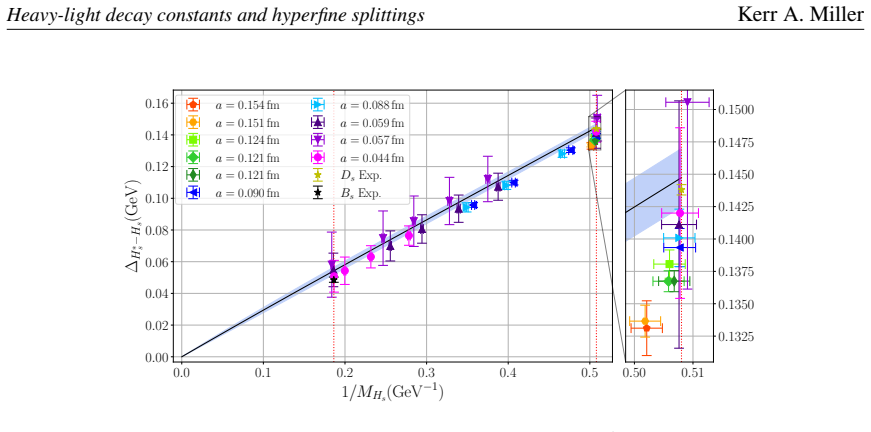
- [Figs. 1-4] The captions describe the black curve and blue band as the physical continuum result, but do not state their precise meaning (e.g., central value and 1-sigma band, or different orders); please clarify.
- [Section 3.2] No information is given on the two-point function fit ranges, priors, or goodness-of-fit (chi^2/dof) for the fits used to extract the amplitudes A^J_0, so the quality of the extracted amplitudes is not documented.
- [Section 4] The text says 'we have determined' the ratios in the conclusions, while the same paragraph says that 'we will obtain' precise values once combined with [27] and that stability testing and QED corrections remain; the framing should be made consistent so the reader knows the results are preliminary.
- [Reference [24]] Reference [24] is cited only as 'corrfitter Version 8.0.2' with a GitHub URL; please provide a persistent, citable version or a published reference.
Circularity Check
No load-bearing circularity: the central ratios are genuine lattice-QCD extractions, though several inputs come from prior HPQCD/MILC work with overlapping authors.
full rationale
The paper's central claims are continuum-extrapolated ratios of lattice-measured decay constants and hyperfine splittings. The amplitudes in Eqs. (5)-(7) are extracted from two-point correlation functions, and the ratios are then fitted to the explicit forms in Eqs. (9), (13), and (14). The physical-point values are read off at the experimental B_s and D_s masses, not fitted to those masses. No equation defines a target quantity in terms of itself, and no fitted parameter is renamed as a prediction. Inputs such as the vector renormalization factor Z_V [14], tensor renormalization factor Z_T [15], alpha_s [20], and the scale-setting parameter w0 [19-21] come from prior lattice calculations by overlapping HPQCD/MILC authors, but those are independent nonperturbative or high-precision determinations, not functions of the quantities predicted here. Citing them is standard lattice practice and does not make the derivation circular. The fit forms follow [10], an overlapping-author paper, but they are openly presented as fit forms, and the lattice data determine the coefficients. The pole-mass proxy m_h^pole = 0.9 M_Hs and the truncation of Eqs. (9), (13), and (14) are assumptions whose stability the paper admits it has not yet finalised (Section 4); those are systematic/correctness risks, not circularity. The results are benchmarked against experimental hyperfine splittings in Fig. 2, providing external falsifiability. Score 2 reflects the presence of self-referential inputs from the HPQCD/MILC line of work without any reduction of the central claims to those inputs.
Assumptions & free parameters
free parameters (6)
- C^{R_s}_{ijk}
- C^{Delta}_{ijk}
- C^{X}_{ijk}
- Mistuning coefficients A, B, C, D
- Pole-mass prefactor 0.9 =
0.9
- Tuned-mass exponent 1.4 =
1.4
assumptions (6)
- domain assumption The fit form in Eq. (9) and the analogous forms in Eqs. (13) and (14) capture the heavy-quark mass dependence of the ratios between charm and bottom.
- ad hoc to paper m_h^{pole}=0.9 M_Hs approximates the heavy-quark pole mass in the perturbative coefficients and renormalization scale.
- domain assumption The vector and tensor renormalization factors from [14,15] and the 3-loop running to 0.9 M_Hs are correct.
- domain assumption The hyperfine splitting vanishes in the static limit, so C_{00k}=0 in Eq. (13).
- domain assumption Valence charm mistuning need not be included in Eq. (10) because it is absorbed by the 1/M_Hs terms.
- domain assumption The tuned strange and charm masses in Eq. (12) with the 2(1.4) exponent correctly fix mistuning.
Cite this review
Pith. "Pith review of Heavy-light meson decay constants and hyperfine splittings with the heavy-HISQ method." pith.science (2026). https://pith.science/paper/P3722UU5
@misc{pith2026250206713,
  author       = {Pith},
  title        = {Pith review of: Heavy-light meson decay constants and hyperfine splittings with the heavy-HISQ method},
  year         = {2026},
  howpublished = {\url{https://pith.science/paper/P3722UU5}},
  note         = {Machine review of arXiv:2502.06713}
}
abstract
We compute ratios between the vector and pseudoscalar, and tensor and vector decay constants, and between hyperfine splittings for $D_{(s)}^{(*)}$ and $B_{(s)}^{(*)}$ mesons. We use the Highly Improved Staggered Quark (HISQ) action for all valence quarks, paired with the second generation MILC $n_f = 2+1+1$ HISQ gluon field configurations. These include light sea quarks with $m_u = m_d \equiv m_l$ going down to the physical values, as well as physically tuned strange and charm sea quarks. We also use a HISQ valence heavy quark, with mass ranging from that of the $c$-quark up to very nearly that of the physical $b$-quark on the finest lattices, allowing us to map out the heavy-quark mass dependence of the decay constant and hyperfine splitting ratios.
Figures


Figures from the paper (1 more)

Reference graph
Works this paper leans on
-
[27]
Bazavov et al.,𝐵- and𝐷-meson leptonic decay constants from four-flavor lattice QCD, Phys
A. Bazavov et al.,𝐵- and𝐷-meson leptonic decay constants from four-flavor lattice QCD, Phys. Rev. D98 (2018) 074512 [1712.09262]
arXiv 2018
-
[1]
J. Harrison, C.T.H. Davies and A. Lytle,HPQCDcollaboration,𝑅(𝐽/𝜓) and 𝐵− 𝑐→𝐽/𝜓ℓ− ¯𝜈ℓ Lepton Flavor Universality Violating Observables from Lattice QCD, Phys. Rev. Lett.125 (2020) 222003 [2007.06956]
work page Pith review arXiv 2020
-
[2]
J. Harrison and C.T.H. Davies,HPQCDcollaboration,𝐵𝑠→𝐷∗ 𝑠 Form Factors for the full𝑞2 range from Lattice QCD, Phys. Rev. D105 (2022) 094506 [2105.11433]
arXiv 2022
-
[3]
N. Gubernari, M. Reboud, D. van Dyk and J. Virto,Improved theory predictions and global analysis of exclusive𝑏→𝑠𝜇+𝜇− processes, JHEP09(2022) 133 [2206.03797]
arXiv 2022
-
[4]
J. Harrison and C.T.H. Davies,HPQCDcollaboration,𝐵→𝐷∗ and𝐵𝑠→𝐷∗ 𝑠 vector, axial-vector and tensor form factors for the full𝑞2 range from lattice QCD,Phys. Rev. D109 (2024) 094515 [2304.03137]
arXiv 2024
-
[5]
A.Bazavovetal., Fermilab Lattice and MILC collaboration,Semileptonicformfactorsfor 𝐵→𝐷∗ℓ𝜈 at nonzero recoil from2+ 1-flavor lattice QCD,Eur. Phys. J. C82(2022) 1141 [2105.14019]
arXiv 2022
-
[6]
B. Chakraborty, W.G. Parrott, C. Bouchard, C.T.H. Davies, J. Koponen and G.P. Lepage, HPQCDcollaboration, Improved𝑉𝑐𝑠 determination using precise lattice QCD form factors for𝐷→𝐾ℓ𝜈, Phys. Rev. D104 (2021) 034505 [2104.09883]
arXiv 2021
-
[7]
T.Hurth, F.MahmoudiandS.Neshatpour, ImplicationsofthenewLHCbangularanalysisof 𝐵→𝐾∗𝜇+𝜇− : Hadronic effects or new physics?, Phys. Rev. D102 (2020) 055001 [2006.04213]
work page Pith review arXiv 2020
Show all 31 references
-
[8]
Ablikim et al.,BESIIIcollaboration, Determination of the pseudoscalar decay constant 𝑓𝐷+𝑠 via𝐷+ 𝑠→𝜇+𝜈𝜇, Phys
M. Ablikim et al.,BESIIIcollaboration, Determination of the pseudoscalar decay constant 𝑓𝐷+𝑠 via𝐷+ 𝑠→𝜇+𝜈𝜇, Phys. Rev. Lett.122 (2019) 071802 [1811.10890]
2019 arXiv
-
[9]
Aoki et al.,Flavour Lattice A veraging Group (FLAG)collaboration,FLAG Review 2024, 2411.04268
Y. Aoki et al.,Flavour Lattice A veraging Group (FLAG)collaboration,FLAG Review 2024, 2411.04268
2024 arXiv
-
[10]
McNeile, C.T.H
C. McNeile, C.T.H. Davies, E. Follana, K. Hornbostel and G.P. Lepage,High-Precision 𝑓𝐵𝑠 and HQET from Relativistic Lattice QCD,Phys. Rev. D85(2012) 031503 [1110.4510]
2012 arXiv
-
[11]
Parrott, C
W.G. Parrott, C. Bouchard, C.T.H. Davies and D. Hatton,Toward accurate form factors for 𝐵-to-light meson decay from lattice QCD, Phys. Rev. D103 (2021) 094506 [2010.07980]
2021 arXiv
-
[12]
Harrison, C.T.H
J. Harrison, C.T.H. Davies and A. Lytle,HPQCDcollaboration,𝐵𝑐→𝐽/𝜓 form factors for the full𝑞2 range from lattice QCD, Phys. Rev. D102 (2020) 094518 [2007.06957]
2020 arXiv
-
[13]
Cooper, C.T.H
L.J. Cooper, C.T.H. Davies, J. Harrison, J. Komijani and M. Wingate,HPQCDcollaboration, 𝐵𝑐→𝐵𝑠(𝑑) form factors from lattice QCD,Phys. Rev. D102(2020) 014513 [2003.00914]
2020 arXiv
-
[14]
D.Hatton, C.T.H.Davies, G.P.LepageandA.T.Lytle, HPQCDcollaboration,Renormalizing vector currents in lattice QCD using momentum-subtraction schemes, Phys. Rev. D100 (2019) 114513 [1909.00756]. 9 Heavy-light decay constants and hyperfine splittings Kerr A. Miller
2019 arXiv
-
[15]
Hatton, C.T.H
D. Hatton, C.T.H. Davies, G.P. Lepage and A.T. Lytle,HPQCD collaboration, Renormalization of the tensor current in lattice QCD and the𝐽/𝜓 tensor decay constant, Phys. Rev. D102(2020) 094509 [2008.02024]
2020 arXiv
-
[16]
Jenkins,Heavy meson masses in chiral perturbation theory with heavy quark symmetry, Nucl
E.E. Jenkins,Heavy meson masses in chiral perturbation theory with heavy quark symmetry, Nucl. Phys. B412(1994) 181 [hep-ph/9212295]
1994 arXiv
-
[17]
Bazavov et al.,MILCcollaboration, Lattice QCD Ensembles with Four Flavors of Highly Improved Staggered Quarks, Phys
A. Bazavov et al.,MILCcollaboration, Lattice QCD Ensembles with Four Flavors of Highly Improved Staggered Quarks, Phys. Rev. D87(2013) 054505 [1212.4768]
2013 arXiv
-
[18]
Bazavov et al.,MILCcollaboration, Scaling studies of QCD with the dynamical HISQ action,Phys
A. Bazavov et al.,MILCcollaboration, Scaling studies of QCD with the dynamical HISQ action,Phys. Rev. D82(2010) 074501 [1004.0342]
2010 arXiv
-
[19]
Dowdall, C.T.H
R.J. Dowdall, C.T.H. Davies, G.P. Lepage and C. McNeile,𝑉𝑢𝑠 from𝜋 and𝐾 decay constants in full lattice QCD with physical𝑢,𝑑,𝑠 and𝑐 quarks,Phys. Rev. D88(2013) 074504 [1303.1670]
2013 arXiv
-
[20]
Chakraborty, C.T.H
B. Chakraborty, C.T.H. Davies, B. Galloway, P. Knecht, J. Koponen, G.C. Donald et al., High-precision quark masses and QCD coupling from𝑛𝑓 = 4 lattice QCD,Phys. Rev. D91 (2015) 054508 [1408.4169]
2015 arXiv
-
[21]
McLean, C.T.H
E. McLean, C.T.H. Davies, J. Koponen and A.T. Lytle,𝐵𝑠→𝐷𝑠ℓ𝜈 Form Factors for the full 𝑞2 range from Lattice QCD with non-perturbatively normalized currents, Phys. Rev. D101 (2020) 074513 [1906.00701]
2020 arXiv
-
[22]
Gracey,Three loopMS tensor current anomalous dimension in QCD, Phys
J.A. Gracey,Three loopMS tensor current anomalous dimension in QCD, Phys. Lett. B488 (2000) 175 [hep-ph/0007171]
2000 arXiv
-
[23]
Follana, Q
E. Follana, Q. Mason, C. Davies, K. Hornbostel, G.P. Lepage, J. Shigemitsu et al.,HPQCD, UKQCDcollaboration, Highly improved staggered quarks on the lattice with applications to charm physics,Phys. Rev. D75 (2007) 054502 [hep-lat/0610092]
2007 arXiv
-
[24]
Lepage,corrfitter,corrfitter Version 8.0.2(github.com/gplepage/corrfitter)
G.P. Lepage,corrfitter,corrfitter Version 8.0.2(github.com/gplepage/corrfitter)
-
[25]
Buchalla,Heavy quark theory, in55th Scottish Universities Summer School in Physics: Heavy Flavor Physics (SUSSP 2001), pp
G. Buchalla,Heavy quark theory, in55th Scottish Universities Summer School in Physics: Heavy Flavor Physics (SUSSP 2001), pp. 57–104, 2, 2002 [hep-ph/0202092]
2001 arXiv
-
[26]
Bekavac, A.G
S. Bekavac, A.G. Grozin, P. Marquard, J.H. Piclum, D. Seidel and M. Steinhauser,Matching QCD and HQET heavy-light currents at three loops,Nucl. Phys. B833 (2010) 46 [0911.3356]
2010 arXiv
-
[28]
Hatton, C.T.H
D. Hatton, C.T.H. Davies, B. Galloway, J. Koponen, G.P. Lepage and A.T. Lytle,HPQCD collaboration, Charmonium properties from lattice QCD+QED : Hyperfine splitting,𝐽/𝜓 leptonic width, charm quark mass, and𝑎𝑐 𝜇,Phys. Rev. D102 (2020) 054511 [2005.01845]. 10 Heavy-light decay co...
2020 arXiv
-
[29]
van Ritbergen, J.A.M
T. van Ritbergen, J.A.M. Vermaseren and S.A. Larin,The four-loop𝛽-function in quantum chromodynamics, Phys. Lett. B400 (1997) 379 [hep-ph/9701390]
1997 arXiv
-
[30]
Schroder,The static potential in QCD to two loops, Phys
Y. Schroder,The static potential in QCD to two loops, Phys. Lett. B447 (1999) 321 [hep-ph/9812205]
1999 arXiv
-
[31]
Lepage and P.B
G.P. Lepage and P.B. Mackenzie,On the viability of lattice perturbation theory,Phys. Rev. D 48 (1993) 2250 [hep-lat/9209022]. 11
1993 arXiv
Reviewed August 8, 2026 · model on record in the stance chip above.
Discussion (0). Continue with ORCID to comment.