REVIEW 5 major objections 7 minor 2 cited by
Towards Understanding of Frequency Dependence on Sound Event Detection
T0 review · 5 major / 7 minor · reviewed 2026-08-08 · deepseek-v4-flash
Pith's one-line read Frequency dependence is a real and exploitable structure in sound event detection: two frequency-aware methods improve SED for distinct reasons and combine for an 11.6% gain over the baseline.
desk verdict A workmanlike analysis of the authors' own frequency-dependent SED methods, with useful new probes and honest limitations, but the FDY conv gain is never isolated from added attention capacity. read the letter →
The pith
A machine-rendered reading of the paper's core claim, the machinery that carries it, and where it could break.
The reading
What carries the argument
The central mechanism is the relaxation of translation equivariance along the frequency axis. Ordinary 2D convolution assumes that shifting input content along either axis changes only position, not meaning; this paper argues that is false for spectrograms because shifting a sound in frequency changes the sound itself. FDY conv implements frequency-dependent kernels by squeezing a time-pooled input through two 1D convolution layers to produce, for each frequency bin, K attention weights, then forming that bin's kernel as a weighted sum of K trainable basis kernels. FilterAugment is the complementary data-side mechanism: during training it multiplies random frequency bands by random gains, either as step-like bands or linearly interpolated weights, so the model must learn sound-event evidence across a range of spectral conditions. Two simpler variants, FK conv with a separate trained kernel per frequency bin and FW conv with fixed per-bin weighted sums of shared basis kernels, act as controls that isolate what the attention mechanism adds.
What would settle it
Train a model identical to the FDY conv model except that the attention weights are shared across all frequency bins, or replaced by a fixed per-bin mask with the same number of parameters. If this frequency-independent attention control matches the 8.95 percent gain over baseline, then the frequency-adaptive kernel hypothesis is not what explains the improvement; if it does not, the paper's interpretation is supported.
Extended reading notes
Core claim
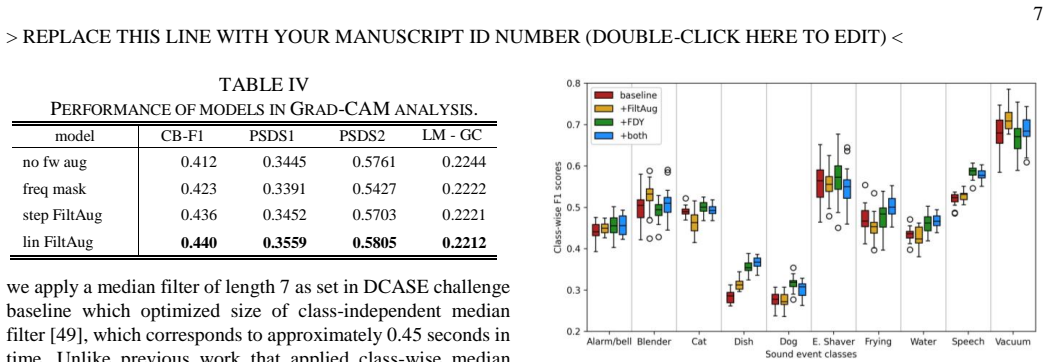
On a CRNN sound event detection model trained on the DESED dataset with the mean-teacher semi-supervised recipe, the paper claims that FilterAugment and frequency dynamic convolution are each helpful and mostly independent: FilterAugment raises CB-F1 from 0.478 to 0.486, adding FDY conv to the baseline raises it to 0.505, and using both reaches 0.517, an 11.6 percent relative gain over baseline that is close to the 14 percent predicted by multiplying the individual gains. Class-wise F1 shows FDY conv is especially strong on non-stationary events such as alarm/bell, dishes, and running water, and weaker on stationary machinery sounds like blender and vacuum cleaner, while FilterAugment consistently helps wideband events but hurts cat, dog, and electric shaver/toothbrush, whose sounds have localized spectral peaks. Grad-CAM visualizations show that FilterAugment draws attention into time-frequency regions tied to the true event, with step-type weighting focusing on narrow, sharp regions and linear-type weighting on broader, continuous regions. Replacing FDY conv with fixed per-frequency kernels (FK conv) hurts performance by 14.66 percent, while fixed frequency-wise weighted sums of basis kernels (FW conv) helps by 3.72 percent, and FDY conv's input-dependent frequency attention helps by 8.95 percent; PCA of the attention weights shows neighboring frequency bins receive similar kernels, and the kernel trajectories differ by sound class and become more distinct in later layers.
Load-bearing premise
The load-bearing premise is that FDY conv's gains come from letting kernels change along frequency rather than from its extra parameters and attention machinery; the paper interprets the gain through frequency adaptation but does not run a control that removes frequency adaptation while keeping the added capacity.
Editorial extensions
If this is right
- Combining FilterAugment with FDY conv gives an 11.6 percent relative gain over the baseline, close to the 14 percent expected if the two methods are independent, so a strong SED system should treat them as complements rather than substitutes.
- Vanilla 2D convolution over spectrograms carries an inappropriate inductive bias for the frequency axis; replacing it with kernels that vary along frequency improves detection, but only when the kernels share basis across neighboring bins, since separate per-bin kernels hurt performance.
- FilterAugment is not universally beneficial: it degrades classes with narrow, fixed spectral peaks, so augmentation schedules may need to be class-aware or gentler for those sounds.
- FDY conv's benefit concentrates on non-stationary events, so frequency-adaptive convolution is most valuable in layers where transient, spectrally evolving patterns must be captured.
Reading between the lines
- Beyond the paper: the same frequency-is-shift-variant argument should transfer to audio tagging, acoustic scene classification, and other spectrogram-based tasks, predicting that combining global spectral perturbation with local kernel adaptation will help there too, but this is an extrapolation rather than a result of the paper.
- Beyond the paper: the smooth frequency trajectories seen in the PCA plots suggest the attention weights could be parameterized more cheaply, for example as a low-rank or smoothly interpolated function of frequency, reducing FDY conv's overhead without losing most of its benefit.
- Beyond the paper: a matched control that keeps FDY conv's attention module and basis-kernel count but makes the attention weights frequency-independent would settle whether the gain is really due to frequency adaptation or to added model capacity; the paper does not run this control.
Editorial analysis
A structured set of objections, weighed in public.
Referee Report
Summary. The paper presents an empirical analysis of two frequency-dependent techniques for sound event detection (SED) on the public DESED dataset with a DCASE 2022 Task 4-style CRNN baseline. The authors compare FilterAugment and frequency dynamic convolution (FDY conv) against a baseline, report class-wise CB-F1 box plots, use Grad-CAM to compare two FilterAugment variants with frequency masking, introduce two simpler frequency-dependent convolution variants (FK conv and FW conv), and apply PCA to the attention weights of FDY conv. The central claims are that frequency dependence plays a significant role in SED, that FilterAugment and FDY conv are effective and complementary, and that FDY conv works by relaxing translation equivariance along the frequency axis.
Significance. If the interpretational claims were supported, the paper would be a useful design guide for frequency-adaptive SED architectures, since FDY conv is already used in several strong SED systems and FilterAugment is a common augmentation. The manuscript is transparent about several limitations, including the qualitative nature of the Grad-CAM case studies and the controlled foreground-only setting of the PCA analysis, and it provides public code. The main analytical conclusions, however, currently rest on an uncontrolled comparison, an unsupported product-rule argument, and maximum-over-seeds reporting, so the significance is conditional on the additional experiments and reinterpretation described below.
major comments (5)
- [Section IV.A] The complementarity claim is load-bearing and rests on an unjustified calculation. The text states that if the two methods were 'completely unrelated,' the joint improvement would equal the product of their individual improvements (14%), and since the observed improvement is 11.6%, the methods are 'complementary rather than overlapping.' This product rule is not derived from any property of the metrics (PSDS1+PSDS2 is a sum, not a multiplicative score) or from a statistical model of interactions. Moreover, Table III reports only the maximum over 12 runs, so the difference between 11.6% and 14% is within the range one would expect from seed variability. Please replace this argument with an interaction analysis based on the actual metric definitions and with error bars, or remove the complementarity claim and report the 2x2 factorial results descriptively.
- [Section II.B and Section IV.C] The causal role of frequency adaptation in FDY conv is not isolated. FDY conv differs from FW conv not only in making kernel weights input-dependent per frequency bin but also in containing a learnable attention module with two additional 1D convolution layers. The FK/FW/FDY comparison varies frequency-dependence and attention capacity simultaneously, so the observed +8.95% over baseline and +5.23% over FW conv could be due to added capacity or content-adaptive weighting in general rather than to relaxing frequency-axis translation equivariance. A control that applies the same attention mechanism in a frequency-agnostic manner, such as sharing one attention vector across all frequency bins or making the attention time-adaptive, is needed. Without this control, the central interpretation in the abstract and conclusion—that frequency dependence itself drives the gain—is not established, especially because FK conv, a purely frequency-dependent kernel, degrades performance by 14.66%.
- [Section III.H and Table III] All headline performance claims report the maximum score over 12 training runs, with no variance, mean, or significance test reported. Because the paper's analytical conclusions are comparative (FDY better than FW, FDY+FA better than FDY+FM, FDY+FA improves the baseline by 11.6%), reporting maxima makes the rankings and the magnitudes unstable and non-falsifiable. Please report the mean and standard deviation (or median and interquartile range) across the 12 runs, and where feasible a paired test across seeds. The class-wise box plots in Fig. 6 should also be accompanied by a statistical test or effect sizes, especially because the stationary/non-stationary classification in Section IV.A is developed after inspecting those box plots.
- [Section IV.A and Section V] The class-wise conclusions are derived post hoc. The statements that FDY conv is 'especially strong on non-stationary sound events' and that FilterAugment is unsuitable for events with 'specific and localized frequency peaks' are based on visual inspection of box plots and on a categorization that is adjusted after seeing the results: electric shaver/toothbrush, frying, and running water are reclassified as 'partially non-stationary' precisely because FDY conv improved on them. This risks circularity. The event categories should be defined a priori using an objective acoustic measure (for example spectral flux or stationarity), and the class-wise hypotheses should then be tested with an appropriate multiple-comparison procedure.
- [Section IV.D] The PCA analysis is used to conclude that 'FDY conv applies frequency-dependent convolution kernels' and that the class-wise separability 'supports its effectiveness,' but the analysis is descriptive and has no null baseline. For example, the observed local clustering of similar colors is unsurprising because the attention weights are produced by 1D convolutions over frequency and are therefore locally smooth; a null model with randomized attention weights or a comparison with the fixed weights of FW conv would be needed to show that the PCA structure is specific to FDY conv's frequency-adaptive mechanism. Please temper the causal wording and, if possible, add a quantitative dispersion or separability measure.
minor comments (7)
- [Section IV.B and Section IV.C] Two different tables are both labeled 'Table IV': the Grad-CAM performance table in Section IV.B and the convolution-method comparison in Section IV.C. Renumber the tables and fix the in-text cross-references.
- [Throughout] Please proofread for typographical errors, including 'equivament' (Section II.B), 'laeyrs' and 'tatget' (Section IV.B), 'ocassionally' (Section IV.B), 'resluts' (Section IV.A), and 'ths' (author biography).
- [Section II.B] The notation in Eq. (1) is unclear: T(x) is used without defining its action on a spectrogram, and the terms 'shift-invariant' and 'shift-variant' are used interchangeably with 'translation equivariance.' Consider defining the operators and consistently using 'translation equivariance' for the convolution property.
- [Section IV.B] The LM-GC metric is described as the squared difference between log-mel and Grad-CAM outputs averaged over active time-frequency regions, but the exact normalization and the criterion for 'active' regions are not specified. A formal definition would make the values in Table IV reproducible.
- [Section IV.C] The sentence 'This does not merely claim the excellence of attention mechanism which adapts to the contents of convolution input' is ungrammatical and should be rephrased for clarity.
- [Section IV.D] Please state how many audio clips per class were used in the PCA analysis and report the percentage of variance explained by the two principal components; otherwise the plot in Fig. 8 is difficult to interpret.
- [References] Several references are incomplete or inconsistent, for example [12] and [14] lack venue and page information. The running header still contains the template placeholder '> REPLACE THIS LINE WITH YOUR MANUSCRIPT ID NUMBER'; remove it before submission.
Circularity Check
No significant circularity: the paper empirically analyzes the authors' own prior methods against public DESED data; its conclusions are not derived from those methods' definitions.
full rationale
The paper's load-bearing claims—that frequency dependence matters for SED and that FilterAugment and FDY conv are complementary—are supported by independent experiments on the public DESED dataset with the DCASE 2022 Task 4 baseline, not by construction from the definitions of the methods. FDY conv and FilterAugment are cited prior works ([26], [35]) whose performance is measured, not re-derived; the new FK conv and FW conv are introduced as explicit controls, and the PCA analysis is descriptive. The 'complementary' inference in Section IV.A is a heuristic calculation from measured improvements (14% expected product vs. 11.6% observed), not an equation that forces the conclusion. The Grad-CAM section is presented as qualitative case studies with stated limitations, and the PCA section explicitly notes the controlled foreground-dataset setting, so these do not smuggle in the conclusion. The only circularity-adjacent feature is the heavy reliance on the authors' own earlier methods as objects of study, but this is not load-bearing in the sense of a derivation reducing to its inputs; a missing non-frequency-adaptive attention control would be a validity concern, not a circularity concern. Score 1 reflects minor self-citation without structural circularity.
Assumptions & free parameters
free parameters (5)
- FDY conv basis kernel count K =
not given in text (inherited from [26])
- Attention reduction ratio r =
not given in text (inherited from [26])
- FilterAugment frequency band count and gain range =
optimal setting from [35]
- Loss weights wW and wc schedule =
wW = 0.5; wc rises from 0 to 2 over 50 epochs
- Median filter length =
7 frames (~0.45 s)
assumptions (5)
- domain assumption The frequency axis of a mel spectrogram is semantically shift-variant, so relaxing translation equivariance along frequency is beneficial for SED.
- domain assumption Grad-CAM maps computed over the full CNN reflect the information the SED model actually uses for a class.
- domain assumption PCA of FDY conv attention weights preserves meaningful structure rather than arbitrary variation.
- domain assumption DESED and the CRNN mean-teacher baseline are representative enough for general conclusions about SED.
- ad hoc to paper The product of individual performance improvements is a valid way to test independence of FilterAugment and FDY conv.
Cite this review
Pith. "Pith review of Towards Understanding of Frequency Dependence on Sound Event Detection." pith.science (2026). https://pith.science/paper/NF4QOAOD
@misc{pith2026250207208,
  author       = {Pith},
  title        = {Pith review of: Towards Understanding of Frequency Dependence on Sound Event Detection},
  year         = {2026},
  howpublished = {\url{https://pith.science/paper/NF4QOAOD}},
  note         = {Machine review of arXiv:2502.07208}
}
read the original abstract
In this work, we conduct an in-depth analysis of two frequency-dependent methods for sound event detection (SED): FilterAugment and frequency dynamic convolution (FDY conv). The goal is to better understand their characteristics and behaviors in the context of SED. While SED has been rapidly advancing through the adoption of various deep learning techniques from other pattern recognition fields, such adopted techniques are often not suitable for SED. To address this issue, two frequency-dependent SED methods were previously proposed: FilterAugment, a data augmentation randomly weighting frequency bands, and FDY conv, an architecture applying frequency adaptive convolution kernels. These methods have demonstrated superior performance in SED, and we aim to further analyze their detailed effectiveness and characteristics in SED. We compare class-wise performance to find out specific pros and cons of FilterAugment and FDY conv. We apply Gradient-weighted Class Activation Mapping (Grad-CAM), which highlights time-frequency region that is more inferred by the model, on SED models with and without frequency masking and two types of FilterAugment to observe their detailed characteristics. We propose simpler frequency dependent convolution methods and compare them with FDY conv to further understand which components of FDY conv affects SED performance. Lastly, we apply PCA to show how FDY conv adapts dynamic kernel across frequency dimensions on different sound event classes. The results and discussions demonstrate that frequency dependency plays a significant role in sound event detection and further confirms the effectiveness of frequency dependent methods on SED.
Figures


Figures from the paper (6 more)




Forward citations
Cited by 2 Pith papers
-
Auditory Intelligence: Understanding the World Through Sound
A position paper proposing four cognitively inspired audio tasks (ASPIRE, SODA, AUX, AUGMENT) to push machine hearing beyond recognition toward explanation, reasoning, and interaction.
-
Frequency Dynamic Convolutions for Sound Event Detection
A family of frequency-adaptive convolutions improves CRNN sound event detection on DESED by up to 10.98% in PSDS1, with a lighter TFD variant matching the best score.
Reference graph
Works this paper leans on
-
[1]
Convolutional Recurrent Neural Networks for Polyphonic Sound Event Detection,
E. C¸akır, G. Parascandolo, T. Heittola, H. Huttunen, and T. Virtanen, “Convolutional Recurrent Neural Networks for Polyphonic Sound Event Detection,” IEEE/ACM Trans. Audio, Speech, Lang. Process., vol. 25, pp. 1291–1303, 2017
work page 2017
-
[2]
T. Virtanen, M. D. Plumbley, and D. Ellis, Computational Analysis of Sound Scenes and Events, 1st ed. Springer Publishing Company, Incorporated, 2017
work page 2017
-
[3]
Metrics for polyphonic sound event detection,
A. Mesaros, T. Heittola, and T. Virtanen, “Metrics for polyphonic sound event detection,” Appl. Sci., 2016
work page 2016
-
[4]
Improving Sound Event Detection Metrics: Insights from DCASE 2020,
G. Ferroni et al., “Improving Sound Event Detection Metrics: Insights from DCASE 2020,” ICASSP, IEEE Int. Conf. Acoust. Speech Signal Process. - Proc., pp. 631–635, 2021
work page 2020
-
[5]
Heavily Augmented Sound Event Detection utilizing Weak Predictions,
H. Nam et al., “Heavily Augmented Sound Event Detection utilizing Weak Predictions,” 2021
work page 2021
-
[6]
SEMI-SUPERVISED SOUND EVENT DETECTION SYSTEM FOR DCASE 2022 TASK 4,
K. He, X. Shu, S. Jia, and Y. He, “SEMI-SUPERVISED SOUND EVENT DETECTION SYSTEM FOR DCASE 2022 TASK 4,” 2022
work page 2022
-
[7]
SELF-TRAINING FOR SOUND EVENT DETECTION IN AUDIO MIXTURES,
S. Park, A. Bellur, D. K. Han, and M. Elhilali, “SELF-TRAINING FOR SOUND EVENT DETECTION IN AUDIO MIXTURES,” ICASSP, IEEE Int. Conf. Acoust. Speech Signal Process. - Proc., pp. 341–345, 2021
work page 2021
-
[8]
Self-Trained Audio Tagging and Sound Event Detection in Domestic Environments,
J. Ebbers and R. Haeb-Umbach, “Self-Trained Audio Tagging and Sound Event Detection in Domestic Environments,” 2021
work page 2021
Show all 55 references
-
[9]
Sound Event Detection with Cross-Referencing Self-Training,
S. Park, W. Choi, and M. Elhilali, “Sound Event Detection with Cross-Referencing Self-Training,” 2021
2021
-
[10]
Zheng USTC Team’s Submission For DCASE2021 Task4 – Semi-Supervised Sound Event Detection,
X. Zheng, H. Chen, and Y. Song, “Zheng USTC Team’s Submission For DCASE2021 Task4 – Semi-Supervised Sound Event Detection,” 2021
2021
-
[11]
Conformer-Based Sound Event Detection With Semi-Supervised Learning and Data Augmentation,
K. Miyazaki et al., “Conformer-Based Sound Event Detection With Semi-Supervised Learning and Data Augmentation,” Dcase2020, no. November, pp. 100–104, 2020
2020
-
[12]
Convolution-Augmented Conformer For Sound Event Detection,
Y. Chen, “Convolution-Augmented Conformer For Sound Event Detection,” 2021
2021
-
[13]
Specaugment: A simple data augmentation method for automatic speech recognition,
D. S. Park et al., “Specaugment: A simple data augmentation method for automatic speech recognition,” in Proc. Interspeech, 2019, pp. 2613–2617
2019
-
[14]
Sound Event Detection Based On Self-Supervised Learning Of Wav2vec 2.0,
H. Koo, H.-M. Park, J. Park, and M. Oh, “Sound Event Detection Based On Self-Supervised Learning Of Wav2vec 2.0,” 2021
2021
-
[15]
Conformer: Convolution-augmented transformer for speech recognition,
A. Gulati et al., “Conformer: Convolution-augmented transformer for speech recognition,” in Proc. Interspeech, 2020
2020
-
[16]
An overview of end-to-end automatic speech recognition,
D. Wang, X. Wang, and S. Lv, “An overview of end-to-end automatic speech recognition,” Symmetry (Basel)., 2019
2019
-
[17]
WAV2vec: Unsupervised pre-training for speech recognition,
S. Schneider, A. Baevski, R. Collobert, and M. Auli, “WAV2vec: Unsupervised pre-training for speech recognition,” Proc. Interspeech, pp. 3465–3469, 2019
2019
-
[18]
wav2vec 2.0: A framework for self-supervised learning of speech representations,
A. Baevski, H. Zhou, A. Mohamed, and M. Auli, “wav2vec 2.0: A framework for self-supervised learning of speech representations,” Adv. Neural Inf. Process. Syst., 2020
2020
-
[19]
Adaptive Convolutional Neural Network for Text-Independent Speaker Recognition,
S. H. Kim and Y. H. Park, “Adaptive Convolutional Neural Network for Text-Independent Speaker Recognition,” in Proc. Interspeech, 2021, vol. 1, pp. 641–645
2021
-
[20]
Temporal Dynamic Convolutional Neural Network for Text-Independent Speaker Verification and Phonemic Analysis,
S. H. Kim, H. Nam, and Y. H. Park, “Temporal Dynamic Convolutional Neural Network for Text-Independent Speaker Verification and Phonemic Analysis,” in International Conference on Acoustics, Speech and Signal Processing (ICASSP), 2022, vol. 2022-May, pp. 6742–6746
2022
-
[21]
Decomposed Temporal Dynamic CNN: Efficient Time-Adaptive Network for Text-Independent Speaker Verification Explained with Speaker Activation Map,
S. Kim, H. Nam, and Y. Park, “Decomposed Temporal Dynamic CNN: Efficient Time-Adaptive Network for Text-Independent Speaker Verification Explained with Speaker Activation Map,” arXiv Prepr. arXiv2203.15277, 2022
2022 arXiv
-
[22]
Rabiner and R
L. Rabiner and R. Schafer, Theory and Applications of Digital Speech Processing, 1st ed. Pearson, 2010
2010
-
[23]
A. V. Oppenheim and R. W. Schafer, Discrete-Time Signal Processing: International Edition, 3rd ed. Pearson, 2010
2010
-
[24]
J. S. Bendat and A. G. Piersol, Random Data: Analysis and Measurement Procedures, 4th ed. Wiley, 2011
2011
-
[25]
Attention is All you Need,
A. Vaswani et al., “Attention is All you Need,” in Advances in Neural Information Processing Systems, 2017
2017
-
[26]
Frequency Dynamic Convolution: Frequency-Adaptive Pattern Recognition for Sound Event Detection,
H. Nam, S. H. Kim, B. Y. Ko, and Y. H. Park, “Frequency Dynamic Convolution: Frequency-Adaptive Pattern Recognition for Sound Event Detection,” in Proc. Interspeech, 2022
2022
-
[27]
CHT+NSYSU Sound Event Detection System With Multiscale Channel Attention And Multiple Consistency Training For DCASE 2021 Task 4,
Y. Wang, C. Chen, C. Lu, B. Chan, and C. T. Laboratories, “CHT+NSYSU Sound Event Detection System With Multiscale Channel Attention And Multiple Consistency Training For DCASE 2021 Task 4,” 2021
2021
-
[28]
SEMI-SUPERVISED LEARNING-BASED SOUND EVENT DETECTION USING FREQUENCY DYNAMIC CONVOLUTION WITH LARGE KERNEL ATTENTION FOR DCASE CHALLENGE 2023 TASK 4,
J. W. Kim, S. W. Son, Y. Song, H. K. Kim, I. H. Song, and J. E. Lim, “SEMI-SUPERVISED LEARNING-BASED SOUND EVENT DETECTION USING FREQUENCY DYNAMIC CONVOLUTION WITH LARGE KERNEL ATTENTION FOR DCASE CHALLENGE 2023 TASK 4,” 2023
2023
-
[29]
Fine-Tune the Pretrained ATST Model for Sound Event Detection,
N. Shao, X. Li, and X. Li, “Fine-Tune the Pretrained ATST Model for Sound Event Detection,” Int. Conf. Acoust. Speech Signal Process., pp. 911–915, 2024. 13 > REPLACE THIS LINE WITH YOUR MANUSCRIPT ID NUMBER (DOUBLE -CLICK HERE TO EDIT) <
2024
-
[30]
Prototype based Masked Audio Model for Self-Supervised Learning of Sound Event Detection,
P. Cai, Y. Song, N. Jiang, Q. Gu, and I. McLoughlin, “Prototype based Masked Audio Model for Self-Supervised Learning of Sound Event Detection,” Int. Conf. Acoust. Speech Signal Process., 2025
2025
-
[31]
Global Enhanced Frame Prompt Tuning for Sound Event Detection,
S. Yu and L. Gao, “Global Enhanced Frame Prompt Tuning for Sound Event Detection,” Int. Conf. Acoust. Speech Signal Process., pp. 1–5
-
[32]
Self Training and Ensembling Frequency Dependent Networks with Coarse Prediction Pooling and Sound Event Bounding Boxes,
H. Nam, D. Min, S. Choi, I. Choi, and Y.-H. Park, “Self Training and Ensembling Frequency Dependent Networks with Coarse Prediction Pooling and Sound Event Bounding Boxes,” DCASE Work., no. October, pp. 2–6, 2024
2024
-
[33]
AST-SED: An Effective Sound Event Detection Method Based on Audio Spectrogram Transformer,
K. Li, Y. Song, L.-R. Dai, I. McLoughlin, X. Fang, and L. Liu, “AST-SED: An Effective Sound Event Detection Method Based on Audio Spectrogram Transformer,” Int. Conf. Acoust. Speech Signal Process., 2023
2023
-
[34]
MAT-SED: A Masked Audio Transformer with Masked-Reconstruction Based Pre-training for Sound Event Detection,
P. Cai, Y. Song, K. Li, H. Song, and I. McLoughlin, “MAT-SED: A Masked Audio Transformer with Masked-Reconstruction Based Pre-training for Sound Event Detection,” Proc. Interspeech, 2024
2024
-
[35]
FilterAugment: An Acoustic Environmental Data Augmentation Method,
H. Nam, S. Kim, and Y. Park, “FilterAugment: An Acoustic Environmental Data Augmentation Method,” in International Conference on Acoustics, Speech and Signal Processing (ICASSP), 2022
2022
-
[36]
Diversifying and Expanding Frequency-Adaptive Convolution Kernels for Sound Event Detection,
H. Nam, S.-H. Kim, D. Min, J. Lee, and Y.-H. Park, “Diversifying and Expanding Frequency-Adaptive Convolution Kernels for Sound Event Detection,” Proc. Interspeech, no. September, pp. 97–101, 2024
2024
-
[37]
Pushing the Limit of Sound Event Detection with Multi-Dilated Frequency Dynamic Convolution,
H. Nam and Y.-H. Park, “Pushing the Limit of Sound Event Detection with Multi-Dilated Frequency Dynamic Convolution,” arXiv, pp. 1–5, 2024
2024
-
[38]
Convolution-Based Channel-Frequency Attention for Text-Independent Speaker Verification,
J. Li, Y. Tian, and T. Lee, “Convolution-Based Channel-Frequency Attention for Text-Independent Speaker Verification,” Int. Conf. Acoust. Speech Signal Process., 2023
2023
-
[39]
Learnable Frequency Filters for Speech Feature Extraction in Speaker Verification,
J. Li, Y. Tian, and T. Lee, “Learnable Frequency Filters for Speech Feature Extraction in Speaker Verification,” in Proc. Interspeech, 2022
2022
-
[40]
Integrating frequency translational invariance in TDNNs and frequency positional information in 2D ResNets to enhance speaker verification,
J. Thienpondt, B. Desplanques, and K. Demuynck, “Integrating frequency translational invariance in TDNNs and frequency positional information in 2D ResNets to enhance speaker verification,” in Proc. Interspeech, 2021, vol. 3
2021
-
[41]
Frequency and Temporal Convolutional Attention for Text-Independent Speaker Recognition,
S. Yadav and A. Rai, “Frequency and Temporal Convolutional Attention for Text-Independent Speaker Recognition,” in International Conference on Acoustics, Speech and Signal Processing (ICASSP), 2020, vol. 2020-May
2020
-
[42]
Multi-dimensional frequency dynamic convolution with confident mean teacher for sound event detection,
S. Xiao, X. Zhang, and P. Zhang, “Multi-dimensional frequency dynamic convolution with confident mean teacher for sound event detection,” Int. Conf. Acoust. Speech Signal Process., pp. 2–6, 2023
2023
-
[43]
Deep convolutional neural networks and data augmentation for acoustic event recognition,
N. Takahashi, M. Gygli, B. Pfister, and L. Van Gool, “Deep convolutional neural networks and data augmentation for acoustic event recognition,” in Proc. Interspeech, 2016
2016
-
[44]
Deep Convolutional Neural Networks and Data Augmentation for Environmental Sound Classification,
J. Salamon and J. P. Bello, “Deep Convolutional Neural Networks and Data Augmentation for Environmental Sound Classification,” IEEE Signal Process. Lett., vol. 24, no. 3, pp. 279–283, 2017
2017
-
[45]
Deep learning based cough detection camera using enhanced features,
G. T. Lee, H. Nam, S. H. Kim, S. M. Choi, Y. Kim, and Y. H. Park, “Deep learning based cough detection camera using enhanced features,” Expert Syst. Appl., vol. 206, no. June, 2022
2022
-
[46]
L. E. Kinsler, A. R. Frey, A. B. Coppens, and J. V. Sanders, Fundamentals of Acoustics, 4th ed. Wiley, 2000
2000
-
[47]
Grad-CAM: Visual Explanations from Deep Networks via Gradient-Based Localization,
R. R. Selvaraju, M. Cogswell, A. Das, R. Vedantam, D. Parikh, and D. Batra, “Grad-CAM: Visual Explanations from Deep Networks via Gradient-Based Localization,” Int. J. Comput. Vis., vol. 128, no. 2, pp. 336–359, 2019
2019
-
[48]
Polyphonic Sound Event Detection Based on Residual Convolutional Recurrent Neural Network with Semi-Supervised Loss Function,
N. K. Kim and H. K. Kim, “Polyphonic Sound Event Detection Based on Residual Convolutional Recurrent Neural Network with Semi-Supervised Loss Function,” IEEE Access, vol. 9, pp. 7564– 7575, 2021
2021
-
[49]
Sound Event Detection in Domestic Environments with Weakly Labeled Data and Soundscape Synthesis,
N. Turpault et al., “Sound Event Detection in Domestic Environments with Weakly Labeled Data and Soundscape Synthesis,” in Workshop on Detection and Classification of Acoustic Scenes and Events, 2020
2020
-
[50]
DCASE2021 Task4 Baseline
N. Turpault, “DCASE2021 Task4 Baseline.” [Online]. Available: https://github.com/DCASE-REPO/DESED_task
-
[51]
Mean teachers are better role models: Weight-averaged consistency targets improve semi- supervised deep learning results,
A. Tarvainen and H. Valpola, “Mean teachers are better role models: Weight-averaged consistency targets improve semi- supervised deep learning results,” in Advances in Neural Information Processing Systems, 2017, pp. 1196–1205
2017
-
[52]
Training Sound Event Detection On A Heterogeneous Dataset,
N. Turpault and R. Serizel, “Training Sound Event Detection On A Heterogeneous Dataset,” no. November, 2020
2020
-
[53]
MixUp: Beyond empirical risk minimization,
H. Zhang, M. Cisse, Y. N. Dauphin, and D. Lopez-Paz, “MixUp: Beyond empirical risk minimization,” in International Conference on Learning Representations, 2018
2018
-
[54]
Learnable pooling with Context Gating for video classification,
A. Miech, I. Laptev, and J. Sivic, “Learnable pooling with Context Gating for video classification,” arXiv:1706.06905v2 [cs.CV], 2017
2017 arXiv
-
[55]
A Framework for the robust evaluation of Sound Event Detction,
Ç . Bilen, G. Ferroni, F. Tuveri, J. Azcarreta, and Sacha Krstulović, “A Framework for the robust evaluation of Sound Event Detction,” in International Conference on Acoustics, Speech and Signal Processing (ICASSP), 2020, pp. 61–65. 14 > REPLACE THIS LINE WITH YOUR MANUSCRIPT ...
2020
Reviewed August 8, 2026 · model on record in the stance chip above.
Discussion (0). Continue with ORCID to comment.