REVIEW 3 major objections 4 minor 30 references
Probing Dark Photons through Gravitational Decoupling of Mass-State Oscillations in Interstellar Media
T0 review · 3 major / 4 minor · reviewed 2026-08-08 · deepseek-v4-flash
Pith's one-line read Gravitational decoupling of photon and dark-photon mass states removes the usual medium-induced suppression, turning lensed-quasar dimming into a probe of ultralight dark photons with $\epsilon<10^{-2}$ near $10^{-14}$ eV.
desk verdict Genuinely new idea, but the central calculation assumes an unphysical initial state and the gravitational decoherence effect is numerically negligible; the claimed discovery channel does not exist. read the letter →
The pith
A machine-rendered reading of the paper's core claim, the machinery that carries it, and where it could break.
The reading
What carries the argument
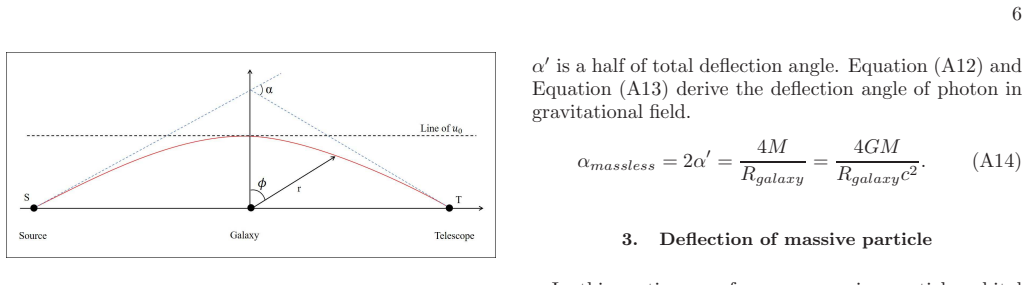
The central objects are the vacuum mass eigenstates $A_1$ (mass zero) and $A_2$ (mass $m_\chi$) of the photon-dark-photon system, related to the interaction eigenstates $A_R$ and $S$ by the rotation matrix $U_{I\to m}$. In a medium the relevant propagation eigenstates are the medium-dependent states $M_1$, $M_2$, and the bridge between the two bases is $U_{M\to m}=U_{I\to m}U_{I\to M}^{-1}$, which generates the oscillation probability of Equation (15). The decoherence length is supplied by the differential gravitational deflection of the massless and massive eigenstates, $\Delta\alpha=(2GM/(R_{\rm gal}c^2))(m_\chi^2/(E^2-m_\chi^2))$, together with the thermal photon coherence length $\Delta h=197\,\mathrm{MeV}\!\cdot\!\mathrm{fm}/E$; these combine into the optical depth $\tau=L/\Delta h$ that controls the flux attenuation in Equation (17).
What would settle it
Recompute the evolution in Equation (13) with the initial condition $A_R=\cos\chi_0\,A_1+\sin\chi_0\,A_2$, which is the state a real source produces, and compare the transition probability with Equation (15); if it reduces to $\epsilon^2 m_\chi^4/|m_\chi^2-m_\gamma^2|^2$, the unsuppressed sensitivity is an artifact of the chosen initial state.
Extended reading notes
Core claim
In a medium the photon and dark photon acquire an effective mass matrix whose diagonalization depends on the medium's plasma frequency, encoded as an effective photon mass $m_\gamma$. The paper shows that rotating from these medium eigenstates back to the vacuum mass eigenstates, via $U_{M\to m}=U_{I\to m}U_{I\to M}^{-1}$, produces a transition from the massless state $A_1$ to the massive state $A_2$ whose time-averaged probability is Equation (15), $P_{A_1\to A_2} = \epsilon^2 m_\gamma^4 / |m_\chi^2 - m_\gamma^2|^2$. Unlike the standard interaction-state result $P = \epsilon^2 m_\chi^4 / |m_\chi^2 - m_\gamma^2|^2$, this form is not suppressed when $m_\chi\ll m_\gamma$. The authors identify the gravitational field of a foreground lensing galaxy as the decoherence mechanism: the two mass eigenstates follow slightly different geodesics, separate by $L\approx L_s\,\Delta\alpha$, and lose coherence over the thermal photon coherence length $\Delta h$, producing an optical depth $\tau=L/\Delta h$ and an exponential attenuation of quasar flux. The resulting expression, Equation (22), predicts spectral hardening and yields the quoted limits on $\epsilon$ in a narrow mass window around $m_\chi\sim 10^{-14}$ eV.
Load-bearing premise
The calculation assumes that an emitted photon starts as the pure vacuum mass eigenstate $A_1$; if real emission produces the interacting photon state $A_R$ instead, the standard $(m_\chi/m_\gamma)^4$ suppression returns and the claimed advantage disappears.
Editorial extensions
If this is right
- If Equation (15) is correct, comparisons of lensed and unlensed quasar luminosity functions become sensitive to the kinetic-mixing parameter $\epsilon$ below $10^{-2}$ in a narrow dark-photon mass window near $10^{-14}$ eV.
- At the resonance $m_\chi\approx m_\gamma$, the inverse-mass-squared factor boosts the reach to roughly $\epsilon\sim10^{-4}$ in the idealized uniform-medium estimate.
- The mechanism predicts that lensed quasar light is spectrally hardened, since lower-energy photons suffer stronger attenuation through the $1/(E^2-m_\chi^2)$ factor in the flux-suppression formula.
- Because the unsuppressed probability grows with the medium's effective photon mass $m_\gamma$ rather than the dark-photon mass $m_\chi$, the method is aimed precisely at the ultralight regime where conventional photon-dark-photon oscillation searches lose sensitivity.
- The same gravitational decoherence idea is proposed to apply to strong-gravity environments such as neutron stars and black hole accretion disks, where the separation effect would be larger but the astrophysical modeling is more demanding.
Reading between the lines
- A decisive follow-up not in the paper is to redo the calculation with the interaction eigenstate $A_R=\cos\chi_0\,A_1+\sin\chi_0\,A_2$ as the initial condition, since that determines whether the unsuppressed probability survives real emission physics.
- Density variations along the line of sight will make the effective photon mass $m_\gamma$ position-dependent and broaden the resonant peak, so a quantitative inhomogeneous-medium model is needed before the quoted reach can be used observationally.
- The same mass-state decoherence logic could be transferred to other light hidden sectors, such as axion-like particles or mirror photons, where gravitational geodesic separation might modify conversion probabilities in strong-lensing and black-hole environments.
- The predicted chromatic dimming is directly testable: multi-band photometry of individual lensed quasar images should show an energy-dependent flux ratio between images if the mechanism operates.
Editorial analysis
A structured set of objections, weighed in public.
Referee Report
Summary. The paper proposes that gravitational separation of photon and dark photon vacuum mass eigenstates during propagation through the interstellar medium can remove the standard medium-induced suppression of photon-to-dark-photon oscillations. The authors derive an oscillation probability P_{A1→A2} for a photon initially in the vacuum mass eigenstate A1, claim that this probability remains unsuppressed for mχ ≪ mγ, and apply it to gravitationally lensed quasar fluxes to derive a sensitivity ε < 10^-2 for dark photon masses near 10^-14 eV. They also suggest extensions to neutron stars and black hole accretion disks.
Significance. If the central calculation were correct, the proposed mechanism would open a qualitatively new detection channel for ultralight dark photons and would make clever use of existing gravitational lensing data. The paper is clearly organized, and the gravitational deflection derivation in Appendix A is pedagogically useful. However, the central claim is not supported: Eq. (15) is computed for an initial pure vacuum mass eigenstate A1, whereas physical electromagnetic sources emit the interaction eigenstate A_R; with the correct initial state the standard (mχ/mγ)^4 suppression is restored. In addition, the reported sensitivity curve sits at the resonance mχ≈mγ, not in the mχ ≪ mγ regime where the claimed advantage would matter, and the attenuation treatment is inconsistent between the exponential and linearized forms. The manuscript contains no machine-checked proofs or reproducible code. The main claim therefore does not survive scrutiny.
major comments (3)
- [Section II, Eqs. (13)-(15)] The derivation of P_{A1→A2} assumes the photon is initially in the vacuum mass eigenstate A1 ('Photons emitted in the (1,0) state (pure A1)'). This is not the state produced by an astrophysical source: Eqs. (3) and (8) show that the electromagnetic current couples to A_R, so a quasar emits A_R = cos χ0 A1 + sin χ0 A2. In the interstellar medium the propagation eigenstates are M1 and M2 (Eq. (11)), and A_R is, to leading order, the medium eigenstate M1 with only a small sterile-dark-photon admixture of order χ0 mχ^2/mγ^2. Evolving A_R and projecting onto the sterile component S reproduces the standard probability of Eq. (2), P ~ ε^2 mχ^4/|mχ^2 - mγ^2|^2 for mχ ≪ mγ, rather than Eq. (15). Equation (15) therefore describes an unphysical preparation of the initial state, and the claimed immunity to medium suppression is an artifact of the chosen basis and initial condition. No mechanism is presented that would convert the source radiation into a pure A1 beam before it interacts with the interstellar medium.
- [Section IV and Fig. 2] The sensitivity curve is quoted for mχ in (0.975-1.025)×10^-14 eV with mγ = 10^-14 eV, i.e., at the resonance mχ ≈ mγ. In this mass range the standard in-medium probability of Eq. (2) is also unsuppressed, since the two formulas agree at resonance up to the factor mχ^4 vs mγ^4, which is O(1) there. The plotted constraint therefore does not probe the mχ ≪ mγ regime that is the paper's claimed advantage; the numerical result cannot serve as evidence for the new mechanism.
- [Section III-IV, Eqs. (16)-(22)] The attenuation treatment is internally inconsistent. Equation (17) gives N = N0 exp(-Pτ), but Eq. (22) uses the linearized expression N/N0 ≈ 1 - Pτ. The stated detection threshold N/N0 < 0.1 corresponds to Pτ > 2.3, where the linearization is invalid; if the intended threshold is instead 10% attenuation, the inequality should be N/N0 < 0.9, not N/N0 < 0.1. Either way, the sensitivity curves derived from Eq. (22) do not follow from the stated detection criterion, and the numerical bounds in Fig. 2 are not reliable.
minor comments (4)
- [Section IV, final paragraph] The text states that 'our method do not achieve sensitivity improved' relative to the Jupiter and COBE/FIRAS bounds; this appears to contradict the abstract and conclusion, which frame the mechanism as a new detection avenue. The authors should reconcile these statements.
- [Fig. 2] The axis labels contain unprintable encoding artifacts ('/uni00000013/...' and 'ms (eV)') and must be regenerated before the figure is usable.
- [Eqs. (14)-(15)] With ε = √2 sin χ0, one has sin^2 2χ0 ≈ 2ε^2; the paper should state explicitly where the factor of two or one-half is absorbed when replacing Eq. (14) by Eq. (15), since the current notation is ambiguous.
- [Title and Section I] The title contains a stray space in 'M ass-State', and Section I has a typo ('could addresses' should be 'could address').
Circularity Check
The claimed unsuppressed dark-photon oscillation probability is an artifact of initializing photons in the vacuum mass eigenstate A1, which the paper's own coupling equations contradict.
-
self definitional
[Section II, Eq. (13)-(15), initial-state sentence preceding Eq. (14)]
"Photons emitted in the (1 , 0) state (pure A1) oscillate to A2 with probability:"
Eq. (15) is obtained by taking the initial state to be pure A1, as quoted. That choice is the sole source of the unsuppressed mγ^4 numerator. Yet Eq. (8) sets J_em = (mγ^2/2) A_R, and the text states 'A_Rμ represents the physically observable photon field in the dark photon model'; hence a quasar emits A_R = cos χ0 A1 + sin χ0 A2, not pure A1. Evolving A_R with the same medium Hamiltonian gives the standard P ≈ ε^2 mχ^4 / |mχ^2 − mγ^2|^2, restoring the (mχ/mγ)^4 suppression. Thus the claimed immunity to medium suppression is not a derived prediction but an artifact of an unphysical initial state; the conclusion is fixed by the choice of basis, not by the physics.
full rationale
The paper's derivation of Eq. (15) is internally consistent for a pure A1 initial state, but the circularity enters when this mathematical result is promoted to a physical prediction for quasar flux attenuation. The paper itself identifies A_R as the physical photon field (Eq. 8 and surrounding text), so real sources emit A_R, not A1. With the physical initial state, the standard mχ^4-suppressed result (Eq. 2) is recovered, and the proposed new detection channel disappears. No external benchmark or independent data is needed to see this; the paper's own equations contradict the initial-state assumption. The later gravitational-deflection and flux-attenuation steps inherit this flaw but are not independently circular. Since the central claim is forced by an unphysical initial-state choice that the paper itself defines away, the score is 8.
Assumptions & free parameters
free parameters (7)
- effective ISM photon mass mγ =
10^-14 eV
- source redshift z =
1
- foreground galaxy mass M =
10^12 solar masses
- foreground galaxy radius Rgal =
1 kpc
- observation energy Eγ =
~1 eV (optical)
- flux attenuation threshold =
10% (N/N0 < 0.1)
- dark photon mass range for sensitivity =
(0.975-1.025) x 10^-14 eV
assumptions (6)
- domain assumption Kinetic mixing U(1)_h extension with Lagrangian Eq (1)
- domain assumption Medium described by effective photon mass mγ with Im[mγ] = 0
- ad hoc to paper Photons are initially in the vacuum mass eigenstate A1
- ad hoc to paper Gravitational decoherence modeled by classical attenuation dN = -N P/l dL
- ad hoc to paper Path-length difference L ≈ Ls Δα and coherence length Δh = 197 MeV fm / E
- domain assumption Uniform ISM density with fixed mγ
Cite this review
Pith. "Pith review of Probing Dark Photons through Gravitational Decoupling of Mass-State Oscillations in Interstellar Media." pith.science (2026). https://pith.science/paper/ENOTU3DP
@misc{pith2026250207450,
  author       = {Pith},
  title        = {Pith review of: Probing Dark Photons through Gravitational Decoupling of Mass-State Oscillations in Interstellar Media},
  year         = {2026},
  howpublished = {\url{https://pith.science/paper/ENOTU3DP}},
  note         = {Machine review of arXiv:2502.07450}
}
abstract
We propose a novel mechanism for photon-dark photon mass state oscillations mediated by gravitational separation during propagation through the interstellar medium. This phenomenon establishes a new avenue for the detection of dark matter. By analyzing gravitational lensing data from quasars, we investigate the sensitivity of this approach to dark photons. Our analysis demonstrates constraints of$\epsilon<10^-2$ in the dark photon mass range of $10^{-14}eV$. Furthermore, we propose potential applications of this mechanism to astrophysical systems with strong gravitational fields, such as neutron stars and black hole accretion disks.
Figures


Reference graph
Works this paper leans on
-
[1]
L. Feng, R.-Z. Yang, H.-N. He, T.-K. Dong, Y.-Z. Fan, and J. Chang, Ams-02 positron excess: new bounds on dark matter models and hint for primary electron spec- trum hardening, Physics Letters B 728, 250 (2014)
work page 2014
-
[2]
Holdom, Two u (1)’s and epsilon charge shifts, Physics Letters B 166, 196 (1986)
B. Holdom, Two u (1)’s and epsilon charge shifts, Physics Letters B 166, 196 (1986)
work page 1986
-
[3]
L. B. Okun, Limits of electrodynamics: paraphotons , Tech. Rep. (Gosudarstvennyj Komitet po Ispol’zovaniyu Atomnoj Ehnergii SSSR, 1982)
work page 1982
-
[4]
J. Redondo, Helioscope bounds on hidden sector photons, Journal of Cosmology and Astroparticle Physics 2008 (07), 008
work page 2008
-
[5]
D. Barducci, E. Bertuzzo, G. Grilli di Cortona, and G. M. Salla, Dark photon bounds in the dark eft, Journal of High Energy Physics 2021, 1 (2021). 5
work page 2021
-
[6]
J. Jaeckel, J. Redondo, and A. Ringwald, Signatures of a hidden cosmic microwave background, Physical review letters 101, 131801 (2008)
work page 2008
-
[7]
M. Danilov, S. Demidov, and D. Gorbunov, Constraints on hidden photons produced in nuclear reactors, Physical Review Letters 122, 041801 (2019)
work page 2019
-
[8]
H. An, M. Pospelov, and J. Pradler, New stellar con- straints on dark photons, Physics Letters B 725, 190 (2013)
work page 2013
Show all 30 references
-
[9]
Mirizzi, J
A. Mirizzi, J. Redondo, and G. Sigl, Microwave back- ground constraints on mixing of photons with hidden photons, Journal of Cosmology and Astroparticle Physics 2009 (03), 026
2009
-
[10]
S. D. McDermott and S. J. Witte, Cosmological evolution of light dark photon dark matter, Physical Review D 101, 063030 (2020)
2020
-
[11]
Caputo, H
A. Caputo, H. Liu, S. Mishra-Sharma, and J. T. Rud- erman, Dark photon oscillations in our inhomogeneous universe, Physical Review Letters 125, 221303 (2020)
2020
-
[12]
A. A. Garc ´ ıa, K. Bondarenko, S. Ploeckinger, J. Pradler, and A. Sokolenko, Effective photon mass and (dark) pho- ton conversion in the inhomogeneous universe, Journal of Cosmology and Astroparticle Physics 2020 (10), 011
2020
-
[13]
Ahlers, H
M. Ahlers, H. Gies, J. Jaeckel, J. Redondo, and A. Ring- wald, Laser experiments explore the hidden sector, Phys- ical Review D—Particles, Fields, Gravitation, and Cos- mology 77, 095001 (2008)
2008
-
[14]
Redondo and G
J. Redondo and G. Raffelt, Solar constraints on hidden photons re-visited, Journal of Cosmology and Astropar- ticle Physics 2013 (08), 034
2013
-
[15]
H. An, M. Pospelov, J. Pradler, and A. Ritz, Direct de- tection constraints on dark photon dark matter, Physics Letters B 747, 331 (2015)
2015
-
[16]
Park, Detecting dark photons with reactor neu- trino experiments, Physical Review Letters 119, 081801 (2017)
H. Park, Detecting dark photons with reactor neu- trino experiments, Physical Review Letters 119, 081801 (2017)
2017
-
[17]
H. An, M. Pospelov, and J. Pradler, Dark matter detec- tors as dark photon helioscopes, Physical review letters 111, 041302 (2013)
2013
-
[18]
Donges, The coherence length of black-body radiatio n, European journal of physics 19, 245 (1998)
A. Donges, The coherence length of black-body radiatio n, European journal of physics 19, 245 (1998)
1998
-
[19]
Gaston, Luminosity function of high-redshift quasa rs, Astrophysical Journal, Part 1 (ISSN 0004-637X), vol
B. Gaston, Luminosity function of high-redshift quasa rs, Astrophysical Journal, Part 1 (ISSN 0004-637X), vol. 272, Sept. 15, 1983, p. 411-433. Research supported by the Pennsylvania State University and NSF. 272, 411 (1983)
1983
-
[20]
Notini and G
P. Notini and G. Richter, Luminosity functions of quasa rs and seyfert galaxies, Astronomische Nachrichten 294, 95 (1972)
1972
-
[21]
Y. C. Pei, The luminosity function of quasars, Astrophy s- ical Journal, Part 1 (ISSN 0004-637X), vol. 438, no. 2, p. 623-631 438, 623 (1995)
1995
-
[22]
Hawkins and P
M. Hawkins and P. Veron, The evolution of the quasar luminosity function, Monthly Notices of the Royal Astro- nomical Society 275, 1102 (1995)
1995
-
[23]
Marocco, Dark photon limits from magnetic fields and astrophysical plasmas, arXiv preprint arXiv:2110.02875 (2021)
G. Marocco, Dark photon limits from magnetic fields and astrophysical plasmas, arXiv preprint arXiv:2110.02875 (2021)
2021 arXiv
-
[24]
S. Yan, L. Li, and J. Fan, Constraints on photon mass and dark photon from the jovian magnetic field, Journal of High Energy Physics 2024, 1 (2024)
2024
-
[25]
D. J. Fixsen, E. Cheng, J. Gales, J. C. Mather, R. Shafer, and E. Wright, The cosmic microwave background spec- trum from the full cobe* firas data set, The Astrophysical Journal 473, 576 (1996). Appendix A: Deflection Angle between Photon and Dark-Photon
1996
-
[26]
Firstly, gravity of foreground is de- scribed by the Schwarzschild metric with isotropic static assuming
Calculation basis This appendix presents calculation process of gravi- tational lensing deflection angle of massive particle and massless particle. Firstly, gravity of foreground is de- scribed by the Schwarzschild metric with isotropic static assuming. ds2 =gµν dxµ dxν = −(1 −...
-
[27]
Set κ = 0, reduce λ and get orbital equation 6 FIG
Deflection of massless particle(photon) This section discusses the massless particle deflection in gravity. Set κ = 0, reduce λ and get orbital equation 6 FIG. 1. Illustration of parameters of massless and massive particle geodesic. by combining Equation (A5) and Equation (A6). ...
-
[28]
(A11) Hence, the first order approximate solution of Equation (A8) is u = cos φ Rgalaxy + M R2 galaxy (1 + sin2 φ)
(A10b) Equation (A10a) describes a scene without gravity, so the solution is u0 = cos φ Rgalaxy . (A11) Hence, the first order approximate solution of Equation (A8) is u = cos φ Rgalaxy + M R2 galaxy (1 + sin2 φ). (A12) Limiting r to infinity, u → 0, Equation (A11) suggests φ′ =...
-
[29]
Set κ = 1 /2, deal like Equation (A7) and Equation (A8), and we have d2u dφ2 + u = M L2 + 3M u2
Deflection of massive particle In this section, we focus on massive particle orbital character in gravity. Set κ = 1 /2, deal like Equation (A7) and Equation (A8), and we have d2u dφ2 + u = M L2 + 3M u2. (A15) We concern the low mass range of DP in order to obtain lower undetec...
-
[30]
the differential angular deflection The differential angular deflection can be derived by taking the difference between Equation (A22) and Equa- tion (A14): ∆ α = 2GM Rgalaxy c2 ( m2 χ E2 − m2 χ ) . (A23)
Reviewed August 8, 2026 · model on record in the stance chip above.
Discussion (0). Continue with ORCID to comment.