REVIEW 3 major objections 5 minor 54 references
Genetic evolution of a multi-generational population in the context of interstellar space travels -- Part II: Phenotypic effects of gene expression
T0 review · 3 major / 5 minor · reviewed 2026-08-08 · deepseek-v4-flash
Pith's one-line read This paper argues that a well-shielded generation ship with a large starting crew would show little genetic change over 600 years, while failed shielding against cosmic radiation would degrade fertility, increase miscarriages, and could…
desk verdict A useful but quantitatively shaky extension of the HERITAGE generation-ship model; the qualitative shielding conclusion is plausible, but a unit error in the neo-mutation rate undermines the specific numbers. read the letter →
The pith
A machine-rendered reading of the paper's core claim, the machinery that carries it, and where it could break.
The reading
What carries the argument
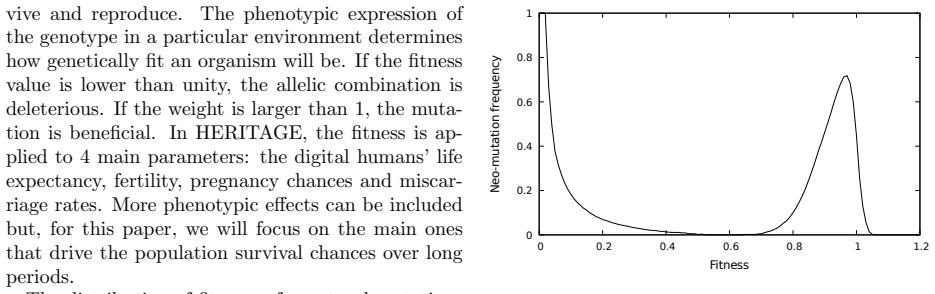
The carrying mechanism is the agent-based Monte Carlo model HERITAGE, which represents each digital human as 46 chromosomes with 2,110 loci, ten normal allelic states, and an eleventh state reserved for radiation-induced neo-mutations. A user-supplied chromosome map marks which loci act on the four phenotypes, and each new allelic combination receives a fitness weight: spontaneous mutations draw from a Gaussian distribution centered at 1 with width 0.025, while neo-mutations draw from a bimodal distribution biased toward harmful and lethal effects. The rate of neo-mutations per year is given by $N_i = \exp(-13.5924 + 0.6931\, R_i) \times 2 \times G$, with $R_i$ the accumulated dose in sieverts and $G = 54{,}083$ the gene count, so the mutation count doubles per sievert and grows exponentially with dose. Multiplying the four phenotype fitnesses together and applying them to each individual's baseline biology is how radiation exposure becomes natural selection in the code.
What would settle it
Recompute the annual neo-mutation count from the paper's own sources: with the spontaneous rate of $1.25 \times 10^{-6}$ per gene per generation, $54{,}083$ genes, and the diploid factor of 2, the expected number of radiation-induced mutations per year at 1 Sv should match the stated 0.27 mutations per genome per Sv; if the corrected per-year rate is far lower, re-running the extreme-background, nuclear-incident, and supernova scenarios with that corrected rate would show whether the predicted population collapses persist.
Extended reading notes
Core claim
The central discovery claimed is that natural selection, entering indirectly through phenotype, does not reshape the genetic structure of a large generation-ship population as long as shielding keeps radiation near terrestrial background. Over a 600-year voyage at 2.4 mSv per year, genome diversity, polymorphism, heterozygosity, and Nei's genetic distance remain essentially unchanged, which the authors read as consistency with the neutral hypothesis. When radiation climbs, the eleventh allelic state introduced for neo-mutations spreads across the genome: the extreme-background run ends with 8.97% genome diversity and 100% polymorphism, a Nei distance of 0.23% that the authors compare to subspecies-level differentiation, and a population they judge likely to die out within centuries or a millennium without new genetic input or lower radiation. A one-year nuclear incident at year 200 nearly extinguishes the crew, which takes about 75 years to recover, while a supernova at 50 light-years deposits most of its dose so late that its genetic effects remain small by the end of the simulation.
Load-bearing premise
The load-bearing premise is that the Section 2.3 formula correctly counts how many radiation-caused mutations appear each year, even though it applies a per-generation mutation rate as a yearly rate and grows the mutation count exponentially with accumulated dose.
Editorial extensions
If this is right
- A starting crew of about 500 under Earth-like background radiation can keep allele frequencies on non-sex chromosomes stable for 600 years, so genetic drift alone is not the dominant risk for large generation-ship populations.
- If shielding holds at 2.4 mSv per year, infertility, miscarriage, and pregnancy rates stay near baseline and the final population is genetically close to the initial one (Nei's distance 0.02%).
- Under a constant 130 mSv per year radiation field, neo-mutations accumulate across generations, reproductive health degrades, and the authors conclude the population is likely to die out within centuries without intervention.
- A single Chernobyl-scale nuclear incident during the voyage can nearly extinguish the crew and leave elevated infertility and miscarriage rates echoing for the remaining centuries.
- A supernova 50 light-years away does not strongly alter the genome within the 600-year window because its radiation arrives late, but the authors note longer simulations would be needed to find the lethal distance.
Reading between the lines
- If the neo-mutation rate law were recalibrated to a true per-generation rate rather than a per-year rate, the qualitative ranking of scenarios might survive while the quantitative severity of the extreme and incident scenarios could be much milder; a direct re-run with corrected calibration would settle this.
- The paper's sharp contrast between shielded and unshielded cases implies that radiation shielding should be treated as the primary genetic-risk control in generation-ship design, ahead of crew size and starting genetic diversity choices.
- The same chromosome-map machinery could be applied to long-duration lunar or Martian habitats, where radiation doses exceed Earth background but remain below deep-space levels, to identify when shielding requirements become binding.
- Because the fitness distributions are user-configurable, the paper's qualitative conclusions could be stress-tested against empirically measured distributions of fitness effects from human disease databases and conservation genetics rather than the idealized Gaussian and bimodal curves used here.
Editorial analysis
A structured set of objections, weighed in public.
Referee Report
Summary. This paper relaxes the neutral-mutation assumption in the HERITAGE agent-based Monte Carlo code by assigning fitness weights to new allelic combinations and applying those weights to life expectancy, fertility, pregnancy chances, and miscarriage rates. It then simulates a 600-year interstellar voyage with an initial crew of 500 under five radiation scenarios: terrestrial background, extreme background, progressive shield degradation, a Chernobyl-like nuclear incident, and a supernova at 50 light-years. The authors report that with adequate shielding the population-genetic indicators remain close to the neutral expectation, while shielding failure produces large increases in heterozygosity, polymorphism, and Nei's genetic distance, leading them to conclude that unshielded cosmic radiation is the dominant genetic threat on generation ships.
Significance. The topic is timely and important: understanding the genetic fate of a multi-generational crew is central to realistic generation-ship mission design. The paper's strength is its breadth—five distinct radiation scenarios, explicit coupling of dosimetry to demography, and a modular code structure that invites parameter changes. If the quantitative results were reliable, they would provide a strong argument that radiation shielding, not genetic drift, is the limiting factor for large crews. However, the quantitative predictions are not currently reliable: the neo-mutation rate law in Section 2.3 contains a unit/dimensional error that inflates mutation counts dramatically in the high-dose scenarios, and some qualitative conclusions (e.g., that selection acts on phenotype) are partly encoded in the model rather than emergent. The code is not released with the manuscript, so the simulations are not independently reproducible from the paper alone. With a corrected mutation-rate model and appropriately reframed claims, the framework could be a useful planning tool.
major comments (3)
- [Section 2.3, neo-mutation rate equation] The formula Ni = exp(-13.5924 + 0.6931 * Ri) * 2 * G has two related dimensional problems. First, the calibration constant is derived from m = 1.25e-6 per gene per generation, but Ni is stated as a per-year rate; this overestimates the spontaneous mutation contribution by roughly the generation time. Second, Ri is the accumulated radiation dose, so under a constant annual dose rate d the predicted rate becomes Ni = 0.135 * 2^(d*t), which grows exponentially with time even when the radiation environment is unchanged. A mutation rate per year should depend on dose rate (or on the dose received in the current year), not on the lifetime accumulated dose. Because Ni enters every genome scan and every reproduction event, the population-level outputs in Table 1 (e.g., Hf = 15.01% and Pf = 100% in the extreme-background scenario) are inflated by this error, and the quantitative ranking of scenarios is unreliable. The authors need to replace this law with a biologically defensible dose-rate formulation and rerun all scenarios before the specific numbers can be taken as predictions.
- [Section 4.1 and Abstract] The central claim that 'for large starting crews (about 500 individuals), the effect aligns with the neutral hypothesis' is not supported by the experiments reported in this paper. Only a single initial crew size (500) is simulated; there is no comparison with smaller crews or a scan over crew sizes. The phrase 'about 500 individuals' and the inference that '500 or more' behaves neutrally therefore go beyond the evidence presented. This claim should either be restricted to the simulated configuration or be backed by additional simulations that vary the initial population size.
- [Section 2.2] The model assigns fitness weights to new allelic combinations and then multiplies the resulting 'genetic fitness' directly into life expectancy, fertility, pregnancy chances, and miscarriage rates. Since these four quantities are the very traits that determine survival and reproduction, the observation that natural selection affects the genetic structure of the simulated population is a direct consequence of the model construction rather than an emergent result of the simulation. The paper should be framed accordingly: the simulations illustrate the consequences of the assumed fitness landscape, but they do not independently demonstrate that natural selection would act in this way on a real generation ship. The agreement with conservation-biology studies should be presented as a design choice of the model, not as an empirical validation.
minor comments (5)
- [Section 2.3] Please define precisely how Ri is accumulated (from birth? from mission start?) and how the annual dose rates shown in the figure panels are converted into Ri for each individual. Without this, the reader cannot reproduce the mutation counts.
- [Section 3.4] The text says the Chang'E 4 LND experiment provides a 'nearby Earth' radiation rate, but the measurement was taken on the lunar surface; please rephrase to avoid the geographical inaccuracy.
- [Figures 2-6, panels (f)] The panels labeled 'Individual heterozygosity among the crew' appear to combine two different quantities (heterozygosity and inbreeding coefficient) on twin y-axes, but the figure captions do not identify which curve corresponds to which scale. Add an explicit legend or separate panels.
- [Throughout] There are several typos that should be corrected: Section 3.1 'have be thoroughly tested' should be 'have been thoroughly tested'; Section 4.4 'smiluation' should be 'simulation'; Section 5 'abord' should be 'aboard', 'articial' should be 'artificial', and 'beend' should be 'been'; the Acknowledgment 'gratful' should be 'grateful'.
- [Section 2.3 and 2.4] The new '11th allelic state' is described as a single value (allele 10) for all radiation-induced mutations at a locus. Please clarify whether all neo-mutations at a given locus are treated as identical by state, and discuss how this simplification affects heterozygosity and polymorphism estimates, since real mutations are generally sequence-specific.
Circularity Check
No significant circularity: the scenario results are emergent from externally calibrated model inputs, and the qualitative selection statement is a modeling frame rather than a fitted prediction.
full rationale
This paper's derivation chain is self-contained rather than circular. The fitness-weighting in Section 2.2 is an explicit modeling assumption: new allelic combinations receive Gaussian-distributed fitness weights that are multiplied into life expectancy, fertility, pregnancy, and miscarriage rates. The abstract's statement that 'natural selection indirectly affects the genetic structure' is a description of what the model does, not an empirical output fitted to the scenario results; the quantitative outcomes in Table 1 (heterozygosity, polymorphism, Nei distance) are emergent from the population dynamics and are not used as calibration targets. The neo-mutation law in Section 2.3 is anchored to external literature values (m = 1.25e-6 per gene per generation; 0.27 events per genome after 1 Sv; doubling per Sv), and the scenario-specific predictions such as 100% polymorphism under extreme background follow from integrating that law over the assumed dose histories rather than from fitting the law to those predicted values. The self-citations to HERITAGE's earlier papers document the baseline code and crew parameters; the phenotypic upgrade and the five radiation scenarios are new and compared against external data (Chernobyl dosimetry, Voyager/Chang'E-4 radiation measurements, supernova spectra), so no load-bearing claim rests on an unverified self-citation. The per-year interpretation of a per-generation-derived constant and the use of accumulated dose in the exponential are genuine correctness risks, not circularity: the prediction is not used to construct the input law. Hence no circular step can be exhibited, and the appropriate score is 1.
Assumptions & free parameters
free parameters (5)
- Gaussian fitness effect width (sigma) =
0.025 (default)
- Fraction of phenotypically active loci =
3.5%
- Neo-mutation baseline constant =
0.135 neo-mutations per year
- Dose doubling constant =
0.6931 per Sv
- Radiation scenario levels =
2.4 and 130 mSv/yr, 0.01%/yr degradation, 4.12 Sv initial for nuclear incident
assumptions (6)
- domain assumption All allelic combinations present in the starting population have neutral fitness 1; any new combination receives a Gaussian fitness weight centered at 1.
- domain assumption Fitness weights multiply across the four phenotypes (life expectancy, fertility, pregnancy, miscarriage) for each individual.
- ad hoc to paper Neo-mutation count per year follows Ni = exp(-13.5924 + 0.6931*Ri) * 2 * 54083, doubling per Sv of accumulated dose.
- domain assumption Neo-mutation fitness follows a bimodal distribution with a lethal tail, per Masel (2013), with parameters not specified.
- standard math Supernova cosmic ray injection and diffusion follow standard power-law and diffusion equations with chosen values alpha = 2.7 and delta = 0.5.
- domain assumption Radiation dose to organisms is computed with Semyonov's conversion and quality factor Q = 10.
invented entities (1)
-
Allele 10 (11th allelic state)
Cite this review
Pith. "Pith review of Genetic evolution of a multi-generational population in the context of interstellar space travels -- Part II: Phenotypic effects of gene expression." pith.science (2026). https://pith.science/paper/ZZHTN2PE
@misc{pith2026250207559,
  author       = {Pith},
  title        = {Pith review of: Genetic evolution of a multi-generational population in the context of interstellar space travels -- Part II: Phenotypic effects of gene expression},
  year         = {2026},
  howpublished = {\url{https://pith.science/paper/ZZHTN2PE}},
  note         = {Machine review of arXiv:2502.07559}
}
read the original abstract
In the first paper of this series, we included the effects of population genetics in the agent-based Monte Carlo code HERITAGE under the hypothesis of neutral phenotypic effects. It implied that mutations (genetic changes) had only neutral physical manifestations. We now relax this assumption by including genetic effects of mutation and neo-mutations (from radiations) onto the population's life expectancy, fertility, pregnancy chances and miscarriage rates. When applied to a population aboard a generation ship that travels at sub-light speed towards a distant exoplanet, we demonstrate that natural selection indirectly affects the genetic structure of a population via the contribution of phenotypes, in agreement with past studies in conservation biology. For large starting crews (about 500 individuals), the effect aligns with the neutral hypothesis and the frequency of alleles (for non-sexual chromosomes) is stable over centuries. Results are completely different if the spacecraft shielding, integrated into hull design, fails to efficiently protect the crew from high-energy cosmic rays and showers of secondary particles. We tested different scenarios, in which the level of radiation is either fixed at normal or extreme levels, or changing over time due to, e.g., shield degradation, on-board nuclear incident or the outburst of a supernova situated 50 light-years away.
Figures


Figures from the paper (3 more)


Reference graph
Works this paper leans on
-
[1]
Toward the Stars: Technological, Ethical, and Sociopolitical Dimensions of Interstellar Exploration
F. Neukart, Toward the Stars: Technologi- cal, Ethical, and Sociopolitical Dimensions of 17 Interstellar Exploration, arXiv e-prints (2024) arXiv:2402.15536arXiv:2402.15536, doi:10. 48550/arXiv.2402.15536
work page Pith review arXiv doi:10.48550/arxiv.2402.15536 2024
-
[2]
F. Marin, C. Beluffi, F. Fischer, Genetic Evolu- tion Of A Multi-Generational Population In The Context Of Interstellar Space Travel, Journal of the British Interplanetary Society 74 (2021) pp.162–184. arXiv:2102.01508
work page Pith review arXiv 2021
-
[3]
S. J. Chancellor JC, Scott GB, Space Radiation: The Number One Risk to Astronaut Health be- yond Low Earth Orbit, Life (Basel) 4 (2014) 491–510. doi:10.3390/life4030491
-
[4]
P. Bradbury, H. Wu, J. U. Choi, A. E. Rowan, H. Zhang, K. Poole, J. Lauko, J. Chou, Mod- eling the Impact of Microgravity at the Cel- lular Level: Implications for Human Disease, Front. Cell Dev. Biol. 8 (2020) 96.doi:10.3389/ fcell.2020.00096
arXiv 2020
- [5]
-
[6]
N. Kanas, Humans in Space: The Psychological Hurdles, Springer Praxis Books, Springer Inter- national Publishing, 2015. URL https://books.google.fr/books?id= 15BargEACAAJ
work page 2015
-
[7]
C. M. Smith, Estimation of a genetically vi- able population for multigenerational interstel- lar voyaging: Review and data for project Hy- perion, Acta Astronautica 97 (2014) 16–29. doi: 10.1016/j.actaastro.2013.12.013
-
[8]
URL https://www.ncbi.nlm.nih.gov/books/ NBK218706/
National Research Council (US) Committee on the Biological Effects of Ionizing Radiation (BEIR V), Genetic Effects of Radiation, Health Effects of Exposure to Low Levels of Ionizing Ra- diation, National Academies Press (US), 1990. URL https://www.ncbi.nlm.nih.gov/books/ NBK218706/
work page 1990
Show all 54 references
-
[9]
S. N. Archer, C. M¨ oller-Levet, M. ´Angeles Bonmat ´ ı-Carri´ on, E. E. Laing, D.-J. Dijk, Extensive dynamic changes in the hu- man transcriptome and its circadian or- ganization during prolonged bed rest, iScience 27 (3) (2024) 109331. doi:https: //doi.org/10.1016/j.isci.202...
2024
-
[10]
D. N. Cooper, Regulatory mutations and human genetic disease, Annals of Medicine 24 (6) (1992) 427–437. arXiv:https: //doi.org/10.3109/07853899209166991, doi:10.3109/07853899209166991. URL https://doi.org/10.3109/ 07853899209166991
1992 doi
-
[11]
Girirajan, E
S. Girirajan, E. E. Eichler, Phenotypic variabil- ity and genetic susceptibility to genomic disor- ders, Human Molecular Genetics 19 (R2) (2010) R176–R187. arXiv:https://academic.oup. com/hmg/article-pdf/19/R2/R176/1790931/ ddq366.pdf, doi:10.1093/hmg/ddq366. URL https://doi.o...
2010 doi
-
[12]
Pagnamenta, C
A. Pagnamenta, C. Camps, E. Giacopuzzi, et al., Structural and non-coding variants in- crease the diagnostic yield of clinical whole genome sequencing for rare diseases, Genome Med 15 (94). doi:https://doi.org/10.1186/ s13073-023-01240-0
-
[13]
F. Marin, HERITAGE: A Monte Carlo code to evaluate the viability of interstellar travels using a multi-generational crew, Journal of the British Interplanetary Society 70 (2017) 184–195
2017
-
[14]
Marin, C
F. Marin, C. Beluffi, Computing the Minimal Crew for a multi-generational space journey to- wards Proxima b, Journal of the British In- terplanetary Society 71 (2018) 45–52. arXiv: 1806.03856
2018 arXiv
-
[15]
Marin, C
F. Marin, C. Beluffi, R. Taylor, L. Grau, Numer- ical constraints on the size of generation ships from total energy expenditure on board, annual food production and space farming techniques, Journal of the British Interplanetary Society 71 (2018) 382–393. arXiv:1901.09542. 18
2018 arXiv
-
[16]
J. H. Gillespie, Population genetics: a concise guide, JHU press, 2004
2004
-
[17]
Bu¨ rger, A
R. Bu¨ rger, A. Gimelfarb, Fluctuating envi- ronments and the role of mutation in main- taining quantitative genetic variation, Geneti- cal research 80 (2002) 31–46. doi:10.1017/ S0016672302005682
2002
-
[18]
Martin, T
G. Martin, T. Lenormand, C. Goodnight, The fitness effect of mutations across environments: A survey in light of fitness landscape models, Evolution 60. doi:10.1554/06-162.1
-
[19]
Tenaillon, O
O. Tenaillon, O. Silander, J.-P. Uzan, L. Chao, Quantifying organismal complexity using a pop- ulation genetic approach, PloS one 2 (2007) e217. doi:10.1371/journal.pone.0000217
2007 doi
-
[20]
Bataillon, S
T. Bataillon, S. Bailey, Effects of new mutations on fitness: Insights from models and data, An- nals of the New York Academy of Sciences 1320. doi:10.1111/nyas.12460
-
[21]
Masel, Q&a: Evolutionary capacitance, BMC biology 11 (2013) 103
J. Masel, Q&a: Evolutionary capacitance, BMC biology 11 (2013) 103. doi:10.1186/ 1741-7007-11-103
2013
-
[22]
A. L. Ogilvy-Stuart, S. M. Shalet, Effect of radi- ation on the human reproductive system, Envi- ronmental Health Perspectives 101 (1993) 109– 116
1993
-
[23]
R. K. Sachs, D. J. Brenner, Solid tumor risks after high doses of ionizing radiation, Pro- ceedings of the National Academy of Sciences 102 (37) (2005) 13040–13045. doi:10.1073/ pnas.0506648102
2005
-
[24]
Imaoka, M
T. Imaoka, M. Nishimura, D. Iizuka, K. Daino, T. Takabatake, M. Okamoto, S. Kakinuma, Y. Shimada, Radiation-induced mammary car- cinogenesis in rodent models: what’s different from chemical carcinogenesis?, Journal of radia- tion research 50 (4) (2009) 281–293
2009
-
[25]
of Medicine, Radiation in Medicine: A Need for Regulatory Reform, The National Academies Press, Washington, DC, 1996
I. of Medicine, Radiation in Medicine: A Need for Regulatory Reform, The National Academies Press, Washington, DC, 1996. doi:10.17226/ 5154
1996
-
[26]
P. B. Roberts, Radiation in relation to mutation rate, mutational damage and human ill-health, Institute of nuclear sciences
-
[27]
F. Cucinotta, Calculation of Heavy Ion Inactiva- tion and Mutation Rates in Radial Dose Model of Track Structure, NASA technical paper, Na- tional Aeronautics and Space Administration, Langley Research Center, 1997
1997
-
[28]
Nakamura, A
N. Nakamura, A. Suyama, A. Noda, Y. Ko- dama, Radiation effects on human heredity, Annual review of genetics 47. doi:10.1146/ annurev-genet-111212-133501
-
[29]
N. R. Council, Effects on Populations of Expo- sure to Low Levels of Ionizing Radiation, The National Academies Press, Washington, DC,
-
[30]
Heller, Relativistic generalization of the incentive trap of interstellar travel with ap- plication to Breakthrough Starshot, MNRAS 470 (3) (2017) 3664–3671
R. Heller, Relativistic generalization of the incentive trap of interstellar travel with ap- plication to Breakthrough Starshot, MNRAS 470 (3) (2017) 3664–3671. doi:10.1093/mnras/ stx1493
2017 doi
-
[31]
1000 Genomes Project Consortium, A global ref- erence for human genetic variation, Nature 526 (2015) 68
2015
-
[32]
Zorrilla, A
M. Zorrilla, A. Yatsenko, The genetics of in- fertility: Current status of the field, Cur- rent genetic medicine reports 1. doi:10.1007/ s40142-013-0027-1
-
[33]
ICRP, Recommendations of the international commission on radiological protection, Interna- tional Commission on Radiological Protection 21 (1991) 1–3
1991
-
[34]
NCRPM, Limitation of exposure to ionizing ra- diation, National Council on Radiation Protec- tion and Measurements
-
[35]
G. H. Anno, R. W. Young, R. M. Bloom, J. R. Mercier, Dose response re- lationships for acute ionizing-radiation lethality, Health Phys. 84 (2003) 565. doi:10.1097/00004032-200305000-00001. 19
2003 doi
-
[36]
U. N. S. Committee, Sources and effects of ioniz- ing radiation, New York: United Nations, 2010
2010
-
[37]
Hendry, S
J. Hendry, S. Simon, A. Wojcik, M. Sohrabi, W. Burkart, E. Cardis, D. Laurier, M. Tir- marche, I. Hayata, Human exposure to high nat- ural background radiation: What can it teach us about radiation risks?, Journal of radiolog- ical protection : official journal of the Society ...
2009 doi
-
[38]
Ghiassi-Nejad, S
M. Ghiassi-Nejad, S. M. J. Mortazavi, J. Cameron, A. Niroomand-Rad, P. Karam, Very high background radiation areas of ramsar, iran: Preliminary biological studies, Health physics 82 (2002) 87–93. doi:10.1097/00004032-200201000-00011
2002 doi
-
[39]
A. C. Cummings, E. C. Stone, B. C. Heikkila, N. Lal, W. R. Webber, G. J´ ohannesson, I. V. Moskalenko, E. Orlando, T. A. Porter, Galactic Cosmic Rays in the Local Interstellar Medium: Voyager 1 Observations and Model Results, As- trophysical Journal 831 (1) (2016) 18. doi: 10....
2016 doi
-
[40]
Z. Quan, R. Wimmer-Schweingruber, S. Kulka- rni, Q. Fu, Z. Zhang, H. Zhang, T. Berger, D. Matthi¨ a, C. Hellweg, X. Hou, J. Cao, First measurements of the radiation dose on the lunar surface, Science Advances 6
-
[41]
Dyson, Project Orion: The True Story of the Atomic Spaceship, Henry Holt and Company, 2003
G. Dyson, Project Orion: The True Story of the Atomic Spaceship, Henry Holt and Company, 2003
2003
-
[42]
Jaworowski, Observations on the chernobyl disaster and lnt, Dose-response : a pub- lication of International Hormesis Society 8 (2010) 148–71
Z. Jaworowski, Observations on the chernobyl disaster and lnt, Dose-response : a pub- lication of International Hormesis Society 8 (2010) 148–71. doi:10.2203/dose-response. 09-029.Jaworowski
2010 doi
-
[43]
J¨ onsson, M
M. J¨ onsson, M. Tondel, M. Isaksson, R. Finck, R. W¨ alinder, A. Mamour, C. R¨ a¨ af, Mod- elling the external radiation exposure from the chernobyl fallout using data from the swedish municipality measurement system, Journal of Environmental Radioactivity 178-179 (2017) 16–2...
2017 doi
-
[44]
Nuclear Energy Agency, Chernobyl: Assess- ment of Radiological and Health Impacts,
-
[45]
Heger, C
A. Heger, C. L. Fryer, S. E. Woosley, N. Langer, D. H. Hartmann, How Massive Single Stars End Their Life, Astrophysical Journal 591 (1) (2003) 288–300. arXiv:astro-ph/0212469, doi:10. 1086/375341
2003 arXiv
- [46]
-
[47]
A. L. Melott, B. C. Thomas, M. Kachelrieß, D. V. Semikoz, A. C. Overholt, A Supernova at 50 pc: Effects on the Earth’s Atmosphere and Biota, Astrophysical Journal 840 (2) (2017) 105. arXiv:1702.04365, doi:10.3847/1538-4357/ aa6c57
2017 arXiv
-
[48]
Gehrels, C
N. Gehrels, C. M. Laird, C. H. Jackman, J. K. Cannizzo, B. J. Mattson, W. Chen, Ozone De- pletion from Nearby Supernovae, Astrophysi- cal Journal 585 (2) (2003) 1169–1176. arXiv: astro-ph/0211361, doi:10.1086/346127
2003 arXiv
-
[49]
B. C. Thomas, A. M. Yelland, Terrestrial Effects of Nearby Supernovae: Updated Modeling, As- trophysical Journal 950 (1) (2023) 41. arXiv: 2301.05757, doi:10.3847/1538-4357/accf8a
2023 arXiv
-
[50]
H. M. L. Perkins, J. Ellis, B. D. Fields, D. H. Hartmann, Z. Liu, G. C. McLaughlin, R. Surman, X. Wang, Could a Kilonova Kill: A Threat Assessment, Astrophysical Journal 961 (2) (2024) 170. arXiv:2310.11627, doi: 10.3847/1538-4357/ad12b7
2024 arXiv
-
[51]
Chakraborty, S
S. Chakraborty, S. Bhattacharjee, Trans- national genetic distance and genetic identity of barak valley hindus en route the journey of 20 mankind from africa for abo gene, Not Sci Biol
-
[52]
J.-H. Cha, S. Kumar Sarath Kumar, J.-E. Noh, J.-S. Choi, Y. Kim, C.-G. Kim, Ultra-high- molecular-weight polyethylene/hydrogen-rich benzoxazine composite with improved inter- laminar shear strength for cosmic radiation shielding and space environment applica- tions, Composite ...
2022
-
[53]
doi:10.15835/nsb336242
- [2003]
Reviewed August 8, 2026 · model on record in the stance chip above.
Discussion (0). Continue with ORCID to comment.