REVIEW 3 major objections 6 minor 90 references
Gamma-ray emission from decays of boosted nuclei in protomagnetar jets
T0 review · 3 major / 6 minor · reviewed 2026-08-08 · deepseek-v4-flash
Pith's one-line read This paper argues that boosted, time-dilated gamma-ray lines from decaying nuclei in protomagnetar jets would be detectable from a Galactic supernova and from on-axis events out to about 35 Mpc.
desk verdict New idea, broken Doppler factor: the claimed tens-of-days line window is actually compressed to about a day for on-axis jets. read the letter →
The pith
A machine-rendered reading of the paper's core claim, the machinery that carries it, and where it could break.
The reading
What carries the argument
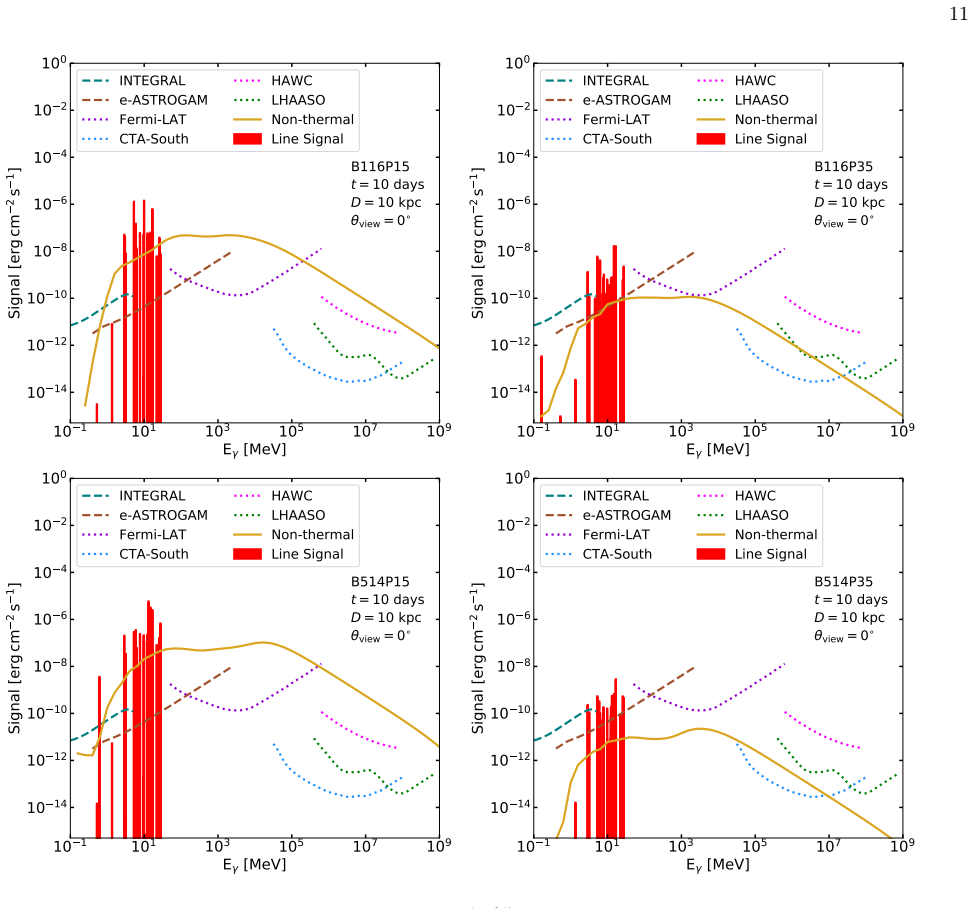
The load-bearing object is the boosted $\beta$-decay line: a nuclear transition with rest-frame energy $E_\gamma$ and half-life $\tau_{1/2}$ seen from a jet with bulk Lorentz factor $\Gamma=10$, so the observed energy is $\delta E_\gamma$ and the observed decay constant is $\Gamma\lambda$. The calculation chains together the protomagnetar wind model for mass loss, temperature, and density; a nuclear reaction network for the abundances; a decay database for half-lives, intensities, and line energies; the jet optical depth for the escape factor $e^{-\tau}$; and the beamed luminosity $L=\delta^3\sum_i (dN_{i,\gamma}/dt)E_{i,\gamma}$. Time dilation is what stretches the signal over tens of days, and the $\delta^3$ beaming is what lets on-axis models be seen at extragalactic distances.
What would settle it
Watch a Galactic core-collapse supernova that shows evidence of an on-axis relativistic jet: if no narrow lines appear at the Doppler-boosted energies of magnesium-28 (about 0.6 MeV), scandium-47 (about 3.2 MeV), zinc-72 (about 2.9 MeV), or krypton-85 (about 3.0 MeV) during the first thirty days at INTEGRAL/SPI or e-ASTROGAM sensitivity, the detectability claim fails. Equivalently, a radiation-transport calculation showing that nuclei with Lorentz factor 10 are photodisintegrated in the jet's photon field before decaying would remove the signal at its source.
Extended reading notes
Core claim
The paper's central claim is that a magnetorotational core-collapse supernova with a jet pointed near our line of sight produces a recognizable, long-lived gamma-ray line signal from the decays of unstable nuclei made inside the jet. Using wind trajectories for four protomagnetar models with dipole fields between $5\times10^{14}$ and $10^{16}$ G and spin periods of 1.5-3.5 ms, the authors compute r-process (rapid-neutron-capture) abundances with a nuclear reaction network, then propagate parent and daughter $\beta$-decay photons through the expanding jet once it becomes optically thin. The observed line energies are Doppler-boosted by a factor of about $\delta\approx20$ for an on-axis jet with $\Gamma=10$, and the decay times are dilated by $\Gamma$, so lines from isotopes such as magnesium-28, scandium-47, zinc-72, and krypton-85 remain above detector sensitivity at 10 kpc for up to tens of days. When 10% of nuclei are accelerated to a nonthermal power law, the decays blend into a continuum that extends to much higher energies and is detectable by ground-based gamma-ray observatories at 10 kpc. The result is a new multimessenger probe: the line spectrum and roughly ten-day light curve carry information about the ejected mass and isotopic yields, which depend on the engine's spin and magnetic field.
Load-bearing premise
The heavy nuclei synthesized in the jet must survive photodisintegration and spallation long enough to decay after the jet becomes transparent; the paper assumes this survival, relying on unpublished work for thermal nuclei and stating the accelerated-nucleus case as an assumption.
Editorial extensions
If this is right
- A Galactic magnetorotational supernova with an on-axis jet would show boosted gamma-ray lines from hundreds of keV to tens of MeV for tens of days, with the fastest-spinning models detectable out to about 35 Mpc.
- Measuring several lines together with the roughly ten-day light curve would break degeneracies between ejected mass, isotope yields, and viewing geometry, constraining the protomagnetar's spin and dipole field.
- Off-axis jets are hard to detect even at the Galactic Center, with critical viewing angles ranging from about 25 to 70 degrees across the four models, so a null detection by itself would not rule out the engine.
- If about 10% of nuclei undergo nonthermal acceleration, a power-law continuum from boosted decays becomes detectable by ground-based gamma-ray observatories at 10 kpc and could extend to water-Cherenkov and air-shower instruments for fast-spinning on-axis models.
- The same decays release roughly $10^{51}$ boosted neutrinos spread over days, potentially giving tens to a hundred events at Hyper-Kamiokande, separated in time from the ordinary ten-second supernova neutrino burst.
Reading between the lines
- Beyond the paper, the same boosted-decay mechanism should apply to any relativistic outflow that synthesizes heavy nuclei; compact binary merger ejecta are mostly subrelativistic, but a relativistic component would inherit the same line boost and time dilation.
- A concrete archival test would be to search past gamma-ray observations of nearby core-collapse supernovae for transient line groups in the 0.1-10 MeV range at the energies predicted by a single Doppler factor, which would appear or not depending on jet orientation and engine parameters.
- If both the line signal and the nonthermal continuum are detected, their ratio would measure the accelerated fraction, turning the signal into a diagnostic of particle acceleration inside protomagnetar jets.
- A null detection in a well-observed nearby event would not cleanly exclude the model, because off-axis geometry, low ejected mass, and nuclei destruction all suppress the signal; the paper leaves that degeneracy open.
Editorial analysis
A structured set of objections, weighed in public.
Referee Report
Summary. The paper proposes that unstable nuclei synthesized in protomagnetar jets can produce detectable gamma-ray line emission, with line energies boosted and decay timescales altered by the jet's bulk Lorentz factor. The authors construct a toy jet model for four protomagnetar parameter sets, compute the optical depth for gamma-ray escape, predict line light curves and spectra, and compare them with INTEGRAL/SPI and e-ASTROGAM sensitivities. They also consider a nonthermal accelerated-nuclei population and predict a continuum extending to very high energies. The headline results are that boosted decay lines are detectable from a 10 kpc Galactic supernova for up to tens of days, and for on-axis jets out to ~35 Mpc.
Significance. If the predictions were correct, this would be a genuinely new multimessenger channel linking r-process nucleosynthesis in protomagnetar jets to gamma-ray line observations, with potentially falsifiable signatures and the ability to discriminate engine parameters. The forward-modeling approach is transparent, the use of published nuclear data and detector sensitivities is careful, and the authors are appropriately explicit about many input choices. However, the central quantitative claim is compromised by an error in the relativistic transformation of decay rates, and the survival of the synthesized nuclei is asserted rather than demonstrated. After correction, the main conclusions regarding the duration and horizon of detectability will likely change substantially.
major comments (3)
- [Eq. (9), Sec. IVA, Abstract] The treatment of relativistic decay rates is inconsistent with special relativity. For an on-axis jet (θ_view = 0), the Doppler factor is δ = 1/[Γ(1−β)] ≈ 2Γ = 20 for Γ = 10, and the observed half-life is τ_obs = τ_rest/δ, i.e., Doppler-compressed, not dilated. Equation (9) defines λ'_i ≡ Γ_bulk λ_i, which makes the decay faster by a factor Γ rather than slower; even ignoring the factor of ~2, the sign is wrong. The abstract and Sec. IVA claim that lines 'can also be seen until later times due to time dilation of the rest-frame half-lives,' but under the standard transformation the favorable isotopes in Table III (rest half-lives 4.6 hours to 8.7 days) would have observed half-lives of order 0.01–0.5 days. Consequently, the predicted line fluxes at t = 10 and 30 days in Figs. 5–7, the 'tens of days' detection window, and the extragalactic horizons quoted in Sec. IVB are not supported. The calculation should be redone with λ_obs = δ λ_rest, and the δ factor should appear consistently in Eq. (11); the detectability at early times after the jet becomes optically thin should be reassessed.
- [Sec. IIIB and Sec. V] The survival of the synthesized nuclei is a precondition for the entire signal, but it is not demonstrated. In Sec. IIIB the statement that 'thermal nuclei are typically not photodisintegrated' is supported only by unpublished work (Ekanger et al. 2025, to be published), and in Sec. V the authors write that 'we must assume nuclei survival' for the nonthermal population, with no quantitative treatment. Since photodisintegration would eliminate the line and continuum signals, the detectability claims should be explicitly conditional on survival; for the nonthermal continuum the results are already labeled an upper limit, but the thermal line signal is presented as a firm prediction despite resting on the same unverified premise. The authors should either provide a published reference with the survival calculation or a self-contained estimate, or clearly frame all predictions as conditional on the survival assumption.
- [Sec. IIC and Sec. VI] The opacity treatment uses a constant κ = 0.1 cm^2 g^-1 taken from Ref. [47], which the authors note was computed for Ye = 0.4 while the jet model uses Ye = 0.45. The optical depth determines the time at which the jet becomes transparent and therefore the peak time and overall normalization of the light curves. The sensitivity of the results to this choice is only discussed qualitatively in Sec. VI ('if the opacity is 1 g^-1 cm^2, for example, the lines are largely unchanged at ten days'). Since the detectability at t ≥ 1 day for the Pi = 1.5 ms models depends on τ falling below unity on that timescale, a quantitative exploration of κ (e.g., 0.01, 0.1, and 1 cm^2 g^-1) should be shown to establish the robustness of the predicted escape times.
minor comments (6)
- [Sec. IVB text near Fig. 5] In the paragraph below Fig. 5, '47S' should be '47Sc' (the table and figures correctly list 47Sc).
- [Sec. VI] The sentence referring to off-axis viewing states 'θview ∼90%'; this should read 'θview ∼90°'.
- [Sec. VI] The phrase '0.1g^{-1} cm^2' in the opacity discussion should be written as '0.1 cm^2 g^{-1}' for consistency with Sec. IIC.
- [Sec. IVA] The text states 'Γbulk = 10 ⇒ δ∼20' but Eq. (9) uses λ' = Γ_bulk λ; the relationship between δ, Γ, and the decay-rate transformation should be stated explicitly and used consistently, since the current inconsistency is central to the main error.
- [Sec. IIIA, Fig. 3] The abundance cutoff Y = 10^-8 is introduced without a sensitivity study; because it directly determines which isotopes appear in Table III, the impact of varying this threshold should be quantified.
- [References] Reference [83] contains a corrupted author string ('Christopher A. aSkyNetnd Pols'); this should be corrected to the proper citation of Hurley, Tout, and Pols.
Circularity Check
Core detectability is a forward model, but the survival of synthesized nuclei — a necessary premise for every predicted line — rests solely on an unpublished self-citation.
-
self citation load bearing
[Sec. IIIB (Survival of heavy nuclei); also Sec. V (Nonthermal Nuclei)]
"Thermal nuclei are typically not photodisintegrated regardless of whether the ambient photon field is thermal or nonthermal [Ekanger et al. 2025 (to be published)]. ... In this case, we must assume nuclei survival, which can occur if photons are also nonthermal, but we do not investigate the process in detail in this work."
The entire gamma-ray line signal requires that synthesized nuclei survive photodisintegration while traveling through the jet; if they are destroyed, the predicted lines, light curves, and detection horizons vanish. The only support offered for this necessary premise is an unpublished manuscript by the same group ('Ekanger et al. 2025 (to be published)'), and the paper explicitly declines to model or verify the process. The claim is therefore not derived from the present equations and not independently checkable; it is imported from an in-preparation self-citation whose assumptions are not stated. This is load-bearing because every thermal line flux in Sec. IV, the light curves in Fig. 4, and the distance horizons in Sec. IVB presuppose survival. The other main input, Ref.
full rationale
The derivation of the gamma-ray signals is a genuine forward model: abundances from the published nucleosynthesis calculation of Ref. [44] are combined with NUDAT decay data, a specified jet geometry, optical depth, and detector sensitivities to produce line fluxes and light curves. No parameter is fitted to the gamma-ray observations being predicted, and the detection claims do not reduce to the inputs by definition. The one load-bearing support gap that resembles circularity is the survival of nuclei: the paper asserts, on the basis of an unpublished same-group manuscript, that thermal nuclei are not photodisintegrated, and then states that for the nonthermal case survival 'must be assumed' and is not investigated. Because every predicted signal presupposes survival, this self-citation is material rather than cosmetic. Separately, the manuscript contains an internal inconsistency between its stated 'time dilation' and Eq. (9)'s λ' = Γλ, which would compress rather than dilate half-lives; that is a serious correctness risk, but it is not a circularity and does not affect this score.
Assumptions & free parameters
free parameters (9)
- Electron fraction Y_e =
0.45
- Bulk Lorentz factor Gamma_bulk =
10
- Gamma-ray opacity kappa =
0.1 cm^2 g^-1
- Jet opening angle theta_op =
1/Gamma_bulk
- Abundance cutoff =
Y = 10^-8
- Thermal fraction f =
0.9
- Nonthermal spectral index =
-2
- CSM constant density =
10^-25 g cm^-3
- Pre-SN mass-loss parameters =
D* = 1, R* = 10^13 cm (IIn); D* = 10^-5, R* = 3 x 10^11 cm (Ibc)
assumptions (9)
- standard math Standard radioactive decay chain equations for parent and daughter, with time-dilated constants lambda' = Gamma * lambda (Eq. 9).
- domain assumption Protomagnetar wind and jet model of Refs. [29] and [44], with neutrino light curves from Ref. [46].
- domain assumption The jet is a uniform-density conical sector between R_bo and R_E,max with a constant velocity and Lorentz factor.
- domain assumption Initial composition is NSE at Y_e = 0.45; reaction rates from REACLIB via SkyNet.
- ad hoc to paper Thermal nuclei survive photodisintegration in the jet; accelerated nuclei survival is assumed.
- domain assumption Opacity is constant at 0.1 cm^2 g^-1 and there is no photon downscattering after the jet becomes optically thin.
- domain assumption At each decay, only first-generation beta-plus/minus gamma rays and daughter gamma rays are included; isomeric transitions are ignored.
- domain assumption The afterglow begins when the swept-up CSM mass equals the jet mass.
- ad hoc to paper Nonthermal accelerated nuclei follow dN/dGamma proportional to Gamma^-2 exp(-Gamma/Gamma_max).
Cite this review
Pith. "Pith review of Gamma-ray emission from decays of boosted nuclei in protomagnetar jets." pith.science (2026). https://pith.science/paper/J4KMR2A6
@misc{pith2026250207888,
  author       = {Pith},
  title        = {Pith review of: Gamma-ray emission from decays of boosted nuclei in protomagnetar jets},
  year         = {2026},
  howpublished = {\url{https://pith.science/paper/J4KMR2A6}},
  note         = {Machine review of arXiv:2502.07888}
}
abstract
We examine the detectability of $\gamma$-ray emission originating from the radioactive decays of unstable nuclei that are synthesized in relativistic outflows launched in magnetorotational core-collapse supernovae. The observed lines have enhanced energies due to the Lorentz boosted nuclei and can also be seen until later times due to time dilation of the rest-frame half-lives. We find that instruments like \textit{e-ASTROGAM} and \textit{INTEGRAL/SPI} are sensitive to these boosted line emissions from hundreds of keV to tens of MeV at a distance of 10 kpc over timescales of tens of days. For favorable viewing angles, these decays can be detected to extragalactic distances for rapidly spinning protomagnetar models. On the other hand, detection for off-axis jets is challenging, even for a supernova at the Galactic Center. Measuring multiple decay lines in addition to the integrated luminosity over $\sim10$ days postbounce would allow for the ability to distinguish between models and shed light on central engine properties like magnetic field and spin.
Figures


Figures from the paper (5 more)


Reference graph
Works this paper leans on
-
[44]
N. Ekanger, M. Bhattacharya, and S. Horiuchi, System- atic exploration of heavy element nucleosynthesis in pro- tomagnetar outflows, Mon. Not. R. Astron. Soc.513, 405 (2022), arXiv:2201.03576 [astro-ph.HE]
arXiv 2022
-
[47]
M.-H. Chen, L.-X. Li, D.-B. Lin, and E.-W. Liang, Gamma-ray emission produced by r-process elements from neutron star mergers, Astrophys. J.919, 59 (2021), arXiv:2107.02982 [astro-ph.HE]
arXiv 2021
-
[1]
R. C. Duncan and C. Thompson, Formation of very strongly magnetized neutron stars: Implications for gamma-ray bursts, Astrophys. J. Lett.392, L9 (1992)
1992
-
[2]
V. V. Usov, Millisecond pulsars with extremely strong magnetic fields as a cosmological source ofγ-ray bursts, Nature357, 472 (1992)
1992
-
[3]
B. Zhang and P. Mészáros, Gamma-ray burst afterglow with continuous energy injection: Signature of a highly magnetized millisecond pulsar, Astrophys. J. Lett.552, L35 (2001), arXiv:astro-ph/0011133
arXiv 2001
-
[4]
R. Marguttiet al., The signature of the central engine in theweakestrelativisticexplosions: GRB100316D,Astro- phys. J.778, 18 (2013), arXiv:1308.1687 [astro-ph.HE]
arXiv 2013
- [5]
-
[6]
R. Marguttiet al., Relativistic supernovae have shorter- lived central engines or more extended progenitors: The case of SN 2012ap, Astrophys. J.797, 107 (2014), arXiv:1402.6344 [astro-ph.HE]
arXiv 2014
Show all 90 references
-
[7]
Kashiyama, K
K. Kashiyama, K. Murase, I. Bartos, K. Kiuchi, and R.Margutti,Multi-messengertestsforfast-spinningnew- born pulsars embedded in stripped-envelope supernovae, Astrophys. J.818, 94 (2016), arXiv:1508.04393 [astro- ph.HE]
2016 arXiv
-
[8]
Arons, Magnetars in the metagalaxy: An origin for ultrahigh-energy cosmic rays in the nearby universe, As- trophys
J. Arons, Magnetars in the metagalaxy: An origin for ultrahigh-energy cosmic rays in the nearby universe, As- trophys. J.589, 871 (2003), arXiv:astro-ph/0208444
2003 arXiv
-
[9]
Kotera, Ultrahigh energy cosmic ray acceleration in newly born magnetars and their associated gravita- tional wave signatures, Phys
K. Kotera, Ultrahigh energy cosmic ray acceleration in newly born magnetars and their associated gravita- tional wave signatures, Phys. Rev. D84, 023002 (2011), arXiv:1106.3060 [astro-ph.HE]
2011 arXiv
-
[10]
Murase and J
K. Murase and J. F. Beacom, Neutrino background flux from sources of ultrahigh-energy cosmic-ray nuclei, Phys. Rev. D81, 123001 (2010), arXiv:1003.4959 [astro- ph.HE]
2010 arXiv
-
[11]
Murase, B
K. Murase, B. Dasgupta, and T. A. Thompson, Qu- asithermal neutrinos from rotating protoneutron stars born during core collapse of massive stars, Phys. Rev. D89, 043012 (2014), arXiv:1303.2612 [astro-ph.HE]
2014 arXiv
-
[13]
Bhattacharya, J
M. Bhattacharya, J. A. Carpio, K. Murase, and S. Hori- uchi, High-energy neutrino emission from magnetised jets of rapidlyrotating protomagnetars, Mon.Not. R. Astron. Soc.521, 2391 (2023), arXiv:2210.08029 [astro-ph.HE]
2023 arXiv
-
[14]
J. A. Carpio, N. Ekanger, M. Bhattacharya, K. Murase, and S. Horiuchi, Quasithermal GeV neutrinos from neutron-loaded magnetized outflows in core-collapse su- pernovae: Spectra and light curves, Phys. Rev. D110, 083012 (2024), arXiv:2310.16823 [astro-ph.HE]
2024 arXiv
-
[15]
Nishimura, T
N. Nishimura, T. Takiwaki, and F. K. Thielemann, The r-process nucleosynthesis in the various jet-like explo- sions of magnetorotational core-collapse supernovae, As- trophys. J.810, 109 (2015), arXiv:1501.06567 [astro- ph.SR]
2015 arXiv
-
[16]
Halevi and P
G. Halevi and P. Mösta,r-Process nucleosynthesis from three-dimensional jet-driven core-collapse super- novae with magnetic misalignments, Mon. Not. R. As- tron. Soc.477, 2366 (2018), arXiv:1801.08943 [astro- ph.HE]
2018 arXiv
-
[17]
Mösta, L
P. Mösta, L. F. Roberts, G. Halevi, C. D. Ott, J. Lip- puner, R. Haas, and E. Schnetter, r-process nucleosyn- thesis from three-dimensional magnetorotational core- collapse supernovae, Astrophys. J.864, 171 (2018), arXiv:1712.09370 [astro-ph.HE]
2018 arXiv
-
[18]
Reichert, M
M. Reichert, M. Bugli, J. Guilet, M. Obergaulinger, M. A. Aloy, and A. Arcones, Nucleosynthesis in mag- netorotational supernovae: Impact of the magnetic field configuration, Mon. Not. R. Astron. Soc.529, 3197 (2024), arXiv:2401.14402 [astro-ph.HE]
2024 arXiv
-
[19]
W. D. Arnett, Type I supernovae. I - analytic solutions for the early part of the light curve, Astrophys. J.253, 785 (1982)
1982
-
[20]
Hamuy, Observed and physical properties of core- collapse supernovae, Astrophys
M. Hamuy, Observed and physical properties of core- collapse supernovae, Astrophys. J.582, 905 (2003), arXiv:astro-ph/0209174
2003 arXiv
-
[21]
Sawada and Y
R. Sawada and Y. Suwa, Updating the 56Ni prob- lem in core-collapse supernova explosion (2023), arXiv:2301.03610 [astro-ph.HE]
2023 arXiv
-
[22]
Anandet al., Collapsars as sites of r-process nucleosyn- thesis: Systematic photometric near-infrared follow-up of type Ic-BL supernovae, Astrophys
S. Anandet al., Collapsars as sites of r-process nucleosyn- thesis: Systematic photometric near-infrared follow-up of type Ic-BL supernovae, Astrophys. J.962, 68 (2024), arXiv:2302.09226 [astro-ph.HE]
2024 arXiv
-
[23]
Astron.8, 774 (2024), arXiv:2308.14197 [astro- ph.HE]
P.K.Blanchardet al.,JWSTdetectionofasupernovaas- sociated with GRB 221009A without an r-process signa- ture, Nat. Astron.8, 774 (2024), arXiv:2308.14197 [astro- ph.HE]
2024 arXiv
-
[24]
J. C. Rastinejadet al., A Hubble Space Telescope search for r-process nucleosynthesis in gamma-ray burst super- novae, Astrophys. J.968, 14 (2024), arXiv:2312.04630 [astro-ph.HE]
2024 arXiv
-
[25]
Côtéet al., The origin of r-process elements in the Milky Way, Astrophys
B. Côtéet al., The origin of r-process elements in the Milky Way, Astrophys. J.855, 99 (2018), arXiv:1710.05875 [astro-ph.GA]
2018 arXiv
-
[26]
Hotokezaka, P
K. Hotokezaka, P. Beniamini, and T. Piran, Neutron star mergers as sites of r-process nucleosynthesis and short gamma-ray bursts, Int. J. Mod. Phys. D27, 1842005 (2018), arXiv:1801.01141 [astro-ph.HE]
2018 arXiv
-
[27]
Kobayashi, A
C. Kobayashi, A. I. Karakas, and M. Lugaro, The origin of elements from carbon to uranium, Astrophys. J.900, 179 (2020), arXiv:2008.04660 [astro-ph.GA]
2020 arXiv
-
[28]
Y. Z. Qian and S. E. Woosley, Nucleosynthesis in neu- trino driven winds: 1. The physical conditions, Astro- phys. J.471, 331 (1996), arXiv:astro-ph/9611094
1996 arXiv
-
[29]
B. D. Metzger, D. Giannios, T. A. Thompson, N. Buc- ciantini, and E. Quataert, The proto-magnetar model for gamma-ray bursts, Mon. Not. R. Astron. Soc.413, 2031 (2011), arXiv:1012.0001 [astro-ph.HE]
2011 arXiv
-
[30]
E. V. Derishev, V. V. Kocharovsky, and V. V. Kocharovsky, The neutron component in fireballs of gamma-ray bursts: Dynamics and observable imprints, Astrophys. J.521, 640 (1999)
1999
-
[31]
Mészáros and E
P. Mészáros and E. Waxman, TeV neutrinos from suc- cessful and choked gamma-ray bursts, Phys. Rev. Lett. 87, 171102 (2001), arXiv:astro-ph/0103275
2001 arXiv
-
[32]
Razzaque, P
S. Razzaque, P. Meszaros, and E. Waxman, TeV neutri- nos from core collapse supernovae and hypernovae, Phys. Rev. Lett.93, 181101 (2004), [Erratum: Phys.Rev.Lett. 94, 109903 (2005)], arXiv:astro-ph/0407064. 15
2004 arXiv
-
[33]
J. N. Bahcall and P. Mészáros, 5-GeV to 10-GeV neutri- nos from gamma-ray burst fireballs, Phys. Rev. Lett.85, 1362 (2000), arXiv:hep-ph/0004019
2000 arXiv
-
[34]
Mészáros and S
P. Mészáros and S. Razzaque, Gamma-ray bursts and high energy neutrinos, Nucl. Phys. B, Proc. Suppl.145, 307 (2005)
2005
-
[35]
Ando and J
S. Ando and J. F. Beacom, Revealing the supernova- gamma-ray burst connection with TeV neutrinos, Phys. Rev. Lett.95, 061103 (2005), arXiv:astro-ph/0502521
2005 arXiv
-
[36]
Horiuchi and S
S. Horiuchi and S. Ando, High-energy neutrinos from reverse shocks in choked and successful relativistic jets, Phys. Rev. D77, 063007 (2008), arXiv:0711.2580 [astro- ph]
2008 arXiv
-
[37]
Murase, K
K. Murase, K. Ioka, S. Nagataki, and T. Nakamura, High-energy cosmic-ray nuclei from high- and low- luminosity gamma-ray bursts and implications for multi- messenger astronomy, Phys. Rev. D78, 023005 (2008), arXiv:0801.2861 [astro-ph]
2008 arXiv
-
[38]
Murase and K
K. Murase and K. Ioka, TeV-PeV neutrinos from low- power gamma-ray burst jets inside stars, Phys. Rev. Lett. 111, 121102 (2013), arXiv:1306.2274 [astro-ph.HE]
2013 arXiv
-
[39]
H.-N. He, A. Kusenko, S. Nagataki, Y.-Z. Fan, and D.-M. Wei, Neutrinos from choked jets accompanied by type-II supernovae, Astrophys. J.856, 119 (2018), arXiv:1803.07478 [astro-ph.HE]
2018 arXiv
-
[40]
Murase and J
K. Murase and J. F. Beacom, Very-high-energy gamma- ray signal from nuclear photodisintegration as a probe of extragalactic sources of ultrahigh-energy nuclei, Phys. Rev. D82, 043008 (2010), arXiv:1002.3980 [astro- ph.HE]
2010 arXiv
-
[41]
v.Bošnjak, B.T.Zhang, K.Murase,andK.Ioka,Off-axis MeV and very-high-energy gamma-ray emissions from structured gamma-ray burst jets, Mon. Not. R. Astron. Soc.528, 4307 (2024), arXiv:2306.14729 [astro-ph.HE]
2024 arXiv
-
[42]
B. D. Metzger, D. Giannios, and S. Horiuchi, Heavy nuclei synthesized in gamma-ray burst outflows as the source of UHECRs, Mon. Not. R. Astron. Soc.415, 2495 (2011), arXiv:1101.4019 [astro-ph.HE]
2011 arXiv
-
[43]
B. T. Zhang, K. Murase, S. S. Kimura, S. Horiuchi, and P. Mészáros, Low-luminosity gamma-ray bursts as the sources of ultrahigh-energy cosmic ray nuclei, Phys. Rev. D97, 083010 (2018), arXiv:1712.09984 [astro-ph.HE]
2018 arXiv
-
[45]
Bhattacharya, S
M. Bhattacharya, S. Horiuchi, and K. Murase, On the synthesis of heavy nuclei in protomagnetar outflows and implications for ultra-high energy cosmic rays, Mon. Not. R. Astron. Soc.514, 6011 (2022), arXiv:2111.05863 [astro-ph.HE]
2022 arXiv
-
[46]
J. A. Pons, S. Reddy, M. Prakash, J. M. Lattimer, and J. A. Miralles, Evolution of protoneutron stars, Astro- phys. J.513, 780 (1999), arXiv:astro-ph/9807040
1999 arXiv
-
[48]
Waxman, E
E. Waxman, E. O. Ofek, D. Kushnir, and A. Gal-Yam, Constraints on the ejecta of the GW170817 neutron-star merger from its electromagnetic emission, Mon. Not. R. Astron. Soc.481, 3423 (2018), arXiv:1711.09638 [astro- ph.HE]
2018 arXiv
-
[49]
Murase, New prospects for detecting high-energy neu- trinos from nearby supernovae, Phys
K. Murase, New prospects for detecting high-energy neu- trinos from nearby supernovae, Phys. Rev. D97, 081301 (2018), arXiv:1705.04750 [astro-ph.HE]
2018 arXiv
-
[50]
Georgy, R
C. Georgy, R. Walder, D. Folini, A. Bykov, A. Mar- cowith, and J. M. Favre, Circum-stellar medium around rotating massive stars at solar metallicity, Astron. Astro- phys.559, A69 (2013), arXiv:1309.1360 [astro-ph.SR]
2013 arXiv
-
[51]
V. V. Dwarkadas, Ionization-gasdynamic simulations of wind-blown nebulae around massive stars, Galaxies10, 37 (2022), arXiv:2202.09432 [astro-ph.SR]
2022 arXiv
-
[52]
V. V. Dwarkadas, On the evolution of, and hot gas in, wind-blown bubbles around massive stars - wind bub- bles are not energy-conserving, Galaxies11, 78 (2023), arXiv:2306.11192 [astro-ph.HE]
2023 arXiv
-
[53]
Lippuner and L
J. Lippuner and L. F. Roberts, SkyNet: A modular nu- clear reaction network library, Astrophys. J. Suppl. Ser. 233, 18 (2017), arXiv:1706.06198 [astro-ph.HE]
2017 arXiv
-
[54]
R. H. Cybertet al., The JINA REACLIB database: Its recent updates and impact on type-I x-ray bursts, Astro- phys. J. Suppl. Ser.189, 240 (2010)
2010
-
[55]
R. R. Kinsey, C. L. Dunford, J. K. Tuli, and T. W. Bur- rows, The NUDAT/PCNUDAT program for nuclear data (Brookhaven National Lab. (BNL), Upton, NY (United States), 1996)
1996
-
[56]
C. M. Urry and P. Padovani, Unified schemes for radio- loud active galactic nuclei, Publ. Astron. Soc. Pac.107, 803 (1995), arXiv:astro-ph/9506063 [astro-ph]
1995 arXiv
-
[57]
Winkleret al., The INTEGRAL mission, Astron
C. Winkleret al., The INTEGRAL mission, Astron. As- trophys.411, L1 (2003)
2003
-
[58]
De Angeliset al.(e-ASTROGAM Collaboration), The e-ASTROGAM mission, Exper
A. De Angeliset al.(e-ASTROGAM Collaboration), The e-ASTROGAM mission, Exper. Astron.44, 25 (2017), arXiv:1611.02232 [astro-ph.HE]
2017 arXiv
-
[59]
X.-Y. Wang, S. Razzaque, and P. Mészáros, On the origin and survival of UHE cosmic-ray nuclei in GRBs and hy- pernovae,Astrophys.J.677,432(2008),arXiv:0711.2065 [astro-ph]
2008 arXiv
-
[60]
Horiuchi, K
S. Horiuchi, K. Murase, K. Ioka, and P. Mészáros, The survival of nuclei in jets associated with core-collapse su- pernovae and gamma-ray bursts, Astrophys. J.753, 69 (2012), arXiv:1203.0296 [astro-ph.HE]
2012 arXiv
-
[61]
Blasi, S
P. Blasi, S. Gabici, and G. Vannoni, On the role of injec- tion in kinetic approaches to nonlinear particle accelera- tionatnon-relativisticshockwaves,Mon.Not.R.Astron. Soc.361, 907 (2005), arXiv:astro-ph/0505351
2005 arXiv
-
[62]
Blasi, Cosmic ray acceleration in supernova remnants, inCosmic Rays for Particle and Astroparticle Physics (World Scientific, Singapore, 2011) pp
P. Blasi, Cosmic ray acceleration in supernova remnants, inCosmic Rays for Particle and Astroparticle Physics (World Scientific, Singapore, 2011) pp. 493–506
2011
-
[63]
Martí-Devesa, C
G. Martí-Devesa, C. C. Cheung, N. Di Lalla, M. Re- naud, G. Principe, N. Omodei, and F. Acero, Early- time gamma-ray constraints on cosmic-ray acceleration in the core-collapse SN 2023ixf with the Fermi Large Area Telescope, Astron. Astrophys.686, A254 (2024), arXiv:2404.10487...
2024 arXiv
-
[64]
B. S. Acharyaet al.(CTA Consortium Collaboration), Science with the Cherenkov Telescope Array(World Sci- entific Publishing, Singapore, 2018) arXiv:1709.07997 [astro-ph.IM]
2018 arXiv
-
[65]
Di Sciascio (LHAASO Collaboration), The LHAASO experiment: From gamma-ray astronomy to cosmic rays, Nucl
G. Di Sciascio (LHAASO Collaboration), The LHAASO experiment: From gamma-ray astronomy to cosmic rays, Nucl. Part. Phys. Proc.279-281, 166 (2016), arXiv:1602.07600 [astro-ph.HE]
2016 arXiv
-
[66]
Addaziet al.(LHAASO Collaboration), The large high altitude air shower observatory (LHAASO) science book (2021 Edition), Chin
A. Addaziet al.(LHAASO Collaboration), The large high altitude air shower observatory (LHAASO) science book (2021 Edition), Chin. Phys. C46, 035001 (2022), 16 arXiv:1905.02773 [astro-ph.HE]
2022
-
[67]
Alfaroet al.(HAWC Collaboration), All-particle cos- mic ray energy spectrum measured by the HAWC ex- periment from 10 to 500 TeV, Phys
R. Alfaroet al.(HAWC Collaboration), All-particle cos- mic ray energy spectrum measured by the HAWC ex- periment from 10 to 500 TeV, Phys. Rev. D96, 122001 (2017), arXiv:1710.00890 [astro-ph.HE]
2017 arXiv
-
[68]
J. A. Morales-Sotoet al.(HAWC Collaboration), The all-particle cosmic ray energy spectrum mea- sured with HAWC, Proc. Sci.ICRC2021, 330 (2021), arXiv:2108.04748 [astro-ph.HE]
2021 arXiv
-
[69]
Ackermannet al.(Fermi-LAT Collaboration), Detec- tion of the characteristic pion-decay signature in super- nova remnants, Science339, 807 (2013), arXiv:1302.3307 [astro-ph.HE]
M. Ackermannet al.(Fermi-LAT Collaboration), Detec- tion of the characteristic pion-decay signature in super- nova remnants, Science339, 807 (2013), arXiv:1302.3307 [astro-ph.HE]
2013 arXiv
-
[70]
π 0-bump
R.-z. Yang, E. Kafexhiu, and F. Aharonian, On the shapeofthegamma-rayspectrumaroundthe“π 0-bump”, Astron. Astrophys.615, A108 (2018), arXiv:1803.05072 [astro-ph.HE]
2018 arXiv
-
[71]
Larinet al.(PrimEx-II Collaboration), Precision mea- surement of the neutral pion lifetime, Science368, 506 (2020)
I. Larinet al.(PrimEx-II Collaboration), Precision mea- surement of the neutral pion lifetime, Science368, 506 (2020)
2020
-
[72]
C.D.DermerandG.Menon,High Energy Radiation from Black Holes: Gamma Rays, Cosmic Rays, and Neutrinos (Princeton University Press, Princeton, NJ, 2009)
2009
-
[73]
Tanaka, D
M. Tanaka, D. Kato, G. Gaigalas, and K. Kawaguchi, Systematic opacity calculations for kilonovae, Mon. Not. R. Astron. Soc.496, 1369 (2020), arXiv:1906.08914 [astro-ph.HE]
2020 arXiv
-
[74]
J.922, 269 (2021), arXiv:2102.11569 [astro-ph.HE]
G.Raaijmakerset al.,Thechallengesaheadformultimes- senger analyses of gravitational waves and kilonova: A case study on GW190425, Astrophys. J.922, 269 (2021), arXiv:2102.11569 [astro-ph.HE]
2021 arXiv
-
[75]
K. A. Lund, J. Engel, G. C. McLaughlin, M. R. Mumpower, E. M. Ney, and R. Surman, The influence ofβ-decay rates on r-process observables, Astrophys. J. 944, 144 (2023), arXiv:2208.06373 [astro-ph.HE]
2023 arXiv
-
[76]
K.Abeet al.(Hyper-KamiokandeCollaboration),Hyper- kamiokande design report, arXiv:1805.04163
-
[77]
V. A. Villaret al., The combined ultraviolet, optical, and near-infrared light curves of the kilonova associated with the binary neutron star merger GW170817: Unified data set, analytic models, and physical implications, Astro- phys. J. Lett.851, L21 (2017), arXiv:1710.11576 [...
2017 arXiv
-
[78]
Fan, R-processβ-decay neutrino flux from binary neutron star mergers and collapsars, Phys
Y.An, M.-R.Wu, G.Guo, Y.-L.S.Tsai, S.-J.Huang,and Y.-Z. Fan, R-processβ-decay neutrino flux from binary neutron star mergers and collapsars, Phys. Rev. D108, 123038 (2023), arXiv:2306.07659 [astro-ph.HE]
2023 arXiv
-
[79]
Amend, C
B. Amend, C. L. Fryer, M. R. Mumpower, and O. Ko- robkin, Detectability prospects for long-lived gamma-ray emission from r-process events, arXiv:2412.05424
-
[80]
A. D. Vlasov, B. D. Metzger, J. Lippuner, L. F. Roberts, and T. A. Thompson, Neutrino-heated winds from millisecond protomagnetars as sources of the weak r-process, Mon. Not. R. Astron. Soc.468, 1522 (2017), arXiv:1701.03123 [astro-ph.HE]
2017 arXiv
-
[81]
Tayloret al., The core collapse supernova rate from the SDSS-II supernova survey, Astrophys
M. Tayloret al., The core collapse supernova rate from the SDSS-II supernova survey, Astrophys. J.792, 135 (2014), arXiv:1407.0999 [astro-ph.SR]
2014 arXiv
-
[82]
Fonget al., A jet break in the x-ray light curve of short GRB 111020A: Implications for energetics and rates, Astrophys
W. Fonget al., A jet break in the x-ray light curve of short GRB 111020A: Implications for energetics and rates, Astrophys. J.756, 189 (2012), arXiv:1204.5475 [astro-ph.HE]
2012 arXiv
-
[83]
J. R. Hurley and O. R. Tout, Christopher A. aSkyNetnd Pols, Evolution of binary stars and the effect of tides on binary populations, Mon. Not. R. Astron. Soc. 329, 897 (2002), arXiv:astro-ph/0201220 [astro-ph]
2002 arXiv
-
[84]
Ivanovaet al., Common envelope evolution: Where we stand and how we can move forward, Astron
N. Ivanovaet al., Common envelope evolution: Where we stand and how we can move forward, Astron. Astrophys. Rev.21, 59 (2013), arXiv:1209.4302 [astro-ph.HE]
2013 arXiv
-
[85]
Kajino, W
T. Kajino, W. Aoki, A. B. Balantekin, R. Diehl, M. A. Famiano, and G. J. Mathews, Current status of r -process nucleosynthesis, Prog. Part. Nucl. Phys.107, 109 (2019), arXiv:1906.05002 [astro-ph.HE]
2019 arXiv
-
[86]
Fujimoto and M.-a
S.-i. Fujimoto and M.-a. Hashimoto, The impact of iso- mers on a kilonova associated with neutron star merg- ers, Mon. Not. R. Astron. Soc.493, L103 (2020), arXiv:2001.10668 [astro-ph.HE]
2020 arXiv
-
[87]
G. W. Misch, S. K. Ghorui, P. Banerjee, Y. Sun, and M. R. Mumpower, Astromers: Nuclear isomers in as- trophysics, Astrophys. J. Suppl. Ser.252, 2 (2021), arXiv:2010.15238 [astro-ph.HE]
2021 arXiv
-
[88]
G. W. Misch, T. M. Sprouse, and M. R. Mumpower, As- tromers in the radioactive decay of r-process nuclei, As- trophys.J. Lett.913,L2 (2021),arXiv:2011.11889 [astro- ph.HE]
2021 arXiv
-
[89]
G. W. Misch and M. R. Mumpower, Astromers: Status and prospects, Eur. Phys. J. Special Topics233, 1075 (2024), arXiv:2401.05598 [astro-ph.HE]
2024 arXiv
-
[90]
M. C. B. Hamilton and J. I. Powell, How do nuclear isomers influence the gamma-ray bursts in binary neu- tron star mergers?, Front. Astron. Space Sci.11, 1384488 (2024), arXiv:2402.06498 [astro-ph.HE]
2024 arXiv
-
[91]
Reichertet al., The nuclear reaction network WinNet, Astrophys
M. Reichertet al., The nuclear reaction network WinNet, Astrophys. J. Suppl. Ser268, 66 (2023), arXiv:2305.07048 [astro-ph.IM]
2023 arXiv
Reviewed August 8, 2026 · model on record in the stance chip above.
Discussion (0). Continue with ORCID to comment.