REVIEW 4 major objections 6 minor 74 references
Field-level inference of $H_0$ from simulated type Ia supernovae in a local Universe analogue
T0 review · 4 major / 6 minor · reviewed 2026-08-08 · deepseek-v4-flash
Pith's one-line read A field-level velocity model recovers H0 from low-redshift supernovae and removes cosmic flows as the cause of the Hubble tension.
desk verdict A clean extension of field-level peculiar-velocity inference to the non-linear 2M++ covariance, with a self-consistent mock validation that stops short of an independent test of the velocity reconstruction. read the letter →
The pith
A machine-rendered reading of the paper's core claim, the machinery that carries it, and where it could break.
The reading
What carries the argument
The central object is a Bayesian hierarchical model in which each observed redshift and distance modulus is treated as a noisy measurement of an unknown cosmological redshift $z_c$ and an unknown peculiar redshift $z_p$, with $z_p$ tied to the 2M++ reconstruction through a multivariate Gaussian whose covariance is the Hartlap-corrected sample covariance across $\sim 240$ forward-modelled velocity realisations. The key analytical step is integrating out $z_c$ and $z_p$ to leave a one-dimensional Gaussian posterior for $5\alpha_B$ (the Hubble-diagram intercept), so the final $H_0$ estimate is a weighted combination of per-supernova estimates whose weights account for the non-linear velocity correlations.
What would settle it
Apply the same pipeline to real low-redshift SNeIa with independent peculiar-velocity measurements, such as host-galaxy distances from other distance indicators; if including $z<0.023$ supernovae moves the inferred $H_0$ by substantially more than the $\sim 0.5$ km s$^{-1}$ Mpc$^{-1}$ implied by the mocks, the reconstruction is not capturing the relevant velocity field.
Extended reading notes
Core claim
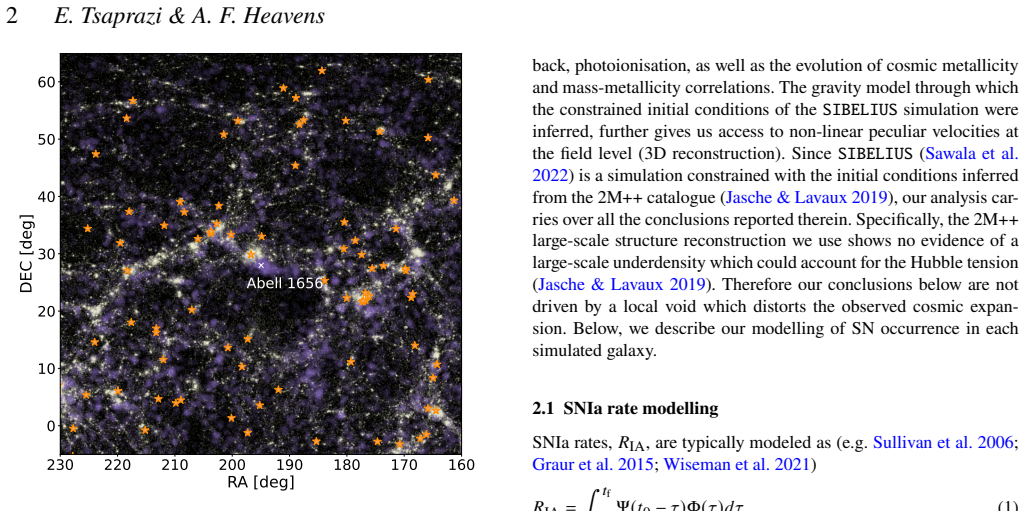
On the paper's own terms, the central discovery is that a field-level treatment of non-linear peculiar velocities, drawn from the Bayesian 2M++ reconstruction, removes low-redshift velocity systematics as a viable explanation of the Hubble tension. The authors build realistic SNIa mocks by placing supernovae in the SIBELIUS-DARK constrained simulation according to GALFORM star-formation histories, then fit them with a hierarchical model that propagates the full non-linear velocity covariance into the $H_0$ posterior. The model reproduces the ground-truth $H_0$ when applied to mocks that include $z<0.023$ supernovae, and it yields only a minimal $H_0$ shift when peculiar velocities are ignored at $0.023<z<0.046$. This opens the door to using low-redshift supernovae, currently excluded, in $H_0$ measurements.
Load-bearing premise
The whole argument rests on the 2M++ Bayesian reconstruction being an accurate description of the true non-linear peculiar velocity field at its 2.65 Mpc/h resolution, with a covariance that faithfully captures the reconstruction's uncertainty.
Editorial extensions
If this is right
- Supernovae below $z=0.023$ can be included in $H_0$ analyses instead of being cut, reducing sample variance.
- Ignoring peculiar velocities biases $H_0$ by only $0.4\pm0.5$ km s$^{-1}$ Mpc$^{-1}$ at $0.023<z<0.046$, so velocity systematics do not account for the reported Hubble tension.
- The per-host SNIa rate model is a secondary ingredient for velocity studies, since uniform rates give the same $H_0$ shift.
- More velocity realisations from future reconstructions will allow the contribution of individual superclusters, such as Hydra-Centaurus and Shapley, to be pinned down precisely.
Reading between the lines
- If the result carries over to real data, extending $H_0$ samples to $z\sim0$ could change the local value's error budget and shift the comparison with early-Universe estimates.
- The analytic marginalisation over $z_p$ and $z_c$ could be applied to other low-redshift distance indicators, such as gravitational-wave standard sirens, wherever a reconstructed peculiar-velocity covariance is available.
- Because the mocks use one 2M++ realisation as truth and the mean field for analysis, the method's success depends on the reconstruction's resolution; surveys that resolve smaller-scale velocity dispersion could reveal a larger bias than reported here.
- The patch decomposition hints that any residual velocity systematic would show up first in the directions of massive superclusters, where the weighted $H_0$ offsets are largest.
Editorial analysis
A structured set of objections, weighed in public.
Referee Report
Summary. The paper develops a Bayesian hierarchical model for inferring the Hubble constant H0 from type Ia supernova (SNIa) redshift and distance-modulus data, incorporating the non-linear peculiar velocity field of the local Universe as reconstructed from the 2M++ catalogue with the BORG algorithm. The velocity information enters through a per-SN mean and covariance, and the model marginalises analytically over unknown cosmological and peculiar redshifts, using a series of approximations to make the high-dimensional integral tractable. The method is tested on mock SNIa catalogues generated from the SIBELIUS-DARK simulation with GALFORM-based SNIa rates: at 0.023<z<0.046, ignoring peculiar velocities is reported to bias H0 by only 0.4±0.5 km/s/Mpc, while at z<0.023 the model is claimed to recover the ground-truth H0 (67.77 km/s/Mpc) even when a wrong fiducial H0 is assumed. The authors conclude that the Hubble tension is unlikely to originate in unaccounted-for non-linear velocity dynamics.
Significance. The paper is a well-structured methods contribution with several genuine strengths: it uses a constrained simulation of the local Universe rather than random N-body simulations; it builds SNIa host populations from individual galaxy star-formation histories; and it propagates the full non-linear velocity covariance at the locations of SNe, going beyond the common 250 km/s dispersion approximation. The analytic marginalisation in Equations (23)-(42) is a useful step toward field-level H0 inference and could enable inclusion of z<0.023 SNe, which are currently discarded. If the method survives external validation, the paper will be an important addition to the literature on local velocity systematics and H0. However, the current validation is largely a self-consistency test: mock data are generated from one realisation of the same 2M++ posterior whose mean and covariance are then used in the analysis. The main quantitative claim (0.4±0.5 km/s/Mpc bias) and the stronger conclusion about the H0 tension therefore do not yet have the independent support they would need to be fully load-bearing.
major comments (4)
- [Section 2.5 and Section 2.3 (mock generation and covariance)] The mock-data validation is self-referential. Section 2.5 step (iv) draws observed peculiar redshifts from a Gaussian with mean equal to one 2M++ realisation and covariance C, while the analysis in Section 2.3 uses the mean peculiar redshift across the same set of ~240 realisations and the same covariance. The 0.4±0.5 km/s/Mpc bias measurement at 0.023<z<0.046 is therefore a test that the Bayesian machinery is internally consistent under the assumption that the 2M++ posterior is the correct description of the velocity field. It cannot detect a systematic error in the reconstructed velocity field, such as a bias from external tidal fields or from inaccurate small-scale velocity modelling. The one independent cross-check mentioned, using SIBELIUS gravity-solver velocities, is reported only for the z<0.023 recovery (Section 3.2, final paragraph) and no quantitative result is given there. The authors should repeat the 0.023<z<0.046 bias measurement with SIBELIUS velocities as the true velocity field, or with an external velocity field, and report the resulting bias; without this, the central quantitative claim is not yet validated against an independent non-linear velocity prediction.
- [Section 2.4, Equations (11), (23), (30)-(31)] The analytic posterior rests on three unquantified approximations: the Doppler term replaces the true peculiar redshift by its mean in Equation (11); the z_c^2 prior is approximated by ztilde^2 and the lower integration limits are extended to -infinity in Equation (31); and the distance modulus is linearised around ztilde in Equation (27). The text states that these have 'very little impact' or 'insignificant impact', but no error estimate or comparison with an exact integration is provided. These approximations are most stressed precisely in the z<0.023 regime that the paper aims to open up. The authors attempted nested sampling but found it non-robust, so the analytic result has not been validated against a high-dimensional integration. A quantitative check, for example a comparison on a few reduced-dimension mocks or a controlled integration on a subset of SNe, is needed to demonstrate that the approximations do not bias the recovered H0.
- [Section 4 and Section 2.3 (conclusions versus stated limitations)] The conclusion that 'it is unlikely that the H0 tension originates in unaccounted-for non-linear velocity dynamics' is stronger than the evidence presented. Section 2.3 states that the 2M++ reconstruction is trusted only above 2.65 Mpc/h and that small-scale velocity dispersion must be modelled externally for real data; Section 4 also mentions possible peculiar velocities sourced outside the 200 Mpc volume. The paper does not estimate the size of these missing contributions. Even if the internal self-consistency test were clean, the result would only bound the bias from the modelled scales and internal dynamics, not from all unaccounted-for velocity dynamics. The conclusion should be rephrased to state that, within the modelled scales and the 2M++ reconstruction, no significant velocity-induced bias is found, rather than making a global statement about the origin of the H0 tension.
- [Section 3.2, Figure 5] Figure 5 shows nine individual H0 posteriors, several of which have MAP values around 1-2 sigma from the ground truth (e.g., panels e and f). The paper states that 100 mock datasets were checked and found consistent with the ground truth, but no summary statistics are given. The authors should report the distribution of MAP values across the 100 datasets (mean offset, scatter, and fraction within 1 sigma) to demonstrate that the quoted per-dataset uncertainties are well calibrated and that the consistency claim is not based on a selected subset.
minor comments (6)
- [Figure 2 caption] The caption contains a typo: 'Flowchart of the the Bayesian hierarchical model' should read 'Flowchart of the Bayesian hierarchical model'.
- [Equations (5)-(6)] The definition and sign convention for alpha_B should be clarified. As written, Equation (6) equates alpha_B to log(1+Delta H/H0), but alpha_B is defined in Equation (5) as a Hubble-diagram intercept; the relationship between the two should be stated explicitly to avoid confusion.
- [Section 2.3] The statement that the covariance matrices are 'robust to this number' of 240 realisations is not supported by a convergence test. A short figure or a quantitative stability check would strengthen the claim that Nsim is sufficient.
- [Section 3.1, Figure 3] In Figure 3(c), the highest-mass bin of strongly star-forming galaxies is stated to contain very few members, but the actual number is not given. Reporting the bin count would help readers judge the significance of the discrepancy.
- [Section 3.2, Figure 4(b)] The patch contributions shown in Figure 4(b) appear to have no uncertainty estimates. Given the small number of SNe per patch (0.7-4.2 sources), error bars or a statement that the values are noise-dominated should be added.
- [Section 4] The caveat that 'It remains to be checked against real data whether the more accurate velocity modelling ... will yield results on H0 at z<0.023 consistent with existing studies' is an important qualification and should be reflected in the abstract or conclusion, since the current abstract makes a stronger statement about recovering ground-truth H0 and ruling out velocity explanations of the tension.
Circularity Check
No significant circularity; the mock validation is a transparent prior-predictive self-consistency check, and the scientific conclusions are conditioned on the external 2M++ reconstruction.
full rationale
The paper's main quantitative claims are (i) the Bayesian hierarchical model recovers H0 in mock data and (ii) ignoring peculiar velocities shifts H0 by 0.4 +/- 0.5 km/s/Mpc. Claim (i) is tested in Sections 2.5 and 3.2 by generating mock redshifts and distance moduli with one 2M++ peculiar-velocity realisation and the covariance C, then analysing with the mean 2M++ field and the same C. This is a prior-predictive self-consistency check: the generative and analysis likelihoods share the covariance, so the posterior is expected to centre on the injected H0 if the analytic Laplace approximation is accurate. This is a standard and transparent validation of the statistical machinery; the paper explicitly calls the data 'self-consistent' and does not present it as an independent test of the velocity reconstruction. The z<0.023 recovery is not a fitted parameter renamed as a prediction: H0 is injected through the distance moduli and inferred from them. Claim (ii) is an estimate of the bias of an analysis that ignores peculiar velocities, using a specific 2M++ realisation as the truth; it is conditional on that reconstruction, which is an external input rather than an output of the paper's inference. The paper itself flags the limitation that, for real data, 'the velocity dispersion on smaller scales must be modelled externally' (Section 2.3), and it notes that a real-data check of the BORG 2M++ velocity modelling remains to be done (Section 4). These are caveats on external validity, not circularity. Self-citations in the paper (Tsaprazi et al. 2022; Sellentin & Heavens 2016; Percival et al. 2022) are contextual or non-load-bearing, and no uniqueness theorem or ansatz is imported from the authors' prior work. Hence no circular step is identifiable.
Assumptions & free parameters
free parameters (8)
- SNIa rate normalisation A =
2.11e-13 SNe/Msun/yr (Wiseman et al. 2021)
- Delay-time distribution slope beta =
-1.13 (Wiseman et al. 2021)
- Prompt delay time tp =
40 Myr (Wiseman et al. 2021)
- Global rate rescaling factor =
~3
- Redshift error sigma_z =
0.001
- Distance modulus error sigma_mu =
0.13 mag
- Number of velocity realisations Nsim =
~240
- Patch query radius =
±10 degrees
assumptions (7)
- standard math Standard matrix identities (Woodbury, determinant theorem) and Gaussian integrals are valid.
- domain assumption The 2M++ BORG reconstruction provides an unbiased non-linear peculiar velocity field at 2.65 Mpc/h resolution.
- domain assumption SIBELIUS-DARK plus GALFORM reproduces realistic SNIa host locations and host velocities in the local Universe.
- domain assumption The peculiar velocity field is independent of the assumed H0.
- ad hoc to paper The Doppler-boosting term can be replaced by using the mean peculiar redshift.
- ad hoc to paper The cosmological redshift prior z^2 can be approximated by a constant and integration limits extended to negative infinity.
- ad hoc to paper The distance modulus is a linear function of cosmological redshift around the peak of the minimiser.
Cite this review
Pith. "Pith review of Field-level inference of $H_0$ from simulated type Ia supernovae in a local Universe analogue." pith.science (2026). https://pith.science/paper/FOZIC3IZ
@misc{pith2026250208385,
  author       = {Pith},
  title        = {Pith review of: Field-level inference of $H_0$ from simulated type Ia supernovae in a local Universe analogue},
  year         = {2026},
  howpublished = {\url{https://pith.science/paper/FOZIC3IZ}},
  note         = {Machine review of arXiv:2502.08385}
}
abstract
Two particular challenges face type Ia supernovae (SNeIa) as probes of the expansion rate of the Universe. One is that they may not be fair tracers of the matter velocity field, and the second is that their peculiar velocities distort the Hubble expansion. Although the latter has been estimated at $\lesssim1.5\%$ for $z>0.023$, this is based either on constrained linear or unconstrained (random) non-linear velocity simulations. In this paper, we address both challenges by incorporating a physical model for the locations of supernovae, and develop a Bayesian Hierarchical Model that accounts for non-linear peculiar velocities in our local Universe, inferred from a Bayesian analysis of the 2M++ spectroscopic galaxy catalogue. With simulated data, the model recovers the ground truth value of the Hubble constant $H_0$ in the presence of peculiar velocities including their correlated uncertainties arising from the Bayesian inference, opening up the potential of including lower redshift SNeIa to measure $H_0$. Ignoring peculiar velocities, the inferred $H_0$ increases minimally by $\sim 0.4 \pm 0.5$ km s$^{-1}$ Mpc$^{-1}$ in the range $0.023<z<0.046$. We conclude it is unlikely that the $H_0$ tension originates in unaccounted-for non-linear velocity dynamics.
Figures


Figures from the paper (2 more)


Reference graph
Works this paper leans on
-
[1]
write newline
" write newline "" before.all 'output.state := FUNCTION fin.entry write newline FUNCTION new.block output.state before.all = 'skip after.block 'output.state := if FUNCTION new.sentence output.state after.block = 'skip output.state before.all = 'skip after.sentence 'output.state := if if FUNCTION not #0 #1 if FUNCTION and 'skip pop #0 if FUNCTION or pop #1...
-
[2]
ZTF SN Ia DR2: Exploring SN Ia properties in the vicinity of under-dense environments
Aubert M., et al., 2024, @doi [arXiv e-prints] 10.48550/arXiv.2406.11680 , https://ui.adsabs.harvard.edu/abs/2024arXiv240611680A p. arXiv:2406.11680
work page Pith review arXiv doi:10.48550/arxiv.2406.11680 2024
-
[3]
B \"o hringer H., Chon G., Collins C. A., 2020, @doi [ ] 10.1051/0004-6361/201936400 , https://ui.adsabs.harvard.edu/abs/2020A&A...633A..19B 633, A19
-
[4]
Briel M. M., Eldridge J. J., Stanway E. R., Stevance H. F., Chrimes A. A., 2022, @doi [ ] 10.1093/mnras/stac1100 , https://ui.adsabs.harvard.edu/abs/2022MNRAS.514.1315B 514, 1315
-
[5]
Camarena D., Marra V., Sakr Z., Clarkson C., 2022, @doi [Classical and Quantum Gravity] 10.1088/1361-6382/ac8635 , https://ui.adsabs.harvard.edu/abs/2022CQGra..39r4001C 39, 184001
-
[6]
Camarena D., et al., 2023, @doi [ ] 10.1051/0004-6361/202244557 , https://ui.adsabs.harvard.edu/abs/2023A&A...671A..68C 671, A68
-
[7]
Cano-D \' az M., \'A vila-Reese V., S \'a nchez S. F., Hern \'a ndez-Toledo H. M., Rodr \' guez-Puebla A., Boquien M., Ibarra-Medel H., 2019, @doi [ ] 10.1093/mnras/stz1894 , https://ui.adsabs.harvard.edu/abs/2019MNRAS.488.3929C 488, 3929
-
[8]
Carlberg R. G., et al., 2008, @doi [ ] 10.1086/590182 , https://ui.adsabs.harvard.edu/abs/2008ApJ...682L..25C 682, L25
Show all 74 references
-
[9]
M., Scolnic D., Said K., Brout D., Peterson E
Carr A., Davis T. M., Scolnic D., Said K., Brout D., Peterson E. R., Kessler R., 2022, @doi [ ] 10.1017/pasa.2022.41 , https://ui.adsabs.harvard.edu/abs/2022PASA...39...46C 39, e046
2022 doi
-
[10]
Carreres B., et al., 2023, @doi [ ] 10.1051/0004-6361/202346173 , https://ui.adsabs.harvard.edu/abs/2023A&A...674A.197C 674, A197
2023 doi
-
[11]
Carreres B., et al., 2024 ( @eprint arXiv 2405.20409 )
2024 arXiv
-
[12]
J., Lavaux G., Hudson M
Carrick J., Turnbull S. J., Lavaux G., Hudson M. J., 2015, @doi [ ] 10.1093/mnras/stv547 , https://ui.adsabs.harvard.edu/abs/2015MNRAS.450..317C 450, 317
2015 doi
-
[13]
o g a s M., M \
Castello S., H \"o g a s M., M \"o rtsell E., 2022, @doi [ ] 10.1088/1475-7516/2022/07/003 , https://ui.adsabs.harvard.edu/abs/2022JCAP...07..003C 2022, 003
2022 doi
-
[14]
Childress M., et al., 2013, @doi [ ] 10.1088/0004-637X/770/2/107 , https://ui.adsabs.harvard.edu/abs/2013ApJ...770..107C 770, 107
2013 doi
-
[15]
M., et al., 2011, @doi [ ] 10.1088/0004-637X/741/1/67 , https://ui.adsabs.harvard.edu/abs/2011ApJ...741...67D 741, 67
Davis T. M., et al., 2011, @doi [ ] 10.1088/0004-637X/741/1/67 , https://ui.adsabs.harvard.edu/abs/2011ApJ...741...67D 741, 67
2011 doi
-
[16]
Efstathiou G., 2021, @doi [ ] 10.1093/mnras/stab1588 , https://ui.adsabs.harvard.edu/abs/2021MNRAS.505.3866E 505, 3866
2021 doi
-
[17]
Feindt U., Nordin J., Rigault M., Brinnel V., Dhawan S., Goobar A., Kowalski M., 2019, @doi [ ] 10.1088/1475-7516/2019/10/005 , https://ui.adsabs.harvard.edu/abs/2019JCAP...10..005F 2019, 005
2019 doi
-
[18]
P., Bridges M., 2009, @doi [ ] 10.1111/j.1365-2966.2009.14548.x , https://ui.adsabs.harvard.edu/abs/2009MNRAS.398.1601F 398, 1601
Feroz F., Hobson M. P., Bridges M., 2009, @doi [ ] 10.1111/j.1365-2966.2009.14548.x , https://ui.adsabs.harvard.edu/abs/2009MNRAS.398.1601F 398, 1601
2009
-
[20]
Fremling C., et al., 2020, @doi [ ] 10.3847/1538-4357/ab8943 , https://ui.adsabs.harvard.edu/abs/2020ApJ...895...32F 895, 32
2020 doi
-
[21]
Freundlich J., Maoz D., 2021, @doi [ ] 10.1093/mnras/stab493 , https://ui.adsabs.harvard.edu/abs/2021MNRAS.502.5882F 502, 5882
2021 doi
-
[22]
Giani L., Howlett C., Said K., Davis T., Vagnozzi S., 2024, @doi [ ] 10.1088/1475-7516/2024/01/071 , https://ui.adsabs.harvard.edu/abs/2024JCAP...01..071G 2024, 071
2024 doi
-
[23]
o rtsell E., Amanullah R., Goliath M., Bergstr \
Goobar A., M \"o rtsell E., Amanullah R., Goliath M., Bergstr \"o m L., Dahl \'e n T., 2002, @doi [ ] 10.1051/0004-6361:20020930 , https://ui.adsabs.harvard.edu/abs/2002A&A...392..757G 392, 757
2002 doi
-
[24]
B., Modjaz M., 2015, @doi [ ] 10.1093/mnras/stv713 , https://ui.adsabs.harvard.edu/abs/2015MNRAS.450..905G 450, 905
Graur O., Bianco F. B., Modjaz M., 2015, @doi [ ] 10.1093/mnras/stv713 , https://ui.adsabs.harvard.edu/abs/2015MNRAS.450..905G 450, 905
2015 doi
-
[25]
Gris P., et al., 2023, @doi [ ] 10.3847/1538-4365/ac9e58 , https://ui.adsabs.harvard.edu/abs/2023ApJS..264...22G 264, 22
2023 doi
-
[26]
J., Hobson M
Handley W. J., Hobson M. P., Lasenby A. N., 2015a, @doi [ ] 10.1093/mnrasl/slv047 , https://ui.adsabs.harvard.edu/abs/2015MNRAS.450L..61H 450, L61
-
[27]
J., Hobson M
Handley W. J., Hobson M. P., Lasenby A. N., 2015b, @doi [ ] 10.1093/mnras/stv1911 , https://ui.adsabs.harvard.edu/abs/2015MNRAS.453.4384H 453, 4384
-
[28]
Hartlap J., Simon P., Schneider P., 2007, @doi [ ] 10.1051/0004-6361:20066170 , https://ui.adsabs.harvard.edu/abs/2007A&A...464..399H 464, 399
2007 doi
-
[29]
CRC Press, https://books.google.co.uk/books?id=nTOFkmnCQuIC
Hockney R., Eastwood J., 2021, Computer Simulation Using Particles. CRC Press, https://books.google.co.uk/books?id=nTOFkmnCQuIC
2021
-
[30]
M., Hudson M
Hollinger A. M., Hudson M. J., 2025, arXiv e-prints, https://ui.adsabs.harvard.edu/abs/2025arXiv250115704H p. arXiv:2501.15704
2025 arXiv
-
[31]
Jasche J., Lavaux G., 2019, @doi [ ] 10.1051/0004-6361/201833710 , https://ui.adsabs.harvard.edu/abs/2019A&A...625A..64J 625, A64
2019 doi
-
[32]
D., 2013, @doi [ ] 10.1093/mnras/stt449 , https://ui.adsabs.harvard.edu/abs/2013MNRAS.432..894J 432, 894
Jasche J., Wandelt B. D., 2013, @doi [ ] 10.1093/mnras/stt449 , https://ui.adsabs.harvard.edu/abs/2013MNRAS.432..894J 432, 894
2013 doi
-
[33]
Kazantzidis L., Perivolaropoulos L., 2020, @doi [ ] 10.1103/PhysRevD.102.023520 , https://ui.adsabs.harvard.edu/abs/2020PhRvD.102b3520K 102, 023520
2020 doi
-
[34]
D., Scolnic D., Riess A., 2019, @doi [ ] 10.3847/1538-4357/ab0ebf , https://ui.adsabs.harvard.edu/abs/2019ApJ...875..145K 875, 145
Kenworthy W. D., Scolnic D., Riess A., 2019, @doi [ ] 10.3847/1538-4357/ab0ebf , https://ui.adsabs.harvard.edu/abs/2019ApJ...875..145K 875, 145
2019 doi
-
[35]
Koposov S., et al., 2024, joshspeagle/dynesty: v2.1.4 , @doi 10.5281/zenodo.3348367
2024 doi
-
[36]
K., Lavaux G., 2022, @doi [ ] 10.1051/0004-6361/202141706 , https://ui.adsabs.harvard.edu/abs/2022A&A...657L..17K 657, L17
Kosti \'c A., Jasche J., Ramanah D. K., Lavaux G., 2022, @doi [ ] 10.1051/0004-6361/202141706 , https://ui.adsabs.harvard.edu/abs/2022A&A...657L..17K 657, L17
2022 doi
-
[37]
G., et al., 2016, @doi [ ] 10.1093/mnras/stw1888 , https://ui.adsabs.harvard.edu/abs/2016MNRAS.462.3854L 462, 3854
Lacey C. G., et al., 2016, @doi [ ] 10.1093/mnras/stw1888 , https://ui.adsabs.harvard.edu/abs/2016MNRAS.462.3854L 462, 3854
2016 doi
-
[38]
J., 2011, @doi [ ] 10.1111/j.1365-2966.2011.19233.x , https://ui.adsabs.harvard.edu/abs/2011MNRAS.416.2840L 416, 2840
Lavaux G., Hudson M. J., 2011, @doi [ ] 10.1111/j.1365-2966.2011.19233.x , https://ui.adsabs.harvard.edu/abs/2011MNRAS.416.2840L 416, 2840
2011
-
[39]
Lavaux G., Jasche J., 2016, @doi [ ] 10.1093/mnras/stv2499 , https://ui.adsabs.harvard.edu/abs/2016MNRAS.455.3169L 455, 3169
2016 doi
-
[40]
Lokken M., et al., 2023, @doi [ ] 10.1093/mnras/stad302 , https://ui.adsabs.harvard.edu/abs/2023MNRAS.520.2887L 520, 2887
2023 doi
-
[41]
T., Della Valle M., Gal-Yam A., Panagia N., 2008, @doi [ ] 10.1111/j.1365-2966.2007.12603.x , https://ui.adsabs.harvard.edu/abs/2008MNRAS.383.1121M 383, 1121
Mannucci F., Maoz D., Sharon K., Botticella M. T., Della Valle M., Gal-Yam A., Panagia N., 2008, @doi [ ] 10.1111/j.1365-2966.2007.12603.x , https://ui.adsabs.harvard.edu/abs/2008MNRAS.383.1121M 383, 1121
2008
-
[42]
Mc Conville R., \'O Colg \'a in E., 2023, @doi [ ] 10.1103/PhysRevD.108.123533 , https://ui.adsabs.harvard.edu/abs/2023PhRvD.108l3533M 108, 123533
2023 doi
-
[43]
McAlpine S., et al., 2022, @doi [ ] 10.1093/mnras/stac295 , https://ui.adsabs.harvard.edu/abs/2022MNRAS.512.5823M 512, 5823
2022 doi
-
[44]
Molero M., Simonetti P., Matteucci F., della Valle M., 2021, @doi [ ] 10.1093/mnras/staa3340 , https://ui.adsabs.harvard.edu/abs/2021MNRAS.500.1071M 500, 1071
2021 doi
-
[45]
R., Jasche J., Wandelt B
Mukherjee S., Lavaux G., Bouchet F. R., Jasche J., Wandelt B. D., Nissanke S., Leclercq F., Hotokezaka K., 2021, @doi [ ] 10.1051/0004-6361/201936724 , https://ui.adsabs.harvard.edu/abs/2021A&A...646A..65M 646, A65
2021 doi
-
[46]
E., Parisi F., Scannapieco C., Richter P., Gottl \"o ber S., Steinmetz M., 2014, @doi [ ] 10.1093/mnras/stu643 , https://ui.adsabs.harvard.edu/abs/2014MNRAS.441.2593N 441, 2593
Nuza S. E., Parisi F., Scannapieco C., Richter P., Gottl \"o ber S., Steinmetz M., 2014, @doi [ ] 10.1093/mnras/stu643 , https://ui.adsabs.harvard.edu/abs/2014MNRAS.441.2593N 441, 2593
2014 doi
-
[47]
M., Hannestad S., 2016, @doi [ ] 10.1088/1475-7516/2016/02/001 , https://ui.adsabs.harvard.edu/abs/2016JCAP...02..001O 2016, 001
Odderskov I., Koksbang S. M., Hannestad S., 2016, @doi [ ] 10.1088/1475-7516/2016/02/001 , https://ui.adsabs.harvard.edu/abs/2016JCAP...02..001O 2016, 001
2016 doi
-
[48]
J., Friedrich O., Sellentin E., Heavens A., 2022, @doi [ ] 10.1093/mnras/stab3540 , https://ui.adsabs.harvard.edu/abs/2022MNRAS.510.3207P 510, 3207
Percival W. J., Friedrich O., Sellentin E., Heavens A., 2022, @doi [ ] 10.1093/mnras/stab3540 , https://ui.adsabs.harvard.edu/abs/2022MNRAS.510.3207P 510, 3207
2022 doi
-
[49]
A., et al., 2020, @doi [The Astrophysical Journal] 10.3847/1538-4357/abbd98 , https://ui.adsabs.harvard.edu/abs/2020ApJ...904...35P 904, 35
Perley D. A., et al., 2020, @doi [The Astrophysical Journal] 10.3847/1538-4357/abbd98 , https://ui.adsabs.harvard.edu/abs/2020ApJ...904...35P 904, 35
2020 doi
-
[50]
R., et al., 2022, @doi [ ] 10.3847/1538-4357/ac4698 , https://ui.adsabs.harvard.edu/abs/2022ApJ...938..112P 938, 112
Peterson E. R., et al., 2022, @doi [ ] 10.3847/1538-4357/ac4698 , https://ui.adsabs.harvard.edu/abs/2022ApJ...938..112P 938, 112
2022 doi
-
[51]
L., Karwal T., 2023, @doi [Physics of the Dark Universe] 10.1016/j.dark.2023.101348 , https://ui.adsabs.harvard.edu/abs/2023PDU....4201348P 42, 101348
Poulin V., Smith T. L., Karwal T., 2023, @doi [Physics of the Dark Universe] 10.1016/j.dark.2023.101348 , https://ui.adsabs.harvard.edu/abs/2023PDU....4201348P 42, 101348
2023
-
[52]
G., et al., 1998, @doi [ ] 10.1086/300499 , https://ui.adsabs.harvard.edu/abs/1998AJ....116.1009R 116, 1009
Riess A. G., et al., 1998, @doi [ ] 10.1086/300499 , https://ui.adsabs.harvard.edu/abs/1998AJ....116.1009R 116, 1009
1998 doi
-
[53]
G., et al., 2016, @doi [ ] 10.3847/0004-637X/826/1/56 , https://ui.adsabs.harvard.edu/abs/2016ApJ...826...56R 826, 56
Riess A. G., et al., 2016, @doi [ ] 10.3847/0004-637X/826/1/56 , https://ui.adsabs.harvard.edu/abs/2016ApJ...826...56R 826, 56
2016 doi
-
[54]
G., et al., 2022, @doi [ ] 10.3847/2041-8213/ac5c5b , https://ui.adsabs.harvard.edu/abs/2022ApJ...934L...7R 934, L7
Riess A. G., et al., 2022, @doi [ ] 10.3847/2041-8213/ac5c5b , https://ui.adsabs.harvard.edu/abs/2022ApJ...934L...7R 934, L7
2022 doi
-
[55]
A., Lablanche P.-Y., Agarwal S., 2017, @doi [ ] 10.1088/1475-7516/2017/10/036 , https://ui.adsabs.harvard.edu/abs/2017JCAP...10..036R 2017, 036
Roberts E., Lochner M., Fonseca J., Bassett B. A., Lablanche P.-Y., Agarwal S., 2017, @doi [ ] 10.1088/1475-7516/2017/10/036 , https://ui.adsabs.harvard.edu/abs/2017JCAP...10..036R 2017, 036
2017 doi
-
[56]
H., Frenk C
Sawala T., McAlpine S., Jasche J., Lavaux G., Jenkins A., Johansson P. H., Frenk C. S., 2022, @doi [ ] 10.1093/mnras/stab2684 , https://ui.adsabs.harvard.edu/abs/2022MNRAS.509.1432S 509, 1432
2022 doi
-
[57]
Schaye J., et al., 2015, @doi [ ] 10.1093/mnras/stu2058 , https://ui.adsabs.harvard.edu/abs/2015MNRAS.446..521S 446, 521
2015 doi
-
[58]
Scolnic D., et al., 2022, @doi [ ] 10.3847/1538-4357/ac8b7a , https://ui.adsabs.harvard.edu/abs/2022ApJ...938..113S 938, 113
2022 doi
-
[59]
Scolnic D., et al., 2023, @doi [ ] 10.3847/2041-8213/ace978 , https://ui.adsabs.harvard.edu/abs/2023ApJ...954L..31S 954, L31
2023 doi
-
[60]
M., Collins C
Sedgwick T. M., Collins C. A., Baldry I. K., James P. A., 2021, @doi [ ] 10.1093/mnras/staa3456 , https://ui.adsabs.harvard.edu/abs/2021MNRAS.500.3728S 500, 3728
2021 doi
-
[61]
F., 2016, @doi [ ] 10.1093/mnrasl/slv190 , https://ui.adsabs.harvard.edu/abs/2016MNRAS.456L.132S 456, L132
Sellentin E., Heavens A. F., 2016, @doi [ ] 10.1093/mnrasl/slv190 , https://ui.adsabs.harvard.edu/abs/2016MNRAS.456L.132S 456, L132
2016 doi
-
[62]
V., eds, American Institute of Physics Conference Series Vol
Skilling J., 2004, in Fischer R., Preuss R., Toussaint U. V., eds, American Institute of Physics Conference Series Vol. 735, Bayesian Inference and Maximum Entropy Methods in Science and Engineering: 24th International Workshop on Bayesian Inference and Maximum Entropy Methods...
2004 doi
-
[63]
Skilling J., 2006, @doi [Bayesian Analysis] 10.1214/06-BA127 , 1, 833
2006 doi
-
[64]
Smith M., et al., 2012, @doi [ ] 10.1088/0004-637X/755/1/61 , https://ui.adsabs.harvard.edu/abs/2012ApJ...755...61S 755, 61
2012 doi
-
[65]
G., Dubois Y., Blaizot J., McGee S
Sorce J. G., Dubois Y., Blaizot J., McGee S. L., Yepes G., Knebe A., 2021, @doi [ ] 10.1093/mnras/stab1021 , https://ui.adsabs.harvard.edu/abs/2021MNRAS.504.2998S 504, 2998
2021 doi
-
[66]
S., 2020, @doi [ ] 10.1093/mnras/staa278 , https://ui.adsabs.harvard.edu/abs/2020MNRAS.493.3132S 493, 3132
Speagle J. S., 2020, @doi [ ] 10.1093/mnras/staa278 , https://ui.adsabs.harvard.edu/abs/2020MNRAS.493.3132S 493, 3132
2020 doi
-
[67]
J., Bartlett D
Stiskalek R., Desmond H., Devriendt J., Slyz A., Lavaux G., Hudson M. J., Bartlett D. J., Courtois H. M., 2025, @doi [arXiv e-prints] 10.48550/arXiv.2502.00121 , https://ui.adsabs.harvard.edu/abs/2025arXiv250200121S p. arXiv:2502.00121
2025 doi
-
[68]
Sullivan M., et al., 2006, @doi [ ] 10.1086/506137 , https://ui.adsabs.harvard.edu/abs/2006ApJ...648..868S 648, 868
2006 doi
-
[69]
Toy M., et al., 2023, @doi [ ] 10.1093/mnras/stad2982 , https://ui.adsabs.harvard.edu/abs/2023MNRAS.526.5292T 526, 5292
2023 doi
-
[70]
Tsaprazi E., et al., 2022, @doi [ ] 10.1093/mnras/stab3525 , https://ui.adsabs.harvard.edu/abs/2022MNRAS.510..366T 510, 366
2022 doi
-
[71]
Vincenzi M., et al., 2021, @doi [ ] 10.1093/mnras/stab1353 , https://ui.adsabs.harvard.edu/abs/2021MNRAS.505.2819V 505, 2819
2021 doi
-
[72]
Wiseman P., et al., 2021, @doi [ ] 10.1093/mnras/stab1943 , https://ui.adsabs.harvard.edu/abs/2021MNRAS.506.3330W 506, 3330
2021 doi
-
[73]
A., Iliev I
Wojtak R., Knebe A., Watson W. A., Iliev I. T., He S., Rapetti D., Yepes G., Gottl \"o ber S., 2014, @doi [ ] 10.1093/mnras/stt2321 , https://ui.adsabs.harvard.edu/abs/2014MNRAS.438.1805W 438, 1805
2014 doi
-
[74]
A., 1950, Inverting modified matrices
Woodbury M. A., 1950, Inverting modified matrices. Princeton University, Princeton, NJ
1950
-
[75]
Wu H.-Y., Huterer D., 2017, @doi [ ] 10.1093/mnras/stx1967 , https://ui.adsabs.harvard.edu/abs/2017MNRAS.471.4946W 471, 4946
2017 doi
Reviewed August 8, 2026 · model on record in the stance chip above.
Discussion (0). Continue with ORCID to comment.