REVIEW 4 major objections 4 minor 142 references
Searching for Nearby Diffuse Dwarf Galaxies in the COSMOS Field
T0 review · 4 major / 4 minor · reviewed 2026-08-08 · deepseek-v4-flash
Pith's one-line read The paper reports three diffuse dwarf galaxies in the COSMOS field, identifies two as ultra-diffuse galaxies, and derives stellar populations, gas content, and dark-matter content that point to diverse formation paths.
desk verdict Credible pilot sample of three diffuse dwarfs in COSMOS; UDG classification and dark-matter claim rest on distances not yet secure. read the letter →
The pith
A machine-rendered reading of the paper's core claim, the machinery that carries it, and where it could break.
The reading
What carries the argument
The machinery is a pipeline that constructs aperture-matched, PSF-matched UV-to-infrared SEDs from clean, neighbour-subtracted images, then feeds them into a Bayesian SED-fitting code that returns stellar mass, age, metallicity, and star-formation rate; structural parameters come from two-dimensional S\'ersic fits to the HST F814W image. For COSMOS-dw1, the neutral-hydrogen line width $W_{50}=18.2$ km s$^{-1}$ enters the dynamical mass estimator $M_{\rm dyn}=3.5\times10^{5}\,r_{\rm e}\,W_{50}^{2}$, which is what supports the dark-matter-dominated inference.
What would settle it
Take spectra of COSMOS-UDG1 and COSMOS-UDG2 or resolve their stars: if COSMOS-UDG1 is at a redshift below roughly 0.074 or COSMOS-UDG2 below roughly 0.043, their physical effective radii drop below 1.5 kpc and the ultra-diffuse classifications collapse; likewise, a secure distance near 56 Mpc for COSMOS-dw1 would raise its stellar mass by an order of magnitude.
Extended reading notes
Core claim
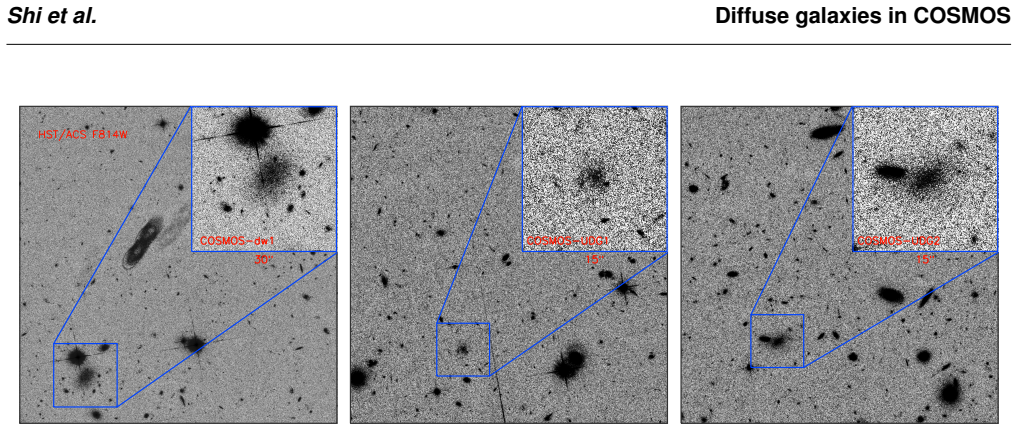
The paper's central claim is that a structured search of the central $36'\times 14'$ region of the COSMOS field uncovers three nearby diffuse dwarf galaxies satisfying $z<0.2$, $r_{\rm e}>1.0''$, and $\mu_0>24$ mag arcsec$^{-2}$. Two are ultra-diffuse galaxies: COSMOS-UDG1 at $z=0.130$ and COSMOS-UDG2 at $z=0.049$, with physical effective radii of 2.64 and 1.70 kpc and stellar masses around $2\times10^{8}\,M_\odot$. The third, COSMOS-dw1 at $z=0.004$, has a stellar mass of $5.6\times10^{6}\,M_\odot$, retains a neutral hydrogen reservoir of $4.90\times10^{6}\,M_\odot$, and has a dynamical mass of $3.4\times10^{7}\,M_\odot$, implying that dark matter dominates it; its low present star formation with residual gas places it at the onset of quenching. The SED-derived stellar populations differ sharply across the three objects, yet all three sit on the local dwarf-galaxy mass-metallicity relation, which the paper takes as evidence that they belong to the dwarf galaxy population.
Load-bearing premise
The distances that convert angular sizes into kiloparsec radii are not secure for two of the three galaxies, which lack spectroscopic redshifts, and the one with a spectrum has two conflicting distance estimates, so a galaxy closer than assumed would fall below the ultra-diffuse radius threshold.
Editorial extensions
If this is right
- If these identifications hold, ultra-diffuse galaxies can be found in random, low-density fields rather than only in clusters and groups, widening the search space for their formation.
- COSMOS-dw1 shows that a dwarf can be simultaneously gas-rich and nearly quenched, with dark matter dominating its dynamics, implying that quenching can begin in isolation without violent stripping.
- The two UDGs have similar stellar masses but different ages and metallicities, so the standard UDG selection criteria do not isolate a single stellar-population or formation channel.
- All three galaxies following the dwarf mass-metallicity relation suggests that the relation is set primarily by stellar mass rather than by galaxy size or diffuse structure.
Reading between the lines
- If colour-based redshifts at $z<0.15$ carry typical errors, blind H I surveys and resolved-star distance campaigns could uncover a population of nearer, lower-mass diffuse dwarfs that optical selection at $z<0.2$ currently misses.
- The factor-of-three distance discrepancy for the one spectroscopically confirmed dwarf suggests a systematic test: computing surface-brightness-fluctuation distances with independent calibrators across the whole COSMOS dwarf sample would show whether the discrepancy is an outlier or a method bias.
- Applying the same selection and SED-fitting machinery to other deep extragalactic fields would turn this pilot into a statistical census of field UDGs, testing whether high-spin or tidal-stripping formation scenarios dominate.
- If gas-rich, dark-matter-dominated dwarfs like COSMOS-dw1 frequently land on the dwarf mass-metallicity relation, stellar mass rather than environment or quenching history may set chemical enrichment even at the low-mass end.
Editorial analysis
A structured set of objections, weighed in public.
Referee Report
Summary. The paper reports a pilot search for diffuse dwarf galaxies in the COSMOS field using deep HST/F814W imaging, identifying three low-surface-brightness galaxies: COSMOS-dw1 (spectroscopically confirmed at z=0.004), COSMOS-UDG1 (photo-z 0.130), and COSMOS-UDG2 (photo-z 0.049). Using aperture-matched photometry from UV to NIR and Prospector SED fitting, the authors derive stellar masses, ages, metallicities, and star formation rates. For COSMOS-dw1 they combine an H I detection with a dynamical mass estimate to argue that the galaxy is predominantly dark matter and possibly in the early stages of quenching. The two UDGs are presented as new field UDGs with diverse stellar populations, and all three objects are compared to the dwarf-galaxy mass-metallicity relation.
Significance. If the distances are correct, the paper would add two new field UDGs at z<0.15 and a nearby gas-rich, dark-matter-dominated dwarf to the small census of diffuse low-surface-brightness galaxies, with well-characterized multiwavelength SEDs. The aperture-matched photometry and the explicit discussion of the SBF distance discrepancy for COSMOS-dw1 are strengths, and the structural fits provide useful quantitative data. However, the central claims—the UDG classifications and the dark-matter-dominated interpretation—depend critically on distances that are not yet secured, so the current significance is conditional on resolving those distances.
major comments (4)
- [Section 2 and Section 4] The UDG classifications and all physical sizes for COSMOS-UDG1 and COSMOS-UDG2 rest on photometric redshifts, with no spec-z available. COSMOS2015 gives z=0.158±0.008 for COSMOS-UDG1 while the adopted EAZY value is 0.130, and for COSMOS-UDG2 the 1σ lower bound z≈0.033 would shrink re from 1.70 kpc to roughly 1.1 kpc, below the 1.5 kpc UDG threshold stated in Section 2. The paper should propagate the full photo-z PDFs into the structural and stellar-population parameters, or present all derived quantities as functions of distance rather than as single adopted values.
- [Section 4] The factor-of-three SBF distance discrepancy for COSMOS-dw1 (22±3 Mpc versus 56.3+10.4−6.7 Mpc) is described but not propagated into the quoted physical parameters. At the larger distance the paper notes that re triples and M* rises by an order of magnitude; additionally, MHI scales as D^2 to ~3–5×10^7 M⊙, making Mbar comparable to or larger than the rescaled Mdyn~1×10^8 M⊙. The conclusion that COSMOS-dw1 is predominantly dark matter is therefore distance-dependent and should be stated under both distance branches, or a specific distance should be adopted with explicit justification.
- [Table 1 versus Table 2] The structural parameters differ substantially between Table 1 and the 1D/2D Sérsic fits in the Appendix. For example, COSMOS-UDG2 has re,I814=1.77″ and n=0.59 in Table 1, but re=2.54″ and n=0.91 in the 2D fit in Table 2; COSMOS-dw1 has n=0.20 in Table 1 versus n=0.53 in the Appendix. Since re enters the UDG selection criterion and the dynamical-mass estimate for COSMOS-dw1, the paper must explain which parameter set is adopted and quantify how the differences affect the conclusions.
- [Abstract and Section 2] The selection criteria are stated inconsistently: the abstract lists re>1.0″ while Section 2 applies re>1.5 kpc using photometric redshifts. These criteria are not equivalent, as COSMOS-dw1 has re=3.42″ but only 0.29 kpc at the adopted distance and is consequently not classified as a UDG. Please unify the criteria and present the selection in one quantitative form, clearly distinguishing the angular-size criterion from the physical-size criterion.
minor comments (4)
- [Figure 8 caption] The caption labels the target as COSMOS-UDG3, but the object discussed throughout the text and in Table 1 is COSMOS-UDG2.
- [Section 3.2] The phrase 'fully Bayesian Bayesian Markov chain Monte Carlo' contains a redundant repetition of 'Bayesian'.
- [Section 2] The EAZY photometric redshifts for COSMOS-UDG1 and COSMOS-UDG2 are quoted without uncertainties, making it difficult to evaluate the statement that they are 'fully consistent' with the COSMOS2015 values; for COSMOS-UDG1 the difference is 0.028, which is several times the quoted COSMOS2015 error of 0.008.
- [Section 4] The text quotes the Sagittarius dwarf spheroidal as having '[Fe/H]∼ 0.4'; the value should presumably be negative, and the sentence should be checked against the cited source.
Circularity Check
No significant circularity: all derived quantities are fits to independent photometry; the acknowledged distance uncertainties affect accuracy, not logical circularity.
full rationale
The paper's derivation chain is not circular. Target selection uses the 3D-HST/CANDELS catalog with photometric redshifts and structural parameters, then applies the stated criteria; the three objects are then re-measured with GALFIT on HST images, and their SEDs are fitted with Prospector/FSPS using standard templates, a Chabrier IMF, and a Calzetti attenuation law. Stellar masses, metallicities, ages, and SFRs are free parameters of those fits, not quantities defined in terms of the conclusions. The dynamical mass of COSMOS-dw1 uses an external formula (Mdyn = 3.5e5 re W50^2) with re from imaging and W50 from an external HI measurement; this is an application of an independent scaling relation, not a fitted input relabeled as a prediction. The paper's own Section 4 explicitly flags the SBF distance discrepancy for COSMOS-dw1 (22 vs 56.3 Mpc) and the photo-z uncertainties for the other two objects, and it states that adopting the larger distance would raise M* by an order of magnitude and triple re; this is a candid robustness concern about distance accuracy, not a logical circularity. Self-citations to Shi et al. (2017, 2018) appear only in introductory lists of prior UDG work and future survey prospects; they are not load-bearing for any derived result. No equation is defined in terms of its own target, no fitted parameter is promoted to a prediction, and no uniqueness claim is imported from the authors' own prior work. The MZR comparison is made against external relations (Kirby et al. 2013; Gallazzi et al. 2005), so the statement that the galaxies 'adhere to the MZR' is an external benchmark rather than a self-confirmation. In summary, the paper is self-contained as a measurement and discovery work; the main risks are statistical and systematic distance uncertainties, which the authors partly acknowledge, but these are not circularity.
Assumptions & free parameters
free parameters (5)
- stellar mass =
log(M*/M_sun) = 6.75, 8.39, 8.34
- stellar metallicity =
log(Z/Z_sun) = -1.47, -0.74, -1.44
- stellar age =
4.10, 1.70, 5.58 Gyr
- SFH e-folding timescale tau =
log(tau/Gyr) = 0.23, 0.50, 0.07
- star formation rate =
0.001, 0.239, 0.008 M_sun/yr
assumptions (4)
- domain assumption Photometric redshifts for COSMOS-UDG1 and COSMOS-UDG2 are accurate enough to determine distances and physical sizes.
- domain assumption The adopted SPS priors (Chabrier IMF, Calzetti dust attenuation, delayed exponential SFH) are appropriate for these galaxies.
- domain assumption The dynamical mass formula Mdyn = 3.5e5 * re * W50^2 with W50 = 18.2 km/s applies to COSMOS-dw1.
- domain assumption The cosmological baryon fraction of 0.16 holds for COSMOS-dw1's dark matter halo.
Cite this review
Pith. "Pith review of Searching for Nearby Diffuse Dwarf Galaxies in the COSMOS Field." pith.science (2026). https://pith.science/paper/4XYTQ6G3
@misc{pith2026250208466,
  author       = {Pith},
  title        = {Pith review of: Searching for Nearby Diffuse Dwarf Galaxies in the COSMOS Field},
  year         = {2026},
  howpublished = {\url{https://pith.science/paper/4XYTQ6G3}},
  note         = {Machine review of arXiv:2502.08466}
}
abstract
It remains challenging to systematically survey nearby diffuse dwarf galaxies and address the formation mechanism of this population distinguishing from regular ones. We carry out a pilot search for these galaxies in the COSMOS field using the deep \textit{HST}/F814W imaging data. We report three diffuse dwarf galaxies satisfying the criteria: (1) redshift $z<0.2$, (2) effective radius $r_{\rm e}>1.0''$, and (3) central surface brightness $\mu_{\rm 0}>24$ mag arcsec$^{-2}$. Two of the three galaxies, COSMOS-UDG1 and COSMOS-UDG2, are recognized as ultra-diffuse galaxies (UDGs) with redshift $z=0.130$ and $0.049$, respectively. The third galaxy, COSMOS-dw1, is spectroscopically confirmed as a dwarf galaxy at $z=0.004$. We derive the physical properties through fitting their spectral energy distributions (SEDs) extracted from deep multiwavelength observations. COSMOS-dw1 has a stellar mass of $5.6_{-2.7}^{+2.5}\times10^{6}$ M$_{\odot}$, harboring neutral hydrogen gas of mass $4.90\pm0.90\times10^{6}$ M$_{\odot}$, hinting that this galaxy may be in the nascent stages of quenching. The estimated dynamical mass of $3.4\times10^{7}\,M_{\odot}$ further suggests that COSMOS-dw1 is predominantly of dark matter. COSMOS-UDG1 and COSMOS-UDG2 exhibit comparable stellar masses of $\sim 2\times10^{8}$ M$_{\odot}$. Notably, COSMOS-UDG1 is younger and more metal-rich than COSMOS-UDG2 and COSMOS-dw1. Conversely, COSMOS-UDG2 and COSMOS-dw1 have similar stellar metallicities, yet COSMOS-UDG2 is older than COSMOS-dw1. All three galaxies adhere to the stellar mass-metallicity relation (MZR) for dwarf galaxies in the local Universe, implying they belong to the dwarf galaxy population.
Figures


Figures from the paper (5 more)


Reference graph
Works this paper leans on
-
[1]
`K>kFUh5(JQ'-olL6 XJ3 PDX
thebibliography [1] 20pt to REFERENCES 6pt =0pt 10pt plus 3pt =0pt =0pt =1pt plus 1pt =0pt =0pt -12pt =13pt plus 1pt =20pt =13pt plus 1pt \@M =10000 =-1.0em =0pt =0pt 0pt =0pt =1.0em @enumiv\@empty 10000 10000 `\.\@m \@noitemerr \@latex@warning Empty `thebibliography' environment \@ifnextchar \@reference \@latexerr Missing key on reference command Each re...
2019
-
[2]
, " * write output.state after.block = add.period write newline
ENTRY address archivePrefix author booktitle chapter doi edition editor eprint howpublished institution journal key month number organization pages publisher school series title misctitle type volume year version url label extra.label sort.label short.list INTEGERS output.state before.all mid.sentence after.sentence after.block FUNCTION init.state.consts ...
-
[3]
write newline
" write newline "" before.all 'output.state := FUNCTION format.url url empty "" new.block "" url * "" * if FUNCTION format.eprint eprint empty "" archivePrefix empty "" archivePrefix "arXiv" = new.block " " eprint * " " * new.block " " eprint * " " * if if if FUNCTION format.doi doi empty "" " " doi * " " * if FUNCTION format.pid doi empty eprint empty ur...
-
[4]
Amorisco , N. C., & Loeb , A. 2016, , 459, L51, 10.1093/mnrasl/slw055
-
[5]
C., Monachesi , A., Agnello , A., & White , S
Amorisco , N. C., Monachesi , A., Agnello , A., & White , S. D. M. 2018, , 475, 4235, 10.1093/mnras/sty116
-
[6]
E., Zaritsky , D., Donnerstein , R., et al
Barbosa , C. E., Zaritsky , D., Donnerstein , R., et al. 2020, , 247, 46, 10.3847/1538-4365/ab7660
-
[7]
Baushev , A. N. 2018, , 60, 69, 10.1016/j.newast.2017.10.008
-
[8]
Beasley , M. A., Romanowsky , A. J., Pota , V., et al. 2016, , 819, L20, 10.3847/2041-8205/819/2/L20
Show all 142 references
-
[9]
A., & Trujillo , I
Beasley , M. A., & Trujillo , I. 2016, , 830, 23, 10.3847/0004-637X/830/1/23
2016 doi
-
[10]
2017, , 467, 3751, 10.1093/mnras/stx236
Bellazzini , M., Belokurov , V., Magrini , L., et al. 2017, , 467, 3751, 10.1093/mnras/stx236
2017 doi
-
[11]
J., Zaritsky , D., et al
Bennet , P., Sand , D. J., Zaritsky , D., et al. 2018, , 866, L11, 10.3847/2041-8213/aadedf
2018 doi
-
[12]
2011, in Astronomical Society of the Pacific Conference Series, Vol
Bertin , E. 2011, in Astronomical Society of the Pacific Conference Series, Vol. 442, Astronomical Data Analysis Software and Systems XX, ed. I. N. Evans , A. Accomazzi , D. J. Mink , & A. H. Rots , 435
2011
-
[13]
1996, , 117, 393, 10.1051/aas:1996164
Bertin , E., & Arnouts , S. 1996, , 117, 393, 10.1051/aas:1996164
1996 doi
-
[14]
B., van Dokkum, P
Brammer, G. B., van Dokkum, P. G., & Coppi, P. 2008, ApJ, 686, 1503, 10.1086/591786
2008 doi
- [15]
-
[16]
S., & Boylan-Kolchin , M
Bullock , J. S., & Boylan-Kolchin , M. 2017, , 55, 343, 10.1146/annurev-astro-091916-055313
2017 doi
-
[17]
2017, , 838, 93, 10.3847/1538-4357/aa671c
Burkert , A. 2017, , 838, 93, 10.3847/1538-4357/aa671c
2017 doi
- [18]
-
[19]
L., Forbes , D
Buzzo , M. L., Forbes , D. A., Brodie , J. P., et al. 2022, , 517, 2231, 10.1093/mnras/stac2442
2022 doi
-
[20]
L., Forbes , D
Buzzo , M. L., Forbes , D. A., Jarrett , T. H., et al. 2024 a , , 529, 3210, 10.1093/mnras/stae564
2024 doi
- [21]
-
[22]
C., et al
Calzetti , D., Armus , L., Bohlin , R. C., et al. 2000, , 533, 682, 10.1086/308692
2000 doi
-
[23]
2019, , 485, 382, 10.1093/mnras/stz383
Carleton , T., Errani , R., Cooper , M., et al. 2019, , 485, 382, 10.1093/mnras/stz383
2019 doi
-
[24]
M., Chen, C.-C., Cowie, L
Casey, C. M., Chen, C.-C., Cowie, L. L., et al. 2013, MNRAS, 436, 1919, 10.1093/mnras/stt1673
2013 doi
-
[25]
2003, Publications of the Astronomical Society of the Pacific, 115, 763, 10.1086/376392
Chabrier, G. 2003, Publications of the Astronomical Society of the Pacific, 115, 763, 10.1086/376392
2003 doi
-
[26]
K., Kere s , D., Wetzel , A., et al
Chan , T. K., Kere s , D., Wetzel , A., et al. 2018, , 478, 906, 10.1093/mnras/sty1153
2018 doi
-
[27]
V., Afanasiev , A
Chilingarian , I. V., Afanasiev , A. V., Grishin , K. A., Fabricant , D., & Moran , S. 2019, , 884, 79, 10.3847/1538-4357/ab4205
2019 doi
-
[28]
R., Cunha , K., et al
Chou , M.-Y., Majewski , S. R., Cunha , K., et al. 2007, , 670, 346, 10.1086/522483
2007 doi
-
[29]
E., & White, M
Conroy, C., Gunn, J. E., & White, M. 2009, ApJ, 699, 486, 10.1088/0004-637X/699/1/486
2009 doi
-
[30]
B., Dutton , A
Di Cintio , A., Brook , C. B., Dutton , A. A., et al. 2017, , 466, L1, 10.1093/mnrasl/slw210
2017 doi
-
[31]
Emsellem , E., van der Burg , R. F. J., Fensch , J., et al. 2019, , 625, A76, 10.1051/0004-6361/201834909
2019 doi
-
[32]
2024, arXiv e-prints, arXiv:2405.13491, 10.48550/arXiv.2405.13491
Euclid Collaboration , Mellier , Y., Abdurro'uf , et al. 2024, arXiv e-prints, arXiv:2405.13491, 10.48550/arXiv.2405.13491
2024 doi
-
[33]
S., Forbes , D
Ferr \'e -Mateu , A., Gannon , J. S., Forbes , D. A., et al. 2023, , 526, 4735, 10.1093/mnras/stad3102
2023 doi
-
[34]
Ferr \'e -Mateu , A., Vazdekis , A., & de la Rosa , I. G. 2013, , 431, 440, 10.1093/mnras/stt193
2013 doi
-
[35]
A., et al
Ferr \'e -Mateu , A., Alabi , A., Forbes , D. A., et al. 2018, , 479, 4891, 10.1093/mnras/sty1597
2018 doi
-
[36]
G., Sand , D
Fielder , C., Jones , M. G., Sand , D. J., et al. 2024, , 168, 212, 10.3847/1538-3881/ad74f6
2024 doi
-
[37]
A., Buzzo , M
Forbes , D. A., Buzzo , M. L., Ferre-Mateu , A., et al. 2025, , 536, 1217, 10.1093/mnras/stae2675
2025 doi
-
[38]
M., Taylor , J
Foster , L. M., Taylor , J. E., & Blakeslee , J. P. 2024, , 527, 1656, 10.1093/mnras/stad3235
2024 doi
-
[39]
Gallazzi, A., Charlot, S., Brinchmann, J., White, S. D. M., & Tremonti, C. A. 2005, Monthly Notices of the Royal Astronomical Society, 362, 41, 10.1111/j.1365-2966.2005.09321.x
2005
-
[40]
S., Ferré-Mateu, A., Forbes, D
Gannon, J. S., Ferré-Mateu, A., Forbes, D. A., et al. 2024, Monthly Notices of the Royal Astronomical Society, 531, 1856, 10.1093/mnras/stae1287
2024 doi
-
[41]
S., Forbes , D
Gannon , J. S., Forbes , D. A., Romanowsky , A. J., et al. 2022, , 510, 946, 10.1093/mnras/stab3297
2022 doi
-
[42]
E., Dunlop, J
Geach, J. E., Dunlop, J. S., Halpern, M., et al. 2016, MNRAS, 465, 1789, 10.1093/mnras/stw2721
2016 doi
-
[43]
P., Greene , J
Greco , J. P., Greene , J. E., Strauss , M. A., et al. 2018 a , , 857, 104, 10.3847/1538-4357/aab842
2018 doi
-
[44]
P., Greene , J
Greco , J. P., Greene , J. E., Price-Whelan , A. M., et al. 2018 b , , 70, S19, 10.1093/pasj/psx051
2018 doi
-
[45]
2018, , 859, 37, 10.3847/1538-4357/aabbae
Gu , M., Conroy , C., Law , D., et al. 2018, , 859, 37, 10.3847/1538-4357/aabbae
2018 doi
-
[46]
A., Maddox, N., et al
Heywood, I., Ponomareva, A. A., Maddox, N., et al. 2024, Monthly Notices of the Royal Astronomical Society, 534, 76, 10.1093/mnras/stae2081
2024 doi
-
[47]
1997, , 35, 267, 10.1146/annurev.astro.35.1.267
Impey , C., & Bothun , G. 1997, , 35, 267, 10.1146/annurev.astro.35.1.267
1997 doi
-
[48]
2020, , 642, A48, 10.1051/0004-6361/202038523
Iodice , E., Cantiello , M., Hilker , M., et al. 2020, , 642, A48, 10.1051/0004-6361/202038523
2020 doi
-
[49]
2023, , 679, A69, 10.1051/0004-6361/202347129
Iodice , E., Hilker , M., Doll , G., et al. 2023, , 679, A69, 10.1051/0004-6361/202347129
2023 doi
-
[50]
2017, , 839, L17, 10.3847/2041-8213/aa667d
Janssens , S., Abraham , R., Brodie , J., et al. 2017, , 839, L17, 10.3847/2041-8213/aa667d
2017 doi
-
[51]
R., Abraham , R., Brodie , J., Forbes , D
Janssens , S. R., Abraham , R., Brodie , J., Forbes , D. A., & Romanowsky , A. J. 2019, , 887, 92, 10.3847/1538-4357/ab536c
2019 doi
-
[52]
G., Verdes-Montenegro , L., Moldon , J., et al
Jones , M. G., Verdes-Montenegro , L., Moldon , J., et al. 2023, , 670, A21, 10.1051/0004-6361/202244622
2023 doi
-
[53]
Kadowaki , J., Zaritsky , D., & Donnerstein , R. L. 2017, , 838, L21, 10.3847/2041-8213/aa653d
2017 doi
-
[54]
2024, , 975, 91, 10.3847/1538-4357/ad77cf
Karunakaran , A., Motiwala , K., Spekkens , K., et al. 2024, , 975, 91, 10.3847/1538-4357/ad77cf
2024 doi
-
[55]
2020, , 902, 39, 10.3847/1538-4357/abb464
Karunakaran , A., Spekkens , K., Zaritsky , D., et al. 2020, , 902, 39, 10.3847/1538-4357/abb464
2020 doi
-
[56]
J., Zaritsky , D., Lambert , M., & Donnerstein , R
Khim , D. J., Zaritsky , D., Lambert , M., & Donnerstein , R. 2024, , 168, 45, 10.3847/1538-3881/ad4ed3
2024 doi
-
[57]
N., Cohen , J
Kirby , E. N., Cohen , J. G., Guhathakurta , P., et al. 2013, , 779, 102, 10.1088/0004-637X/779/2/102
2013 doi
-
[58]
2015, , 807, L2, 10.1088/2041-8205/807/1/L2
Koda , J., Yagi , M., Yamanoi , H., & Komiyama , Y. 2015, , 807, L2, 10.1088/2041-8205/807/1/L2
2015 doi
-
[59]
2024, The Open Journal of Astrophysics, 7, 117, 10.33232/001c.127487
Kravtsov , A. 2024, The Open Journal of Astrophysics, 7, 117, 10.33232/001c.127487
2024 doi
-
[60]
2022 a , , 665, A105, 10.1051/0004-6361/202142367
La Marca , A., Iodice , E., Cantiello , M., et al. 2022 a , , 665, A105, 10.1051/0004-6361/202142367
2022 doi
-
[61]
2022 b , , 659, A92, 10.1051/0004-6361/202141901
La Marca , A., Peletier , R., Iodice , E., et al. 2022 b , , 659, A92, 10.1051/0004-6361/202141901
2022 doi
-
[62]
J., Ilbert , O., et al
Laigle , C., McCracken , H. J., Ilbert , O., et al. 2016, , 224, 24, 10.3847/0067-0049/224/2/24
2016 doi
-
[63]
J., Zaritsky , D., & Donnerstein , R
Lambert , M., Khim , D. J., Zaritsky , D., & Donnerstein , R. 2024, , 167, 61, 10.3847/1538-3881/ad0f25
2024 doi
-
[64]
H., Kang , J., Lee , M
Lee , J. H., Kang , J., Lee , M. G., & Jang , I. S. 2020, , 894, 75, 10.3847/1538-4357/ab8632
2020 doi
-
[65]
G., Kang , J., Lee , J
Lee , M. G., Kang , J., Lee , J. H., & Jang , I. S. 2017, , 844, 157, 10.3847/1538-4357/aa78fb
2017 doi
-
[66]
P., Janowiecki , S., et al
Leisman , L., Haynes , M. P., Janowiecki , S., et al. 2017, , 842, 133, 10.3847/1538-4357/aa7575
2017 doi
-
[67]
D., Conroy , C., van Dokkum , P
Leja , J., Johnson , B. D., Conroy , C., van Dokkum , P. G., & Byler , N. 2017, , 837, 170, 10.3847/1538-4357/aa5ffe
2017 doi
-
[68]
D., Conroy , C., et al
Leja , J., Johnson , B. D., Conroy , C., et al. 2019, , 877, 140, 10.3847/1538-4357/ab1d5a
2019 doi
-
[69]
A., van Gorkom , J
Levy , L., Rose , J. A., van Gorkom , J. H., & Chaboyer , B. 2007, , 133, 1104, 10.1086/510723
2007 doi
-
[70]
J., Le F \`e vre , O., Renzini , A., et al
Lilly , S. J., Le F \`e vre , O., Renzini , A., et al. 2007, , 172, 70, 10.1086/516589
2007 doi
-
[71]
W., C \^o t \'e , P., et al
Lim , S., Peng , E. W., C \^o t \'e , P., et al. 2018, , 862, 82, 10.3847/1538-4357/aacb81
2018 doi
-
[72]
W., Blakeslee , J., et al
Liu , Y., Peng , E. W., Blakeslee , J., et al. 2016, , 818, 179, 10.3847/0004-637X/818/2/179
2016 doi
-
[73]
F., Faucher-Gigu \`e re , C.-A., et al
Ma , X., Hopkins , P. F., Faucher-Gigu \`e re , C.-A., et al. 2016, , 456, 2140, 10.1093/mnras/stv2659
2016 doi
-
[74]
R., Duc , P.-A., Poulain , M., et al
Marleau , F. R., Duc , P.-A., Poulain , M., et al. 2024, , 690, A339, 10.1051/0004-6361/202449617
2024 doi
-
[75]
E., Spavone , M., et al
Martin , G., Bazkiaei , A. E., Spavone , M., et al. 2022, , 513, 1459, 10.1093/mnras/stac1003
2022 doi
-
[76]
2016, , 151, 96, 10.3847/0004-6256/151/4/96
Mart \' nez-Delgado , D., L \"a sker , R., Sharina , M., et al. 2016, , 151, 96, 10.3847/0004-6256/151/4/96
2016 doi
-
[77]
McConnachie , A. W. 2012, , 144, 4, 10.1088/0004-6256/144/1/4
2012 doi
-
[78]
J., Capak , P., Salvato , M., et al
McCracken , H. J., Capak , P., Salvato , M., et al. 2010, , 708, 202, 10.1088/0004-637X/708/1/202
2010 doi
-
[79]
J., Milvang-Jensen , B., Dunlop , J., et al
McCracken , H. J., Milvang-Jensen , B., Dunlop , J., et al. 2012, , 544, A156, 10.1051/0004-6361/201219507
2012 doi
-
[80]
2016, , 833, 168, 10.3847/1538-4357/833/2/168
Merritt , A., van Dokkum , P., Danieli , S., et al. 2016, , 833, 168, 10.3847/1538-4357/833/2/168
2016 doi
-
[81]
J., Dunlop, J
Michałowski, M. J., Dunlop, J. S., Koprowski, M. P., et al. 2017, MNRAS, 469, 492, 10.1093/mnras/stx861
2017 doi
-
[82]
C., Harding , P., Feldmeier , J
Mihos , J. C., Harding , P., Feldmeier , J. J., et al. 2017, , 834, 16, 10.3847/1538-4357/834/1/16
2017 doi
-
[83]
C., Durrell , P
Mihos , J. C., Durrell , P. R., Ferrarese , L., et al. 2015, , 809, L21, 10.1088/2041-8205/809/2/L21
2015 doi
-
[84]
G., Brammer , G
Momcheva , I. G., Brammer , G. B., van Dokkum , P. G., et al. 2016, , 225, 27, 10.3847/0067-0049/225/2/27
2016 doi
-
[85]
2020, , 904, 114, 10.3847/1538-4357/abc340
Montes , M., Infante-Sainz , R., Madrigal-Aguado , A., et al. 2020, , 904, 114, 10.3847/1538-4357/abc340
2020 doi
- [86]
-
[87]
2024, , 681, A15, 10.1051/0004-6361/202347667
Montes , M., Trujillo , I., Karunakaran , A., et al. 2024, , 681, A15, 10.1051/0004-6361/202347667
2024 doi
-
[88]
P., Eigenthaler , P., Puzia , T
Mu \ n oz , R. P., Eigenthaler , P., Puzia , T. H., et al. 2015, , 813, L15, 10.1088/2041-8205/813/1/L15
2015 doi
-
[89]
2018, , 615, A105, 10.1051/0004-6361/201832897
M \"u ller , O., Jerjen , H., & Binggeli , B. 2018, , 615, A105, 10.1051/0004-6361/201832897
2018 doi
-
[90]
2018, , 480, L106, 10.1093/mnrasl/sly138
Ogiya , G. 2018, , 480, L106, 10.1093/mnrasl/sly138
2018 doi
-
[91]
A., Puzia , T
Ordenes-Brice \ n o , Y., Taylor , M. A., Puzia , T. H., et al. 2016, , 463, 1284, 10.1093/mnras/stw2066
2016 doi
-
[92]
J., Zhu , M., et al
Pan , H., Jarvis , M. J., Zhu , M., et al. 2024, , 534, 202, 10.1093/mnras/stae2054
2024 doi
-
[93]
J., Laine , S., et al
Pandya , V., Romanowsky , A. J., Laine , S., et al. 2018, , 858, 29, 10.3847/1538-4357/aab498
2018 doi
-
[94]
Papastergis , E., Adams , E. A. K., & Romanowsky , A. J. 2017, , 601, L10, 10.1051/0004-6361/201730795
2017 doi
-
[95]
Y., Ho , L
Peng , C. Y., Ho , L. C., Impey , C. D., & Rix , H.-W. 2002, , 124, 266, 10.1086/340952
2002 doi
-
[96]
2010, , 139, 2097, 10.1088/0004-6256/139/6/2097
---. 2010, , 139, 2097, 10.1088/0004-6256/139/6/2097
2010 doi
- [97]
-
[98]
Piña, P. E. M., Fraternali, F., Adams, E. A. K., et al. 2019, The Astrophysical Journal Letters, 883, L33, 10.3847/2041-8213/ab40c7
2019 doi
-
[99]
P., & Romanowsky , A
Polzin , A., van Dokkum , P., Danieli , S., Greco , J. P., & Romanowsky , A. J. 2021, , 914, L23, 10.3847/2041-8213/ac024f
2021 doi
-
[100]
J., van der Burg , R
Prole , D. J., van der Burg , R. F. J., Hilker , M., & Davies , J. I. 2019, , 488, 2143, 10.1093/mnras/stz1843
2019 doi
- [101]
-
[102]
A., Ruiz-Lara , T., & Valls-Gabaud , D
Rom \'a n , J., Beasley , M. A., Ruiz-Lara , T., & Valls-Gabaud , D. 2019, , 486, 823, 10.1093/mnras/stz835
2019 doi
-
[103]
2017 a , , 468, 703, 10.1093/mnras/stx438
Rom \'a n , J., & Trujillo , I. 2017 a , , 468, 703, 10.1093/mnras/stx438
2017 doi
- [104]
-
[105]
2017, , 470, 4231, 10.1093/mnras/stx1440
Rong , Y., Guo , Q., Gao , L., et al. 2017, , 470, 4231, 10.1093/mnras/stx1440
2017 doi
-
[106]
J., et al
Rong , Y., Zhu , K., Johnston , E. J., et al. 2020, , 899, L12, 10.3847/2041-8213/aba8aa
2020 doi
-
[107]
A., Falc \'o n-Barroso , J., et al
Ruiz-Lara , T., Beasley , M. A., Falc \'o n-Barroso , J., et al. 2018, , 478, 2034, 10.1093/mnras/sty1112
2018 doi
-
[108]
V., Navarro , J
Sales , L. V., Navarro , J. F., Pe \ n afiel , L., et al. 2020, , 494, 1848, 10.1093/mnras/staa854
2020 doi
-
[109]
B., Salvato , M., Aussel , H., et al
Sanders , D. B., Salvato , M., Aussel , H., et al. 2007, , 172, 86, 10.1086/517885
2007 doi
-
[110]
L., et al
Schinnerer, E., Smolčić, V., Carilli, C. L., et al. 2007, ApJS, 172, 46, 10.1086/516587
2007 doi
-
[111]
2021, , 914, L12, 10.3847/2041-8213/ac0335
Shen , Z., Danieli , S., van Dokkum , P., et al. 2021, , 914, L12, 10.3847/2041-8213/ac0335
2021 doi
-
[112]
P., van Dokkum , P., et al
Shen , Z., Bowman , W. P., van Dokkum , P., et al. 2024, , 976, 75, 10.3847/1538-4357/ad84e2
2024 doi
-
[113]
D., Zheng , X
Shi , D. D., Zheng , X. Z., Zhao , H. B., et al. 2018, Acta Astronomica Sinica, 59, 22
2018
- [114]
-
[115]
V., Faifer , F
Smith Castelli , A. V., Faifer , F. R., & Escudero , C. G. 2016, , 596, A23, 10.1051/0004-6361/201628969
2016 doi
-
[116]
J., Greene , J
Somalwar , J. J., Greene , J. E., Greco , J. P., et al. 2020, , 902, 45, 10.3847/1538-4357/abb1b2
2020 doi
-
[117]
2018, , 855, 28, 10.3847/1538-4357/aa94be
Spekkens , K., & Karunakaran , A. 2018, , 855, 28, 10.3847/1538-4357/aa94be
2018 doi
-
[118]
2007, , 172, 9, 10.1086/516596
Taniguchi , Y., Scoville , N., Murayama , T., et al. 2007, , 172, 9, 10.1086/516596
2007 doi
-
[119]
2018, , 856, L31, 10.3847/2041-8213/aab603
Toloba , E., Lim , S., Peng , E., et al. 2018, , 856, L31, 10.3847/2041-8213/aab603
2018 doi
-
[120]
C., Brooks , A
Tremmel , M., Wright , A. C., Brooks , A. M., et al. 2020, , 497, 2786, 10.1093/mnras/staa2015
2020 doi
-
[121]
2017, , 836, 191, 10.3847/1538-4357/aa5cbb
Trujillo , I., Roman , J., Filho , M., & S \'a nchez Almeida , J. 2017, , 836, 191, 10.3847/1538-4357/aa5cbb
2017 doi
-
[122]
A., Borlaff , A., et al
Trujillo , I., Beasley , M. A., Borlaff , A., et al. 2019, , 486, 1192, 10.1093/mnras/stz771
2019 doi
-
[123]
van der Burg , R. F. J., Muzzin , A., & Hoekstra , H. 2016, , 590, A20, 10.1051/0004-6361/201628222
2016 doi
-
[124]
van der Burg , R. F. J., Hoekstra , H., Muzzin , A., et al. 2017, , 607, A79, 10.1051/0004-6361/201731335
2017 doi
- [125]
-
[126]
van Dokkum , P., Danieli , S., Abraham , R., Conroy , C., & Romanowsky , A. J. 2019, , 874, L5, 10.3847/2041-8213/ab0d92
2019 doi
-
[127]
J., & Conroy , C
van Dokkum , P., Danieli , S., Cohen , Y., Romanowsky , A. J., & Conroy , C. 2018 a , , 864, L18, 10.3847/2041-8213/aada4d
2018 doi
-
[128]
2016, , 828, L6, 10.3847/2041-8205/828/1/L6
van Dokkum , P., Abraham , R., Brodie , J., et al. 2016, , 828, L6, 10.3847/2041-8205/828/1/L6
2016 doi
-
[129]
J., et al
van Dokkum , P., Abraham , R., Romanowsky , A. J., et al. 2017, , 844, L11, 10.3847/2041-8213/aa7ca2
2017 doi
-
[130]
2018 b , , 555, 629, 10.1038/nature25767
van Dokkum , P., Danieli , S., Cohen , Y., et al. 2018 b , , 555, 629, 10.1038/nature25767
2018 doi
-
[131]
A., et al
van Dokkum , P., Shen , Z., Keim , M. A., et al. 2022, , 605, 435, 10.1038/s41586-022-04665-6
2022 doi
-
[132]
G., Abraham , R., Merritt , A., et al
van Dokkum , P. G., Abraham , R., Merritt , A., et al. 2015 a , , 798, L45, 10.1088/2041-8205/798/2/L45
2015 doi
-
[133]
G., Romanowsky , A
van Dokkum , P. G., Romanowsky , A. J., Abraham , R., et al. 2015 b , , 804, L26, 10.1088/2041-8205/804/1/L26
2015 doi
-
[134]
F., Salo , H., et al
Venhola , A., Peletier , R. F., Salo , H., et al. 2022, , 662, A43, 10.1051/0004-6361/202141756
2022 doi
-
[135]
J., Brodie, J., et al
Villaume, A., Romanowsky, A. J., Brodie, J., et al. 2022, The Astrophysical Journal, 924, 32, 10.3847/1538-4357/ac341e
2022 doi
-
[136]
2023, Science China Physics, Mechanics, and Astronomy, 66, 109512, 10.1007/s11433-023-2197-5
Wang , T., Liu , G., Cai , Z., et al. 2023, Science China Physics, Mechanics, and Astronomy, 66, 109512, 10.1007/s11433-023-2197-5
2023 doi
-
[137]
2017, , 470, 1512, 10.1093/mnras/stx1229
Wittmann , C., Lisker , T., Ambachew Tilahun , L., et al. 2017, , 470, 1512, 10.1093/mnras/stx1229
2017 doi
-
[138]
2016, , 225, 11, 10.3847/0067-0049/225/1/11
Yagi , M., Koda , J., Komiyama , Y., & Yamanoi , H. 2016, , 225, 11, 10.3847/0067-0049/225/1/11
2016 doi
-
[139]
J., Kudritzki , R.-P., Conroy , C., Andrews , B., & Ho , I
Zahid , H. J., Kudritzki , R.-P., Conroy , C., Andrews , B., & Ho , I. T. 2017, , 847, 18, 10.3847/1538-4357/aa88ae
2017 doi
-
[140]
A., Schiminovich , D., Rich , R
Zamojski , M. A., Schiminovich , D., Rich , R. M., et al. 2007, , 172, 468, 10.1086/516593
2007 doi
-
[141]
2023, , 267, 27, 10.3847/1538-4365/acdd71
Zaritsky , D., Donnerstein , R., Dey , A., et al. 2023, , 267, 27, 10.3847/1538-4365/acdd71
2023 doi
-
[142]
2011, Scientia Sinica Physica, Mechanica & Astronomica, 41, 1441, 10.1360/132011-961
Zhan , H. 2011, Scientia Sinica Physica, Mechanica & Astronomica, 41, 1441, 10.1360/132011-961
2011 doi
Reviewed August 8, 2026 · model on record in the stance chip above.
Discussion (0). Continue with ORCID to comment.