REVIEW 2 major objections 5 minor 15 references
Gordian Unlinks
T0 review · 2 major / 5 minor · reviewed 2026-08-08 · deepseek-v4-flash
Pith's one-line read This paper constructs the first examples of gordian unlinks, thick unlinks that cannot be split by any isotopy preserving length and thickness.
desk verdict The 2-component construction is sound and genuinely new; the n-component generalization in the final remark is not supported under the paper's own definition. read the letter →
The pith
A machine-rendered reading of the paper's core claim, the machinery that carries it, and where it could break.
The reading
What carries the argument
The engine of the proof is Lemma 2.3, a rigidity statement: if a rectifiable curve β has length exactly 8+4π and admits four points with pairwise distance at least two and distance at least two from β whose convex hull contains β's centroid, then the cone over β to its centroid has cone angle exactly 2π and β lies in a plane. The proof combines an isoperimetric inequality on cone surfaces, a Crofton-formula bound on cone angle, and the fact that closest-point projection in a CAT(0) space shortens curves. Lemma 3.2 then uses non-zero linking numbers of arcs joined by geodesics to force each arc of α between the four points to have length above 8.8, and an open-closed argument on the set of times where the five locking conditions hold shows the four intersection points survive all the way to any splitting attempt.
What would settle it
Find a thick isotopy that separates the two components of L(m,n) while preserving length and thickness, or construct a rectifiable closed curve of length exactly 8+4π with four points pairwise at distance at least two and at distance at least two from the curve whose cone to its centroid has angle greater than 2π; either would refute Theorem 3.3 and Lemma 2.3 respectively.
Extended reading notes
Core claim
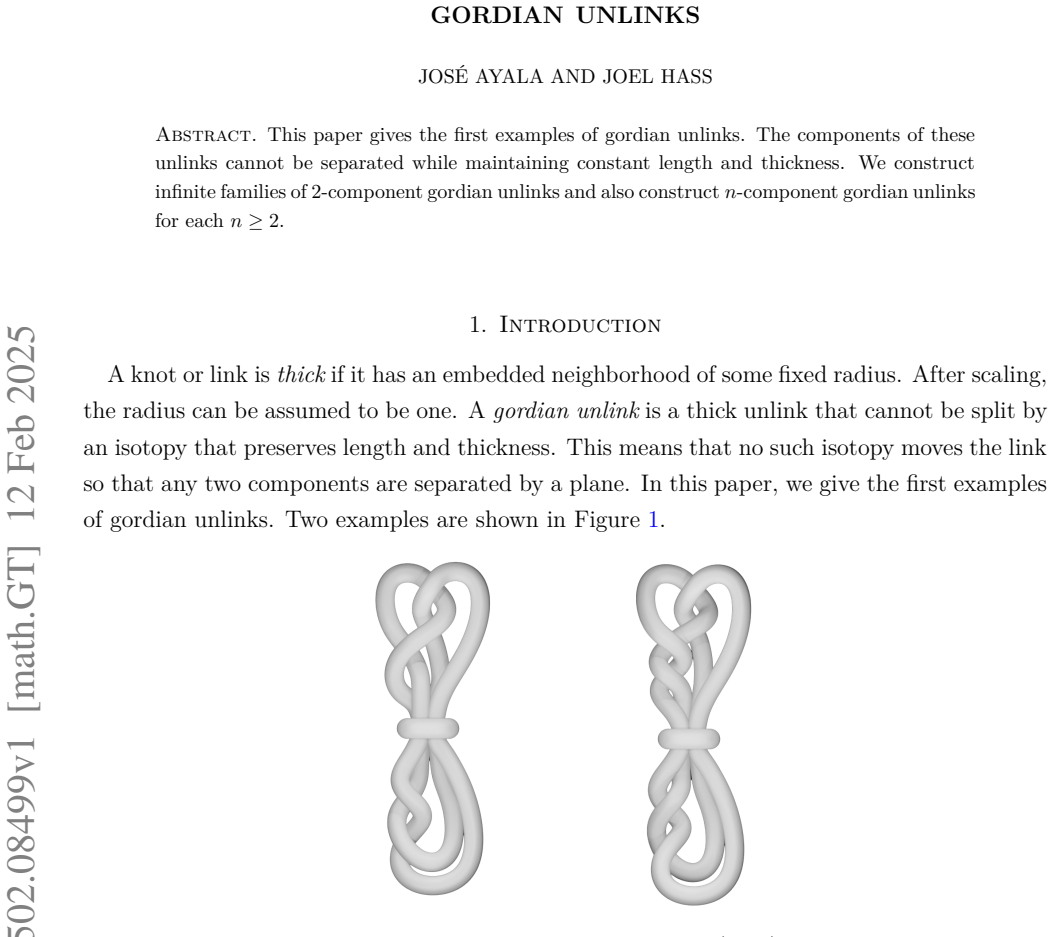
The central claim is Theorem 3.3: the two-component unlink L, drawn with one component α weaving through four unit disks whose centers lie in a square, and a second component β of length exactly 8+4π in the plane, is gordian. No isotopy that keeps both components at fixed length and fixed thickness of at least one can move the link to a split configuration. The same argument proves that every link L(m,n) with nonzero integers m,n is gordian, and that for each n≥2 there are n-component gordian unlinks. The reason is that throughout any such isotopy the four points of intersection of α with the cone over β must persist: Lemma 2.3 shows that β's exact length forces the cone angle to be exactly 2π and β to remain a planar convex curve, so the linking data built into α and β cannot dissolve.
Load-bearing premise
The proof rests on the second component β having length exactly 8+4π; if β were even slightly longer, the inequality in Lemma 2.3 would no longer force the cone angle to be 2π, and β could bend out of the plane and allow the link to split.
Editorial extensions
If this is right
- For every choice of nonzero integers m and n, the two-component unlink L(m,n) is gordian, so the construction yields infinitely many distinct examples.
- For every n≥2 there exist n-component gordian unlinks, obtained by stacking parallel copies of the planar curve β.
- The existence of gordian unlinks implies that the space of thick k-component unlinks is not homotopy equivalent to the space of configurations of k unlinked round circles, contradicting the natural thick analogue of the classical configuration-space result.
- The paper notes that minimizing the length of α in the thick isotopy class of L produces an ideal two-component unlink configuration that is not the standard one, though its explicit shape is not given.
Reading between the lines
- A natural next step is to compute the maximal length of β for which the link remains gordian; beyond that threshold the planarity argument breaks down and an explicit splitting isotopy may exist.
- The four-point locking mechanism suggests a possible route toward a gordian unknot, whose existence remains open, by arranging analogous self-locking constraints within a single component.
- Lemma 2.3 could be tested numerically: a search for rectifiable closed curves of length exactly 8+4π with four well-separated points and cone angle strictly above 2π would either confirm the rigidity or locate its boundary.
Editorial analysis
A structured set of objections, weighed in public.
Referee Report
Summary. The paper defines a gordian unlink as a thick unlink that cannot be split by a length- and thickness-preserving isotopy, meaning that no such isotopy moves the link so that two components are separated by a plane. The main construction is a 2-component unlink L (and a family L(m,n)) whose planar component β has length 8+4π and encloses four unit disks centered at points p_i; the other component α passes through the p_i and creates nonzero linking of the arcs when they are closed off by geodesic segments. The central result, Theorem 3.3, proves that L is gordian. The proof shows that Lemma 2.3 forces the cone angle θ(t) to be 2π and β(t) to be planar whenever the four-point property and length hypotheses hold, and then uses an open/closed argument to show that α(t) always meets the cone over β(t), preventing a plane from separating the two components. The paper also claims, in the abstract and in Final Remark (1), that n-component gordian unlinks exist for every n≥2.
Significance. If the 2-component result is correct, it provides the first examples of gordian unlinks and answers a natural question in geometric knot theory. The construction is explicit and uses no fitted parameters; the main argument is an appealing equality-based geometric lemma combined with an open/closed continuity argument. The paper also draws an interesting consequence for configuration spaces of thick unlinks. The authors are appropriately careful about the concurrent announcement by Kusner and Kusner and about the limitation that exact length equality in β is what forces planarity. However, the n-component assertion is not supported by the construction as written, and one geometric estimate in Lemma 3.2 is asserted from a figure rather than proved.
major comments (2)
- [Final Remark (1); Abstract] The claimed n-component generalization is not supported by the given construction. Stacking n−1 parallel copies of β in distinct parallel planes produces an initial configuration in which, for example, adjacent copies lie on opposite sides of a plane, so the link is already split under the paper's own definition of gordian unlink given in the introduction. If a different arrangement is intended, such as a single α woven through all copies, it is not described, and Lemma 3.2 does not automatically extend to several β-components because the invariant controls only one planar cone C(β(t)) at a time. The abstract's assertion that n-component gordian unlinks are constructed for every n≥2 is therefore unsubstantiated; the authors should either remove this claim or provide a valid construction and proof.
- [Section 3, Lemma 3.2] The lower bound of √3 on the distance between γ1(t) and γ3(t) is asserted from Figure 6 rather than proven. This bound is load-bearing in the proof because it gives the area lower bound 3π and hence the inequality ℓ(α_i(t))>8.8, which is used for the openness and closedness of W in Theorem 3.3. A short derivation from the parallelogram geometry of K(t) and the thickness and arc-length estimates would make the proof complete.
minor comments (5)
- [Section 3, Lemma 3.2 proof] The sentence "the distance between any two of the {pi(t)} is equal to two" is false if it is meant for all pairs; the diagonals of the parallelogram are generally longer than two. It should say "the side lengths of K(t) are equal to two" or "consecutive points are distance two apart."
- [Theorem 3.3, closedness proof] In the closedness part, "Thus γt1 satisfies the four-point property" appears to be a typo; it should refer to β(t1) or L(t1).
- [Introduction, definition] The phrase "moves the link so that any two components are separated by a plane" is ambiguous for more than two components; it should be clarified whether a single separating plane for some pair is intended, since this matters for the n-component claim.
- [Section 3, opening paragraph] The family L(m,n) is described verbally and by figures rather than by an explicit parametrization; a precise definition of the twisting operations would help the reader verify that the link remains an unlink for all nonzero m,n.
- [Lemma 2.1 proof] There is a typo in the displayed convergence line: "ℓ(γ)i)" should read "ℓ(γ_i)".
Circularity Check
The two-component gordian-unlink proof is self-contained and non-circular; the only self-citation is contextual, though the n-component generalization in Final Remark (1) is unsupported as a correctness matter.
full rationale
The central derivation chain for Theorem 3.3 is not circular: the length bound ℓ(β) = 8 + 4π is an explicit chosen hypothesis, Lemma 2.3 derives planarity from an extremal equality in a CAT(0) cone, and the four-point property is verified at t = 0 and propagated by an open/closed argument. The proof relies on external mathematical results — Bridson–Haefliger, Cantarella–Kusner–Sullivan, Izmestiev, and Santaló — none of which encode the conclusion that L is gordian. The only self-citation is Ayala [1], used solely to contrast prior methods in the introduction, so it is not load-bearing. The Kusner–Kusner announcement [11] is disclosed and not used. Two non-circular weaknesses appear: Final Remark (1) claims n-component gordian unlinks by stacking parallel copies of β, but under the paper's own definition a configuration with parallel copies stacked in distinct planes is already separated by a plane for n > 2, so the generalization is not established; and Final Remark (3) openly leaves the maximal β-length uncomputed. These are completeness or correctness concerns, not cases where a prediction reduces to its inputs by construction.
Assumptions & free parameters
free parameters (1)
- Length of planar component beta =
8+4π
assumptions (6)
- standard math Isoperimetric inequality for Euclidean cone surfaces with cone angle at least 2π (area ≤ length^2 / 4π)
- standard math CAT(0) cone geometry: unique geodesics, convex hulls, and closest point projection decreasing distances in spaces with cone angle at least 2π
- standard math Crofton formula on the sphere: length of a curve on S^2 is one fourth the integral of the number of intersections with great circles
- standard math Gauss-Bonnet theorem for surfaces with cone singularities
- domain assumption C^{1,1} regularity and unit-ball separation properties of thick links (Lemma 5 of [4])
- standard math Smooth approximation of rectifiable curves with controlled convergence of lengths, cone points, and cone angles
Cite this review
Pith. "Pith review of Gordian Unlinks." pith.science (2026). https://pith.science/paper/WTOHWWCA
@misc{pith2026250208499,
  author       = {Pith},
  title        = {Pith review of: Gordian Unlinks},
  year         = {2026},
  howpublished = {\url{https://pith.science/paper/WTOHWWCA}},
  note         = {Machine review of arXiv:2502.08499}
}
abstract
This paper gives the first examples of gordian unlinks. The components of these unlinks cannot be separated while maintaining constant length and thickness. We construct infinite families of 2-component gordian unlinks and also construct $n$-component gordian unlinks for each $n \geq 2$.
Figures


Figures from the paper (3 more)


Reference graph
Works this paper leans on
-
[1]
J. Ayala, Thin Gordian Unlinks,Proceedings of the Royal Society of Edinburgh, Section A, accepted for publication, https://arxiv.org/abs/2310.14846
-
[2]
T. E. Brendle and A. E. Hatcher,Configuration spaces of rings and wickets, Comment. Math. Helv. 88 (2013), 131–162
work page 2013
-
[3]
M. Bridson and A. Haefliger,Metric Spaces of Non-positive Curvature, Springer-Verlag, Berlin, Heidelberg, 1999
work page 1999
-
[4]
J. Cantarella, R. B. Kusner, and J. M. Sullivan,On the minimum ropelength of knots and links, Invent. Math. 150 (2002), 257–286
work page 2002
-
[5]
A. Coward and J. Hass,Topological and physical knot theory are distinct, Pacific J. Math.276(2) (2015), 387–400
work page 2015
-
[6]
E. Flapan and H. Wong (eds.),Topology and geometry of biopolymers: AMS special session topology of biopolymers April 21-22, 2018 Northeastern University, Boston, Massachusetts, Contemp. Math., American Mathematical Society, 2018
work page 2018
-
[7]
O. Gonzalez and J. H. Maddocks,Global curvature, thickness, and the ideal shapes of knots, Proc. Nat. Acad. Sci. USA96 (1999), 4769–4773
work page 1999
-
[8]
Hatcher,A proof of the Smale conjecture,Diff(S3)≃ O(4), Ann
A. Hatcher,A proof of the Smale conjecture,Diff(S3)≃ O(4), Ann. Math. 117 (1983), 553–607. GORDIAN UNLINKS 11
work page 1983
Show all 15 references
-
[9]
Izmestiev, A simple proof of an isoperimetric inequality for Euclidean and hyperbolic cone-surfaces, Differential Geom
I. Izmestiev, A simple proof of an isoperimetric inequality for Euclidean and hyperbolic cone-surfaces, Differential Geom. Appl.43 (2015), 95–101
2015
-
[10]
Kusner and W
R. Kusner and W. Kusner,A Gordian pair of links, Geometriae Dedicata217 (2023), Article 47
2023
-
[11]
Kusner and W
R. Kusner and W. Kusner, The Xarax Unlinks are Physically Gordon, Circle Packings, Minimal Sur- faces, and Discrete Differential Geometry Poster Session Abstracts, ICERM 2/11/25,https://app.icerm. brown.edu/assets/521/8574/8574_4906_021120251500_Slides.pdf
-
[12]
Stasiak, V
A. Stasiak, V. Katritch, L. H. Kauffman (Eds.),Ideal Knots, Series on Knots and Everything, Vol. 19, World Scientific Publishing, 1998, pp. 20-41, doi: 10.1142/3843
1998 doi
-
[13]
L. A. Santaló,Integral formulas in Crofton’s style on the sphere and some inequalities referring to spherical curves, Duke Math. J.9(4) (1942), 707–722. DOI: 10.1215/S0012-7094-42-00949-9
1942 doi
-
[14]
Segura, O
J. Segura, O. Díaz-Ingelmo, B. Martínez-García, A. Ayats-Fraile, C. Nikolaou, and J. Roca,Nucleosomal DNA has topological memory, Nature Commun. 15 (2024), Article 4526
2024
-
[15]
Tubiana, G
L. Tubiana, G. P. Alexander, A. Barbensi, et al.,Topology in soft and biological matter, Phys. Rep. 1075 (2024), 1–137. Universidad de Tarapacá, Iquique, Chile Email address: jayalhoff@gmail.com Department of Mathematics, University of California, Davis California 95616 Email ...
2024
Reviewed August 8, 2026 · model on record in the stance chip above.
Discussion (0). Continue with ORCID to comment.