REVIEW 3 major objections 5 minor 1 cited by
Transient growth and nonlinear breakdown of wavelet-based resolvent modes in turbulent channel flow
T0 review · 3 major / 5 minor · reviewed 2026-08-08 · deepseek-v4-flash
Pith's one-line read Injected linear mode briefly drives near-wall streaks in turbulent channel flow.
desk verdict Careful forced-DNS test of wavelet resolvent modes shows early linear agreement then nonlinear decay; frozen-mean caveat is real but not fatal. read the letter →
The pith
A machine-rendered reading of the paper's core claim, the machinery that carries it, and where it could break.
The reading
What carries the argument
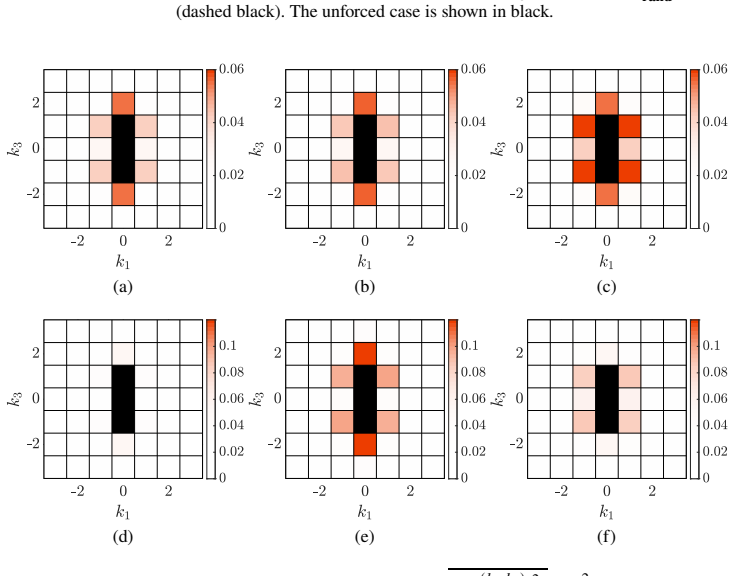
The central object is the windowed wavelet-based resolvent operator $\tilde{H}^{(0,1)} B$, where $\tilde{H}$ is the discrete linearized Navier-Stokes operator in a wavelet-in-time basis and $B$ is a windowing matrix that restricts the forcing to a compact Daubechies-8 scaling-function pulse at a chosen scale and shift. An SVD of this combined operator yields the optimal forcing mode (streamwise rolls) and the corresponding transient response mode (streamwise streaks), ordered by time-integrated kinetic-energy amplification. The second half of the machinery is the scale-to-scale energy-transfer diagnostic $\hat{T}^{(0,1)}_{(p_1,p_3)}$, which decomposes nonlinear transfer from the actuated mode by interacting wavenumbers and by advection direction; this diagnostic localizes the $(0,2)$ and $(1,1)$ sinks and identifies spanwise self-advection as the dominant pathway.
What would settle it
Run the same forced DNS with the mean-fixing body force removed at $\varepsilon = 10\%$; if the DNS still tracks the linear response mode up to $t\approx 0.7\,h/u_\tau$ and the peak streak energy still scales sub-quadratically, the frozen-mean assumption is not biasing the comparison, but if the deviation begins earlier or the peak shifts significantly, the paper's attribution of the premature decay to nonlinearity is called into question.
Extended reading notes
Core claim
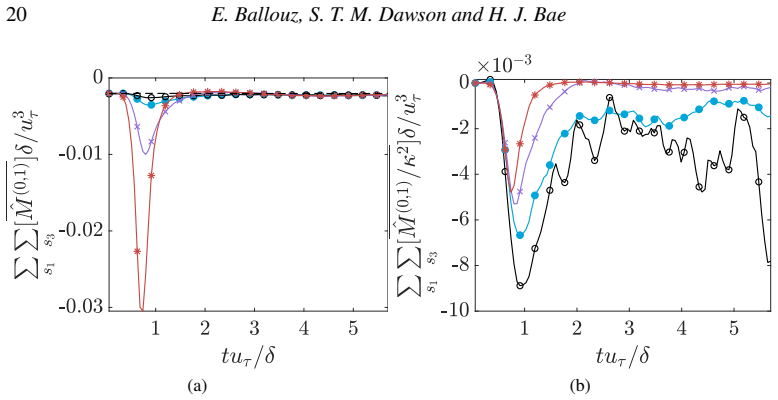
The central claim is that the time-localized principal resolvent forcing mode, obtained from an SVD of the windowed wavelet-based resolvent operator, is an effective but imperfect actuator for the buffer-layer streak cycle. In the minimal flow unit at $Re_\tau\approx 186$, forcing that mode at intensities $\varepsilon = 1\%$ to $10\%$ of the unforced nonlinearity produces the expected rolls-to-streaks lift-up growth, and the instantaneous streamwise velocity deviation collapses onto the linear response mode for $t \lesssim 0.7\,h/u_\tau$ and $y^+ \lesssim 15$. Beyond that, the response decays prematurely in all cases, with peak streak energy scaling sub-quadratically and decay time scaling as $\varepsilon^{-0.65}$. The principal mode still outperforms the first suboptimal mode and a random forcing structure at amplifying near-wall streaks, though the effective amplification gap is small. The paper also claims that the nonlinear breakdown follows a fixed spatial template: spanwise self-advection feeds a $(0,2)$ mode in the near-wall region and a $(1,1)$ mode in the outer region, and resolvent modes of those secondary scales sit exactly at the foci of energy transfer.
Load-bearing premise
The whole comparison assumes the mean streamwise profile stays exactly as in the unforced flow, enforced by an artificial body force, so the resolvent mode remains optimal for the base flow the DNS actually sees.
Editorial extensions
If this is right
- Resolvent-based control designs must discount linear amplification by an intensity-dependent factor, because the DNS amplification coefficient $\sigma_{eff}$ is always below $\sigma_1 = 11.54$ and decreases with forcing strength.
- Streak breakdown is wavenumber-selective: actuating the $(0,1)$ mode feeds the $(0,2)$ mode near the wall and the $(1,1)$ mode in the outer layer, so control aimed at sustaining streaks should target those two secondary modes.
- The dominance of spanwise self-advection in the nonlinear energy transfer implies that reducing spanwise gradients of the actuated streak, rather than streamwise or wall-normal coupling, is the likeliest way to prolong transient growth.
- The early collapse of the DNS onto the linear response mode, lasting roughly an eddy turnover time near the wall, supports using the wavelet-resolvent mode as a short-horizon predictor of actuation effects in wall-bounded turbulence.
Reading between the lines
- One editorial extension: the same wavelet-resolvent construction could be applied to streak modes of different spanwise wavelengths to test whether linear amplification or nonlinear transfer controls streak spacing in larger channels.
- The paper's frozen-mean setting is its most delicate assumption; an unfixed-mean experiment at $\varepsilon = 10\%$ would cleanly check whether the early-time agreement is an artifact of holding the base flow constant.
- A practical control corollary left implicit is that there is a sweet spot in forcing intensity: too weak actuation wastes the mode's efficiency, while too strong trips the fast spanwise-advection decay, so an intermediate $\varepsilon$ should maximize time-integrated streak energy.
Editorial analysis
A structured set of objections, weighed in public.
Referee Report
Summary. The paper tests whether time-localised wavelet-based resolvent forcing modes, which are optimal for the linearised Navier-Stokes operator about a frozen mean profile, can transiently actuate near-wall streaks in a fully nonlinear minimal channel at Re_tau=186. Modes are computed by SVD of a windowed wavelet resolvent operator for the (k_x,k_z)=(0,1) Fourier mode, injected into an ensemble of forced DNS at amplitudes epsilon=1,2,5,10%, and compared with the optimal linear response mode. The authors report that the DNS tracks the optimal linear response at early times and near the wall, that nonlinearity causes premature decay with faster decay for stronger forcing, that the principal forcing mode outperforms random and second-suboptimal forcing, and that spanwise self-advection transfers energy to the (0,2) and (1,1) modes in the near-wall and outer regions. The manuscript also contains a quasi-linear model of the nonlinear energy transfer and resolvent analysis of the secondary modes.
Significance. If the central claims survive revision, the work provides a notable demonstration that transient resolvent modes can act as meaningful actuation structures in nonlinear turbulence and quantifies how nonlinearity clips linear optimal growth. The experimental design is careful in several respects: large ensembles (1000-4000), phase alignment via Eq. (2.10), modified wavenumbers matched to the DNS grid, and conservative comparisons against random and suboptimal forcing. The nonlinear energy transfer analysis and the quasi-linear model are valuable additions. The main caveat is that the frozen-mean constraint is load-bearing and the unfixed-mean check is asserted but not shown; this currently limits confidence in the claim that the DNS response tracks the linear response mode.
major comments (3)
- [§2.4 (Eq. 2.11) and §3.3] The artificial body force F that pins the mean streamwise profile to U1(y) is load-bearing for the central early-time agreement claim. The resolvent modes are optimal about this same frozen base flow, and both forced and unforced runs remove the (0,0) contribution of the right-hand side, so the comparison in Figs. 5-6 is between a constrained DNS and a linear operator defined about the same constrained base state. The authors acknowledge this and state in §3.3 that an unfixed-mean run for epsilon=5% gives a streak energy profile 'indeed very close' to Fig. 3(a), but no data, figure, or quantitative comparison is provided. Because allowing the mean to evolve would change the instantaneous linear operator and could reduce the alignment with the injected mode, the missing check directly affects the interpretation of the headline result. Please provide the unfixed-mean results (e.g., streak energy curve, peak and decay times, and the deviation from the linear response mode) or explicitly restrict the conclusions to the frozen-mean system.
- [§3.1 (Fig. 3b,d)] The scaling laws dE_hat_1 ~ |epsilon|^1.44 and dt_decay ~ |epsilon|^{-0.65} are presented as quantitative results but are fitted to only four forcing amplitudes with no uncertainty estimates, goodness-of-fit measures, or statement of the fit procedure. Since these exponents are used in the narrative that nonlinearities curtail linear growth and that stronger forcing accelerates decay, either provide confidence intervals and residual information or present these trends as qualitative descriptions of the four computed cases.
- [§3.3 (Fig. 7)] The abstract's claim that the principal forcing mode is 'more effective' than the second suboptimal mode rests on the observation that sigma_eff for phi1 exceeds that for phi3 by only a factor of 1.03, while the corresponding linear ratio sigma1/sigma3 is 2.16. No confidence interval is given for this 3% difference. Given that the ensemble sizes vary between 1000 and 4000 and that the earlier convergence check (§2.4) was reported for streak energy rather than for sigma_eff, please provide a statistical uncertainty estimate (e.g., bootstrap across initial conditions) for the effective amplification ratio to support the ordering claim.
minor comments (5)
- [§2.4, text after Eq. (2.9)] The sentence 'such that the resolvent forcing mode is increasing the initial energy of the right-hand side by epsilon%' is grammatically unclear; 'increasing' should be 'increases' and the sentence should be rephrased.
- [§3.3, last paragraph] The sentence 'very close to the what is shown in figure 3(a)' contains a typo ('the what'); please correct it and, more importantly, reference a figure or table for the unfixed-mean result.
- [Figure 9 caption] The caption states 'epsilon≈5%' for the purple case, whereas all other cases use exact percentages; please state the exact value or explain the approximation.
- [§4.1, first paragraph] The sentence 'The energy content of the secondary modes (figures 8, 9) are the result of nonlinear interactions' has a subject-verb disagreement; 'are' should be 'is'.
- [§2.4, random forcing] The random forcing mode phi_rand is not fully specified; please state how the random spatial field is sampled (e.g., Gaussian, wall-normal support) and how its normalization is performed, to enable reproducibility.
Circularity Check
No significant circularity: the DNS injection is an external test of the resolvent modes, with no fitted parameters; the frozen-mean constraint is a stated assumption and the missing unfixed-mean check is a transparency limitation, not a circular reduction.
full rationale
The paper's derivation chain is: (i) compute a turbulent mean profile U1 from unforced DNS; (ii) build a wavelet-based resolvent operator about U1, take its SVD, and obtain optimal forcing and response modes; (iii) inject the principal forcing mode into a fully nonlinear DNS, artificially freezing the mean profile via the body force F=(F1,0,0) in Eq. (2.11); (iv) compare the DNS velocity deviation Δ with the linear resolvent response σ1ψ1. The central claim—that the DNS initially tracks the linear response and then decays prematurely due to nonlinearity—is an external test rather than a constructed equivalence. No parameter of the DNS is fitted to force agreement; the linear response is computed from the linearised operator, while the DNS evolves the full nonlinear equations with turbulent initial conditions. The early-time agreement is a nontrivial quantitative result, and the paper explicitly reports the overprediction and nonlinear breakdown. The self-citations to Ballouz et al. for the wavelet-resolvent formulation are normal references to prior published methodology, not load-bearing appeals to a uniqueness theorem; the framework is used as a tool, not as evidence for the DNS outcome. The main caveat is that the frozen-mean forcing F in Eq. (2.11) keeps the base flow artificially fixed to the resolvent's base profile, so the early-time comparison could be favourably biased. The authors acknowledge this in §3.3: 'allowing the mean profile to vary may reduce the effectiveness of the forcing mode', and they assert an unfixed-mean check: 'Though not shown, the streak energy profile obtained for ε=5% and an unfixed mean velocity is indeed very close to the what is shown in figure 3(a)'. This check is not displayed or quantified, which weakens the support for the frozen-mean assumption. However, this is a limitation or missing-support issue, not a circularity: the DNS is still a genuinely nonlinear, independent simulation, and the linear response is not obtained from the DNS data. Overall, the derivation is self-contained against an external benchmark, and the circularity score is low.
Assumptions & free parameters
free parameters (2)
- Peak streak energy scaling exponent =
1.44
- Decay time scaling exponent =
-0.65
assumptions (6)
- domain assumption The linearised Navier-Stokes equations about the mean turbulent profile capture the dominant amplification mechanism for the targeted (0,1) mode.
- standard math The wavelet-based resolvent formulation of Ballouz et al. (2024b) correctly extends resolvent analysis to transient trajectories.
- domain assumption A single-level Daubechies-8 wavelet/scaling-function pair is sufficient to represent the time-localized forcing and response.
- ad hoc to paper Freezing the mean profile with the artificial forcing F does not qualitatively change the (0,1)-mode dynamics.
- domain assumption The minimal flow unit at Re_tau=186 with wavenumbers (0,1) is representative of the near-wall self-sustaining cycle.
- standard math The scale-to-scale nonlinear energy transfer term (4.4), taken from Symon et al. (2021) and Ding et al. (2025), correctly isolates mode-to-mode energy exchange.
Cite this review
Pith. "Pith review of Transient growth and nonlinear breakdown of wavelet-based resolvent modes in turbulent channel flow." pith.science (2026). https://pith.science/paper/FBCSN572
@misc{pith2026250208670,
  author       = {Pith},
  title        = {Pith review of: Transient growth and nonlinear breakdown of wavelet-based resolvent modes in turbulent channel flow},
  year         = {2026},
  howpublished = {\url{https://pith.science/paper/FBCSN572}},
  note         = {Machine review of arXiv:2502.08670}
}
read the original abstract
We study the effectiveness of the time-localised principal resolvent forcing mode at actuating the near wall cycle of turbulence. The mode is restricted to a wavelet pulse and computed from an SVD of the windowed wavelet-based resolvent operator so that it produces the largest amplification via the linearised Navier-Stokes equations. We then inject this time-localised mode into the turbulent minimal flow unit at different intensities, and measure the instantaneous deviation of the system's response from the optimal resolvent response mode. This is possible under the new formulation, which enables the modes to represent transient trajectories. For the most energetic spatial wave numbers in the minimal flow unit -- constant in the streamwise direction and once-periodic in the spanwise direction -- the forcing mode takes the shape of streamwise rolls and produces a response mode in the form of streamwise streaks that transiently grow and decay. For initial times and close to the wall, the DNS response matches the principal response mode well, but due to nonlinearities, the response across all forcing intensities decays prematurely, and a higher forcing intensity leads to faster energy decay. The principal forcing mode still leads to significant energy amplification and is more effective than a randomly-generated forcing structure and the second suboptimal resolvent forcing mode at amplifying the near-wall streaks. We compute the nonlinear energy transfer to secondary modes and observe that the breakdown of the actuated mode proceeds similarly across all forcing intensities: in the near-wall region, the induced streak forks into a structure twice periodic in the spanwise direction; in the outer region, the streak breaks up into a structure that is once periodic in the streamwise direction. In both regions, spanwise gradients account for the dominant share of nonlinear energy transfer.
Figures


Figures from the paper (17 more)





Forward citations
Cited by 1 Pith paper
-
Extracting dominant dynamics about unsteady base flows
A perspective review of methods for extracting perturbation dynamics about time-varying base flows, identifying unresolved challenges in defining the base flow and extending operator-based analyses to aperiodic flows.
Reference graph
Works this paper leans on
-
[1]
, " * write output.state after.block = add.period write newline
ENTRY address author booktitle chapter edition editor howpublished institution journal key month note number organization pages publisher school series title type volume year eprint label extra.label sort.label short.list INTEGERS output.state before.all mid.sentence after.sentence after.block FUNCTION init.state.consts #0 'before.all := #1 'mid.sentence ...
-
[2]
write newline
" write newline "" before.all 'output.state := FUNCTION n.dashify 't := "" t empty not t #1 #1 substring "-" = t #1 #2 substring "--" = not "--" * t #2 global.max substring 't := t #1 #1 substring "-" = "-" * t #2 global.max substring 't := while if t #1 #1 substring * t #2 global.max substring 't := if while FUNCTION word.in bbl.in capitalize " " * FUNCT...
-
[3]
Adrian, R. J. 2007 Hairpin vortex organization in wall turbulence . Phys. Fluids 19 (4)
work page 2007
-
[4]
Bae, H. J. , Lozano-Dur \'a n, A. , Bose, S. T. & Moin, P. 2019 Dynamic slip wall model for large-eddy simulation . J. Fluid Mech. 859 , 400--432
2019
-
[5]
Bae, H. J. , Lozano-Durán, A. , Bose, S. T. & Moin, P. 2018 Turbulence intensities in large-eddy simulation of wall-bounded flows . Phys. Rev. Fluids 3 (1), 014610
work page 2018
-
[6]
Bae, H. J. , Lozano-Durán, A. & McKeon, B. J. 2021 Nonlinear mechanism of the self-sustaining process in the buffer and logarithmic layer of wall-bounded flows . J. Fluid Mech. 914 , A3
work page 2021
-
[7]
Bakewell Jr., H. P. & Lumley, J. L. 1967 Viscous sublayer and adjacent wall region in turbulent pipe flow . Phys. Fluids 10 (9), 1880--1889
work page 1967
-
[8]
Ballouz, E. , Dawson, S. T. M. & Bae, H. J. 2024 a\/ Transient growth of wavelet-based resolvent modes in the buffer layer of wall-bounded turbulence. In J. Phys.: Conference Series\/ , , vol. 2753 , p. 012002 . IOP Publishing
work page 2024
Show all 69 references
-
[9]
, Lopez-Doriga, B
Ballouz, E. , Lopez-Doriga, B. , Dawson, S. T. & Bae, H. J. 2023 Wavelet-based resolvent analysis for statistically-stationary and temporally-evolving flows. In AIAA SCITECH 2023 Forum\/ , p. 0676
2023
-
[10]
, Lopez-Doriga, B
Ballouz, E. , Lopez-Doriga, B. , Dawson, S. T. M. & Bae, H. J. 2024 b\/ Wavelet-based resolvent analysis of non-stationary flows . J. Fluid Mech. 999 , A53
2024
-
[11]
Blackwelder, R. F. & Eckelmann, H. 1979 Streamwise vortices associated with the bursting phenomenon . J. Fluid Mech. 94 (3), 577--594
1979
-
[12]
Butler, K. M. & Farrell, B. F. 1993 Optimal perturbations and streak spacing in wall-bounded turbulent shear flow . Phys. Fluids A 5 (3), 774--777
1993
-
[13]
Chernyshenko, S. I. & Baig, M. F. 2005 The mechanism of streak formation in near-wall turbulence . J. Fluid Mech. 544 , 99--131
2005
-
[14]
, Hwang, Y
Cho, M. , Hwang, Y. & Choi, H. 2018 Scale interactions and spectral energy transfer in turbulent channel flow . J. Fluid Mech. 854 , 474--504
2018
-
[15]
1992 Ten lectures on wavelets\/
Daubechies, I. 1992 Ten lectures on wavelets\/ . SIAM
1992
-
[16]
Del Alamo, J. C. & Jiménez, J. 2006 Linear energy amplification in turbulent channels . J. Fluid Mech. 559 , 205--213
2006
-
[17]
Journal of Fluid Mechanics 1002 , A42
Ding, Jitong , Chung, Daniel & Illingworth, Simon J 2025 Mode-to-mode nonlinear energy transfer in turbulent channel flows . Journal of Fluid Mechanics 1002 , A42
2025
-
[18]
, Lenz, E
Elnahhas, A. , Lenz, E. , Moin, P. , Lozano-Dur \'a n, A. & Bae, H. J. 2024 Are the dynamics of wall turbulence in minimal channels and larger domain channels equivalent ? A graph-theoretic approach . J. Phys.:Conf. Ser. 2753 , 012004
2024
-
[19]
Encinar, M. P. & Jim \'e nez, J. 2020 Momentum transfer by linearised eddies in turbulent channel flows . J. Fluid Mech. 895 , A23
2020
-
[20]
Farrell, B. F. , Gayme, D. F. & Ioannou, P. J. 2017 A statistical state dynamics approach to wall turbulence . Phil. Trans. R. Soc. A 375 (2089), 20160081
2017
-
[21]
Gayme, D. F. & Minnick, B. A. 2019 Coherent structure-based approach to modeling wall turbulence . Phys. Rev. Fluids 4 (11), 110505
2019
-
[22]
Hamilton, J. M. , Kim, J. & Waleffe, F. 1995 Regeneration mechanisms of near-wall turbulence structures . J. Fluid Mech. 287 , 317--348
1995
-
[23]
Heide, A. L. & Hemati, M. S. 2023 An optimization framework for analyzing nonlinear stability due to sparse finite-amplitude perturbations. In AIAA AVIATION 2023 Forum\/ , p. 4258
2023
-
[24]
, Toedtli, S
Huang, Y. , Toedtli, S. S. , Chini, G. P. & McKeon, B. J. 2023 Spatio-temporal characterization of non-linear forcing in turbulence . arXiv preprint arXiv:2305.00095
2023 arXiv
-
[25]
& Cossu, C
Hwang, Y. & Cossu, C. 2010 Self-sustained process at large scales in turbulent channel flow . Phys. Rev. Lett. 105 (4), 044505
2010
-
[26]
, Nichols, J
Jeun, J. , Nichols, J. W. & Jovanovi \'c , M. R. 2016 Input-output analysis of high-speed axisymmetric isothermal jet noise . Phys. Fluids 28 (4), 047101
2016
-
[27]
2013 How linear is wall-bounded turbulence? Phys
Jim \'e nez, J. 2013 How linear is wall-bounded turbulence? Phys. Fluids 25 (11)
2013
-
[28]
2018 Coherent structures in wall-bounded turbulence
Jim \'e nez, J. 2018 Coherent structures in wall-bounded turbulence . J. Fluid Mech. 842 , P1
2018
-
[29]
& Moin, P
Jim \'e nez, J. & Moin, P. 1991 The minimal flow unit in near-wall turbulence . J. Fluid Mech. 225 , 213--240
1991
-
[30]
Johansson, A. V. , Her, J.-Y. & Haritonidis, J. H 1987 On the generation of high-amplitude wall-pressure peaks in turbulent boundary layers and spots . J. Fluid Mech. 175 , 119--142
1987
-
[31]
Kerswell, R. R. 2018 Nonlinear nonmodal stability theory . Ann. Rev. Fluid Mech. 50 (1), 319--345
2018
-
[32]
Kim, H. T. , Kline, S. J. & Reynolds, W. C. 1971 The production of turbulence near a smooth wall in a turbulent boundary layer . J. Fluid Mech. 50 (1), 133--160
1971
-
[33]
& Moin, P
Kim, J. & Moin, P. 1985 Application of a fractional-step method to incompressible N avier- S tokes equations . J. Comput. Phys. 59 (2), 308--323
1985
-
[34]
Klebanoff, P. S. , Tidstrom, K. D. & Sargent, L. M. 1962 The three-dimensional nature of boundary-layer instability . J. Fluid Mech. 12 (1), 1--34
1962
-
[35]
Kline, S. J. , Reynolds, W. C. , Schraub, F. A. & Runstadler, P. W. 1967 The structure of turbulent boundary layers . J. Fluid Mech. 30 (4), 741--773
1967
-
[36]
, Yeh, C
Kojima, Y. , Yeh, C. , Taira, K. & Kameda, M. 2020 Resolvent analysis on the origin of two-dimensional transonic buffet . J. Fluid Mech. 885 , R1
2020
-
[37]
Landahl, M. T. 1980 A note on an algebraic instability of inviscid parallel shear flows . J. Fluid Mech. 98 (2), 243--251
1980
-
[38]
, Tsai, M.-L
Lin, C.-T. , Tsai, M.-L. & Tsai, H.-C. 2023 Flow control of a plunging cylinder based on resolvent analysis . J. of Fluid Mech. 967 , A41
2023
-
[39]
, Sun, Y
Liu, Q. , Sun, Y. , Yeh, C.-A. , Ukeiley, L. S. , Cattafesta III, L. N. & Taira, K. 2021 Unsteady control of supersonic turbulent cavity flow based on resolvent analysis . J. Fluid Mech. 925 , A5
2021
-
[40]
, Ballouz, E
L\'opez-Doriga, B. , Ballouz, E. , Bae, H. J. & Dawson, S. T. M. 2023 A sparsity-promoting resolvent analysis for the identification of spatiotemporally-localized amplification mechanisms. In AIAA SCITECH 2023 Forum\/ , p. 0677
2023
-
[41]
, Ballouz, E
L\'opez-Doriga, B. , Ballouz, E. , Bae, H. J. & Dawson, S. T. M. 2024 Sparse space–time resolvent analysis for statistically stationary and time-varying flows . J. Fluid Mech. 999 , A87
2024
-
[42]
& Bae, H
Lozano-Dur \'a n, A. & Bae, H. J. 2016 Turbulent channel with slip boundaries as a benchmark for subgrid-scale models in les . Annual Research Briefs. Center for Turbulence Research 2016 , 97--103
2016
-
[43]
, Constantinou, N
Lozano-Dur \'a n, A. , Constantinou, N. C. , Nikolaidis, M.-A. & Karp, M. 2021 Cause-and-effect of linear mechanisms sustaining wall turbulence . J. Fluid Mech. 914 , A8
2021
-
[44]
1999 A wavelet tour of signal processing\/
Mallat, S. 1999 A wavelet tour of signal processing\/ . Elsevier
1999
-
[45]
Markeviciute, V. K. & Kerswell, R. R. 2024 Threshold transient growth as a criterion for turbulent mean profiles . J. Fluid Mech. 996 , A32
2024
-
[46]
McKeon, B. J. 2017 The engine behind (wall) turbulence: perspectives on scale interactions . J. Fluid Mech. 817 , P1
2017
-
[47]
McKeon, B. J. & Sharma, A. S. 2010 A critical-layer framework for turbulent pipe flow . J. Fluid Mech. 658 , 336--382
2010
-
[48]
, Sharma, A
Moarref, R. , Sharma, A. S. , Tropp, J. A. & McKeon, B. J. 2013 Model-based scaling of the streamwise energy density in high- R eynolds-number turbulent channels . J. Fluid Mech. 734 , 275--316
2013
-
[49]
, Nogueira, P
Morra, P. , Nogueira, P. A. S. , Cavalieri, A. V. G. & Henningson, D. S. 2021 The colour of forcing statistics in resolvent analyses of turbulent channel flows . J. Fluid Mech. 907 , A24
2021
-
[50]
, Semeraro, O
Morra, P. , Semeraro, O. , Henningson, D. S. & Cossu, C. 2019 On the relevance of R eynolds stresses in resolvent analyses of turbulent wall-bounded flows . J. Fluid Mech. 867 , 969--984
2019
-
[51]
2012 Wavelets: A concise guide\/
Najmi, A.-H. 2012 Wavelets: A concise guide\/ . JHU Press
2012
-
[52]
2000 Fluid flow phenomena: a numerical toolkit
Orlandi, P. 2000 Fluid flow phenomena: a numerical toolkit . Springer Science & Business Media 55
2000
-
[53]
Orr, W. M. F. 1907 The stability or instability of the steady motions of a perfect liquid and of a viscous liquid. P art II : A viscous liquid 27 , 69--138
1907
-
[54]
Panton, R. L. 2001 Overview of the self-sustaining mechanisms of wall turbulence . Prog. Aerosp. Sci. 37 (4), 341--383
2001
-
[55]
2000 Turbulent flows\/
Pope, S.B. 2000 Turbulent flows\/ . Cambridge University Press
2000
-
[56]
, Garc \' a-Villalba, M
Pujals, G. , Garc \' a-Villalba, M. , Cossu, C. & Depardon, S. 2009 A note on optimal transient growth in turbulent channel flows . Phys. Fluids 21 (1), 015109
2009
-
[57]
Robinson, S. K. 1991 Coherent motions in the turbulent boundary layer . Annu. Rev. Fluid Mech. 23 (1), 601--639
1991
-
[58]
Schmid, P. J. , Henningson, D. S. & Jankowski, D. F. 2002 Stability and transition in shear flows. applied mathematical sciences, vol. 142 . Appl. Mech. Rev. 55 (3), B57--B59
2002
-
[59]
Smith, C. R. & Metzler, S. P. 1983 The characteristics of low-speed streaks in the near-wall region of a turbulent boundary layer . J. Fluid Mech. 129 , 27--54
1983
-
[60]
Smits, A. J. , McKeon, B. J. & Marusic, I. 2011 High-- R eynolds number wall turbulence . Annu. Rev. Fluid Mech. 43 , 353--375
2011
-
[61]
, Illingworth, S
Symon, S. , Illingworth, S. J. & Marusic, I. 2021 Energy transfer in turbulent channel flows and implications for resolvent modelling . J. Fluid Mech. 911 , A3
2021
-
[62]
, Madhusudanan, A
Symon, S. , Madhusudanan, A. , Illingworth, S. J. & Marusic, I. 2023 Use of eddy viscosity in resolvent analysis of turbulent channel flow . Phys. Rev. Fluids 8 (6), 064601
2023
-
[63]
& Lumley, J
Tennekes, H. & Lumley, J. L. 1972 A first course in turbulence\/ . MIT press
1972
-
[64]
Thomas, V. L. , Lieu, B. K. , Jovanovi \'c , M. R. , Farrell, B. F. , Ioannou, P. J. & Gayme, D. F. 2014 Self-sustaining turbulence in a restricted nonlinear model of plane C ouette flow . Phys. Fluids 26 (10)
2014
-
[65]
Toedtli, S. S. , Luhar, M. & McKeon, B. J. 2019 Predicting the response of turbulent channel flow to varying-phase opposition control: resolvent analysis as a tool for flow control design . Phys. Rev. Fluids 4 (7), 073905
2019
-
[66]
1997 On a self-sustaining process in shear flows
Waleffe, F. 1997 On a self-sustaining process in shear flows . Phys. Fluids 9 (4), 883--900
1997
-
[67]
Wray, A. A. 1990 Minimal storage time advancement schemes for spectral methods . NASA Ames Research Center, California, Report No. MS 202
1990
-
[68]
& Taira, K
Yeh, C.-A. & Taira, K. 2019 Resolvent-analysis-based design of airfoil separation control . J. Fluid Mech. 867 , 572--610
2019
-
[69]
, Jovanovi \'c , M
Zare, A. , Jovanovi \'c , M. R. & Georgiou, T. T. 2017 Colour of turbulence . J. Fluid Mech. 812 , 636--680
2017
Reviewed August 8, 2026 · model on record in the stance chip above.
Discussion (0). Continue with ORCID to comment.