REVIEW 3 major objections 5 minor 83 references
The long life of ultra diffuse galaxies inside low-density dark matter halos: the case of AGC 114905
T0 review · 3 major / 5 minor · reviewed 2026-08-07 · deepseek-v4-flash
Pith's one-line read AGC 114905's stellar and gas discs remain globally stable for 5 Gyr even inside the very low-density dark halo implied by its rotation curve, overturning the earlier claim that such a halo would let the discs fly apart.
desk verdict A solid, well-scoped stability study of AGC 114905 that resolves the SS22 discrepancy using updated MP24 inputs, with the main caveat being that the result is contingent on those inputs and on a nonstandard gas-IC mapping. read the letter →
The pith
A machine-rendered reading of the paper's core claim, the machinery that carries it, and where it could break.
The reading
What carries the argument
The argument is carried by a self-consistent, three-component equilibrium model of the galaxy—a stellar disc, a gas disc, and a live dark-matter halo—constructed from distribution functions so that the initial density and kinematics match the revised observations. The two quantities that move the system across the instability threshold are the radial velocity dispersion of the disc gas (about 40% higher than the earlier estimate, reaching roughly 14 km/s in the centre) and the dark-matter mass within 10 kpc (about $9.2\times 10^8$ to $1.1\times 10^9\,M_\odot$). Stability is checked with the Toomre $Q$ parameter, its three-dimensional extension, the swing-amplification parameter $X$, and the global bar-stability parameter $E$; the fiducial models sit on the stable side of all these criteria, while the old-input models fall below them.
What would settle it
A deep, resolved observation of AGC 114905 that reveals a bar or strong m=2 spiral distortion in the stellar or gas disc would contradict the stability claim, as would a kinematic re-analysis that lowers the gas velocity dispersion to about 5 km/s or pushes the dark-matter mass within 10 kpc below roughly $9\times 10^8\,M_\odot$. The paper's own 'No DM' and cold-disc runs show such inputs form a bar within a few Gyr.
Extended reading notes
Core claim
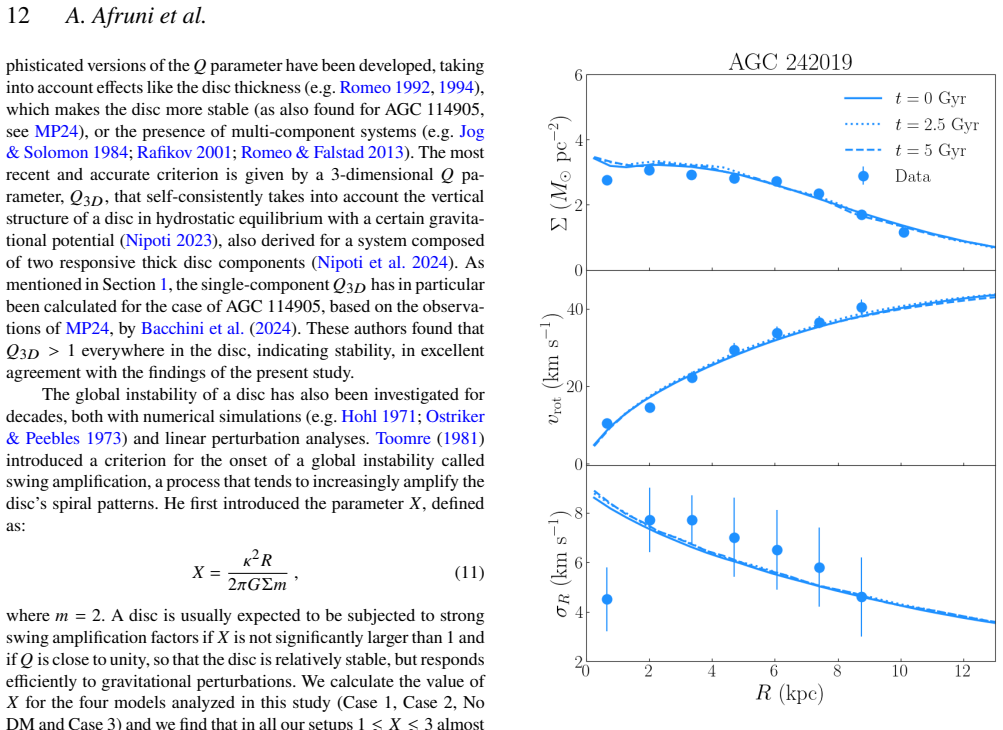
On the paper's own terms, the discovery is that AGC 114905 is not the dynamically fragile system it appeared to be. With the updated observational constraints the stellar and gas discs stay globally stable for the full 5 Gyr of simulation time, in both collisionless and hydrodynamic treatments and for both allowed dark-halo models: the lower-mass halo (Case 1, with a high baryon fraction) and the slightly more massive halo (Case 2, at the cosmological baryon fraction). Surface-density, scale-height, rotation, and velocity-dispersion profiles are essentially unchanged over the run. The earlier instability is reproduced only when the old, colder inputs are used—discs with velocity dispersion near 5 km/s and a dark halo with about $6.6\times 10^8\,M_\odot$ within 10 kpc—whereas models built from the revised data (about $9.2\times 10^8$ to $1.1\times 10^9\,M_\odot$ within 10 kpc, with dispersion rising to roughly 14 km/s in the centre) are stable. A test simulation for a second gas-rich ultra diffuse galaxy, AGC 242019, also shows no instability.
Load-bearing premise
The load-bearing premise is that the revised kinematic model of AGC 114905 is correct: if the gas is really much colder (near 5 km/s) or the dark halo is really much less massive within 10 kpc, the same simulations produce global instabilities.
Editorial extensions
If this is right
- AGC 114905 can persist unperturbed for at least 5 Gyr in both allowed low-concentration dark halos, making the low inner dark-matter densities inferred from its rotation curve dynamically plausible.
- The conflict with the earlier N-body result is explained: the older model used colder discs and a lighter halo, and simulations with those inputs do go unstable; the updated observations place the galaxy on the stable side.
- Because the most extreme known gas-rich ultra diffuse galaxy is stable, other HI-rich ultra diffuse galaxies with similar halos are likely stable too; the paper demonstrates this directly for AGC 242019.
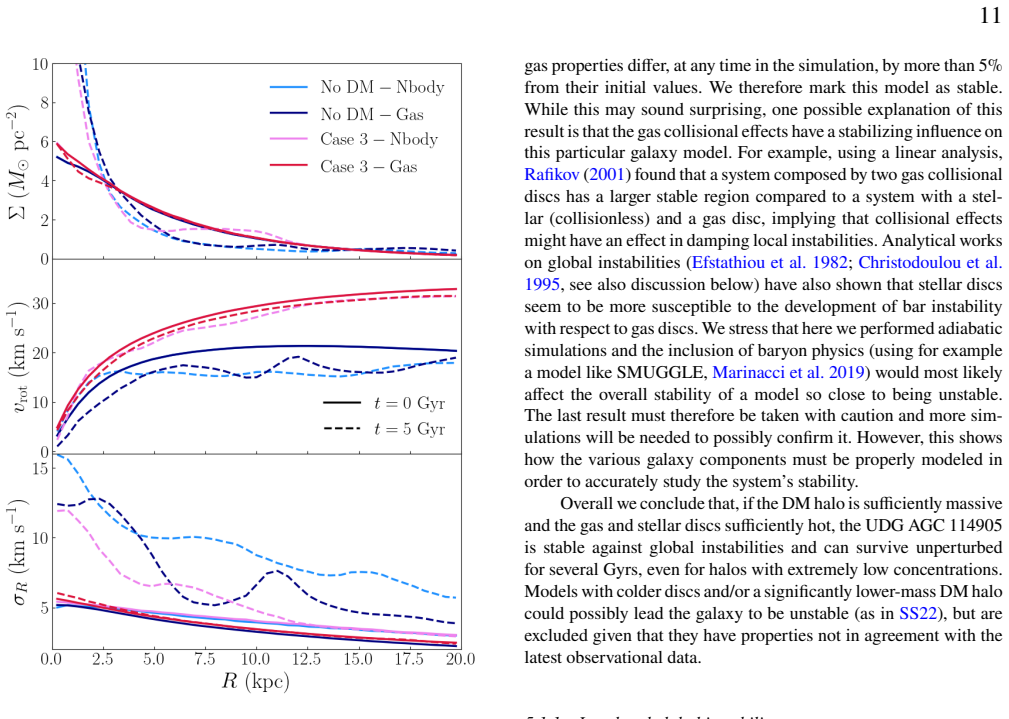
- Near the stability boundary, simple analytic criteria can be misleading: the cold-disc model with the Case 2 halo develops a bar in the collisionless run but stays stable when hydrodynamics is included, so full numerical treatment is needed for borderline systems.
Reading between the lines
- A natural next step is to map the instability boundary in the plane of gas velocity dispersion versus dark-matter mass within 10 kpc, so that other ultra diffuse galaxies can be classified as stable or unstable directly from their observed kinematics without running new simulations.
- Because the simulations are adiabatic and omit cooling, star formation, and feedback, the stability of borderline cases is the least secure conclusion; adding those processes could plausibly push near-threshold models either way, and this is the obvious stress test.
- The paper shifts the open question from whether such a galaxy can be stable to how such a low-density halo can form; testing formation channels, including self-interacting dark matter, is the logical follow-up.
Editorial analysis
A structured set of objections, weighed in public.
Referee Report
Summary. The paper revisits the global gravitational stability of the ultra-diffuse galaxy AGC 114905, using idealized AREPO simulations with initial conditions built from the updated observational constraints of Mancera Piña et al. (2024, MP24). The authors construct self-consistent equilibrium models with AGAMA, comprising a stellar disc, a gas disc, and a live coreNFW dark matter halo, and evolve them for 5 Gyr in four fiducial configurations: two halo cases (Case 1 and Case 2) each with collisionless N-body and adiabatic hydrodynamic treatments. They report that all four simulations show no significant evolution in surface density, scale height, rotation curve, or velocity dispersion, hence no global instabilities. To explain the discrepancy with Sellwood & Sanders (2022), they run control models with a low-mass halo and/or cold discs (5 km/s) and recover the previously reported instabilities. They also extend one simulation to another HI-rich UDG, AGC 242019, and find stability. The paper concludes that AGC 114905 and similar UDGs can survive in very low-concentration dark matter halos, thereby removing a dynamical objection to the observational inferences.
Significance. If the conclusion holds, the paper resolves an important tension: the low-density, low-concentration halos inferred from observations of AGC 114905 would be dynamically plausible despite the earlier instability claim of Sellwood & Sanders (2022). The choice of control runs is a clear strength: the 'No DM' and 'Case 3' models reproduce SS22's instabilities, which internally validates the numerical setup. The paper also makes a concrete, testable prediction that the stellar disc should rotate significantly more slowly than the gas disc due to asymmetric drift. The main limitation, which is honestly acknowledged, is that the stability result depends on the revised MP24 kinematic constraints; the paper shows explicitly that colder discs or a lower-mass halo would be unstable. Overall, the work is a useful contribution to the debate on UDG formation and dark matter models, though the central claim is conditional on the adopted observational parameters.
major comments (3)
- [Section 3.2.1, Eqs (8)-(9)] The conversion of the AGAMA particle velocity dispersion into internal energy via U_int = sigma_z^2 / ((gamma-1)(1-beta^2)) with beta=0.27 is an ad hoc prescription rather than a derived equilibrium condition. The paper does not demonstrate that the resulting gas disc is in vertical hydrostatic equilibrium under the ideal-gas equation of state, nor that the radial pressure gradient entering Eq. (9) matches the intended support for the adopted density and kinematics. Since the 'Case 3' simulation is stable with hydrodynamics but unstable in the collisionless run, the hydrodynamic stability appears sensitive to this mapping. I ask the authors to validate the mapping by, e.g., checking the residual of the vertical momentum equation at t=0, comparing the pressure-gradient-corrected rotation curve with the input circular velocity in detail, and performing a sensitivity run with a different beta value or an isothermal closure.
- [Section 5.1, Case 3 with hydrodynamics] The stability assessment for the hydrodynamic 'Case 3' run is based solely on gas properties: the text states that 'none of the gas properties differ ... by more than 5% from their initial values' and the model is then marked as stable. The collisionless version of the same model develops global instabilities in both the gas and stellar discs, so it is possible that the stellar disc in the hydrodynamic case is unstable even if the gas remains quiescent. Because the paper's conclusion (iii) claims that this intermediate model is stable, the authors should report the evolution of the stellar disc (surface density, kinematics, and scale height) for this run, or explicitly qualify the conclusion to refer to the gas disc only.
- [Section 4 and Table 2] Each model is simulated with a single realization and no convergence or particle-number study is presented. The 'Case 3' collisionless run develops a global instability despite having E=1.28, which the Efstathiou criterion predicts to be stable; this suggests that the stability boundary for these models is not well captured by global criteria and that the fiducial models, with Q~2, may be closer to marginality than the reported indicators alone imply. To support the robustness of the central claim, I request at least one additional realization with a different random seed or a higher particle number for the fiducial Case 2 model (or, minimally, for the 'Case 3' model), and a brief discussion of the effect on the evolution.
minor comments (5)
- [Section 3.2] The word 'politropic' should be 'polytropic'.
- [Section 3.2.1] The claim that the velocity-dispersion reduction factor beta=0.27 is independent of radius is stated but not shown; a small figure or table of beta(R) would make this more convincing.
- [Section 5.1] The definition of t_inst as the time when the average relative difference in at least one of Sigma, v_rot, or sigma_R exceeds 20% is not fully specified; please state the radial range and weighting used for the average.
- [Section 3.1.2] The values of the distribution-function input parameters (Sigma_i,0, R_d,i, sigma_X,i,0, R_sigma,X,i, h_i) are not reported in a table; providing them would improve reproducibility.
- [Abstract and Section 6] The phrase 'demonstrate that AGC 114905 ... can evolve unperturbed' is strong given that the result is conditional on the revised MP24 constraints; a formulation such as 'we show that, under the updated observational constraints, ...' would be more precise.
Circularity Check
No significant circularity: the 5 Gyr stability of the discs is an emergent simulation result, and the only overlapping-author input (MP24) is an independent observational analysis that does not itself assert stability.
full rationale
The paper's central claim is that the stellar and gas discs of AGC 114905 remain stable for 5 Gyr when initial conditions are built from the MP24 observational constraints. This claim is not inserted into the initial conditions as an input. The authors construct equilibrium models with AGAMA from the observed surface densities, circular velocities, and velocity dispersions, then evolve them with AREPO; the persistence of the density and kinematic profiles over 5 Gyr is the output of the time integration, not a fitted parameter or a definitional consequence. The stability diagnostics quoted in the paper (Toomre Q and Efstathiou E in Table 2) are computed from the same input quantities and are consistent with the simulation outcome, but the paper does not present the simulation as a restatement of those criteria; it uses the simulations as the actual test and explicitly notes that simple criteria can fail for near-marginal models. The only self-citation that is load-bearing in the sense of supplying inputs is MP24, but MP24 is an independent observational paper with new optical data and a kinematic modelling effort; its results are externally falsifiable and are not derived from the present stability claim. The gas initial-condition conversion in Section 3.2.1 sets the total velocity dispersion at t=0 equal to the observed value by construction, but the constancy of that dispersion and the absence of global instabilities over the subsequent evolution are emergent. The SS22-based control simulations show that the stability outcome depends on the adopted halo mass and velocity dispersion, which is parameter sensitivity rather than circularity. No step in the derivation reduces to its own input by definition, and no prediction is merely a fitted parameter renamed.
Assumptions & free parameters
free parameters (5)
- DM halo parameters (Case 1 and Case 2) =
log M200/Msun = 9.59 (Case 1), 10.13 (Case 2); c200 = 2.76, 1.2
- Gas disc velocity dispersion profile =
Approximately 14 km/s at center declining to approximately 5 km/s at 10 kpc
- Stellar disc velocity dispersion profile =
Similar to gas profile, approximately 14 to 5 km/s
- Disc structural parameters (Sigma_i,0, R_d,i, h_i) =
Not tabulated; tuned by trial and error in AGAMA
- Beta factor =
0.27
assumptions (4)
- standard math AGAMA's Staeckel fudge and Eddington inversion produce a steady, self-consistent multi-component equilibrium.
- domain assumption The gas disc is an ideal adiabatic fluid with no cooling, star formation, or feedback.
- domain assumption The MP24 kinematic decomposition is a faithful tracer of the gravitational potential.
- standard math Toomre Q, Efstathiou E, and swing X criteria apply to these thick two-component discs.
Cite this review
Pith. "Pith review of The long life of ultra diffuse galaxies inside low-density dark matter halos: the case of AGC 114905." pith.science (2026). https://pith.science/paper/GO4IPOHT
@misc{pith2026250208717,
  author       = {Pith},
  title        = {Pith review of: The long life of ultra diffuse galaxies inside low-density dark matter halos: the case of AGC 114905},
  year         = {2026},
  howpublished = {\url{https://pith.science/paper/GO4IPOHT}},
  note         = {Machine review of arXiv:2502.08717}
}
read the original abstract
It has long been known that, in the absence of a dark matter (DM) halo, galaxy discs tend to develop global gravitational instabilities that strongly modify their initial structure. The recent discovery of gas-rich ultra diffuse galaxies (UDGs) that seem to live in DM halos with very low concentrations, a very atypical configuration in the standard cosmological framework, poses therefore a crucial question: is the small contribution from such DM halos sufficient to stabilize the UDG discs? In this work we investigate this question, focusing on the extreme UDG AGC 114905, which previous works found to be unstable. Here, we revisit these studies, using idealised numerical simulations with AREPO of a system composed by a stellar disc, a gas disc and a DM halo in initial equilibrium with each other and with properties based on slightly revised observational data of AGC 114905. We explore different scenarios for the DM halo and we run our simulations for 5 Gyr. We find that in all cases the stellar and the gas discs are stable and that their initial density distributions and kinematic properties remain unchanged during the course of the simulation. We discuss how the apparent discrepancy with previous works (where the UDG developed instabilities) is due to our discs being dynamically hotter and living in slightly more massive DM halos, in accordance with the new observational constraints, previously unavailable. Our findings demonstrate that AGC 114905 (and likely other similar UDGs) can evolve unperturbed in halos that challenge current cosmological models.
Figures


Figures from the paper (6 more)


Reference graph
Works this paper leans on
-
[1]
Athanassoula E., 2002, @doi [ ] 10.1086/340784 , https://ui.adsabs.harvard.edu/abs/2002ApJ...569L..83A 569, L83
doi:10.1086/340784 2002
-
[2]
Bacchini C., Fraternali F., Iorio G., Pezzulli G., 2019, @doi [ ] 10.1051/0004-6361/201834382 , https://ui.adsabs.harvard.edu/abs/2019A&A...622A..64B 622, A64
-
[3]
Bacchini C., et al., 2024, @doi [ ] 10.1051/0004-6361/202449925 , https://ui.adsabs.harvard.edu/abs/2024A&A...687A.115B 687, A115
-
[4]
Bagla J. S., 2002, @doi [Journal of Astrophysics and Astronomy] 10.1007/BF02702282 , https://ui.adsabs.harvard.edu/abs/2002JApA...23..185B 23, 185
-
[5]
Benavides J. A., Sales L. V., Abadi M. G., Marinacci F., Vogelsberger M., Hernquist L., 2023, @doi [ ] 10.1093/mnras/stad1053 , https://ui.adsabs.harvard.edu/abs/2023MNRAS.522.1033B 522, 1033
- [6]
-
[7]
Binney J., Tremaine S., 2008, Galactic Dynamics: Second Edition
2008
-
[8]
F., eds, Society of Photo-Optical Instrumentation Engineers (SPIE) Conference Series Vol
Cepa J., et al., 2000, in Iye M., Moorwood A. F., eds, Society of Photo-Optical Instrumentation Engineers (SPIE) Conference Series Vol. 4008, Optical and IR Telescope Instrumentation and Detectors. pp 623--631, @doi 10.1117/12.395520
Show all 83 references
-
[9]
H., 2020, @doi [ ] 10.1051/0004-6361/201936821 , https://ui.adsabs.harvard.edu/abs/2020A&A...633L...3C 633, L3
Chamba N., Trujillo I., Knapen J. H., 2020, @doi [ ] 10.1051/0004-6361/201936821 , https://ui.adsabs.harvard.edu/abs/2020A&A...633L...3C 633, L3
2020 doi
-
[10]
K., Kere s D., Wetzel A., Hopkins P
Chan T. K., Kere s D., Wetzel A., Hopkins P. F., Faucher-Gigu \`e re C. A., El-Badry K., Garrison-Kimmel S., Boylan-Kolchin M., 2018, @doi [ ] 10.1093/mnras/sty1153 , https://ui.adsabs.harvard.edu/abs/2018MNRAS.478..906C 478, 906
2018 doi
-
[11]
M., Shlosman I., Tohline J
Christodoulou D. M., Shlosman I., Tohline J. E., 1995, @doi [ ] 10.1086/175547 , https://ui.adsabs.harvard.edu/abs/1995ApJ...443..551C 443, 551
1995 doi
-
[12]
Cimatti A., Fraternali F., Nipoti C., 2019, Introduction to Galaxy Formation and Evolution: From Primordial Gas to Present-Day Galaxies
2019
-
[13]
J., 2018, @doi [Research Notes of the American Astronomical Society] 10.3847/2515-5172/aab7f6 , https://ui.adsabs.harvard.edu/abs/2018RNAAS...2...43C 2, 43
Conselice C. J., 2018, @doi [Research Notes of the American Astronomical Society] 10.3847/2515-5172/aab7f6 , https://ui.adsabs.harvard.edu/abs/2018RNAAS...2...43C 2, 43
2018 doi
-
[14]
M., Randriamampandry T., Carignan C., 2019, @doi [ ] 10.1093/mnras/stz1203 , https://ui.adsabs.harvard.edu/abs/2019MNRAS.486.5391D 486, 5391
Deg N., Widrow L. M., Randriamampandry T., Carignan C., 2019, @doi [ ] 10.1093/mnras/stz1203 , https://ui.adsabs.harvard.edu/abs/2019MNRAS.486.5391D 486, 5391
2019 doi
-
[15]
I., 2011, @doi [European Physical Journal Plus] 10.1140/epjp/i2011-11055-3 , https://ui.adsabs.harvard.edu/abs/2011EPJP..126...55D 126, 55
Dehnen W., Read J. I., 2011, @doi [European Physical Journal Plus] 10.1140/epjp/i2011-11055-3 , https://ui.adsabs.harvard.edu/abs/2011EPJP..126...55D 126, 55
2011 doi
-
[16]
B., Dutton A
Di Cintio A., Brook C. B., Dutton A. A., Macci \`o A. V., Obreja A., Dekel A., 2017, @doi [ ] 10.1093/mnrasl/slw210 , https://ui.adsabs.harvard.edu/abs/2017MNRAS.466L...1D 466, L1
2017 doi
-
[17]
M., Fraternali F., 2015, @doi [ ] 10.1093/mnras/stv1213 , https://ui.adsabs.harvard.edu/abs/2015MNRAS.451.3021D 451, 3021
Di Teodoro E. M., Fraternali F., 2015, @doi [ ] 10.1093/mnras/stv1213 , https://ui.adsabs.harvard.edu/abs/2015MNRAS.451.3021D 451, 3021
2015 doi
-
[18]
S., 2020, @doi [ ] 10.3847/1538-3881/aba754 , https://ui.adsabs.harvard.edu/abs/2020AJ....160..122D 160, 122
Du W., McGaugh S. S., 2020, @doi [ ] 10.3847/1538-3881/aba754 , https://ui.adsabs.harvard.edu/abs/2020AJ....160..122D 160, 122
2020 doi
-
[19]
A., Macci \`o A
Dutton A. A., Macci \`o A. V., 2014, @doi [ ] 10.1093/mnras/stu742 , http://adsabs.harvard.edu/abs/2014MNRAS.441.3359D 441, 3359
2014 doi
-
[20]
S., 1916, @doi [ ] 10.1093/mnras/76.7.572 , https://ui.adsabs.harvard.edu/abs/1916MNRAS..76..572E 76, 572
Eddington A. S., 1916, @doi [ ] 10.1093/mnras/76.7.572 , https://ui.adsabs.harvard.edu/abs/1916MNRAS..76..572E 76, 572
1916 doi
-
[21]
Efstathiou G., Lake G., Negroponte J., 1982, @doi [ ] 10.1093/mnras/199.4.1069 , https://ui.adsabs.harvard.edu/abs/1982MNRAS.199.1069E 199, 1069
1982 doi
-
[22]
E., 2018, @doi [ ] 10.1093/mnras/sty893 , https://ui.adsabs.harvard.edu/abs/2018MNRAS.477.3807F 477, 3807
Fiacconi D., Sijacki D., Pringle J. E., 2018, @doi [ ] 10.1093/mnras/sty893 , https://ui.adsabs.harvard.edu/abs/2018MNRAS.477.3807F 477, 3807
2018 doi
-
[23]
Hohl F., 1971, @doi [ ] 10.1086/151091 , https://ui.adsabs.harvard.edu/abs/1971ApJ...168..343H 168, 343
1971 doi
-
[24]
Hu H.-J., Guo Q., Zheng Z., Yang H., Tsai C.-W., Zhang H.-X., Zhang Z.-Y., 2023, @doi [ ] 10.3847/2041-8213/acc7a4 , https://ui.adsabs.harvard.edu/abs/2023ApJ...947L...9H 947, L9
2023 doi
-
[25]
Impey C., Bothun G., 1997, @doi [ ] 10.1146/annurev.astro.35.1.267 , https://ui.adsabs.harvard.edu/abs/1997ARA&A..35..267I 35, 267
1997 doi
-
[26]
I., Battaglia G., 2017, @doi [ ] 10.1093/mnras/stw3285 , https://ui.adsabs.harvard.edu/abs/2017MNRAS.466.4159I 466, 4159
Iorio G., Fraternali F., Nipoti C., Di Teodoro E., Read J. I., Battaglia G., 2017, @doi [ ] 10.1093/mnras/stw3285 , https://ui.adsabs.harvard.edu/abs/2017MNRAS.466.4159I 466, 4159
2017 doi
-
[27]
G., Leisman L., Webb A., 2019, @doi [ ] 10.1093/mnras/stz1868 , https://ui.adsabs.harvard.edu/abs/2019MNRAS.490..566J 490, 566
Janowiecki S., Jones M. G., Leisman L., Webb A., 2019, @doi [ ] 10.1093/mnras/stz1868 , https://ui.adsabs.harvard.edu/abs/2019MNRAS.490..566J 490, 566
2019 doi
-
[28]
J., Solomon P
Jog C. J., Solomon P. M., 1984, @doi [ ] 10.1086/161597 , https://ui.adsabs.harvard.edu/abs/1984ApJ...276..114J 276, 114
1984 doi
-
[29]
E., 2022, @doi [ ] 10.3847/1538-4357/ac8875 , https://ui.adsabs.harvard.edu/abs/2022ApJ...936..166K 936, 166
Kong D., Kaplinghat M., Yu H.-B., Fraternali F., Mancera Pi \ n a P. E., 2022, @doi [ ] 10.3847/1538-4357/ac8875 , https://ui.adsabs.harvard.edu/abs/2022ApJ...936..166K 936, 166
2022 doi
-
[30]
Leisman L., et al., 2017, @doi [ ] 10.3847/1538-4357/aa7575 , https://ui.adsabs.harvard.edu/abs/2017ApJ...842..133L 842, 133
2017 doi
-
[31]
Lelli F., 2024, @doi [ ] 10.1051/0004-6361/202451289 , https://ui.adsabs.harvard.edu/abs/2024A&A...689L...3L 689, L3
2024 doi
-
[32]
C., Shu F
Lin C. C., Shu F. H., 1964, @doi [ ] 10.1086/147955 , https://ui.adsabs.harvard.edu/abs/1964ApJ...140..646L 140, 646
1964 doi
-
[33]
E., Peletier R
Mancera Pi \ n a P. E., Peletier R. F., Aguerri J. A. L., Venhola A., Trager S., Choque Challapa N., 2018, @doi [ ] 10.1093/mnras/sty2574 , https://ui.adsabs.harvard.edu/abs/2018MNRAS.481.4381M 481, 4381
2018 doi
-
[34]
E., et al., 2019, @doi [ ] 10.3847/2041-8213/ab40c7 , https://ui.adsabs.harvard.edu/abs/2019ApJ...883L..33M 883, L33
Mancera Pi \ n a P. E., et al., 2019, @doi [ ] 10.3847/2041-8213/ab40c7 , https://ui.adsabs.harvard.edu/abs/2019ApJ...883L..33M 883, L33
2019 doi
-
[35]
E., Posti L., Fraternali F., Adams E
Mancera Pi \ n a P. E., Posti L., Fraternali F., Adams E. A. K., Oosterloo T., 2021, @doi [ ] 10.1051/0004-6361/202039340 , https://ui.adsabs.harvard.edu/abs/2021A&A...647A..76M 647, A76
2021 doi
-
[36]
E., Fraternali F., Oosterloo T., Adams E
Mancera Pi \ n a P. E., Fraternali F., Oosterloo T., Adams E. A. K., Oman K. A., Leisman L., 2022a, @doi [ ] 10.1093/mnras/stab3491 , https://ui.adsabs.harvard.edu/abs/2022MNRAS.512.3230M 512, 3230
-
[37]
E., Fraternali F., Oosterloo T., Adams E
Mancera Pi \ n a P. E., Fraternali F., Oosterloo T., Adams E. A. K., di Teodoro E., Bacchini C., Iorio G., 2022b, @doi [ ] 10.1093/mnras/stac1508 , https://ui.adsabs.harvard.edu/abs/2022MNRAS.514.3329M 514, 3329
-
[38]
E., Golini G., Trujillo I., Montes M., 2024, @doi [ ] 10.1051/0004-6361/202450230 , https://ui.adsabs.harvard.edu/abs/2024A&A...689A.344M 689, A344
Mancera Pi \ n a P. E., Golini G., Trujillo I., Montes M., 2024, @doi [ ] 10.1051/0004-6361/202450230 , https://ui.adsabs.harvard.edu/abs/2024A&A...689A.344M 689, A344
2024 doi
-
[39]
M., Oosterloo T., 2017, @doi [ ] 10.1051/0004-6361/201731054 , https://ui.adsabs.harvard.edu/abs/2017A&A...607A.106M 607, A106
Marasco A., Fraternali F., van der Hulst J. M., Oosterloo T., 2017, @doi [ ] 10.1051/0004-6361/201731054 , https://ui.adsabs.harvard.edu/abs/2017A&A...607A.106M 607, A106
2017 doi
-
[40]
V., Vogelsberger M., Torrey P., Springel V., 2019, @doi [ ] 10.1093/mnras/stz2391 , https://ui.adsabs.harvard.edu/abs/2019MNRAS.489.4233M 489, 4233
Marinacci F., Sales L. V., Vogelsberger M., Torrey P., Springel V., 2019, @doi [ ] 10.1093/mnras/stz2391 , https://ui.adsabs.harvard.edu/abs/2019MNRAS.489.4233M 489, 4233
2019 doi
-
[41]
Montes M., Trujillo I., 2019, @doi [ ] 10.1093/mnras/sty2858 , https://ui.adsabs.harvard.edu/abs/2019MNRAS.482.2838M 482, 2838
2019 doi
-
[42]
O., Yang D., Yu H.-B., 2023, @doi [ ] 10.3847/2041-8213/ad0e09 , https://ui.adsabs.harvard.edu/abs/2023ApJ...958L..39N 958, L39
Nadler E. O., Yang D., Yu H.-B., 2023, @doi [ ] 10.3847/2041-8213/ad0e09 , https://ui.adsabs.harvard.edu/abs/2023ApJ...958L..39N 958, L39
2023 doi
-
[43]
F., Frenk C
Navarro J. F., Frenk C. S., White S. D. M., 1996, @doi [ ] 10.1086/177173 , https://ui.adsabs.harvard.edu/abs/1996ApJ...462..563N 462, 563
1996 doi
-
[44]
Nelson D., et al., 2019, @doi [ ] 10.1093/mnras/stz2306 , https://ui.adsabs.harvard.edu/abs/2019MNRAS.490.3234N 490, 3234
2019 doi
-
[45]
Nipoti C., 2023, @doi [ ] 10.1093/mnras/stac3403 , https://ui.adsabs.harvard.edu/abs/2023MNRAS.518.5154N 518, 5154
2023 doi
- [46]
-
[47]
Oosterloo T., Fraternali F., Sancisi R., 2007, @doi [ ] 10.1086/520332 , https://ui.adsabs.harvard.edu/abs/2007AJ....134.1019O 134, 1019
2007 doi
-
[48]
P., Peebles P
Ostriker J. P., Peebles P. J. E., 1973, @doi [ ] 10.1086/152513 , https://ui.adsabs.harvard.edu/abs/1973ApJ...186..467O 186, 467
1973 doi
-
[49]
J., Ohlmann S
Pakmor R., Springel V., Bauer A., Mocz P., Munoz D. J., Ohlmann S. T., Schaal K., Zhu C., 2016, @doi [ ] 10.1093/mnras/stv2380 , https://ui.adsabs.harvard.edu/abs/2016MNRAS.455.1134P 455, 1134
2016 doi
-
[50]
Planck Collaboration et al., 2020, @doi [ ] 10.1051/0004-6361/201833910 , https://ui.adsabs.harvard.edu/abs/2020A&A...641A...6P 641, A6
2020 doi
-
[51]
Posti L., Binney J., Nipoti C., Ciotti L., 2015, @doi [ ] 10.1093/mnras/stu2608 , https://ui.adsabs.harvard.edu/abs/2015MNRAS.447.3060P 447, 3060
2015 doi
-
[52]
R., 2001, @doi [ ] 10.1046/j.1365-8711.2001.04201.x , https://ui.adsabs.harvard.edu/abs/2001MNRAS.323..445R 323, 445
Rafikov R. R., 2001, @doi [ ] 10.1046/j.1365-8711.2001.04201.x , https://ui.adsabs.harvard.edu/abs/2001MNRAS.323..445R 323, 445
2001
-
[53]
I., Agertz O., Collins M
Read J. I., Agertz O., Collins M. L. M., 2016a, @doi [ ] 10.1093/mnras/stw713 , https://ui.adsabs.harvard.edu/abs/2016MNRAS.459.2573R 459, 2573
-
[54]
I., Iorio G., Agertz O., Fraternali F., 2016b, @doi [ ] 10.1093/mnras/stw1876 , https://ui.adsabs.harvard.edu/abs/2016MNRAS.462.3628R 462, 3628
Read J. I., Iorio G., Agertz O., Fraternali F., 2016b, @doi [ ] 10.1093/mnras/stw1876 , https://ui.adsabs.harvard.edu/abs/2016MNRAS.462.3628R 462, 3628
-
[55]
I., Iorio G., Agertz O., Fraternali F., 2017, @doi [ ] 10.1093/mnras/stx147 , https://ui.adsabs.harvard.edu/abs/2017MNRAS.467.2019R 467, 2019
Read J. I., Iorio G., Agertz O., Fraternali F., 2017, @doi [ ] 10.1093/mnras/stx147 , https://ui.adsabs.harvard.edu/abs/2017MNRAS.467.2019R 467, 2019
2017 doi
-
[56]
Rom \'a n J., Trujillo I., 2017, @doi [ ] 10.1093/mnras/stx694 , https://ui.adsabs.harvard.edu/abs/2017MNRAS.468.4039R 468, 4039
2017 doi
-
[57]
B., 1992, @doi [ ] 10.1093/mnras/256.2.307 , https://ui.adsabs.harvard.edu/abs/1992MNRAS.256..307R 256, 307
Romeo A. B., 1992, @doi [ ] 10.1093/mnras/256.2.307 , https://ui.adsabs.harvard.edu/abs/1992MNRAS.256..307R 256, 307
1992 doi
-
[58]
B., 1994, , https://ui.adsabs.harvard.edu/abs/1994A&A...286..799R 286, 799
Romeo A. B., 1994, , https://ui.adsabs.harvard.edu/abs/1994A&A...286..799R 286, 799
1994
-
[59]
B., Falstad N., 2013, @doi [ ] 10.1093/mnras/stt809 , https://ui.adsabs.harvard.edu/abs/2013MNRAS.433.1389R 433, 1389
Romeo A. B., Falstad N., 2013, @doi [ ] 10.1093/mnras/stt809 , https://ui.adsabs.harvard.edu/abs/2013MNRAS.433.1389R 433, 1389
2013 doi
-
[60]
B., Agertz O., Renaud F., 2023, @doi [ ] 10.1093/mnras/stac3074 , https://ui.adsabs.harvard.edu/abs/2023MNRAS.518.1002R 518, 1002
Romeo A. B., Agertz O., Renaud F., 2023, @doi [ ] 10.1093/mnras/stac3074 , https://ui.adsabs.harvard.edu/abs/2023MNRAS.518.1002R 518, 1002
2023 doi
-
[61]
S., 1960, Annales d'Astrophysique, https://ui.adsabs.harvard.edu/abs/1960AnAp...23..979S 23, 979
Safronov V. S., 1960, Annales d'Astrophysique, https://ui.adsabs.harvard.edu/abs/1960AnAp...23..979S 23, 979
1960
-
[62]
V., Wetzel A., Fattahi A., 2022, @doi [Nature Astronomy] 10.1038/s41550-022-01689-w , https://ui.adsabs.harvard.edu/abs/2022NatAs...6..897S 6, 897
Sales L. V., Wetzel A., Fattahi A., 2022, @doi [Nature Astronomy] 10.1038/s41550-022-01689-w , https://ui.adsabs.harvard.edu/abs/2022NatAs...6..897S 6, 897
2022 doi
-
[63]
A., 2016, @doi [ ] 10.3847/0004-637X/819/2/92 , https://ui.adsabs.harvard.edu/abs/2016ApJ...819...92S 819, 92
Sellwood J. A., 2016, @doi [ ] 10.3847/0004-637X/819/2/92 , https://ui.adsabs.harvard.edu/abs/2016ApJ...819...92S 819, 92
2016 doi
-
[64]
A., Sanders R
Sellwood J. A., Sanders R. H., 2022, @doi [ ] 10.1093/mnras/stac1604 , https://ui.adsabs.harvard.edu/abs/2022MNRAS.514.4008S 514, 4008
2022 doi
-
[65]
C., Chung A., Wong O
Sengupta C., Scott T. C., Chung A., Wong O. I., 2019, @doi [ ] 10.1093/mnras/stz1884 , https://ui.adsabs.harvard.edu/abs/2019MNRAS.488.3222S 488, 3222
2019 doi
-
[66]
Shi Y., Zhang Z.-Y., Wang J., Chen J., Gu Q., Yu X., Li S., 2021, @doi [ ] 10.3847/1538-4357/abd777 , https://ui.adsabs.harvard.edu/abs/2021ApJ...909...20S 909, 20
2021 doi
-
[67]
Spekkens K., Karunakaran A., 2018, @doi [ ] 10.3847/1538-4357/aa94be , https://ui.adsabs.harvard.edu/abs/2018ApJ...855...28S 855, 28
2018 doi
-
[68]
Springel V., 2010, @doi [ ] 10.1111/j.1365-2966.2009.15715.x , https://ui.adsabs.harvard.edu/abs/2010MNRAS.401..791S 401, 791
2010
-
[69]
Springel V., Di Matteo T., Hernquist L., 2005, @doi [ ] 10.1111/j.1365-2966.2005.09238.x , https://ui.adsabs.harvard.edu/abs/2005MNRAS.361..776S 361, 776
2005
- [70]
- [71]
-
[72]
Toomre A., 1964, @doi [ ] 10.1086/147861 , https://ui.adsabs.harvard.edu/abs/1964ApJ...139.1217T 139, 1217
1964 doi
-
[73]
M., Lynden-Bell D., eds, Structure and Evolution of Normal Galaxies
Toomre A., 1981, in Fall S. M., Lynden-Bell D., eds, Structure and Evolution of Normal Galaxies. pp 111--136
1981
-
[74]
Tulin S., Yu H.-B., 2018, @doi [ ] 10.1016/j.physrep.2017.11.004 , https://ui.adsabs.harvard.edu/abs/2018PhR...730....1T 730, 1
2018 doi
-
[75]
Vasiliev E., 2019, @doi [ ] 10.1093/mnras/sty2672 , https://ui.adsabs.harvard.edu/abs/2019MNRAS.482.1525V 482, 1525
2019 doi
-
[76]
Vogelsberger M., et al., 2014, @doi [ ] 10.1093/mnras/stu1536 , https://ui.adsabs.harvard.edu/abs/2014MNRAS.444.1518V 444, 1518
2014 doi
-
[77]
Weinberger R., Springel V., Pakmor R., 2020, @doi [ ] 10.3847/1538-4365/ab908c , https://ui.adsabs.harvard.edu/abs/2020ApJS..248...32W 248, 32
2020 doi
-
[78]
O., Yu H.-B., Zhong Y.-M., 2024, @doi [ ] 10.1088/1475-7516/2024/02/032 , https://ui.adsabs.harvard.edu/abs/2024JCAP...02..032Y 2024, 032
Yang D., Nadler E. O., Yu H.-B., Zhong Y.-M., 2024, @doi [ ] 10.1088/1475-7516/2024/02/032 , https://ui.adsabs.harvard.edu/abs/2024JCAP...02..032Y 2024, 032
2024 doi
-
[79]
J., Rosolowsky E., van der Hulst J
Yim K., Wong T., Xue R., Rand R. J., Rosolowsky E., van der Hulst J. M., Benjamin R., Murphy E. J., 2014, @doi [ ] 10.1088/0004-6256/148/6/127 , https://ui.adsabs.harvard.edu/abs/2014AJ....148..127Y 148, 127
2014 doi
-
[80]
G., Abraham R., Merritt A., Zhang J., Geha M., Conroy C., 2015, @doi [ ] 10.1088/2041-8205/798/2/L45 , https://ui.adsabs.harvard.edu/abs/2015ApJ...798L..45V 798, L45
van Dokkum P. G., Abraham R., Merritt A., Zhang J., Geha M., Conroy C., 2015, @doi [ ] 10.1088/2041-8205/798/2/L45 , https://ui.adsabs.harvard.edu/abs/2015ApJ...798L..45V 798, L45
2015 doi
-
[81]
van Dokkum P., et al., 2018, @doi [ ] 10.1038/nature25767 , https://ui.adsabs.harvard.edu/abs/2018Natur.555..629V 555, 629
2018 doi
-
[82]
write newline
" write newline "" before.all 'output.state := FUNCTION fin.entry write newline FUNCTION new.block output.state before.all = 'skip after.block 'output.state := if FUNCTION new.sentence output.state after.block = 'skip output.state before.all = 'skip after.sentence 'output.stat...
-
[83]
write newline
" write newline "" before.all 'output.state := FUNCTION fin.entry write newline FUNCTION new.block output.state before.all = 'skip after.block 'output.state := if FUNCTION new.sentence output.state after.block = 'skip output.state before.all = 'skip after.sentence 'output.stat...
Reviewed August 7, 2026 · model on record in the stance chip above.
Discussion (0). Continue with ORCID to comment.