REVIEW 1 major objections 4 minor 77 references
Orthology and Near-Cographs in the Context of Phylogenetic Networks
T0 review · 1 major / 4 minor · reviewed 2026-08-07 · deepseek-v4-flash
Pith's one-line read A graph is level-1 explainable if and only if every primitive induced subgraph is a near-cograph.
desk verdict A clean, carefully argued characterization of level-1 explainable orthology graphs, with a linear-time algorithm; the main caveat is that the proof leans on imported theorems and a slightly nonstandard definition of level-1. read the letter →
The pith
A machine-rendered reading of the paper's core claim, the machinery that carries it, and where it could break.
The reading
What carries the argument
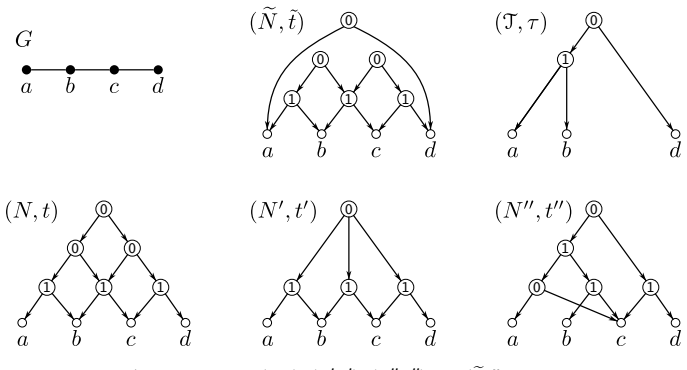
The machinery is modular decomposition together with prime-vertex replacement: the modular decomposition tree of $G$ organizes the strong modules into series, parallel, and prime nodes, and each prime module $M$ is represented by its quotient graph $G[M]/M_{\max}(G[M])$. The key step is Theorem 4.12, which shows that a primitive graph is level-1 explainable exactly when it is a primitive near-cograph; the proof reduces a primitive level-1 network to a regular, 2-lca-relevant network (one in which every vertex is a least common ancestor of some one- or two-leaf set) with a single hybrid leaf, and then removes that leaf to obtain a cotree. Near-cographs are the atomic graphs: a graph from which one vertex deletion gives a cograph, where a cograph is a graph with no induced $P_4$ built from disjoint unions and joins. Prime-vertex replacement networks then assemble a level-1 network for the whole graph by substituting each prime quotient with such an atomic network inside the modular decomposition tree.
What would settle it
Take the 5-cycle $C_5$: deleting any one vertex leaves a path on four vertices, which is not a cograph, so $C_5$ is primitive and not a near-cograph; the theorem predicts that no level-1 network with speciation labels can explain it. Finding such a network would refute the central claim.
Extended reading notes
Core claim
The paper's central claim is Theorem 4.20: a graph $G$ is level-1 explainable if and only if every primitive induced subgraph of $G$ is a near-cograph. A near-cograph is a graph from which removing one vertex yields a cograph, and a cograph is a graph with no induced path on four vertices ($P_4$). The characterization is shown to be equivalent to the statement that, for every non-trivial prime module $M$ of the modular decomposition, the quotient graph $G[M]/M_{\max}(G[M])$ is a near-cograph (Theorem 4.19), and to the statement that $G$ can be built from single vertices and primitive near-cographs using disjoint unions, joins, and vertex substitution (Theorems 4.24 and 4.26). The paper further proves that level-1 explainable graphs are weakly chordal and hence perfect, and that they have twin-width at most 2, so algorithmic tools for those graph classes apply to them.
Load-bearing premise
The load-bearing premise is that any level-1 explainable graph can be explained by a regular level-1 network whose clusters faithfully encode all pairwise least common ancestors, and that level-1 networks are exactly those whose cluster systems are closed and satisfy the technical property (L); if these imported equivalences fail, or hold only for the generalized level-1 definition that allows hybrid leaves, the near-cograph criterion may not transfer to standard networks.
Editorial extensions
If this is right
- Every graph is level-$k$ explainable for some $k<|X|$, so for large $k$ the network model imposes no structural restriction; the level-1 condition is where a meaningful, testable constraint appears.
- Any graph containing an induced cycle or anti-cycle on $n\ge 5$ vertices is not level-1 explainable, since such subgraphs are primitive and not near-cographs.
- The class of level-1 explainable graphs is hereditary and closed under disjoint unions, joins, and vertex substitution, giving a recursive grammar whose atoms are single vertices and primitive near-cographs.
- There is an $O(|X|+|E|)$-time algorithm that recognizes level-1 explainable graphs and, if possible, constructs an explaining level-1 network.
- Level-1 explainable graphs are weakly chordal, perfect, and have twin-width at most 2, placing them in known algorithmic regimes.
Reading between the lines
- Editorial inference: since every graph is explainable at some level, the biologically meaningful boundary is the number of reticulation events per block; level-1 is the only level that still yields a non-trivial graph class, so comparing inferred orthology graphs against this class can serve as a test for 'almost tree-like' evolution.
- Editorial inference: the characterization suggests a new editing problem—turn an input orthology graph into the nearest level-1 explainable graph—whose complexity the paper leaves open; such an algorithm would be a network-aware alternative to cograph editing for data cleaning.
- Editorial inference: the modular-decomposition-plus-replacement strategy is a plausible template for level-2 and higher networks, but the paper's Figure 5 shows that a second hybrid can change the primitive graphs substantially, so a level-2 characterization would require genuinely new structural control rather than a routine extension.
Editorial analysis
A structured set of objections, weighed in public.
Referee Report
Summary. The paper studies graphs that can be explained by 0/1-labeled phylogenetic level-1 networks (LEV-1-EX graphs), motivated by orthology graphs. The central result is Theorem 4.20: a graph is LEV-1-EX if and only if every primitive induced subgraph is a near-cograph. Equivalent characterizations are also given in terms of prime quotient graphs being near-cographs (Theorem 4.19), phylogenetic level-1 explainability (Theorem 4.21), and closure under substitution and atomic expressions (Theorems 4.24 and 4.26). The paper further shows that every graph is explainable by some level-k network with k < |X| (Theorem 3.10), provides a linear-time recognition and construction algorithm (Theorem 4.22), and proves that LEV-1-EX graphs are weakly chordal, perfect, and of twin-width at most 2 (Theorem 4.29 and Proposition 4.30).
Significance. If the result holds, this is a substantial contribution to the theory of orthology graphs under network-like evolution: it extends the tree/cograph characterization to the level-1 network setting in a clean, modular-decomposition way. The proof structure is transparent, with the primitive case (Theorem 4.12) proved by explicit network constructions and then lifted to arbitrary graphs via prime-vertex replacement networks. The linear-time algorithm is a concrete algorithmic payoff, and the graph-class consequences (weakly chordal, perfect, twin-width at most 2) give falsifiable structural predictions. The main caveat is that the primitive-case reduction relies on imported structural characterizations of level-1 networks from [42] and [47]; within the paper's own definitional framework the derivation is coherent, and no circularity was found.
major comments (1)
- [§2, Definition 2.2; §3.2, Theorem 3.6; §4.2, Lemma 4.7] Lemma 4.7, which is load-bearing for the central characterization, assumes that an arbitrary level-1 explainable graph can be represented by a regular, 2-lca-relevant level-1 network (Theorem 3.6, via [42, Thm. 3.12]) and that level-1 network cluster systems are exactly the closed systems satisfying property (L) (Theorem 2.12, imported from [47]). Since Definition 2.2 deliberately generalizes the customary notion of level-1 networks by allowing hybrid leaves, the paper should state explicitly that Theorem 2.12 and the level-1 results of [47] are valid for this generalized class, or else prove the needed direction for hybrid leaves. As written, the conclusion of Lemma 4.7 that the unique hybrid can be taken to be a leaf, and therefore Theorems 4.19 and 4.20, inherits this external assumption; the transfer to the stricter standard level-1 class is not established. This is a scope and correctness clarification rather than an internal contradiction, but it is load-bearing and should be addressed in the revision.
minor comments (4)
- [§3.2, Theorem 3.10 and thereafter] The abbreviation LEV-k-EX is used starting from Theorem 3.10 and throughout Section 4, but it appears not to be formally defined; please add a definition near Definition 3.1 or at the first use of LEV-k-EX.
- [§4.4, Theorem 4.22 proof] The final sentence of the proof reads 'In summary, can be verified in O(|X|+|E|) time'; the subject 'it' is missing and should be restored.
- [§4.1, modular decomposition] In the definition of series and parallel strong modules, the text appears to print 'G[M] is disconnected' in both cases; the series case should refer to the complement graph, so please check the typesetting of the overline.
- [§4.3, Definition 4.15] The condition for two networks to be internal vertex-disjoint should be that the displayed intersection is empty; the printed '=/0' is easy to misread as nonempty and should be typeset unambiguously as the empty set.
Circularity Check
No circularity: the LEV-1-EX characterizations are derived from independent network-cluster and modular-decomposition lemmas, not from their own conclusions.
full rationale
The paper's central claim, that LEV-1-EX graphs are exactly those whose primitive induced subgraphs are near-cographs (Theorem 4.20), is a genuine equivalence between two independently defined notions: explainability by a 0/1-labeled level-1 network (Definition 3.1, Definition 2.2) and near-cographness (Definition 4.8). The proof path goes through Theorem 4.12, whose forward direction uses Lemma 4.7 to force a primitive LEV-1-EX graph to have exactly one hybrid leaf, then removes that hybrid and shows the remaining cluster system is a hierarchy by Theorem 2.11. This is a real structural reduction, not a restatement of the target. Lemma 4.7 itself invokes Theorem 3.6 and Theorem 2.12, which are imported from [42] and [47]; these are parameter-free mathematical characterizations of DAGs and level-1 cluster systems that do not mention near-cographs or LEV-1-EX, so citing them is legitimate independent support rather than a circular chain. Similarly, Theorems 4.19, 4.24, and 4.26 follow from modular-decomposition facts (Lemma 4.3, Proposition 4.17, Lemma 4.18) and the primitive case, with no fitted parameters and no definition that presupposes the result. The paper does contain substantial self-citation, especially from [42], [58], and [47], but none of the load-bearing uses reduces to the authors' own conclusion; they are auxiliary structural lemmas. The algorithmic result (Theorem 4.22) is also supported by independent linear-time cograph recognition and modular decomposition routines. Therefore no circular step is present, and the appropriate score is 0.
Assumptions & free parameters
assumptions (5)
- domain assumption Orthology graphs are modeled by 0/1-labeled DAGs with the 2-lca property, where an edge exists iff the label of the least common ancestor is 1 (Definition 3.1, based on [45]).
- domain assumption A clustering system is the cluster system of a level-1 network if and only if it is closed and satisfies property (L) (Theorem 2.12, imported from [47]).
- domain assumption Every level-1 explainable graph can be explained by a regular, 2-lca-relevant level-1 network (Theorem 3.6, via [42, Thm. 3.12]).
- domain assumption For any lca-network explaining G, an induced subgraph G[W] is explained by the Hasse diagram of the restricted cluster system (Proposition 3.5, imported from [58]).
- domain assumption The pvr-network construction explains any graph given a prime-explaining family (Proposition 4.17, imported from [58]).
Cite this review
Pith. "Pith review of Orthology and Near-Cographs in the Context of Phylogenetic Networks." pith.science (2026). https://pith.science/paper/AS6G4QMV
@misc{pith2026250208746,
  author       = {Pith},
  title        = {Pith review of: Orthology and Near-Cographs in the Context of Phylogenetic Networks},
  year         = {2026},
  howpublished = {\url{https://pith.science/paper/AS6G4QMV}},
  note         = {Machine review of arXiv:2502.08746}
}
read the original abstract
Orthologous genes, which arise through speciation, play a key role in comparative genomics and functional inference. In particular, graph-based methods allow for the inference of orthology estimates without prior knowledge of the underlying gene or species trees. This results in orthology graphs, where each vertex represents a gene, and an edge exists between two vertices if the corresponding genes are estimated to be orthologs. Orthology graphs inferred under a tree-like evolutionary model must be cographs. However, real-world data often deviate from this property, either due to noise in the data, errors in inference methods or, simply, because evolution follows a network-like rather than a tree-like process. The latter, in particular, raises the question of whether and how orthology graphs can be derived from or, equivalently, are explained by phylogenetic networks. Here, we study the constraints imposed on orthology graphs when the underlying evolutionary history follows a phylogenetic network instead of a tree. We show that any orthology graph can be represented by a sufficiently complex level-k network. However, such networks lack biologically meaningful constraints. In contrast, level-1 networks provide a simpler explanation, and we establish characterizations for level-1 explainable orthology graphs, i.e., those derived from level-1 evolutionary histories. To this end, we employ modular decomposition, a classical technique for studying graph structures. Specifically, an arbitrary graph is level-1 explainable if and only if each primitive subgraph is a near-cograph (a graph in which the removal of a single vertex results in a cograph). Additionally, we present a linear-time algorithm to recognize level-1 explainable orthology graphs and to construct a level-1 network that explains them, if such a network exists.
Figures


Figures from the paper (2 more)


Reference graph
Works this paper leans on
-
[47]
Theory in Biosciences 142(4):301–358, DOI 10.1007/s12064-023-00398-w
Hellmuth M, Schaller D, Stadler PF (2023) Clustering systems of phylogenetic networks. Theory in Biosciences 142(4):301–358, DOI 10.1007/s12064-023-00398-w
-
[42]
URL https://arxiv.org/abs/2411.14057, 2411.14057
Hellmuth M, Lindeberg A (2024) Characterizing and transforming DAGs within the I-LCA framework. URL https://arxiv.org/abs/2411.14057, 2411.14057
arXiv 2024
-
[1]
URLhttps://arxiv.org/ abs/2501.00991, 2501.00991
Ahn J, Jacob H, K ¨ohler N, Paul C, Reinald A, Wiederrecht S (2025) Twin-width one. URLhttps://arxiv.org/ abs/2501.00991, 2501.00991
arXiv 2025
-
[2]
DOI 10.1007/978-1-4939-9074-0 5 21
Altenhoff AM, Glover NM, Dessimoz C (2019) Inferring Orthology and Paralogy, Springer New York, New York, NY , pp 149–175. DOI 10.1007/978-1-4939-9074-0 5 21
-
[3]
Aschbacher M (1976) A homomorphism theorem for finite graphs. Proceedings of the American Mathematical Society 54(1):468–470, DOI 10.1090/S0002-9939-1976-0505776-7
-
[4]
Ann Comb 8:391–408, DOI 10.1007/s00026-004-0228-0
Baroni M, Semple C, Steel M (2005) A framework for representing reticulate evolution. Ann Comb 8:391–408, DOI 10.1007/s00026-004-0228-0
-
[5]
Journal of Graph Theory 2(1):19–24, DOI 10.1002/jgt
Blass A (1978) Graphs with unique maximal clumpings. Journal of Graph Theory 2(1):19–24, DOI 10.1002/jgt. 3190020104
doi:10.1002/jgt 1978
-
[6]
J ACM 69(1):46, DOI 10.1145/3486655
Bonnet E, Kim EJ, Thomass ´e S, Watrigant R (2021) Twin-width I: Tractable FO Model Checking. J ACM 69(1):46, DOI 10.1145/3486655
doi:10.1145/3486655 2021
Show all 77 references
-
[7]
SIAM Journal on Computing 53(5):1602–1640, DOI 10.1137/21M142188X
Bonnet E, Geniet C, Kim EJ, Thomass´e S, Watrigant R (2024) Twin-width III: Max independent set, min dominating set, and coloring. SIAM Journal on Computing 53(5):1602–1640, DOI 10.1137/21M142188X
2024 doi
-
[8]
SIAM, DOI 10.1137/1.9780898719796
Brandst ¨adt A, Le VB, Spinrad JP (1999) Graph Classes: A Survey. SIAM, DOI 10.1137/1.9780898719796
1999 doi
-
[9]
Discrete Applied Mathematics 257:60–66, DOI 10.1016/j.dam.2018.10.030
Brignall R, Choi H, Jeong J, il Oum S (2019) Deciding whether there are infinitely many prime graphs with forbid- den induced subgraphs. Discrete Applied Mathematics 257:60–66, DOI 10.1016/j.dam.2018.10.030
2019 doi
-
[10]
Discrete Applied Mathematics 310:1–9, DOI 10.1016/j.dam.2021.12.017
Bruckmann C, Stadler PF, Hellmuth M (2022) From modular decomposition trees to rooted median graphs. Discrete Applied Mathematics 310:1–9, DOI 10.1016/j.dam.2021.12.017
2022 doi
-
[11]
LIRMM, Universite Montpellier, rapport de recherche 94073
Capelle C, Cournier A, Habib M (1994) Cograph recognition algorithm revisited and online induced P4 search. LIRMM, Universite Montpellier, rapport de recherche 94073
1994
-
[12]
Molecular systems biology 12(5):872, DOI 10.15252/msb.20156777
Chandrasekaran S, Cokol-Cakmak M, Sahin N, Yilancioglu K, Kazan H, Collins JJ, Cokol M (2016) Chemoge- nomics and orthology-based design of antibiotic combination therapies. Molecular systems biology 12(5):872, DOI 10.15252/msb.20156777
2016 doi
-
[13]
Discrete Applied Mathematics 3(3):163–174, DOI 10.1016/0166-218X(81)90013-5
Corneil D, Lerchs H, Burlingham LS (1981) Complement reducible graphs. Discrete Applied Mathematics 3(3):163–174, DOI 10.1016/0166-218X(81)90013-5
1981 doi
-
[14]
SIAM Journal on Computing 14(4):926–934, DOI 10.1137/0214065
Corneil DG, Perl Y , Stewart LK (1985) A linear recognition algorithm for cographs. SIAM Journal on Computing 14(4):926–934, DOI 10.1137/0214065
1985 doi
-
[15]
Cournier A, Habib M (1994) A new linear algorithm for modular decomposition. In: Tison S (ed) Trees in Algebra and Programming — CAAP’94, Lecture Notes in Computer Science, vol 787, Springer Berlin Heidelberg, Berlin, Heidelberg, pp 68–84, DOI 10.1007/BFb0017474
1994 doi
-
[16]
Discrete Mathematics 183(1):61–80, DOI 10.1016/ S0012-365X(97)00077-0
Cournier A, Ille P (1998) Minimal indecomposable graphs. Discrete Mathematics 183(1):61–80, DOI 10.1016/ S0012-365X(97)00077-0
1998
-
[17]
In: Comparative Genomics: RECOMB 2005 International Workshop, RCG 2005, Dublin, Ireland, Septem- ber 18-20, 2005
Dessimoz C, Cannarozzi G, Gil M, Margadant D, Roth A, Schneider A, Gonnet GH (2005) Oma, a comprehensive, automated project for the identification of orthologs from complete genome data: introduction and first achieve- ments. In: Comparative Genomics: RECOMB 2005 International...
2005 doi
-
[18]
Procedia computer science 108:1115–1124, DOI 10.1016/j.procs.2017.05.047
Dondi R, Mauri G, Zoppis I (2017) Orthology correction for gene tree reconstruction: Theoretical and experimental results. Procedia computer science 108:1115–1124, DOI 10.1016/j.procs.2017.05.047
2017 doi
-
[19]
European Journal of Combinatorics 32(8):1317– 1328, DOI 10.1016/j.ejc.2011.05.001
Drgas-Burchardt E (2011) On prime inductive classes of graphs. European Journal of Combinatorics 32(8):1317– 1328, DOI 10.1016/j.ejc.2011.05.001
2011 doi
-
[20]
Discrete Applied Mathematics 291:201–222, DOI 10.1016/j.dam.2020.12.018
Ducoffe G, Popa A (2021) The use of a pruned modular decomposition for maximum matching algorithms on some graph classes. Discrete Applied Mathematics 291:201–222, DOI 10.1016/j.dam.2020.12.018
2021 doi
-
[21]
American Journal of Mathematics 63(3):600–610, DOI 10
Dushnik B, Miller EW (1941) Partially ordered sets. American Journal of Mathematics 63(3):600–610, DOI 10. 2307/2371374
1941
-
[22]
Theoretical Computer Science 70(3):343–358, DOI 10.1016/0304-3975(90)90131-Z
Ehrenfeucht A, Rozenberg G (1990) Primitivity is hereditary for 2-structures. Theoretical Computer Science 70(3):343–358, DOI 10.1016/0304-3975(90)90131-Z
1990 doi
-
[23]
Theo- retical Computer Science 70(3):277–303, DOI 10.1016/0304-3975(90)90129-6
Ehrenfeucht A, Rozenberg G (1990) Theory of 2-structures, part I: Clans, basic subclasses, and morphisms. Theo- retical Computer Science 70(3):277–303, DOI 10.1016/0304-3975(90)90129-6
1990 doi
-
[24]
Theoretical Computer Science 70(3):305–342, DOI 10.1016/0304-3975(90)90130-A 22
Ehrenfeucht A, Rozenberg G (1990) Theory of 2-structures, part II: Representation through labeled tree families. Theoretical Computer Science 70(3):305–342, DOI 10.1016/0304-3975(90)90130-A 22
1990 doi
-
[25]
Journal of Algorithms 16(2):283–294, DOI 10.1006/jagm.1994.1013
Ehrenfeucht A, Gabow H, Mcconnell R, Sullivan S (1994) An O( n2) divide-and-conquer algorithm for the prime tree decomposition of two-structures and modular decomposition of graphs. Journal of Algorithms 16(2):283–294, DOI 10.1006/jagm.1994.1013
1994
-
[26]
Genome research 8(3):163–167, DOI 10.1101/gr.8.3.163
Eisen JA (1998) Phylogenomics: improving functional predictions for uncharacterized genes by evolutionary anal- ysis. Genome research 8(3):163–167, DOI 10.1101/gr.8.3.163
1998 doi
-
[27]
Theoretical Computer Science 154(2):247–282, DOI 10.1016/0304-3975(94)00272-X
Engelfriet J, Harju T, Proskurowski A, Rozenberg G (1996) Characterization and complexity of uniformly nonprim- itive labeled 2-structures. Theoretical Computer Science 154(2):247–282, DOI 10.1016/0304-3975(94)00272-X
1996 doi
-
[28]
Syst Zool 19:99–113, DOI 10.2307/ 2412448
Fitch WM (1970) Distinguishing homologous from analogous proteins. Syst Zool 19:99–113, DOI 10.2307/ 2412448
1970
-
[29]
Trends Genet 16:227–231, DOI 10.1016/ S0168-9525(00)02005-9
Fitch WM (2000) Homology: a personal view on some of the problems. Trends Genet 16:227–231, DOI 10.1016/ S0168-9525(00)02005-9
2000
-
[30]
Briefings in bioinformatics 12(5):463–473, DOI 10.1093/bib/bbr024
Forslund K, Schreiber F, Thanintorn N, Sonnhammer EL (2011) Orthodisease: tracking disease gene orthologs across 100 species. Briefings in bioinformatics 12(5):463–473, DOI 10.1093/bib/bbr024
2011 doi
-
[31]
Art of Discrete and Applied Mathematics 3(2), DOI 10.26493/2590-9770.1252.e71
Fritz A, Hellmuth M, Stadler PF, Wieseke N (2020) Cograph editing: Merging modules is equivalent to editing P4s. Art of Discrete and Applied Mathematics 3(2), DOI 10.26493/2590-9770.1252.e71
2020
-
[32]
Acta Mathematica Academiae Scientiarum Hungarica 18(1):25– 66, DOI 10.1007/BF02020961
Gallai T (1967) Transitiv orientierbare Graphen. Acta Mathematica Academiae Scientiarum Hungarica 18(1):25– 66, DOI 10.1007/BF02020961
1967 doi
-
[33]
J Math Biol 78:2015–2057, DOI 10.1007/s00285-019-01332-9
Geiß M, Ch ´avez E, Gonz´alez Laffitte M, L´opez S´anchez A, Stadler BMR, Valdivia DI, Hellmuth M, Hern´andez Ros- ales M, Stadler PF (2019) Best match graphs. J Math Biol 78:2015–2057, DOI 10.1007/s00285-019-01332-9
2019 doi
-
[34]
Journal of Mathematical Biology 80(5):1459–1495, DOI 10
Geiß M, Laffitte MEG, S ´anchez AL, Valdivia DI, Hellmuth M, Rosales MH, Stadler PF (2020) Best match graphs and reconciliation of gene trees with species trees. Journal of Mathematical Biology 80(5):1459–1495, DOI 10. 1007/s00285-020-01469-y
2020
-
[35]
Theoretical Computer Science 370(1):74–93, DOI 10.1016/j.tcs.2006.10.024
Giakoumakis V , Olariu S (2007) All minimal prime extensions of hereditary classes of graphs. Theoretical Computer Science 370(1):74–93, DOI 10.1016/j.tcs.2006.10.024
2007 doi
-
[36]
Discrete Applied Mathematics 9(2):157–170, DOI 10.1016/0166-218X(84)90016-7
Golumbic MC, Monma CL, Trotter WT (1984) Tolerance graphs. Discrete Applied Mathematics 9(2):157–170, DOI 10.1016/0166-218X(84)90016-7
1984 doi
-
[37]
BMC bioinformatics 12:1–9, DOI 10.1186/1471-2105-12-S1-S15
G ´orecki P, Burleigh GJ, Eulenstein O (2011) Maximum likelihood models and algorithms for gene tree evolution with duplications and losses. BMC bioinformatics 12:1–9, DOI 10.1186/1471-2105-12-S1-S15
2011 doi
-
[38]
Mol Biol Evol 1:57–66, DOI 10.1093/oxfordjournals.molbev.a040298
Gray GS, Fitch WM (1983) Evolution of antibiotic resistance genes: The DNA sequence of a kanamycin resistance gene from Staphylococcus aureus. Mol Biol Evol 1:57–66, DOI 10.1093/oxfordjournals.molbev.a040298
1983 doi
-
[39]
In: Berge C, Chv ´atal V (eds) Topics on Perfect Graphs, North-Holland Mathematics Studies, vol 88, North-Holland, pp 325–356, DOI 10.1016/S0304-0208(08)72943-8
Gr ¨otschel M, Lov ´asz L, Schrijver A (1984) Polynomial algorithms for perfect graphs. In: Berge C, Chv ´atal V (eds) Topics on Perfect Graphs, North-Holland Mathematics Studies, vol 88, North-Holland, pp 325–356, DOI 10.1016/S0304-0208(08)72943-8
1984 doi
-
[40]
Computer Science Review 4(1):41–59, DOI 10.1016/j.cosrev.2010.01.001
Habib M, Paul C (2010) A survey of the algorithmic aspects of modular decomposition. Computer Science Review 4(1):41–59, DOI 10.1016/j.cosrev.2010.01.001
2010 doi
-
[41]
Journal of Combinatorial Theory, Series B 39(3):200–208, DOI 10.1016/0095-8956(85)90050-4
Hayward RB (1985) Weakly triangulated graphs. Journal of Combinatorial Theory, Series B 39(3):200–208, DOI 10.1016/0095-8956(85)90050-4
1985 doi
-
[43]
Discrete Applied Mathematics 321:179–219, DOI 10.1016/j.dam.2022.06.042
Hellmuth M, Scholz GE (2022) From modular decomposition trees to level-1 networks: Pseudo-cographs, polar- cats and prime polar-cats. Discrete Applied Mathematics 321:179–219, DOI 10.1016/j.dam.2022.06.042
2022 doi
-
[44]
Discrete Applied Mathematics 343:25–43, DOI 10.1016/j.dam.2023.09.034
Hellmuth M, Scholz GE (2024) Resolving prime modules: The structure of pseudo-cographs and galled-tree ex- plainable graphs. Discrete Applied Mathematics 343:25–43, DOI 10.1016/j.dam.2023.09.034
2024 doi
-
[45]
J Math Biol 66(1-2):399–420, DOI 10.1007/s00285-012-0525-x
Hellmuth M, Hernandez-Rosales M, Huber KT, Moulton V , Stadler PF, Wieseke N (2013) Orthology relations, symbolic ultrametrics, and cographs. J Math Biol 66(1-2):399–420, DOI 10.1007/s00285-012-0525-x
2013 doi
-
[46]
PNAS 112(7):2058–2063, DOI 10.1073/pnas.1412770112 23
Hellmuth M, Wieseke N, Lechner M, Lenhof HP, Middendorf M, Stadler PF (2015) Phylogenomics with paralogs. PNAS 112(7):2058–2063, DOI 10.1073/pnas.1412770112 23
2015 doi
-
[48]
Algorithmica 80(1):73–103, DOI 10.1007/s00453-016-0241-9
Huber KT, Scholz GE (2018) Beyond representing orthology relations by trees. Algorithmica 80(1):73–103, DOI 10.1007/s00453-016-0241-9
2018 doi
-
[49]
Cam- bridge University Press
Huson DH, Rupp R, Scornavacca C (2010) Phylogenetic networks: concepts, algorithms and applications. Cam- bridge University Press
2010
-
[50]
Discrete Mathematics 173(1):71–78, DOI 10.1016/S0012-365X(96)00097-0
Ille P (1997) Indecomposable graphs. Discrete Mathematics 173(1):71–78, DOI 10.1016/S0012-365X(96)00097-0
1997 doi
-
[51]
In: Rival I (ed) Graphs and Order: The Role of Graphs in the Theory of Ordered Sets and Its Applications, Springer Netherlands, Dordrecht, pp 3–40, DOI 10.1007/978-94-009-5315-4 1
Kelly D (1985) Comparability graphs. In: Rival I (ed) Graphs and Order: The Role of Graphs in the Theory of Ordered Sets and Its Applications, Springer Netherlands, Dordrecht, pp 3–40, DOI 10.1007/978-94-009-5315-4 1
1985 doi
-
[52]
J Math Biol 84(6):47, DOI 10.1007/s00285-022-01746-y
Kong S, Pons JC, Kubatko L, Wicke K (2022) Classes of explicit phylogenetic networks and their biological and mathematical significance. J Math Biol 84(6):47, DOI 10.1007/s00285-022-01746-y
2022 doi
-
[53]
Briefings in Bioinformatics 12(5):379–391, DOI 10.1093/bib/bbr030
Kristensen DM, Wolf YI, Mushegian AR, Koonin EV (2011) Computational methods for gene orthology inference. Briefings in Bioinformatics 12(5):379–391, DOI 10.1093/bib/bbr030
2011 doi
-
[54]
TRENDS in Genetics 21(1):25–30, DOI 10.1016/j.tig.2004.11.007
Kummerfeld SK, Teichmann SA (2005) Relative rates of gene fusion and fission in multi-domain proteins. TRENDS in Genetics 21(1):25–30, DOI 10.1016/j.tig.2004.11.007
2005 doi
-
[55]
Trends in Genetics 24(11):539–551, DOI 10.1016/j.tig.2008.08.009
Kuzniar A, van Ham RC, Pongor S, Leunissen JA (2008) The quest for orthologs: finding the corresponding gene across genomes. Trends in Genetics 24(11):539–551, DOI 10.1016/j.tig.2008.08.009
2008 doi
-
[56]
Journal of Computer and System Sciences 20(2):219–230, DOI 10.1016/0022-0000(80)90060-4
Lewis JM, Yannakakis M (1980) The node-deletion problem for hereditary properties is NP-complete. Journal of Computer and System Sciences 20(2):219–230, DOI 10.1016/0022-0000(80)90060-4
1980 doi
-
[57]
Bulletin of Mathematical Biology 87(3):44, DOI 10.1007/s11538-025-01419-z
Lindeberg A, Hellmuth M (2025) Simplifying and characterizing DAGs and phylogenetic networks via least com- mon ancestor constraints. Bulletin of Mathematical Biology 87(3):44, DOI 10.1007/s11538-025-01419-z
2025 doi
-
[58]
Vietnam Journal of Mathematics Special Issue dedicated to the memory of Andreas Dress (to appear, preprint arXiv:2406.18713)
Lindeberg A, Scholz G, Hellmuth M (2024) Network representation and modular decomposition of combinatorial structures: A galled-tree perspective. Vietnam Journal of Mathematics Special Issue dedicated to the memory of Andreas Dress (to appear, preprint arXiv:2406.18713)
2024 arXiv
-
[59]
Journal of Combinatorial Theory, Series B 13(2):95–98, DOI 10.1016/0095-8956(72)90045-7
Lov ´asz L (1972) A characterization of perfect graphs. Journal of Combinatorial Theory, Series B 13(2):95–98, DOI 10.1016/0095-8956(72)90045-7
1972 doi
-
[60]
Discrete Mathematics 2(3):253–267, DOI 10.1016/0012-365X(72)90006-4
Lov ´asz L (1972) Normal hypergraphs and the perfect graph conjecture. Discrete Mathematics 2(3):253–267, DOI 10.1016/0012-365X(72)90006-4
1972 doi
-
[61]
PLOS Computational Biology 18(11):e1010621, DOI 10.1371/journal.pcbi.1010621
Menet H, Daubin V , Tannier E (2022) Phylogenetic reconciliation. PLOS Computational Biology 18(11):e1010621, DOI 10.1371/journal.pcbi.1010621
2022 doi
-
[62]
Annals of Operations Research 4(1):195–225, DOI 10.1007/BF02022041
M ¨ohring R (1985) Algorithmic aspects of the substitution decomposition in optimization over relations, set systems and boolean functions. Annals of Operations Research 4(1):195–225, DOI 10.1007/BF02022041
1985 doi
-
[63]
M ¨ohring R, Radermacher F (1984) Substitution decomposition for discrete structures and connections with com- binatorial optimization. In: Burkard R, Cuninghame-Green R, Zimmermann U (eds) Algebraic and Combinatorial Methods in Operations Research, North-Holland Mathematics S...
1984 doi
-
[64]
Nature 431(7005):152–155, DOI 10.1038/nature02848
Rivera MC, Lake JA (2004) The ring of life provides evidence for a genome fusion origin of eukaryotes. Nature 431(7005):152–155, DOI 10.1038/nature02848
2004 doi
-
[65]
Best Match Graphs
Schaller D, Geiß M, Ch ´avez E, Gonz ´alez Laffitte M, L ´opez S´anchez A, Stadler BMR, Valdivia DI, Hellmuth M, Hern´andez Rosales M, Stadler PF (2021) Corrigendum to “Best Match Graphs”. J Math Biol 82:47, DOI 10.1007/ s00285-021-01601-6
2021
-
[66]
J Math Biol 82:20, DOI 10.1007/s00285-021-01564-8
Schaller D, Geiß M, Stadler PF, Hellmuth M (2021) Complete characterization of incorrect orthology assignments in best match graphs. J Math Biol 82:20, DOI 10.1007/s00285-021-01564-8
2021 doi
-
[67]
In: 2022 Proceedings of the Symposium on Algorithm Engineering and Experiments (ALENEX), SIAM, pp 67–77, DOI 10.1137/1.9781611977042.6
Schidler A, Szeider S (2022) A SAT approach to twin-width. In: 2022 Proceedings of the Symposium on Algorithm Engineering and Experiments (ALENEX), SIAM, pp 67–77, DOI 10.1137/1.9781611977042.6
2022 doi
-
[68]
Discrete Mathematics 113(1):191–205, DOI 10.1016/0012-365X(93)90516-V 24
Schmerl JH, Trotter WT (1993) Critically indecomposable partially ordered sets, graphs, tournaments and other binary relational structures. Discrete Mathematics 113(1):191–205, DOI 10.1016/0012-365X(93)90516-V 24
1993 doi
-
[69]
Journal of Combinatorial Theory, Series B 16(2):191–193, DOI 10.1016/0095-8956(74)90063-X
Seinsche D (1974) On a property of the class of n-colorable graphs. Journal of Combinatorial Theory, Series B 16(2):191–193, DOI 10.1016/0095-8956(74)90063-X
1974 doi
-
[70]
Oxford University Press, Oxford, UK
Semple C, Steel M (2003) Phylogenetics, Oxford Lecture Series in Mathematics and its Applications, vol 24. Oxford University Press, Oxford, UK
2003
-
[71]
In: Kalyanasundaram S, Maheshwari A (eds) Algorithms and Discrete Applied Mathematics, Springer Nature Switzerland, Cham, pp 148–161, DOI 10.1007/978-3-031-52213-0 11
Shanavas A V , Changat M, Hellmuth M, Stadler PF (2024) Unique least common ancestors and clusters in di- rected acyclic graphs. In: Kalyanasundaram S, Maheshwari A (eds) Algorithms and Discrete Applied Mathematics, Springer Nature Switzerland, Cham, pp 148–161, DOI 10.1007/97...
2024 doi
-
[72]
Systematic biology 63(3):409–420, DOI 10.1093/sysbio/syu007
Sj ¨ostrand J, Tofigh A, Daubin V , Arvestad L, Sennblad B, Lagergren J (2014) A bayesian method for analyzing lateral gene transfer. Systematic biology 63(3):409–420, DOI 10.1093/sysbio/syu007
2014 doi
-
[73]
Discrete Mathematics 6(3):281–298, DOI 10.1016/0012-365X(73)90100-3
Sumner DP (1973) Graphs indecomposable with respect to the X-join. Discrete Mathematics 6(3):281–298, DOI 10.1016/0012-365X(73)90100-3
1973 doi
-
[74]
Journal of the Australian Mathematical Society 18(4):492–502, DOI 10.1017/ S1446788700029232
Sumner DP (1974) Dacey graphs. Journal of the Australian Mathematical Society 18(4):492–502, DOI 10.1017/ S1446788700029232
1974
-
[75]
Science 278(5338):631–637, DOI 10.1126/science.278.5338.631
Tatusov RL, Koonin EV , Lipman DJ (1997) A genomic perspective on protein families. Science 278(5338):631–637, DOI 10.1126/science.278.5338.631
1997 doi
-
[76]
IEEE/ACM transactions on computational biology and bioinformatics 8(2):517–535, DOI 10.1109/TCBB.2010.14
Tofigh A, Hallett M, Lagergren J (2010) Simultaneous identification of duplications and lateral gene transfers. IEEE/ACM transactions on computational biology and bioinformatics 8(2):517–535, DOI 10.1109/TCBB.2010.14
2010 doi
-
[77]
Discrete Applied Mathematics 128(2):487– 509, DOI 10.1016/S0166-218X(02)00507-3 25
Zverovich I (2003) Extension of hereditary classes with substitutions. Discrete Applied Mathematics 128(2):487– 509, DOI 10.1016/S0166-218X(02)00507-3 25
2003 doi
Reviewed August 7, 2026 · model on record in the stance chip above.
Discussion (0). Continue with ORCID to comment.